Unfortunately, many young people and their parents didn't understand this dynamic of watering down and still believe that the degree opens a path to a better life, while the truth is, most people are just not talented enough to be employed into demanding and well-paying office positions that most of us here work in. The Universities are silently running a scam, taking advantage of the obliviousness of young people and their parents by selling them a way to waste 4 years of their lives in exchange for a lifetime of debt... It sounds really horrible. At least here in Europe education is free so you "only" spend 4 years doing things that won't help you in life later.
Luckily, the stories of people who graduated only to sell shoes or coffee are now prevalent enough to make the next generation more aware of the real value (or lack of thereof) of a degree in something non-commercial from an average university. In my family, I now see younger people more often deciding that higher ed is not for them and going straight into trades.
Need or want?
We've spent 30yr trying very hard to remove individual judgement and responsibility from the corporate world. Most employers larger than say ~75 people likely have enough process built up that they can skate by on people who mindlessly follow process with a few talented people sprinkled about to spice things up.
>while the truth is, most people are just not talented enough to be employed into demanding and well-paying office positions that most of us here work in.
The hardest part about working as a programmer is getting your first job as a programmer which usually means suffering through Calc 3 you'll never think very hard about again. Getting a pay stub is on FAANG letterhead doesn't automatically equate with intelligence though many here may keep telling themselves that. The bulk of the SWEs and SREs in those companies are just going through the motions and reacting to situations as any other person operating under the same constraints would. Besides basic problem solving ability that all humans have and a background with experiences that qualify you for the job there's nothing special about it.
I think it's need. There's plenty of chairwarmers hired as senior managers in my place of employment. The company would be doing radically better if these people were genuinely talented and dedicated, but apparently it was too hard to hire such folks, so we got those impostors instead. The whole department is a mess as a result. And it's mostly the same across the whole org. The world just doesn't have that many talented and dedicated people, and also a lot of them decide to just launch their own businesses instead of being a part of some corporate charade.
> Besides basic problem solving ability that all humans have and a background with experiences that qualify you for the job there's nothing special about it.
Are you aware of basic problem solving abilities of average human? They're... not that great. Intelligence plays a key role in constructing good ad-hoc working theories as to the hidden/internal state of the mess you're currently working with. Smart people are just better/faster at it and the more complex the problem is (and we're working with problems of huge complexity - often with codebases that are to large to understand within a lifetime), the more important that becomes. Not to mention that there's plenty of people who just don't tolerate (emotionally) uncertainty too well, and they feel terrible at jobs like ours, preferring to be a supermarket clerk or doing something else with minimum uncertainty, exploration and decision-making. For example, my mother once worked with a woman who has severely stressed over having to learn to operate a new kind of cash register (and she was a clerk at a store). Imagine how well would she do in the world of front-end development...
I don't believe that's true at all. Historically, in the US anyway, a university education was a wealth signal more than an intelligence or work ethic signal.
The only hard part about the literature classes was how much reading was assigned (often 300+ pages before the next class, per class, which might be 2 days later). But for the most part you could skim them just enough to take the pop quiz for the day and then get the parts the professor wanted you to know from the lectures, although I did my best to actually keep up with the reading. Tests and essays for lit classes were super easy for me, mostly just required parroting back what was covered in the lectures.
For Computer Science classes (in particular the programming assignments), if I couldn't figure out how to get something working, I ended up sitting in the computer labs for an extra 10-20+ hours until I could, because otherwise the best I could hope for on the assignment was a C. Professor's office hours were usually a joke for me, I even got told once "If you didn't get it in class I can't help you now," which I thought was the whole point of office hours. Didn't have Stack Overflow or Youtube or even very many tutorials online back then either to help out.
Also I had several friends who pursued various humanities majors, and it never seemed like they were ever as busy as I was. I even thought maybe I picked the wrong major at one point because I was spending so much of it stressed out about classes (that's actually the main reason I minored in English, I spent a semester only taking English classes, considering changing my major, but didn't end up doing it).
Now that I've ended up working in software engineering, I wish I'd had the foresight to have done joint degree in computer science and literature. Applying NLP techniques to literature would have been a blast.
My Religion degree, esp. when we got to things like post-modern criticism and Hegel, were leap-years more difficult than anything we had to study in computer science. So, yeah, I take umbrage to people saying that the humanities are easy.
(The Religion degree was incredibly interesting, too, though ultimately not terribly practical for anything but law, and I wasn't really interested in doing that.)
To your point, though, studying just for interest is probably not prudent, and it's also probably not prudent to study humanities if you're not prepared to attain a subsequent degree/go on the academic track.
> Majority of students go for practically sounding degrees - like various business related degrees. They tend to learn to like them somewhat, but generally are not intrinsically motivated to be accountants or what not at first. They are not making childhood passion based decisions, but the "what gets me job" decisions.
I welcome some evidence here. I’m very skeptical.
Source: https://educationdata.org/number-of-college-graduates
For bachelors degrees: 432,077 STEM 386,201 business 244,909 healthcare 44,262 liberal arts 82,621 education
So business is approx 9 times more popular than all of liberal arts combined with the vast majority of the rest being made up of degrees that would seem to be things that make money.
Looking at the pie graph breakdown by field business is the largest section not including "Other fields": https://educationdata.org/wp-content/uploads/76/bachelors-pr...
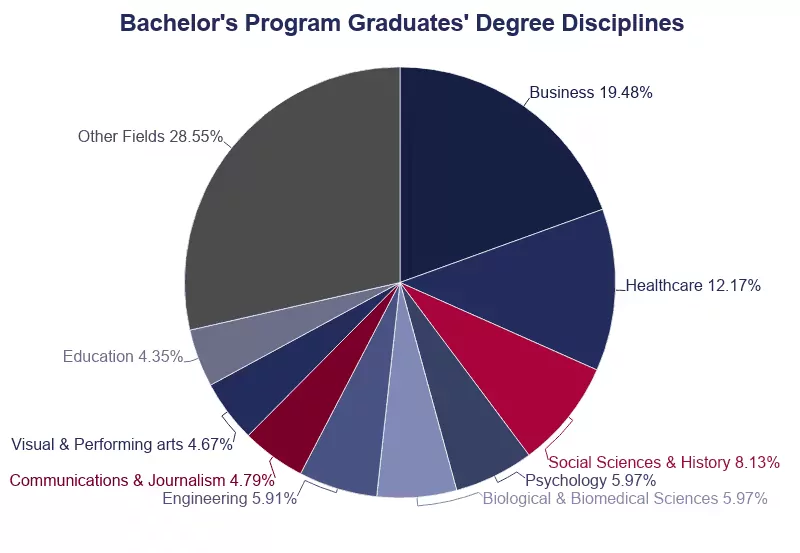
So appears the person you're responding to is exactly right.
Some of those things are not like the other. I studied computer science, plenty of people partied and as far as I can tell, people who studied humanities like literature had to work more. It was not easier major in terms of how much you have to work. I liked computer science, so I am always surprised about how many people seem to hold resentment toward those who studied less fun majors.
In any case, miniscule amount of population majored in women’s studies and they tend to cluster in top universities and from richer families. Meaning, it is not major drag on their future.
Majority of students go for practically sounding degrees - like various business related degrees. They tend to learn to like them somewhat, but generally are not intrinsically motivated to be accountants or what not at first. They are not making childhood passion based decisions, but the "what gets me job" decisions.