I completely blame the food. Even eating absolute junk in Europe I noticed I lost 5 or 6 pounds over 2 weeks.
Here if I eat junk food for 3 days my weight jumps by 7 pounds. I am a bit dismayed with all the attempts to normalize obesity in the US. I was morbidly obese up until I got serious about my weight in my early 20s. You can read all the dating books you want, but getting in shape is the only thing that works. It's much easier to hop on Reddit and complain though.
I'm very optimistic I'll be able to move to a healthier country once I retire at 40 or so. Not exactly easy to stay in shape when this country tries to pump us all full of corn syrup
I don't. Certainly it doesn't help and, of course, Americans should eat much better than they do, but ...
I think the most important factor is that our built and cultural environment are constructed to make us obese.
If one does not live in a modern city center one barely ever walks. Most Americans sit all day - at a desk or in a car.
Further, many Americans are 1-2 generations removed from "the farm" and are still heavily influenced by habits like "three square meals per day" that made great sense on the farm and make no sense at all in the city.
We're bad at being urban.
I contrast us with people I see who are good at being urban. The old Chinese women in the park doing Tai Chi every morning. The 70+ woman I saw running (running!) to get the bus in Zurich. The Spanish people I lived with who sort-of ate one big meal every day at 14:00 ...
We'll get there ...
If you dig more into it, you'll find the obesity crisis started around the late 70s with a change in dietary guidelines and medical guidelines saying basically 'fat & meat bad' and 'carbs good' along with the widespread introduction of vegetable oils, leading to too much insulin and other hormonal effects slowly increasing diabetes & obesity in our population. Also food companies honing on what obesogenic combos of food lead to people to eat more, buy more and thus get better sales.
Read "The Obesity Code" if you want a more detailed description with a lot of links to papers and studies for more info. [0]
[0] I said this yesterday too in another article: https://news.ycombinator.com/item?id=25767604
For another anecdote, my wife's friend worked at Starbucks in Canada and in Japan. She said the Frappuccinos in Canada use around double the amount of syrup than those in Japan.
> how much of a punch in the face of sweetness/richness literally everything available in US restaurants is
Yeah, too much sugar/salt/syrup/condiments, too many artificial ingredients on things. Today I was talking to my wife how the Cheetos here is not so good, as it has a weird orange color and the taste is way too much superficial. The cheese too. too many cheddar varieties with colors that doesn't seem like something made out of milk.
The sweetness is another major put off. There's no concept of a savory snack here. There's also no culture of an afternoon or tea time snacking. In my personal opinion, having a small post-lunch snack helps me stay satiated for longer and have a much smaller supper instead of a large dinner.
Why is it so Easy to be Thin in Japan?
Spending has dropped because there are such large subsidies to cheap carbs, and that is the bulk of many people's diets. A steak and veggies is no cheaper than it was 40-50 years ago, but we're eating far more refined junk with additives because it is cheap and convenient.
I believe the leading hypothesis is that being rich absolves you of the stressors that make junk food attractive. Others are, as you mentioned, the ability to buy more expensive food with more nourishment/satiation per calorie ("protein leverage hypothesis"), or access to nature and refuge from pollution (it's certainly the rich people where I live who ride bicycles.).
Regardless, a poor person from 50 years ago couldn't buy the cheap sugary crap even if they wanted to.
That is, the point of the parent's post was not obviously "crap food is so much cheaper than high quality food", but as most naturally read as "because we can afford more food, we're buying and eating more"
My point was "if that logic holds, I would expect the rich to be significantly fatter than the poor". Which, as you note, is not the case. Nothing more.
Other restaurants have retired round plates and serve meals on platters.
[1]https://www.youtube.com/watch?v=Q2UnOryQiIY
[2]https://www.amazon.com/Big-Fat-Surprise-Butter-Healthy/dp/14...
You can also write an article for the Huffington Post arguing it's impossible to ever lose weight.
I'm not calling for fat shamming, but you can't be both obese and healthy. You can't really be obese ( over a certain point anyway) and be happy. When I was over 300 pounds every day was an experience in pain.
But it's considered rude even for doctors to say you need to lose weight. I was fortunate enough that an alternative medicine provider told me to just lose weight.
And that said, I'm even reluctant to make the argument above since there's a lot of really angry people who will try to misconcue it and call me a monster or something. But I've been morbidly obese, and I'm in shape now ( still trying to lose that last 10 pounds ) .
Life is better now in every single way.
I'm pretty sure this isn't actually true. I mean I'm sure there are some people that get offended, but some people will get offended at anything and being called "overweight" when you are convinced you are just "big boned" isn't pleasant.
It wasn't my doctor's advice that led to my weight loss though, it was my father dying prematurely. He wasn't even obese, he just had a poor diet and little exercise. A real wake up call.
Really? Is it a US thing?
I'm overweight but not obese, and basically every doctor I've seen for various issues (blood pressure, back pain, sprained ankle) told me to lose weight, in two european countries.
I don't think so. They may be referring to the fact that it is increasingly becoming an issue of political correctness. But science is pretty clear about the risks of obesity and the medical professions follow that.
https://www.nytimes.com/2013/06/19/business/ama-recognizes-o...
I have a friend who's (US) doctor told he needs to lose weight or he will die. It got him to join a gym at least.
Obesity is more or less considered to be normal now, it’s a real shift in the last few decades.
With my new doctor, I was looking at my last 2 yrs of blood tests and my LDL cholesterol has been at 105. Losing more weight will help with that, so will changing my diet - but my doctor didn’t point my LDL out as a problem even though it is.
So if that's the case, why does it matter what the Huffington Post says?
I'm not morbidly obese, so perhaps I've missed the pro-obesity PR. A fashion magazine might give a cover to an obese model once a year, but the other 11 months all seem to have the same rail thin models that have dominated since the '80s.
Same goes for TV and movies. Producers wouldn't hire a fat guy to play Mark David Chapman, it'd be an easier sell to get a fit actor and have him balloon up to that desired weight.
The only obese poeople of renown in our society are older politicians and the rich, i.e. people that do not care about meeting society's beauty standards.
People used to see those and aspire to be like them and improve themselves. Something changed over the last decade or more, and now no one wants to do any better than they currently are. They are despairing in content with themselves.
People still aspire to be attractive they just don't feel the same social pressure to chase it that they used to. Personally I don't see the problem for the USA, if people are happy being unhealthy then let them be unhealthy. If this was Europe I could see a public cost argument but US businesses are already starting to charge more to people who are inconveniently obese so I don't see why it's a real concern.
They're not happy. They're suffering and helpless. That's the problem.
It's not about beauty standards, it's about healthy standards. Remember when there was a push-back from models being too thin? Everyone agreed that it was bad to show ultra-thin models because it was unhealthy and generally unobtainable. The same should be for overweight people, except now we have the concept of body-shaming (which didn't apply to ultra-thin models??). There needs to be more of a focus on self resposibility along with a push-back against the bad practices of the food industry.
I don't have any references or numbers to back that up, but that's what I've understood from what I've read in papers and heard from some people who apparently did the math.
With that said, physical activity has lots of benefits beyond just weight loss, and it would be worth it to make one's lifestyle non-sedentary in any case.
For one, an hour you spend exercising or walking around is probably an hour that you're not eating. Many Americans are constantly eating when they're at home, either mindlessly snacking or eating a huge meal. Given that you only have 8 hours between work and sleep, occupying yourself for 1 of those hours could mean a significant decrease in time spent eating.
Incidentally, this is why intermittent fasting works well for some people.
Diet is clearly a much more important aspect for weight loss. Exercise has many other benefits though.
When I lost 70lbs, I did so by deciding it was easier just to not consume the calories in the first place rather than trying to burn them off.
On my bike I have a power meter which uses strain guages and an accelerometer to calculate force x distance / time at the crankset so I have accurate calorie burn numbers.
Riding for an hour at the output a generally sedentary person can manage, I’ll burn sub 500 calories. Riding at my maximum output for an hour burns about 1000. Given that the recommended energy intake for a day is 2500, you can see what a difference that makes proportionally to what you can consume.
The fact that companies sell you these “features” in products is a scandal in my opinion, because it’s nothing more than a totally inappropriate guess. They always overestimate based on my experience when compared against actual output measurements, and that can only be harmful to people that are trying to use them to lose weight.
(Not to totally give up exercise tho' - there are other health benefits besides losing weight)
The only caveat I've learned is that weightlifting can make a dent. It's one of the few things where as you improve, you can burn more calories in the same amount of time instead of fewer (partly because you're doing more work as you add weights, partly because the muscle you build is more metabolically expensive to maintain).
I also had success restructuring my life so accessing food was way more of a hassle. Kept a mostly empty fridge. Meal prepped so only whole meals were there. Don't take money unless I know I need to buy something, found a few reasonable options at local sandwich places that became routine, etc.
I'd love to see a correlational study on fridge size and obesity. In America we buy SUV fulls of food, in Europe it's much smaller frequent trips, i.e. generally higher hassle per calorie.
Or more! When I started losing weight, my target was 1600 kcals a day. I learned that I was eating 1600+ calories __every single meal__, plus snacks. Pasta is the devil y'all.
And yet Italians are generally slim and healthy :)
In take is the kcal of the food times the digestion factor. The kcal out is the metabolic need, which depend on factors such as fat building vs energy usage, which in turn is influenced by stress but also things like dieting.
This is why counting calories can be an ineffective strategy for some while for others it is a good match.
Let say 1000 kcal in, and for an average healthy person 1000 kcal in metabolic rate.
For digestion, this person eat mostly proteins resulting in about 20% of kcal going into energy for the digestion system itself (proteins is relative hard to break down). Let also say that in addition, sloppy digestion and incorrect gut bacteria is resulting in additional 20% of the food never getting digested and resulting in feces. Result is a loss of 400.
If thats the whole story you have a person that is loosing weight despite keeping a diet that seemingly fulfills their calories need.
Lets now change metabolic aspects. Rather than suffering from bad digestion they are suffering from chronic stress with high cortisol, adrenal and other stress hormones. The body crave more food that cost less to digest, ie fat and sugar, insulin is spiking in order to get the body to take up more energy, the body goes into lethargic state in order to save energy, muscle and organ cell production is decreased in favor of fat cells. Instead of 1000 kcal in metabolic rate we might have 600 kcal, with now a surplus of +400 going into fat production.
The upper bound on bioavailable kcals is still 1000 kcal, but the numbers won't tell you if the person is going to loose weight or gain it, unless the person is in good healthy to begin with.
Intuition would make me wager testosterone levels of you average powerlifter would be in the higher ranges (necessary to build muscle), despite not generally being lean.
Meh, Americans snack all the time. French people are anal about their meal structures and times and we’re not fat.
Or...to quit and become a lumberjack, etc.
I don't like to go to parties with an empty stomach, because of the poor choice of food there (chips, salsa, cake, cookies, etc.). If I go with an empty stomach, I know I would not resist, and I would feel sick and bloated later, high on sugar & salt, and dehydrated with alcohol.
Just don't snack.
> If one does not live in a modern city center one barely ever walks. Most Americans sit all day - at a desk or in a car.
As opposed to someone in China, where we must do such extraneous physical activities like order take-out delivered to our place less than 15 minutes, then order a masseuse to come give us a massage and finally order a bottle of wine to top the night off, all without needing to get out of bed.
The food ingredients in this country are, on average, garbage. With careful shopping you can get around this but it does take effort and vigilence.
Cultural expectations around both diet (especially portion size) and exercise (I cite the walking thing a lot too) are also bad. It takes effort to avoid those hazards.
I think both of these and probably a few other factors are a terrible combination that compliment each other in a bad way.
That said, I'm 30 lbs heavier than I was a decade ago. I know WHAT I need to do (exercise more, drink less), it's just been hard to get back into better habits.
I’ve also had the same experience on shorter (few month) stays in Europe, while still working a 9-5.
Philippines was part of the Spanish crown and had Spanish customs. Plenty of European (Western) countries have balanced diets and healthy lifestyles.
But for them, it might as well be. People simply did not eat large amounts of packaged, processed food only a few generations ago, like people do everywhere in the west, including the EU.
Also, exercise accounts for maybe a hundred or two calories a day for the average person who isn't into marathons or something, so the only true way to lose weight is to decrease what you eat.
It's not lack of exercise, that's the way these corporations try to blame you for being lazy so you forget their food is garbage that's making you fat.
Yes, driving cars everywhere is not great. But we’re also more obese than other car dependent cultures, so it’s not a satisfactory answer to say that it’s entirely about being sedentary.
I eat mostly fruits, veggies and meats. Pretty much 80% natural foods. But I live in east Asia now so it’s easier to do that and with more variety.
But, I don’t recall American supermarkets food feeling strange. Unless you mean the processed stuff?
For the rest of it: might just be my perception to be honest, my impression was that the fruits and vegetables tasted very watery with little flavour, as if they were grown in the most efficient way to bring them to market quickly. Same for the meat, was kind of floppy and the cheese just didn't taste like much. There were some good things from farmers markets, but at absurd prices.
I see differences in Europe as well, e.g. I think the quality in Switzerland is better than Germany and Austria. In Spain and France I was able to get really good food, probably because it's closer to where it is produced.
Again this might be my perception, didn't do a blind tasting. Unless the food is specially prepared to be stored (like fermented food, cheese, etc.), I don't think the highly industrial production, refrigeration and long transportation is doing the quality any favours.
https://www.greenoptimistic.com/fruit-vegetables-taste-europ...
https://www.treehugger.com/why-doesnt-american-produce-taste...
The key point seems to be that we prioritize the looks, which unintentionally affects taste.
As an American who recently moved to Europe, I don't think 20 minutes of walking per day is being generous. COVID-related measures aside, I find I add about 20min/day of walking easily, and more if I need to do something (e.g. buying groceries). Now, in the US I own a car and here I do not -- but in my Midwestern town I am totally obligated to own and operate a car. Here in Europe I get along fine with walking, riding a bike, and using public transport.
Yes but not by a very wide margin. [1]
Average BMI in the US is 28.5, Saudi Arabia is the same, Mexico is 28.1, New Zealand is 27.9, UK is 27.3, Canada is 27.2.
My point is that the impression that the US is unreasonably fat compared to the rest of the world is mostly just bias.
[1] https://en.wikipedia.org/wiki/List_of_countries_by_body_mass...
Some people seemed very very fat.
Edit found something that would support that idea.
Proportion of people who are obese over the globe: https://ourworldindata.org/grapher/share-of-men-defined-as-o... https://ourworldindata.org/grapher/share-of-females-defined-...
Walmarts are everywhere, there are thousands of them and millions of people in them every day. You're going to see the best and the worst just because of sheer numbers.
Not saying that the fatest American isn't fatter than the fatest Australian but "people of walmart" is a bit of a misnomer because you only need one picture of a fat person in a Walmart and there's literally millions of opportunities each day to see that one example.
This shows IMO in obesity rates - they are significantly lower in London than the rest of the UK.
The other major factor is wealth. Richer people can afford higher quality food. Poor people generally consume more calories from junk foods and sugary drinks, which are staples of drive-throughs and fast food chains.
It is not as entirely car dominated as the USA, but I think it's pretty fair to call it "car reliant".
If you are gaining 7 pounds in 3 days, I imagine the vast majority is just water weight, which can probably be attributed to the salt levels in the junk food more than anything else.
During the early pandemic, I stopped drinking for 3-4 months...and still didn't lose any weight. I honestly don't understand the human body.
The most shocking thing to me when I first moved alone was how easy it was too eat a ton of sugar, without realising it till after.
My solution these days is to just ensure its not there, and commit to not getting takeaway (easy if I think about all the money I save).
Even doing all that, I still have habits I need to keep up: eating toast too often is a problem, for example. I've eliminated peanut butter entirely. Don't eat lunch when I'm at a desk job and replace it with just mid afternoon coffee to keep me going.
The human body is stupidly efficient, unfortunately.
It's shocking how much of your calorie budget a sugared soft drink has.
Soft drinks have a ton of calories which have to go somewhere; we all know that. The paradox is that the human brain does not generally treat liquid calories as calories. So even though you might drink down 300 calories of soda, your brain will not adjust your hunger levels to match. This is obviously very bad.
Eat warm porridge and on average you will feel twice as full as the equivalent calories in white bread: https://pdfs.semanticscholar.org/b3cf/3b7d71a7485e6355e49b2e...
Counterpoint: I got in great shape in my early 20s, but didn't have much luck with dating because I was still a "Reddit niceguys"-style jerk
Later on I stopped being a jerk, and even though I ballooned back to a very stately American weight I had way better luck with dating. Including "attractive females" as a young involuntarily-celibate gentleman might say
If you don't happen to be at least average in terms of looks, things are looking grim.
Going on a dating site and messaging attractive women there is like sending resumes into the online job sites for Google/Facebook/etc. MAYBE you'll get a response, but more likely you're just wasting your time.
In the working world, you can build up your skills and network to get a referral
In the dating world, you can improve your hygeine/personality and get an introduction via mutual friends/family/family's friends/family's friends' coworkers.
The best way to meet people will always be to leave your house and become socially active. You may even meet people of various genders just to hang out with ! Online dating profiles are more mostly bots / con artist anyway. The FTC filing against Match goes into detail here.
The best fun I've had was on the way to the club with my amazing friends, irrespective of if I meet anyone that night. The biggest sin of social media has been to convince people they didn't need real friends .
The world is great, is you save the 40$ a month Match.com cost for 12 months you can afford a trip to London or Paris, then at least you'll have some interesting stories to share at your local bar!
Do you seriously believe women will suddenly view a physically unattractive male as sexually desirable just because they got an introduction? It doesn't happen.
Raw sexual attraction is not something one builds towards with friend/family introductions/referrals and good hygiene. It's a visceral, almost animal-like condition that manifests at the drop of a hat and physical appearance (face, height, build) is _the_ most (if not the only) important attribute.
Those that have won the genetic lottery are smooth sailing. The sky is the limit.
Those that are average have to put in work to get results (and there are definite limits, they will hit a ceiling).
Those that have lost the genetic lottery are kneecapped from the get-go and they're looking at a vastly diminished set of possible partners and opportunities.
Will she sleep with him that night? Probably not. Would she agree to a date right away? Also probably not. Six months later, after a dozen group social events, might she have a serious crush? Decent chance. (Might his fast-burning infatuation be dead by then? Also yes, been there done that).
Seriously, the first hurdle is not 'is this guy sexually attractive' but 'is this guy potentially dangerous', and it's far safer to err on the side of caution.
I guess you can get some signals, sometimes... For when a person IS a danger.
But anyhow, most abuse happens in the privacy of a home, so I don't think I'd be able to vouch for anyone to really not be a creep. You never know what side of their personality people might be keeping hidden.
There is more to sexual attraction than photos. Sense of humor plays a great role. If you can make a girl laugh out loud, you're half way to wherever you want to have her. As are other elements of personality; some people are so irresistible in person that you forget their homely face. This works for both sexes, btw.
Yes, this does not work on Tinder, unfortunately. Dating apps are absolutely unnatural in this regard, very one-dimensional.
Sure high social status alone can help you land relationships but absent raw physical attraction, the foundation will be shaky. There is such a thing as a trophy wife / gold digger after all.
Instead of being a sweaty, nervous wreck desperately trying to hold an awkward conversation, you could just be a cool dude hanging out with his friends, playing Fortnite or hacking firmware or making pizza. Your date can see what actually makes you cool and fun, instead of just seeing some fake persona you've constructed.. and if she doesn't like it, forget about her.
People tried to tell me this when I was a kid/younger man, and I just assumed they were all a bunch of ignorant old fools. I didn't figure it out on my own until I was in my 30s, and then I was married before I knew it.
I do my best to try and pass this advice on whenever I can, even though I know that most guys who had the same issue as me won't heed it. Shockingly, I explained this to my greasy 12 year old nephew when he was complaining about women.. at the time he basically told me to piss off, but a few months later he had a girlfriend, haha.
(incidentally - is 'creamytaco' a veiled sexual reference?)
It is entirely justified and reasonable, but if you didn’t notice the gap, you will end up believing people have a bad character.
Personally, I think that whiteboarding/in-person interviews are mostly BS and "culture fit" (AKA: You like the person) has an oversized impact. But since you're not trying to woo the hiring manager into bed with you, you just have to make sure you aren't obnoxiously gross. Even if you're the ugliest dude on the planet, all that means is you need to take a shower and wear clean clothes.
I know I’m sounding naive, but if it’s something you decided to change and were able to, maybe it could be interesting.
https://www.niddk.nih.gov/-/media/Images/Health-Information/...
That's impossible you would have to eat 8167 extra calories a day to do that, you are doing something else like drinking lots of water or something.
I believe it’s my glycogen storage increasing, along with water weight due to the excess salt.
When I stop, it comes right off again in a couple of days.
This pandemic of shitty food starts with the kids and their tastes being set at a young age.
Still managed to lose 2 pounds. In the 3 days I was back here, I managed to eat a burger and pizza. I guess I could have politely say no. But clearly the processed food here in US is ubiquitous and cheap, so difficult to escape.
No idea if this is the reason of lower testosterone. But I realize that simple food based on fresh products would go a long way.
I watched this youtube video recently about recipes for cutting (weightlifting term for a diet that makes you lose weight) and eating some of the food has helped me lose some weight.
World obesity rankings are curiously topped by a bunch of small Pacific island nations and Kuwait, followed by the US:
https://en.wikipedia.org/wiki/List_of_countries_by_obesity_r...
That's it I think. Advertising has become much more effective over the past 40 years. Humans can simply not resist.
There should be advertising for healthy eating, to steer people to healthy food.
The problem now is we have #fatfobia that shames people for advertising their healthy lifestyle.
Europe is on the rise: https://www.euro.who.int/en/health-topics/noncommunicable-di....
No way to, pun not intended, sugar-coat this fact.
Sorry to say that, but "moving to a healthier country" is an excuse. Come on, dude! :)
I don't completely blame the food itself. It's more about food habits.
One of the things I found very weird was American portion sizes. Go to any restaurant and plates were easily double the amount I was previously used to. I felt bad leaving almost half of a plate every time.
And then... I got used to it. But also very fat. With similar levels of sedentarism so it's not only about exercise levels. And frankly, while exercise is healthy, you don't burn that much energy with cardio. Every time I do the calculations I'm shocked. From a weight loss perspective, you're better off reducing food quantity (and the proportion of highly energy dense food types) than just increasing exercise. Unless you are at marathon-levels, that is. Increasing muscle mass is also time well spent (still pales in comparison to just eating less). Need to do it for the health benefits anyway, but it's easy to see why people get frustrated.
The kind of food served must have an impact too. Most places, if you are even offered a salad, it's awful. It's either tasteless or downright nasty and you can only make it palatable by overdosing on dressings. It seems that the nastiest tasting greens are chosen - don't even get me started on the "spring mix". So many people just don't eat salad and I can't blame them. Kids are right to rebel against their vegetables.
The American-style breakfast is delicious. It's just that most options are caloric bombs.
This is obviously not applicable if you don't eat out with any regularity. But that was the norm pre-pandemic, whether it's a restaurant or a $5 meal at Taco Bell with the nastiest (but tasty to our lizard brain) calories imaginable. Given that many people in the US don't really have the habit (or the employer doesn't give them time) of having lunch, burgers and the like are common.
Fine, let's eat healthy then and stop complaining. Let's start with fruits.
... and they suck. Apples are tasteless. Bananas are terrible. Mangos are a shadow of what they are supposed to be. Some grapes are ok. Berries are good (but not cheap in most places!). And so on. Fruits seem to be selected for appearance, easy of transport and shelf life, nevermind if they taste like used cardboard. Except berries and even then, IFF they are sourced locally.
You can make a decent salad with ingredients found in any supermarket, so there's that. Less convenient - you need to make your own with tastier greens(whatever your preference is!) rather than grabbing a box of spring mix that tastes like grass that was mowed a week ago. Add some lemon, vinegar and a very small amount of salt and it's all you need.
Meat is essentially the same everywhere(barring some food regulations). Can be affordable if one is ok with eating based on what's available, as prices fluctuate like crazy.
You _can_ eat healthy in the US. But you'll be battling: affordability, time, convenience and cultural norms. You need to check the labels on everything too, the corn syrup comment is relevant.
Little kids are really surrounded by lots of fresh new plastic.
That or USA citizens really like to eat overly sweet and fat stuff.
This is also the case in restaurants. I get it that many people pack left over to go, but the portions served are comically large. For someone with broken "I am full" sensor, it is easy to consume the whole portion at once, and then get a dessert.
I cook most of my meals at home though, which allows me to get enough without needing desert every meal. Plus my cooking tastes better since it is real flavor not added sugar/salt.
Depending on where exactly you were, this is the experience of a lot of Americans compared to the sizes from their childhoods. A lot of places missed the point on Super-Size Me and just renamed their sizes to eliminate extra-larges around that time. So a 16oz shifted from being medium to being small.
There's weirdly enough, quite a bit of scholarly literature on this.
Here's a decent survey, scroll down to see the links
https://journalistsresource.org/studies/environment/energy/g...
There's also studies that show increasing gasoline sales tax is predictive of future obesity prevalence (see https://www.ncbi.nlm.nih.gov/pmc/articles/PMC5415832/). The correlation appears robust enough to generally use petroleum prices as an indicator of obesity prevalence as measured through BMI.
They're all pretty careful to note that "the relationship between gasoline prices and physical activity must be empirically determined".
Maybe, for instance, people purchase less food or go out to eat less frequently in high gas-price places. (See https://onlinelibrary.wiley.com/doi/abs/10.1002/j.1550-8528....)
Maybe people spend less time commuting in high petroleum prices areas, which increases well being and decreases obesity prevalence (see https://link.springer.com/article/10.1007/s11524-012-9678-6)
Maybe petroleum-based fertilizers lead to high obesity (see https://www.cambridge.org/core/journals/british-journal-of-n...).
Maybe the psychological activity of driving affects metabolism (see https://www.sciencedirect.com/science/article/pii/S009174351...).
Maybe this is all p-hacking and it's nonsense.
Regardless, if scholarship is to be believed, moving to a place with high gas prices might help you lose weight. Yes, it still sounds nutty to me as well.
Rumi
I don't know my guy. I'm 39, weigh 280lbs at 5'9 but am married to a smart and beautiful women a decade younger than me and 150lbs lighter than me. It's not a sugar daddy thing either, she makes more than I do. Not everyone is shallow and a great sense of humor / shared interests / good personality is more than enough for plenty of people. That said, being fit certainly ups the odds in your favor.
If you’re a man in DC, NYC, or some rural town you’ll have more luck.
Bay Area? Zero chance.
So, after correcting for BMI, physical activity, etc, there was still a very significant decline in testosterone between 1999-2000 and 2015-2016.
"According to Lokeshwar, potential causes for these declines could be increased obesity/BMI, assay variations, diet/phytoestrogens, declined exercise and physical activity, fat percentage, marijuana use, and environmental toxins."
My personal, totally unsupported hypothesis: society is simply kinder and gentler now. As evidenced by the high testosterone in prison populations, this hormone responds to environmental threats of potential violence.
Loved reading that. I don't know if it's true, but I hope so.
That’s funny as the first time I heard about feedback loop was in college biology courses, when we were taught how women hormones interactions are modelizable.
Was 1999-2000 that golden age when we all threshed the fields by hand and steered the plows on foot ?
I remember people being quite sedentary and obese then and I don't know that an activity comparison to 1999-2000 has any utility ...
EDIT: OK, I am thinking about this backwards - if, as I suggest, people were just as sedentary in the first period as they are in the second, then the T drop begs a different explanation. As you suggest, they also corrected for age.
So, perhaps, my instinct is wrong. I would still look very closely at the (adjusted, corrected) physical activity before drawing any other conclusions ...
I mean ideally they'd have huge numbers of testosterone samples from all of human history, but what are they going to do?
The first strangeness is that this hints at a much weaker effect. The second strangeness is reporting the p value rather than the effect size. I clicked the link to a pdf at the bottom of the article, but it is not the paper. shrug
This is something I can anecdotally confirm: A few years ago my libido was low and I had borderline depression. After my lifts exceeded 100 kg (220 lb), there was a noticeable positive correlation between my libido and the deadlift days.
Our bodies need to move. Isn’t there strong evidence that we can’t even function properly without exercise? I mean, basic functions like regular waste disposal/cell regeneration. Circulation is insufficient without some added pressure and agitation. All kinds of stuff.
We are too fat and lazy, period.
It’s an “easy” fix, but it’s also really, really, really hard. Man. I used to run 50km per week, now I don’t even walk 5km. So much kid stuff, work stuff, house stuff.
Sexual behaviors can radically change testosterone as well.
> Lokeshwar noted that even men with a normal BMI (18.5-24.9) had declining total testosterone levels (P < .05) during the same time frames.
There are men who exercise and yet have low T.
In the abstract of your [3] we see a problem. Quote:
> If you have a low level of fitness you are likely to have a greater increase in testosterone response to exercise. As your body adjusts to the demands of exercise the testosterone response will decrease.
Basically you have to be unfit to get a T boost from lifting some weights. If you're already fit and adapted to exercise, more exercise won't fix the T problem.
Ive been around this discussion a lot and everyone seems to want to blame the whole phenomenon on some chemical or another, "xenoestrogens" are thrown around a lot. Yes, there are more unnatural chemical compounds entering our bodies than in the past (also important to examine) but addressing the terribly unhealthy lives most of us lead is obviously the first step.
> After controlling for confounders—including year of study, age, race, BMI, comorbidity status, alcohol and smoking use, and level of physical activity—total testosterone was lower among men in the later (2011-2016) versus earlier (1999-2000) cycles (P < 0.001)
But if you look at the study the effect persists after controlling for both BMI and exercise. There must be more to it.
- High yield, less nutritious crops - Climate change - less physical activity
https://www.politico.com/agenda/story/2017/09/13/food-nutrie...
But sugar, or more specifically insulin can reduce testosterone in the blood as well. Sugar will also make you put on weight more easily and body fat will also increase estrogen.
This is a needlessly complex explanation.
Very low physical activity rates are the likely cause.
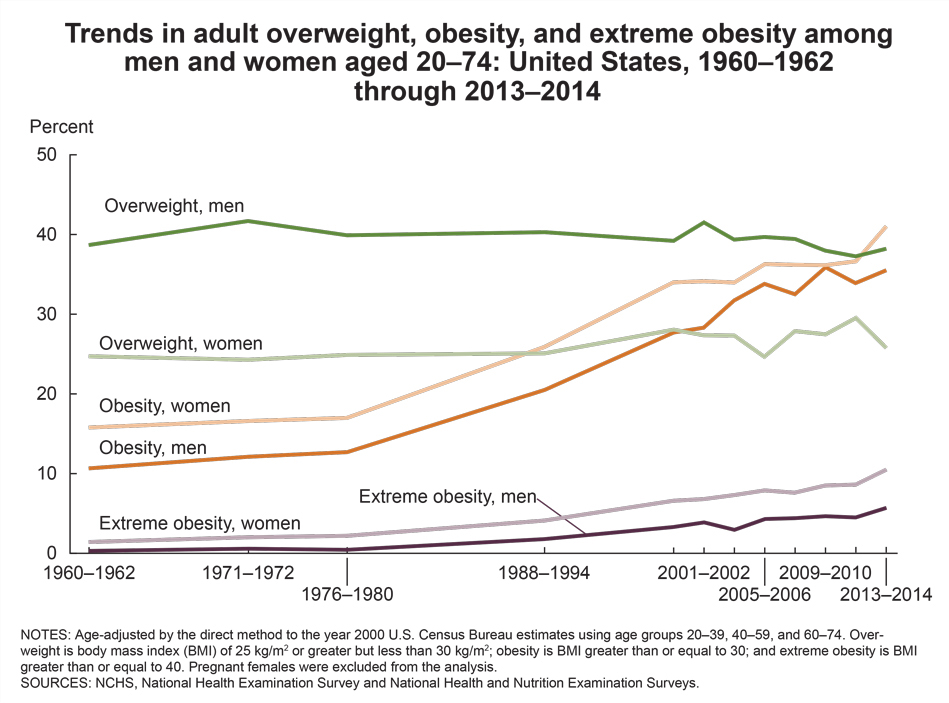
A majority of men in the US are obese or overweight[1] and, culturally, Americans barely even walk.
Testosterone levels are linked to physical activity.[2][3]
[1] https://en.wikipedia.org/wiki/Obesity_in_the_United_States#P...
[2] https://www.ncbi.nlm.nih.gov/pmc/articles/PMC4706091/
[3] https://www.cpandr.co.uk/2018/08/22/the-impact-exercise-has-...