I just want hot water. Give me hot water.
(Though some kind of temperature sensor could be nice.)
My second rage inducing grievance is bad cleanability. All the places dirt, scuz, grime fill up. Nooks, crannies, crevices, shelves, dials, mounts.
My third grievance is bad cable management. WTF am I supposed to tuck away the power cable? How do I secure it for storage?
My Vitamix blender, mixer, hot iron, instapot, sawzall, portable fans and heaters, the pre-USB-C Mac power bricks... All piss me off on the regular.
The least cleanable product I've ever owned was a Samsung fridge. iFixit would give it a -2/10 rating. I can only conclude its designers and product manager had never seen a fridge before. Or thoroughly hated all fridge-kind and were exacting revenge as part of some enduring blood feud.
PS- We need an iCleanIt product review site.
There are many NSF approved products that work well in home (microwaves). Others such as commercial refrigerators are generally not appropriate for home use.
I'd be ecstatic if there were exposed tines and I could just wrap the power cord. Like a typical vacuum cleaner.
But it's a recessed wind up area, and you really have to force the cable in, precisely to fully hide the cable. If you don't, there's a pig tail remainder. In which case, why bother at all?
the vitamin blender, for cleaning, fill it water, some dish soap, and blend for 45 seconds at full power, then rinse out.
For the instant pot. It’s just a regular pot. Take it out and stick it in the dishwasher. I agree with your point in general but those are dead simple to manage.
VitaMix
There are two hard to reach cavities.
The outer ring of the top plug fills with debris. https://www.webstaurantstore.com/vitamix-062984-lid-plug/HP7... This one really pisses me off. It'd be so easy to redesign the plug to eliminate the cavity.
The second is the underside of the pitcher, between the side wall and the center spindle. This one is only annoying. Can't find a pic, but this is the pitcher. https://thingsaroundthehouse.com/vitamix-7500-vs-5200/
I use looped pipe cleaners to scrub these cavities clean.
I could fully disassemble my former KitchenAide's pitcher to clean every component. Alas, the Vitamix does better with all the big leafy greens I now consume.
InstaPot
I like the cord unplugs from the appliance. This should be the norm.
Where do I put the cord? Inside the pot? Great, now I have to clean the cord too. Or rinse the pot before using it again. Sometimes I kinda fold the cord and stuff it thru the top handle.
I've had a single Vitamix for...huh, well over a decade, at any rate, and I've never had this problem with pretty consistent heavy use the whole time we've owned it. Pretty consistently cleaned according to directions, which are as described upthread.
Not easy to clean. :( Not impossible, but if anything gets caked on there, rather annoying.
Also the lid gets scummy, not hard to wipe off, but there are enough snooks and crannies that it is a bit irritating.
I loved my Magefesa pressure cooker. So easy to clean. Its design is very nearly the pinnacle of human achievement. I damaged the valve and that tiny plastic insert cost almost as much as a whole new unit, so I decided to try the InstaPot that everyone was crazy about.
I cannot fathom how someone ends up designing the InstaPot. They must have started with a CrockPot.
I do like the timer. Next time I'll upgrade my stove and stick with the dumb pot.
The problem with cleaning an instant pot is not the metal pot itself, but the body and lid.
The body is a little annoying, but I've had good luck just running a damp folded cloth/paper towel around it towards the wider part, takes a few seconds.
I appreciate the beeps might have a purpose for accessibility but it really feels like the mute function should be active by default, rather than digging through the manual to find out how to mute it.
Some microwaves have a steam sensor, and use that to detect how cooked something is
Source: https://www.youtube.com/watch?v=UiS27feX8o0&t=239 at 3:59
Electric Kettle is wasting energy either way - almost none have configurable temps.
Strangely all UK stores (Tesco, John-Lewis, Currys, et al.) appear only to sell the traditional boil-only ones, which is curious.
As I drink primarily instant coffee I'm in the market for a temp control kettle, hopefully with double-wall insulation. Open to suggestions!
In terms of time and energy, a kettle is faster and more efficient.
I guess a kettle is a single-purpose tool, and if a microwave oven is available, and you don't mind waiting while large volumes (1+ litres) are boiled, and have suitable receptacles to hold and contain that much water while boiling inside a microwave oven, this makes some sense.
(In contrast, I don't own a microwave oven.)
OTOH, in my workshop, I just got done running a 60A circuit at 220v for a welder. I wish I could have the same for a kettle.
Also, on safety, I don't know the statistics, but subjectively, electricity feels much more dangerous in the US because of the plug and socket design.
F.e. standard USA circuits are 15A, IIRC. In Australia, in contrast, it's typically 10A.
Hence, Australia's safer than USA - though realistically any amount of current is fairly unpleasant.
The current is determined by the voltage divided the resistance.
The current that flows during a shock would not be limited by breaker size in any country -- you'll be long dead by the time 1 amp flows.
Or did you mean. 230 volts?. Every time I accidentally come in contact with mains (only twice in my life, but that is more than enough) I'm glad we are lower, and wish it was less.
In any case, regardless of geographical location, voltage doesn't kill you -- current does.
In Australia most household circuits are ~230V AC at 50Hz at 10 Amp, though 15 Amp circuits are not uncommon (the earth pin - we have three pins in a frowny-face configuration, earth being the lower / vertical one) on those are much larger, so you can't accidentally put that into a standard 10A (female) socket.
We have three-phase options too, which is ~ 415V AC - not something that's commonly used in residential environments.
In any case, 230V @ 10A is less dangerous than 110V at 15A.
I will note that 0.2A is enough to stop your heart, and 2A will almost definitely kill you (with enough damage that you're probably not coming back).
Consequently I'm not sure how a 15A (USA) circuit could be considered safe even in the relative sense.
High voltages are dangerous because they can overcome the resistance of human skin, which then enables current to flow.
Does that hypothesis actually align with the data?
I'm struggling to find good figures that spell this out on a region by region basis.
The data are often muddied, f.e. by including lightning strikes, ladders or trucks hitting overhead high-voltage power lines, self-harm / suicide attempts, etc.
For example, some Australian data for a 2-year period [1]
  > 55 deaths involving electrical injury - 50 male, 5 female
  > 8 were lightning strikes
  > 17 were intentional self-harm
  > 18 were were due to exposure to other specified electric current
In the USA I'm finding:
  > Electrocution is the fifth leading cause of occupational injury death
  > 41% of cases involved overhead power lines
  > Electrocution is sixth among causes of workplace deaths
  > Electrical hazards cause more than 300 deaths
[1] https://www.aihw.gov.au/reports/injury/electrical-injuries-d...
I was including lightning strikes in the AU numbers, but the US numbers were electrical (lines, domestic, construction, etc) only.
So fatality ratios skew higher in the USA than AU, at least. The numbers are quite low in both cases, so the ostensible safety benefits of 110V at 15-20A may not be terribly compelling in practice.
/0.5jk
I just have a big 12L boiler on the counter, it's always hot and usually full, and I never have to wait very long for a hot drink. It's amazing. I couldn't live without it now.
This bugs me to no end, and it isn't limited to consumer-grade appliances. Work tables, counters, and other surfaces will be made of a food-grade stainless while simultaneously having a giant crevice that can't be properly accessed without a pressure washer and which has the moldy gunk cleaned out of it...never.
I always forget that Americans heat water in the microwave instead of an electric kettle.
https://www.amazon.com/s?k=zojirushi+water+boiler&crid=32LNK...
Ours is a 2005 model and it is in pristine condition, has no scaling, because we descale it once or twice a year, and it still works as well as it did when it was first purchased. My wife is Chinese-American and "water pots" are standard fare in most Asian households. Ditto for Zojirushi Rice Cookers. For the record, our rice cooker is 13 years old, is used 4-5+ times a week, and both looks and works as if it were brand new.
So I heated it a second time and it got to boiling point violently all at once.
I think it's because all the air is boiled out of it the first time, which agitates things as it reaches 212f/100c
Oh wait, that doesn't mean it's better and the intrusiveness cancels out all the convenience plus more.
BTW, amusingly enough, my microwave manages to overcomplicate even the "add 30 seconds" button, because after 7 presses, it switches to "add 60 seconds". You can't use it to do 4:00 because the 8th press goes from 3:30 to 4:30. :D
Edit: I should add that I absolutely do not want my microwave to record telemetry and phone home with it. But if they could magically know that 99.99% of user scenarios could be covered without all the fancy features, I think that would be useful.
Beep, beep, beep, beep, beep, beep, beep, beep.
Plus, if there's any sauce in any components, you'll need to be stopping the timer every 2.5 minutes to stir it around, lest you get a sauce that starts boiling/burning in some parts while still being frozen/tepid in others.
† As in, "something better than a TV dinner." One of the main reasons (other than cost) that TV dinners generally have such strange/unpleasant/non-complementary side-dishes in them, is the fact that the components of the meal are chosen to all have matching reheat times. (And even then, many still have instructions requiring you take things out half-way to poke holes in plastic etc., to switch some meal-components from being both irradiated themselves while also being steamed by irradiated water, to only being directly irradiated.)
I'm curious, what's an example?
All the frozen dinners at my supermarket are a protein (beef, chicken, turkey) with a starch (noodles, mashed potatoes) and maybe frozen veggies. Often with sauce/gravy. All totally normal.
I'm struggling to imagine a strange/unpleasant side dish.
And of all vegetables these freeze and microwave pretty well!
Also, freezing and then microwaving is literally indistinguishable from steaming fresh over hot water in a pot.
The whole point of freezing is that no flavor or nutrients are lost, only texture because cell walls burst -- but then you lose the crunchy texture because cell walls burst equivalently when steaming anyways, which is why freezing+microwaving works so well. Nothing is lost at all.
I occasionally steam veg, but more often Blanche and then do something else with them, not something that works as well with frozen.
Also, losing texture isn't a small thing.
I'm not suggesting you microwave your shumai dumplings or your egg custard.
But for your standard fibrous veggies like peas, carrots, broccoli, cauliflower, lima beans, etc.?
Yes, frozen plus microwaved vs. steamed yields identical results, provided you stir in the microwave every minute to avoid building up hot spots. It's just physics.
I tried kale in the microwave once (with a bit of water and covered in cling film (seran(?) wrap)) and it was awful.
To me at least 'stir in the microwave every minute to avoid building up hot spots' just isn't easier, I only use mine for defrosting/reheating things (I live alone so there's always multiple portions left over).
If I hit 1,2, or 3, it will cook for that many minutes with some (very minor) level of 'sensing'; If you hit 3 when you meant 1 you're still gonna get a dry brick still, but I don't find myself having to 'fine tune' my cook time to the second.
However, I never remember the right order of events to specify a power level, because this thing apparently lets you pre-program multiple cooking phases (e.x. 6 mins at 50%, then 3 mins at 30%).
And honestly, it would probably be a great feature if they didn't skimp out on the screen or buttons.
I'm imagining something where either the buttons light up (for example, to clarify whether I'm setting Power level, or Time) or a screen that doesn't feel like it came out of a 1980s LED Calculator warehouse.
For many things, I agree that dials are the easiest. The only downsides are needing to be careful if you want exact times and not having adjustable power levels. A microwave with a dial for power would be awesome though.
I would say most UK microwaves have a time knob and up/down buttons for power.
Keeping bread in the fridge and want it very quickly room temperature for a rush sandwich? Does it really need to be in the fridge?
and then stop it with a minute left?
And the grill/convection plus a slightly larger size should allow me to use it instead of a regular oven, at least for my limited needs. Still to be tested.
I only ever bought two dial microwaves. Power and time, two variables, easy to understand and intuitive.
Granted, I might try the microwave Technology Connections demonstrated [0] because it sounds like it actually works.. but no chance of getting an old model where I live... or anywhere else.
I just press start on our microwave and it heats it up to an edible temperature. Press the up or down arrows to change the goal temperature. There's another button for defrost that goes slower.
It's 15 years old so not exactly high technology.
(A defrost button that is a shortcut to 270W power, then turns the usually time knob into an approx mass selector from which it presumably has some time look-up table.)
The one I have now, a higher end model with plenty of features and auto-stuff. But it is actually simpler when used as a basic microwave.
It has two big buttons: start and stop. If you press start, it sets the timer for 30 seconds and runs at max power. If you press the button when the microwave is running, it adds 30 seconds.
If you want more precise timing, you can also preset the time using + and - buttons and set the power with the "power" button. Then press start.
It also has a nice safety feature. The microwave will refuse to turn on if you didn't open the door recently. This is to limit the risk of running it empty, which can damage it. From my experience, it is an actually useful feature and not an annoyance.
So, 3 improvements over the "two dials" interface: easier for the most common case (30 second start), more precise timer when you need it, and an added safety feature.
It's always struck me as odd that just about every microwave out there will put a couple of thermal cut offs in there but none of them have any kind of microwave intensity sensor to actually detect when the cavity is empty or presenting too low of a load. Even the naive approach of just adding a weak antenna and attenuating the crap out of it would seem to be cheap enough in added parts at least for "luxury" brands and it would not only protect the microwave from damage but also allow fine power level control based on actual intensity instead of just total load.
Yeah, I pop popcorn all the time.
After enough iterations, I've learned that 2 minutes and 22 seconds is the right amount of time. A longer time risks burning, and a shorter time won't pop as many kernels.
With a knob, I don't think I'd be able to dial in 2:22. So I'd have to stand there and monitor it the whole time instead of being able to walk away. And microwaves are supposed to be convenient.
[1] https://shop.sharpusa.com/medium-duty-commercial-microwave-o...
Instructions will generally tell you to wind past a certain point (in your case, probably 5 minutes) and then wind back to your preferred time.
I assume that when you cook for 25+ minutes, you're using the lowest power setting?
Most often, I just preprogram microwave to 1) heat water for 4,5-5 minutes at max power to boil it, then 2) keep water hot for meal specific duration from 10 to 60 minutes at 30-40%, like in slow cooker. It works for a single meal, but I'm single, so it works for me. If microwave is not programmable, e.g. at work, then I cook at 60%, but it's a bit hard to guess proper cooking time and get reliable result.
I will not publish all recipes there, of course. By a book.
While some ways to cook eggs may be trickier, there exists at least one very simple way. Break one egg and put the content into a glass cup (thermoresistant). Add a little oil (e.g. olive oil) and salt. Beat well with a fork, then 1 minute at microwaves should be enough.
However, I had abandoned other techniques like frying many years ago, so the fact that using microwaves is restricted to steaming and boiling poses no problem for me.
I boil food that requires added water, e.g. rice, corn flour, semolina or other dry cereals and dry legumes, such as dry beans, lentils and so on.
I cook by steaming (in glass vessels with lids) meat, fish, invertebrates, fresh and frozen vegetables (e.g. broccoli, cauliflower, carrots, celery, onion, cabbage and many others), certain fruits (e.g. quinces), potatoes, sweet potatoes, sweet corn, green peas or beans and so on.
Most vegetables can be steamed or boiled at full power, depending on kind and quantity at times between 5 min and 15 min, while animal food usually requires steaming at reduced power (e.g. 440 W) for 15 min to 20 min (after a short time at high power to preheat).
I drink a lot of herbal teas and I make those using a glass teapot in which I put 1 liter of water, I preheat for 4 min, I add 2 tea bags, then I heat again for 2 min. It is much more tasty than made on a kitchen stove.
Using microwaves has 2 advantages: much shorter time and perfect reproducibility.
Because I eat only food that I cook myself from raw ingredients, before converting to microwaves I wasted a large part of one of the weekend days with cooking food for all the next week.
Now I cook each day mostly what I am eating that day, wasting just 15 to 20 min at most, on average, except when some ingredients can not be partitioned in small enough portions, e.g. a packet of meat that must all be cooked immediately, when that ingredient after cooking will be kept refrigerated and parts of it added each day to whatever else I am cooking.
Every time I am buying something that I have not cooked before at microwaves, that may require a little experimentation to determine the right cooking time. However, once the time is known, it will be used forever in the future, because the results will be the same.
Once you have steamed or boiled the food ingredients that require thermal processing, they can be mixed as you wish according to any traditional recipes.
Cooking in microwave is really simple, when you understand how to regulate cooking temperature with water, and how much time and power you need to cook meal.
Example recipe: put into a dish cup of water, half cup of rice, slice of chicken at top. Cook for about 20 minutes at 600W, or (easier) cook at 900W for 5m, to boil water, then continue to cook at about 40% for about 18m. If it undercooked: warm it again and keep warm for some time. If it overcooked or boiled out: next time add more water or/and reduce cooking time and/or power. At the end, add butter, vegetables, salt, etc. To keep the meal warm at low power and to avoid excessive drying at high power, cover the dish with another dish.
Similar recipe here: https://steamykitchen.com/22048-how-to-cook-rice-microwave.h...
I either want low wattage + long duration or vice versa, so dials (which allow very speedy rotation between the endpoints) are absolutely awesome for the job.
My second best microwave was a Samsung. It was terrible in the way all Samsung products are EXCEPT it had a "sound off" button so your microwave didn't wake the whole house when it finished cooking your 1:00am burrito. After about 3 years (standard for Samsung products to become garbage) it stopped working and I replaced it with the 3 year newer model that didn't have the volume kill switch.
Funnily, I found this really expensive, but slightly broken microwave in the trash some months ago, and fixing it up with my own controller is still on the to-do list.. (sure, I could easily afford to buy a new one of the same model, but I could never make myself spend that kind of money on a microwave)
The one you linked seems a little bit too small for me (I use a 1200W one).
Sharp still sells commercial microwaves with a dial, but it's digital and so just works, like the Sharp R21LCFS.
(one exception: I would not like a mechanical analog countdown dial, the kind that ticks)
It has never made me lash out in frustration, unlike every smart microwave I’ve used. It turns out, I also have never needed accuracy to the second when reheating food.
It seems like a show of power. "You're going to give us $4000 for some appliances and we're going to make you listen to a 30-second MIDI track each time your load is done, and there's nothing you can do about it :)"
Microwaves are already loud appliances, I can hear it running from the next room. Meanwhile you'll be hard-pressed to find a toaster that beeps.
And there are plenty of other fans. :)
Once?
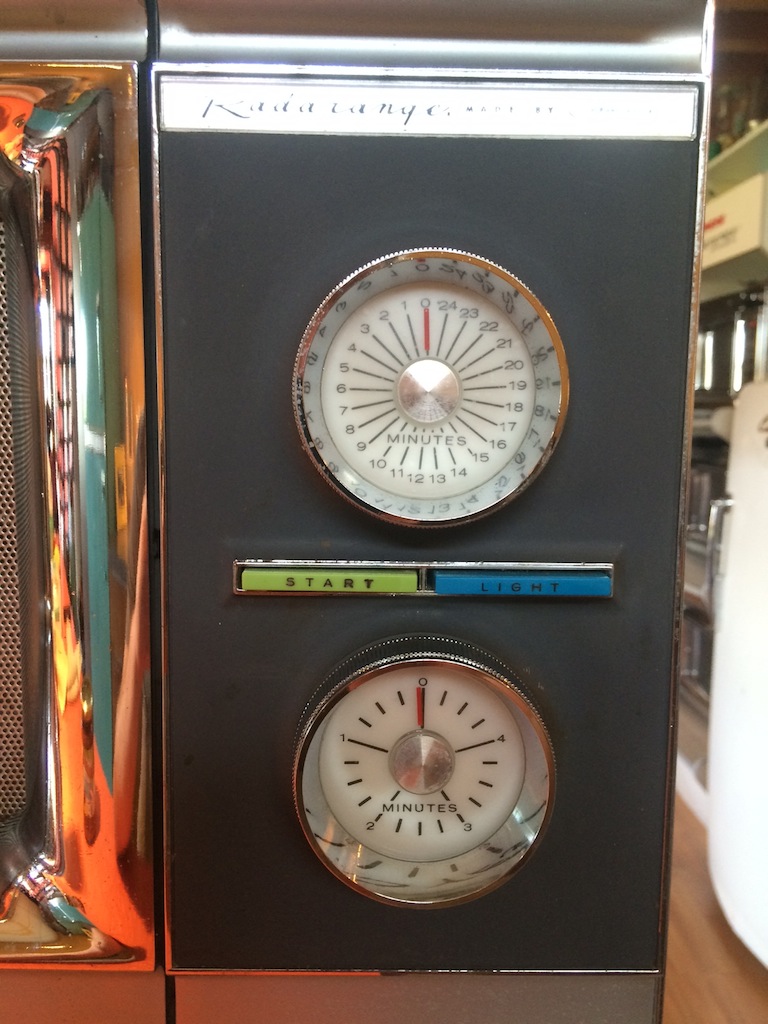
Two dials: power and time. The time dial moved to indicate how much time was left. It went "ding" when it was finished. That was it.
I can understand the need for features that automatically calculate how long to cook the food, and so on, but if you want those features you seem to have to take a massive hit in usability. They all seem to have cumbersome button-based user interfaces like this.