The U.S. economy is nearly 2x larger than China's, and if you're counting the entire "West" (I'm guessing you mean Europe + US?), it's about 4x larger. And that's just looking at GDP; if you consider GDP per capita, the difference is even starker: the U.S. is nearly 7x higher. In terms of immigration, the U.S. has roughly 750x more inbound immigration than China [1], and the EU has similar numbers [2].
I don't think the numbers back up what you're saying here — they contradict it pretty soundly. In fact, the U.S. currently is (IMO stupidly) trying to prevent people from coming at all because it has such a huge volume of inbound immigration.
Furthermore, compensation for technically skilled individuals is significantly lower in the rest of the world than in the US: visa barriers are definitely holding US tech salaries up. Although China has even stronger restrictions on foreigners, for those who can get into China but not the US it may be a good deal.
No, it's not. This is a flaw of using nominal GDP which doesn't take into account currency differentials, and therefore costs of production.
China's GDP(PPP) is already bigger
https://en.wikipedia.org/wiki/List_of_countries_by_GDP_(PPP)
And for the result of GDP(PPP) on individuals within domestic markets — which was another of the OP's claims, that individuals are likely to obtain more impact and success in China than in the West — you want GDP(PPP) per capita, not overall GDP(PPP). And the numbers still don't back up that claim: China is closer to Iraq than it is to even a fairly economically-challenged Western country like Greece, and nowhere near the US. [1]
Hong Kong — when measured separately from the rest of China — is actually very close to US-level GDP(PPP) per capita. But... I think HK's futures in that respect have declined significantly due to the PRC. In fact, Hong Kong used to be slightly higher than the US, and HK has declined on that metric over time while the US has risen.
1: https://en.wikipedia.org/wiki/List_of_countries_by_GDP_(PPP)...
I agree that for TSMC, market size is more important, but the blanket statement about global economic power is a little bit excessive. If we want to have COVID19 PPE, mass-produce medical equipment, or rapidly build military equipment, China can out-manufacture the US.
I know 2 of those three will be controversial (esp. military equipment), but I think they're true. The US military is probably superior to China's today, but the US had an inferior military at the start of WWII as well. However, the US was a manufacturing superpower and produced a superior military quite quickly. If China were to focus its manufacturing and engineering prowess on military technology, I think it would pass the US rather quickly at this point too. Yes, I'm aware of US technological superiority, and yes, I've seen estimates of how long it would take China to bridge the gap. No, I don't believe those estimates. I think there are a lot of mistaken assumptions in them, and it's to everyone's benefit (US' and China's) to believe the US is further ahead than it is.
only if that military power is _used_. During WW2, the USA had to use that power of manufacture to win the war.
So unless you're suggesting that china is willing to go to a hot war with the US, and out manufacture military products to win it, this argument holds no water. and this isn't even taking into account nukes.
The only time you have wars is if either the military powers are nearly equal, or the demands are over-the-top unreasonable.
* China won't take over Taiwan while the US is defending Taiwan if the US can defeat China in open warfare.
* If things are close, it'll think twice about trying. That'd be an expensive bit of work.
* If China has clear military superiority, I think they'd topple Taiwan's government overnight. The US would back down.
The whole point of a big stick is that you don't have to use it. If I come up to you on the street, point a gun at you, and politely ask for your wallet, I'm much more likely to get your wallet than to need to use my gun.
US nominal GDP is higher only because US dollar is 7x a Chinese yuan.
But there absolutely are more humans in China, with enough yuan to buy more chips than the US. Only that they'll get paid in a lesser currency.
Er, no. By definition a country with higher nominal GDP can afford to import more chips than a country with lower nominal GDP. That's exactly what nominal GDP calculates. This is probably why you're being downvoted into oblivion. It's also why TSMC isn't exporting its chips to Huawei anymore.
Also, there's a reason that the yuan is worth 7x less than the USD: it's because the PRC has intentionally devalued its own currency to keep manufacturing costs low and prop up local manufacturing instead of relying on imports, most recently in 2019 in an escalation of the U.S.-China trade war [1]. This helps bolster China's domestic manufacturing capabilities, but bites China in predictable ways when it wants to spend money abroad, e.g. importing chips from Taiwan.
1: https://www.investopedia.com/trading/chinese-devaluation-yua...
Of course what sustains this is $ as global reserve and for most of last few decades need for dollars to buy oil
These things are changing. China's size and demand for commodities pushes oil exporters and commodity exporters more and more to accepting yuan.
US loss of industry on the margins means $ has less use as reserve. Why stock pile dollars and treasuries if you anticipate large devaluation (deficits) in the future and are purchasing more goods from China?
What does US do as a result? Sanction and or invade oil exporters trading for other currencies. Iraq, Iran, Syria, Venezuela, Russia.
Nordstream 2 is a big one. Germany and Europe perfectly content to buy cheaper oil from Russia going forward. Much less need for $ though, as a result.
Thus, this overvalued $ (based on balance of trade fundamentals) won't perpetuate as it has previously.
Source of currency manipulation claims: https://home.treasury.gov/news/press-releases/sm751
Yes its US Gov source, but there is a lot of data presented here which I frankly can not grasp: https://home.treasury.gov/system/files/206/2019-05-28-May-20...
> On the mainland if you are a leading expert in this field or that, or belong to specific establishments (such as public security or state security) you cannot exit the country without permission from higher up the food chain.
That alone will be enough to deter people from moving to China for even 10x salary. Getting locked into an insane Han-supremacy regime is walking into the dragon’s mouth with a torch.
Intellectuals get attracted to more than just money. Especially industry experts.
> [..] any writer who adopts the totalitarian outlook, who finds excuses for persecution and the falsification of reality, thereby destroys himself as a writer. There is no way out of this. No tirades against ‘individualism’ and the ‘ivory tower’, no pious platitudes to the effect that ‘true individuality is only attained through identification with the community’, can get over the fact that a bought mind is a spoiled mind. Unless spontaneity enters at some point or another, literary creation is impossible, and language itself becomes something totally different from what it is now, we may learn to separate literary creation from intellectual honesty. At present we know only that the imagination, like certain wild animals, will not breed in captivity. Any writer or journalist who denies that fact — and nearly all the current praise of the Soviet Union contains or implies such a denial — is, in effect, demanding his own destruction.
-- George Orwell, "The Prevention of Literature"
This is just as true for scientists. Bought, caged, too addicted to harmony with peers -- all these and more have the same result.
If you cannot even say that the Tiananmen Square massacre happened, if there is an arbitrary set of facts you are even allowed to acknowledge, determined basically by brownshirts through violence, you may be doing something, but you're not being a fully fledged scientists anymore than an elephant could be found in a small fridge. I don't even need to look at the person, the circumstances are fully sufficient for this determination.
Which is kind of insane to think about. I don’t know them too well otherwise I’d ask them of their reasons for moving permanently out of China.
Just that I have a sample size of 1, so take it with a grain of salt.
The government has many "legal" means to "take everything away" from someone, including taking away their means of doing business or their access to power, running stories to defame them, using threats of tax issues, fraud, sexual crimes, national security violation, and other means of control. Sound familiar?
If you think human nature is different because there is some scrap of paper from two hundred years ago you may be sorely disappointed when trying to redeem on your protections and rights, which it sounds like you've never had to do. This, mind you, is the same scrap of paper that claims all men are created equal.
In the US, a certain level of person has nearly carte blanche against scandal, against being accused of crimes or pursuing pathological policy positions. Of course, in the US, a small person's life can be snuffed out if they annoy the wrong cop and their life can be made miserable if they go up against the justice system or other powerful forces.
I'm sure what how well the two system play against each other on the world stage at this point.
Is US / the West fair? Not by a long shot. Tons of shitty stuff happening, from George Floyd, to Harvey Weinstein, to Jeffrey Epstein, to Julian Assange. But at least we know about them.
But compared to China? You won't even hear about the "small person's life". I'm sure life in China can be great, unless you're Muslim, or Buddhist / Tibetan, or Falun Gong, or Canadian, or ...
I don't know about you, but for me, there's no question which of these systems I'd prefer to live under. Even if I were black! (Notify me when China gets a black president.)
I would prefer live in the West also. I also know a lot of people in the world value security over free expression.
Just as much, I'm reasonably sophisticated in my reading of the news and the open expression here allows me to pick the truth reasonably easily out of a stream of lies. But the stream of lies is there, every day I encounter people online who instead fall for the stream of shrill claim sloshing around both the Internet (aside from Murdock crap, you have "Russian Bounties", etc). Again, the US still looks better to me but the way things are going, the US is not doing a good job selling it's model.
Of course, if you mention Epstein, everyone here knows about him but few-to-no US paper, "pedophile, apparently murdered in prison by persons unknown" and people in China know often know the operations of the state to that degree, at points when the real story is obvious and the state isn't that concerned. Admittedly, there are stories about prison officials moving Maxwell around the prison to prevent her from also being murdered - but directly calling officials for Epstein's murder, not visible (no, I don't miss him but his murder was clearly to protect the guilty and nations should pretend the rule of law at least).
The US definitely has more free expression, of course.
In the US we have been selling off our privacy and ability to affect public policy through our leaders for much the same reasons, ie short-term gains for the few. Difference is we gave it voluntarily.
The probability of that happening is not so big considering people from such areas tend to have low quality schools around them, which tends to mean low test scores, maybe even involvement with the "justice" system, no real opportunity to land a semiconductor job.
What you said sounds nice, but I doubt happens much in practice.
I have friends living in Shenzhen, I asked them, and they said they never saw such signs. It could be that they are visiting different groups of restaurants or hotels etc.
[1] https://twitter.com/BlackLivityCN/status/1249011762638266374
Not necessarily. You could also lose your job and get totally screwed professionally if you speak against the last political trend. University professors could for instance lose a job over a pronoun matter. Sharing a memo have also been proven risky. The actors are different (state in one case, mob and PC in the other) but the end result can be pretty similar.
Try organising a Tiananmn protest, or criticising the Uyghur internment camps within China
I think he's referring to Han people studying/working overseas returning to their ethno-state. I can't imagine many non-Chinese would move to China instead of choosing to live in a fairer, rule of law Western democracy where the work is often better paid.
Careful with present tense, things have taken a stark turn for the worse in terms of the day-to-day reality of western foreigners in China, and it already was not spectacular (minders checking in on your domicile every couple weeks or month, basically zero standing in legal disputes including routine contract disputes).
China isn't afraid to play nasty political football using imprisoned and tortured and unconnected westerners as pawns.
It's easy to romanticize tech in China from afar, but in reality it's like how it was in the 90's in the US and needs a lot of catch up. One issue that I'd highlight right away is that there seems to be a real lack of interest in the actual work; everything's done at breakneck speed for purely practical reasons and they wouldn't get very far without being able to copy/paste from github.
Hence throwing money at strategically important industries like semiconductors. The goal isn't to pay more the west in everything, but to enough premium attract the necessary talent to meet development objectives. Like attracting sufficient Chinese engineers from the valley to sea turtle back to bolster domestic innovation while locals spam derivative products until something competitive arises. At least data from the last few years shows it's drawing Taiwanese and Korean semi engineers. But semiconductors are very hard, like turbojet engines which China also has difficulties tackling, so who knows how well this strategy will work. Only that it's worked for everything else.
>Chinese Tech
It's not romanticization, I'm not in tech and I don't know what goes on method of cultural wise behind the scenes. I just know most everyday services I interact with when in China is ahead of the west, with exception of Google maps. Maybe the code is all duct taped from github, the workers are underpaid and overworked, but the experience is better from a consumer experience. So for me whatever is happening is sufficient, and breakneck speed for practice reasons might be the kind of consumer oriented process I prefer. Silicon Valley may poach most of the talent, and have the best pay, but they haven't made my life as convenient in comparison.
The way China has developed and the growth potential still there, I can totally see Chinese expats moving back there.
My girlfriend (Beijing-born, came over as a grad student and stayed) has told me several horror stories of her time spent working as a SWE in China and Singapore. Based on her experiences, it seems like women should be especially disinterested in returning.
For the record, I would be ok with living in China for some time, or even relocating there long-term if/when the mantle is passed. Though I wouldn't do it without someone who speaks Mandarin.
What happened in Singapore? I moved here earlier this year but haven't heard much beyond the usual grumbling about long hours.
Sure, economic impact and power are huge. And that's far from a settled zone of conflict, I would add. But when a values-based culture leans into its strengths once again, in the famous United sense, one must ask how well its competitors can compete, or if they can compete at all, in that specific arena.
The idea that adopting repression is the only recourse here is in effect directly advising against the deployment of established strengths. (By the way, did all those millions of Hong Kongers in the streets suddenly disappear, or...?)
It’s also the mother of the GFW, which greatly impede the innovation. For example, many latest IT technology cannot be speeded effectively.
GFW by itself is no small engineering feat either. It's technology is widely relevant in many technical areas related to traffic control and network management. For example, deep packet inspection was applied in GFW, and had been quite useful in intrusion detection. Of course now with the popularity of encryption, DPI is no longer very relevant. But that's the example of it being advancing technology.
> During WWII, he was involved in the Manhattan Project, which ultimately led to the successful development of the first atomic bomb in America.
> During the Second Red Scare, in the 1950s, the US federal government accused him of communist sympathies. In 1950, despite protests by his colleagues, he was stripped of his security clearance. He decided to return to China...
> Upon his return, he helped lead the Chinese nuclear weapons program. This effort ultimately led to China's first successful atomic bomb test and hydrogen bomb test, making China the fifth nuclear weapons state, and achieving the fastest fission-to-fusion development in history.
> Qian was invited to visit the US ..., but he refused the invitation, having wanted a formal apology for his detention. In a reminiscence published in 2002, Marble stated that he believed Qian had "lost faith in the American government" but that he had "always had very warm feelings for the American people."
So this idea that it is not that secure/free because of a minor uptick in racism is ridiculous. China is routinely kidnapping and torturing anyone who disagrees with them - citizen or not. And we still don’t know where many missing journalists have ended up.
Actually the mainstream TV & newspaper media are overall owned by a very few holding companies and there's plenty of stories of people being subtly or overtly pressured to either change tune or be forced off the air if they ie spoke extensively against the Iraq War pre-invasion.
And you have plenty of organisations like NPR and PBS which are truly independent.
Also anyone can create a news site or blog without worrying about it being blocked.
Not sure through what mechanism you think they are directly controlled.
Personally I think anyone can live in their own fiction as long as they are not hurting anyone else, but to consider a strategic resource like the media as being truly independent in any country is naive. You're literally missing an entire world if you do not look outside your home country.
Why control things directly when you don't have to?
No. They're controlled by multinational corporations with clear profit motives and conflicts of interests and thus tend to be biased in favor of those industries.
In China you have state dominance so you have state controlled media, in the U.S. you have corporate media. That's not independent media, just the other side of the same coin.
And if your argument is "they don't control the army", the military industrial complex means they don't have to do so directly.
The uptick or racism is not minor either. Racism has been embedded in the American way of life and the fight against it has been long and painful. Being a minority in the US is absolutely a huge risk factor.
> China is routinely kidnapping and torturing anyone who disagrees with them
American police kill a lot of citizens, and incarcerate a large number of mostly POC.
And the current POTUS has repeatedly said he won’t leave office even if votes out, and has speculated openly on staying in office beyond term limits. So please don’t give me crap about China when our country is at the precipice of losing its status as a Democracy.
I find these 'but the US' responses to be particularly unhelpful as they attempt to frame things very much in the vein of China's own 'do not meddle in our internal affairs ' rhetoric.
I am a little bit speechless at all this vile of anti-US propaganda. It is insane.
One big benefit of living there is you won't be bombed by the US military, I guess.
US Military bombs Canadians living in Canada? I didn't know, source?
California grows a lot of water-expensive crops (e.g. almonds) because legacy farmers don’t pay anything near what residents, commercial, or new farmers do. That would rebalance quickly and obviate the need for any invasion if we just dumped wasteful “water rights” and instead priced water like any other rivalrous good (e.g. govt auctions).
There is a lot of shit wrong with America. But, seems like people are getting more nationalistic and throwing away logic, reasoning, objectivity, rationale and common sense - most importantly self introspection of tribalism that is going on these days.
Folks - the world is getting more inwards looking. Be careful if your psyche falls into the trap of nationalism. It will cloud your judgement and pretty much everything with it.
I am seeing this, frankly, a lot from our friends in EU. Authoritarian governments want the west to fragment and cause infighting amongst themselves. We must use facts, truth and integrity. Our democracies is at stake. It is unfortunately, not going to go well with this type of climate exasperated by Coronavirus travel restrictions.
We are heading to the wrong direction.
Many authoritarian governments in history and today exist because people desire security and fear the incredible violence exhibited by an external, dominant power. If you don't make sure this actually is hyperbole and check the abuse of power at home and abroad, the violence will one day (perhaps soon) come to you, along with authoritarianism. Not recognizing the cause and not seeing the already creeping trend in the face of all evidence is what's clouding people's judgement.
Most of the drawbacks you've heard about Canadian healthcare have been promulgated by the many many entities whose pockets are lined by this idiotic system continuing to grind forward.
A recent tech company I worked for in the Bay Area charged about $50 pre-tax twice a month and I paid nothing out of pocket. The gulf between good healthcare coverage and bad coverage is what’s obscene in the US.
I haven’t seen an argument for how the good coverage is worse, which is why I always ask.
The existence of premium healthcare plans for the high earners or the wealthy is not a reflection of the healthcare system. It’s how much access most people have that matters, statistically.
If it was just the rich that did well, it would be trivial to get consensus to vote for change.
Moving countries isn’t easy. Sometimes you just gotta find a part of the dumpster that isn’t on fire and do the best you can.
True, it does not. But who is the judge? The idea is that you have your own backyard cleaned before barking about someone else. Otherwise you just do not have that high moral ground to speak from.
They weren't comparing the US to China, they were explaining the flaws with American democracy/judiciary/media. The US is not a shining beacon to be held up in those categories compared to eg New Zealand/Germany (proportional representation), Denmark (judicial independence - the US doesn't crack the top ten[1]), or most of the rest of the West (see how far you have to scroll in press freedom rankings to find the US [2] - they have very weak media ownership rules, and while the media is free from a lot of govt limitations, it's free to be biased and partisan as hell)
Or just watch the opening from the Newsroom. [3]
[1] https://worldjusticeproject.org/sites/default/files/images/2...
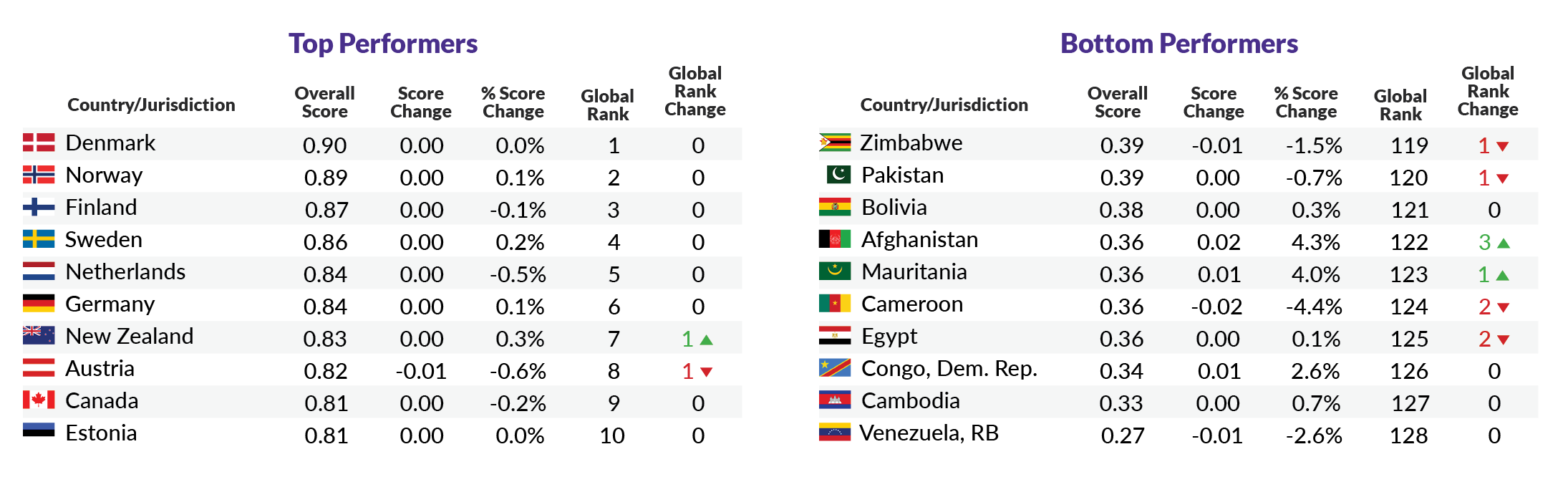
Of course they were comparing US with China, implying the US has its own flaws and shouldn't lecture China. That's like saying US had its own racisim in 1930 so it had no right to interefere in Nazi Germany's internal policies.
US may not be a shining beacon of democratic values but it's a country that can do something about China's rise as a world super power(unlike Denmark, NZ or Germany).
I’m not sure you know what the phrase “at the precipice” means, but the US isn’t even close to losing it. The separation of duties between the state and the federal government in conjunction with the branches of government means that even a fully compromised election for one of the positions cannot take the whole country.
By what objective criteria do you classify it as “on the precipice”?
> keep democracy functioning (Federal Agencies, Judiciary, Education, EPA etc)
Democracy existed before the EPA, the department of education, and essentially every other federal agency. Consolidation of ever more power at the federal level is antithetical to democracy anyway - the federal govt is a republic of democratic states.
> which if the current POTUS wins, will signal the de facto end of Democracy
You’re saying that if he wins a democratic election, it will be the end of democracy? That just sounds like sour grapes over an asshole being picked.
This is a kind of value and ideology as well, just a unsophisticated and primitive one.
Just wanted to add a few comments. Yes, I realized after I wrote it, the chief economist guy definitely didn't swim across the entire straits. He deliberately asked to be posted to Kimen or (maybe it was Quemoy), anyway they are very close to Xiamen on the mainland. Allegedly, he actually paddled by holding on floatation ballons or something.
My comment about only going so far in the U.S. has more to do with the executive and political leadership roles in the U.S. and not about compensation (which is far higher in SV, though I am not sure how comp works at top SWE roles in China). Very few Chinese top performers make it to senior executive roles in the U.S. much less, much less the big chairs (CEO, board, etc).
Also I was more talking about hardware talent then software. I think in terms of software the quality on the mainland is already quite good, at least in certain domains, but all the hardware comes from the U.S. if you think of NVIDIA or this semiconductor duke out, the weakness is hardware. So if you have "special hardware" talent you are feted like a debutante in China.
Anyway, as someone who has been around the block a couple of times on both sides of the Pacific, I see no happy ending to the current situation. I have said this multiple times in other threads, we used to think economic engagement will turn the Chinese system more liberal but I think what is really happening is that it is turning the American one more authoritarian and state driven. If we look at the policies of the Trump administration against China, it's basically the type of economic statecraft China uses herself. So great, if you are anti-Chinese that's rich irony, but I think ultimately, there will be no winner and the process of fighting China will make America become just like China.
Really now?
He swam from Kinmen, a small island about 2 miles from the mainland.
It's only a couple of kilometers from the Kinmen to Xiamen:
[1]https://en.wikipedia.org/wiki/Justin_Yifu_Lin
I was also dubious. The swim was from Kinmen to Xiamen (~6 km)
@Dang can you investigate this. I feel like the ccp is directly targeting hacker news to spread misinformation. Very scary.
First, a lot of Westerners hold anti-Western views—for whatever reason. This leads them to pro-China positions as a matter of tactics—the enemy of my enemy etc.
Second, a lot of Westerners hold anti-US views. That's similar to category 1 but different. We see this from some Canadian, Australian, and European users, and of course even from some American users—again, for whatever reason; people are complicated. This sort of user will also take China's side in a China/US conflict, for reasons of their own that have nothing to do with being Chinese communists.
Third, there are Westerners of Chinese background, either immigrants or children of immigrants, who have pro-China views because they identify with the Chinese dimension of their family history. Sometimes the children of immigrants have more strident views on these things than their parents. Where the parents naturally sought to fit in as immigrants in the West, the next generation tries to balance the two worlds by leaning back towards the country of origin. This group is the most likely to sound like "CCP propaganda" because they have deep knowledge of the culture and usually the language. And of course, if they're first-generation immigrants, their English may not sound native.
Fourth, there are Westerners of non-Chinese background who have spent a lot of time in China, usually for work (less often for travel), who developed pro-Chinese views, or complex/ambivalent views, simply by the natural process of having spent time there. This sort of user often feels like their fellow Westerners have a cartoonish and ignorant view of China, and wants to educate them. Sometimes they 'educate' them by insulting their ignorance, which is unhelpful. These users have native English and can sound like ardent propagandists as well, but actually their motive is to correct what they perceive as a distortion in Western public opinion. Their own views tend to be critical of the CCP, but they dislike what they regard as ignorant anti-Chinese views, and so will argue a pro-China position out of contrarianism. They tend to favor friendly trade and political relations with China, and since the trend of the last few years has been clearly against that, they can come across as rather aggrieved.
Fifth, there are many people who grew up in China, who came to the West for school (or work) and stayed here. Often they are caught between two worlds—having to defend the West and their choice to stay there to their families back home, and at the same time struck painfully by the ignorance, misunderstanding and hostility that they encounter about China here. HN has such users and they are in a difficult position: vastly outnumbered on intense, divisive questions that they happen to have deep personal experience of.
Sometimes these categories also intersect: for example there are Canadian children of Chinese-Canadian immigrants who speak Mandarin and have spent time working at tech companies in China. Their views come from having grown up in a Chinese-Canadian family and having spent time in China itself, and they feel demeaned and even slurred by the generalizations about China that they see on Western internet forums. They show up in the threads with counterarguments, and their counterarguments are often intensely detailed because they have so much personal experience with the topics.
Can you see how complex this situation is? Each of these categories is a minority on HN, but HN is big enough that 'minority' can still mean thousands of people, any of whom may comment in a thread like this—and no doubt there are additional categories that I didn't list (edit: here's another: Westerners with Chinese spouses). Any of these users can post what seem like absurdly pro-CCP comments in a HN thread, for complicated reasons that come from their own life experience. When they do that, other users run into their comments with no idea of the background that would lead someone to post that way, and it creates a shock experience. (For more on the shock experience, see [1] and [2]). Basically, they go 'WTF?' and wonder how anyone could possibly post like this.
Now here comes the pivot in the whole business. When you experience that 'WTF?', you have two choices. First choice, you can say "wow, I wonder how different our experiences must be that you would post what seems to me like such an obviously wrong and evil comment!" That fork leads to curious conversation in which people get to know each other better. Second choice, you can say "You must be a communist party shill! No one would post like this for any other reason! How much are they paying you?" Which percentage of HN users makes the first choice vs. the second choice? Exercise for the reader.
[1] https://hn.algolia.com/?dateRange=all&page=0&prefix=true&que...
My concern was based on intuition which in turn was based on the fact that I have seen a lot more pro ccp comments in recent months on HN, as well as seeing that people who openly question the ccp in ways such as their human rights records, diversity, IP theft, etc be downvoted when raising these points. Although this may be anecdotal and is definitely not proof of interference, I thought it would be wise to finally raise the issue with you.
Thank you for taking a look at this, and for all the work you do on keeping HN a healthy environment.
What all that means is that we're likely to continue to see more pro- and anti- comments on China-related topics, for reasons that are easily explained by the dynamics in our own societies. Reaching for "CCP shill" as an explanation is unnecessary, and to some extent is harmful because it reflects an assumption that no one could hold certain views in good faith, when we know for a fact that some people in fact do hold those views in good faith—again, for reasons of their own life experience.
This does not imply that we're closed to investigating claims of abuse and manipulation. On the contrary, our contract with HN users is that if someone is worried about abuse, they're always welcome to let us know at [email protected] and we will always take a look. I wrote new code the other day to help with such investigations. Another part of our contract with HN users is that we will tell the truth about what we find. The truth is that we haven't found even a trace of anything like that on HN—just a lot of human beings with very different backgrounds and very strong feelings. There's more about this at https://news.ycombinator.com/item?id=23839602 from a couple days ago.
It's an obvious fact that nationalistic passions are inflamed these days and getting worse. That inevitably shows up on HN and leads to low-quality, denunciatory comments and even outright slurs. We need to try for better than that.
Why don't you just call it what it is: A Prison!
Say no to political correctness!
Sure some may want to work in such an environment but this is modern day slavery. Nothing else!
For example, Justin Yifu Lin, the former World Bank chief economist was a Taiwanese defector who to swam to Mainland China. Before he defected in the (early 90's I believe) he was a rising star within the establishment in Taiwan.
Short term definitively bad for Huawei, but the long term it should help the development of the indigenous semiconductor industry on the mainland. Necessity is the mother of invention and nowhere else is there the capital, political will and now sheer necessity as there is on the Mainland.
A lot of "huaqiao" i.e. overseas Chinese that go back to the mainland (I include Taiwanese people here) despite the repressive political atmosphere and bad environmental quality, food safety are motivated by this. In the West you can only go so far, back there, especially if you have specialized technical knowledge, you have a chance to make an impact at scale that would never be possible in the West.
I am not sure what the U.S. can really do about this without adopting essentially the same repression as in China. I.E. control the flow of personal. On the mainland if you are a leading expert in this field or that, or belong to specific establishments (such as public security or state security) you cannot exit the country without permission from higher up the food chain.
Anyways, my point at the end, is the central point of competitive advantage or a company or nation is human talent. You can restrict technology or natural resources but it's human beings that make a company or a nation competitive. So unless the U.S. finds a way to prevent talent from flowing to the mainland, either from the U.S. and/or other parts of the world it is very hard to prevent another country, especially such a big one from doing what you don't want. And when they eventually do get to that point they will be twice as bitter at you for having tried to stop them.