This is a conclusion I'm coming to more and more. It's easy to blame Presidential overreach or Supreme Court overreach, but the Congress seems to be steadily abdicating responsibility while still managing to get very little of substance accomplished.
They are supposed to be the most powerful branch of government, but instead they have deadlocked themselves into uselessness. In some ways we're probably fortunate that the other two branches have picked up the slack, as much as we (myself included) like to complain about it.
"Ambition must be made to counteract ambition" he tells us in Federalist 10. The idea of a legislator who would derive self-worth not from actually doing things (good or bad) but rather by approbation from their faction solely for making the other side mad was not something they thought possible.
Edit: Since most replies are talking about the empire, I just want to reiterate that my comment was regarding the end of the Republic, which imo is a more analogous situation to modern USA. (Not to say it's identical, of course!)
In relation to the parent point, Octavian also went through great lengths to _appear_ to be acting at the will of the Senate. He was "first citizen" and all rights and protections granted to him here "granted" by the Senate. Whether this was under duress or just abdication for the sake of peace is debated.
There are some parallels between the current situation and the fall of the Republic, but there are for more differences. We are more at the Gracchi stage than the Caesar stage at this point. So there is hope!
https://www.washingtonpost.com/opinions/is-the-us-presidenti...
America was thought to be an exception because both parties used to be more centrist with wide overlap, but it seems they've become increasingly polarized, which makes the whole system less stable.
"The violent death of Caligula [the previous emperor] afforded the Romans a fresh opportunity to have asserted the liberty of their country; but the conspirators had concerted no plan, by which they should proceed upon the assassination of that tyrant; and the indecision of the senate, in a debate of two days, on so sudden an emergency, gave time to the caprice of the soldiers to interpose in the settlement of the government.
By an accident the most fortuitous, a man devoid of all pretensions to personal merit, so weak in understanding as to be the common sport of the emperor’s household, and an object of contempt even to his own kindred; this man, in the hour of military insolence, was nominated by the soldiers as successor to the Roman throne."
The US Congress has incredibly low approval ratings, as a whole. But each individual congressperson enjoys surprisingly high approval from their constituents. I guess Madison just didn't see that those two things could happen at the same time.
There are deep divides between the branches of the electorate that have brought the representatives to office, as the United States faces a number of divisive issues. Those divides, and a preference for combat over compromise, leave us deadlocked. The center is there for the first party that chooses to leave its entrenchement.
When Congress reaches approximate agreement on an issue, particularly an emerging one, it can move fast. See the passage of the PATRIOT Act or the recent move to spend more than $1,000,000,000,000 on COVID-19 economic relief.
Unfortunately, that just isn't so. The evidence of the last three decades has been that every time the Democrats compromised a little, the Republicans just moved further to the right and re-entrenched themselves.
https://www.lgbtqnation.com/2020/07/massachusetts-city-begin...
For animals, there's the Harkness Test.
It doesn't literally have to be the exact same issue over and over.
Compromise implies both sides give and take, and in the case of gun rights, democrats have only taken.
Sure, we can compromise on the background check requirements such that certain types of sales don't require background checks... well, ok, but then that just means that the people who would fail a background check will buy privately or from a gun show, and their access isn't really diminished, so the so-called "compromise" was little better than not passing a law at all.
It still boggles my mind that if I want to drive a car, I have to be tested and licensed, and carry insurance, but if I want to buy a device specifically designed to kill, I can just walk into a store, and after any weak legally-mandated waiting period, walk out with a gun I don't even know how to use, let alone use safely.
And all this because it has to do with an amendment to the constitution that was never intended to mean what people have since "decided" it means. The current legal interpretation of 2A only exists because of lobbying groups like the NRA.
On your automotive analogy - anyone can own a car. I can gift one to my 5 year old and so long as it stays home, he's 100% legal. Driving it is a privilege that's regulated. Likewise, carrying a gun is often regulated as you wish - and beyond reasonable levels in several states.
The "gun show loophole" is nonsense. Very few guns are transferred that way, and essentially zero "crime guns" were purchased this way. They were all either acquired via straw purchases (already highly illegal) or completely above board in a state with lax reporting requirements to the background check system. Ironically, the gun industry and gun community are, generally, huge supporters of addressing both of those issues.
Not everywhere; in some (many?) states, even cars intended to sit idle on private property must be registered (usually for a lower fee), and you can't put a 5 year old's name on the registration. Regardless, giving your 5 year old a car and saying he "owns" it is laughable.
Your analogy doesn't really make sense, either. You could give your 5 year old a gun to keep in his room, and while that's a terrible idea, it'd be difficult for you to get in trouble for it. Either way, your 5 year old isn't gonna be able to walk into a car dealership and buy a car any more than he could walk into a gun store and buy a gun.
> Likewise, carrying a gun is often regulated as you wish - and beyond reasonable levels in several states.
No state regulates guns as I wish. I won't elaborate much because I doubt we're going to find any form of agreement there. I will say that I support the repeal of 2A (not like that will ever happen), and at the very least I'd like the states to have the power to regulate firearms in whatever ways they see fit.
> This idea that we've only had gun rights since Heller is itself a modern invention.
I don't think anyone's claiming that we didn't have gun rights before 2008. But Heller (and other cases over the last 80? years or so) have narrowed the kinds of restrictions that are considered constitutional. Heller finally taking the position that 2A protects gun ownership regardless of participation in a militia was a big deal as well.
Let's take a state like Hawaii - what additional restrictions would you like to see them place on guns? It's already about impossible there.
This is a gross misunderstanding of the law. If you run a firearms business, you must have an FFL. If you have an FFL your must perform background checks for transfers regardless of where they occur.
Private party transfers are only from one non-dealer to another and must be infrequent / not a source of income for you. Purchasing a gun on behalf of another (such as to avoid checks) is called a straw purchase and is illegal regardless.
This is actually a very good point. I wonder what the response would be to a Democrat-authored bill that (say) demanded universal background checks and proof of a firearms safety course completion and mandatory insurance like a driver's license that ALSO banned any restrictions on large magazine size and removed any restrictions on fully-automatic weapons, or something similar.
Imagine carrying free speech insurance.
Most accept drivers licenses however the constitution grants the absolute right to travel in the same way it grants the right to speech. This has actually been used by the ACLU in an attempt to challenge no-fly lists, and hopefully drivers licenses will also be challenged.
The American political system doesn't support a la carte ordering, it only has prix fixe options. If your priority is some main course, you might not be able to get the side you want with it.
America has by far the most relaxed gun laws in the western world. Most other countries simply ban ownership of most guns outright.
The current situation IS the compromise. And it's pretty stupid I agree. But, there are no states that ban guns and plenty of them want to.
There is no hyper political, highly targeted, industry funded political action group just like the NRA on the side of banning guns.
After every mass shooting in this country democrats have to fight tooth and nail to get even a tiny consideration of regulation in response to human tragedy. And even that usually fails. In what world is that rational? In what world is that not compromise from the left?
At every step, law-abiding gun owners have given up rights and gotten nothing in return.
The great irony, to me, is that almost all of the "successful" gun/weapon control campaigns have been rooted in nearly blatant racism. Yet repealing those laws born of racism isn't something the left is willing to entertain.
Supreme court opinion on gun ownership was that it could be far more restricted (and it was in many cases!) until Heller.
Miller was dead by the time his case was decided, nobody argued his side, and the courts argument was was dishonest at best.
No, it wasn't. The current legal interpretation that most gun-rights advocates swear by has existed for a relatively short time, after the lobbying efforts of groups like the NRA.
According to this article[0], the early US adopted numerous restrictions on guns based on preexisting English common law, and during the revolutionary war even forbid anyone from owning a firearm without first swearing a loyalty oath to the government[1].
And of course 200 years ago, slaves weren't allowed to own guns for obvious reasons[2]. Of course, slaves weren't considered persons at the time either.
It doesn't appear that there was ever actually a time in the US when gun ownership was completely unrestricted.
[0]https://theconversation.com/five-types-of-gun-laws-the-found...
[1]https://founders.archives.gov/documents/Adams/01-03-02-0016-...
[2]https://www.sedgwickcounty.org/media/29093/the-racist-origin...
Which is not what I was talking about. I was talking about gun types not regulations to get a gun, store a gun, registration or anything like that.
>And of course 200 years ago, slaves weren't allowed to own guns for obvious reasons[2]. Of course, slaves weren't considered persons at the time either.
I wasn't clear. I meant any free adult not anybody.
Some slaves were slave drivers. White slave drivers had access to guns. It is not clear if slave drivers who were slaves had guns but it is possible. This of course would be an exception if it did happen.
The average slave of course would not own a gun.
>It doesn't appear that there was ever actually a time in the US when gun ownership was completely unrestricted.
Again, that is not what I was arguing. There doesn't appear to be any restriction on the type of gun you could own. There were other restrictions like not shooting cannons inside of city limits for example. People were allowed to own cannons though.
You may be unaware because this isn't an important issue to you but just off the top of my head the Brady Campaign, Everytown for Gun Safety and the Coalition to Stop Gun Violence all have major financial backing and support firearm bans in one form or another.
There are plenty of states that have attempted to but the courts have stated the laws are unconstitutional.
And if you want an example of the Democrats doing something similar, maybe the immigration situation? It is also nuanced and complicated, but the appearance isn't that the Democrats are consistently working to uphold the consensus position as found in the law. There is a lot of demonising.
Objectively, Republicans are not compromising, they are often explicit that they are waging a scorched earth zero compromise negotiating style. The heritage foundation wrote the template for the ACA in the 70s as an alternative to Medicare expansion. It was then Bob Dole’s plan when he ran against Bill Clinton, and was Dole’s alternative to Clinton’s health plan. Then Romney passed it in Massachusetts. But when Obama consciously tries to compromise and meet in the middle instead of participating they say it’s communism. They spent a decade to repeal a plan they invented.
Similar with global warming. Cap and trade was a republican idea. Where have they compromised? Instead they are demonizing all of science to shift the conversation to absurdity.
How about the 2008 stimulus. Obama has to fight tooth an nail for 800 billion even though economists say the output gap is $1.5 Trillion and the stimulus needs to be bigger. But Obama agrees thinking when it’s clear more is needed more will be available. He underestimated how much Mitch meant it when he said “the single objective is to make Obama a one term president” and was willing to let the economy struggle if needed. Then Trump gets $3 trillion with Democrats compromising all over the place.
Citation needed.
I have seen this claim about the left at least as much as about the right. I would definitely appreciate someone who could bring facts to the discussion.
And a one sided list of things that party X did is just emotion.
(Also, a good rule in honest debate is to never argue unless you have at least two advantages to the opposing position. Such that I hate Windows, but I wish Linux had their GUI... This helps bridge the "us" and "them", and gets to a much more accurate result)
It seems that the vast majority of comparisons of left/right in the US are comparing either how many people identify with one side, or how each side views the other. This particular chart however was part of an article that tried to enumerate the actual political stances of major parties (in the US, and I think it included UK ones as a reference point, but not sure about that - may have been a separate part in the same article) and show how they changed over time.
The structure of this chart was a vertical line graph, where "now" was at the top and the past was at the bottom. I think it went back to around 2000, maybe a little earlier. Being vertical it was rather distinctive and I'm hoping this jogs someone's memory so it can be found again.
On it, over the past 10 years or so, the Republican party has only shifted slightly to the right, while the Democratic party veered way way way to the left.
Edit: Found it: https://www.nytimes.com/interactive/2019/06/26/opinion/sunda...
The specific chart I'm remembering is halfway down the page, and right below it the methodology is described.
The republicans have led for decades. They are responsible for each vast increase, especially during Obama. Always pushing it further and further toward nothing getting done in the name of never compromising.
> According to the system, both parties have been on a trajectory toward more “extreme” positions since roughly 1970, the natural result of which is more polarization. However, the parties do not quite share equal responsibility for this: Republicans have moved about twice as much to the right as Democrats have to the left. Also, while the Democrats’ leftward shift was essentially a one-off event, the result of many moderate, Southern Democrats losing their seats in the early 1990s, the Republicans’ rightward transition has been continuous and steady.
Although to caution too-credulous interpretation, the DW-NOMINATE scores are derived from roll-call votes, so they may be biased by the issues brought up for such votes.
Approval voting is a much simpler system that gives better results.
Not voting for someone who can win is "wasting your vote" so people won't do that. Which, essentially, locks us into two parties. When the two parties know they are safe from a third, they're naturally going to be driven by the extremes and not the middle ground, because the national, fast-paced media lives off controversy between the extremes, which just ratchets it up farther.
IMO, the fact that we had political parties rise and fall (via third parties) in the past was more a historical artifact of not having a national, near-instant media to make sure things were polarized the same way nationally, nor could they let you know that a third party vote was a waste. In a sense it was more like local politics today, in that things weren't uniformly hyper-partisan, and a third party could make headway regionally and become a real contender before the rest of the country knew they were a wasted vote.
The 115th (2017-2018)[1] Congress had both a Republican House and Senate and it got extremely little done.
Our Congress is completely ineffective.
[1]:Fixed.
Especially since law-makers have a strong incentive to further their own careers by introducing changes. This system forces law-makers to work harder to get change passed, it often must be a change that benefits more than just a simple majority.
It doesn't even require a majority: we've so predisposed the system to inaction that a small number of people can block it. To pass legislation you need the consent of the House and the President and a supermajority of the Senate. Any of those can stop a law in its tracks.
It's easy to say that we should favor not changing things, and there are definitely ways that we should force people to seek consensus. But when the current setup works against you, you can suffer for decades without getting relief, and it's not a good look to just shrug our shoulders and say, "Well, it's working for me".
Generally though, I agree with you that we should all strive to vote for the greater good. We should fight against injustices even if they do not directly affect us.
I think that many of the issues come down to differing views of what more just: IE employment opportunities for a citizen vs. an immigrant, rights of a criminal vs. a victim, autonomy over one's body vs. a potential life. Those don't have easy answers.
This is the overall design.
So out of simple self interest it behooves us not to just say "the status quo should be hard to change". When we see an injustice, we should fight to change it, even when it's not to our own immediate advantage.
It is an amazing read, but the things that stand out to me are these.
1. Have diffuse/decentralized power centers to make it harder for special interest groups to gain power and control things. The last two centuries have had a tendency to move power from states to federal government; and from Congress to the President. So the balance of power has centralized.
2. Avoid a direct democracy because they tend to get subjected to demagogues. The direct election of senators was a major turning point in helping centralize power; since states became more and more irrelevant.
I am always impressed by how much Madison understood the nuances of political power and tyranny.
[1] https://billofrightsinstitute.org/founding-documents/primary...
Perhaps the line of reasoning you're alluding to is that, at the time, state and local prohibition laws were already so common that the Prohibition Amendment shouldn't have changed the effective legality of alcohol consumption for most Americans. But to maintain the status quo in perpetuity, locking in Temperance Movement reforms without defectors slowly eating them away, a national law was desirable.
[1] I'm still looking for the citation, but IIRC the reasoning was that the court wouldn't interpret the amendment to reach private, non-commercial activity unless it was explicit on that point; it wasn't just a cop-out textualist dance with the word "manufacture".
> But to maintain the status quo in perpetuity, locking in Temperance Movement reforms without defectors slowly eating them away, a national law was desirable.
But overall yes — this what what I was referring to. Even if I wasn’t clear on the state vs federal level, the overall argument that I’ve seen is that the proponents of prohibition wanted to increase the difficulty of rolling back prohibition. And if alcohol was banned through legislation, it would just take a single election (state or federal, depending on the law) to change things back.
You think so? It lasted all of fourteen years and did very little to stop the flow of alcohol throughout the country. And I believe it's the only amendment to have been repealed.
If it were a legislative action, rather than an amendment, I suspect it would have been more effective in the long term since legislation is usually more thorough and detailed than constitutional amendments.
Weather or not the law had the desired effect relative to hypothetical legislative action is an open debate but undoubtedly could be overturned with less votes.
Which it was, by the (post-Armistice, pre-18th-Amendment-ratification) “Wartime Prohibition Act”.
You might not agree with the principle, but given they haven't done much shrinking you cannot call it their principle.

As a portion of the economy, just our public spending on healthcare is higher than the OECD average public spending: https://www.oecd.org/media/oecdorg/satellitesites/newsroom/4...
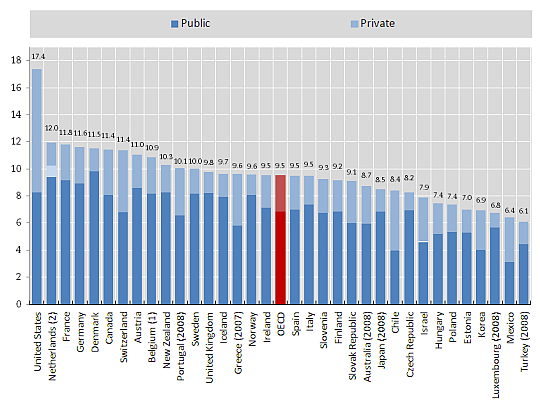
Regardless, you could also argue that -- similar to healthcare -- dollars in is not a great metric anyway. Are we getting the best outcomes for that money? We certainly aren't for healthcare, and my (admittedly incomplete) reading on this topic is that our K-12 education system is nothing to be particularly proud of.
Obviously high-cost states spend more than low-cost states. But their education spending is consistent with the size of their economies. Mississippi has a GSP per capita of $35,000 and spends $8,700 per student. Italy, Spain, and New Zealand have similar GDP per capita and also spend a similar amount per student.
Its really terrifying to see people confidently and passionately argue about politics while pulling their "facts" from an alternate universe.
The highest paid government employees in most states are football coaches for the state schools? Why? I thought schools job were to educate not cause brain injuries in their students? Why pay millions of tax payer dollars earmarked for education for someone to coach a game that injures the mental capacity of the students. Why not hire more professors with that money? why not pay teachers more or fix facilities buy material and equipment make teachers not have to spend their own money on basic supplies?
I used to feel this way too, but my understanding is that investing in sports programs tends to _bring in_ more money for universities, on net. I don't think it's accurate to consider it as trading off against academic investment.
At any rate, this is a bit tangential: American universities are the best in the world, so the conversation is more about high school and lower, where our educational outcomes lag by some metrics.
This awkwardly also highlights ignored externalities and implied awkward questions in ways essentially nobody is comfortable is with the implications of especially regarding free choice and perverse incentives where the "best" option still has messed up implications.
One of the best places in America to get education happens to be free: the public school system of Lexington [1]. But you'd be hard-pressed to get a house there for less than a million. Secondly, every other student in Lexington happens to have private instructors on the side. It's funny, if you randomly walk into a Starbucks in Lexington, chances are very highly you'll see an elder person with a young person training for standardized exams.
[1]: https://www.nytimes.com/interactive/2016/04/29/upshot/money-...
Instead, it is evidence that there is bipartisan support for educational spending, but with uneven beneficiaries.
This is a different issue and the solutions to the first problem are not the solutions to the second.
Last, this isn't really a partisan federal issue. Most school spending is determined the state or local level and the same inequality is present in predominantly red and blue states.
That does not correspond with the rhetoric that I've seen. Republicans are adamantly opposed to increasing spending for public education, and have systematically cut support for higher education spending in state budgets. Instead, I regularly see the meme that there's tons of fat in the education system; that we spend just as much as everyone else, but have worse outcomes. The fault is in the schools for not spending what they have wisely enough.
And I think that the funding story is flatly untrue. Because the dominant source of public education funding is from local taxes, there are vast differences in the per-student level of funding across the country.
This is patently false. Local governments provide 45% of K-12 educational spending. State governments spend 47% and the federal government spends 8%: https://www.urban.org/sites/default/files/styles/optimized_d.... State and federal funding go overwhelmingly to erasing the disparities in local funding.

Look at the funding numbers in your own state. Here is mine: https://i2.wp.com/conduitstreet.mdcounties.org/wp-content/up.... The funding differences are based on cost of living, not local income. My solidly middle/upper middle class county has spending near the bottom because it’s pretty rural. Baltimore which is very poor has among the highest. Montgomery and Prince George’s, which are opposite sides of the income spectrum, get almost the same amount of funding. You can also see in that chart how differences in local funding are more than compensated for by differences in state funding.

And it isn't enough. Not even close.
Boulder Valley: 13.8k/student. Pueblo: 10.5k/ea. Fort Morgan: 9.5k/student. Those are sufficiently widely varying that looking at "average spending" paints an inaccurate picture.
Durham public schools: 10.5k/ea. Chapel-Hill/Carrboro: 15k/ea.
https://ballotpedia.org/Analysis_of_spending_in_America%27s_...
Range of total spending per student spreads by over a factor of 4x.
Second, I’m not sure what your Colorado example is supposed to prove. Boulder is a much more expensive city than Pueblo. Land for schools is cheaper, salaries are lower, etc. Those costs seem roughly comparable accounting for local costs.
Third, comparing spending across states is deeply misleading. The cost of schooling in Idaho (which makes up several of the lowest spending school districts in your link) bears little relation to the cost of schooling in New York (which makes up several of the highest spending school districts in your link). The irony of your example is that Idaho spends about 1/3 of what New York spends per student, and Idaho students outperform New York students: https://www.sde.idaho.gov/assessment/naep/files/general/naep...
Fourth, even the low spending school districts in your examples spend more than European countries: https://www.statista.com/statistics/381745/education-expendi.... School spending in London is about $7,402 per student. That’s substantially less than Pueblo or Durham, and only a bit more than the state average for Idaho ($7,100). I guarantee you that money goes a hell of a lot further in Durham or Boise than London!
That said, what do you think drives the disparity in outcomes between different US districts and schools, if the funding roughly tracks with cost of living? Similarly, why are schools in European countries so much more efficient in terms of educational costs?
One thought on the first question that comes to my mind is that students who are impoverished or have english as a second language will not have comparable outcomes, even if their school districts have comparable funding.
I wonder if one aspect of the second question is the handling of special education for disabled students. Do European countries educate these students in a different manner from the US. Is the funding taken into account when we look at per student costs?
> Third, comparing spending across states is deeply misleading.
This is why you cannot use averages to talk about school funding relative to the rest of the OECD. That's my point. You asked for statistics in my state. I gave them, in my most recent two states of residence.
I wonder if it has to do with the level of services expected and provided between locations, states, and counties.
For example, I know that special needs students, which can be notoriously expensive to educate.
Moreover, many countries exempt teachers from the national pension scheme, just like the US. The UK, which I used as an example above, has a teacher pension system
French income tax maxes out at 45% on income above €157,807, while US federal income tax maxes out at 37% above $518,401
Spending levels are much higher than parent reported. [1] for one school chosen at random shows that their budget was almost 8000 GBP/pupil - over 30% higher than cited. Furthermore, 82% was staffing. A mere 3% is allocated to facilities.
In my local school district[2], salaries for all staff add up to a little less than 60% of the budget. Facilities (21.6%) and debt service (7.6%) are a far greater fraction of our costs.
In short, the "education is cheaper in London" story is a lie. Many of their costs are payed for by a different color of money entirely, and simply doesn't show up on the education budget.
[1] https://schools-financial-benchmarking.service.gov.uk/school...
[2] https://www.adams12.org/financial-services/documents/fiscal-...
This is what I said as well. There is also vast difference in per-student spending within blue states and blue counties. This is evidence that the problem crosses party lines.
I'd see it rather as evidence that most educational spending happens at the state and local level, not the federal level.

Second, the military is one of the few aspects of government that’s clearly supposed to be done at a federal level. Why do you think there is anything inconsistent about conservatives not cutting back government uniformly?
According to the 18th-century conception, the army indeed becomes a federal concern in wartime, but on an everyday peacetime basis, the training of soldiers was supposed to be done within militias regulated by the states.
There are 2 things that are not being taken into account.
First, historic trends are not reversed by relatively recent changes in allocation to the US military.
Second relatively recent changes in military utility of manpower vs aircraft vs cruise missile has made certain kinds of spending obsolete. A modern, effective military does not require the same logistics anymore, so of course spending has gone down.
There is nothing inconsistent about conservatives (Republicans) expanding military spending, as they always have and will continue to do so within the bounds of recommendations from the industrial military complex.
They just want to spend the money that doesn't exist on different things.
Humility is a virtue.
I'm well aware of who he is. What he wants doesn't actually get done, no matter how many pledges people sign. It's a fantasy.
I could write a piece of code that adds two numbers but takes two days and all available memory to compute the result.
A lot of laws are on all levels of government from both sides of the isle are well intentioned but the costs surrounding the laws are prohibitive.
That doesn’t imply we need less laws, that doesn’t imply we don’t have enough laws, it means we need to take a hard look at where the bottlenecks are and streamline the process and to achieve the desired result.
The problem with the 115th Congress is that Republicans have done a good job getting their base to believe that various policies are bad for the country, but when push comes to shove even they recognize that: 1 - they have no viable alternative, and 2 - that said policies are better than nothing.
You should not conflate one party's inability to govern with Congress being dysfunctional overall. When the Dems get control of all branches of government again, I fully expect to see the logjam clear up for at least a few years.
This time was an extraordinary humiliation for Paul Ryan in particular because it should have been an opportunity to get lots of ideologically-motivated things done really quickly, and yet they failed to achieve even incremental progress on Trump's top legislative priorities, like repealing the ACA and securing funding for the wall.
This is separation of powers at work and is a good thing.
Edit: the comment above was edited to change the congress and dates in question
Yes, Congress is ineffective -- I think that's almost become an axiom at this point.
But it is often ineffective because of the rules it has adopted itself. The filibuster was removed for federal justices, and guess what? I think it's nearly 200 justices confirmed in the last three years, and while I don't remember the exact number during previous congresses I believe it's significantly higher.
As already noted, the filibuster is the root of a lot of this, but should the filibuster go away? McConnell famously told Reid he was going to pay for removing it, and he's made good on that promise, essentially transforming the entire federal judiciary with the power he was given. I view the filibuster as a check on the power of a tiny fractional majority -- should one party totally control everything that happens with a single vote majority? That essentially ignores the concerns of the rest. The filibuster at least forces some consensus building.
Better would be to have more than two parties. But how we could ever get there now I have no idea, the two parties in power have no intent of giving it up, and most people quite frankly are too stupid to even be bothered to vote, and those that do might be even more stupid in some ways. "Congress" is bad, "my congressperson" is the greatest ever because they get me money, and that seems to be the guiding principle for people voting these days. Maybe it always has been.
Approval Voting simply allows the voter to vote for or against each candidate independently. (The instruction is to "vote for all candidates you approve of" -- hence the name.) "One person, one vote" becomes "one person, one candidate, one vote".
Instant-Runoff Voting (aka Ranked-Choice Voting, though there are other ranked-choice systems) is getting more buzz these days than Approval Voting, but AV is superior: much simpler to implement, easier to understand, and much less likely to return an anomalous result.
For more info: https://www.electionscience.org/
So I'm still putting the blame right on them.
Personally I don’t think the decline in Congressional power has a single cause. But the decline of political party power is surely one.
Concretely, I think we should prioritize campaign finance reform and lobbying. It's only a start, but a potentially important one.
No, it's not; political opinion in the US is closer to a bimodal than a normal distribution; the center of the current Overton Window is a place where you lose your base while not meaningfully appealing to people inclined to vote for your opponent, plus even if you succeed momentarily when (probably not “because”) you do that (e.g., Bill Clinton), the result is shifting the near pole of the Overton Window toward your opponents’ position which almost invariably results in a similar movement of the far pole maintaining the width of the Window.
A lot of the dynamics of this is tied to the structure of our electoral system; more effectively representative, multiparty systems have different dynamics.
eg in federal legislation: the House (majority); the Senate, representing increasingly tiny numbers of Americans (supermajority, often: cloture); the president, and the supreme court.
Ezra Klein wrote a book about it. https://simonandschusterpublishing.com/why-were-polarized/
1. What sort of compromises with the modern Republican party do you expect the Democrats to have to make, that they haven't already been making?
2. And what will their reward for making them be? Another supreme court appointment unfilled until the president is a Republican? Another crappy compromise healthcare bill that maintains the status quo? Another decade or two of inaction on climate change?
As you note, when congress sees an urgent problem worth solving, they move quickly.
When I read, "congress is abdicating its responsibility", it seems to me people are just upset a law they like wasn't passed.
In other words, people want a dictator they agree with, rather than taking the time and effort to change the minds of their fellow citizens on any given issue.
Besides, inaction is often the best path to take, particularly when there isn't a clear winning idea.
It's like the old joke about Academia: the political infighting is so intense because the stakes are so low.
https://www.amazon.com/Subtle-Art-Not-Giving-Counterintuitiv...
If Americans cannot agree on anything, therefore, congress cannot either. People blame congress, but it's the American people who are ultimately responsible.
(by design! the point was to give smaller states a say and that itself is the problem, it is a bad idea to let a minority be able to grind all action to a halt. You say "but what if they do something I don't like" and the answer is vote them out next time, elections should have consequences and winning an election should result in a government that is able to accomplish policy. Setting it up deliberately to deadlock just because they might do something you don't like is a terrible idea and needs to stop being viewed as some kind of virtue of the design of the American system. Just because the founders did it, doesn't mean that it is a good design, they had lots of bad decisions... like slavery, and setting up the government to allow slave states to have equal control to the free states.)
if you assume some kind of relative equality of states, then on the whole the senate should approximate the house, and you can easily come to the conclusion that we really don't need the senate itself at all. abolish it and go to a unicameral system.
Similarly the parliamentary system where the executive is chosen by the majority of the legislature is a much better idea - again because it results in a government that is actually able to accomplish policy.
there is very much a reason that none of the other countries whose constitutions we wrote over the years (Japan, Germany, etc) use the American system. Everyone in power realizes that the American system is terrible and doesn't produce a mandate to govern.
It's amazing that it worked for as long as it did.
The solution is not to remove the Senate/House combination that balances the will of people and the will of States, but for larger states to break up into smaller ones.
Oh we must, must we? Why's that?
It's not an assumption, but rather an assertion, based on the observed outcomes of this system in action, and the strife it has caused (literally a civil war, and gridlock in the modern era).
The assumption here is that representing states themselves is in any way a desirable goal. Just because the founders did it, does not mean that it was a good idea. Being able to observe outcomes and change your course of action when the results are not good is the mature thing to do. We do not need fetishism of the actions of people who are 200 years in the grave, the founders themselves advised against such a thing and gave mechanisms for the constitution to be changed. Unfortunately these have atrophied along with the rest of the american federal system.
States have lots of other ways to express their will: they have unitary power within their territory, they have the ability to lobby congress and the people, and they can sue if they believe their powers have been unfairly abrogated. The senate as an institution representing states directly has been dead for over a century. It is now an institution representing the people in those states already - but a very undemocratic and unfair one.
> The solution is not to remove the Senate/House combination that balances the will of people and the will of States, but for larger states to break up into smaller ones.
Which is a tacit admission that you think equality of states is a necessary and worthwhile goal to make the Senate work properly. You just disagree about how to fix the current problems with the Senate.
Sure, dividing states up to a more equal population is one way to make it work. Probably not really possible when New York City alone has the population of what, 15 or so states combined? Do you suggest fracturing the city into 15 states? That would be incredibly awful to administer.
Very simply, the Senate is just a failed design and cannot be reasonably fixed without inflicting even more cumbersome forms of government just to try and preserve it for the sake of preserving it. It needs to just be eliminated.
Not that there is any plausible means to reach any of these goals of course, Congress would not approve of states dividing themselves up since that would disadvantage Republicans. Politicians will never vote to remove their own structural advantages even when it is the democratic thing to do.
They were always intended to be both. Since there had to be such a powerful entity within the government (the power exists, so it has to be put somewhere), the best course of action to prevent any whim of politics doing irreparable damage is to pit congress against itself so that any actions it takes are generally too slow for transient whims to affect it.
Better that the powerful are inefficient.
The first hundred years of the US tend to disagree with that statement
Rome had many periods and the dynamics have played out before and provided disturbingly apt precedents even with the alien trappings and values.
Was the founders intention to have a super-class who had political determination?
Could you expand a little on your point?
There is an element of bias to this, and it often reveals a political preference of the author, but it's not without some merit.
Not the executive, and not he judicial (it's not even well defined in the Constitution).
The elected body of representatives is supposed to be where the action is.
They've gradually been failing more and more
That's what many Americans wanted, and voted for. A government that governs least governs best, after all.
American politics has become less about policy and more about ideology and party loyalty over time, and that ideology has become more entrenched and unwilling to compromise with opponents.
I'm not smart enough to know if there is a better solution for America.
So get rid of congressional districts and instead fill the House according to proportional representation.
The US needs more than two parties.
Because I'm not really interested in abandoning my fellow citizens who lack the means or the support structures to leave where they currently are to the tender mercies of people who plainly don't give a damn about them.
Even every "red state" has plenty of people in need who can't afford to go elsewhere and shouldn't be asked to abandon their families and their lives to just not die.
(EDIT: I normally don't respond to killed comments, because feeding the trolls sucks, but: I live in Massachusetts, dude. I'm used to a state that actually works. I wish you all had them too.)
>Even every "red state" has plenty of people in need who can't afford to go elsewhere and shouldn't be asked to abandon their families and their lives to just not die.
>(EDIT: I normally don't respond to killed comments, because feeding the trolls sucks, but: I live in Massachusetts, dude. I'm used to a state that actually works. I wish you all had them too.)
You could write an analogous comment from a perspective of "people in the blue states need saving too".
Are you going to be singing that same pro-federal tune if issues don't go your way at the federal level?
I live in Massachusetts too. While the burning dollars of taxpayers does keep us warm there is no shortage of states in the nation that would revolt if it had government that "works" the way our government "works". People in other states are not so willfully subservient to government in the name of the common good as we are. We step in line for things that would provoke revolt in states with stronger traditions of individualism and distrust for government.
We have a limited federal government for a reason. Massholes like us have no business telling people thousands of miles away with different cultural values and different economic circumstances how to live their lives. The hell do you or I know about what's best Wyoming? Exactly.
The root problem here is the people who insist that their political beliefs should be implemented for everyone in the country, not just for the people around them who agree with those beliefs. This idea that "we can't leave anything up to local government because there might be some local government out there who disagrees with me" is why we have so much federal gridlock.
I don't particularly care about self-inflicted wounds, but the splash damage upon the people whose lives they make worse in the offing is a damning indictment of this conception of federalism.
Shit's broken, and it's broken for the weakest among us, and it's only getting worse with the "drown it in a bathtub" corps stomping through the White House.
I respectfully submit that you might want to reconsider your priors and update them if you want to accurately reason about the present state of the USA Republic.
The Trump administration has observably almost fully embraced an MMT style social welfare program. The sovereign currency denominated deficits don't matter position has won. The only thing that's missing is the employment backstop, but the $600 a week federal unemployment bonus arguably achieves the same fiscal effects as paying for busywork.
The reality is everyone cares, they just disagree sharply on how to solve issues or which issues are priorities — to which the solution of several independent approaches seems reasonable.
When people in state A see that state B is doing much better because of policy X, they can choose to enact similar. I’m not sure I understand why they need to be compelled to adopt your preferred policies.
It’s interesting that you discuss “red states” being in need — but ignore the prolific violence in “blue cities” and poor trapped there.
As they say: Cure yourself, doctor.
I'd be inclined to agree with you, expect I feel this is what got us Obamacare instead of a better system - and _even then_, there was a multitude of red states that refused to accept the Medicaid expansion, to the harm of precisely the people you speak of. Pushing societal improvements on states that don't want them feels like buying a sandwich for a homeless person and having them throw it on the ground, and I no longer feel its worth the effort.
Two or even three is not usually not considered to be several.
Too slow, too reliant on voluntary compliance, and most importantly, too difficult to make decisions with long term time horizons.
Not sure you want an efficient, consolidated government if the wrong party is leading it.
This chart shows government spending by various levels of government: https://images.app.goo.gl/iVpyyr2Ftzo6m7PB6
In the US, about half of all spending happens at the federal level. Germany, which also has a federal system as a matter of its constitution, also has the central government spending about half of all government dollars. Canada is even more federalist. The vast majority, about 3/4 of 4/5 of government spending happens at the provincial level. Denmark also has the majority of spending at the local level. Belgium, Spain, Sweden, Chile, and Mexico are about the same as the US in pushing about half of all spending down to the local governments.
In a two-party system that gentlemanly good faith eventually breaks down and you end up with our current problem, where you need supermajority control of all branches of government to actually do anything, because if you lack even one single point of control then party-line behavior will allow everything to be ground to a halt.
Parliamentary systems are better, there is just one house in most cases, and the executive is of the same party as the legislature, so when a government forms it has consensus and can execute policy. Yes, this is less checked-and-balanced, and that's a good thing, because accomplishing policy and checks and balances are opposing goals. Too much checks and balance and nothing gets done. If everything is fine that's great, but our system has been deadlocked for 20 years now, things are not great, and nothing can be done about it.
And there are still an executive and judicial branches in a parliamentary system, it is still a federal system, just not the American federal system.
The real "checks and balances" is ultimately voting. Having snap elections allows that check to be manifested much more readily when the government begins to go off the rails of public opinion.
(the queen is actually a very interesting apparatus in the british government... apart from having some kind of maximum duration between elections, you are dependent on someone to decide when to call a snap election. Obviously you can't really rely on a government that is completely off the rails to call an election on itself, and party line voting poses obvious problems. So how do you deal with it? An oracle machine (in the crypto sense) that exists outside the system and can operate independently to decide when to call an election. Which is what the queen does, she can dissolve parliament and call an election.)
https://www.etymonline.com/word/veto
This even appears in technical projects, e.g., Linus Torvalds, who's for years been the Linux kernal's "no" man:
[I]n the end, my job is to say no. Somebody has to be able to say no to people.
https://linux.slashdot.org/story/20/07/03/2133201/linus-torv...
Smaller, simpler systems, with greater levels of trust, or greater inequalities of power, seem to avoid this. Large ones, not.
I'm sure there's some discussion of this in political theory, though I'm unaware of it. Listing out a typology of other loci of power would also be interesting.
I posit that there will always be this conflict until cities have a blue federation superimposed on a red countryside. But the constitution isn't set up that way. Maybe next time.
If Congressional lockdown was useless, it would've been fixed. Clearly, there's plenty of interests that favor a Congress/Senate that isn't able to move legislation forward.
Are you talking about Congress or the country as a whole?
That isn't an invitation for the executive branch (or judiciary) to overreach.
In theory congress could go years without passing a single law, and that would be fine. It would signal that the current laws are sufficient.
(As an aside, congress has ceded much of it's lawmaking authority to federal agencies anyway -- so even if they didn't pass any new laws, the legal code will still change every year.)
"Today’s decision must be recognized for what it is: an effort to avoid a politically controversial but legally correct decision. The Court could have made clear that the solution respondents seek must come from the Legislative Branch. Instead, the majority has decided to prolong [the Department of Homeland Security's (DHS)] initial overreach by providing a stopgap measure of its own. In doing so, it has given the green light for future political battles to be fought in this Court rather than where they rightfully belong—the political branches. Such timidity forsakes the Court’s duty to apply the law according to neutral principles, and the ripple effects of the majority’s error will be felt throughout our system of self-government."
.
This was his dissent on DACA. Agree or disagree with the program that allows undocumented immigrants to stay and go to school, I don't care. It's not legislative, it's not judicial, it was a program by DHS setup under the last administration. Now the court rules the current administration can't undo the program? It's bizzare.
Things like DACA _need_ to be written in stone to avoid forcing the supreme court to become the effective legislator instead of having congress pass a law that enacts it as an actual program.
It didn't rule that the current administration can't undo the program, it ruled that the administration has to properly justify that decision, and not doing so is unlawful.
At no point did it rule on DACA itself, or prevent the administration from providing actual, motivated and legal reasoning for rescinding the program.
Also
> This was his dissent on DACA.
Which corresponds to the majority ruling on this case, yet I can't help but notice Gorsuch joined the liberal justices in the majority, not Thomas.
That's incredibly problematic. According to the recent ruling therefore, a President has the power to issue and EO which prevents the enforcement of certain laws.
> According to the recent ruling therefore, a President has the power to issue and EO which prevents the enforcement of certain laws
is flatly untrue.
The court rules that the current administration can't undo it simply by waking up one morning and say "I wish that it be done;" it actually has to go through a process to explain why it is taking the decision it is, which is the same process it had to do to enact the program in the first place.
https://thehill.com/homenews/administration/506018-trump-exp...
It's bizarre to have someone quote a judge's dissenting opinion but not read the main gist of the actual verdict.
In this case, that's exactly what the majority concluded. In layman's terms, this is a decision that says, "We aren't doing a thing. Congress made a promise. If you want to rescind it, go talk to congress, not us."
When exactly did that happen?
If respondents want to undo that promise, they need to take the matter up with congress. That's what the court is saying. You can't short circuit the constitutional order. The court is right to drop this right back in the lap of congress.
... and therefore the promise is still in force and should be upheld.
Congress has to do its job. Or not. Whichever it chooses. But it can't rely on the courts to do its job. The courts are right to let everything sit exactly where it is, and drop the entire matter back in the lap of congress.
If I am not mistaken, this ruling only pertains to the Major Crimes Act[0]. It doesn't mean half of Oklahoma "belongs to the tribe", it just means half of Oklahoma doesn't have criminal jurisdiction for a short list of crimes when they are committed by tribal citizens.
Normally this wouldn't be so bad, Congress is bad at making small evidence based changes on a reasonable timeline so instead they setup the rules for making the rules and the goals and instantiate or grant that authority to a division of the executive. Unfortunately it seems the courts have become very enthralled to varying degrees to the unitary executive theory which makes corralling that power more difficult.
This not accurate. Congress failing to act due to deadlock does not indicate that either party agrees that no change ought to be made, only that congress couldn’t come to an agreement about how it should be made.
To say otherwise is akin to saying that, because you and your husband can’t agree on where to eat for dinner, you must not be hungry.
Both parties might believe that a law needs to be changed, but changed in opposite directions: one might want it repealed, the other strengthened.
That is actually literally what it means. The way the Union is set up, there is a certain amount of consensus necessary to pass legislation over 50 States across 300+ million people.
If there is a deadlock, then it's the system telling you that the consensus isn't met. In a Federal system, this means that the next best place to (try to) pass the law is at the State level, where you may have less of a deadlock.
It also ignores the fundamental brokenness of the system through a sort of circular logic: things didn’t change since they didn’t need to be changed.
> If congress doesn't change something, then that means they have determined no change is necessary.
Is not accurately reworded as:
>this lack of specific consensus on action is actually a form of broad consensus on inaction
The justices' point is that congress, in its inaction, has not enabled the reduction in Creek reservations that has been perpetrated through large-scale disenfranchisement all all levels of governance, actions which are in direct conflict with the reservation treaty signed in perpetuity.
For these actions to be legal, Congress must have authorized them. This has not happened and therefore, as the justices rule, these actions are unconstitutional.
My disagreement is with people who excuse executive overreach by saying, "congress refused to act." Put another way, they're saying, "I had to work around the law to get what I wanted."
It either has to be something populist - everyone wants it so I won't get voted out of office - or it needs to be worth spending a ton of political power. When Congress is overwhelmingly in favor of a law, they can prevent a presidential veto. But that degree of unanimity is rarely free. It cost people something else, so it better be worth the opportunity cost.
I would assume (haven’t read the whole opinion yet) that nothing about this ruling now prohibits Congress from exercising their authority to take any further action.
This could mean a lot of things. Do you mean no change to the law is necessary? SCOTUS is upholding that principle. It is saying that the law as written stands.
The Judiciary is not overreaching here. They are doing exactly what their job says - they're interpreting existing laws, not writing new laws.
Agreed. Congress is way too addicted to political grandstanding and partial fighting instead of making laws to clarify the situation. It seems pretty clear that with all the 5-4 divisions the Constitution is not precise enough to decide these things unambiguously.
Yes, both are major oversimplifications to a complicated situation, with path dependencies and subtle counterintuitive cofactors. But it's good battle cry.
We need more accountability, more transparency, more democracy.
A systems engineer strives to create functional feedback loops. Today, that means closing the gaps in our broken feedback loops. Consent of the governed, and so forth.
We need more Civics classes for students.
Branches of the Federal Government being put into the decision because of a massive failure of another is exactly why we have 3 branches. It's rock-paper-scissors. Checks and balances. Which is why, for instance, people squawk so much when the executive branch imagines itself new powers it was not granted.
The normal idea behind "checks-and-balances" is that if one branch exceeds their authority, the other two branches can serve as a check on abuse of that authority. The argument being made by GP, though, is pretty much the opposite: Congress isn't overstepping their authority, they're abdicating it. It's basically like they want to be 'checked' by the Supreme Court, because they don't want to have to take a clear stand in the first place.
It's also simply the fact that politics abhors a power vacuum. If one branch of government abdicates its power, that slack has to be taken up elsewhere.
It could all spin based off of the next appointment.
But The Founders clearly thought Congress should be somewhere else than yelling from the sidelines.
As with so many controversial court rulings like the ACA mandate case, our courts keep getting put into the decision because of the massive failure that congress is. Congress should either fulfill the promise or not, or whatever. instead the judicial bodies end up making legal judgements with big ramifcations that largely should be left to the legislative body.