I am not implying this applies to OP.
These were almost all technical people, raised on the Internet, social media, and discussions in comment sections. It was fascinating to see how bad they expected America to be according to Internet comments and news articles. Many of them were shocked to realize that we do have social safety nets, disability programs, heavily subsidized or government healthcare for lower incomes, and so on.
I’ll be the first to admit that our systems require improvement and are far from perfect, but at the same time it’s not the dystopian society as portrayed on Reddit’s front page or in certain media outlets day in and day out.
I can’t speak to the OP’s situation because obviously we don’t know the particular details, but given the mention of nearly $10 million of medical treatment it’s possible they were referring to a new or experimental treatment that wasn’t yet covered by traditional healthcare options. We have a lot of cutting-edge and experimental treatments in the United States, but insurance usually refuses to cover expensive experimental treatments until the evidence is sufficient to support their use. For rare disorders, it can take an extremely long time to collect enough evidence to reach that tipping point. It should be noted that many nationalized healthcare programs won’t cover or offer these treatments for the same evidentiary reasons, so I wouldn’t assume this was a uniquely American problem without further details.
Let me give you one example: my friend(and at the time business partner)'s wife got cancer in the US. It was fairly "mundane"/common cancer that got treated and everything was alright at the end. He was working as a software developer (normal employee, not self-employed - our venture was a side project) with the aforementioned "good health insurance" well paid professional middle-class Americans get. At the end of the ordeal he was stuck with a $65k bill (presumably that's just the tip of iceberg and insurance paid more).
Years later I had a malignant tumor here in Germany. Again everything is fine at the end, but it was in many ways a worse case than my friend's wife (due to where the tumor was) & I spent several weeks in a (very nice) hospital in Berlin. I also get an MRI every 6 months to keep track of the situation. I paid a grand total of ~€500 despite being self-employed at the time (so I only had standard public insurance everyone in Germany gets). My twice-yearly MRIs are free. When I was diagnosed with the tumor they offered me an appointment for surgery for 3 days later (I ended up taking it a week later than that as I wanted to get a 2nd opinion).
Neither mine nor my friend's experiences are exceptions.
My dr referred me to a specialist, I asked if he was in network for my insurance and everything seemed good. But in what I have since come to realize is a quintessential US healthcare experience, it turns out the facility that this independent surgeon used and the anesthesiologist were not in network. Nobody bothered to tell me about this before the surgery, so I went through with it.
Later I see the bill is about $39k, and my insurance has decided they’ll pay $1174. I was freaking out, but I got a call from the billing department and they asked if I could just pay $200, which I did and they called it a day and everything was settled.
It makes just as little sense as any of the horror stories I’ve heard, but somehow worked out pretty reasonably for me. I still have no idea how this happened. Did I get incredibly lucky? Or are more of these horror stories you hear where someone “ended up with a $50k medical bill”, just on paper and those amounts rarely actually need to be paid?
I once paid cash up front for a procedure, charged at 25% of the insurance rate. This was put in writing as the total cost of the procedure. Afterwards, they billed me as if I owed 75% of the other rate, with threats of legal action accompanying invoices. I did not immediately locate in my files my copy of the initial contract. Like you, I was freaking out. Even after finding my copy, and knowing that I would prevail in court if it came to it, I worried about all the indirect ways the situation could harm me. Eventually they dropped the issue.
A friend agreed to a few procedures without knowing the price, and was then charged a bizarre, absurd amount of money (I comparison researched, after the fact). He offered to pay 50%, and they gladly, eagerly accepted. I heard the call, they sounded surprised and happy. Clearly he could have paid much less.
It's mostly a game played between insurance provider and medical provider. They ask for 50k--knowing it the insurance is going to low ball them.
Even among people who file for bankruptcy, most have little medical debt: https://www.forbes.com/sites/aparnamathur/2018/04/09/exposin...
> Department of Justice did a similar survey of bankruptcy filers between 2000 and 2002, which included a much larger sample of 5,203 filers, and found that 90 percent of filers had medical debts less than $5,000, and 54 percent had no medical debt.
We’re talking about 10% of 1% of people that file for bankrupt y and have more than $5,000 in medical debt.
The other thing people don’t mention is the aggressive cost controls in other countries. In the U.K., the NHS will pay $30k on average for treatment that is expected to increase life by one quality-adjusted year: https://www.kingsfund.org.uk/publications/articles/ministers.... For cancer, etc., it’s double that.
> NICE has on occasion approved treatments that cost more than £30,000 per QALY. In addition, since 2009, there has been a higher threshold of £50,000 per QALY for end-of-life care, which in practice has applied chiefly, although again not exclusively, to cancer drugs.
In the pre-Obamacare days when there were lifetime limits, you’d see stories of people blowing through a $1 million limit, and then dying a couple of years later $500,000 in debt. Tragic yes, but in the U.K. or Germany these people would have been counseled into hospice instead.
https://www.politico.eu/article/cancer-europe-america-compar...
> Speedy access to cutting-edge treatments cuts deep into America’s national purse. One study, summarized in the New York Times, determined that the U.S. averted 265,000 more deaths of colorectal cancer compared to Western Europe between 1982 and 2010. Each year of healthy life gained cost $110,000. The costs for gains in prostate and breast cancers were even more dramatic.
The incremental lives we saved in the US for these cancers came at a cost double that of what would have been approved by the U.K. NHS.
Finally, the other thing most people don’t mention is that Americans have vastly more money in their pockets due to higher incomes and lower taxes: https://images.app.goo.gl/n8Qs8eBa84yuo3by7
There is a small chance that, in the US, you’ll get cancer or have a heart attack, and fall through the cracks of health insurance, Medicaid, and Medicare. But you pay a significant price for reducing that risk.
There is a lot of rhetoric in this area, but few firm conclusions to be drawn.
That's because in Germany, "healthcare" is about caring for your health.
In the US "healthcare" is about keeping laborers productive. Anyone who can generate value for capital will get the care they need to remain productive. When the cost of that care exceeds the value they generate, they are not covered. Public assistance programs are really just the bare minimum that is necessary to keep the following QOL issues from popping up in view of the upper class: homeless overrunning the streets, shantytowns and slums, rioting, black markets.
Recently I went to the local medical center and had got some basic checkups and diagnostics. The healthcare was fine, but the billing and medical record interactions were terrible. The negotiation about the amount I owed, which was always in the $50-150 range, was dragged out over six months and involved five different corporations (the medical center, their independent billing agency, the collections agency, my insurer, and my insurer's third party negotiation firm). It went to collections even though all parties had agreed it should be on hold pending the "investigation", which never seemed to bring any new details to light. Then finally they lowered it significantly at the end and never provided a reason why it was different.
IMO, this is a somewhat misleading statement as Germanys public insurance (that everyone can sign up for), costs quite a lot. Normally the employer would cover 50% of the contribution, but as you mentioned being self-employed that could easily be over 800 Euros per month.
That doesn't quite tip the scale in favour for the US, but the differences between the two health care systems are more nuanced as you're making it out to be.
PS: From personal experience, I find that health care providers in North America will jump to expensive tests or hospitalization much quicker than European counter-parts. I don't know if that's common (I don't have enough data-points) but this could be another factor explaining the difference in cost.
In addition you need to pay 3% Pflegeversicherung (nursing care insurance).
https://www.krankenkassen.de/gesetzliche-krankenkassen/krank...
I believe that outside the absolute top couple of % of wage earners German total costs are similar to high-tax US states like California.
It's very possible he could have haggled it down but why should you need to? Especially in a vulnerable situation like after getting out of cancer treatment.
I can guarantee you I wouldn't have had the wherewithal to fight it in his spot. I barely managed to do anything for 6 months after getting out of my own cancer treatment (and for psychological, not pyshiological reasons).
In Germany (if I recall) it’s closer to 50% taxes so $50k a year.
Presumably you can expect cancer once or less, but effectively you only need ~4 years of income to make up for that $65k bill in the US. Not bad at all. Obviously that differs based on income, but you can a see how (for many people in the US) the system works great
Now to compare cost of living - let's say you wanted to compare Berlin vs SF, for similarly ridiculous housing markets. A quick search[0] suggests that living in Berlin costs nearly half as much - Berlin's $65k is more like a San Francisco $130k.
Now the downside is that you're not actually going to get paid as much in Berlin - maybe $68k as a senior software developer, as opposed to $135k-ish in SF. Plugging these numbers into a couple of actual quick tax calculators rather than using the averages, the Berliner makes about $41k, while the worker in San Francisco makes about $87k - although these are both without going through an accountant to massage the numbers. After our magic divider, that's a difference of about $2.5k.
Perhaps the US allows an accountant to massage the numbers more than Germany, but honestly, as someone currently in Germany, that doesn't pass the smell test.
So all in all, you wind up with $2.5k a year over the Berliner with which to cover everything that Germany's system does. And this is one of the best case scenarios - a high-salary tech worker with good benefits. For everyone else in the US, their quality of life and access to effective healthcare is likely to be significantly lower.
[0] https://www.numbeo.com/cost-of-living/compare_cities.jsp?cou...
I wonder if the insane costs and dysfunction of coastal cities is one of the driving factors of the differences in politics between those places and the rest of the country. I live in a Trump precinct in a historically red but recently purple county about an hour from DC. Median income in my county is $90,000, and you can buy a family house in a good school district for $300,000. We might feel differently about politics if our incomes were no higher and houses cost $1.3 million and our schools were among the worst in the country. But that’s California’s self-inflicted problem.
EDIT: I took your number of 1/2 as truth, went through the numbers, and... our worker in Des Moines makes about 5k a year more than the one in Berlin. It'd still take 12 years to pay off the person above's unexpected medical expenses.
Then, after running the numbers for a high-tech worker, do you want to run the numbers for your janitor?
The definition of "health insurance" in the US is weird - it doesn't actually seem to mean you're going to be able to be able to access either expected or unexpected healthcare needs at a price you can afford.
That's probably quite accurate. But most people don't have a $60,000 unexpected health expenditure before they're eligible for Medicare at 65. https://www.ncbi.nlm.nih.gov/pmc/articles/PMC5865642/
> We calculated this estimate as follows: the graph shows that, on average, a hospitalization increases the annual probability of going bankrupt in the following 4 years by 0.004. Multiplying this figure by the annual hospitalization rate of 7.8% for our population (which we calculated using the 1999–2010 Medical Expenditure Panel Survey) reveals that 0.031% (0.004 × 7.8%) of the population goes bankrupt each year as the result of a hospitalization.
If you extrapolate this out over the 40-year period covered in the study (it covers people ages 25-65) there is just a 1.2% chance that you'll go bankrupt as a result of medical debt in your working lifetime. In a country of 205 million working-age adults, that amounts to 2-3 million people. That's why you see so many news stories about it. But the odds of it actually happening to you are fairly low. Meanwhile, the higher taxes from universal healthcare are something that affect 100% of people.
If you ask people "would you rather make $5,000 more per year, or have a 1.2% chance that sometime in your working life, you'll have to declare bankruptcy due to exorbitant medical bills?" You can't say it's an irrational choice if people choose to have more money in their pocket now.
> The definition of "health insurance" in the US is weird - it doesn't actually seem to mean you're going to be able to be able to access either expected or unexpected healthcare needs at a price you can afford.
And what are you basing this on? I've got a wife and two kids. We've need to rely on our health insurance for everything from a car accident that almost resulted in a pre-term birth, to child births. The system is chaotic and confusing, but as long as you're on top of the paperwork the coverage is usually very good. According to Gallup polling, people have negative views of the healthcare system as a whole, but most rate their own coverage as good or excellent (69%) and their own healthcare service quality as good or excellent (80%): https://news.gallup.com/poll/245195/americans-rate-healthcar....
Talking to working-class friends in the US about their access to healthcare. They feel concerned about the price of going to their doctor about things that our doctors urge us to talk to them about. Routine, expected medical treatment often takes years of saving up, and I've had friends die before they managed to get that treatment. When people wind up with an illness requiring ongoing treatment, any additional money they might make quickly goes down the drain.
They also feel scared about losing their job, and therefore their access to healthcare, if they ever become ill enough to have to call off sick, thus compounding the problem.
Yes, it's rational when you're well-off to want to keep your money. But I'd very much prefer to make sure the people around me have real access to healthcare than that I can maybe buy a slightly nicer house.
The whole system (not just health care) seems so stressful and antagonistic in the US.
If I had an extra $5k/year I'd probably just spend it on meaningless consumption like a bigger TV or a better car, where as not having to give a second thought about costs for medical care or higher education for my kids gives me so much more peace of mind.
Also keep in mind that not everybody has their proverbial shit together. You have to be resilient and make a lot of right life choices or you can fall into a pretty deep hole. The "paternalistic" approach of welfare states like in central & northern Europe means that as long as you basically "follow the rules" (like not breaking the law & having/keeping just about any job/career, even working-class ones) you're going to have a decent life, at least materially.
We do. The median house in the US is twice as big as in Germany or France. We have 50% more cars per person than Germany and almost twice as many as France. Even excluding healthcare (to exclude the effect of inflated healthcare costs in the US), per person household consumption spending is 50% higher in the US than France, based on OECD data.
America is a staggeringly wealthy country and yet you spend all that wealth on trinkets while saying you can't afford universal healthcare, free education, fewer working hours, more vacation days, paid parental leave & other social benefits almost every other developed country provides their citizens.
It’s actually an issue where I can see the landscape changing rapidly, and fully expect major changes in the next 5 or so years.
EDIT from what I can tell from very quick googling total taxes on $100k in California would be ~29% (not including health insurance) where as in Germany they would be ~34% (on $100k = ~€92k, including health insurance).
So I guess whatever's better in that example depends on if you think German health insurance is worth 5% of your income. Your $500/m amount to 6% of income so similar to Germany either way.
Keep in mind this is for single & childless, and Germany has outrageously generous tax breaks for having children as well as being married when one spouse earns a lot less than the other.
But it depends on state and stuff like church taxes (optional, you can declare being atheist & pay none) plus other things like marital status, tax classes, which public health insurance you choose, etc.
And the end of the day you pay similar taxes on income in Germany as you do in a high-tax US states like California.
On 92,000 Euro I get 45% total. In California it’s 30%. Moreover, if you’re making $100,000, you’re almost certainly getting health insurance as part of the salary in California, so you don’t need to add the cost of health insurance on top of that.
I used mostly default values in the first online calculators I found for both California & Germany in the example in my original post.
My personal tax rate is even lower than that as we have 2 kids & my wife and I file together (both self employed so we add up our incomes and file with all tax bracket at double the threshold). I think we ended up paying just over 15% off the top of my head but don't quote me on that (I earn less than €92k but still enough to have a very comfortable life).
I knew you pay more as a single/childless person but I didn't realize just how much more - which makes it all the more surprising that Germans have such a low rate of both marriage and reproduction.
Basically the way the American healthcare system works, they will eventually pick up the tab. They just go out of their way to bleed you dry on the way.
Your impression really depends on where you go.


In most countries, most people are reliant on the safety net in the case of illness or disability. The French safety net is much more comprehensive, but the US has safety net programs. But they’re unevenly distributed across the country. When one of my family members on the west coast was unemployed, his treatment for his heart attack was covered by Medicaid. Most of the populous states extend Medicaid to everyone below a certain income level. Indeed, about 3/4 of the uninsured in the US are eligible for some sort of insurance, and many of them are eligible for Medicaid but simply don’t sign up. Some states like Texas don’t extend Medicaid to working age adults, but they’re in the minority of states.
The gulf between the US and “the other side of the Atlantic” is much smaller than it is made to seem. Federal, state, and local governments spend almost $7 trillion a year on services. We spend 35% of GDP, compared to say 38% for the UK or 41% for Spain: https://www.economicshelp.org/wp-content/uploads/2020/01/top.... There is a bigger gap between Sweden and Spain than Spain and the US.
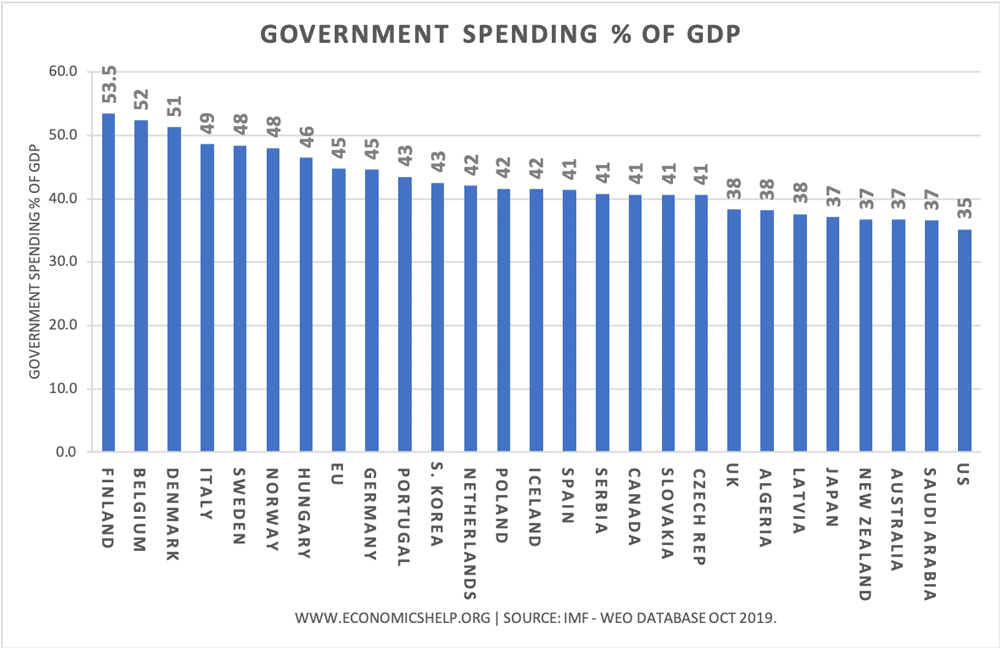
Moreover, people understate the structural challenges in the US that can’t be solved by money. If we just enacted universal healthcare (Medicare for All) our total government spending would jump to 50% of GDP, higher than Sweden or Norway. (And that’s not even adding in free college, etc.)
https://www.politifact.com/factchecks/2020/feb/26/bernie-san...
that part is absolutely a zero sum game.
now once you start adding in the rest of the plan the costs go up but that is a result of actual improvements in benefits (a good thing).
when I said worst case I was picking from studies unrelated to bernie's platform that showed an increase vs current system projects spending but it was modest. 700 billion/year in additional costs beyond what bernie has accounted for. and that is using the most expensive analysis I could find.
its probably not going to work quite that cleanly in reality. but the numbers are close enough that its worth it for our country to move to single payer with the additional benefits.
here is one of the sources I used to pull total costs from. most of the stuff I found personally ended up below their estimates. politifact's range is actually far less than the one I used by almost 20 trillion.
https://www.urban.org/urban-wire/dont-confuse-changes-federa...
--- this is a document i wrote up for my friends/family on the topic has all my sources and various other commentary.
https://docs.google.com/document/d/1-4-fYlRSRvtCar98APl6PzLL...
I'm not saying that it's not like that in other countries, but the big difference between the US and many other western countries, is that core services (health, education, freedom, etc.) are unfortunately so heavily influenced by private interest, that the majority of Americans end up paying more for less - while some few end up filthy rich.
And it is quite interesting - if you ever find yourself reading about some policies getting put on the table, just follow the money.
For the past 50 years, the following things have outpaced generally used inflation indicators: housing, education, health care. Basically, the inflation experienced by poor people has drastically exceeded the inflation experienced by rich people.
Incomes for our lower quantiles is often higher than countries with comparable gdp/capita. But those incomes don't translate to a comparable standard of living.
I like to pay taxes. With them, I buy civilization.
https://www.goodreads.com/quotes/17105-i-like-to-pay-taxes-w...
https://www.taxpolicycenter.org/briefing-book/how-much-does-...
This website states in 2018, the federal government spent $582B on Medicare, and $389B on Medicaid, plus all the tax exemption for employer sponsored health insurance and ACA subsidies to individual buyers, etc.
https://www.thebalance.com/fy-2018-trump-federal-budget-requ...
Defense and Homeland Security was only ~$630B or so.
Exact interest on past military spending is arguable, but those bills still need to be paid.
PS: US healthcare expenditures is similarly a complex topic. Do you include the heath insurance costs of government contractors etc?
https://www.thebalance.com/u-s-federal-budget-breakdown-3305...
> The government expects to spend $4.829 trillion in 2021.1 Almost 60% of that pays for mandated benefits such as Social Security, Medicare, and Medicaid.
> Social Security will be the biggest expense, budgeted at $1.151 trillion. It's followed by Medicare at $722 billion and Medicaid at $448 billion.
I am not saying any specific number is correct, but that 1T figure excludes military pensions and heath care excludes related research spending. Neither includes any debt payments from past spending or projections of future obligations. In the end it is actually possible to construct a number for each where federal defense spending is greater than federal healthcare spending, but again I don’t agree with such categorizations.
PS: This gets back to the oldest trick in “cutting“ spending, define a portion as something else. Similarly, define a category of taxes as “income taxes“ so you can exclude payroll taxes when talking about them.
The actual facts are in support of the posters point: https://www.abpi.org.uk/facts-and-figures/science-and-innova...
But your example is a real occurrence of abuse under the US system.
The first world has successfully encouraged the drug makers to sell their product cheaper in the third world. If you look on wikipedia drug articles you'll see the price for the generic in the developed and developing world.
https://mobile.abc.net.au/news/2019-04-03/federal-budget-201...
Main problem was being dismissed for 3 years and doctors not taking to each other.
I can see what people start going to alternative medicine.
One of the treatment options is a specialized diet. So all the crazy diet people are actually circling around valid treatment options.
Health care can be done cheaper. But when a doctor has 5 minutes, there is only so much that can be done.
> if something were to happen to me or my fellow citizen, at least there wouldn't be millions of dollars in hospital bills to pay back and there would be aid for a home to avoid ending up on the streets
Not trying to be an asshole, but that's not a description of the American system.
Personally, I was just hospitalized with a bout of diabetic ketoacidosis, probably just a day away from going into a coma. I haven’t even had to see a bill. It was 100% paid by the state and federal programs.
If I hadn’t set up insurance before going to the doctor, though, I’d have received ridiculously high bills, probably been provided less service, and it would be up to me to get it paid back. I had a situation before where I went to the ER while an insurance application was pending, and then after it was approved and I provided my info, the private hospital dilly dallied and sent it to collections anyway.
No, its not. US public healthcare spending (which in most states is the lion’s share of public welfare spending, and is also on the US is more than defense spending and is, in fact, pretty typical as a share of GDP, high as a share of taxes (because of the light US tax burden), and enormous per capita compared to other industrialized nations. Its small as a share of total national healthcare spending compared to other countries, because we have to even more private spending on top of it, and the whole healthcare system (or, rather, the literally hundreds of mutually-interfering public and private healthcare systems) is the single most inefficient healthcare delivery system in the world, but we spend plenty of money on it, just not well.
I had a friend try to adopt a baby from china many years ago (1990s). He was rejected. The Chinese thought he didn't earn enough to safely raise a kid. They were using a means test designed for US applicants. My friend lobbied to explain all the things he gets in Canada for free, health care being the big ticket item. The Chinese authorities relented and he was allowed to adopt.
My company would happily hand our insurance premiums over to California in return for not having to deal with sleazy insurance dickwads.
So where would the discrepancy in accounting between that and Canada come from? It seems unlikely that the Chinese government would assume that even Americans buy health insurance retail.
They aren't assuming anything. They know that healthcare in the US is hit-or-miss, that it is normally for people to move between having and not having healthcare throughout a lifetime.
>> The new report highlights that 5.5% of children under the age of 19 were uninsured, largely because of a decline in public coverage.
https://www.census.gov/library/stories/2019/09/uninsured-rat...
1 in 20 American kids are uninsured, not counting the undocumented who don't answer the census. That's ridiculous today but it was even worse in the 90s. That's why the Chinese didn't want to give kids to non-wealthy Americans. Uninsured children are almost unheard of in Canada. Only some illegal immigrant children, but even there they have systems in place.
That's a general complaint that has nothing to do with insurance being a cost you pay out of your take-home salary in the US.
Your anecdote seemed to be predicated on an accounting difference between the US and Canada, that the Chinese supposedly didn't know about. I'm saying that doesn't really exist. The sort of people who adopt would have a job with insurance, but the price of the insurance would not be included in their salary.
In my lifetime, I have been uninsured, insured by my employer, on an ACA (Obamacare) plan, etc. But never been in the situation where I was making a good salary and paying full price out of it for a health insurance policy, like people do with car insurance. Nor have I ever known anyone who did. Of course, somebody probably has, somehow, but it's not common, let alone a norm that some government would assume.
The second group may be unprofitable with lower payments, but the insurer doesn't even want the second group, the profits are from decreased expenditures on the first group.
I’m not arguing those other conditions shouldn’t exist, but rather making the weaker, more limited argument considering “given the arrangement of the insurance market as it exists today, what should the price for that insurance offer be?” In other words, “What should a for-profit insurance company do, acting on their own and immediately?” because I think that’s pretty close to the question they’re facing when setting pricing for individual plans.
I think you’re arguing that perhaps health outcomes should not be funded by private for-profit insurance companies and I’d agree, but while it is, this outcome seems grounded in actuarially sound math.
Is Y’s behavior being on average healthier and therefore less costly to insure?
5.5% of children under the age of 19 were uninsured
Most employers in the US subsidize healthcare, but employees still pay. You usually pay X if you are single, a bit more if you are married, and ~2.5X if you are married with children. Each company has negotiated it slightly differently and it also depends on the specific plan and the state you are in.
but that is not all.
You also pay a co-pay ($15-$50) per visit to a doctor and a co-pay for many prescription drugs. In NYC, a pregnancy with my diamond healthplan cost ~$10k
You also pay a deductible (can be $0 to $5000 or more) where you cover the first $X of the annual payments.
Finally, depending on the state you are in (some allow it, some do not) you also pay balance billing. Basically, the hospital/doctor comes up with some surprise figure of how much you owe, they subtract what insurance paid, and you owe the rest. Usually it is nothing. In the case of more complicated things like surgery, it can be thousands.
I only heard of startups doing this. Outside of that you pay x % for healthcare per paycheck the employer covers some other amount. Healthcare might not be socialized but at least I can always find a new provider if I absolutely wanted one just pay out of my own pocket is the only downside. The subsidizing happens for bigger corps usually and negotations between healthcare providers vs insurance companies. The more clients you have the more effective the negotiations.
It is similar in other European countries (at least as far as I can tell from a cursory search showing that sources can’t really agree on what the highest marginal rate is).
I would be interested in seeing a chart of gross to net income and effective tax rate in different countries but this is hard (eg do you count employer payroll taxes? Do you count removal of state’s benefits that might not be used anyway? How do you deal with countries that have more complicated systems with eg deductions or allowances based on personal situations?)
All that said, I think the post you’re replying to could just mean “approximately half,” ands I think 40% would fit that description.
in the U.K. the max marginal income tax rate is 45%
I think income tax was even higher during WW2, but that's pretty much a special case.
[1] If you're paying £15,000 a year in council tax, you must have some kind of gigantic property whose maintenance costs would dwarf that figure anyway.
My effective rate is actually 40%, not 50%. (although this doesn't include VED, fuel duty, insurance tax, alcohol tax, tobacco tax, flight taxes, VAT or any of the myriad of little taxes here and there)
Depends on where and depends how you're counting it.
In Ontario, Canada, and I'm not an accountant so very approximately based on GoC website:
At ~~$150k CAD you are at 29% federal + 12 % Provincial tax.
On anything you buy though you get another 13% VAT
So now we are at 54%, plus CPP and EI.
Plus any other taxes - property, land transfer, etc - overall it's well above 50% for what would be ~100k USD
https://www.taxtips.ca/calculators/basic/basic-tax-calculato... is a good resource - it shows that your effective tax rate in Ontario on $150k gross is 30.3%.
You probably also contribute 18% to your RRSP on that huge salary, which drops your effective tax rate to about 27.4%.
Also, you aren't paying 13% VAT on everything you buy - lots is exempt like food and your mortgage/rent. Even if you spend every dollar of your net income, VAT is probably closer to 8% of your total net income (which is 72.6% of your gross, so 5.8% of your gross going to VAT).
CPP and EI total $3754 in 2020, so that's another 2.5% total.
So that's a total of 35.8% tax on your gross salary. Also note it's much less if you have any common deductions, like children, dependents, education expenses, etc.
Top income tax bracket in BC in 2013: 43.7%
Top income tax bracket in BC in 2014 and 2015: 45.8%
Top income tax bracket in BC in 2016 and 2017: 47.7%
Top income tax bracket in BC in 2018 and 2019: 49.8%
Top income tax bracket in BC starting in 2020: 53.5%.
I believe that there have been similar effects in ON from increases & new brackets, on both the federal and provincial level.
[1] https://twitter.com/cperciva/status/1229900065726054400?s=21
2015 top bracket: "over $151,050"
2019 top bracket: "over $205,842"
So anyone anywhere near that bracket, despite the increased percentages, is probably paying less tax overall.
Again, this is a rough rule that’ll typically be personally conservative, not a precise calculation.
The problems in this country, including the mess that is the tax system, cannot be solved by snarky comments like "donate your money if you think taxes are too low." They require a longitudinal and deep response.
So how does Germany pay for its expansive welfare state? It has a 42% bracket that kicks in at 57,000 euro. In California, the marginal dollar income tax at that level is just 26% (federal plus state). It also has a 20% VAT. In both Germany and the US, the vast majority of income is earned by the bottom 99%. In the US, we don’t tax those people enough.
(Or we tax them what they want to be taxed. I can’t help but notice that while half the country wants European-style social services, nobody is proposing European-style taxes on people making under six figures, or a VAT. Even Sanders promised not to raise taxes on people making below $250,000. The math just doesn’t work. Americans—the bottom 99% that makes 80% of all income—have chosen to be taxed less than Europe in return for less social services than Europe.)
There's plenty of analysis out there showing how the very wealthy in the US pay less effective tax than middle class families. That's not "empty rhetoric". It's a genuine problem and something we should be trying to solve.
Anyone who thinks that low tax rates on wealthy people isn't a problem should also read "Moneyland" by Oliver Bullough.
As to the “very wealthy”—Tim Cook’s tax rate on his $135 million bonus a few years ago was 52%. The people you’re talking about aren’t even ordinary wealthy people: CEOs, movie stars, and the like. What you’re talking about the Warren Buffets of the world that make money through investments. But there’s just not very many of those people. The IMF estimates the global cost of individual tax avoidance at $200 billion per year: https://www.imf.org/external/pubs/ft/fandd/2019/09/tackling-.... Say half that is attributable to the US. That’s about the same as the cost of the deductions for mortgage interest and local property taxes.
Federal, state, and local governments tax more than $5 trillion annually. One party is proposing new spending amounting to several trillion more annually. In the face of those numbers, talking about $50 billion or $100 billion issues with respect to the taxation of the very wealthy is indeed empty rhetoric. You hear a lot of talk about billionaires this and billionaires that. The total income of all billionaires in the US is $130 billion, or about 1% of all income. It just doesn’t matter very much what the tax rate is on people who comprise only 1% of the tax base. Spending 90% of your time talking about tax issues that could fund at most 10% of your proposed new spending is empty rhetoric. Meanwhile, German levels of taxation on the middle class, and a German-style VAT would raise trillions annually. Guess why nobody talks about that.
Capital gains is 20% federal plus state (13% in California)
This is the kind of selective data that makes this subject so infurating to argue about. I'm sure this fact is true. But what you're trying to imply is that Tim Cook's overall tax payments were very high, and that's not remotely true at all! A bonus is one of the few bits of income he has, in fact, that is taxed as routine "income" that the rest of us pay. Almost everything the guy makes is in long term assets, and those are absolutely not taxed at 52%.
Tim Cook shouldn't pay a lower tax rate than I do. And while I don't have numbers for Cook specifically, I'm pretty sure he does. Everyone in that world pays less tax than I do. And they shouldn't.
Most economists agree that capital gains should be taxed lower than ordinary income, which is why most developed countries including social democracies have preferential capital gains rates.
And again, why do you care about the taxation of the super wealthy so much? Even if we taxed capital gains at the level of Denmark (9 points more than California) would raise less than $70 billion a year. Even Warren’s completely bonkers wealth tax (which would have had a top rate four times higher than Sweden did before it got rid of the wealth tax) would have raised only 10% of what Warren was proposing in new spending. Why spend so much time talking about a potential source of revenue that would do so little to actually increase the government’s ability to provide social services—even if we taxed the wealthy far in excess of European countries?
It’s as massive effort in deception. People don’t want to put their money where their mouths are. They want Medicare for All—but only if someone else pays for it. If proponents of these social were forthright in asserting that wealth taxes or whatever would only pay for 10%, and European-style taxes on the middle class would be required to pick up the rest of the tab, support for these proposals would evaporate: https://www.cato.org/publications/commentary/millennials-soc...
> When tax rates are not explicit, millennials say they’d prefer larger government offering more services (54 percent) to smaller government offering fewer services (43 percent). However when larger government offering more services is described as requiring high taxes, support flips and 57 percent of millennials opt for smaller government with fewer services and low taxes, while 41 percent prefer large government.
For what it’s worth, I’m pro paying higher taxes. I’d be happy to pay what people in Germany pay at my tax bracket. But only if middle class taxes also go up. Otherwise, there is no point—we won’t be able to tackle the big ticket items like universal healthcare without the trillions in revenue we could raise through a 10% VAT, a 10% payroll tax, etc.
This is always the retreat: "OK, taxation is unfair, but you can't prove there's a problem so it doesn't really matter, does it?"
I say: taxation is unfair, and we should make it fair instead of constantly trying to justify the fact that the very wealthy (who are, relative to US society, wealthier than they have ever been and getting steadily wealthier) are paying less tax than you or I do. Let's start there.
To wit: why are you so invested in the regressiveness of current taxation policies? Shouldn't you at least accept that we should make it fair?
If it was fair, maybe you'd have an easier time convincing the hippies not to try to pay for your health care or whatever.
Beyond that, taxes are just a means to an end. I accept that taxes are necessary for providing social services. So I find it extremely disingenuous to focus so much on a potential source of tax revenue that won’t cover 90% of what we need to provide universal healthcare, etc. I find it disingenuous when people like Warren talk about Medicare for All (which by her own math will cost $30 trillion over 10 years) and then spend the rest of the speech talking about wealth taxes (which by her own math would raise only $3-4 trillion over that same period), and then also promise not to raise taxes in the middle class. It’s rank manipulation: you’re trying to make voters believe we can pay for these services through higher taxes on the rich, and burying in the fine print the fact that the middle class will have to pay 90% of the bill. (This manipulation also undermines the prospect of us ever getting universal healthcare, because no real plan can achieve that without the massive middle class tax increases you’ve convinced voters are unnecessary.)
The motivation seems to be more focused on taking money away from certain people (because “the billionaires shouldn’t exist” or some such tripe), than raising the money we need to pay for social services people supposedly want, and figuring out how to do that with minimal distortion to the economy. I think that’s a toxic brand of politics. It’s also a departure from what other developed countries are doing. Economists agree that the most efficient sort of tax is consumption taxes, which is why every OECD country relies heavily on VAT. (If our taxation profile was the same as Spain’s, payroll and consumption taxes would go up $2 trillion per year, while income taxes—paid mainly by the rich—would actually go down $1 trillion per year.) So this rhetoric seems both spiteful and empirically unwise.
> The motivation seems to be more focused on taking money away from certain people
I straight up told you what my motivation was, and it wasn't that.
Why? There just too few people in that echelon for higher taxes to make a dent.
So one might think these pushers of more social aid might realize, "ok we have to raise taxes on the middle class to get the funds we need... and introduce a national sales tax (VAT) that everyone, even the poor, must pay."
Do they say that? Do they come to that conclusion?
No, they imstead promulgate ideas such as wealth ceilings: anything you earn over 100 million is taxed 100%. There can be no billionaires.
> No, they imstead promulgate ideas such as wealth ceilings: anything you earn over 100 million is taxed 100%. There can be no billionaires.
I'm sorry... who is saying this? This isn't a serious policy promoted by anyone that I'm aware of.
https://en.m.wikipedia.org/wiki/Maximum_wage
The history section is particularly interesting especially the recent history. I hear this talk all the time on social media.
> Bezos currently pays less tax than I do, and he should at least pay that much, right?
I don’t know your earnings, but let’s assume it’s under $1M annually. I do not believe you pay more in gross taxes than Jeff Bezos. If you paid more, you would likely have $0.00 remaining. What is your source for how much tax he pays? It is likely in the millions.
When Buffet for instance says he pays less in taxes than his secretary he means a a percentage of his total earnings.
I disagree, most wealthy EU citizens I know said they wouldn't mind being taxed more.
Because capital gains, ironically, do not apply to gains in capital assets. They have to "realize" the gains as "income", usually by selling the asset. So a millionaire (stockholder) can become a billionaire without ever paying a cent in capital gains tax. Only when they sell the stock is it subject to taxation.
This allows them to pay tax selectively. Even if they want a chunk of money all at once, they can take a loan against their capital assets. There is no income realized when taking a loan. They then selectively sell stock to pay down the loan, preferably in years when they are taking a loss in some other area, nullifying the taxable gain on the asset sale. Such tricks are why, for billionaires, paying capital gains tax is basically voluntary.
You can grow your wealth without virtually no taxable income. It's real wealth - you can buy houses and yachts with it - but you don't need to pay tax unless you choose to.
In reality most money at this level is made by speculation, and speculation is spectacularly under-taxed.
For example Forex trading in the City of London moves $6.6 trillion of money around, every single day. A Tobin Tax of 0.1% on that would raise $2.5tn a year - which would almost instantly wipe out the UK's entire national debt.
Of course you'd lose some transaction volume - you might earn "only" $500bn - but the principle remains. A lot of economic activity isn't taxed at all, mostly to the benefit of the rich. This has huge effects on the quality of life of most of the population.
There's a principle you won't find in econ books, which is that in an industrial economy basic maintenance spending isn't optional.
If you don't pay for good education, you pay for it in lost economic activity. Likewise for infrastructure. And health care.
The idea that these are somehow nice extras that the population shouldn't expect because they're "too expensive" is so wrong it's borderline insane.
Everyone pays anyway. You may as well organise this properly so the work gets done and prosperity increases, because the alternative is instability, loss of opportunity, and ultimately a real risk of complete social and economic collapse.
Traders can just move money to other trading system, e.g. futures, or they can just stop trading and instantly gain $2.5T a year in saved taxes, which is equivalent of UK's entire national debt!
If you want to capture these $2.5T, you need to close borders and tax these traders physically, one by one, like Soviet Union, China, North Korea, etc.
Apples and oranges comparison. The US government is fundamentally different concept of national government. Between healthcare and the military, US per-citizen spending it far beyond, as European examples, Germany (more than double). In short, the US has to tax more because its government is so much bigger. Add to that the greater wealth disparities in the US, taxes on US rich need to be higher if the US ever wants to climb into the black.
Germany: 399 billion / 83 million people = ~$5,000/person/year
US: 3.8 Trillion / 328 million people = ~$12,000/person/year
It seems reasonable to point out that there’s another direction we could go to solve that imbalance. (Could be across the board or in certain categories.)
>US: 3.8 Trillion / 328 million people = ~$12,000/person/year
Apples and oranges comparison. The US subsidies most EU militaries. NATO spending is a great example. US is the only member who actually fulfills their obligations.
Basically GP is more right than you
If everyone gives more money, we can actually make things better.
I am willing to pay more taxes if it actually helps, which is why I will only give more when we make everyone give more.
Some people believe that giving less = actually make things better because it will limit the bad things a government can do.
When it comes to healthcare, the vast weight of the evidence supports strong government intervention in healthcare. When examples of profit driven healthcare exist, the vast weight of the evidence would lead you to conclude that it is less efficient and more expensive, delivering worse outcomes for higher cost.
on edit: changed libertarians to Randians.
I was just arguing against the idea of 'you just pay more taxes if you want to' being a solution.
I will only give more when we make everyone give more
Only government legislation is working. It is people pushing for it, but they still mostly have the same mentality of "I will only do X when everyone does X".
Public health is not a panacea, although I’m happy for the people who get a good deal out of it.
In US, poor people are seen as worker bees who just get enough to live and have an illusion of freedom.
But then I think of stories like this, and how easily it could have been me with an illness requiring expensive medical treatment and possibly preventing me from working regular jobs.
And so I pay my tax with pleasure, knowing that if something were to happen to me or my fellow citizen, at least there wouldn't be millions of dollars in hospital bills to pay back and there would be aid for a home to avoid ending up on the streets.