This is why you have the seemingly incongruous effect of high taxes encouraging growth and low taxes stifling it. Ultimately "high taxes" tend to effect the rich a lot more than the poor, and the money ends up being redistributed somewhat equally, spurring demand as the poor can suddenly afford a lot more good and services.
There isn't an idea that alone "capital drives growth," that's an idea that Keynes came up with by misreading Jean-Baptiste Say. Paraphrasing him to say that "supply creates its own demand," which we all know is nonsensical, but that's not what Jean-Baptiste Say was saying. The idea is far more complicated than your simple explanation offers, though I sympathize with your view (though, at least the second paragraph is almost entirely wrong), it is narrow in its scope to the study of economics.
This is an alien concept to many people and economic policy makers. See the parent article. They report on a capital glut, but are puzzled that it exists. The Fed keeps pumping capital into the economy in hopes it will fuel growth. But pumping capital into a capital glut doesn't do much.
Look at Japan since 1989. Japan hit this about two decades before the US did. They never really figured out what to do about it. That's discouraging, because if Japan had a solution, we'd have a success to look at.
So nobody really knows what to do about a capital glut and a demand shortage.
Back in 2013, HuffPost ran an article pointing out that had minimum wage kept up with inflation, it would be $10.50/hr and actually more like $21 if it had kept up with productivity growth [0]. That, of course, assumes that the original minimum wage rate was set reasonably, but I can promise you that few people, save some well-educated counter-cutlurists, can live on $7.50/hr these days. And even if they could, they wouldn't really be spurring demand in the greater economy.
[0] http://www.huffingtonpost.com/2013/02/13/minimum-wage-produc...
But there's definitely a need to reduce poverty. And there's a need to allow ourselves to stop working as hard as we do. A basic minimum income would help accomplish these things. Where do we get the money from? It doesn't really matter, there's plenty of it sloshing around. As Charlie Munger said:
“This has basically never happened before in my whole life. I can remember 1½ percent rates. It certainly surprised all the economists. It surprised the people who created the life insurance industry in Japan, who basically all went broke because they guaranteed to pay a 3% interest rate. I think everybody’s been surprised by it, including all the people who are in the economics profession who kind of pretend they knew it all along. But I think practically everybody was flabbergasted. I was flabbergasted when they went low; when they went negative in Europe – I’m really flabbergasted. How many in this room would have predicted negative interest rates in Europe? Raise your hands. [No hands go up]. That’s exactly the way I feel. How can I be an expert in something I never even thought about that seems so unlikely. It’s new territory….
I think something so strange and so important is likely to have consequences. I think it’s highly likely that the people who confidently think they know the consequences – none of whom predicted this – now they know what’s going to happen next? Again, the witch doctors. You ask me what’s going to happen? Hell, I don’t know what’s going to happen. I regard it all as very weird. If interest rates go to zero and all the governments in the world print money like crazy and prices go down – of course I’m confused. Anybody who is intelligent who is not confused doesn’t understand the situation very well. If you find it puzzling, your brain is working correctly.”
Simplified primer by Joseph stiglitz.
http://huffpost.com/us/entry/world-economy-2016_b_8908560.ht...
Really? There is nothing you could improve in the human condition that would make life better?
The world isn't static.
In pure economic terms, curing cancer has little benefit to society. Cancer is not any one specific disease. It's a class of diseases, of which there are thousands (or more) of variants.
We may stumble on some amazingly technologically advanced cure to some forms of cancer but the more rare the form, the less likely there will ever be a treatment.
Most people get upset when you talk about humans as assets because we're indoctrinated at a very young age to value human life above all else.
If you can, in fact, speak about humans in economic terms of supply/demand. We have an overabundance of people, and nothing useful to give them jobs to do.
It's like the current oil market. Oil was highly valued due to the inelasticity of supply. Now that there is a glut of over supply and inelasticity greatly reduced, the value has dropped dramatically.
The supply of humans capable of doing useful work used to be somewhat constrained. Now, we have more people than can be reasonably assigned to do useful work without essentially paying them to warm a chair. Yet, like the oil market nothing is stopping people from having more kids and increasing the supply. The government even directly subsidizes people for the number of children they have due the persistent belief that GDP is directly dependent on population.
People can increase their value proposition by earning many degrees and racking up huge amounts of debt but, unless you're going to work in the industries that are thriving, it's a buyers market for employers.
Business owners have their choice pick of the herd. They can keep wages as low as possible and skim more cream off the top because there's a line out the door of people waiting the replace a worker who quits.
Who knows, maybe this is just the supply limit (ie in environmental science terms) as it applies to the human population. Poverty and misery is the expected result of making too many people before we can come up with enough useful reasons to sustain them.
One counter to this argument is that as this process of overpopulation (relative to useful jobs) begins to happen, standard of living decreases.* As standard of living decreases on average, people start to have less children. So the imbalance is somewhat self-correcting, it's just that human lives are getting to be longer while the time between inventions that obviate the need for human labor seems to be getting shorter.
Longer average lifespans (with the same legal retirement age for social security, medical benefits) exacerbate this problem.
But there is always one industry that can be fueled by human lives and that looks great on an economic balance sheet - war. It decreases surplus labor, increases nationalism and social cohesion (if people generally see the necessity of the war), and injects a huge stimulus of demand into the economy through gov spending on all sorts of goods for the war effort, as well as investments in R&D that adds to the country's infrastructure base.
If the latency between idle/restless/poor/disenfranchised population and meaningful/useful jobs gets to be too large, then all it takes is a spark to start a protest, rebellion, or war as people have nothing else to really live for.
* I would use GDP/capita to have a more quantifiable benchmark, but I find GDP to be almost completely useless when accounting for things that matter to actual human beings such as quality of social cohesion, potential social mobility, amount of pollution, etc.
That seems counter to all actual evidence doesn't it? The places with the poorest standards of living have the most children and visa verse.
We actually have some pretty good existing examples to draw from to conclude this. Japan has arguably the highest standard of living, but also a decreaseing birth rate.
Women in Australia and America are having children later in life, and having fewer of them as well.
Meanwhile in developing countries where access to birth control and education are more limited, birth rates are sky high.
Production does not fund other things, and disease cures are not something that people willingly buy. Excess production just wastes resources on things people do not want to buy (unsold automobile inventory, etc.) and is enabled by access to too much speculative capital. Redistribution of that capital (in the form of higher taxes) into government-mandated and funded research programs to find cures for cancer is how you find a cure for cancer. Disease research in the United States is not funded by pouring water on your head (http://www.nbcnews.com/health/health-news/ice-bucket-challen...) or Tim Ferriss (https://www.crowdrise.com/timferriss), but by the $30 billion budget of the National Institutes of Health.
The person you replied to said "production isn't the problem, distribution is", and you seemed to agree with that in your comment. Getting poor people cars and houses and services isn't a production problem, it's a distribution problem. It's a pricing problem. It's an efficiency problem. Producing more cars isn't going to make them easier for poor people to afford.
And even when they do overestimate demand, like you said, it gets marked down. So it all gets consumed in the end, and the producers might not even take that big of a loss depending on how much it was marked down. And the poor people benefit from that too of course.
Unless people start throwing away new cars then they aren't over producing.
About throwing away new things - heard of planned obsolescence? That's what companies now do to cope with falling demand. Yes, your car maker does it too.
I don't actually think they are overproducing. They make a huge markup on new cars, so having to discount a few that don't sell isn't a loss.
Also factories are pretty much large fixed costs. Overproducing actually doesn't cost that much. The car might only cost $500 worth of raw materials, but the cost of the factories and infrastructure necessary to turn that into a car is massive.
>(aka. no one wants to buy the last few carrots)
Which is literally only true for vegetables, not the economy in general. And you only need to sacrifice a handful of vegetables to for it, so it's a fixed cost.
But just because we don't overproduce right now doesn't mean we couldn't if we wanted to. I'm still not seeing where production is the problem. If production was the limiting factor, they would be running the factories 24/7 instead of shutting them down. The only reason to underproduce is to increase demand. But if you lower supply and demand doesn't increase, you've already been overproducing. So if they're closing factories, it means they've been overproducing.
Which was done just after a recession. That's not evidence of overproduction in general, just one year when demand unexpectedly went down.
>But just because we don't overproduce right now doesn't mean we couldn't if we wanted to. I'm still not seeing where production is the problem. If production was the limiting factor, they would be running the factories 24/7 instead of shutting them down.
But if we can produce so many cars, why are cars still expensive? Shouldn't the ability to create massive supply drive the price down a lot?
There are plenty of people that want new cars. And are willing to pay for them. It's not like we have more cars than people actually want. It just costs a lot to make a car. And that cost includes fixed costs like the factory itself. But factories wouldn't be closing down if other costs weren't also very large.
Yes in theory we could make millions more cars than we do. But not for free. It would require buying more materials, hiring more workers, building new production lines, etc. Those costs must be greater than the expected return for selling another car. Otherwise they would already be doing it.
But again, we're talking economics right now. The subject is production. Once again I ask: you said we're limited by our ability to produce, do you have anything to back that up? And no, saying "it costs a lot of money" is not proof of a production bottleneck, it's proof that companies hire accountants.
So at this point I'm going to step away from this conversation because I don't think it's going anywhere. You've made me think a bit about economics, so thanks. Good conversation.
What I'm arguing for is on how we should look at universal basic income. Some people see UBI as a way to increase aggregate demand. I see UBI as a way to get rid of poverty, so there would be no such thing as what you call "the poor". The difference is that I don't see a lack of aggregate demand as a problem. If we could rid our society of poverty without making a dent in aggregate demand, I see that as a win.
Another way to think about it is in terms of productivity. Do we really need to make everyone more productive? Do we need to be make the poor maximally productive before lifting them out of poverty? Why can't we just lift them out of poverty?
People regularly die from starvation, but the world produces more than enough food to feed everyone. It is a problem of distribution.
There are hundreds of thousands of vacant homes in San Bernardino, there are many thousands of homeless that could easily be transported there. If those homeless were to move into those homes they would soon be evicted or arrested and imprisoned. This is an issue with ownership, not distribution. Much food from local restaurants, cafes, and grocery stores is thrown out every day as it nears expiration. Thousands of hungry would love to enjoy this food rather than waste it. This food could be donated or even left out for people to scavenge, yet it ends up in locked dumpsters. Again, this doesn't sound like a distribution problem but instead a problem with ownership.
We do produce more than we need, if need is conditioned on ability to pay.
Redistributing wealth means spreading out ownership more.
For the people with no excess of capital, though, we can improve the situation.
That's like saying "Restaurants have food, and there are homeless people in the city, so why can't we distribute the food from the restaurant to hungry homeless people in the city?".
If you were to distribute foods from the restaurant to the hungry people in the city, then these restaurants won't produce that food, because they are not a charity, they are in the business.
Similarly, if you don't figure out where this money would come from, you will soon stop seeing all this money you want to give away.
A basic income is a far better solution than our current mess of bureaucratic welfare programs that are both inefficient and rife with harmful unintended consequences for those they intend to support. Milton Friedman's "negative income tax" was intended to be a basic income until it was bastardized into the EITC.
If you don't give basic income for kids, then people with a lot of kids won't be able to live.
Of course, you can adjust the amount between the too extremes of full basic income and no basic income for kids, but just because you have a target standard of living and give the parents money to meet that for the kids, doesn't mean the parents aren't going to turn around and spend that money on themselves. They might not care that their kids are in poverty as long as they get the drugs/alcohol/new car/fashionable clothes or whatever.
As you already stated, bureaucratic welfare programs don't work, so what is the solution here?
I've never seen this discussed, and it seems like a major oversight of the basic income proponents.
You've got to search for an alternate location, consider schools, work, commutes. Neighbors. Etc.
I can see major arguments for managing rent as a social function.
Though that depends heavily on supply and demand factors as well.
Economic incentives should encourage local, suitable (even for apartments) housing in an area to be approximately equal to the number of jobs in that area (then pad up slightly for BIG if that's also an 'employer').
1) If a single mother/father only spent 1 hour a week taking care of their kid, they would surely be punished for neglect. So we are willing to literally coerce people who choose to be parents into working at least 52*18...938 hours. At a minimum wage of $5.35, that is at least $5,000 of coercion.
2) If we have a workable basic income, then someone shouldn't find themselves in the desperate position of having a medical procedure done to make ends meet unless we don't have universal healthcare.
I know of 3 small children in my own life whose parents collect welfare, and are meth addicted.
Maybe for the first 20 years of the program every child affords a parent some additional BI based on the child's age. Raising a child when health care is inexpensive(my vision of BI does include pretty much free health care), job's are optional, and schooling is free makes the most expensive times to be early in the child's life when they are constantly outgrowing their clothing and beds and using up diapers at an impressive rate.
Eventually the amount of BI awarded becomes sufficient for most family situations(Star Trek post-scarcity style) or other factors like perfect birth control allow us to remove the child BI bonus.
Imagine the minimum income for children was diverted into services. So the government buys free clothes, school breakfasts+lunches, and medical insurance. This decreases the cost for a poor family to raise a child which allows you to give less money per child, and reduces the incentives for child farming.
This sounds like the edge case a non-parent would bring up. People who make poor life choices make them for far less insightful reasons that time-value calculus.
It would take an unbelievable amount of money for me to have another kid. It would be cheaper to buy my retirement.
A living wage means just that: what is required to support a worker, their family, including children, and educate them, to provide the next generation of workers. Adam Smith discusses this at length in Wealth of Nations (Book 1, Chapter 8: https://en.m.wikisource.org/wiki/The_Wealth_of_Nations/Book_...)
You'll find other examples in Richard Meier, Science and Economic Development, 1966, dating to California during the Great Depression.
China has for years done intense injections into its economy (both top and bottom down), with worker training programs, state owned enterprises, etc; and now they became so reliant on the artificial demand created by their own government that they have huge slack in inventories. There's a reason why copper/steel/oil are plunging.
There aren't many, if any, examples of "demand drives growth" working in a long term situation. In the short run economies simply need to work out their gluts, and slack. Famously coined "creative destruction," the unhealthy aspect (especially after Keynes) is that growth become a policy goal rather than sustainability in that growth. To this Keynes said "in the long run we're all dead," putting short term growth into focus of government policy makers rather than long term growth which often requires negative GDP growth and recessions.
Anyhow, you're also mischaracterizing the Chicago School and Milton Friedman. There is no claim that you can "never run out of demand." And the "freshwater school" is about discretionary policy of government policy, not whatever you just tried to say. This is one reason why Friedman was fond of the "Friedman rule" or the "K% Rule," because it took discretionary powers away from the Federal Reserve. The idea is that with rational expectation of monetary growth the market can set its expectations to not be prone to monetary policy failures. The same is true of government failures. The idea of "market failure" is a criticism, but the Chicago School doesn't deny market failure exists, only that the government should have a limited discretionary role involved in picking up any demand slack.
If the government bought wheat, for instance, to keep its price high and keep farmers employed; then burns it, this creates asset misallocations, though it is technically creating demand (this still happens to this day.) A policy measure is put into place to address a problem, but instead of the market correcting to shift to different types of production it continues its course and creates slack in other areas (such as too little corn, or soy.)
This has been done successfully but without the burning. Just keep the price stables buying when the price fall and selling when the price goes up.
The idea of a buffer should be easy to understand here in HN. It can be done with all kind of things: http://bilbo.economicoutlook.net/blog/?p=23578
This "creative destruction" doesn't look very rational, don't you think? Is it not the goal of an economy to provide a good life for the human beings in that economy?
We should be able to do better than destroy capital in order to start again the game, but this time with less people owning more of the pie.
And there is no need for the government to be involved in that either. If there was really predictable price fluctuations between years, investors could make money buying up commodities on good years and selling during bad years (and they do.)
I just said that it have been used successfully as a way of buffering prices, without the need of burning anything, in comparison to this "creative destruction" that he sees as necessary.
The comment I was answering, talked about a government buffering mechanism as something wrong and destructive (burning real wealth). I just pointed that this kind of mechanism is not necessarily destructive.
In the next paragraph he proposes that the only way to go out of recessions is the "creative destruction" of capitalism. This is effective destruction of real wealth. It seems, that if the markets decide to destroy real wealth, then it's OK.
My answer was only about that and I was not saying that the buffering mechanism created demand.
Interestingly enough, even if I was not claiming anything about that before, there is a buffering mechanism that would create demand, and keep inflation in check: Job Guarantee as a buffer mechanism of jobs.
http://www.epicoalition.org/docs/buffer_stock_employment_mod...
I am not totally convinced about the idea myself, but I think it deserves more attention
Of course, this can be done not completely blindly, by investing 10 to 1 with existing investors, or providing a guarantee to return 50% of lost capital, or having milestones companies need to hit, or have experts in the field provide "votes" toward getting higher levels of funding after examining their progress so far.
At better approach to stimulating demand would be to offer a cash prize or a guaranteed purchase contract for specific innovations that meet defined criteria. For example, what if the US federal government offered to purchase 10 million doses of a 90%+ effective Zika virus vaccine at $100 per dose? I'll bet that would encourage private investors to take a gamble.
The Chicago School has always been quite diverse, from its early days with Frank Knight, Jacob Viner and Henry Simons to later periods of law and economics, new institutionalism and other tendencies.
Saltwater/freshwater came about because of a dispute in the dominant neo-Keynesian macro at the time (which both sides subscribed to) regarding the IS-LM model and the Phillips curve unemployment-inflation trade-off. Naive expositions of IS-LM had ignored the money demand function, which Friedman pointed out and ended up kickstarting the monetarist controversy. Phelps and Friedman also discovered a flaw in the absolutist Phillips curve and augmented it for rational expectations in 1968, destroying its former validity and anticipating the ensuing stagflation. This influenced Barro and Lucas to start the rational expectations revolution in macroeconomics, but it ended up being taken overboard to model always-clearing markets and other perfections.
Make no mistake, though. Both sides were operating in the same general framework. Most Chicagoites absolutely did not deny that there could be aggregate demand shortfalls. They were mostly Keynesians like the rest.
The connective tissue is that in order to think that, it helps if you think there's untapped demand constrained by monetary policy.
At the margins, the cost of additional production is so low that there are multiple deflationary pressures even if everything looks normal.
The basic Market Monetarist ( the intellectual sons & daughters of Friedman ) stuff these days is quite interesting. It's very little fun because there's nothing to it to where you can have a "program" - either spending or austerity - to fit the ( lack of ) ideology[1]. So policy makers aren't interested. My favorite Monetarist - Scott Sumner - gets dismissed by such as Paul Krugman, saying that the stories are too hard; that's the politics are wrong[2]. It's not an assault on it even; just a dismissal. Very enlightening.
[1] which is in itself an ideology with certain blinders on - one I ascribe to, unfortunately.
[2] which I think means it has no politics and resembles control theory too much. If everybody can buy the Monetary Policy expansion pack for MATLAB and check the economists' work, there won't be any economists beyond a level....
I believe this is a phenomenon captured by the term "Pushing on a string."
These schools differ in their analysis of the business cycle, that is the fluctuations around equilibrium output that are called booms and recessions/depressions. Saltwater economists believe that you can have too little/too much demand during booms/recessions. These are generally called "out of equilibrium" conditions. Neither group claim that in equilibrium, you can run out of demand.
Source: I have a PhD in economics.
EDIT: also see vezzy-fnord's answer, most "Freshwater" economists are and were some kind of Keynesian.
Instead of trying to increase demand to match supply, what if we decreased supply, like having a four hour workweek?
There is nothing wrong with a four hour work week. The reason people still work long hours is not careful engineering of the economy to keep demand high, but people's natural desire for essentials like healthcare, and also luxuries and status-signalling goods. Also hours seem to be decreasing in Europe, which has a different culture to the US.
Also, one (left-wing) colleague of mine made the following point to me when I said something similar about economic growth: Would I be happy to see the world level out on a 1920's standard of living, including healthcare? If not, why is the current standard of living acceptable? Especially when a given average standard of living will also entail people who are much worse off. So to raise the standard of the worst off, we most likely need growth for everyone.
Sure they do. The concept of "Unlimited Wants" and Thorstein Veblen's "Pecuniary Canons of Taste" pretty much wrap up a capital glut. Spend it. Money flows somewhere. A demand shortage is not necessarily permanent (horse carriages vs automobiles withstanding)...that's one of the many reasons why the word pivot exists in YC vernacular. Everyone/everything living consumes. There are demands that are fundamental, and demands that are extraordinary. A market exists for all demands, no matter how small or how large. Demands = needs small or great. If you are selling buggy whips in the automobile age, yeah, you might have a demand shortage...so think and pivot. Absolutes have a place in extremum; an exercise left to the reader.
Then with that tax you re-invest in infrastructure, exploration of new resources, and even missions to space. (I'd rather we have a (robotic) mission to the asteroid belt than mars...).
How is it not an idea and an idea simultaneously
Does it? Maybe I'm just cynical but the idea of raising taxes on the wealthy sounds to me like just moving money from one set of rich white guys to another set of rich white guys. I vote one of them in to power at the local elementary school and the other every time I pull out my wallet. I'm not really convinced that either group as a whole spends their money more responsibly.
If we already had a social safety net reform in place, knew how much it was going to cost, and then pushed for higher taxes in order to directly fund the new safety net, that would be different. I think that's what PG meant recently when he said something along the lines of 'focus on poverty, not on income inequality'.
PS: One of the odd things is just how poor people used to be. Work minimum wage for 1 week and you can avoid starvation for ~1 year. Yet, people used to regularly starve.
Remember historically most people where poor by our standards. Yes, the things that survive where of high quality, but a lot of junk did not make it. Consider what a 'sod' roof meant. https://en.wikipedia.org/wiki/Sod_roof#/media/File:Norskfolk...

Now picture such a thing without modern materials to keep dirt from falling on you. Granted, the floor is often hard pack dirt anyway and done well it's ok. But, again poor and minimally trained.
PS: Sure, if you where rich or competent you could go beyond that standard and there was plenty of high quality stuff made. But, the average farm house, private trail, foot bridge etc... was crap.
I live in DC and if there's one thing government spending does, it increases the number of Lamborghinis on the road. A lot of the new money around here comes directly from government defense spending going to consulting firms which has a strong tendency to make the rich even richer.
The focus on income tax creates a situation where the person who makes $200k/yr but has a net worth of $0 gets taxed far more than the person whose investments bring them $100k/yr and they have a net worth of $2,500,000.
Oh, and their lifestyle might be about the same despite the disparity in income, because one of them needs to work for a living so they'll need to live somewhere close to jobs, pay more for transportation, etc.
Higher income tax is great, if you're already wealthy. If I was wealthy, I'd be very happy people if stay focused on that. But I think taxing accumulated wealth is a much better way of leveling the playing field over time and also making sure capital stays in productive use. France already has something like a 0.5-1% "solidarity tax" on wealth, and it's a progressive tax.
According to Piketty, the return on capital has historically been around 5% per year, and returns are better at scale. For multi-billion dollar funds, the rates are around 9-10%. The "Financial Independence/ Retire Early" people who plan for pessimistic scenarios say to expect 4% return. Let's say it's reliable to expect 2-3%.
At $10M a person can expect about $200-300k in income. If we have a wealth tax of 1% their investment income after taxes reduces to $100-200k. If they want to maintain their previous standard of living, they need to make about $100k per year.
At $100M let's say economies of scale start to happen and even in a pessimistic scenario you can expect a 4% return. If we have a 2% wealth tax at this point, the person can still expect an investment-only income of $2M per year.
You can see where this is going. At $1B with a 5% pessimistic return, 3% wealth tax, $20M investment income. At $10B with a 6% pessimistic return, 4% wealth tax, $200M investment income.
The nice side effect of this is that the mere scale of capital doesn't provide competitive advantage. The wealth tax should be designed to even out the advantage of scale so that larger accumulations of capital need to be put to best use.
Putting some numbers on the napkin... The US has an aggregate net worth of $85 trillion dollars. The federal budget is $4 trillion. Assuming a power law distribution of net worth, let's guesstimate an average 2% tax on that $85 trillion, which comes out to $1.7 trillion. We could roughly cut income taxes in half or eliminate them except at very high levels ($1M+) if we used a wealth tax instead.
The important thing to note here is that the wealth tax still leaves about 2% investment income, it doesn't reduce the total over time. I think it's great that people can accumulate wealth and then live on it, or pass it on to the next generation. But it would be great if we can keep the income at around 1-2% so that the nearly guaranteed increase in accumulated wealth is the same or less than the growth rate of the economy, meaning that people who build businesses today have the ability to reach the same heights as those who built businesses yesterday, without extraordinary luck or blunders by those with wealth.
Stocks are traded on public exchanges. Land and buildings stay in one place. Private jets need to land at airports and they each have a tail number. Most things to be sold efficiently are sold in public marketplaces. There are probably some assets that are hard to track, just like there is currently income that is hard to track. Some people are paid in cash and don't report it. A whole multi-billion-dollar black market of drugs, prostitution, etc. exists that is largely not income taxed. It happens. But in general income tax works, and a wealth tax would too.
Uh, I don't see how that follows. Sometimes "it is not feasible" is first objection simply because it's the easiest to articulate and support.
I mean, not everything is equivalent to a proposal to, say, kill all the poor: https://www.youtube.com/watch?v=owI7DOeO_yg
If you did this you would not need a very high tax rate (my guess is something around 1%) and it would encourage efficient allocation of assets. Of course the owners of all these assets won’t be happy and since they are very powerful this idea has zero chance of ever being adopted.
For the intangible things I would say that an open bidding process every census period would be a good way of judging what the market thinks it's worth. Adjustments might be necessary for changes in the constitution of an asset. (E.G. There's now a building, discovered natural resource, or it's part of a different sized lot unit.) Approximations in resource description could be used to round up/down and group together the units in an area for some anonymity and consistency.
To prevent collusion in 'sitting' on an area those who own it would also be required to bid in buying it back. If they come out over the median bid then they get their land back (but are taxed at the rate they sold it for), if they don't then they can keep the land but get taxed at the 95th percentile bid rate for that area. The top 1% of bidders would also have the option of buying any asset forfeitures within that area at the price that they listed. That would also be the assessed tax value of that land for that period.
Do you mean earned income, aka labor? vs unearned income, aka capital?
If you are advocating the shift of tax burden from labor back unto capital, reversing policy of the last 35 years (Reaganomics), then I agree with you.
capital isn't unearned - it has to have come from somewhere (perhaps the grandfather generation).
Unearned income refers to income received by virtue of owning property (known as property income), inheritance, pensions and payments received from public welfare. The three major forms of unearned income based on property ownership are rent, received from the ownership of natural resources; interest, received by virtue of owning financial assets; and profit, received from the ownership of capital equipment. As such, unearned income is often categorized as "passive income".
https://en.wikipedia.org/wiki/Unearned_income
This covers the policy debate part, which you may be referring to:
Second point against a pure wealth tax: some of that wealth might be tied up in very illiquid assets (say, a castle worth €20m), meaning you might not be able to keep them because you have to pay the annual wealth tax. Or in say, art, which can be highly volatile in its valuation. This will automatically lead to disputes with tax authorities about valuations, etc etc. Not exactly fun to deal with + it's hard to enforce/verify
Given you already paid capital gains tax (or income tax) when you generated that wealth, there's also the double taxation component. Wealth taxes (at least to me) seem like a great way to punish people who are doing well.
At the end of the day, we're living in a globalised world, where borders matter less and less (at least in the west).
That said, land value tax and seigniorage seem like the best taxes on many metrics.
Isn't this an argument against real estate taxes in general, which are universally accepted? There are mechanisms to recover those taxes eventually.
I think I have a new thing to wishfully ramble about at the pub.
http://rare.us/story/memo-to-liberals-theres-no-such-thing-a...
This is the ultimate problem with 'trickle down' economics.
This is why you have the seemingly incongruous effect of high taxes encouraging growth and low taxes stifling it.
What we both want is basic income. But I'm not sure about taxing "rich" who could easily leave. Then you're not taxing the "rich" any more.
Where are they going to go? And once you come to the logical conclusion that only a few outliers will actually "leave", they will leave a void that someone will fill, and be taxed.
You're also assuming the government can just "implement" the "ideas" you have and everything will be alright. As if they really rich will give in without resistance. It doesn't work with drugs, it won't work with money. You add laws, they find loop holes, and I'm pretty sure the private sector can afford smarter people than the government. The government will be too slow and inefficient to tackle this, unless you turn into Germany BOM ;-). So now you're spending resources to gain resources, which... might stimulate the economy, sure, heh gotta spend money to make money, aye?
Jokes aside, to make things easier, imagine the war on drugs. It doesn't work no matter how much you yell drugs are bad. You can tell "tax" the rich, but as an idea it doesn't mean shit, unless you manage to implement it, which I have my doubts.
The best solutions are always the most pragmatic ones, it can be hard to see it when ones views are clouded with personal feelings. I can admit I that there are some things I wouldn't want to compromise on.. again, Germany.
I'm also suspecting you're assuming leave as in physically leaving, you're in for a surprise when you find out that the truly rich can have the cake and eat it so no one would "fill" their void if there are options, and there will always be options for someone who is truly rich.
Otherwise you just end up taxing the shit out of regular employees, some who makes higher salaries in volatile markets.
Your conclusion isn't logical. Human nature, machines, etc etc.
All the disposable income is being sucked into rents, and eventually that will make the economy run slower and slower, fewer sales to be made, businesses to close, more people to be unemployed, in a feedback loop until all the capital is held on one side of the table and there are a bunch of unemployed people on the other side who are willing to work, able to work, and want to buy things, but have no capital.
But you should state the answer directly rather than assuming it under a layer of indirection.
Most wealthy individuals aren't holding cash, they put the money in a savings account or investment that has a return. This money appears to be held to most people, but even money in a savings account makes its way back into the economy by affecting the reserve requirements of banks. Its a proportional effect, because reserve requirements are greater than 0% but lower than 100%, but it still contributes.
If they actually are hoarding, the question is why and in the past that is usually because savings returns and investment returns are expected to be negative. In which case, thats the problem to solve.
I wonder if it's something like... the average individual spends half of whatever cash they have available every year... but the average business that takes investment lets 6 to 12 months of it sit in accounts. I realize the bank would then loan against the money in those accounts, but is it "turtles all the way down"?
I'll have to refresh my understanding of fractional reserve banking, but I don't think a loan from Bank A being put into Bank B and so on can lead to infinite money supply. If I remember correctly it somehow leads to some multiple of the input money being generated. Here's a Wikipedia article about it:
https://en.wikipedia.org/wiki/Money_multiplier#Reserves_firs...
At some point all the institutions sitting on their money eventually does result in that money being sat on, and not being circulated through the economy.
Money creation in practice differs from some popular misconceptions — banks do not act simply as intermediaries, lending out deposits that savers place with them, and nor do they ‘multiply up’ central bank money to create new loans and deposits. (...)
Whenever a bank makes a loan, it simultaneously creates a matching deposit in the borrower’s bank account, thereby creating new money.
Not necessarily true, given what the yields on savings accounts have been recently. Yes, a completely rational actor will invest capital in whatever market is currently generating the highest rate of return. But people are not rational actors. More specifically, people tend to be extremely loss averse - they will go to far greater lengths to avoid a result of -$1 than they will go to achieve a result of +$1, even though the delta (a dollar either way) is exactly the same for both situations. This loss aversion only gets worse when you scale up the numbers to -$1,000,000 and +$1,000,000.
This is why higher levels of inequality are correlated with lower growth. Capital owning rentiers are entirely happy with a 2% (or less) rate of return, so long as the risk of a negative rate of return is negligible. Meanwhile entrepreneurs who can generate much higher rates of return (but with a correspondingly higher probability of negative returns) are starved for capital.
In corporate finance and equities analysis, the term "cash equivalents" includes very liquid short-term investments like US treasuries, CDs and money-market accounts.
> If they actually are hoarding, the question is why and in the past that is usually because savings returns and investment returns are expected to be negative. In which case, thats the problem to solve.
Er, no. The question is why companies -- which traditionally need to borrow money to operate -- are keeping large amounts of savings (earning positive but still very small returns) instead of increasing their capital expenditures by building factories, or writing more software, etc.
I remember some journals ( it was Financial Times or Wall Street etc type ) making the relationship case. Stating people has actually been making less money when rent is deducted.
The cost of living is high, people used to say this without putting things into perspective. Cost of Foods / Transport and Rent may be high in London, but you do get a higher minimum wages. Compared this some South Asia Countries where Cost of Foods and Transport is low but Rent is exceptionally, and there may be no minimum wages or wages are comparatively low.
Our of the all four cost of living, Food, Transport, Clothes and Home, Home takes the biggest cost percentage. More then 50%. And it happens that only Home; Land, Rent / Property prices is an investment option out of the 4, and are suspected to be driven up and down by market / monopoly / government.
The world needs to start looking into Property market and tax on its profits, both selling or leasing. As well as allowing % of rent to be deducted in tax calculation.
I strongly believe, that anyone making more then the average median income ( so called middle class ) should be able to afford to buy or rent a house, that has heating in winter and can afford a 10 min Hot shower without skimming on their entertainment like movies, and be able to have decent meals a week while making some savings. The world we are at now are having middle class passing more of their wealth into property market and their living standard aren't that much different then lower class.
Unfortunately the dysfunction in U.S. politics prevents the government from pursuing policies that explicitly buttress the middle class. What happens instead are more indirect interventions like the Fed-driven stimulation of asset prices and increased defense spending. (Both of which benefit relatively narrow segments of society.)
An economy turns not on capital but the movement of capital from one place to another (ie trade). Atm the money is with corporations. They don't actually want it. They would rather have customers buying their products than money sitting in a box. The role of government in resolving this impasse is to somehow make that parked money move again. Either take it via taxes (very difficult as the US does not generally tax assets) or get the corporations to spent it willingly.
I'd vote for a rule that would mandate dividend payouts by corporations that hoard money. Define a fixed amount that is acceptable, say 25% of net worth, and any liquid assets above that number must be paid as dividends. That will move a pile of money from corporations to wealthy stockholders, which in turn pay taxes and hopefully will spend some on products. Yes, it is a "trickle-down" approach, but I think that is the only approach the US electorate can stomach these days. Or, to avoid paying said dividends, corporations would invest in/hire people who would then pay taxes and otherwise keep the money flowing through the economy.
An easy way for demand to rise would be if wages didn't stagnate but went up with productivity. The top earners won't spend more money if you give them more. And new products won't be bought if no one can afford them.
Maybe there are tax schemes that encourage paying higher wages but I don't know.
How is the US out of demand? Peak consumption years of population are between twenties and fifties and the biggest cohort of US demographics - the millennials - is just getting started. They crossed over the Boomers last year and now are the largest group. Behind them the younger (Gen Z) equally large in size is ready to backfill in another 15 years. It is true that demand from Boomers is done, but the Gen X's are not big enough to backfill the falling demand.
With a lower tax load and no student loan payments, my economic life would be fairly different. At least a second car, definitely more travel, nicer house, more random spending, etc. When we do hiring here I'm floored by how low entry-level salaries are for people with 4 year degrees and 1-4 years of work. Hell, we opened a coordinator level position recently and got resumes for people mid-career dying for work.
I think the economic picture isn't as pretty as some stats make it out to be. x, y, and z just won't have Boomer wealth and our economy must adapt to that. Its not the end of the world, but it won't be like the Clinton years again.
Also, there's a pretty rough calculation in regards to real estate prices vs income. A middle class income in the 70s got you a decent house with a reasonable percentage of your salary to pay for it. That relationship is kinda crazy now as high real estate prices have become the norm. I couldn't afford my parent's house I grew up in and I make 3 to 4x what they made. Fixed for inflation, I make easily 2x what they made.
They have no money to spend and little to spend it on. This has a ripple effect.
Many of them don't want to buy cars--Uber/Lyft allows them to dodge that (for now). Lots of them aren't getting married--this then drops spending of the household since they don't have children which sucks up vast amounts of resources. etc.
So long as you have a low-paid workforce who have to save their money (either themselves or via insurance companies) in case they get an infected tooth or need to see a doctor for an antibiotic prescription, you'll have low consumption spending and low growth.
I'd love to stop paying $3500/month in rent, but any property to buy around here has a median price of $1.2 million. Unless we all move to rural Indiana, housing + healthcare is designed to eat 100% of your after-tax income with no room for further growth.
(of course, that's assuming you're just a putz serial employee like myself and not a wise investor who can share the success of 1,000 companies at once without having to do any real work yourself.)
At $3500/mo (about $750k house), there are over 500 house available right now[0] just in the actual city of Portland (not including suburbs). And that's just limiting it to 2bd 1.25ba (and above) detached houses (not including condos, duplexes, etc)
It's totally possible to work and live somewhere other than California.
[0] - https://www.redfin.com/city/30772/OR/Portland/filter#!uipt=1...
The amount of available jobs and their salaries is vastly different in each location.
One minute of searching for "software developer" on indeed.com:
SF: 7,223 jobs, median $95k Portland, OR: 1,222 jobs, median $80k
From a real standard of living, the cut in pay is overwhelming made up by the fact that I live in my own detached 2k+ sqft house on a .25 acre of land (and at significantly less than $3500/mo). Again, just looking at the city of SF directly, there are 13 homes for sale under $750k with a min of 2bd/1.25ba. Take a pay cut, have access to 40 times as many houses.
It's possible to do software development and not pay $3500. Which was what the above poster was talking about "I'd love to stop paying $3500/month in rent, but any property to buy around here has a median price of $1.2 million."
the most important differentiation between Portland and SF?
Also, the most important differentiation between Portland and SF is the weather. Anyone will skill can get a job here (I've never had to look more than a couple weeks).
[1] http://www.numbeo.com/cost-of-living/compare_cities.jsp?coun...
The summers are amazing though!
You get spoiled living here and thats why people like it.
Yeah, but they're all broke and living with their parents.
As a millennial, this is hilarious to me. I hope your startup doesn't depend on millennials consuming ANYTHING. The best you can MAYBE achieve is having people disable their adblocker.
It's a combination of many factors. CEOs and management aren't motivated to invest in the long term of companies. A lot of big companies are structured so it is very difficult for them to apply capital in a way that facilitates growth. They are risk averse. This is esp. true when there is an air of global economic uncertainty like we've had over the last decade or so. This produces motivation to have a large capital safety buffer (because e.g. if you don't have capital you wouldn't be able to borrow it). In turn this compounds the problem. We are in a low inflation environment so you can sit on your money without losing much value. Tax considerations force capital to remain where it can't effectively be used so US companies don't bring their cash back to spend in the US because they are trying to save the tax.
Individuals are also very cautious because of economic uncertainty. If I look at myself I find myself spending less and trying to save more. I don't buy things I don't really need. If I felt more secure I might spend more money.
I think if we want a shorter work-week, more holidays, and more leisure then we have to concede a bit on demand/buying shit. The endless race for growth eventually hits the laws of diminishing returns hard. Worst of all, automation is here in significant ways now. A lot of jobs are going to be gone forever with very limited new growth to make up for it. If I'm automating the responsibilities of hundreds of employees, I just don't see what can make up for it. A handful of devs, managers, sysadmins, etc can replace a significant number of jobs nowadays.
I think aging Western economies have a long adaptation process ahead of them to later stages capitalism and this is one of the first signs this move is now mandatory. How we handle automation, slow growth, etc will be the political fights of the future. We're already seeing some implementations of Guaranteed Minimum Income and other things completely unthinkable 30 years ago.
It was a pretty fabulous kind of life. People felt rich, there were shiny new buildings going up everywhere, the government's budget was running at a surplus, there was a general feeling of optimism and hope for the future. Given the choice, I'll pick that over trying to come up with reasons why our current situation of general political and economic misery is somehow morally better.
Sorry, it's not obvious to me at least. Can you explain why they weren't sustainable?
But basically the hypergrowth of the '90s was borrowed from the future. All policy was good if GDP grew. Greenspan noodled on the problem--"irrational exuberance"--but unfortunately became convinced the existing pyramid scheme was working. He's since publicly expressed regret over a ton of those decisions.
http://www.mybudget360.com/wp-content/uploads/2011/07/index_...
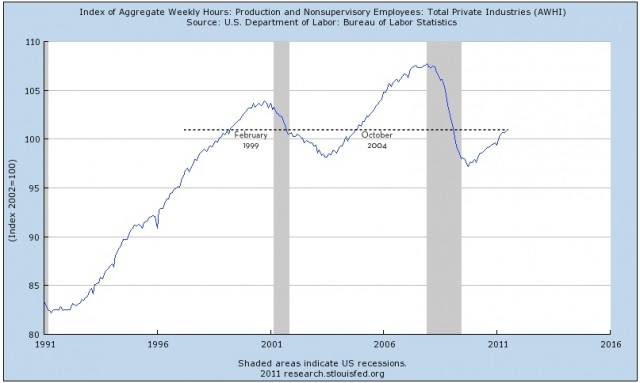
http://bigpicture.typepad.com/comments/images/wsj_prod_vs_ho...

https://qzprod.files.wordpress.com/2014/09/average-annual-ho...

especially for allegedly supervisory positions with job security & a salary, which no longer have to pay overtime; Hours worked per full-time employee has gone up, while part-time hourly positions have become much more common. Hourly jobs we now expect to work just enough that no benefits are offered (~39.9 hours), and double up to 78.8 hours over two jobs if we want to actually support a family... the better half of retail jobs will respect that sort of arrangement, while the worse half will require you to work 25-39 hours virtually "on-call", coming in whenever a gap presents itself, if you want to achieve that many hours.
The death of the labor movement has not helped the situation.
The best I could find to support your argument is
http://b-i.forbesimg.com/theapothecary/files/2013/07/PTEcono...

http://ibankcoin.com/news/files/2013/04/labor-force-particip...
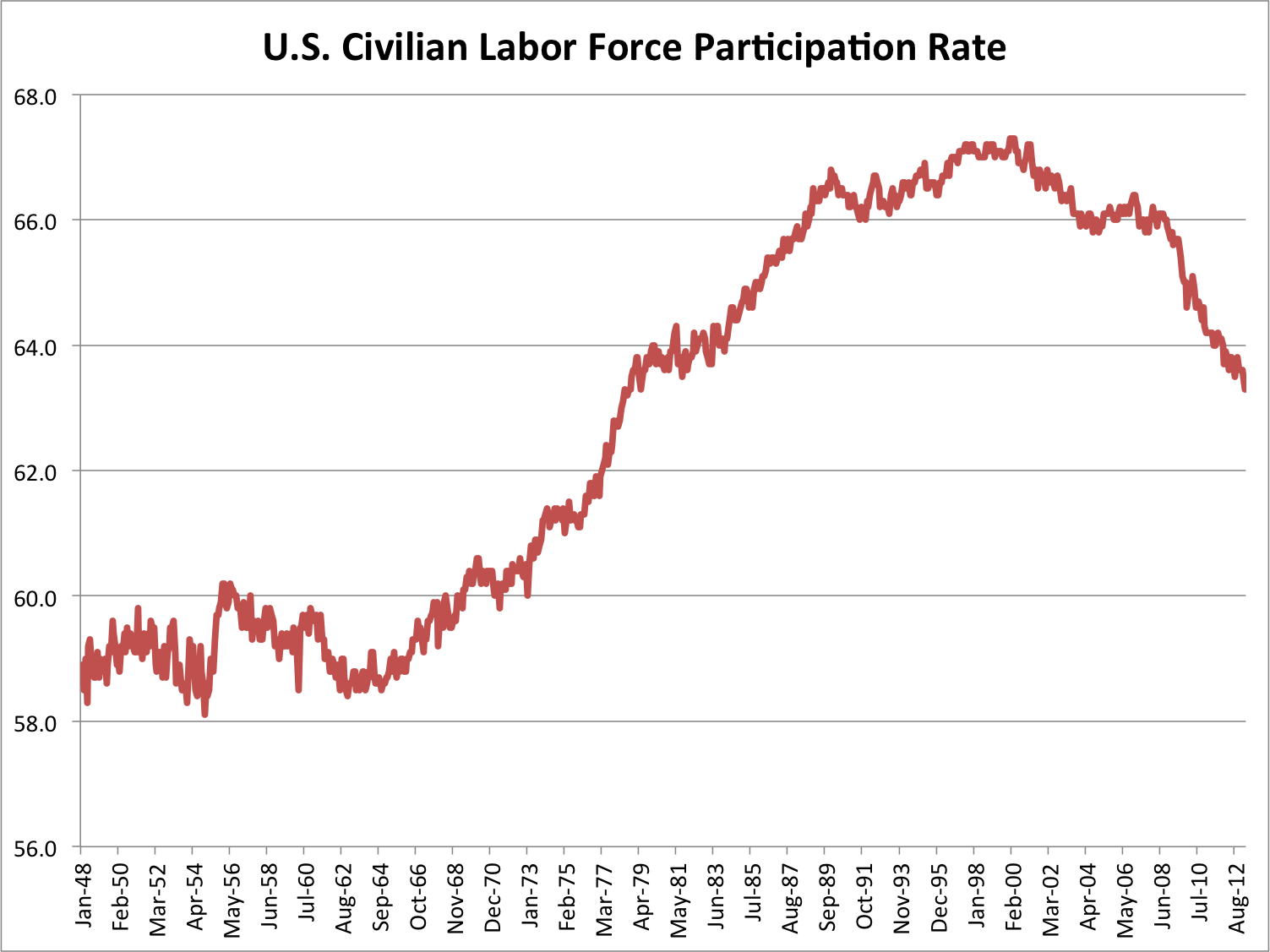
You do see that there is a price to pay for that, right?
Future generations pay the cost, not you. So you are deciding to imperil people who are children, or who do not yet exist. There's a clear line to draw from "more holidays" and "more leisure" to "fewer diseases cured" and "E.U.-style fiscal crisis."
The American tradition of working away continuously, hacking away, jamming hard on a challenge all night is really, really a good thing. It's saved the world a few times. It's good.
I'd much rather have my grandkids enjoy a 24 hour workweek and be surrounded by automation than continuing the keep up this house of cards with its 50-60 hours work weeks, endless stress, constant retraining, constant layoffs, endless warfare for resources, etc to keep the status quo afloat.
Its clear to me that Bush 43 was our last hurrah for the old way of doing things. Automation is just eating the world and denying that is just not going to help us.
>The American tradition of working away continuously, hacking away, jamming hard on a challenge all night is really, really a good thing.
Creative people will always be this way. You're confusing values with jobs. The hardest and best projects in my life were done with zero exception of monetary gain. Ask any hacker. They'd be doing this shit anyway. Linus had no idea Linux would go anywhere, for example, and thought of his project as being largely academic at first.
This has always been true. My dad, a career Air Force officer, would shake his head at the servicemen who ate steak after payday, and were down to eating beans by the next.
Heck, I read Ambrose's book about the building of the intercontinental railroad in the 1860s, where he describes the profligate spending of the construction crews immediately after payday, and the Hell On Wheels camps that sprung up to take that money, providing hookers and blackjack.
One strategy for "growth" could be cashectomies via taxing windfall profits, idle assets, or just because.
Another could be changing from measuring consumption (GDP) and to something else, like happiness, life expectancy, or standard of living.
A modern "new deal" for elder care would also do the trick..
Oh please no! Boomers have already pillaged and mortgaged the futures of the youth enough already. The last thing we need is for them to stick it one more time with a new set of unpaid indefinite obligations.
For a simpler approach, just give everybody $X (00 or 000?) either one off or repeatedly. It's as progressive as it gets and at least some youth will benefit.
I'm pretty sure elder care isn't indefinite. Maybe we end it after this current generation of old people (our parents/grandparents) are no longer around.
One of the biggest social problems we'll face in the next 10 years is millions of people with dementia who can't take care of themselves just... existing. What do we do?
One fun story I've heard is a doctor gave an old woman with full blown dementia an operation to keep her alive, then she lived another 15 years just completely out of touch with the world. The family had to sell all her belongings (eating through their inheritance too), then pay even more to keep her in full time care. It makes no sense, but that's the standard set of rules. Little known fact: before medicare will pay out for extend services, they force your relatives to sell all your belongings (property, land, investments, etc) to pay for medical services before any other payments kick in.
Once you reach 65 and are eligible to start receiving payments, are you going to be okay when they say "nope, well's dry?" You would if you didn't realize they had been garnishing your salary for thirty years. But anyone with any sense of responsibility would be furious if they decided to just stop paying benefits after one generation.
Besides, how do you decide when a generation ends to stop paying?!
At least until we start hosting Carousel.
https://fair.org/home/convincing-the-young-to-blame-the-old-...
http://www.nakedcapitalism.com/2014/01/three-card-monte-gene...
Chicago pension crisis for retiring boomers.
https://www.illinoispolicy.org/chicagos-63-billion-debt-burd...
"When you include the city’s share of Cook County’s debt, Chicago’s total pension debt increases to $32 billion."
Rahm's Record $589M Property Tax Hike OK'd
https://www.dnainfo.com/chicago/20151028/downtown/record-pro...
Note, this tax increase just gets Chicago above water for 48 months. It does not remotely solve the problem. Chicagoans are expected to receive massive tax increases for years going forward.
"the mayor’s tax hike will be $1.9 billion short of the extra contributions needed through 2025."
http://www.illinoispolicy.org/mayor-emanuels-property-tax-hi...
So a business model of screwing every penny out of your staff and suppliers can result in customers too poor to buy your merchandise?
Who could have forseen this?
How much of your current Walmart receipt goes to the non-executive-management in-store staff?
The implication of course is that it would be significant.
It's echoes of the uninformed arguments around the UAW though. Back in 2008 the $70 was all anyone could talk about. That despite the fact that included funding for benefits the Japanese automakers didn't provide because they were socialized. Also completely ignoring that total labor cost was around 10%. Just how much did people think it could be cut?
Cut compensation and benefits in half and you save a whopping $1,500 on that $30,000 car. You know, the domestic one that's already cheaper that you weren't considering in the first place.
So would I tolerate my grocery bill being 2% higher to give cashiers/stockers/etc a living wage? Absolutely. I pay a lot more than that just to avoid shopping at Walmart in the first place (the parking lot is always packed, the lines are long, the aisles a mess and it's further away than Fiesta, the asian market, Albertson's, Kroger's or Target).
What if the receipt was 10% higher? If it provided a living wage, decent benefits, and improved their stores generally then yeah, I probably would. The spread between the asian market and Target is already much much higher than that.
More than that? Not unless they excelled in some area. For packaged meats Target does a real decent job. For produce the asian market is where it's at. For bulk items at low prices Fiesta rules. The others are sort of middle-of-the-road in offerings, at decent, if not amazing prices.
But I seriously doubt anything like or above 10% would be close to necessary to achieve what was proposed.
- Krugman, http://www.nybooks.com/articles/2015/12/17/robert-reich-chal...
"The employment effect of the minimum wage is one of the most studied topics in all of economics. This report examines the most recent wave of this research – roughly since 2000 – to determine the best current estimates of the impact of increases in the minimum wage on the employment prospects of low-wage workers. The weight of that evidence points to little or no employment response to modest increases in the minimum wage."
Schmitt, https://cepr.net/documents/publications/min-wage-2013-02.pdf
That means you're missing The Allusionist! http://www.theallusionist.org/
Too few skills (reading, maths) and now automation is coming to agriculture even fast food restaurants, and at $15 min wage, you can hire a high school dropout, if you really need manual labor.
That assumes that these workers are coming from countries where opportunities for paid work are equal to or better than those available in the US, and are equally lucrative. Many workers come from communities destroyed by the drug wars, or from economies ruined by corrupt governance. If those structural factors don't see improvement, the impact on net low-skilled migration to the US won't budge much.
For a lot of people, decision making is based on which option allows them to just live another day; relative to their circumstances, we are exceptionally privileged to be able to make decisions based on the extent to which macroeconomic indicators impact our standard of living.
And, as minimum wages go up, high school graduates become more willing to work. At $10 you may not find manual labor worthwhile, but at $15 it looks more enticing. Now, immigrants typically work a little harder, but not so much to overcome a lack of education and poor communication skills --which can take years to develop if Eng is not their native lang.
As tech advances and "hollows out" low skilled labor from advanced economies, these economies will struggle to keep their mid skills labor market employed.
One plausible exception would be for items so expensive that they're often financed with debt: A car manufacturing company might plausibly generate more than a dollar in revenue in the short-term if its employees borrowed money to finance it.
Another plausible exception would be if you gave someone a temporary raise, and they immediately started spending more and going further into debt(think buying a bigger house, bigger car, funding a bonus vacation on a credit card, etc.). Then when you cut their wages 6 months later, it's possible that for some items you would've convinced your own employees to spend more money than you gave them on your own products.
A third exception might be for companies that completely control the employees' spending. For example, a prison or a camp full of debt slaves might be paid $3/hour, but they could only spend it on overpriced company goods. Raising it to $4/hour still wouldn't exactly generate direct revenue over the long term, but it wouldn't cost the company much at all since they'd capture 100% of the spending. Anything short of that 100% is savings, and people might be more willing to spend down their savings if they thought money was easier to get. So you could - in the short term - make money by raising wages. Doubly-so if you extend them credit(on top of whatever debt they're working off).
I can't think of a way that the "giving people more money gives them more money to give back to you" argument actually works that doesn't involve saddling them with debt. And these are merely plausible - I don't know that they're what would actually happen.
Actually, what does them being employees have to do with the argument? If that argument were valid, why wouldn't my local grocery store hand out free $20 bills to anyone who comes in, since this would spur them to buy stuff? Or if you were truly convinced that this would make the companies more money, you could easily be a millionaire by buying up a local McDonalds(with a government-backed loan), raising everyone's wages, and then when your income goes up by x% reselling the business for an x% increase on the $300,000 or so you bought the McDonald's for(and repeating this a couple times).
If the companies are searching for a way to leverage lower wages for employees - that isn't real value creation. Driving wages too low, we get our current economic stagnation.
I don't actually have an opinion, but your statement is missing the point.
http://www.theguardian.com/business/2015/oct/14/walmart-prof...
http://www.zerohedge.com/news/2016-01-15/walmart-fire-16000-...
When Walmart tried to compete with ALDI in Germany, they couldn’t. They gave up after just a few years, because ALDI managed to have lower prices and higher wages, because they had optimized every single process to maximum efficiency.
The CEO of WalMart has mentioned this. They have a direct view into the spent-out economy - same-store sales data. Sales decline each week after payday, then recover after payday. Sales move to necessities later in the month.
That's why companies aren't investing in capacity.