News for hackers. Stuff that matters.
Re:What happens when a culture is driven by the need for mon... by hliyan on Wednesday November 11, 2015 @12:35PM (#10547831)
I've recently come to the conclusion that any society where it is easier for the rich become richer than it is for the poor to become richer, regardless of its starting state, will tend toward feudalism over time. While modern day America is starting to look more and more like a data point that supports this conclusion, I'd like to think that there's a certain amount of mathematical certainty involved too:

    money => more money ------- (1)
    money <=> power ----------- (2)
(1) and (2) over time will result in the bifurcation of society into two groups: the rich and powerful, and the rest. This probably doesn't apply to corporations though.
Re:What happens when a culture is driven by the need for mon... by JonFish85 on Wednesday November 11, 2015 @02:35PM (#10548698)
What I don't get about this argument (and others similar to it) is that the US seems to have a pretty good turnover of money. According to Forbes' billionaires list, "[f]ully 1,191 members of the list are self-made billionaires, while just 230 inherited their wealth"[1]. The top 3 richest people on the planet at this point made their money themselves, and 2 of them (Gates & Buffett) are not going to pass their wealth down the family tree.

We're less than 100 years from one of the richest people of all time, JD Rockefeller (net worth ~$300+bn). His family is essentially dedicated to giving that money away at this point, and I believe the family's net worth at this point is in the $15bn range--not peanuts, but hardly growing.

Money doesn't last, but there are always rich people. Paris Hilton, trust fund baby, has made more money from her own businesses than she'd ever inherit from her grandfather. Same with Julia Louis-Dreyfus. But after a couple of generations, the old money is usually gone. As much as people like to complain about "the rich", there really aren't as many generationally-rich people as some make it seem.

[1] http://www.forbes.com/sites/kerryadolan/2015/03/02/inside-th...

Re:What happens when a culture is driven by the need for mon... by bitbuilder on Wednesday November 11, 2015 @03:48PM (#10549158)
Doesn't your Paris Hilton example prove GPs point, rather than refute it? It's precisely due to her family's considerable wealth that she was able to make more than she'll inherit. Would Julia Louis-Dreyfus have been able to pursue an acting career so easily without family wealth? But I'm not sure it's even useful to consider celebrities when discussing wealth acquisition in our country. I'd consider them outliers, in the grand scheme of things.
Re:What happens when a culture is driven by the need for mon... by marknutter on Wednesday November 11, 2015 @06:29PM (#10550168)
She is definitely an outlier. I would venture to guess that the success rate of trust fund babies in business is about on par with the success rate of inner city kids. They both lack the proper incentives to succeed, but in dramatically different ways.
Re:What happens when a culture is driven by the need for mon... by jpapon on Wednesday November 11, 2015 @07:26PM (#10550442)
That's just ridiculous. Inner city kids don't lack the proper incentives to succeed (they're poor, after all), they lack the resources needed to succeed.
Re:What happens when a culture is driven by the need for mon... by workitout on Wednesday November 11, 2015 @07:51PM (#10550553)
I grew up poor in the south. People don't need to be handed incentives to succeed. Some people don't mind being poor. Some people will be poor before long even if you give them a million dollars. If success is important to you, you work for it. Success is defined differently for all of us. Lifelong welfare is not helping someone, it is not incentivizing them. That has to some from within.
Re:What happens when a culture is driven by the need for mon... by omonra on Wednesday November 11, 2015 @09:55PM (#10551017)
I think he meant to say that trust fund kids lack motivation while inner city kids lack the skills.
Re:What happens when a culture is driven by the need for mon... by marknutter on Wednesday November 11, 2015 @10:04PM (#10551044)
Exactly. I don't know which is worse..
Re:What happens when a culture is driven by the need for mon... by CPLX on Thursday November 12, 2015 @08:01AM (#10552813)
I do.
Re:What happens when a culture is driven by the need for mon... by marknutter on Thursday November 12, 2015 @10:29AM (#10553691)
Being a trust fund baby.
Re:What happens when a culture is driven by the need for mon... by oberstein on Wednesday November 11, 2015 @07:47PM (#10550538)
Is IQ a resource?
Re:What happens when a culture is driven by the need for mon... by fauigerzigerk on Wednesday November 11, 2015 @03:37PM (#10549102)
That's what you get when you focus on the outliers. I doubt that causality plays a big role in determining who becomes a billionaire (Zuckerberg, Gates, Buffett) and who stays a mere doctor, lawyer or congressman (father of Zuckerberg, father of Gates, father of Buffett).

But that is a question of who belongs to the 0.01% and who belongs to the 1%. It's not a very interesting social mobility study and I agree with you that the "rich get richer" argument makes no sense for the super rich outliers.

Unfortunately, things do get a lot more predictable at the lower percentiles.

Re:What happens when a culture is driven by the need for mon... by FD3SA on Wednesday November 11, 2015 @03:10PM (#10548939)
The good old "Bill Gates the bootstrapped college dropout" argument. These myths never die.

William Henry Gates the Third had a trust fund before he was born. His downside risks for anything he chose to do in life were completely nonexistent. Same with Zuck. Same with Spiegel. Same with 99% of the entrepreneurs HN idolizes.

Here's some light reading:

http://qz.com/455109/entrepreneurs-dont-have-a-special-gene-...

http://philip.greenspun.com/bg/

EDIT: Removed potentially inflammatory line, which went as follows: "Just a bunch of rich kids trying to prove a point to their parents".

This is definitely a personal opinion, but one that has merit if you examine the evolutionary psychology of parent-child relationships. The conversation is a bit in depth, but please understand that I was not trying to simply fire off an ad hominem. I was instead trying to hint at the incentives which drive an already rich child to strive for more wealth. For the vast majority of us who have to work for a living, such behaviors seem confusing. Only upon deeper analysis do the pyschological incentives for such individuals begin to make sense.

Re:What happens when a culture is driven by the need for mon... by Natsu on Wednesday November 11, 2015 @03:46PM (#10549149)
> The good old "Bill Gates the bootstrapped college dropout" argument. These myths never die.

You appear to be refuting a claim that was not made in the GP post or in the Forbes article they cited.

Grandparent only said that Gates is among the top 3 riches and is not going to pass on his wealth, they did NOT claim that Gates was born poor or otherwise among the self-made millionaires.

Similarly Forbes lists Gates as the richest person, but makes no claims whatsoever about how he made his fortune. There are two independent claims there and at no time does either source claim that Gates is in the self-made group.

Your QZ article is more responsive, but it boils down to saying that one needs access to capital to start a business. This is not really surprising and ensuring that any capable person can get funding is why we have things like YC. If there's any group out there with good ideas that's being systematically ignored or denied funding, you and anyone else could make big money by investing in them. All you need to do is prove there's an opportunity being ignored and people will jump on it, chasing the money.

Re:What happens when a culture is driven by the need for mon... by tw04 on Wednesday November 11, 2015 @08:32PM (#10550718)
"Not going to pass on his wealth" is pretty relative. He gave his kids millions of dollars, he just didn't give them billions.
Re:What happens when a culture is driven by the need for mon... by Natsu on Wednesday November 11, 2015 @09:59PM (#10551034)
A million dollars is rather achievable with a good education, good health and drive, provided you live in a developed part of the world and can keep expenses lower than earnings. Hopefully we someday develop the rest of the world, as well as making sure that everyone can get all the education and healthcare they need, so that this level of success no longer boils down to luck.
Re:What happens when a culture is driven by the need for mon... by lmartel on Wednesday November 11, 2015 @10:36PM (#10551148)
But a million dollars at age 18/21/whatever isn't. Trust fund kids still get a head start of a couple decades.
Re:What happens when a culture is driven by the need for mon... by JonFish85 on Wednesday November 11, 2015 @04:32PM (#10549447)
That's not at all the argument I'm making, and probably isn't an argument made by anyone. Going from dirt-poor to richest-in-the-world is much harder than any other economic jump. My argument was simply that "the richest don't stay the richest" for very long. If you take $330bn and spend $1m a day (getting no interest on the principle) it would take 1,000 years to spend it all. You'd expect that the money would last the Rockefellers for centuries, but in fact it's pretty quickly been "returned" to the central money pot.
Re:What happens when a culture is driven by the need for mon... by crpatino on Wednesday November 11, 2015 @07:02PM (#10550349)
If every tycoon has 2 or 3 heirs, chances are that unless one of them inherits the parent drive (and then goes to amass more wealth), the fortune will spread out. We all know how the exponential function works, it does not take that many generations to level off any finite amount of money.
Re:What happens when a culture is driven by the need for mon... by drumdance on Wednesday November 11, 2015 @03:29PM (#10549062)
It's a bunch of rich kids trying to get richer than their parents to prove a point.

You had me until there. Why question their motives? Is it really so hard to believe that Gates really loved computers?

If he was just thinking in terms of outstripping his parents, there were lots of other more-credible avenues available to him. The very idea of a personal computer was scoffed at. Not just by non-techies, but people like DEC founder Ken Olsen.

Re:What happens when a culture is driven by the need for mon... by Anechoic on Wednesday November 11, 2015 @03:35PM (#10549085)
Why question their motives? Is it really so hard to believe that Gates really loved computers?

Did Gates' love of computers motivate Microsoft's anticompetitive moves in the 1990s?

Re:What happens when a culture is driven by the need for mon... by drumdance on Wednesday November 11, 2015 @04:33PM (#10549454)
I don't see what one has to do with the other. Professional athletes get caught cheating all the time, but I don't doubt they still love their sports.

One may as well doubt that Hitler actually liked being a vegetarian.

Re:What happens when a culture is driven by the need for mon... by Anechoic on Wednesday November 11, 2015 @06:49PM (#10550287)
Professional athletes get caught cheating all the time, but I don't doubt they still love their sports.

I very much doubt that cheating athletes love the sport. They may love the fame and benefits that come with the sport, but if they loved the sport, they would work hard to become better at it rather than cheating.

I love my job. I read up on research, volunteer at conferences, tinker/hack on my own time, and provide lots of free consulting. Heck, the only reason I don't provide more free consulting is, well, because I have bills to pay. I certainly can't imaging expressing my love for the field by engaging in unethical, immoral or illegal activities. I suppose if it was the money I loved foremost, it might be different.

Re:What happens when a culture is driven by the need for mon... by Retra on Wednesday November 11, 2015 @05:41PM (#10549913)
It's a funny way of showing love to a sport when you subvert the rules that make it fair. No doubt if everyone cheated all the time, practically nobody would love the sport.

One may as well think that Hitler eating meat remains a vegetarian.

Re:What happens when a culture is driven by the need for mon... by drumdance on Wednesday November 11, 2015 @06:13PM (#10550085)
It's a funny way of showing love to a sport when you subvert the rules that make it fair.

Uber and AirBnB are subverting rules and breaking laws in hundreds of municipalities. Do you think they don't care about what they're building over there? Is it just money-money-money and no serious interest in technology? Does that mean, by proxy, that Paul Graham only cares about money?

Is it really so hard to believe that people can have more than one thing that motivates them? Why did Ray Ozzie join such an evil beast? Surely he's just motivated by greed!

Black and white thinking will be the death of us all.

Re:What happens when a culture is driven by the need for mon... by Retra on Wednesday November 11, 2015 @07:09PM (#10550374)
I don't know where you got black and white thinking from. I wouldn't say Bill Gates doesn't love computers, just that he loves something else more. Something that may very well not be good for computing.

Uber and AirBnB? Do they love the work they do? Maybe. But they love themselves more. They love the idea of being "disruptors" or "innovators" or "rich" more than they care about transportation, housing, or their customers.

And those guys who love sports? Maybe they love winning more.

It's easy to feign passion, after all. Especially when you're already committed to investors.

Re:What happens when a culture is driven by the need for mon... by drumdance on Thursday November 12, 2015 @11:52AM (#10554298)
I like to accept what people say at face value until evidence suggests otherwise.

People go on about Bill Gates and antitrust, but do they really think Steve Jobs or Scott McNealy or even Page & Brin would behave differently?

Bill Gates' biggest fear was not losing the OS monopoly. His fear was of Microsoft turning into IBM -- always having to run everything you do by lawyers.

MS-DOS wouldn't even exist if IBM hadn't had the justice department watching their every move.

Re:What happens when a culture is driven by the need for mon... by eli_gottlieb on Thursday November 12, 2015 @12:33PM (#10554618)
And Microsoft wouldn't exist if the Bush Administration hadn't ordered their monopoly conviction pardoned.
Re:What happens when a culture is driven by the need for mon... by vezzy-fnord on Wednesday November 11, 2015 @04:37PM (#10549490)
The PC revolution owes its greatest debt not to Gates, but to Kildall, in terms of individual contribution.

It may well be that Gates was driven to purposeful action from a love of computers. That he has had no notable productivity since Altair BASIC (other than third-party accounts of him doing code reviews early at Microsoft), nor any research, would nevertheless make his contributions to the field quite little.

Re:What happens when a culture is driven by the need for mon... by drumdance on Thursday November 12, 2015 @11:59AM (#10554360)
"Code reviews" makes it sound like something he did for 15 minutes as part of a standup. He was known to be incredibly sharp, asking extremely detailed questions.

http://www.joelonsoftware.com/items/2006/06/16.html

"Bill Gates was amazingly technical. He understood Variants, and COM objects, and IDispatch and why Automation is different than vtables and why this might lead to dual interfaces. He worried about date functions. He didn't meddle in software if he trusted the people who were working on it, but you couldn't bullshit him for a minute because he was a programmer. A real, actual, programmer."

Edit: My point is, one can love computers and be very good at them without making significant contributions to the field. That describes me and probably most of the people on HN.

Re:What happens when a culture is driven by the need for mon... by vezzy-fnord on Thursday November 12, 2015 @01:06PM (#10554887)
Of course you can. The fact remains that Bill Gates has not been associated with any directly technical work in decades, so his action in the distant past is of little relevance to his action in the less distant past and the present, and moreover is irrelevant to the GP's assertion of his familial wealth.
Re:What happens when a culture is driven by the need for mon... by e40 on Wednesday November 11, 2015 @03:36PM (#10549091)
It's pretty obvious that he didn't just like computers. Bill Gates was a consummate competitor. He loved competing.

I agree, it doesn't matter what his motivation was, but he wasn't solely motivated by "computers".

Re:What happens when a culture is driven by the need for mon... by drumdance on Wednesday November 11, 2015 @06:16PM (#10550095)
Of course not. But if he was more motivated by money than technology, I doubt he would have spent four years building a company trying to sell a product that nobody wanted. (Microsoft basically had zero revenue for its first four years.) He would have been better off going into real estate, and I think he was smart enough to know that even at 19.

I love computers, but I don't start companies just to say I start companies. I expect a financial return.

Re:What happens when a culture is driven by the need for mon... by FD3SA on Wednesday November 11, 2015 @03:51PM (#10549183)
>"[f]ully 1,191 members of the list are self-made billionaires, while just 230 inherited their wealth"[1]. The top 3 richest people on the planet at this point made their money themselves, and 2 of them (Gates & Buffett) are not going to pass their wealth down the family tree.

@Natsu, my point of contention is the very liberal definition of "self-made" and "made their money themselves". If you give every reader on HN a trust fund, and a few start successful companies, would these individuals be considered "self-made"?

I don't think so. Self made means start with zero net worth. That means no trust funds, no loans at 0% from parents with infinite payback periods, and no parent board members making absurdly lucrative deals that you'd never get otherwise. Just money you've made from your own labor, and loans you've received without nepotism. You'd be surprised how few entrepreneurs fall under this category.

If you don't restrict your definition in this way, then every rich person is self made, because the interest accruing in their trust fund happened during their lifetimes.

Re:What happens when a culture is driven by the need for mon... by thedufer on Wednesday November 11, 2015 @05:07PM (#10549685)
> Just money you've made from your own labor, and loans you've received without nepotism. You'd be surprised how few entrepreneurs fall under this category.

Frankly, I'd be surprised if anyone fits under that category. Pretty hard to survive as an infant completely on your own.

I mean, obviously that doesn't count. But where exactly are you drawing the line? It's less black and white than you are implying; it seems like there's enough fuzziness here that you can put anyone in the "not self-made" category, so of course group X has very few members outside that category. Because, you know, Mr. CEO over here was driven to college by his parents once, so he's out, and Ms. Entrepreneur there inherited a few hundred dollars from her grandfather, so that's no good either.

Re:What happens when a culture is driven by the need for mon... by andosa on Wednesday November 11, 2015 @02:54PM (#10548839)
That doesn't really refute gp's point. In medieval times, there were periods where dynasties didn't last, and every generation had new warlords from new families. That doesn't mean it wasn't a feudal society.
Re:What happens when a culture is driven by the need for mon... by Swizec on Wednesday November 11, 2015 @03:07PM (#10548918)
The main issue, as I see it, is that going from upper middle class (or even mid-range middle class) to mega rich is easier than it is to go from poor to lower middle class.

Most rags to riches stories we have these days, are really a relatively well off to riches stories when you look at them. The only exceptions are people who won the celebrity lottery.

It's surprisingly hard to accumulate wealth when you're struggling to keep the lights on.

Re:What happens when a culture is driven by the need for mon... by rnovak on Wednesday November 11, 2015 @03:29PM (#10549065)
Why wouldn't it be easier?

Someone who has more discretionary income can take on more risk than someone who can't keep their lights on, and a failed venture doesn't have the same consequences.

Just by virtue of taking more risk, those in the middle class are expanding their chance of success by orders of magnitude more.

I'd dare say it's impossible for the middle class to not to become "mega rich" at a greater incidence than poor becoming middle class.

Re:What happens when a culture is driven by the need for mon... by Swizec on Wednesday November 11, 2015 @03:49PM (#10549163)
I agree.

I'm just saying that a lot of the people who normally discuss these "But it's not that hard or impossible to become rich, what are you talking about?" stories, are the kind of people who somehow magically were able to go to an ivy league school or similar.

They say they became rich on their own, and that most of the mega rich also became rich on their own, but forget that compared to the vast majority of the population, even confined to the US, they were already born rich and have a massive leg-up in the world from day 1.

edit: As Donald Trump would say "I made all my own money. My dad only gave me a small 1 million dollar loan, and with that I was able to make my own fortune."

Re:What happens when a culture is driven by the need for mon... by JonFish85 on Wednesday November 11, 2015 @06:06PM (#10550057)
The problem with that quote is that no entrepreneur now can say anything less. Any company founder at this point has likely taken over a million dollars in venture capital--are they not to be called self-made if their company does well? Nobody is ever "self made" if you take that argument.
Re:What happens when a culture is driven by the need for mon... by Swizec on Wednesday November 11, 2015 @07:04PM (#10550358)
I would assume there is a big difference between your dad giving you a loan and investors who don't have social ties with you since childhood.

The assumption is that the dad will be less stringent on due diligence, more forgiving in what he gets in return, and most importantly, will have brought you up all your life in such a way that you are primed for handling those kinds of money.

The wider point is that someone who grew up in a trailer park, doesn't even have access to investors in the first place. For example: how are you going to get an investment, if you can't afford to to schmooze with investors? What if a $50 dinner is completely out of your price range? What if buying someone a $5 coffee is a big deal financially?

And then there's the issue of safety net. There's a big difference between your venture failing meaning you end up living on the streets, or in your parents' garage.

Re:What happens when a culture is driven by the need for mon... by meric on Wednesday November 11, 2015 @07:55PM (#10550568)
It does take several generations.

1. My great grandmother was a homeless woman after getting kicked out of the household because she was the second wife of a husband who had passed, leaving my grandmother in orphanage during WWII when the Japanese invaded China.

2. A couple of years later, her family came back for her. My grandmother worked odd jobs here and there, and my great grandmother gambles it away. My grandmother, fed up, left her to go live in Hong Kong with an uncle.

3. My grandmother's uncle was only employed from time to time. They lived on one meal a day, some rice, flavoured with a few drops of pig fat. My grandmother wanted a better life. She signed up as a labourer to carry tens of kilograms of dirt everyday on her shoulders[1], as part of a project to clear a mountain. Her uncle said she wouldn't last 3 days. It was such painful work she almost went home on the first day. But with such a stark challenge from her uncle and she didn't want to lose face, she stayed for 3 months. She was 14. She went on to work as a servant, but more or less treated as a slave, getting yelled at and beaten, and then finally someone taught her the business of picking up factory fabric scraps, weaving them into clothes to sell them. And that's the business she was in, even until the time I was following her around when I was 5 or 6. She bought factory scraps in bulk, using her sewing machine, made shirts and pants, and in 1995 or so, sold them for HK$10 each. It put my mother through school and nursing school. [2]

4. My mother was a nurse, and it was a well paid profession. However, my parents lost almost everything from their real estate investments in the 1997 Asian financial crisis. Debt can ruin you like that. They sold everything, my mother left her position as chief nurse in a hospital, and using a skilled migration visa, we moved to Australia, starting from zero.

5. Today I'm working as a software engineer in Australia. When I was tempted to slacken for my university exams, when I was tempted to lower my ambitions and stay in an unskilled job, when I was tempted to take an employer's low ball salary offer based on my living expenses, I remember what my grandmother had gone through, to put me here. And I will follow her example, and do the same for my family.

"Stay hungry, stay young, stay foolish, stay curious, and above all, stay humble."

[1] A carrying pole. https://en.wikipedia.org/wiki/Carrying_pole [2] My grandfather had an accident while fixing a lift, and lose control of his legs. Unable to provide for the family, he killed himself. My uncle, my mum's brother, grew up mentally ill. My mother also had a sister. My grandmother brought up three children and supported my great-grandmother, on her own.

Re:What happens when a culture is driven by the need for mon... by rnovak on Thursday November 12, 2015 @02:09AM (#10551737)
you mean except for all of the companies that are bootstraped, and never take a dime from venture capital, right?
Re:What happens when a culture is driven by the need for mon... by nickbauman on Wednesday November 11, 2015 @10:50PM (#10551198)
Gates is the son of a wealthy corporate lawyer. He went to one of the only high schools in the US that allowed their students computer access at the time. If you consider his wealth "self-made", I'd like to know what you define as self-made. Bill Gates, Dreyfus, Hilton only prove rich parents can produce even richer kids. Buffet's father was a congressman, not exactly the definition of wealthy (although these days it is), but definitely enfranchised.
Re:What happens when a culture is driven by the need for mon... by subdane on Wednesday November 11, 2015 @03:41PM (#10549123)
The post is about "An investment mentality that hollows out our culture." Even if the folks that profit from the hollowing give the money away, the hole's still there. To be specific to the example in the article, it's not like Rockefeller's heirs are literally giving money to Mom and Pop delis to compete with banks for New York's street corners.
Re:What happens when a culture is driven by the need for mon... by ryguytilidie on Wednesday November 11, 2015 @03:20PM (#10548999)
Would a self made billionaire include someone who inherited say 800 million and turned it into a billion?
Re:What happens when a culture is driven by the need for mon... by bko on Wednesday November 11, 2015 @03:42PM (#10549127)
From the article:

> There’s no doubt that entrepreneurship is thriving globally. Fully 1,191 members of the list are self-made billionaires, while just 230 inherited their wealth. Another 405 inherited at least a portion but are still working to increase their fortunes.

Not sure how "at least a portion" is defined, but I imagine less than half had significant inheritance. That's not to say the self-made billionaires were born middle class, but it does suggest that wealth does not necessarily beget wealth.

Re:What happens when a culture is driven by the need for mon... by coldtea on Wednesday November 11, 2015 @04:26PM (#10549404)
Again, 635 out of 1191 started out rich (either for the whole sum, or a portion of it). That's 53% of them.

But even if 1190 of them had gone "rich from zero" and only 1 had inherited his wealth, it wouldn't be that comforting by itself.

What you generally want in a society is: lots of poor people to be able to get out of poverty (into middle class), middle class to have a decent chance to become upper middle class, etc -- and of course most middle class to be stable and not fall into poverty.

That is, things that affect the majority of the population.

A society with a middle class that shrinks and worse prospects for 99% of kids compared to their parents is not absolved if it has 1000 billionaires emerge out of poverty (or middle class). A society with just 10 billionaires but far better social mobility (e.g. like in the 50's) would be much better to live in.

That's just relevant as an opportunity to a mere .0002857% of the population.

Re:What happens when a culture is driven by the need for mon... by JonFish85 on Wednesday November 11, 2015 @04:38PM (#10549497)
>635 out of 1191

I know it's pretty minor, but it's actually 1,826 in total, so it's 35%.

>A society with a middle class that shrinks and worse prospects for 99% of kids compared to their parents is not absolved if it has 1000 billionaires emerge out of poverty (or middle class). A society with just 10 billionaires but far better social mobility (e.g. like in the 50's) would be much better to live in.

I don't follow this logic at all. Does number of billionaires created affect anything else? They seem somewhat unrelated to me, especially in light of what I said before about the rich constantly turning over.

Re:What happens when a culture is driven by the need for mon... by coldtea on Wednesday November 11, 2015 @04:40PM (#10549518)
>I know it's pretty minor, but it's actually 1,826 in total, so it's 35%

A, thanks. Missed that, thought 1191 was the total given.

I think the rest of the argument remains unaffected though, so wont change it.

>I don't follow this logic at all. Does number of billionaires created affect anything else?

Yes, I don't see the two things as "unrelated" events, but as the difference between a society set up to sustain and grow a strong middle class, and one that caters to a tiny majority of rich (regardless how they got there, by inheritance or bootstrapping) to the detriment of the middle class.

That is, this outcome is not just the effect of random people going about their life more or less independently and succeeding or not, but of a society (laws, education, etc) that has been rigged towards sustaining and growing (but always to a negligible percentage of the total) the upper classes, and milking the middle class and the poor to oblivion.

Re:What happens when a culture is driven by the need for mon... by bko on Wednesday November 11, 2015 @06:24PM (#10550140)
> This year, we gave each member of The Forbes 400 a score on a scale from 1 to 10 — a 1 indicating the fortune was completely inherited, while a 10 was for a Horatio Alger-esque journey. We also did the analysis for every 10 years going back to 1984. Looking at the numbers over time, the data lead us to an interesting insight: in 1984, less than half of people on The Forbes 400 were self-made; today, 69% of the 400 created their own fortunes. [0]

If upward mobility to achieve great wealth is your concern, surely this means we're heading in the right direction. I don't think the system is rigged towards benefiting those with already great wealth, but markets have expanded and entrepreneurship has a bigger upside than it has in the past. You don't have to take the analysis I quoted at face value, but just take a look at the richest Americans. No Vanderbilts, Rockefellers or Carnegies.

My opinion may not be popular, but I find it encouraging to think that so few can create such great wealth in today's society, even if the odds are against me creating such wealth. In many cases, that means that a product or service one person creates can benefit a large number of people and make you very wealthy. And I personally benefit from many of the products and services that were created by this generation of the wealthy individuals.

[0] http://www.forbes.com/sites/afontevecchia/2014/10/02/the-new...

Re:What happens when a culture is driven by the need for mon... by coldtea on Wednesday November 11, 2015 @09:17PM (#10550877)
>If upward mobility to achieve great wealth is your concern, surely this means we're heading in the right direction.

No, "upward mobility to achieve great wealth" is not my concern -- I think I made that clear in the comment.

Upward mobility to middle class, middle class stability (to going back to poverty), and upward mobility from middle class to upper middle class are my concerns.

To which "upward mobility to achieve great wealth" could even be working against -- while itself concerning a very tiny majority.

>I don't think the system is rigged towards benefiting those with already great wealth, but markets have expanded and entrepreneurship has a bigger upside than it has in the past. You don't have to take the analysis I quoted at face value, but just take a look at the richest Americans. No Vanderbilts, Rockefellers or Carnegies.

What I'm trying to get at is that there's a difference though between:

"we could only make 10 non-rich people ultra-rich in 1950, whereas we have 1000 non-rich made ultra-rich today".

Which might be all well and good, but this "upward mobility" only concerns a tiny minority, and having a healthy "upward mobility" and social stability for the large masses.

Re:What happens when a culture is driven by the need for mon... by bcassedy on Wednesday November 11, 2015 @07:02PM (#10550350)
I feel like looking at how the 0.01% got ultra-rich is mostly focusing on the wrong thing. The problem is that the rich and ultra-rich are getting richer while everyone else is stagnating or regressing
Re:What happens when a culture is driven by the need for mon... by marknutter on Wednesday November 11, 2015 @06:35PM (#10550197)
> What you generally want in a society is: lots of poor people to be able to get out of poverty (into middle class), middle class to have a decent chance to become upper middle class, etc -- and of course most middle class to be stable and not fall into poverty.

I hear this a lot but I really don't understand the logic. Because the middle class is a subjective and proportionate categorization, your target is always going to be moving. Who cares about joining the middle class if most of their needs already being met.

If, for instance, a replicator was invented that provided food and shelter to anyone who wanted it for free, a hell of a lot of people could live quite happily and comfortably without being middle class. So the goal should be to get to that sort of scenario as fast as possible. That is, a world in which the cost of covering our basic human needs is so small that nobody needs to be middle-class or higher to be happy.

Re:What happens when a culture is driven by the need for mon... by coldtea on Wednesday November 11, 2015 @09:25PM (#10550899)
>I hear this a lot but I really don't understand the logic. Because the middle class is a subjective and proportionate categorization, your target is always going to be moving.

Of course the target its moving. That means society is progressing in the aggregate. So why keep "desired standards of living" stuck in the past? In 1840 having no electricity and running water was considered acceptable. Today we think even internet is a kind of necessary good.

So, with progress the definition of rich / middle class / poverty etc should move too. Who said poverty is some absolute measurable state? Obviously you shouldn't consider yourself "rich" or even middle class, if you live in a trailer park with $100/month, just because you have housing, electricity and lots of available food in Walmart, whereas 1200 A.D peasants and 10000 B.C cavemen had neither...

What was the case "in the past" doesn't come into play when people compare their status to other contemporaries -- and the level of the society they live in.

Re:What happens when a culture is driven by the need for mon... by marknutter on Wednesday November 11, 2015 @10:03PM (#10551043)
> What was the case "in the past" doesn't come into play when people compare their status to other contemporaries -- and the level of the society they live in.

So then it's all about envying those who have more, no matter how comfortable a life you happen to have.

Re:What happens when a culture is driven by the need for mon... by coldtea on Thursday November 12, 2015 @09:19AM (#10553228)
>So then it's all about envying those who have more, no matter how comfortable a life you happen to have.

You could use the moralistic conception of "envy", and make it sound bad, like telling kids "you should not envy your brother other".

Or you could:

1) see that envy and egoism is considered a primary motivator for advancement (if you like free market theories, e.g. Adam Smith and the "egoism of the butcher", etc.)

2) accept that humanity should progress in tandem, not just let some people get the majority of the benefits of today, just because the vast majority is also "better off compared to people in the past" (if you prefer socialist theories).

If they take away your internet access, will you be fine with that because people in 1850 lived in log cabins without internet, electricity or running water and you still have it so much better than them?

Re:What happens when a culture is driven by the need for mon... by marknutter on Thursday November 12, 2015 @10:29AM (#10553689)
> 1) see that envy and egoism is considered a primary motivator for advancement (if you like free market theories, e.g. Adam Smith and the "egoism of the butcher", etc.)

I agree it's a primary motivator for advancement, but if the government redistributes wealth it destroys that motivation and the benefits that come along with people having it (new businesses, higher productivity, increased education, etc).

> 2) accept that humanity should progress in tandem, not just let some people get the majority of the benefits of today, just because the vast majority is also "better off compared to people in the past" (if you prefer socialist theories).

I think at some point there's little point to everyone increasing their standard of living. We're already reaching a point here in the US where people are simply bored. Would we all be better off as a society if everyone had an extra 500 sq. ft. added to their homes, or a Tesla in their garage, or designer clothes? We are reaching the point of diminishing returns when it comes to material possessions, unless it's all about envy like I suggested in my previous reply.

> If they take away your internet access, will you be fine with that because people in 1850 lived in log cabins without internet, electricity or running water and you still have it so much better than them?

Well, I'm not being "given" my internet access, I pay for it. But yes, if I could no longer afford to pay for my internet access I would still thank my lucky stars I have electricity and running water. Duh?

Re:What happens when a culture is driven by the need for mon... by marincounty on Wednesday November 11, 2015 @06:31PM (#10550177)
I've only met, or overheard one wealthy man give proper credit to his families wealth(money, access to power, access to good attorneys, the best schools, the best loans, the best business advisors, etc.), reguarding the fortune they amassed, and that was George Sorows. George said in numerious interviews, 'I owe everything to my father. With out him, and his money, I wouldn't have anything.' I'm paraphrasing. The rest of the rich boys always leave out the inside help they received in critical points in their career, or climb to the top.

I guess what I'm saying is they all want the world to think they made their own money. All are modern day Horiatio Algiers?

So, I don't buy Forbes figures; "There’s no doubt that entrepreneurship is thriving globally. Fully 1,191 members of the list are self-made billionaires, while just 230 inherited their wealth. Another 405 inherited at least a portion but are still working to increase their fortunes."

Exactly how did Forbes come up with these numbers? I quickly looked at the list, and I buy the athletes didn't have much help, but the rest; I wouldn't bet on it. They had a lot of unseen help. Yea, you can always find a few exceptions, but I bet it's less than 10 individuals.

Re:What happens when a culture is driven by the need for mon... by zasz on Wednesday November 11, 2015 @07:23PM (#10550430)
If you look at the overall trends, economic mobility is decreasing for most Americans.

http://www.pewtrusts.org/en/research-and-analysis/reports/20...

Calling the US a 'feudal' state is obviously hyperbolic, but it's most definitely a classist society.

Re:What happens when a culture is driven by the need for mon... by nugget on Wednesday November 11, 2015 @12:49PM (#10547945)
There are some interesting social trends at work here. One of the most interesting to me is the concept of Assortive Mating. This is the idea that 30 years ago a physician, for example, would likely marry a nurse, or an executive would likely marry his secretary. Whereas today, the physician marries the executive and the nurse marries the secretary instead. Rather than pair one high and one low income/wealth/status individual together and reduce overall inequality, the gap (financially, socially, and culturally) is now widened even more. And of course this inequality is very likely to impact the next generation because the well educated, high income parents (now with more uniformly high income extended families) tend to give a higher level of attention, resources, and support to their children compared to the children of the poor, working, and middle classes.
Re:What happens when a culture is driven by the need for mon... by mahyarm on Wednesday November 11, 2015 @02:52PM (#10548826)
I think part of this is driven by workplace sexual harassment laws, conflict of interest policies and relationship disclosure policies in your examples.

The risks for dating your assistant or a nurse are higher compared to what it was 30-60 years ago for example. Now it's safer to date someone at the same income level. Or someone in the same social group but outside of work, which will tend to be the same income level again compared to a workplace.

The other part is probably driven by how there are more dual income families competing for the same limited resources, such as housing, making the income of your spouse more relevant.

Re:What happens when a culture is driven by the need for mon... by totalrobe on Wednesday November 11, 2015 @04:22PM (#10549385)
Well paid DINKs are the only people buying houses where I live (DC metro area)
Re:What happens when a culture is driven by the need for mon... by kbenson on Wednesday November 11, 2015 @01:25PM (#10548224)
I'm not sure that's really as much of an income gap as you may think. You are taking modern assumptions, that a woman can succeed in any career, and applying it to a society that it was arguably less true in. It's entirely possible the nurse or secretary of twenty years ago might be a physician or executive if brought up twenty years later.

Additionally, I think you are conflating education with social standing, when they are somewhat different, and there have been different levels of social pressure against doing either at different times in history.

Re:What happens when a culture is driven by the need for mon... by nugget on Wednesday November 11, 2015 @01:33PM (#10548289)
Here's an interesting paper on the topic:

http://www.nber.org/papers/w19829

I agree that females who would have become nurses and secretaries in the past are now becoming physicians and executives, and without doubt this a good thing. My observation is just that by solving one problem (limited opportunities for women to become professionals) we inadvertently encouraged another (assortive mating on the rise which reinforces inequality).

It's also interesting you mention social pressure at different times in history. I am working my way through Downtown Abbey at the moment and it reminds me that throughout history there have been strong pressures for people to marry within their own class/caste systems. Probably for many reasons, but one of them is certainly the maintenance of wealth and power, which has typically been far less equal throughout those historical periods than the US is today. The post WW1 period in the US has been the exception not the norm.

Re:What happens when a culture is driven by the need for mon... by kbenson on Wednesday November 11, 2015 @01:42PM (#10548343)
I won't dispute that there is some level of extra assortive mating going on because of more equal opportunities for women. Even if it was just due to more opportunity and exposure, that makes sense. I do question whether in the past if the physician that married the nurse was really providing any sort of opportunity for status change (in either economic or social standing) in most cases, since I imagine the nurse and physician probably came from similar social standings, and thus likely similar economic standings.

If the nurse or secretary of 20 or more years ago was "from a good family", what change was really spurred by the union?

Re:What happens when a culture is driven by the need for mon... by vox_mollis on Wednesday November 11, 2015 @01:48PM (#10548388)
because the well educated, high income parents (now with more uniformly high income extended families) tend to give a higher level of attention, resources, and support to their children compared to the children of the poor, working, and middle classes.

That's the uncontroversial perspective, yes. The more controversial, but far better-supported-by-evidence perspective is that the estimated 40-80% contribution that genes make to people's intelligence, conscientiousness, and work ethic is much more likely to be at play, here.

Re:What happens when a culture is driven by the need for mon... by YeGoblynQueenne on Wednesday November 11, 2015 @06:06PM (#10550052)
> the estimated 40-80% contribution that genes make to people's intelligence, conscientiousness, and work ethic is much more likely to be at play, here.

I don't think you really need to get into genetics to explain anything here. Some people get lucky, their children inherit their wealth and maybe squander it after a few generations, or maybe they don't. Neither the parents nor the children need to be particularly smart; they just need to get lucky.

Using money as a measure of intelligence is very risky. On the one hand, sure, everyone wants to be filthy rich (presumably) so there's a lot of competition. On the other hand, there are large swaths of the whole world population that will find it impossible to be the next Zuckerberg or the next Bill Gates- say, a daughter of a Bangladeshi weaver is probably not going to travel to Silicon Valley and fund the next unicorn startup, sell it for billions and bequeath some of them to her children.

That's not because of a difference in intelligence with someone who will follow that path. It's because we can't fit 7 billion people in Silicon Valley, and a few tens of thousands of jobs in tech.

I guess you can argue that the people who are already in Silicon Valley have some sort of genetic advantage but unfortunately that way lies a whole bunch of very gnarly racial bias that is going to be extremely fiddly to untangle. Therefore, see above: using money as a measure of intelligence is very risky.

Re:What happens when a culture is driven by the need for mon... by pyrocat on Wednesday November 11, 2015 @01:57PM (#10548452)
> better-supported-by-evidence

hah, ok, go ahead and make that claim with zero links to back it up. Please, tell me more about eugenics.

Re:What happens when a culture is driven by the need for mon... by vox_mollis on Wednesday November 11, 2015 @02:27PM (#10548633)
Steve Hsu giving a talk @ Google on the topic, with myriad citations:

https://www.youtube.com/watch?v=62jZENi1ed8

Four studies cited on this handy chart:

https://jaymans.files.wordpress.com/2014/04/iq-heritability-...
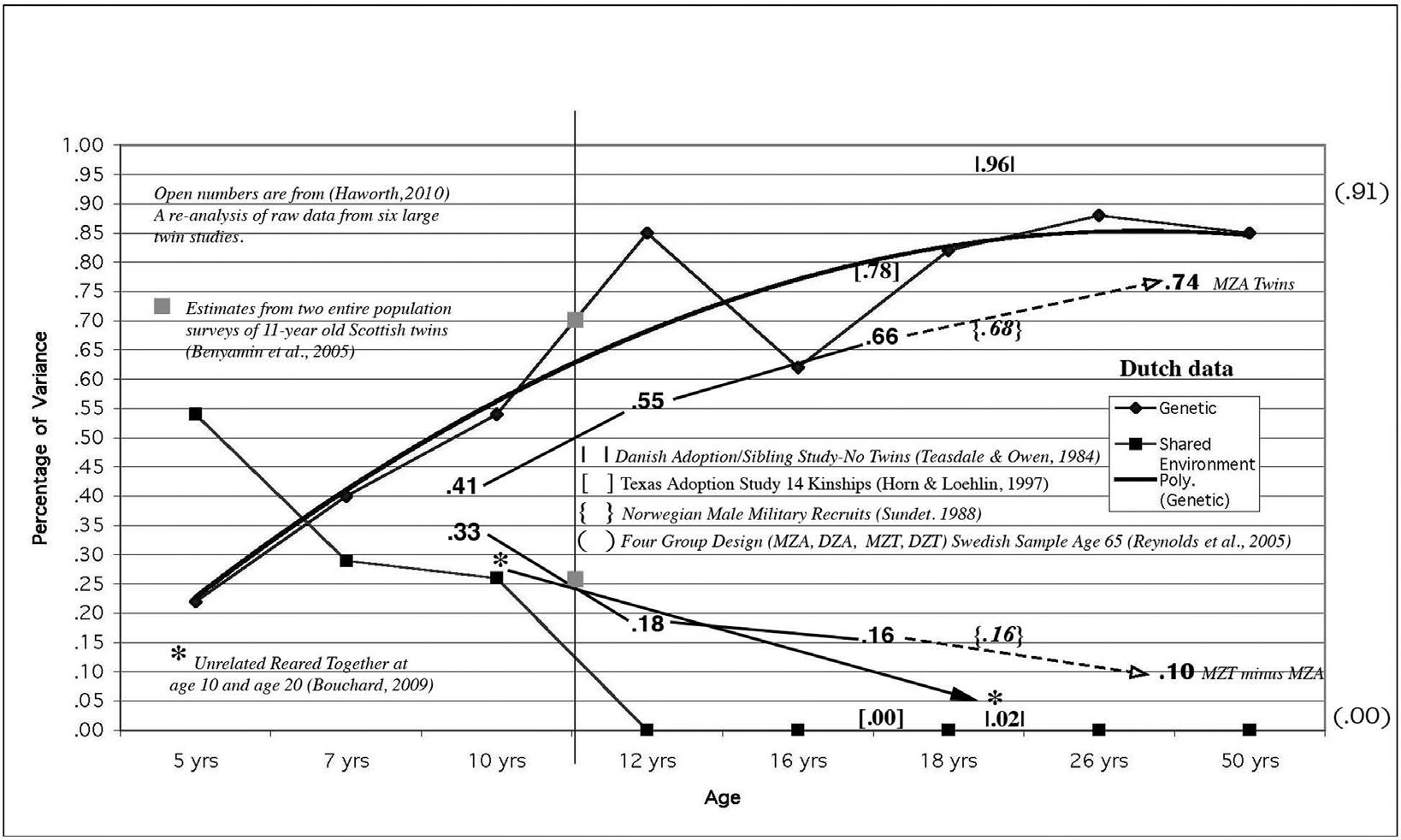
It's very well-established science that you could have easily googled, but downvoting unpopular research, pointing and shrieking "eugenics!" is a better argumentation technique, I suppose.

Re:What happens when a culture is driven by the need for mon... by papapra on Wednesday November 11, 2015 @02:59PM (#10548876)
Your post should be submitted here too: https://news.ycombinator.com/item?id=10545689
Re:What happens when a culture is driven by the need for mon... by burkaman on Wednesday November 11, 2015 @02:17PM (#10548582)
Saying genes contribute to intelligence is not eugenics. Here's the first link I saw: http://www.nature.com/mp/journal/v20/n1/full/mp2014105a.html

From the abstract: "Intelligence is one of the most heritable behavioural traits."

Re:What happens when a culture is driven by the need for mon... by wyago on Wednesday November 11, 2015 @03:03PM (#10548892)
Native language is an almost perfectly heritable trait, but that does not imply it is genetic.

(However, it is true that saying that genes contribute to intelligence isn't eugenics. Eugenics is a methodology where you attempt to selectively breed humankind by broader intent, rather than by emergent properties of human tendencies. A proposed trait to optimize is often intelligence, but similarly frequently it's attractiveness and things like that. Genetic influence on intelligence is simply a hypothesis whose testing would have consequences on the practice of eugenics.)

------- edit ------- I see your reply to the other comment. I think a quote from the article that makes your point far better is "[...] studies have consistently shown that genetic influence on individual differences in intelligence is substantial." I negligently assumed you were specifically talking about heritability.

Re:What happens when a culture is driven by the need for mon... by burkaman on Thursday November 12, 2015 @09:32AM (#10553303)
I can't say for sure, but I think at least in biological sciences, heritability specifically refers to genetics.

From wikipedia (https://en.wikipedia.org/wiki/Heritability): "Heritability is a statistic used in breeding and genetics works that estimates how much variation in a phenotypic trait in a population is due to genetic variation among individuals in that population."

Re:What happens when a culture is driven by the need for mon... by danharaj on Wednesday November 11, 2015 @02:47PM (#10548788)
Heritability is a relative measurement. You need to know what environmental factors you are controlling for in order to measure it. Because we live in societies that are highly stratified based on attributes that are genetically linked there can be environmental effects on intelligence that are difficult or impossible to correct for that create a correlation between genetics and intelligence.
Re:What happens when a culture is driven by the need for mon... by burkaman on Wednesday November 11, 2015 @02:58PM (#10548869)
I know, that's why I linked to an article written by scientists that understand that, with hundreds of references to actual studies. The article goes into a lot of depth about what they mean by heritability, what genes are involved and how they are involved, what studies have led to these conclusions, etc.

The section titled "Intelligence brings (some) genetics to ‘social’ epidemiology" addresses your concerns about environmental factors.

I don't think it's very controversial to say genes contribute to intelligence. Genes contribute to everything, how could they not affect intelligence? This isn't eugenics, nobody is saying we should (or could) use this information to selectively breed humans, and nobody is saying intelligence can be correlated to race.

Re:What happens when a culture is driven by the need for mon... by danharaj on Wednesday November 11, 2015 @03:14PM (#10548972)
I get what you're saying. I don't think it's contentious to say genetics influence intelligence. One thing that I strongly disagree with about the way intelligence research is done is that it seems highly based on tests of individual intelligence. There's no IQ test for groups of people.

We know that selection happens at the level of genes, not individuals. You can't measure the fitness of genes by evaluating their effects solely on individuals because their effects may involve ensembles of individuals. Since humans are highly social beings, I'd expect our genes to be selected for intelligence at the level of cooperating brains as well as individual brains. There doesn't seem to be much research on measuring this aspect of intelligence.

Re:What happens when a culture is driven by the need for mon... by ashwinaj on Wednesday November 11, 2015 @02:36PM (#10548707)
Not everyone has to be a rocket scientist. At least today some manual labor is required (handyman, janitors, construction workers, farmers and the like). The issue the author I think is pointing out is the fact that low wage workers are squeezed out.
Re:What happens when a culture is driven by the need for mon... by beachstartup on Wednesday November 11, 2015 @01:09PM (#10548109)
there is quite a bit of politically impolite theorizing on the internet these days about the rise of women in the academic and business contributing to the decline of marriage and rise in inequality (as a whole). i.e. women don't marry down, and men are falling further behind.
Re:What happens when a culture is driven by the need for mon... by circlecrimson on Wednesday November 11, 2015 @01:30PM (#10548269)
The cause of this was the vilification of motherhood by society. Girls needed to be "strong independent women" and the concept of women being a kind and nurturing homemaker was seen as old fashioned, even though these skills are absolutely essential to raising a well grounded, sensible self actuated and well adjusted child. The fabric of our society depends on it and somehow this was allowed to happen.
Re:What happens when a culture is driven by the need for mon... by YeGoblynQueenne on Wednesday November 11, 2015 @06:15PM (#10550093)
Woa, woa. Wait a second- why is the mother the one that has to stay home and raise the child with her "kind and nurturing" homemaking skills? Why can't the dad stay home with the kids and leave the mom be the "strong independent" woman she wants to be?

Society vilifies motherhood? Then all the dads who want to put the borked society back together again can take up the mantle of the caring parent. Be my guests, eh.

Re:What happens when a culture is driven by the need for mon... by aianus on Wednesday November 11, 2015 @10:15PM (#10551079)
> Why can't the dad stay home with the kids and leave the mom be the "strong independent" woman she wants to be?

Because the wife won't allow it; it's extremely unattractive to women to be a stay-at-home-husband, or so I've been told (by women).

Re:What happens when a culture is driven by the need for mon... by circlecrimson on Thursday November 12, 2015 @11:44PM (#10558048)
Women are, in the vast vast majority, far superior at raising children. To deny this is to deny reality.
Re:What happens when a culture is driven by the need for mon... by lordCarbonFiber on Friday November 13, 2015 @03:57PM (#10562354)
[citation not found]
Re:What happens when a culture is driven by the need for mon... by mikeash on Wednesday November 11, 2015 @06:18PM (#10550108)
This does not appear to be the case at all. Women are merely encouraged to be both now.
Re:What happens when a culture is driven by the need for mon... by bluedino on Wednesday November 11, 2015 @04:14PM (#10549335)
>> 30 years ago a physician, for example, would likely marry a nurse

Women have mad inroads in the workplace. Women don't necessarily look to 'marry up' and stay home, they can be the executive now.

The secretary still gets married, she's just the second wife.

Re:What happens when a culture is driven by the need for mon... by gaius on Wednesday November 11, 2015 @12:54PM (#10547995)
They tried to do this deliberately in the early 20th century, incentivise college professors to breed and so on. Events transpired to make eugenics programmes unacceptable however.
Re:What happens when a culture is driven by the need for mon... by chc on Wednesday November 11, 2015 @01:01PM (#10548046)
I think nugget's point wasn't about eugenics so much as discouraging the concentration of wealth in specific groups.
Re:What happens when a culture is driven by the need for mon... by CodeCube on Wednesday November 11, 2015 @01:08PM (#10548098)
hahaha, really? I'm curious, is there any writings or media on this phenomenon? was it similar to the danish "Do it for mom" campaign (https://www.youtube.com/watch?v=B00grl3K01g)?
Re:What happens when a culture is driven by the need for mon... by plonh on Wednesday November 11, 2015 @04:14PM (#10549333)
Going back to feudal times , arranging marriages among aristocracy was a major issue. No princesses marrying peasants.
Re:What happens when a culture is driven by the need for mon... by branchless on Wednesday November 11, 2015 @02:09PM (#10548527)
Wages lag production so debt is required. The banks in this article are everywhere because they have a monopoly on credit creation and demand interest.

Take 5 minutes to read this, it articulates what the author failed to (and as a result reached a conclusion of little use):

http://www.socred.org/index.php/blogs/view/it-s-time-for-an-...

Think of the banks everywhere. They are today's churches. Big spacious lobbies. Stand in awe not at the creativity but at the sheer amount of high value real-estate they can waste.

The guy writing this article doesn't understand the wider dynamics at all. It's about money creation and the use of that to ramp land prices in order to compel everyone to hand over part of their labour.

As you note if you have money you can get more of it because you can leverage it. But that's only part of the picture.

I'd encourage everyone to read the above link and also Henry George "progress and poverty"

http://www.amazon.com/Progress-Poverty-Industrial-Depression...

Re:What happens when a culture is driven by the need for mon... by drumdance on Wednesday November 11, 2015 @03:32PM (#10549075)
It's about money creation and the use of that to ramp land prices in order to compel everyone to hand over part of their labour.

If you could point me to a single bank president who says his goal is to "compel everyone to hand over part of their labour," I might find this believable. Otherwise it reads like an Us vs. Them Marxist diatribe. Red meat for the proletariat, no different than the Tea Party.

I agree that there are systemic forces at work, and that they should be changed, but it's silly to impute dark intentions.

Re:What happens when a culture is driven by the need for mon... by rlucas on Wednesday November 11, 2015 @04:20PM (#10549375)
It's not very fair to say "I'll only believe that an esoteric motivation exists if the party motivated by it explicitly states that publicly."

(By esoteric motivation, I mean either an "underlying" motivation or an "epiphenomenon" that feeds back onto itself.)

It is not necessary to acknowledge or even to know that you are behaving as part of some esoteric motivation, for it to be either a true or at least useful model. For example, think of "selfish gene" type explanation of reproductive / behavioral biology. That is a useful model for thinking about behavior even if the parties themselves talk about courtly love, religious morality, etc.

Particularly in the case of a highly developed financial economy, there are lots of decisions that have effects, which effects tend to reinforce making those decisions, without anyone explicitly talking about those effects.

For example, the political decision to create and maintain the tax-deferral advantages of e.g. 401k accounts, is bipartisan and widely touted as helping to advance the cause of retirement security and broad prosperity. However, in a very real way, it's also about shunting vast quantities of "dumb money" into a relatively high-fee intermediary industry of 401k administration, mutual fund management, and etc. In turn, those intermediaries employ vast numbers of well paid personnel, as well as enjoy concentrated financial returns to their ownership -- and the owners and workers of the intermediaries lend massive poltiical support to perpetuating and extending those types of program (see e.g. the successive creation of more and more favored account types: Roth IRAs, 529s, Coverdell ESAs, HSAs, FSAs, etc. etc.). This means that Congress is compelling the nation at large to turn over a higher % of GDP to financial intermediaries.

It would be disingenuous to claim to disbelieve this unless a Senator stood up and said his goal is to "turn over a higher % of GDP to financial intermediaries." That is certainly not his exoteric goal and probably not even something that he thinks about. But it is a very real consequence, and the feedback loop from the beneficiaries (lobbying, jobs, contributions) most certainly influences him and makes it "about" that.

Re:What happens when a culture is driven by the need for mon... by YeGoblynQueenne on Wednesday November 11, 2015 @06:26PM (#10550149)
> It is not necessary to acknowledge or even to know that you are behaving as part of some esoteric motivation, for it to be either a true or at least useful model. For example, think of "selfish gene" type explanation of reproductive / behavioral biology. That is a useful model for thinking about behavior even if the parties themselves talk about courtly love, religious morality, etc.

Very good point.

To give an example- oil companies advocate for the continued use of fossil fuels, because it is in their financial interest to do so. At the same time the employees of those companies have an interest to not screw up the planet completely for their own children and grandchildren. It's not as if those people are part of some dark conspiracy to destroy the environment, but they do seem to be trapped by the forces of the economy into which they have to participate.

Basically, you don't really need an "esoteric motivation" to have totally evil behaviour. You just need to be at the wrong position in the wrong organisation.

Re:What happens when a culture is driven by the need for mon... by drumdance on Thursday November 12, 2015 @11:46AM (#10554250)
I agree that systemic forces are at work, but implying that people at oil companies or banks or other big institutions want "compel everyone to hand over part of their labour" adds more heat than light.

And if you actually want to change things, yelling "evil!" at the people you want to change is a terrible strategy.

Re:What happens when a culture is driven by the need for mon... by drumdance on Wednesday November 11, 2015 @04:31PM (#10549436)
> It's not very fair to say "I'll only believe that an esoteric motivation exists if the party motivated by it explicitly states that publicly."

Who said it has to be explicitly stated publicly? There are thousands of lawsuits every year and millions of pages of testimony. That's why you can point to Jeffrey Skilling or Bernie Ebbers or George Madoff and say "those guys are frauds." But you can't just point at bankers and CEOs as a class, and with no evidence, claim to know what they believe in their hearts.

Re:What happens when a culture is driven by the need for mon... by branchless on Wednesday November 11, 2015 @04:23PM (#10549389)
> It's not very fair to say "I'll only believe that an esoteric motivation exists if the party motivated by it explicitly states that publicly."

I'd go further: it's plain daft.

Re:What happens when a culture is driven by the need for mon... by megrimlock on Wednesday November 11, 2015 @09:47PM (#10550980)
> If you could point me to a single bank president who says

Why do you think they would say what their true goals are to you? People in positions of power are extremely judicious and strategic about what they say and to whom. They get daily exercise in this and only the best survive. The most effective are excellent at pursuing their goals while maintaining a socially credible exterior. The less effective use coded language (corpspeak or political rhetoric) to try to hedge through via indirection.

Re:What happens when a culture is driven by the need for mon... by dredwerker on Wednesday November 11, 2015 @09:31PM (#10550921)
Is it dark intentions when the nature of a company is to make as much money as possible? The banks want house/land prices to go up so that they can charge one as much in interest as they can get from one's income, whilst making money on any land/property capital appreciation that they have. This is just capitalism surely.

My solution - nationalise the mortgage lenders and cap the mortgage to a 3 * multiplier of annual earnings.

Re:What happens when a culture is driven by the need for mon... by branchless on Thursday November 12, 2015 @10:01AM (#10553492)
Thank you for having a brain. You'd also need to have a new way of issuing money as mortgage lending is how we currently add fresh money as debt. I'd recommend something like social credit.
Re:What happens when a culture is driven by the need for mon... by iamsohungry on Wednesday November 11, 2015 @02:49PM (#10548803)
> Wages lag production so debt is required.

An alternative would be for wages to not lag production, and for the ultra-rich to make less money.

Re:What happens when a culture is driven by the need for mon... by branchless on Wednesday November 11, 2015 @03:20PM (#10548995)
This isn't what social credit is about. Even if you add up all the wages that go to the rich it's still less than the value of the goods produced, hence the need for debt to fill the gap.

I agree I'd like to see far less inequality BTW.

Re:What happens when a culture is driven by the need for mon... by ZenoArrow on Wednesday November 11, 2015 @03:10PM (#10548937)
The ideas of social credit definitely have some merit, though I think it's important to flesh out how it would be implemented, as there are clearly risks if it's implemented poorly. For example, how would you guard against over-consumption?

Would be interested to hear your thoughts on the Positive Money campaign, I believe you'll be interested in it.

http://positivemoney.org/

Re:What happens when a culture is driven by the need for mon... by Natsu on Wednesday November 11, 2015 @04:10PM (#10549302)
In the current system, you have to get money by convincing other people to give it to you. There are plenty of flaws in that which we know all too well, but I couldn't find any description of how "positivemoney" was actually supposed to work, only lists of problems and appeals for donations. There were no descriptions of what it would do to actually solve the issues in the text.

Their description of the problems with debt is particularly confusing because it's not clear how they intend to avoid any of those things. There seems to be a lot of concern about numbers shown in bank accounts and no concern for what happens to production of and access to goods and services, which is what's really important. The comments there are more interesting than the main article: http://positivemoney.org/issues/debt/

Re:What happens when a culture is driven by the need for mon... by ZenoArrow on Wednesday November 11, 2015 @04:36PM (#10549482)
> "I couldn't find any description of how "positivemoney" was actually supposed to work, only lists of problems and appeals for donations. There were no descriptions of what it would do to actually solve the issues in the text."

Thank you for the feedback about the website. I've been attending Positive Money meetings close to where I live, I'll be sure to raise those points at the next meeting I attend.

With regards to the plan, I'll try to give a short summary. I would say there are three central ideas, the rest of the details follow on from these ideas:

1. Control over how much money is created would be moved away from those with the power to spend it.

2. The group in charge of creating money would base their decisions on how much new money to make on economic data, for example keeping unemployment low.

3. The money that was created would be debt-free. Interest would not need to be paid back to the creators of new money.

I can go into some of the implications, but before then do you have any questions about the three points above?

Re:What happens when a culture is driven by the need for mon... by Natsu on Wednesday November 11, 2015 @06:21PM (#10550122)
1) Money is created by giving out loans (fractional reserve banking), so I assume you're talking about some other way of creating money. What, exactly, would you do to the Fed to change governance?

2) I believe that's already a goal, though there are certainly perverse incentives. How does this plan correct those incentives, specifically? I'm looking less for goals and more for action plans.

3) This sounds like bitcoin, but I don't see how you can abolish the idea of debt entirely or even why that's desirable. Say I don't have enough money for food (or whatever). If I don't even have the option of going into debt, I starve?

I could see more use for something like debt horizons or forgiveness (i.e. debt expires after a time), but we more or less have this already with bankruptcy, though obviously there are plenty of flaws in that. And then it's hard to get anyone to give you more money because, well, you've already shown that you probably won't be able to pay it back.

I do find some fundamental disconnects on what money is, though. It seems like the idea conveyed there is a simple number in a bank account, but in actuality it's far more complex than that. Ultimately the numbers on your account aren't what's important: access to goods and services is. There are also issues with the idea of trying to rate limit everyone from becoming "too rich." You might prevent future Rockafellers, but you'll also get rid of future Elon Musks.

It seems more useful to prevent people from falling off the bottom than trying to shave off the peaks at the top.

Re:What happens when a culture is driven by the need for mon... by Natsu on Wednesday November 11, 2015 @09:53PM (#10551007)
Though I see you're talking about the UK now (something you may want to make clear on the site), just to provide a cite on #2 with respect to the US, I find that's explicitly the case for the US Federal Reserve:

"The U.S. Congress established three key objectives for monetary policy in the Federal Reserve Act: Maximum employment, stable prices, and moderate long-term interest rates.[10] The first two objectives are sometimes referred to as the Federal Reserve's dual mandate."

Given that it seems you want to recreate something like the Federal Reserve for the UK, I'm curious about which parts of the system you want to reuse vs. change.

[1] https://en.wikipedia.org/wiki/Federal_Reserve_System

Re:What happens when a culture is driven by the need for mon... by ZenoArrow on Wednesday November 11, 2015 @10:39PM (#10551158)
> "Though I see you're talking about the UK now"

There are similar monetary reform movements in the US, the one I linked to just happened to be driving for change in the UK.

With regards to recreating the Federal Reserve, you could argue that any central bank has a similar role to play, and the UK already has a central bank (the Bank of England). In some ways, you're right, that is similar to what is being proposed, but there are some key differences. Let's use the US system as an example again.

The money in the new system would be debt-free. This is a very important part of the system. Central banks like the Federal Reserve would not be accruing more debt just to do their job (for those that may be thinking having that debt is good, a decent chunk of US taxes goes into servicing that debt, effectively paying off the interest on a loan you didn't need to take out in the first place).

Not only does it take the debt burden away, it also allows greater flexibility with economic strategy. For example, in the current global economic system we go through cycles of activity. When the economy is booming, more money is created, facilitating easier trades. However, in times of recession, the money supply shrinks (or rather the flow of available currency shrinks), making trades harder just at the time when more money would be useful to help the economy recover. Instead what you want is a money supply that can expand even during a recession, and that's easier to arrange by using debt-free money guided by a central authority.

Transparency is another key difference. It should be possible to follow most/all of the debates shaping monetary policy. Correct me of I'm wrong, but we don't seem to have this level of insight into the inner workings of the Federal Reserve.

Re:What happens when a culture is driven by the need for mon... by Natsu on Wednesday November 11, 2015 @11:53PM (#10551371)
What does "debt free" mean exactly? I see a few options, but I'm not sure what you're trying to forbid:

  * I can never promise to pay someone back in the future?  
  * I can never draw on more resources than I have?
  * I can borrow money and never pay it back?
This first is doubtful, because you mentioned loans earlier. The last is the case currently, via bankruptcy, but there are serious limits on it. Otherwise no one would ever want to lend money--someone could always just abscond with it.

[Edits: better formatting]

Re:What happens when a culture is driven by the need for mon... by ZenoArrow on Thursday November 12, 2015 @03:14AM (#10551919)
To understand what debt-free money is (and to address how the US money system currently works), I'd recommend this video:

http://youtu.be/iFDe5kUUyT0

Please note that although there are a couple of subtle hints in the video about returning to the gold standard, the video can still be of use as a general introduction into the US money system even if you don't think that's a good idea (I don't think it's a good idea to go back to the gold standard).

Hope the video can be useful for you, I know I found it useful. Feel free to ask me any questions about debt-free money (and how it could be implemented) after watching the video.

Re:What happens when a culture is driven by the need for mon... by ZenoArrow on Wednesday November 11, 2015 @07:04PM (#10550361)
> "1) Money is created by giving out loans (fractional reserve banking), so I assume you're talking about some other way of creating money. What, exactly, would you do to the Fed to change governance?"

Let's look at this in more detail, as it's clear I haven't explained the plan well enough yet.

First, I should clarify the Positive Money campaign I linked to is about money reform in the UK banking sector, but the general ideas can apply equally to the US, even if the implementation details would be different.

Okay, so let's look at the situation in the US. Money in the US is generated in two different ways:

1. Federal Reserve generates money for the US government to spend through the sale of government bonds.

2. Banking system generates money through making loans.

I'm going to leave the problems with the current systems for the time being, so let's skip to what we would change if we wanted to have a single central body in charge of new money.

Firstly, you would take the power to create money away from the banks. Banks could only lend money they had available to lend. This could work through lending out the savings of other bank customers, with customers able to choose how much or little of their money they wanted to invest, and what risk/reward ratio they wanted to have with their investments.

Secondly, you would want to change how money reached into the economy. If banks couldn't create new money, who can? Should government take on this role? The risk with giving governments this power is they might end up printing more money than is needed in order to fund extravagant government projects. How do you get around this?

If the Positive Money ideas were applied in the US, you wouldn't have the Fed selling bonds. In some sense the Fed wouldn't exist. What you'd have instead is one central, transparently-run group controlling how much new money was created, which sets the budget for the government to spend. All new money would be spent into the economy through government programs. There would be no need to sell bonds, the money would be created without debt (i.e. without the need to pay interest to groups willing to buy government bonds), it would simply be new units of exchange available for use in the economy.

Any questions on the above?

Re:What happens when a culture is driven by the need for mon... by Natsu on Wednesday November 11, 2015 @07:52PM (#10550555)
Who is the transparent group? How are they held accountable? Aren't they a de facto part of the government by virtue of being able to govern the flow of money, whether or not they're a de jure part of the government?

What is the incentive structure and how does it penalize gamesmanship? How is the group ruled and why can't 51% of it say that we want to create all of the money for ourselves?

Aren't people already paid for using their money as loans in the form of interest rates and being able to structure how and when the money can be withdrawn (money market vs. savings, etc.)? What advantages are there to this? How do you get banks to offer that and what does the average guy like me even know about trying to control the money supply?

And even in that case, don't you still run contrary to the goal in that those with larger amounts of money still manipulate the money supply by choosing investments?

Re:What happens when a culture is driven by the need for mon... by ZenoArrow on Wednesday November 11, 2015 @08:21PM (#10550686)
> "Who is the transparent group? How are they held accountable? Aren't they a de facto part of the government by virtue of being able to govern the flow of money, whether or not they're a de jure part of the government? What is the incentive structure and how does it penalize gamesmanship? How is the group ruled and why can't 51% of it say that we want to create all of the money for ourselves?"

The group may be appointed in a number of different ways, though I suspect it'd be mostly down to standard job hiring, with some key positions appointed by government. If it helps, I imagine it'd be similar process to how judges are appointed.

However, it's important that the money creation group not be part of government. Furthermore, they do not dictate the flow of money, but rather the amount of new money. Any attempt for a non-elected body to control how money is spent opens up a whole host of potential problems. Instead, it is the government that would decide how new money would flow into the economy, i.e. what that new money was spent on.

In terms of gaming the system, there's always a risk of gaming any system, but it's important to be clear that the decisions on how much new money is available and how that money is spent are being made by two different groups of people. Let's put it like this, if you wanted to game this particular system, how would you do it?

Re:What happens when a culture is driven by the need for mon... by Natsu on Wednesday November 11, 2015 @09:47PM (#10550974)
> The group may be appointed in a number of different ways, though I suspect it'd be mostly down to standard job hiring, with some key positions appointed by government. If it helps, I imagine it'd be similar process to how judges are appointed.

Isn't that more or less how we get the membership of the US Federal Reserve? https://en.wikipedia.org/wiki/Federal_Reserve_System

Also, it's not clear what "not being part of the government" means if some positions are politically appointed. I suppose you're saying new ones can be appointed but old ones cannot be removed, but then that either makes it a lifelong post (which sounds worrisome as they'd be a prime target of corruption) or someone else decides their removal (based on what?).

> Any attempt for a non-elected body to control how money is spent opens up a whole host of potential problems. Instead, it is the government that would decide how new money would flow into the economy, i.e. what that new money was spent on.

I'm having trouble understanding this because the sentences appear to contradict each other in part.

> Let's put it like this, if you wanted to game this particular system, how would you do it?

I'd have to understand it better, first. But in general, a corrupt person would divert the supply of money to flow to them or people who would give them kickbacks (buy their stuff, hire their friends, etc.). They'd divert money away from whatever groups they did not like (political, religious/atheist, minorities, you name it). They'd use control of supply to direct flow to favored media outlets and away from those critical of them. I'm sure there are plenty more evil things to do that I haven't thought of, as well.

Re:What happens when a culture is driven by the need for mon... by ZenoArrow on Wednesday November 11, 2015 @10:44PM (#10551179)
> "Also, it's not clear what "not being part of the government" means if some positions are politically appointed."

Are judges in the US legal system part of the US government?

Re:What happens when a culture is driven by the need for mon... by Natsu on Wednesday November 11, 2015 @11:43PM (#10551348)
Yes, they're part of the Judicial branch, established by Article III of the US Constitution [1]. Not all judges are Article III judges with the protections mentioned therein, but all judges are part of the government on some level. You can see some measures to establish independence from the other branches as well as accountability if you read the section. For the subset of judges that are Article III judges, their wages cannot be reduced and they have a lifetime appointment "in good behavior" (which means they can be impeached for misconduct). What you won't find in the text is anything about judicial review of laws. The court came up with that doctrine on its own in Marbury v. Madison. [2]

[1] http://www.archives.gov/exhibits/charters/constitution_trans...

[2] https://en.wikipedia.org/wiki/Marbury_v._Madison

Re:What happens when a culture is driven by the need for mon... by JulianMorrison on Wednesday November 11, 2015 @12:47PM (#10547937)
Also: Any economic system that can be modeled as a random walk of dollars between nodes representing human/corporations who come out unequal winners on transactions, will generate a distribution curve of inequality, and your rules one and two will automatically amplify this into feudalism. That's just what money does on its own (and this laughs in the face of "meritocracy").

Redistribution through tax can be seen as "baling the water back out of the boat" in this context: it pulls money away from the rich, but doesn't prevent it continuing to rush back to them. It's a thankless never-ending job and politically motivated interruptions in "baling" will immediately result in inequality growing again.

I'm with the Zeitgeist Movement on this: money as a Thing needs to go away. It's intrinsically harmful.

Re:What happens when a culture is driven by the need for mon... by sageikosa on Wednesday November 11, 2015 @03:59PM (#10549241)
Simple: just outlaw trade and exchange worldwide. You might find it tricky after a while to police the state of affairs, if only because there won't be a system of accounting costs to figure out resource distribution for the police force.
Re:What happens when a culture is driven by the need for mon... by joshuaheard on Wednesday November 11, 2015 @03:48PM (#10549162)
If you do away with money, what will you use as a medium of exchange of the value of production?
Re:What happens when a culture is driven by the need for mon... by JulianMorrison on Wednesday November 11, 2015 @06:43PM (#10550254)
You don't.

You run the scutwork of the economy with automation, robots, etc, which provides a basic living for nothing, and let people pursue their vocations.

The process for handling large allocations of resources is left as an exercise, but I'd favour direct democracy via recursive vote delegation ("liquid democracy"), at the most local possible scope (following the principle of subsidiarity).

Re:What happens when a culture is driven by the need for mon... by oberstein on Wednesday November 11, 2015 @07:55PM (#10550569)
You kind of need an AI God to bootstrap that. At least, that's the easiest way to get from here (needing a money concept) to there (not needing a money concept).
Re:What happens when a culture is driven by the need for mon... by JulianMorrison on Wednesday November 11, 2015 @09:00PM (#10550828)
The fastest realistic one is probably via basic income.
Re:What happens when a culture is driven by the need for mon... by prodmerc on Wednesday November 11, 2015 @07:03PM (#10550354)
You are severely underestimating the need for people to interact. People love to have subordinates (i.e. someone to boss around), and people love to be subordinates (i.e. have someone tell them what to do).

Being free to do what you want is great, but most people don't know what they want, yet they have a natural disposition/desire/urge to lead or follow, and most definitely interact.

Re:What happens when a culture is driven by the need for mon... by JulianMorrison on Wednesday November 11, 2015 @09:08PM (#10550849)
I don't think cynicism is true. People play hierarchical control games because they live in a society where both starvation and hoarding are possible. Basic income would eliminate starvation; deleting money would eliminate hoarding. People do have vocations. They are just suppressed by the 9-5 grind. It would take a bit, but they'd pick them up.
Re:What happens when a culture is driven by the need for mon... by gefh on Wednesday November 11, 2015 @12:47PM (#10547933)
This is one of the arguments in favor of inheritance/estate taxes - they should have a distributive effect that prevents the formation of a nobility or royal class. Of course, no-one with enough foresight actually ens up paying a significant amount these days.
Re:What happens when a culture is driven by the need for mon... by nugget on Wednesday November 11, 2015 @01:02PM (#10548055)
There are a few challenges here.

Unless you fundamentally alter the way trust funds shelter wealth and income across generations, then all raising the inheritance tax does is widen the gap between the 1% (who you will tax) and the .1% (who will remain out of reach and become relatively more entrenched).

Second is the fact that we live in a global economy now and taxes that are not applied globally will encourage human and capital flight. If, for example, you gutted trust funds or raised inheritance taxes to 75% in the US, you would likely find many wealthy families relocating (and expatriating if necessary) to more favorable jurisdictions. For a few generations now the US enjoyed unrivaled status as the best/safest/most desirable place in the world to live (for most people), but this is already lessening as the world becomes smaller and more connected. It's already much easier for me to imagine raising my kids in London or Singapore (especially if I'm worth tens of millions) than it was for my parents.

Personally I would be in favor of a globally applied inheritance tax set at a high level but the devil is in the details and I don't think we'll get there in our lifetimes.

Re:What happens when a culture is driven by the need for mon... by harryh on Wednesday November 11, 2015 @12:52PM (#10547975)
Americans paid 19 billion in inheritance taxes in 2014.
Re:What happens when a culture is driven by the need for mon... by smtddr on Wednesday November 11, 2015 @12:57PM (#10548012)
In comparison to what? And exactly what income-levels paid what percentage of that? Did the poor & middle class paid 98% of of that? Did the rich & powerful use all kinds of crazy tax-loop-holes to avoid paying trillions? Cost of living/retirement in what parts of America?....maybe 19 billion is a drop in the ocean, maybe not.

19 billion tells me nothing.

Re:What happens when a culture is driven by the need for mon... by harryh on Wednesday November 11, 2015 @01:00PM (#10548037)
Well, roughly 2.6 million Americans died in 2014. I've read that 1 in 500 estates gets taxed so that's about 5200 estates.

19 billion / 5200 = an mean of ~3.65 million per taxed estate. That's all I know off the top of my head.

In general I've found the trope of "the rich don't pay taxes because of their fancy lawyers and accountants" generally turns out to be false.

Re:What happens when a culture is driven by the need for mon... by smtddr on Wednesday November 11, 2015 @01:05PM (#10548078)
>>In general I've found the trope of "the rich don't pay taxes because of their fancy lawyers and accountants" generally turns out to be false.

It's not that they don't pay taxes at all, but they definitely pay less than they should. http://money.cnn.com/2013/03/04/news/economy/buffett-secreta...

There's no way you can believe otherwise, a millionaire can afford all kinds of financial experts to work 40hrs/week to move money all over the place to avoid taxes. It's unreasonable to think they don't (ab)use that ability.

Re:What happens when a culture is driven by the need for mon... by harryh on Wednesday November 11, 2015 @01:07PM (#10548088)
Buffet doesn't pay lower taxes because of fancy lawyers and accountants though. He pays lower taxes because capital gains are taxed at a lower rate than ordinary income.

We can certainly debate whether that is good policy or not, but it has absolutely nothing to do with any sort of fancy tricks.

Re:What happens when a culture is driven by the need for mon... by ashwinaj on Wednesday November 11, 2015 @02:42PM (#10548749)
I wonder which group of people lobbied for capital gains to be taxed lower than ordinary income? Is it coincidence that since the law (one of Reagan's tax cuts) was passed a lot of executives are paid a lower base salary and tons of stock options?

I'd consider that a fancy trick :)

EDIT: To answer harryh: Yes and it has been steadily decreasing [1]. And your point is? I think we can agree this mainly benefits the rich; I don't see someone in the middle class would have the discretionary income (not 401k, I'm talking about leftover income after expenses) to put his/her money in massive amounts stocks.

[1] http://www.taxpolicycenter.org/taxfacts/displayafact.cfm?Doc...

Re:What happens when a culture is driven by the need for mon... by harryh on Wednesday November 11, 2015 @02:49PM (#10548811)
Capital gains taxes have almost always been lower than ordinary income taxes. This is not a new post-Reagan phenomenon.
Re:What happens when a culture is driven by the need for mon... by drumdance on Wednesday November 11, 2015 @03:37PM (#10549099)
The rate was much higher pre-Reagan, nearly double what it is today.

Also, the rise of finance means a lot of Wall Street hedge fund managers who should be paying ordinary income tax are paying cap gains rates through the carried interest exception. Venture capitalists too.

http://avc.com/2010/05/why-taxing-carried-interest-as-ordina...

Re:What happens when a culture is driven by the need for mon... by harryh on Wednesday November 11, 2015 @03:50PM (#10549175)
Reagan lowered max cap gains rates from 39% down to 20% but then back up to 28%. At the same time he lowered the max rate on ordinary income from 70% down to 50% then down to 28%. So ya, at the end their they were briefly the same (which is why I used the word almost). But in general my point stands. Capital gains rates are generally lower than ordinary income rates as a matter of public policy.

A similar point holds for the carried interest rule. Those taking advantage of it aren't doing so because they've hired amazing accountants to file their taxes. They're just following relatively straight forward tax law.

Adjacently, while I generally agree with you on the topic of carried interest I did find this column thought provoking. You might enjoy it.

http://www.nytimes.com/2012/03/04/business/capital-gains-vs-...

Re:What happens when a culture is driven by the need for mon... by drumdance on Wednesday November 11, 2015 @04:27PM (#10549407)
My understanding is that the carried interest rule was originally created as an incentive for mining exploration. It wasn't until the 80s that Wall Street hedged funds started taking off, and that they really started making use of it.

My feeling is, if you don't have actual capital at risk, you shouldn't get a break. Or put another way, if it's not possible for you to experience a capital loss, then it's not possible to experience a capital gain. Most VCs and hedge funds also invest a substantial amount of their own capital in the funds they manage, so it's not like it would be a radical change.

A few years ago I went to the Aspen Ideas Festival. One of the speakers was David Rubinstein of the Carlyle Group. Someone cheekily asked him what the tax on carried interest should be. He said "It should be zero. But politicians 'earn' so much money in donations by by threatening to repeal it, I predict it will always come up as an issue every three or four years, and will always stay about what it is now."

Re:What happens when a culture is driven by the need for mon... by harryh on Wednesday November 11, 2015 @04:32PM (#10549446)
I generally agree with you about risk, though the counter argument is that they are putting capital at risk. They are taking some portion of their compensation as equity that may or may not turn out to have any value. It might not be actual dollars coming out of a bank account but the risk is still there.

Incidentally, since this is HN, one might ask if startup employees are doing the same thing to which I would generally nod and agree with you.

Re:What happens when a culture is driven by the need for mon... by walshemj on Wednesday November 11, 2015 @05:37PM (#10549897)
And it makes sense as there would be no incentive to invest in business if you are taxed the same on T Bills, Bonds Consols, Guits etc
Re:What happens when a culture is driven by the need for mon... by mikeyouse on Wednesday November 11, 2015 @03:03PM (#10548896)
But Buffett does make his capital gains exclusively through Berkshire who absolutely does make money through fancy lawyers and tax loopholes.. See the pointless Burger King / Tim Horton's inversion they shepherded through last year;

http://www.bloomberg.com/news/articles/2014-12-15/berkshire-...

This isn't productive work on any scale except tax optimization and is only available to massive companies and their teams of lawyers.

Re:What happens when a culture is driven by the need for mon... by harryh on Wednesday November 11, 2015 @03:40PM (#10549114)
Shares of BRK.B are available to anyone who wants to buy them. So they can participate in those gains as well.

What you're really getting at is tax incidence. Ultimately corporate taxes are still taxes on people. It's a complicated question to figure out which people. Sometimes it's shareholders like buffet, but it's also often employees or customers.

I do generally agree with you though that corporate taxes probably fall disproportionately on rich shareholders so to whatever degree there are shenanigans it's probably benefiting those rich shareholders.

Personally this makes me question the value of corporate taxes entirely. Just get rid of them and tax people directly. It would save a lot of paperwork and be easier for everyone to understand. Most people disagree with me on this point (though I would say that's because they don't think about tax incidence!).

Re:What happens when a culture is driven by the need for mon... by plonh on Wednesday November 11, 2015 @04:18PM (#10549357)
Not everyone can obtain very many BRK shares. Buffet has very many.
Re:What happens when a culture is driven by the need for mon... by harryh on Wednesday November 11, 2015 @04:24PM (#10549392)
Yes. Clearly. Hence "I do generally agree with you though that corporate taxes probably fall disproportionately on rich shareholders."
Re:What happens when a culture is driven by the need for mon... by drumdance on Wednesday November 11, 2015 @03:39PM (#10549110)
This is why I actually favor doing away with the corporate income tax. Hundreds of thousands, maybe millions, of accountants and tax lawyers would be out of work, but on the flip side companies would have no incentive to play all these games and keep money offshore. Just pay a dividend, or don't, and let the investors figure it out.
Re:What happens when a culture is driven by the need for mon... by plonh on Wednesday November 11, 2015 @04:19PM (#10549364)
Then you'd need a property tax or else the investors can keep accumulating value and never paying tax.
Re:What happens when a culture is driven by the need for mon... by drumdance on Wednesday November 11, 2015 @04:34PM (#10549468)
No, you'd still tax distributions to investors. Basically, once money touches a personal bank account, it becomes taxable. The difference is that corporations would have much less incentive to hide their earnings.
Re:What happens when a culture is driven by the need for mon... by sageikosa on Wednesday November 11, 2015 @01:53PM (#10548420)
How much one "should" pay in property/income forfeiture is, of course, a matter of political policy.

Just think how much money goes into the economy to preserve income...if we simplified the tax code in any way, so many people would be out of work in both the private and public sectors.

Re:What happens when a culture is driven by the need for mon... by harryh on Wednesday November 11, 2015 @02:05PM (#10548504)
> if we simplified the tax code in any way, so many people would be out of work in both the private and public sectors.

This is an excellent demonstration of the broken window fallacy.

Re:What happens when a culture is driven by the need for mon... by washadjeffmad on Wednesday November 11, 2015 @09:08PM (#10550852)
From 2003 to 2013, the top marginal and capital gains tax rates were 35% and 15% respectively, and the top 0.01% of taxpayers faced an average tax rate of effectively 25%. The last time rates were that low was before WW2, leading up to a period we remember as the Great Depression. During the nation's most prosperous decades, those rates were consistently above 40%, and leading up to them, ranged between 60% and 40%.

The issue isn't that the mega-wealthy pay no taxes, but that the value of the taxable income of a handful of people vastly supersedes that of most of that of the rest of the population. In essence, lower tax rates didn't fix anything about the economy unless you thought taxes were the problem and provided no overall boost to the economic security or general prosperity of the public.

So when GE Capital pays no corporate taxes and someone points that out, you're likely to hear that they pay those taxes through the number of people they employ. This is deceptive, since a legitimate small business would be paying both taxes. That entities like GE Capital exist is the trope that you need to dispel. Or did those estate taxes not come from the earnings of mom and pop shop owners and people who put in their 40 quarters with a little wise investing?

Re:What happens when a culture is driven by the need for mon... by asmithmd1 on Wednesday November 11, 2015 @03:26PM (#10549039)
Taxes are for the 99% The 1% can and do pay lawyers to get out of paying much. Check out this loophole - it is complicated but basically if you can afford to set up one of these trusts you can give money to your kids tax free:

https://en.wikipedia.org/wiki/Grantor_retained_annuity_trust

Re:What happens when a culture is driven by the need for mon... by sumedh on Wednesday November 11, 2015 @10:48PM (#10551197)
> "the rich don't pay taxes because of their fancy lawyers and accountants" generally turns out to be false.

So why does Buffett keep on saying that he pays low taxes compared to his secretary?

Re:What happens when a culture is driven by the need for mon... by kspaans on Wednesday November 11, 2015 @11:23PM (#10551294)
Short explanation: capital gains, dividend income is taxed less than normal (wage, salary, etc) income. And I believe Buffett means that he pays a lower effective tax rate than his secretary, not fewer taxes in absolute terms.
Re:What happens when a culture is driven by the need for mon... by toomuchtodo on Wednesday November 11, 2015 @12:59PM (#10548024)
Your first $5.3 million is exempt from inheritance tax when you die.
Re:What happens when a culture is driven by the need for mon... by harryh on Wednesday November 11, 2015 @01:02PM (#10548052)
$5.45 million if you can hold out until 2016!
Re:What happens when a culture is driven by the need for mon... by sevensor on Wednesday November 11, 2015 @03:11PM (#10548943)
Relevant Monty Python:

"...rigged the market, made a cool forty million, payed off the Lord Mayor, and put the lot into diesel-powered nuns."

"Which is where he went wrong, eh?"

"Exactly"

"When's the funeral?"

"Oh, he hasn't killed himself yet."

"He hasn't?"

"No, waiting 'til April the fifth. Some sort of tax dodge."

Re:What happens when a culture is driven by the need for mon... by tanderson92 on Wednesday November 11, 2015 @02:29PM (#10548654)
Marking my calendar!
Re:What happens when a culture is driven by the need for mon... by zevyoura on Wednesday November 11, 2015 @01:09PM (#10548103)
That's not a particularly meaningful number without knowing the total amount that was inherited.
Re:What happens when a culture is driven by the need for mon... by yongjik on Wednesday November 11, 2015 @02:58PM (#10548871)
American's 2014 GDP is 17.4 trillion dollars.

It seems reasonable to assume that some portion of it will accumulate among the wealthiest class and be inherited. Probably much more than ~0.1%.

Re:What happens when a culture is driven by the need for mon... by harryh on Wednesday November 11, 2015 @03:08PM (#10548926)
Rather than comparing to GDP it's probably better to compare to net worth which is about 70 trillion dollars. With an expected lifespan of ~80 years that's roughly 875 billion passed on in any given year.

Let's assume that all inheritance taxes are paid by the top 1%. They own about a third of total assets. So that's about 290 billion being passed on.

19 / 290 = 6.5% being paid in inheritance taxes. To high? To low? I dunno, but that's my best guess back of the envelope math.

Re:What happens when a culture is driven by the need for mon... by asmithmd1 on Wednesday November 11, 2015 @03:51PM (#10549185)
Nice estimates. The nominal US estate tax rate for estates $1M over the exclusion is 40% so I would say your estimate of 6.5% shows how effective the 1% have been at sheltering their wealth from estate tax. The GRAT was invented (and patented[1]) as a way to transfer money tax free after congress closed the GRIT loophole in 1990:

https://en.wikipedia.org/wiki/Grantor_retained_annuity_trust

[1] https://www.google.com/patents/US6567790

Re:What happens when a culture is driven by the need for mon... by harryh on Wednesday November 11, 2015 @03:56PM (#10549209)
Completely separate from the rest of this discussion, but I am amazed that you can patent something like that.
Re:What happens when a culture is driven by the need for mon... by tunesmith on Wednesday November 11, 2015 @05:37PM (#10549893)
Another thing you could do is a logarithmic flat tax, where everyone pays the same amount of relative resources. The value of money as people get richer is roughly logarithmic. The simplest plan I've seen along these lines is:

Figure your year's revenue. Find out how many times the poverty level that is, for your family size. (Twice the poverty level, 10x the poverty level, etc.) Take the log base 10. Multiply that by some constant that is the same for every tax payer in the nation (both people and businesses). Currently, that "flat" constant would be about 9. The resultant number is your tax rate.

(Hint: this would be a massive tax cut for pretty much everyone short of billionaires.)

Re:What happens when a culture is driven by the need for mon... by kamaal on Wednesday November 11, 2015 @03:00PM (#10548881)
What distributive effect are you talking about? Almost every free market economy today is an equal opportunity space. And that is only thing that should count.

If people can't even keep their own money earned for themselves, you are just killing the incentive to even earn it at the first place. You seem to suggesting we must periodically make the rich, poor. This kind of equality is more dangerous than inequality. Look up the failure of socialist/communist set ups in past century that will tell you why this is such a bad idea.

The whole scheme over time feels like punishing people for working hard and generating wealth, while remainder free loads on the assumption they are entitled to free money.

What follow next is exodus of smart, hard working people to better countries.

Re:What happens when a culture is driven by the need for mon... by SalmoShalazar on Wednesday November 11, 2015 @03:10PM (#10548941)
I think you may be confusing Atlas Shrugged with reality my friend.
Re:What happens when a culture is driven by the need for mon... by zo1 on Wednesday November 11, 2015 @03:55PM (#10549206)
Well, are his ideas/comments/arguments valid or invalid? Or are you simply dismissing it because it's too-similar to a line of thinking that is often popularized by a single book?
Re:What happens when a culture is driven by the need for mon... by drumdance on Wednesday November 11, 2015 @05:49PM (#10549964)
Lots and lots and LOTs of sectors are heavily regulated, which leads to rent seeking which leads to protectionism, either via foreign trade barriers or just making it bureaucratically difficult for competitors to enter (i.e. Uber getting flack from municipalities).

For a long time the rent-seeking was done by unions, but these days its more commonly done by corporations.

Re:What happens when a culture is driven by the need for mon... by kamaal on Wednesday November 11, 2015 @04:38PM (#10549496)
Care to explain your version of 'reality'?
Re:What happens when a culture is driven by the need for mon... by gefh on Thursday November 12, 2015 @01:55PM (#10555285)
If you can figure out how to use your money after you're dead, I'll make an exception for you in my Kingdom.
Re:What happens when a culture is driven by the need for mon... by oldmanjay on Wednesday November 11, 2015 @12:50PM (#10547951)
Money is just a proxy for power, and there has literally never been a society where it is easier for the powerless to become powerful than it is for the powerful to accrue more power. The "best" you can do to prevent the powerful from accruing power is consolidate all meaningful power as tightly as possible, which history teaches us is a recipe for misery.
Re:What happens when a culture is driven by the need for mon... by nostrademons on Wednesday November 11, 2015 @03:03PM (#10548895)
Umm, every revolution in history is an example of the powerless becoming more powerful. We (in the U.S. at least) are not still subjects of the English Crown, and indeed many people look at the monarchy as a joke these days. If you look at which families are powerful now vs. who was powerful 150 years ago, there's a huge disparity.

I think that when people say "It's impossible for the powerless to become powerful", they really mean "It's very unlikely for me to become powerful", which is statistically true. Powerful people are rare - that's what it means to be powerful - and so no matter how much mobility there is at the top, the odds of any one person making it there are quite slim.

Re:What happens when a culture is driven by the need for mon... by vezzy-fnord on Wednesday November 11, 2015 @03:12PM (#10548954)
And yet the irony is that some of the freest countries around with high HDI and GDP are constitutional/ceremonial monarchies. And then you have luxurious and prosperous microstates like Monaco and Liechtenstein which are both democratic yet retaining monarchs who actively exercise their executive powers.

Then there's the controversial question of whether a monarchy's efficacy may in fact be greater than that of a republic, a topic that authors such as Erik von Kuehnelt-Leddihn and Hans-Hermann Hoppe have explored.

Re:What happens when a culture is driven by the need for mon... by nostrademons on Wednesday November 11, 2015 @03:33PM (#10549078)
There are a lot of ironies when it comes to power. Another big one, relating to the article under discussion, is that it's by the CEO of a company dedicated to taking money from the poor and giving it to startup founders so that they may become rich.

I think a lot of the confusion is because power operates as a hierarchy (or oftentimes, a graph), and each layer of the hierarchy tends to oppress the layer below it while itself being oppressed by the layer above. Hence you had poor blacks in Reconstruction being oppressed by the KKK (largely composed of poor white sharecroppers), who were being oppressed by the Northern bourgeoisie, who were being oppressed by Gilded Age industrialists who were being oppressed by populist politicians who were allied with the poor white sharecroppers. That's why you may have a monarchy with strong support from the common people: the monarchy keeps wealthy business owners in line, which keeps them from oppressing ordinary citizens. It also explains the current political situation in the U.S, where the Republican party is an uneasy coalition of wealthy plutocrats, small business owners, and poor rural religious whites, while the Democratic party is an uneasy coalition of academics, white Yuppies, unionized black factory workers, and immigrant Hispanics. The plutocrats oppress the yuppies, who offend the small business owners, who oppress the immigrants, who take jobs away from the rural poor, who discriminate against blacks.

https://www.youtube.com/watch?v=aIlJ8ZCs4jY

Re:What happens when a culture is driven by the need for mon... by pjc50 on Wednesday November 11, 2015 @04:20PM (#10549371)
Monaco and Liechtenstein function as tax havens; they effectively import GDP.
Re:What happens when a culture is driven by the need for mon... by drumdance on Wednesday November 11, 2015 @03:42PM (#10549129)
Who benefitted most from the US revolution: sharecroppers or land owners?

It was an enormous risk for Thomas Jefferson, Ben Franklin & company, but the upside was huge. The average worker not so much. Non-landowners weren't even allowed to vote!

Re:What happens when a culture is driven by the need for mon... by nostrademons on Wednesday November 11, 2015 @04:00PM (#10549246)
That's what I'm saying about it being virtually impossible, by definition, to raise a class of people into power. What would it even look like for the proletariat to be in power? This was the promise of the Russian Revolution, but instead, what happened was that a small group of elites (the Communist Party Central Committee) was formed to do the actual governing, and then the proletariat remained the proletariat.

There are certainly examples of individual sharecroppers who attained power as a result of revolution, eg. William Few. [1]

[1] https://en.wikipedia.org/wiki/William_Few

Re:What happens when a culture is driven by the need for mon... by walshemj on Wednesday November 11, 2015 @05:42PM (#10549924)
Some people say that the AWI was a counter revolution by rich landowners
Re:What happens when a culture is driven by the need for mon... by plonh on Wednesday November 11, 2015 @04:20PM (#10549374)
In a realized democratic or communist society, you wouldn't have powerful people. Power would be distributed
Re:What happens when a culture is driven by the need for mon... by oldmanjay on Wednesday November 11, 2015 @05:08PM (#10549697)
Well, you've made a powerful argument against a position I didn't articulate. Thank you for starting out your comment with the snotty "Umm" of seeming disagreement that never materialized, I appreciate it.
Re:What happens when a culture is driven by the need for mon... by vegabook on Wednesday November 11, 2015 @01:00PM (#10548035)
History tends to support your conclusion, but most of the time high concentration of wealth leads to social instability and then (bloody) revolt, overthrow of whichever 1% runs the show at the time. Then the (+/- 70-100 year) cycle starts again. It seems it's best to be born about 10-20 years after each of these crises (see Baby Boomers). It's worst to be born just before / during such societal quakes and unfortunately, we seem to be on the cusp of a new one now. I would add that that before the change occurs, there is inevitably a long period of oppression first as the privileged try to defend their positions, with increasing amounts of suppressive behaviour. We see that already with the surveillance society in which anybody who might challenge the current powers will be branded a terrorist, and even in the economic policy of QE which has the main effect of supporting the financial interests of the wealthy incumbents.
Re:What happens when a culture is driven by the need for mon... by pasbesoin on Wednesday November 11, 2015 @02:32PM (#10548677)
I wonder whether people these days don't receive a definition and education about "capitalism" akin to that I which I and my contemporaries received -- average though it may have been and dim as it is in my mind, these many years later.

"Capitalism" emphasizes (take this as a principle, or principal -- regardless of truth) the primacy of capital in production -- and, by extension, ownership. Labor, et al. are not capital. Land, factories, machinery: Those are capital.

What happens when capitalism becomes unmitigated and ownership concentrated? Only those who have the capital, can produce. And the more capital they control, the more production they control -- the more power they have.

And for some, that power, and being at the pinnacle of the hierarchy, are more important than the absolute progress of the community.

(Understand, too, that this is not simply some cartoon-esque "power for power's sake" quest. It leads, overall, to better life, greater health, and better outcomes for one's offspring and friends.)

There are many people with much potential and many good ideas, who are not allowed the resources with which to pursue them.

This is where that community needs to curtail unbridled capitalism.

(The "rising tide that lifts all boats" may lead to a better collective outcome. To greater absolute progress. But also, perhaps, to less control, advantage, and security at the top.)

And this is why you never want all of your resources, production, and knowledge to reside under the control of a single authority, nor anything overly approaching such.

We aren't all equivalent (i.e. the same, as opposed to some qualitative assessment of "equal"). And we do enhance our abilities by forming organized structures. But no absolute hierarchy has demonstrated the ability to maximize potential -- neither in us nor in biology.

Re:What happens when a culture is driven by the need for mon... by jonknee on Wednesday November 11, 2015 @12:37PM (#10547842)
You should read Capital in the Twenty-First Century by Thomas Piketty. It deals with this concept extensively.
Re:What happens when a culture is driven by the need for mon... by forinti on Wednesday November 11, 2015 @12:51PM (#10547966)
This is an interesting book. It gives a different angle on the ideia in Yanis Varoufakis' book The Global Minotaur which is that money has to circulate in order for the economy to function with stability. You just can't let it pile up too much in one place.
Re:What happens when a culture is driven by the need for mon... by yummyfajitas on Wednesday November 11, 2015 @01:30PM (#10548265)
Most of the wealth held by the rich isn't money failing to circulate. It's productive capacity producing goods for others. Elon Musk's wealth isn't a vault full of gold coins. It's a factory producing cars that other people get to drive.

Piketty's book describes this phenomenon as well - his book is fundamentally about the world moving from a situation of having a $1M factory producing $100k in income to a situation of a $2M factory producing $150k in income. (I.e., r=2, g=1.5.)

Re:What happens when a culture is driven by the need for mon... by Florin_Andrei on Wednesday November 11, 2015 @01:40PM (#10548331)
> Elon Musk's wealth isn't a vault full of gold coins.

Elon is one of the very few people who put their money to excellent use.

But for every Elon Musk out there, there are hundreds of Paris Hiltons.

Re:What happens when a culture is driven by the need for mon... by yummyfajitas on Wednesday November 11, 2015 @01:46PM (#10548374)
It's Paris Hilton, the self-made millionaire you are referring to, right? The one disowned by her family, but who leveraged an entertaining personality into her own brand of fashion and and entertainment products? From what I can tell, most of her wealth is in the form of jewelry production and sales.

Had she kept her inherited wealth it would be mostly in the form of hotels rather than money.

Re:What happens when a culture is driven by the need for mon... by Locke1689 on Wednesday November 11, 2015 @02:13PM (#10548555)
The parent I think is clearly going down the wrong road. Almost by definition, if you've heard of the person to cite then they have an outsized impact on wealth circulation.

The people to look at are, say, Peter Oppenheimer, former CFO of Apple (picked at random). I'm sure his net worth is in the hundreds of millions and he has a few very nice houses -- but what's the likelihood that a significant portion of his wealth is reintroduced into the economy? I really know nothing about him, so maybe I'm being unfair and he spends lavishly on yachts and mansions, or is an angel investor in 100s of startups, but I think the prototypical Fortune 500 C-level is probably someone who lives very well, but not lavishly and not up to their very generous means.

I should also note I'm excluding passive investment in mutual or hedge funds for the sake of argument, but I'm not sure whether they produce sufficient results to count as "reintroducing" money into the market.

Re:What happens when a culture is driven by the need for mon... by yummyfajitas on Wednesday November 11, 2015 @02:19PM (#10548590)
It's highly unlikely that Oppenheimer is sitting on large piles of cash. Most likely his wealth is again in productive assets - e.g. shares of SPY.

As an owner of shares of SPY, he then owns small percentages of factories, airplanes, hotels, logistics and similar things. Virtually no one is actually sitting on money because that's a really dumb thing to do. Investing in productive capacity just provides a lot more money.

Re:What happens when a culture is driven by the need for mon... by Florin_Andrei on Wednesday November 11, 2015 @02:28PM (#10548645)
You speak as if he's playing any role in that money doing useful work. He's not, he's sipping drinks by the pool, while millions are doing all the actual work. He just happens to have his name written on the paper. That money would do the same work no matter what the name is - or indeed, without any name on the label. That's what differentiates someone doing useful work (e.g. Elon Musk) from all the fancy-drink-sippers no matter what their names are.

Beyond a certain limit, ownership is bullshit. It's really stewardship, but it's forgotten its true limits and purpose.

When you're touching so many people and resources, you're a steward, not an owner, period. What's lacking now is a mechanism for the bad stewards to undergo corrective action.

Re:What happens when a culture is driven by the need for mon... by yummyfajitas on Wednesday November 11, 2015 @02:46PM (#10548782)
I didn't claim he was playing a role in the management of any company, I merely claimed he wasn't holding money.

If you believe Piketty that the wealthy are better investors than the rest of us then the wealthy are actually doing useful work: directing resources towards their most productive use.

Re:What happens when a culture is driven by the need for mon... by Locke1689 on Wednesday November 11, 2015 @02:24PM (#10548619)
I specifically excluded SPY in the last paragraph as a "productive" investment, but only for the sake of argument -- I admit I'm inclined to agree with you that even passive investment of this type is productive.

I think the problem pointed out by the original article is that they don't like this because it tends to produce oligopolies (i.e., "chains"). Unfortunately, I think that's just because non-colluding oligopolies are efficient.

So the market is "working," some just don't like the outcome.

Re:What happens when a culture is driven by the need for mon... by jonknee on Wednesday November 11, 2015 @02:25PM (#10548625)
Buying someone else's shares of a public company isn't super productive. You're buying a stake in future cash flows at companies, not investing in growth. Especially the way buybacks have been going lately,
Re:What happens when a culture is driven by the need for mon... by aleh on Wednesday November 11, 2015 @03:24PM (#10549014)
The cash one exchanges for shares of a public company is usually spent on paying wages, buying equipment, funding R&D etc, thus enabling future growth.

If one happens to invest into the inefficient company in a long term it is going to be bust along with investor.

How comes this is not productive?

Re:What happens when a culture is driven by the need for mon... by jonknee on Wednesday November 11, 2015 @04:27PM (#10549408)
When you buy a share of SPY you're not paying that cash to all the S&P 500 companies, you're paying it to another party that already has a share of SPY. IPOs give money to companies, but trading shares between parties does nothing for the company and contributes $0 to wages, equipment, R&D, etc.

I own shares of SPY, if I sell them to you what exactly changes?

Re:What happens when a culture is driven by the need for mon... by refurb on Wednesday November 11, 2015 @08:38PM (#10550752)
Yes, the cash doesn't go directly from you to the company, but you're creating a market by which a company can raise funds through a stock offering.

Take away the market and the company wouldn't get any money.

Re:What happens when a culture is driven by the need for mon... by danharaj on Wednesday November 11, 2015 @12:54PM (#10547983)
Not to mention Capital itself. Whether or not you agree with it, and its historiography is mostly proved bunk by now, its analysis has value. The linked article is kind of boring because it explicitly does not analyze the structural conditions of capitalism which make the phenomena it criticizes inevitable. You can't fight these trends within the framework of capitalism.
Re:What happens when a culture is driven by the need for mon... by ricksplat on Wednesday November 11, 2015 @01:41PM (#10548339)
I don't think history has proven Das Kapital to be complete bunk - it's kind of like Freud - often said to be bunk but many of his ideas were revolutionary at the time and are considered to be mostly mainstream now. Things like the subconcious, ego, the importance of childhood development on adult psyche - even if not completely scientifically rigorous are useful tools for understanding our reality. But it was his more loony ideas that stick out now and for which he is remembered. So that's why people think that firstly rather than take note of the other stuff.

And so it goes with Marx, the first volume certainly is hugely prescient and correctly predicts much of the economic progress that has come since. Workers as stakeholders in a business is considered fairly mainstream in many modern economies as is the role of the state.

But as with Freud it was the later stuff particularly in Volume 2 that got him his reputation as a looney. Sadly he formulated the manifesto as a precursor to writing the book and this bound him to a particular conclusion even if his research in the meantime didn't match up. Volume 2 was never finished and what was eventually published was the unfinished manuscript as well as some notes, post humous.

It is unfortunate that Marx couldn't have just left it at Volume 1, and put aside the fanatical fervour of his younger years. Had he done so it could have formed the basis of a more humane society and he would not have been associated with some of the more attrocious implementations of communism, and a reputation which he doesn't wholly deserve.

Re:What happens when a culture is driven by the need for mon... by ArkyBeagle on Wednesday November 11, 2015 @01:29PM (#10548257)
I tend to rely ( probably too much ) on Adam Smith for my ideas about capitalism, and so far as they go these phenomena are not that.

Specifically land leads to Ricardian rents, and historical examples of taxing land rents abound. Japan went from medeviel backwater to industrial giant in ... decades through the use of land taxation.

At some point, they decided the classical Japanese values were more important and that is when the industrialists took over as an update to the Samurai and the rest is history. I don't blame them - classical/medieval Japanese culture is extraordinarily beautiful. But the Bushido Code does not mix with machine guns.

Generally, capitalism if practiced by ... Vulcans or robots would not result in most of what we attribute to it as ills. But humans love to cheat, and the cost of prosecuting all that cheating is probably too high.

We also seem unable to develop a media culture that does not fawn all over the rich and powerful.

Actual Capitalist ethics emphasize consumer surplus most of all. Whether the externalities are what we think they are is a much richer discussion. Quite difficult. It is important to realistically believe you are serving your fellow man in this way.

Re:What happens when a culture is driven by the need for mon... by zo1 on Wednesday November 11, 2015 @04:08PM (#10549290)
>"We also seem unable to develop a media culture that does not fawn all over the rich and powerful."

They get the opposite as well. I've seen so much sheer, unreasoned hatred of the rich, simply for being rich. Almost as if it is assumed that they only got that way by some illegal/immoral means.

Then, you get the other half of that side of the coin. That even if the rich did earn their money using legal/ethical means, they don't deserve it (or to keep/use it). It's inherent in all discussions of wealth inequality. Really, it's not enough to just let it be, but everyone wants to play social-engineer with progressively richer individuals.

One additional thing, that you can see running in this discussion. That legality is not somehow an indicator of fairness/justice. A few commentators here have noted that rich people use tax "holes" and legal financial constructs to "evade" tax, as if it's a bad thing, and as if it's not something that was put in place by legal, democratic means. At this point, I'm inclined to believe that these individuals are content with circular reasoning because none of these points can be proven by themselves, and rather always rely on some other piece of the landscape to deflect critique.

Re:What happens when a culture is driven by the need for mon... by ArkyBeagle on Thursday November 12, 2015 @01:03PM (#10554869)
You have equal but opposite contempt for the poor in, of course, different people.

And depending on which sort of rich person they are, different media will take totally different angles.

Re:What happens when a culture is driven by the need for mon... by Kalium on Wednesday November 11, 2015 @01:40PM (#10548330)
Our media culture seems to have two modes - aspiration and spite. Either we aspire to be like more "successful" people or we spite them for being more "successful" than us.

I suspect this maps well to an ingroup/outgroup divide.

Re:What happens when a culture is driven by the need for mon... by toomuchtodo on Wednesday November 11, 2015 @12:46PM (#10547917)
Seconded for Capital in the Twenty-First Century.
Re:What happens when a culture is driven by the need for mon... by drzaiusapelord on Wednesday November 11, 2015 @01:00PM (#10548036)
Except the US is rolling in wealth and has real class mobility. Countries with top-level hoarding like many in South America countries or oligarchies like Russia are better examples.

I know HN is US-centric and all its criticisms centered on the US, but its asinine to use the US as an example of "feudalism" when we're seeing much, much worse elswhere. With a 5.5% unemployment rate and median household income of $55k, there's a lot of opportunity.

France, and other Euro states, has twice the unemployment rate and almost half the household income. Yet it always gets a free pass in these discussions.

In Russia 111 people control 19 percent of all wealth. This is a country with a $1.5T GDP and 145m people! One fifth of it controlled by a mere 111 men? Yes somehow Russia also gets a free pass during these discussions. Hell, in Brazil the bottom 10% of the population lives on about $1 a day and the top 10% owns almost half of the wealth!

Yeah, a lot of countries have fallen into near feudalism, but the US isn't one of them. At least its not the best example for breathless exposes of wealth inequility.

Re:What happens when a culture is driven by the need for mon... by sammydavis on Wednesday November 11, 2015 @02:02PM (#10548474)
The US hasn't fallen into feudalism, but it is increasingly much harder for people with interest and capabilities to get to college because of the cost - unless their own parents "gifted them" with a good edu & economic background. I went to a moderately good southern university but was able to get a phd in cs, and then was able to work for many of the leading tech companies in the world (like facebook, google, microsoft or amazon). I followed in the footsteps of my parents, both of whom had college degrees. If instead I was the first person in my family to make it to college, and my parents had been uneducated or suffered from being drug addicted, or I had gone to a terrible public school, it would have been tremendously harder for me to succeed. And I can help my own kids to succeed.

Your parent's educational and economic background is a huge factor in your personal success. We should strive to make it so that intelligent people with interest can succeed (educationally and personally), and strive to make it so that people see this is an opportunity not preserved for the rich. We should not (as someone suggested) make it society work such that wealth is randomly moved between people, as then there would be no benefit to learning and trying to better the world; somehow this has to be balanced with a good and decent life for everyone, people shouldn't just die if they don't happen to have health care (or their parents are poor).

Re:What happens when a culture is driven by the need for mon... by drzaiusapelord on Wednesday November 11, 2015 @02:41PM (#10548743)
My parents were poor immigrants. We didn't die when we got sick, we went to the public hospital and/or went to a cheap doctor who specialized in the immigrant community and had pricing to reflect that. We were taught a certain work ethic by seeing the people around us try to improve themselves and their situation.

We didn't go to good schools, but they were good enough and student loans go us into decent state colleges (and later private school via the same loan system). So yeah, your hypothetical hopeless sob story kinda pisses on the many people who rose above economic hardships. Many immigrants rise ahead in the US due to all the opportunity here. Ironically, the minorities we coddle with welfare, political correctness, and never-ending social programs that do next to nothing but drain tax dollars tend to be the ones who don't thrive and degenerate into multi-generation poverty. Maybe the white liberal mid/upper class political thought should focus on jobs and incentives and not-hand wringing about how hopeless everything is.

>wealth is randomly moved between people,

Everyone I know has a job/wealth via some level of meritocracy. I don't know anyone who randomly ran into money. If money was this easy to get then we wouldn't be having this conversation.

The anti-US bias on sites like Reddit and HN is just ignorant. I don't think people appreciate what they have and the praise of places like Russia or China as being better or more free or more economically viable is hilariously ignorant. Or the masive ignorance of how bad Europe's finances and employment situation is in many of its countries, especially places like Italy, Spain, France, and of course Greece. Life is a lot more complex than "omg the US is the worst country ever." Seriously, if you guys want a conversation about oligarchies and inequality then Russia or Brazil are probably the best examples around. The US is very far from those levels of inequality. Pointing this out, sadly, gets you mega downvotes here. I'm curious why this forum needs to have this hysterical and furious anti-US bias all the time? Why are you being socially rewarded by this narrative? Have you ever questioned this narrative the types of people who are constantly selling it to you? Or their motivations?

Re:What happens when a culture is driven by the need for mon... by vezzy-fnord on Wednesday November 11, 2015 @03:00PM (#10548883)
You're never addressing anything, only diverting by baiting about Russia and China and how all criticism of the U.S. is unfounded because "What about country X?" and some rants about the Protestant work ethic. That's not an argument, it's tu quoque.

I'm skeptical as to your characterization of Italy, Spain and France. It sounds like you're just observing some macroeconomic forecasts without taking into account societal microfoundations like mobility, legislation and culture. These can make immense differences in ensuring a greater subjective feeling of freedom or a greater real resilience against cyclical factors.

Re:What happens when a culture is driven by the need for mon... by lumberjack on Wednesday November 11, 2015 @01:22PM (#10548206)
Pretty sure France and most EU states have higher class mobility than the US most entirely due to much more accessible education and larger welfare states.

http://www.oecd.org/eco/labour/49849281.pdf

Re:What happens when a culture is driven by the need for mon... by SandersAK on Wednesday November 11, 2015 @02:13PM (#10548554)
maybe in the last few decades, but increasingly unemployment is rising in Europe.
Re:What happens when a culture is driven by the need for mon... by OtherTiberius on Wednesday November 11, 2015 @01:17PM (#10548168)
I think about this quite a bit and haven't come to a solution. In a truly equal society every person would have equal opportunity and achievement. For example, if x% of the population are in college then a child should have x% probability of going to college regardless of his parent's income and other factors. In modern day America it's probably something like the below (using made up numbers):

Upper class: 95% probability of child going to college Middle class: 65% probability of child going to college Lower Class: 30% probability of child going to college

This is just one example but I believe the same concept can be used for myriad situations. This is going to create a huge cycle of inequality that will widen as the economy grows and those with money can exert power and influence to maintain their power and influence, create a feedback cycle.

From reading other comments it sounds like the new "Capital" book is some interesting reading on this subject.

Re:What happens when a culture is driven by the need for mon... by nugget on Wednesday November 11, 2015 @01:23PM (#10548211)
Of the 30% of lower class kids who go to college, how many are successful in the ways they want to be? A lower class kid who wants to become a doctor should have the same opportunities as anyone else and we should work hard to support them. But I see kids all the time who majored in communications or social studies (not kidding) and came out with $40k in student debt (half of which was spent on inflated rent and social activities). They had no guidance from their typically lower class parents beyond ''go to college'' because that is what society has been drilling into their collective heads for 30 years. We need to fundamentally rethink how to set up vocational pathways and training for young people, not try to push more of them into a system that is increasingly failing.
Re:What happens when a culture is driven by the need for mon... by chillwaves on Wednesday November 11, 2015 @01:44PM (#10548358)
Story of my life.. sadly my parents just had no real concept of professional jobs, let alone connections or the experience to guide me into such a world. Eventually I wised up and took the IT path, but it was after I wasted college getting a worthless BA.

On the bright side, I grew up just before the internet got big and kids today seem much sharper, so I hold out hope for the next generation.

Re:What happens when a culture is driven by the need for mon... by forrestthewoods on Wednesday November 11, 2015 @01:39PM (#10548326)
In absolute terms the poor get richer by doing absolutely nothing. Being poor today is objectively superior than being poor 25, 50, 100, or 200 years ago.

So I suppose your conclusion is we're doing it right? Well alrighty then.

Re:What happens when a culture is driven by the need for mon... by branchless on Wednesday November 11, 2015 @02:16PM (#10548573)
I can never understand this mentality. Can I keep you in terrible living conditions "because it's better than 30BC"?

Judgement on inequality has to be relative to the here and now.

Re:What happens when a culture is driven by the need for mon... by nostrademons on Wednesday November 11, 2015 @03:07PM (#10548923)
Why? Why is it better to compare yourself to the guy down the street than to compare yourself to your past self of 10 years ago?

I've usually tried to compare myself vs. who I was 10 years ago, not to the people around me, and I suspect I've ended up significantly happier (and quite possibly wealthier) because of it.

Re:What happens when a culture is driven by the need for mon... by forrestthewoods on Wednesday November 11, 2015 @02:20PM (#10548593)
You'll have to objectively define "terrible living conditions" on an international level. But sure. Go ahead. Issue your judgement. I'm curious.
Re:What happens when a culture is driven by the need for mon... by SHIT_TALKER on Wednesday November 11, 2015 @02:37PM (#10548711)
We don't determine "poverty" by living conditions but income. As someone who tries to "earn" as little as possible for tax-protest reasons, I can vouch for the parent commenter's statement. By picking the right location and work, I'm able to support a family on $20K (AGI) per year. The used cars I buy in cash get better every time I need to get another one. As people in my area moved to bigger houses in the perimeter of the city, I was able to buy a nice Victorian-era home with plenty of room for just north of the annual median U.S. income. (And I don't have a mortgage.) The home's location is easily walkable to schools, stores, shops, doctors, etc. My "living conditions" are really pretty great just making do with the castoff affluence around me. Yet my income level is considered by the federal government to be below the "poverty level". And compared to my great-grandparents, who were successful subsistence farmers, I'd say I have it pretty damn great as my "living conditions" are far superior to theirs, even though my "relative" poverty is greater.
Re:What happens when a culture is driven by the need for mon... by pjc50 on Wednesday November 11, 2015 @04:19PM (#10549365)
This is what Piketty's "r > g" is about: if the return on capital is greater than overall growth, then the returns of that growth are going disproportionately to the richest.
Re:What happens when a culture is driven by the need for mon... by hammock on Wednesday November 11, 2015 @02:07PM (#10548516)
I see evidence that inequality is rising, however do you have evidence that "the rich" is a consistent group over time and not subject to change?

As a counter example, it's incredible to compare the abject poverty of, e.g. Asian immigrants to the US with the relative wealth of their first-generation American children. That's happening alongside rising inequality, but it's definitely not "the rich getting richer."

Re:What happens when a culture is driven by the need for mon... by samscully on Wednesday November 11, 2015 @03:12PM (#10548952)
The Great Gatsby curve [1] suggests that increasing inequality may lead to lower social mobility. The further apart the rungs are on the ladder, the harder it is to climb.

[1] https://en.wikipedia.org/wiki/Great_Gatsby_curve

Re:What happens when a culture is driven by the need for mon... by RangerScience on Wednesday November 11, 2015 @02:38PM (#10548717)
Totally applies to corporations. Applies to any entity capable of pooling and growing wealth. People, families, institutions, social groups...

Let's call it "super-critical" and "sub-critical". Super-critical is always-positive wealth growth rates, no matter quantity of wealth. This will then always occur (or, according to theory, should always occur).

If it's always sub-critical, then you don't have wealth growth, because it never makes sense. I think maybe.

So what you want is a transition point at which in order to "grow personal wealth" what you actually have to do is grow /other/ people's wealth (who are below that point)... but then it becomes growing power (social connections and allegiances) rather than monetary power (wealth).

And because monetary wealth is actually possible to quantify and thus measure, account for, examine, track, etc - it's arguably better, as we call use of that power "corruption".

In which case the only known solution is the periodic upheaval.

Re:What happens when a culture is driven by the need for mon... by mindcrime on Wednesday November 11, 2015 @03:04PM (#10548905)
Applies to any entity capable of pooling and growing wealth. People, families, institutions, social groups...

Yes, but not to an absolute degree. Go back and look at a list of the "Fortune 500" (or something equivalent) from, say, 1900. I believe you'll find that most of those companies no longer even exist at all. Likewise if you enumerate a list of the richest people in the world from that era, their grand-children (or great grand children, whatever) aren't necessarily in corresponding positions in the modern "richest people in the world" list.

One thing that the discussions often seem to neglect to consider, is the impact of disruptive (sorry, it's the only word that made sense here) technological change. New technologies come along and create a sort of "upheaval" (something like Schumpeterian "creative destruction") that "resets" things periodically.

There are also "dis-economies" of scale where size works against a firm's ability to grow larger and more profitable.

Re:What happens when a culture is driven by the need for mon... by RangerScience on Wednesday November 11, 2015 @03:12PM (#10548960)
Oh, absolutely.

Families are interesting because you have the generational laziness issue - All you need is one person in the chain to lose the wealth, and it's gone.

Disruptive technologies, social changes, and legal changes could be considered forms of "periodic, non-violent revolution".

Dis-economies would then be built-in inflection points where you don't need an out-of-context solution (aka, laws) to create a sub-critical point for wealth growth. Interesting, didn't know that happened. Can you point me at some examples?

Re: Disruptive - It may have become startup corporate jargon, but it still makes sense. Look up something called the OODA loop, and note that according to it, a "good maneuver" doesn't have to be one that's successful or further your goals, it can just be one that changes the playing field faster than your opponents can react.

Re:What happens when a culture is driven by the need for mon... by mindcrime on Wednesday November 11, 2015 @03:22PM (#10549004)
Dis-economies would then be built-in inflection points where you don't need an out-of-context solution (aka, laws) to create a sub-critical point for wealth growth. Interesting, didn't know that happened. Can you point me at some examples?

The idea of a "dis-economy of scale as inflection point" is probably valid, but I'm not actually sure that I know of a specific example. It's also muddled up with the technological change issue, as a new technology comes along, and a smaller, nimbler company is more able to adopt and commercialize that technology than a larger, more bureaucracy bound company.

Look up something called the OODA loop, and note that according to it, a "good maneuver" doesn't have to be one that's successful or further your goals, it can just be one that changes the playing field faster than your opponents can react.

Yep, I'm a big fan of that concept myself.

Re:What happens when a culture is driven by the need for mon... by RangerScience on Wednesday November 11, 2015 @02:41PM (#10548742)
Hmm. Which then leads me to think - Is there a way to institutionalize the periodic upheaval? Or at least prevent the violence and/or civilizational collapse?

But, wasn't that part of the point of the US system - getting closer to a periodic / on-going non-violent revolution?

Re:What happens when a culture is driven by the need for mon... by tn13 on Wednesday November 11, 2015 @03:43PM (#10549133)
I dont think that is true at all. This sort of extrapolation is mostly based on our mental heuristics which turn out to be false because we fail to account for several other factors that might be affecting poor and rich.

For example I would love to be a poor person in today's American which rich are richer than a poor person 30 years ago. The fact that rich people get rich basically suggest accelerated pace of development that brings down cost of living for everyone including the poor. Even though the average income of a poor family in United states might not have grown substantially in last 30 years, what they can afford for that money has changed a lot.

Money <=> Power is not true unless government interferes too much in Economy. In USA however that is happening in the name of helping poor.

Re:What happens when a culture is driven by the need for mon... by baddox on Wednesday November 11, 2015 @04:51PM (#10549595)
Isn't your premise only true if it's impossible or very hard (in absolute terms, not relative to rich people) for poor people to get richer? "Feudalism," while not being very well-defined as far as I know, implies that the lower class has a low quality of life.
Re:What happens when a culture is driven by the need for mon... by amalcon on Wednesday November 11, 2015 @07:32PM (#10550472)
Money is really just an abstraction layer on top of power, which makes #2 tautological and reduces #1 to:

power => more power

Phrased in this way, it's unsurprising that most societies have this property.

Re:What happens when a culture is driven by the need for mon... by calebm on Wednesday November 11, 2015 @01:54PM (#10548424)
I believe you've happened upon a law of Psychohistory :)
Re:What happens when a culture is driven by the need for mon... by wyager on Wednesday November 11, 2015 @03:34PM (#10549081)
People die and are victims of circumstance.