I don't think you really need to get into genetics to explain anything here. Some people get lucky, their children inherit their wealth and maybe squander it after a few generations, or maybe they don't. Neither the parents nor the children need to be particularly smart; they just need to get lucky.
Using money as a measure of intelligence is very risky. On the one hand, sure, everyone wants to be filthy rich (presumably) so there's a lot of competition. On the other hand, there are large swaths of the whole world population that will find it impossible to be the next Zuckerberg or the next Bill Gates- say, a daughter of a Bangladeshi weaver is probably not going to travel to Silicon Valley and fund the next unicorn startup, sell it for billions and bequeath some of them to her children.
That's not because of a difference in intelligence with someone who will follow that path. It's because we can't fit 7 billion people in Silicon Valley, and a few tens of thousands of jobs in tech.
I guess you can argue that the people who are already in Silicon Valley have some sort of genetic advantage but unfortunately that way lies a whole bunch of very gnarly racial bias that is going to be extremely fiddly to untangle. Therefore, see above: using money as a measure of intelligence is very risky.
hah, ok, go ahead and make that claim with zero links to back it up. Please, tell me more about eugenics.
https://www.youtube.com/watch?v=62jZENi1ed8
Four studies cited on this handy chart:
https://jaymans.files.wordpress.com/2014/04/iq-heritability-...
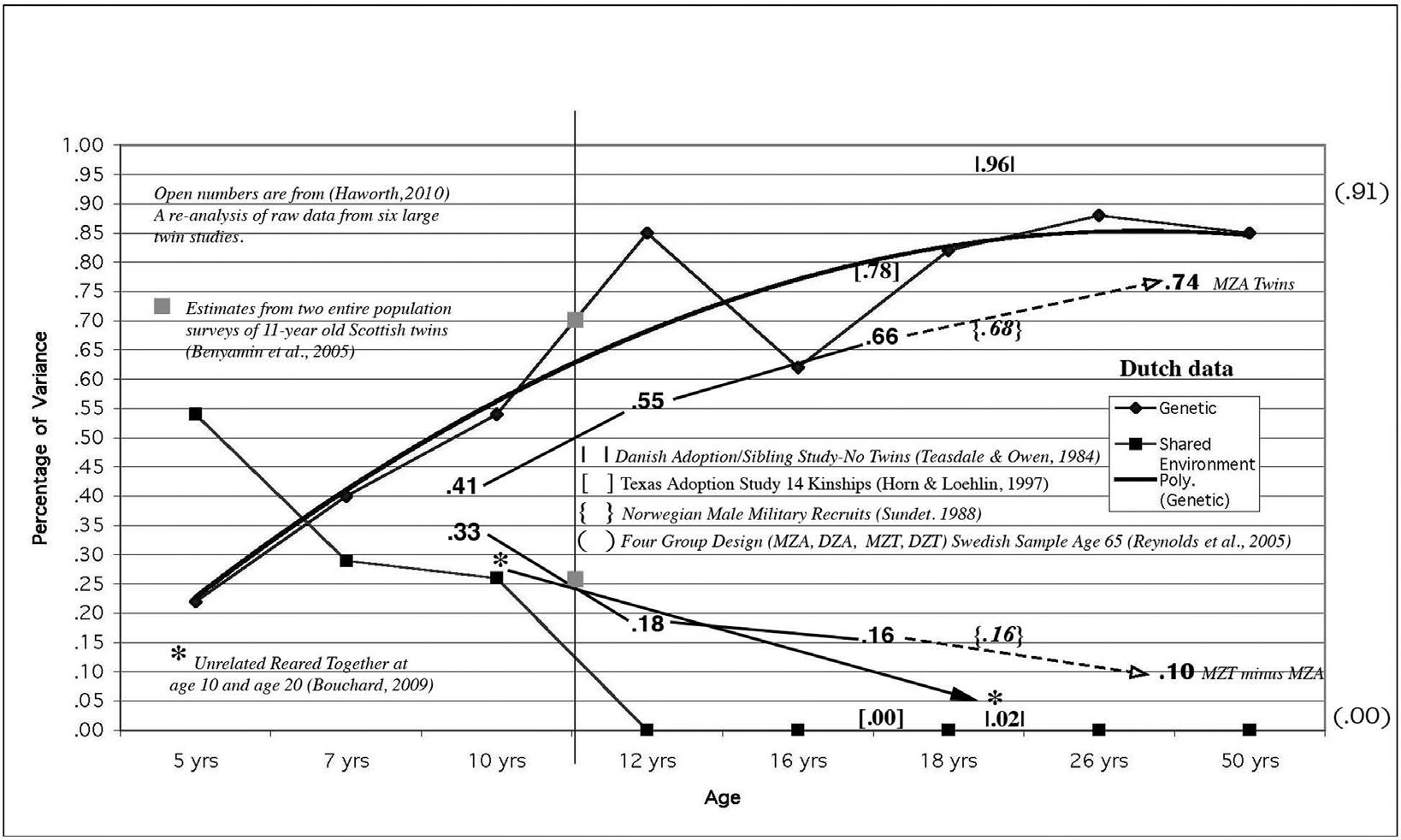
It's very well-established science that you could have easily googled, but downvoting unpopular research, pointing and shrieking "eugenics!" is a better argumentation technique, I suppose.
From the abstract: "Intelligence is one of the most heritable behavioural traits."
(However, it is true that saying that genes contribute to intelligence isn't eugenics. Eugenics is a methodology where you attempt to selectively breed humankind by broader intent, rather than by emergent properties of human tendencies. A proposed trait to optimize is often intelligence, but similarly frequently it's attractiveness and things like that. Genetic influence on intelligence is simply a hypothesis whose testing would have consequences on the practice of eugenics.)
------- edit ------- I see your reply to the other comment. I think a quote from the article that makes your point far better is "[...] studies have consistently shown that genetic influence on individual differences in intelligence is substantial." I negligently assumed you were specifically talking about heritability.
From wikipedia (https://en.wikipedia.org/wiki/Heritability): "Heritability is a statistic used in breeding and genetics works that estimates how much variation in a phenotypic trait in a population is due to genetic variation among individuals in that population."
The section titled "Intelligence brings (some) genetics to ‘social’ epidemiology" addresses your concerns about environmental factors.
I don't think it's very controversial to say genes contribute to intelligence. Genes contribute to everything, how could they not affect intelligence? This isn't eugenics, nobody is saying we should (or could) use this information to selectively breed humans, and nobody is saying intelligence can be correlated to race.
We know that selection happens at the level of genes, not individuals. You can't measure the fitness of genes by evaluating their effects solely on individuals because their effects may involve ensembles of individuals. Since humans are highly social beings, I'd expect our genes to be selected for intelligence at the level of cooperating brains as well as individual brains. There doesn't seem to be much research on measuring this aspect of intelligence.
That's the uncontroversial perspective, yes. The more controversial, but far better-supported-by-evidence perspective is that the estimated 40-80% contribution that genes make to people's intelligence, conscientiousness, and work ethic is much more likely to be at play, here.