but does anyone in this space take interest in public objection to (further, and continuously) altering the atmosphere and its balances/patterns?
Is this discussed? What is the community model on this - is it like fracking, where everybody tells each other there’s no way it’s big enough to make a difference to anything?
I don’t think this sulfur-in-shipping-fuels-creating-cloud-cover topic has been studied for decades, a lot of the research is new in just the last couple years
Carbon dioxide annual emissions, despite years of discussion around lowering them, continue to rise. With the resulting atmospheric levels reaching levels not seen in human existence. And this shipping fuel change is (surprisingly quickly) revealing some of the impacts of that, that the warming caused by carbon emissions is much higher than previously understood.
and other levers for environmental weather-pattern alteration (used both for vanity projects like the Olympics in China, all the way down to farming assistance and etc) that impact balances and threshold patterns in surrounding areas.
Somewhat counterintuively, if we suddenly somehow reduced our emissions to 0 overnight, the global warming would rapidly accelerate for a few years before declining.
Regardless of the current strength of aerosol cooling, all future climate change scenarios project decreases in particulates and this includes the scenarios where 1.5 °C (2.7 °F) and 2 °C (3.6 °F) targets are met: their specific emission reduction targets assume the need to make up for lower dimming.[85] Since models estimate that the cooling caused by sulfates is largely equivalent to the warming caused by atmospheric methane (and since methane is a relatively short-lived greenhouse gas), it is believed that simultaneous reductions in both would effectively cancel each other out.[86] [87] Yet, in the recent years, methane concentrations had been increasing at rates exceeding their previous period of peak growth in the 1980s,[88][89] with wetland methane emissions driving much of the recent growth,[90][91] while air pollution is getting cleaned up aggressively.[92] These trends are some of the main reasons why 1.5 °C (2.7 °F) warming is now expected around 2030, as opposed to the mid-2010s estimates where it would not occur until 2040.[83]
the rest
https://en.wikipedia.org/w/index.php?title=Special:Search&se...
Agree the OP article is about SO, thanks for playing along.
I didn’t understand SO2 being zeroed out by methane. Like one warms, one cools, they cancel eachother out? In this case humanity is removing SO2 (net = warmer) and adding methane (net = warmer) so if seems they both make things worse.
It seems like those clouds _shouldn't_ exist if they are caused by sulfur being pumped into the atmosphere? Why do we want them back?
Sunlight does stuff besides create heat.
Are you aware of fungal infections and deaths spiking recently?
At the cost of whatever it is the sulfur in shipping fuel did that got it banned.
Don’t bog me down with non-conversation - you don’t like something I’ve said, tell us all why.
We're talking, strictly, about loss of the cloud cover over the oceans. Put that strawman away.
is the point I’m raising.
No straw man or speculation, just asking questions about known mechanisms of biology, ecology.
https://bpb-us-e1.wpmucdn.com/you.stonybrook.edu/dist/7/4538...
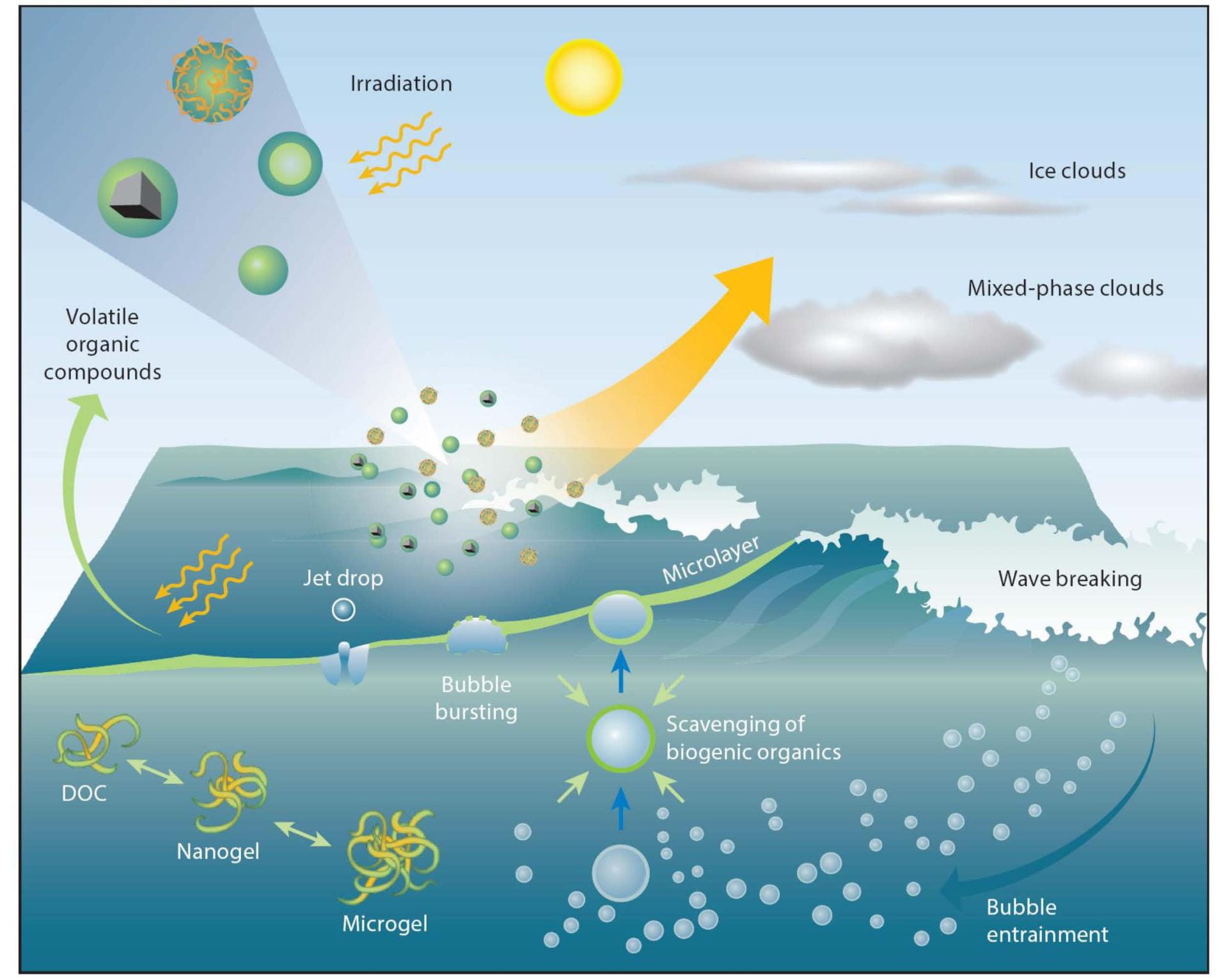
https://www.frontiersin.org/202b0306-bf2d-4244-9a94-97b6c9e3...
Only 25% of airborne microbes over the ocean are of marine origin, over 40% are terrestrial. There’s a lot going on out there.
No need to get snippy.
It would give us more time to address the issues before things go catastrophically wrong with the climate that we have.
If the argument is "we're not going to do anything anyways, might as well take our lumps with the new climate" then geo-engineering is a waste of time.
If the argument is "we need a bit more time to address the social and political issues that decarbonization brings about and get some sanity in the larger industrialized nations", then geo-engineering helps provide that time.
I'd predict that it would be used as an excuse to keep pumping fossil fuels for longer to increase that ppm since the urgency is dimished.
I'm sorry but this is incredibly naive. We're so far away when it comes to international shipping, grid scale storage especially in northern climates, etc Our global co2 emissions are still going up.
Look at the value of your solar panel in e.g. Berlin in winter. Do a bit of the math to see how much you should compensate for it. The more the renewables grow the more the compensation becomes important and pumping in norway gets you only so far and interconnects to benefit from wind never quite get there and are still intermitent. In other words your dependence on gas grows. Same with the wildly optimistic eu reports about net zero metal production. Even they are essentially saying oh we're just gonna produce a lot less high quality steel after we build a boatload of nuclear plants and the renewable transition is complete.
>synthetic fuels with net zero carbon
Presuming you're talking about hydrogen and derivatives (and not bioethanol) not only are they never quite net zero the issues with their energy conversion efficiency, the material science of the catalyists involved, etc remains mostly stuck.
I think it's an important part of the transition because heavy machinery, heavy freight, certain industrial processes, etc just doesn't quite work purely batteries in some contexts. But let's not pretend those projects are anywhere near where they should be and where they're at it's typically due to massive subsidies, wild twisting of the numbers, white hydrogen or optimal production environments that are limited in scale. I had a quick look. Less than 1% of production was green hydrogen less than 3 years ago. There's good reason for that.
>Therefore, anything we can do to delay climate change is good.
You're not delaying it at all. You're masking it. What's more is that the only meaningfull difference between masking it now vs in another half century is in you taking the pressure of to transition.
Once the genie is out of the bottle it's quite damn hard to put it back. Physics makes sure of that. Your best bet is to let it out as little as possible as soon as possible. The absolute best bet is still to focus on not letting it out.
If you want another fun bit of napkin math look at our best experimental carbon capture plants like the one in iceland or so and their (again optimistic) numbers then see how many we'd need to cover only our current emissions.
Happy for any followup questions.
Here’s an article from MIT explaining more: https://climate.mit.edu/ask-mit/how-much-global-warming-has-...
For lots of cargo, it doesn't matter if the shipment takes extra couple months.
We used to have a wind powered shipping industry before.
With solar/wind only, you would let the ship take longer. But it would be simpler and cheaper. Maybe a couple of batteries for electronics, but not for movement.
Going fully remote via Starlink would indeed be a requirement. You manage a bigger slower fleet instead of a single ship.
The first ship in the new wave is Neoliner Origin operating between Baltimore and France
https://en.wikipedia.org/wiki/Neoliner_Origin
Then this isn’t cargo but it is a very cool solar/wind electric ship for cruising the arctic:
https://selar.cc/pages/the-ship
A lot of the images are renders but the ship exists and going through sea trials now
They are both equipped with diesel engines as backup. Hopefully these two will provide valuable experience for these rigid sails.
I'd like explanations and excuses from all those who want to pack us in cities, in high-rises, like ants, and who keep attacking individuals' rights to move freely using cars.
I'd like to know who you are talking about? I have never heard of bands of eco activists rounding people up and herding them into cities and high rises like cattle.
> who keep attacking individuals' rights to move freely using cars
Absolutely. Those street gangs of eco activists stopping us at gun point and forcing us out of our cars are really becoming a nuissance.
/s
Like never before, we need the street fighting mathematicians and other scientists to engage these roving hordes.
Cornelis Drebbel (1572-1633) is my favorite Alchemist. Not only did he create the first cybernetic system (a thermostat) and perpetual motion machine (powered by fluctuations of barometric pressure) but also the first functional submarine.
Around 1620, witnesses saw it row under the Thames for hours.
Robert Boyle speculated how they might refresh the air — and of course oxygen is an issue — but carbon dioxide build up is bigger.
I suspect Drebbel used a slurry of lime as ballast to pull out the CO2. (I have a full sized replica of his sub in Amsterdam, but no I haven’t tried it yet.)
Just in case you wanted a historical perspective on carbon sequestration!
It just so happens that Beavers are the only other species capable of this kind of land use change.
So I think for this problem it’s us and the beavers…
Beavers are far from the only animal that produces land use change. But they are one of the smaller number that change it for their own benefit.
If reduction alone was an effective strategy we wouldn’t be where we are today.
What you're worried about is people looking for someone to blame ... and finding you. Politics, in other words.
Although I'll agree with politics on one front: any form of geoengineering, including further increasing global warming, will have winners and losers. And global warming is pretty unique in that it essentially only has winners. The earth becomes greener, more fertile, and needs a lot less heat. Fixing it will ... well, it will do the opposite.
But my mental model is that the stable climate we have is more like a light switch. It's not about a little warmer, it's about we go too far and switch into a chaotic climate unknown in the entirety of human existence. Even with the "big" affects we've seen so far, they're still in the "stable climate zone", haven't flipped the switch yet. Thoughts?
Doing nothing is certain doom, so why not do something? We can't fuck the planet any harder than we already have.
What do you mean doing nothing is certain doom?
Sorry, I mean to say that's the scientific consensus, in IPCC reports, ... Both of those.
Keep being on the wrong side of history. The history books will label what you probably view as "plausibly reasonable" hemming and hawing as ecoterrorism.
I don't need to convince you, you already know you're (we're) wrong in the way we handle our climate. It's just a question of whether or not you'll acknowledge the guilt around it.
What on Earth are you on about?
Every other planet we know of is a counterexample to this argument.
The Earth is a paradise, but it's fragile; and things can get SO MUCH worse.
Here’s my two for why I say we’re still in a stable climate. But we are very much in a period where, if we don’t change anything, we won’t be for long.
1. If we look at the geological time of all of human existence, we’ve been around for 1.5° of warming before. And the climate didn’t fall off a cliff.
2. That’s said, Earth has not been at 420 parts per million of carbon dioxide in human history. We’ve never breathed air with this much carbon dioxide in it. If nothing changes over the next hundred years or so, then we will be in a chaotic climate unknown. (i’m not sure how strict a definition of this is, if nothing changes. If we continue emitting like we are, certainly, but if we halted all emissions today, which again I don’t think is all that likely, but it might be that we don’t go over the cliff)
The path ahead is clear. It’s up to us to figure out whether we change it or not.
To me, a chaotic climate is post ice shelves melting, poles going away, and tundra methane bomb going off.
Active measures to control (ie. choose) the outcome are known as geoengineering. Read up on it.
Wait, what? Are you seriously saying this?
One notable change to Bangladesh is that the southern desert has withdrawn ... literally to zero, there isn't a square centimeter of desert left, but it wasn't huge to begin with, plus it wasn't entirely in what is today Bangladesh.
In 1850, before global warming (or at least the human part), probably 40% of India was a desert, versus 13% now. And India is the size of Western Europe right. The area that became agricultural land and forest because of global warming is about the size of France PLUS the size of Germany.
Additionally, global warming is increasing the water available to Bangladesh, not decreasing it as you might expect. But as you point out, yes, there are winners and losers. Although, frankly, a water infrastructure project (that needs to be done regardless of global warming or not) could fix the lowlands problem AND help the water shortage in other parts of the country. That should be a priority, but they won't do it.
But yes, in summary, I would consider the people of Bangladesh, and especially all of India overall winners in global warming. Very big winners in fact.
That won't stay that way: water shortages in the Ganges valley will get worse and worse over the next century (whether or not global warming continues, just for slightly different reasons in each case). But the problem hasn't really taken off yet. It's a rounding error at the moment.
I do understand that past performance is no guarantee of future success and there are regions of India (not Bangladesh btw) that will become difficult to inhabit at over 2 degree warming. On the one hand I'd say they have plenty of warning, but I don't believe for one second they'll do anything about it.
The point is that change is change. Global warming has so far had very few victims (and yes "so far" is probably justified in that sentence). Really. But not zero. Absolutely. Not zero.
https://wsup.com/media-centre/news/what-bangladeshs-groundwa...
Among other considerable problems they caused they pumped so much water sea water is spreading inland through the ground and poisoning and contaminating the soil (apparently this doesn't just introduce salt, but also dangerous bacteria and viruses).
This is interesting in itself.
I wonder what this data looks like if you only took data from habitable places, e.g. you could grow grass naturally for a portion of the year.
Lots of nonsensical places to live are being propped up by cheap utilities right now…
The farms suffering from drought would like a word with you.
And yet we're still pumping up fossil fuels and this geoengineering would be used as an excuse to keep doing it. At some point we're going to feel other effects or potentially be trapped expending resources to keep the geoengineering going.
Looking at the cold, hard numbers, geoengineering isn‘t the best option to keep the nightmare level tipping points from happening. It’s the ONLY one.
This is a problem 200 years on the making and the numbers and the momentum is incomprehensible. We can scramble how many more teaspoons of rudder surface we can get into the water to turn the Titanic around, or we can use the same energy to put rubber on the hull.
All we need is buy us time for 50 more years.
There really is too much warming. We have in fact known that humanity's CO2 emissions will be dangerous for well, well over a century but haven't done much in mitigation efforts ever since for much too long, especially "thanks" to fossil fuel corporations investing a lot of money into deflection such as the "co2 footprint" [2].
The problem is, with each year we wait in reducing carbon emissions, we have to do much more work in the future. Carbon dioxide (and other climate gases) are like compounding interest in debt, the longer you wait the more you gotta pay in the end.
[1] https://en.wikipedia.org/wiki/History_of_climate_change_scie...
[2] https://www.theguardian.com/commentisfree/2021/aug/23/big-oi...
(Do people really believe that? Is this based on watching too many Bind films?)
The first one.
Thank you for asking, it shows that you know what you don't know, and that are willing to learn. Wish more people were like that.
Now that you have the answer, you can go forth today with new knowledge and ponder new possibilities.
At least you aren't asking questions about which your mind is already made up, with an intention to argue with the people who give you the correct answers, like some sort of bad-faith internet poster.
Any strategy which you fail to apply is going to be ineffective.
The reason I say that's the main problem, is because that's also the main problem with reducing fossil fuel usage.
It's fun to debate the technical details of geoengineering (solar shades, atmospheric aerosols, enhanced weathering, etc.), in the same way that it's fun to debate the technical details of carbon reduction (energy storage methods, approaches to electrical transmission, remote work, land use, etc.).
But none of that really matters if we, collectively, don't actually do anything! It's not as fun as comparing scifi fantasies, but the problem we need to solve is that of getting humanity to actually do something, at scale, which is collectively acknowledged as necessary yet is not immediately/individually profitable.
If we could solve that, then we could do geoengineering; but in such a world, we might not need to, because we could also do carbon reduction, plus a bunch of other stuff!
However, if we can't solve that, then geoengineering is an illusion.
It's a grass-is-greener fallacy: what makes any geoengineering project seem remotely feasible, in a world where we can't even coordinate on the obviously-a-good-idea stuff?
Why change the habit of a species? Just saying.
Clutching at our pearls at this stage just seems a bit ... ridiculous considering what's gone on.
As opposed to trying to flinch away from it and pretend it doesn't exist. And then acting surprised when that doesn't make their influence go away - and merely makes it unguided, purposeless and often harmful.
The way I see it, if we want to inhabit this planet for the next several hundred thousand years, eventually natural variations will arrive that swamp anything we've unseriously done. So we're going to need to figure out how to set the world's thermostat. Might as well start working the problem now.
Geoengineering on a planetary scale is like "fixing a bug" in a foundational software service without enumerating all the customer use cases - you will get burned.
As an example of the system's complexity that blows my mind, scientists discovered that bears pulling salmon out of rivers is a critical supplier of nitrogen to the forests on the west coast.
Feels more like saying “we’ve been smashing the house up by flailing this hammer around wildly, and now you suddenly want to use it to repair the furniture?!” Sure, I get the temptation to lick the hammer away in a box, and the carpenter will eventually repair the house without a hammer, but I think they might be faster with the hammer.
The real danger of geoengineering (and perhaps a good reason to hold back until we’re well on the path to carbon neutrality) is that it can hide the long term damage in the short term, and we need people to reduce the long term damage, or geoengineering becomes a crutch.
Or to bring my metaphor back, we really don’t want to our carpenter to start seeing everything as a nail just because they’re holding a hammer.
Yes, that's geoengineering; but it's not "collectively acknowledged as necessary yet is not immediately/individually profitable". That was a crucial part of my argument.
It's not hard to drive adoption of things which are profitable (quite the opposite, e.g. we have all sorts of black markets).
> Clutching at our pearls at this stage just seems a bit ... ridiculous considering what's gone on
I wasn't pearl clutching. I was pointing out that beneficial, climate-mitigating geoengineering (which, unfortunately, is not directly profitable) is not actually happening. Like, at all.
Complaints about carbon reduction not happening fast enough are absolutely valid; but that also undermines any hope of doing enough geoengineering either, given that's even less active, and has even less incentive (it wouldn't be a full solution, potential downsides, yada yada). Again, I'm not saying we shouldn't do it because of those factors; I'm saying that it's literally not happening, and those factors don't help with adoption.
Conversely, if we try to hand-wave the coordination problem for (beneficial, not-directly-profitable) geoen, and just assume that enough powerful actors will eventually get on board with geoengineering for whatever reason; then why can't we wave our hands in the same way for carbon reduction too?
I'm not complaining about the implementation details, I'm complaining about the logic. It's a grass-is-always-greener fallacy: geoengineering would suffer exactly the same coordination problems that are clearly hampering the carbon reduction approach. Unless we solve the coordination problem, we can't do either of them.
Geoengineering can be carried out by a single country unilaterally. That's the geoengineering edge.
Emissions have to be solved by every major country, and in coordination - otherwise, economics favor whoever fails to do it.
This has plusses and minuses, but mostly minuses. It is less invasive to the rest of the world's ecosystems than either continued global warming or solar geoengineering with sulfur compounds. Most of the damage is confined to humanity, along with making a few areas that were already ecological wastelands uninhabitable (though interestingly, that has improved biodiversity in the Chernobyl Exclusion Area and North Korean DMZ). The downside is, of course, that 75-90% of us will be dead and whatever modern technologically-advanced society we have will collapse.
The MAD nuclear standoff means that every country stands to lose a lot and gain very little by pulling the trigger. If starting a nuclear war is lose-lose for every actor, war can be prevented with low coordination burden, as long as the decision-making remains anywhere near "rational self-interest."
1) There are not so many nuclear-armed states that one country can launch an attack and have enough country blamed for it. Likewise, there are not so many nuclear-armed states that one country might launch nukes by accident or irrationality.
2) All nuclear armed states have a future, i.e. there is no nuclear-armed power that is facing an existential threat other than nuclear weapons.
#1 is the wisdom behind nuclear non-proliferation, and why all nuclear-armed powers do everything they can to prevent other states or non-state actors (like terrorist groups) from getting nuclear weapons. If there is ever a situation where a suitcase nuke goes off in Washington or Moscow and they aren't sure who did it, the world ends. The set of nuclear-armed powers initially started with the 5 members of the UN Permanent Security Counsel and since then has expanded by Israel, India, Pakistan, and North Korea, with Iran being widely suspected of being close. You see similar examples of cartel-collapse (another MAD situation, with lower stakes) when the number of participants reaches about 10 - notably, one mechanism by which OPEC prices often collapse is when smaller member states secretly overproduce and Saudi Arabia has to cut to make up the difference. Another mechanism is when new firms enter the market without any incentive to maintain the existing detente (eg. the U.S. entering the oil market with the fracking boom of the early 2010s, or Facebook blowing up the high tech wage-fixing cartel by poaching everybody's employees with generous stock grants).
#2 follows from the finite/infinite game distinction. As long as the payoff for launching nukes is destruction of your state, there's a strong incentive not to do it. But if your state is gone anyway, and launching a war of aggression gives you a chance of not dying, the incentives flip. A (non-nuclear, but business) example of this was the patent detente among major tech companies in 2010, "and then Nokia launched the missiles". They were facing bankruptcy anyway, launching a bunch of patent troll lawsuits gave them a potential way out, and if everybody else retaliated, the worst that would happen is they go bankrupt, which was happening anyway.
I've heard a number of geopolitical analysts speculate that the Russia/Ukraine war was driven by exactly this: Russia's terrible demographics following the post-Soviet collapse, compounded by the death toll from COVID, meant that they will no longer have the capacity to wage war as an advanced industrialized power within 5-10 years, and so it was now or never. Climate change is another very obvious trigger for why a state may end up default-dead and hence have nothing to lose from starting WW3.
Exactly! We must learn to cope with it. Without stopping to look for a solution that does not impact the economy negatively.
Inaction is, on the other hand, very easy to justify. That doesn't make it a good choice.
Acting with imperfect understanding beats letting climate change unfold as is.
"Stop pumping out crazy amounts of CO2" sounds nice on paper, but has proven challenging to implement in practice - fossil fuels are too damn useful. And even if we got over that hurdle and somehow terminated CO2 emissions to net zero by 2030 (fairy tale levels of realistic), we'd still have decades of warming baked in because of CO2 that was already released.
In reality, it seems likely that the burn on fossil fuels will continue for as long as it makes economic sense for it to. Read: multiple decades before net zero at the minimum.
So, are we going to eat multiple decades worth of global warming - or are we actually going to do something about it?
Because geoengineering has already mapped out levers with outsized effects on climate. And we understand pretty damn well what the consequences of not pulling those levers are.
(disclaimer that I manage a climate research group, and this hit a nerve because we've had balanced discussions on this topic ad nauseam for the last 30+ years)
And as soon as a major country experiences a climate event (especially heat wave) which seriously endangers its ruling class, the gloves are going to come off - "Shut up and seed those big, reflective clouds NOW."
The earth seems to get along just fine without us and it keeps showing us by somehow always being the last thing standing when yet another civilisation collapses - as ours will too.
Somebody wants to try remediation, and instantly folks say Whoa! Not so fast!
Or do you mean it's better to do unintentionally?
https://attheu.utah.edu/research/cleaner-ship-fuel-changed-c...
Not even clear if there was a change ...
> It turned out that the clouds after the fuel change held more total water overall, which balanced out changes in droplet size and maintained cloud solar reflectivity, known as albedo. Had the albedo of Atlantic clouds reduced, they would have reflected less of the sun’s heat back into space, thereby warming the climate.
>In 2020, fuel regulations abruptly reduced the emission of sulfur dioxide from international shipping by about 80% and created an inadvertent geoengineering termination shock with global impact. (...) The amount of radiative forcing could lead to a doubling (or more) of the warming rate in the 2020s. (...) The warming effect is consistent with the recent observed strong warming in 2023 and expected to make the 2020s anomalously warm.
But haven't we recently learned that marine algae are the primary net absorbers of CO2? cutting their sunlight therefore cannot do much good. Better than we cut sunlight over land than water. (Plants absorb CO2 but do not sequester it nearly as much as oceanic algae.)
https://www.whoi.edu/ocean-learning-hub/ocean-topics/climate...
https://en.wikipedia.org/wiki/Iron_fertilization
It's based on that the bottleneck for marine algae is nutrients... and so if you dump a few tons of rust in the ocean, you'll fertilize it, start an algae bloom which absorbs CO2 out of the water (allowing it to be replaced by atmospheric CO2)... and then when the algae dies it descends to the ocean floor where its trapped.
https://cpo.noaa.gov/the-unintended-consequences-of-reducing...
Climate science is complicated and confusing.
I’m exploring how to cleanly re-create those lost clouds over the ocean. Fuel additives, spraying sea salt into clouds, modifying ship routing. If this is up your alley hit reply.