How long do you sit in a bath?
> Of course, there's also an app so you can start filling up the bathtub when you leave work for home so a hot bath is waiting for you.
My immediate reaction to this is, “there’s a way for my house to be remotely flooded”.
Another Japan resident here! It is common for a family to share a bath for the evening. (One at a time!) This works because each person showers to get clean before you get in the bath. Many also have folding bath covers, which help to avoid the water from cooling down and to keep the water clean during the showers. Still, nobody wants to be last.
> My immediate reaction to this is, “there’s a way for my house to be remotely flooded”.
A smart reaction! But most baths are also whole-room units, with a floor drain, and are intended to get wet. I myself have forgotten to stop the bath water a number of times (neither I nor my bath are so "smart") and while it is an unfortunate waste of water, there is no danger of flooding, only slight embarrassment.
BTW, Japanese bathing is somewhat visible in My Neighbor Totoro, a really cute movie.
That's unexpected.
Nice concept! Do you have any problems with mold build up?
Bath rooms in smaller apartments, and also in hotels, tend to be, literally, whole-room plastic/resin structures, so it dries easier and if mold appears it's in the plastic surface and easy to get rid of it.
I have a friend with a very big fancy apartment, and his huge bath room is covered mostly in tile and has very good ventilation. The bath even has a waterproof TV so you can watch a movie meanwhile!
I live in famously hot and humid Singapore, and it's usually around 70% to 80% humidity here during the day. I find it hard to believe Japan is even muggier?
I just randomly checked the weather for Osaka and Tokyo (on Google) and they have about 60% to 70% at the moment.
It's fun in the winter when you're running humidifiers but forget to turn off your house ventilation and don't understand why you're still so dry.
Do they have Mechanical Ventilation and Heat Recovery (MVHR) or is this more like Aircon? I've recently moved somewhere more humid and I'm looking to get a grip on what other countries do.
80kg of meat can hold a lot of heat. It cools quicker than you think it would. Also, Japanese families often share the bathwater within themselves(but everyone showers outside the tub first), and the water will become lukewarm at some point in that use case.
> My immediate reaction to this is, “there’s a way for my house to be remotely flooded”.
Yep, remotely operating a machinery will always have some risks. Every machinery should have someone with an emergency stop button should be monitoring it at all time, ideally. But it's a well engineered tub auto-fill in the shower room, it effectively belongs to "inherently safe" category of equipment.
This is uncommon in the US, so a bath overflow quickly becomes a significant structural issue.
It's the metal plate usually just below the faucet that looks like it might be useless. But it has an opening underneath to let the overflow water in. These are always sized to handle more water than the faucet can output.
This is basically a non-concern in anything but very, very old, unremodeled bathrooms.
The sinks do as well, but it is more obvious.
But the sibling comment to this one, where a sink had an overflow, but it was not connected, did not meet code [also 1].
Go figure. There must be some reasoning there, but I'm confused as to what it is.
https://forms.iapmo.org/email_marketing/codespotlight/2018/m...
So if you have old two-prong outlets in your house from back when, those are allowed.
If you replace them with a three-pronged outlet which is ungrounded, that breaks code.
If the three-pronged outlet is a GFCI outlet labeled with NO ELECTRICAL GROUND, that is allowed.
Basically a spa experience every day.
I just wish dish washers and dryers were more common in Japanese households. I'm in Okinawa where dryers are a lot more "standard", but dish washers are relatively rare.
truly bizarre
I think a lot of European houses have floor drains in the bath, you can basically hose the bathroom down.
More on topic. Outside of the US R290 (propane) heat pumps are common. But illegal in the US because the refrigerant manufacturers control the code bodies. You can have a 20lb propane tank hanging off a BBQ which in normal operation is literally on fire. But you can't have an R290 monoblack cause it's too dangerous.
Weirdly, in the UK it's common to have carpet in the bathrooms.
I'm an American and my answer is at least an hour, maybe more, depending on how I'm feeling. I usually listen to an audiobook. Baths are for hanging out and relaxing in.
Taking your wife into the tub with you is just good economics then. Saves on water necessary to fill the thing p.
We love our baths here in Japan
> My immediate reaction to this is, “there’s a way for my house to be remotely flooded”.
I forgot to mention that it senses and automatically stops filling the bath at a select number of liters, even if you start a bath using the physical button when you're at home.
The entire point of a bath is to relax and soak in it. Otherwise I'd just take a far more economical shower.
Depends on setup, of course. If there's a central AC blowing hot/cold air through ducts, you're stuck using a grey water loop. But it is the least attractive setup...
These are truly _bath_ rooms. The shower and bath are side by side, with the intent that you wash off before hopping into the bath to soak. Thus if the tub overflowed it would just go down the shower drain.
You can totally remodel bathrooms to be "wet rooms" in the US, it is well worth it.
Kids flooding the bathroom via the tub? Not a problem. Toilet overflowing? Gross, but not a problem.
I wish I would have made all the bathrooms in my home wet rooms.
Contrast this with the all-in-one design where a person taking a shower monopolizes all the plumbing fixtures even while they are not using them. I was on a bachelor party trip with 8 guys and two bathrooms where some inconsiderate people camped out in the shower for 20 minutes while people waking up had to pee so badly they went outside in the bushes. Meanwhile on a trip to Japan with five people we could easily share one or two split bathrooms and never had an issue.
Oh, and the electric bidet is a clear winner in terms of bathroom accessory to buy. Less TP use and no threat of swamp ass that demands you take a shower. Heated seat in winter is a blessing, especially in the morning. After my Japan trip it was the first thing I bought when I got back home.
I've also got the ecocute but I was told that it's cheaper to just pump fresh hot water into the bath than recirculate the cooled down water. It uses less energy to pump the already boiled water into the tub than to heat it back up.
Though fresh water and letting out the old will clean the water you are soaking in, which may be valuable.
My rates are 36yen from 6am to 10pm and 19yen on the other end.
Re-reading my earlier post, I should’ve said cost and not energy.
However this is somewhat old fashioned, the most modern tarrifs vary on a 30 minute window, with prices set a day ahead. If there's a lot of solar and little demand on say a sunny sunday afternoon or windy february nighttime, then the prices may even go negative.
You want your consumption to be tied into there. You can do this with batteries -- for example on Tuesday I used 34kWh, 24kWh overnight (mainly to charge the car) and 10kWh in the day. If I had a battery I could have charged that battery overnight and saved a couple of quid, or about £600 a year (depends on what my daytime usage is)
However with a 30kWh battery I could have charged it on Sunday afternoon and been paid for that, and not used any power on Monday, Tuesday or Wednesday for the house. But then the agile rate last night was 25p/kWh. I did look at getting a battery and inverter installed but it wasn't cheap.
On top of that you've got self generation. I have very little solar generation, but in theory I reckon I could have 8kWp on the roof -- I'd want to charge the car (and house battery, and any heatpump or ac) when the sun was shining then, which would be even cheaper than charging at night. Home Assistant will do that, but it feels a little fragile with my car charger (if the HA dies, the charger won't start, and then I can't go anywhere. It's not a great charger)
In fairness it probably works ok for homes insulated to a much higher standard than most British ones.
I'd love to have something like that!
Whenever I take a hot shower I fantasize about putting in a liquid-to-liquid heat exchanger so the hot water can heat up the cold water and you can run the hot water at a much lower temperature.
This application with the bath tub feels way more justified.
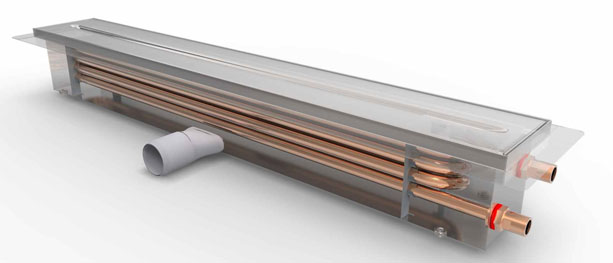
This is even simpler: https://warmduscher.de/produkt/warmduscher-original/
Drain heat exchangers are really expensive, this 3” by 48” copper one costs over $1000: https://www.homedepot.com/p/Power-Pipe-3-in-x-48-in-Drain-Wa...
Any calculations I've done made it unfortunately useless to buy solar and instead favoured investing the money in the stock market.
Having two options during cold winters can pay for itself with one emergency repair though, or be a massive savings if it can't be fixed fast enough and pipes burst.
> Gas is surprisingly, weirdly cheap, often not even metered in apartments.
One of the houses I rented many years ago didn't even have metered gas. We paid a "hookup" fee to the city (like... $40/quarter?), and they didn't care how much we used, as long as it wasn't for commercial purposes. I assume the city had something for detecting extreme use or leaks, but that's probably it. It was a somewhat strange property though.
What you're describing is closest to "actually fair" I think we can get. A neighbour of someone I know leaves their apartment empty for long periods of time and when they're gone they just shut off their heating completely and leave all of their neighbours to pick up the bill - each apartment has their own heating system but they share walls, floors, and ceilings.
In Ontario Canada; your gas hookup is CAD$29/month (~US$21) every month of the year, on top of a per m3 charge for delivery to you before the gas cost itself. So on a smaller or well insulated residence, capping that pipe really helps push the economics in favour of heat pumps.
https://www.enbridgegas.com/-/media/Extranet-Pages/ontario/r...
You do not, to be clear, have a 98% efficient gas boiler. You _may_ have a gas condenser boiler which claims 98% efficiency in absolutely ideal circumstances, but realistically you're likely not getting close to that. AIUI 80% efficiency is fairly normal for real-world condenser boiler usage (non-condensers were more like 70%)
That alone probably will make a huge difference in how often you have to deep clean it.
I mean you can as long as you make the bathroom a wet room and shower outside the tub, which is exactly how the Japanese do it.
The biggest issue in the west is the room being wet to start with.
most owned apartments also are not build in a way where it's easy to retrofit. So if you don't do a "in depth" renovation anyway, its often just not a good option from a financial POV. Especially if you have to reroute plumbing (for the floor level wet room sink), especially if beton floor or pre-existing floor heating is involved.
Interesting! Is there some sort of filter system you can easily clean out, to avoid any issues?
I quite like the quarterly pricing, for example today the home-battery charged for 3 hours during the cheapest time (13:00 - 16:00), and discharged again for the most expensive hours (19:00 to 21:00), and kept my house's grid-input at zero for the rest of the day.
Feeding back a few kwh's during the most expensive hours gives me a big kickback, making electricity use for the rest of the day mostly free. (Since there is usually a 150-250% price difference between cheap and expensive timeslots).
(For price-charts, see https://jeroen.nl/dynamische-energie/stroom/prijzen/vandaag or price-predictions upto a week ahead there's https://wattwanneer.nl )
I don't have long-term data yet, as I just implemented this about 6 weeks ago, but last month's bill was 10% lower than the previous month and the same month the previous year. I'm looking forward to seeing the results over time.
I've been trying to think of what other automations I can try out when the price gets high. I thought maybe shorter light timers for automated lights, but all of our lights are LED, so the savings isn't really worth it.
My understanding is that there are large savings available theoretically at the grid level but the capital to build it is limited and the grid interconnects to make it work are limited.
So globally there are huge amounts of battery storage being added to the grid but this is bottlenecked by capital and grid connections. Oh and land/planning permissions.
Long story short, house level battery storage may be worth it for some people
As electric cars become more popular, we should see a deep market for second-hand batteries?
We have quarter-hour pricing here in Vienna and during the sunnier half of the year electricity is cheaper during the day.
It would be interesting to calculate how long it would take to pay off.
A market economist might remark that perhaps that shouldn't be surprising given the lack of intraday rates and the buy-all-sell-all policies.
> In the Netherlands (and the rest of western europe), we have hourly and quarterly energy pricing (opt-in), next to pricing plans that have one or two fixed tariffs during the day/year
So your policies create incentives for residential customers to become net producers of electricity (with resilient local storage)?
Huh. Is the heat exchanger located near the bathtub or in the EcoCute unit? And do you need to do anything complex to periodically sterilize the tub side of the pipes and the heat exchanger?
We have one of the "all-denka" electric plans, where we trade off cheap rates during solar hours for expensive rates during duck curve hours. By having the hot water only run during cheap hours, and having the aircon turned off/down during the expensive hours, we're paying less in energy for our all-electric house than we did in combined electric+gas in our 3x smaller apartment.
We pay approx (before fees, and the rates change slightly by season):
* 8 AM - 10 AM: 35 yen/kWh
* 10 AM - 4 PM: 13 yen/kWh
* 4 PM - 6 PM: 35 yen/kWh
* 6 PM - 8 AM: 19 yen/kWh
Our Mitsubishi has other nice features like it can recirculate the water in the bath through a heat exchanger after you already filled it and got in, so it will keep the water from cooling down to lukewarm, and you can even adjust the bath water temperature if you ended up with filling it with too warm or too cold water. Of course, there's also an app so you can start filling up the bathtub when you leave work for home so a hot bath is waiting for you. There's also an intercom to the kitchen "so mom can tell the kids to get out of the bath, dinner is ready".
edit: the wifi integration does have one actually useful feature: if we had solar panels, then it can use data from them to know when to run "for free", and it can use weather data to predict if it should wait for sun or not to run