Aside: I used to unicycle to work, and I have to say that it was both fantastic and much faster than walking while on a 27.5" wheel.
When you account for calorie transport it's possible the e-bike comes out on top, especially if charged from a local renewable electricity source.
This is simply not true. A pedal-assist bike will go faster with the same amount of W put into the pedals, yes. But will people put in the same amount of W if 60 % will get you to your "target speed"? I doubt it. And then you get less health benefits for the same distance traveled.
On my 8 kilometer commute I average 150 W. Not because I use it as exercise. That's just where I find my comfortable level of output. Every time I've ridden on ebikes I've put in much, much less effort. I'd be surprised if I put in even a third of the energy. That's great if you just need a mode of transport. Bikes are practical, efficient, and planning for them improves cities. Even ignoring the potential health benefits. But claiming that a pedalassist bike gives the same fitness benefits just doesn't pass the smell test.
They are both Pareto-efficient. Here's a chart of cost of transport (calories/gram/km) vs weight (kg) comparing a salmon vs a bicycle vs a jet fighter etc: https://www.bike.nyc/wp-content/uploads/2017/04/efficiency-g...
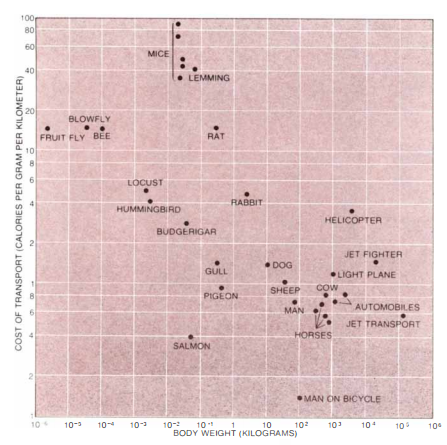
If everything around you is built with base assumption that you must have a car, then the optimization was done by someone else with a different definition of efficiency.
This isn't unique to cars - trains could give the same, but we already have a road network.
I think the same can be said (to a lesser degree maybe) about cars, which are very space inefficient. With enough sprawl and a certain density, e.g. in Toronto, it's just gonna be traffic for every one.
Cars don't enable many people to own 100 square miles - but I can get pretty close if I settle for 5 acres in an exurb. Many find that a single family house gives them close enough (they get a small garden - most likely grass they mow weekly - which is all they really want). But again it is a compromise. If we had science fiction technology (terraform Mars and Venus; teleporters) that 100 square miles might be reasonable.
Torotno exists, so of course car dependency is somewhat feasible in real life. The impossible part is travelling in the sprawl with relatively short time, as limited by the road's speed limit. The real limiting factor most of the time is traffic, because of the space inefficiency of cars.
I made this point because I seem to recall a city simulation game despawn cars (literally physically impossible) to make car dependent designs "work".
---
> you can reach enough of a city to consider it all the advantages of a city
With enough people driving downtown you lose most of the advantages, and it makes the lives of those who didn't choose this lifestyle worse.
Like, you'd probably expend a lot of calories traveling 10 miles by unicycle, and over time maybe that would be more significant than the materials difference compared to cycling?
Of course, it depends a lot on the diet of the human in question.
This is one area where I am concerned about the impacts of electric vehicles. They weigh a lot more than ICE cars and might cause more significant injuries for pedestrians. There probably ought to be some sort of tax or fee on vehicles that scales by weight. However, that would favor ICE vehicles over EVs so it may not be popular among the people who might otherwise be interested in such things.
I wouldn’t be surprised if the higher-mass electric vehicles are more dangerous to other cars when involved in car-vs-car collisions, though.
If you take a direct hit with even a tiny car at faster than 30mph you are dead. However smaller cars make it somewhat less likely you take that direct hit.
In a similar body size, EVs tend to weigh more, due to all the extra battery.
> The probability of a fatality, conditional on a collision, is 0.19 percent -- or about one in five hundred. The authors find that being hit by a 1,000-pound heavier vehicle results in a 47 percent increase in the baseline probability of being killed in the accident...
https://www.nber.org/digest/nov11/vehicle-weight-and-automot....
And of course not everyone wants to live in such a place, but plenty of people would. And in the US this is fairly rare compared to many other parts of the world.
Unfortunately they stopped building communities like this in the 1950s, but they sprawl for miles around Dublin, and I consider myself lucky to be able to live here.
I've visited cities in the Midwest of the US and found them to be like hell. Can't walk anywhere.
Many people live within 5 miles of one, but usually in denser areas where 5 miles could easily take 30-60 min of travel.
That's exactly the problem. There needs to be more housing built near grocery stores, and more grocery stores built where the housing is, instead of 5 miles away.
And no, fresh bread is not really a thing, outside of a few urbanish settings. A healthy proportion of bakeries don't even sell bread - only pastries, cakes, etc.
Most of us don't go to the grocery store more than once or twice a week. When we do, it's often a big purchase that you can't carry back in your hands or on a small bike. You'd need something with more cargo space.
I can't control the prices of the local store, and so it is efficient to have the ability to choose other stores and thus force them to compete on price.
EVs are pretty close to being able to replace ICE cars around here, but still can't match the range, cost, or longevity of an ICE vehicle. I could do 80%+ of my miles in an EV, but once or twice a year, we take a 1000 mile road trip that would be considerably more painful in an EV. If we're only going to own one car, it still needs to be ICE.
That said, I do own two cars. One of them is a 2001 Ford truck that is on its last legs. It's not very environmentally friendly to run, but given that I put so few miles on it per year, it's probably better than causing a new car to be produced, regardless of its technology.
Would I still be able to run a 2023 EV in 2044? Will the batteries last that long, with any sort of usable range?
You could just rent a car for those two trips like you suggested yourself in your first paragraph ;). Optimise for the most common scenario, not the least common one.
> Would I still be able to run a 2023 EV in 2044? Will the batteries last that long, with any sort of usable range?
Replacing the battery pack on an EV once every 15 years is certainly cheaper than all the maintenance that goes into an ICE in the same timeframe. Hopefully we can start recycling batteries properly before the current generation of EVs is up for battery replacements.
I recently hired a small car for £20 a day. Not a special deal, that’s just the price. A week would make that £140. An old car would cost almost twice that in taxes. Then you have maintenance, insurance, MOT, and devaluation.
This is true, but it's also worth noting that it's true because small and medium-sized cities systematically dismantled their public transportation systems between the 1920s and 1960s, replacing them with infrequent bus services.
One of the things I do when trying to understand how so many of our smaller cities became car hells is to Google "$CITY streetcars 20th century." We had the infrastructure and chose to remove it.
From anecdotes I've seen online, the only people who experience serious serious range degradation are atypical users (eg a taxi with 500k miles that exclusively uses fast charging) or owners of cars that don't have any thermal management for the battery (e.g. Nissan Leaf).
Amateur numbers.
The F-150 Lightning is 6,500 lb (2,950 kg) and the Rivian trucks (R1T, R1S) are 7,000 lb (3,175 kg). The electric F-150 is 35% heavier than the ICE model.
Meanwhile:
For those that have never tried it: it's like trying to go for a jog while maintaining a three-quarters-squat posture.
Space efficiency - how wide it takes to reach a certain throughput - train wins
Time efficiency - how much time it takes to get from point A to point B - barring traffic, car wins
Energy efficiency - how much energy it takes - bike wins
Your argument is just as strong without the subjective ranking of efficiency.
This depends quite a lot on ridership. E.g. a typical MAX train in Portland, filled at perhaps 10% capacity aside from a few narrow time periods in the morning and evening, loses out on efficiency to a Honda Civic with four people. Trains are heavy even when they are empty.
And many don't drive a Honda civic: they are driving the biggest, heaviest car they can get their hands on
Let me stop you right there. We "don't need" most of the possessions you currently own, including the one you're using to browse HN. We don't live for mere subsistence.
People can decide for themselves what they want to give up to reduce their carbon footprint, and that doesn't necessarily have to be their vehicle.
That was one of the exercises I had when studying - calculate the energy intensity of various modes of transport. It turns out that if you calculate the whole energy requirements to get the extra food into someone's mouth that they'll want if they are walking or biking, then it's not much different to the amount of energy that would be used by just driving a car. Making food is energy-intensive, and the conversion efficiency into mechanical output by a working person is very low. In contrast, an electric motor and a battery can both be made extremely efficient.
A gallon of gasoline has about 31,000 kcal. In the US, a typical sedan gets about 30 miles per gallon.
Walking a mile at 150lb bodyweight burns about 100 kcal. (This is non linear though: walking longer distances will burn less per mile on average)
If we assume linearity, to walk an extra 30 miles in a day you'd need 3000 more kcal of food. What is the energy cost of growing and transporting 3000 kcal of food? Does it exceed 31,000 kcal?
I can well believe that there is a 10:1 ratio between energy in and mechanical energy out of a human.
However my point wasn't that cars and humans are about the same. That's probably only true in the "same order of magnitude" sense. My point was that humans are way less efficient at propelling a bicycle than an electric motor is.
In order of efficiency:
(1) Walk
(2) Unicycle, roller skate, scooter (no battery, very little material)
(2) Bike
(3) Electric bike (and all forms of newfangled electric: escooters, segways)
(4) Electric motorbike or scooter
(5) Mass transit (can be public/private) transportation: Electric trains
(6) Mass transit (can be public/private) transportation: Electric buses
(7) Zipline
(8) Carpools on BEV
(9) Carpools on PHEV
(10) BEV
We can stop buying gas cars. Pollution kills 10 million EVERY year[1]. For context, the cumulative COVID deaths over 3 years are ~6.5 million. And fossil fuels are subsidized (Trillions of dollars per year). For 2022, this is $7 trillion[2]. Why are we subsidizing fuels that are proven to cause all kinds of diseases (nearly everything except STIs).
[1] Air Pollution Kills 10 Million People a Year. Why Do We Accept That as Normal?: https://www.nytimes.com/2022/07/08/opinion/environment/air-p...
[2] Why Are Governments Still Subsidizing Fossil Fuels? https://www.bloomberg.com/opinion/articles/2023-10-16/climat...
[3] https://www.imf.org/en/Blogs/Articles/2023/08/24/fossil-fuel...