Now I don’t think the ABA ratings are worth anything, but your assertion is factually untrue.
https://www.techdirt.com/2022/09/16/5th-circuit-rewrites-a-c...
It goes into thorough analysis into why this is such a lazy, stupid decision. This is the quote I agree with:
> Frankly, Oldham’s arguments sound much more like the arguments made by ignorant trolls in our comments than anyone with any knowledge or experience with 1st Amendment law.
This "judge" is an unqualified political hack.
The author, Mike Masnick, is a tech blogger — not an attorney, as far as I've been able to determine.
Even Eugene Volokh — who is both an actual attorney and uniquely qualified to weigh in here — didn't attempt to digest the 113 pages of the opinion, much less immediately produce a reasoned analysis. I'm sure one will be forthcoming.
The quote you cited from Masnick certainly isn't legal analysis. It's empty invective, as are statements like "This "judge" is an unqualified political hack".
A few other sources:
- Lawrence Tribe, a very senior center-left constitutional lawyer and Harvard prof: https://twitter.com/tribelaw/status/1562951505451266050
"A disgraceful Fifth Circuit decision"
- Reporters' Committee on Freedom of the Press (a deeply centrist/neutral organization) https://twitter.com/katie_rcfp/status/1570897188359909377
"Just finished reading the 5th Circuit’s decision in the NetChoice v. Paxton case and it’s . . . not good. To say the First Amendment analysis is deeply flawed would be an understatement."
- Orin Kerr, a conservative attorney who's also been a Federalist Society backer: https://twitter.com/OrinKerr/status/1570900354061180929
"I am old-fashioned, but I would think that inferior courts start with what the Supreme Court has said the text means."
(I did a quick search and found three sources that span the ideological spectrum, which show how widespread the negativity about this decision has been.)
This is a terribly-reasoned decision that doesn't make much legal sense. It's an ideological decision, motivated by the feeling that rightwing voices, which are actually boosted by the rich people that own social media, are instead, against all sense, suppressed.
That tweet isn't even about this case, it's about voting rights for felons.
Volokh is the Gary T. Schwartz Distinguished Professor of Law at UCLA, uniquely qualified to weigh in on first amendment law, wrote a column on first amendment and speech issues for the Washington Post for years, and frankly, I imagine would be pretty disappointed (but not surprised, in these illiberal times), to be written off as a “conservative attorney” when he’s consistently espoused libertarian views over the decades.
On top of which, he hasn’t actually weighed in on this ruling yet, and may very well take umbrage with the decision!
His blog at reason did, in fact, post a guest article arguing that the ruling falls afoul of the takings clause.
> Orin Kerr, a conservative attorney and notable Federalist Society backer
You just disqualified Volokh for being a “conservative attorney”.
Now you’re citing a conservative attorney whose opinion suits your argument?
That’s not arguing logically or in good faith, even putting aside the fact that your claims regarding Volokh are a fabrication.
They mentioned they cited sources across the ideological spectrum. In theory, that's good.
It sounds like the primary issue here is mischaracterization of Volokh, but that doesn't necessarily change or invalidate the other sources mentioned.
Volokh is a highly-credentialed subject matter expert whose work has been cited by the Supreme Court, and who has been working in first amendment and related law for decades.
His first book, in 2001, was "The First Amendment: Problems, Cases and Policy Arguments. New York: Foundation Press."
He published a 100+ page, peer-reviewed article covering this subject area in 2021:
https://papers.ssrn.com/sol3/papers.cfm?abstract_id=3913792
> He seems no more qualified than the sources mhneu provided.
He's a great deal more qualified, but that's not the point. He hasn't weighed in on this decision at all yet, other than to note that it was released.
I swear, the amount of "motivated reading" by emotionally invested commenters has me seriously suspicious of anyone that holds a particularly strong legal position on this just-released decision. People do not appear to be thinking. At all.
> This decision has been soundly roasted across the spectrum.
It may very well be rebutted by Volokh, but if so, it won't be a "roasting", and his position will certainly be a great deal more erudite than "this judge is an idiot!"
I brought up Volokh in contrast with the random tech blogger's review of the decision that was cited by the (now great-great-great...-grant-parent post), because if a subject matter expert like Volokh has not yet had time to read and properly analyze the decision, there's simply no way "Mike Masnick" of "Techdirt" has.
To me the one interesting bit was this: “ The websites do engage in editorial control. The difference from newspapers is that it’s ex post control. If there are complaints, they will review the content afterwards to see if it matches with their editorial policies (i.e., terms of use).”
I mean, I disagree — terms of use of a tech platform are miles away from an actual editorial opinion, they are bloodless legal documents and virtually impossible to read for pleasure, unlike actual editorial - but at least this engages with the decision on the merits.
I’d encourage anyone to read the actual decision, it (and the dissent) are more interesting reading than this. (And unlike at TechDirt the citations don’t approvingly quote someone named “Wonton Killing Hat”). https://www.ca5.uscourts.gov/opinions/pub/21/21-51178-CV1.pd...
For example, just look at the section where the opinion argues that the platform is bringing up "hypotheticals" it talking about curbing pro-Nazi or terrorist posts. I kept re-reading the quoted opinion again and again thinking "Is this judge a complete idiot?" To be clear, I'm not basing this on the commentary from the article's author (though I agree with him). But trying to argue that pro-Nazi and terrorist speech on tech platforms are "hypotheticals" makes me wonder if this judge has ever seen the Internet.
But IANAL and had to read through it pretty fast.
The judge’s use of the term “hypothetical” was correct, and does not represent an assertion, one way or the other, about whether “pro-Nazi and terrorist speech” does or does not exist on these platforms.
It's not a way of engaging in dialectic/dialogue. It's saying it's so bad you won't engage in dialogue. That's a legitimate position in some circumstances.
That this is a court decision, however, might mean that in these circumstance one does need to directly challenge despite it's qualities.
If someone doesn't want to discuss a topic, all they have to do is not discuss the topic.
Expressing such a position isn't a legitimate contribution to public discourse; it's a tactic that inhibits the process of building mutual understanding through discourse.
A reply that says "this is obviously wrong" may seem contentless but it's just "minimal content". You should be able to respond like this for the same reason you should be able to down vote things without comment. It's like a professor giving comment on an exam. Some questions they will just mark wrong, some they might write "makes no sense" to get the person thinking or clarifying and others they'd go into detail with.
There was literally zero argument in the original post. You don't have to write a full analysis of everything that was said, you can just pick the parts you're willing to discuss and focus your attention on that or don't engage at all.
That is clearly not based on facts. Corporations simply have a right to choose which speech they will AMPLIFY. That is not the same as muzzling anybody.
They don't knock on your door and say you better stop expressing these views or we will harm you. They don't even harass people online. They just simply choose which speech they will pass on and which not.
If you tell me something and I don't tell anybody what you told me, does that mean I "muzzle your speech". Of course not. Rather it is the case that you don't have the right to demand that I pass on your emails to all my contacts.
This is bad jurisprudence. I wonder, was this judge perhaps nominated by D. Trump?
That makes private messages an interesting question, though. Or even cases where many people explicitly subscribe to a single voice -- is the platform really amplifying anything?
Blocking such messages (to specific recipients who specifically opt to receive them) seems materially different than declining to promote/amplify such messages.
I'm speaking from an ethical standpoint; it may or may not matter legally.
I'll readily admit that algorithms can amplify content; but more than enough people have been tweeting for years and barely have any likes on their tweets (see @CNN, though I'm being cheeky). People say that algorithms reward bad content, because they amplify controversy; but really they just give people what they want. A "controversial" tweet with no likes won't get amplified.
The crux is that if you agree that due to their use of algorithms, these platforms "amplify" all the content they host, then surely that means they endorse whatever they don't ban, to some extent? I'm not making a legal argument, just an intuitive one. That reasoning doesn't scale to an understaffed, undermoderated social media platform that can't even ban the omnipresent "double your crypto" scam accounts.
It depends, can I go to the mall and start preaching the gospel?
The answer is yes - at least in NYC, SF, Chicago, etc (where these legal cases have played out). I’m legally aloud to do that; and as it’s the public square I cannot legally be removed (doesn’t mean you wont). It is considered the commons and open to the public. Inside a store is not the same thing, some jurisdictions have various rules.
Now back to this discussion. I agree a company wouldn’t be obligated to amplify, ie promote via an algorithm. That said, they shouldn’t remove someone’s ability to share political speech. On social media platforms they have been banning people for just that.
Social media is the commons, as such anyone should be able to preach to the masses. Though, perhaps it’ll be limited to only those who follow them.
That said, I think the Texas law is kinda stupid. Because the tech companies have claimed they ban for other reasons such as: misinformation — challenging elections, questioning vaccines, questioning masks, etc all get banned.
None of them are directly political in nature. However, only one political party rejects that stuff… that said, arguably I could go to a mall and preach any of those. The same protections should apply.
Social media is not the commons.
The internet is the commons.
Social media platforms are the stores.
Even for technical users, if you want to post a political video, is there really an alternative to YouTube with any audience for it?
Add to that platforms such as Facebook groups and Reddit subreddits, where the individual groups are much more like stalls and the platform is like the mall.
To be fair, Rumble is a decent alternative. Some videos have millions of views, they basically accept anything that’s protected by the first amendment. A lot of banned creators have moved or are moving there.
That said, I’d still argue YouTube is “the commons”. Just like you can have multiple malls and a town square, there’s no real argument there should be a limit.
In a free society you’re free to speak in the commons. That doesn’t mean anyone has to listen. That said you can’t boot everyone you don’t like from the town square.
Social media posts can be made, doesn’t mean you have to follow or read.
... or share posts. The same applies to social-media-companies themselves. They don't have to "share" your post to anybody.
They have much the same rights and obligations as you do (especially if you believe that corporations are "people").
It is a different question as to are they monopolies and should the law do something about monopolies.
Social media companies' platforms are not "Town Square". How do we know that? Because tax-payers are not paying for their operations. Their share-holders are paying for that by retaining some or most of the revenues in the company.
> Social media companies' platforms are not "Town Square". How do we know that? Because tax-payers are not paying for their operations. Their share-holders are paying for that by retaining some or most of the revenues in the company.
This has already been litigated in American history. It’s called a “company town”. I also previously mentioned how you can have protected speech in places like malls (litigated in New York and Chicago).
https://en.m.wikipedia.org/wiki/Marsh_v._Alabama
> ruled that a state trespassing statute could not be used to prevent the distribution of religious materials on a town's sidewalk even though the sidewalk was part of a privately-owned company town
That would be like expecting Facebook or Twitter to distribute any materials you give them, to everybody who visits FB. That would be totally unfair, companies don't have the obligation to pass on your messages to anybody.
Freedom of Speech means I don't have to repeat and amplify what somebody else says or wants me to say. It is not only the freedom to speak what I want, but also the freedom to NOT speak. And companies have freedom of speech too.
This judicial ruling sounds very suspicious to me.
The stores would be equivalent to stores. So Amazon, Etsy, etc. you can get there through social media.
They are actively blocking stories about Biden. Actively filtering stories about negative aspects of COVID vaccines. They are actively filtering stories about inconsistencies in the 2020 election - "The most secure ever".
They are amplifying stuff - absolutely... but they are also censoring free speech because "corporations are allowed too".
"If you tell me something and I don't tell anybody what you told me, does that mean I "muzzle your speech"."
No... but if you post a story and your account gets banned for stuff that's later found out to be true (IE: hunters laptop and the New York Post RIGHT BEFORE AN ELECTION)? that's absolutely muzzling speech and suppressing facts.
...or from forever blocking nonsense unscientific articles from a newsfeed
...or from wearing a shirt that's pro-Democrat at a convention
...or from bringing scientific consensus into Fox talking heads shows
...or from posting on their subreddit unless certified by a peer as being sufficiently conservative
That your post focuses singularly on denial of Republican establishment talking points shows the real intent implied by those pushing such laws, without any consideration that the "cancel culture" has been a deep tradition pervasive in media and American life on both sides of the aisle.
Also, corporations either have personhood or they don't. Do you support the Citizens United decision?
I'm fine with allowing them to censor speech if they also are liable for the speech they do choose to publish, just like any other individual, newspaper, or publisher would be.
Platforms cannot simultaneously claim that:
(1) They are mere conduits for other people's speech, and thus, deserve to be shielded from any liability for what they publish
(2) What they publish is their own speech, and thus, their publication choices should be considered protected expression under the first amendment.
If Fox News publishes libel, they can’t just claim that they’re hosting someone else’s reporting.
If a telecommunications provider publishes someone’s libel, they are shielded from liability as a common carrier. In exchange, however, they must provide their services non-discriminatorily to the public.
If FedEx delivers controlled substances as part of their usual course of business, they are also shielded from liability as a common carrier, but the same responsibility to serve the general public applies.
YouTube and other “interactive computer services”, however, were granted an explicit privileged shield from liability by the Communications Decency Act of 1996, with none of the responsibilities historically associated with that privilege.
Without the CDA, Twitter wouldn’t exist; they’d have been sued into oblivion long ago. Instead of solving that problem by extending our well-understood common carrier framework to “interactive computer services”, we granted them a massive privilege and asked for nothing in return.
Providing service without discriminating... how does holding all users accountable to the same terms of service not satisfy that requirement? I don't know of any cases where a person kicked off their ISP for torrenting subsequently denounced the ISP as a "publisher".
Are you saying that we get to dictate to internet companies exactly what their services entail? Doesn't sound quite right to me.
The idea that a single website is a common carrier seems to stretch the definition to the breaking point. It ignores the general understanding that common carrier designations tend to occur in situations involving natural monopolies.
A website decides what information it takes in, stores, displays, and transfers. No one's rights are violated when they take information from you but don't display it anywhere else. You are not entitled to an audience on their infrastructure; go find a website who shares your ideas about how to operate.
Really, I'm curious if you think making websites liable for the content their users post will actually further the goals of free expression on the Internet.
When internet giants suddenly have a huge incentive to withhold content that powerful interests might sue over, what sort of platform for free expression do you think social media will end up becoming?
https://news.softpedia.com/news/ISP-Sued-For-Banning-BitTorr...
In countries with Net Neutrality, or more : those where Internet access has been deemed a minimal human right, needed for basic citizenship, Internet Service Providers are indeed very restricted in what and how they are allowed to block...
The definition and purpose of a "common carrier" has no relation to monopoly status whatsoever, whether you're referring to English common law (the concept dates back to the 1600s), or in its modern US incarnations.
Conceptually, the principle of common carriage is that:
(1) There are beneficial services that private entities can only feasibly provide if they are granted special privileges generally reserved by the government.
(2) Such services, in exchange for being granted those privileges at a cost to the public, must also serve the public.
> Are you saying that we get to dictate to internet companies exactly what their services entail? Doesn't sound quite right to me.
"Telecommunications providers" — landline and cellular telephone companies — are already classified as common carriers under our telecommunication laws. We don't dictate exactly what their services entail.
ISPs are not classified as "telecommunications providers", mainly because ISPs have spent a lot of money and lobbied very, very hard over the past three decades to avoid exactly that outcome. They convinced Congress to grant them the privileges without the responsibilities. Net neutrality was just a skirmish in this very long-running war.
> Really, I'm curious if you think making websites liable for the content their users post will actually further the goals of free expression on the Internet.
Yes, absolutely. If you do not want to operate as a common carrier — that is, on a non-discriminatory basis, neutral as to use and user — then you do not get the special privileges granted by the government to common carriers serving the public interest.
Websites will be forced to either:
(1) Take responsibility for their content posted by their users — including the spread of libel, disinformation, harassment, doxing, threats, et al, or
(2) Serve the public square, neutral as to use and user, in exchange for the privilege of limited liability for what they publish.
From https://scholarship.law.upenn.edu/cgi/viewcontent.cgi?articl...:
"As part of its attempt to exempt new entrants from common carriage requirements, the FCC ruled that even providers who held themselves out as serving all comers were not common carriers unless they possessed market power, only to see this decision struck down on judicial review as exceeding the FCC’s statutory authority. Congress subsequently amended the statute to give the FCC the authority to exempt firms that lacked monopoly power from common carriage requirements. After experimenting with different approaches, the FCC now applies a traditional market-power framework to determine when it should exercise its so-called forbearance authority.
Even skeptical commentators recognize that it has become the dominant, if not the sole, criterion for determining the scope of common carriage."
> > Really, I'm curious if you think making websites liable for the content their users post will actually further the goals of free expression on the Internet.
> Yes, absolutely. If you do not want to operate as a common carrier — that is, on a non-discriminatory basis, neutral as to use and user — then you do not get the special privileges granted by the government to common carriers serving the public interest.
Is this dichotomy recognized as such in any consequential legal decisions? Where can it be shown that internet companies meet the standard criteria for being a common carrier? Since I cited a source, perhaps you might also.
> on a non-discriminatory basis
All references I can find to nondiscrimination in connection with common carriers are about price, e.g. charging different prices for the same service quality, or vice versa. How does this apply to social media companies who charge their users nothing, and whose service is not a commodity whose quality is measurable in absolute terms?
You clearly don't like section 230, but you're not really contending with the ramifications of your position.
Your analysis stops at the point of passage of some hypothetical legislation removing section 230 protections, which is not really the point of my question about free expression. What is the actual downstream systemic effect on what speech users are allowed to express, and that providers are discouraged from permitting?
I think it's safe to say that correctly identifying disinformation (not to mention libel) is flat-out impossible at a certain scale. Much disinformation is impossible to prove as such at any scale - would you require users to cite sources? Or just limit themselves to expressions of opinion?
Providers and users will thus have to satisfy themselves with imperfectly coarse filters and policies that inevitably chill more speech than intended. This probably goes double for video content, since analysis is that much more difficult.
Not an internet I would be interested in using.
Lobbying efforts, lobbyist-funded legal opinions, and a captured regulatory body don’t a valid legal/policy argument make.
Yes, congress has given away massive privileges to ISPs and none of the responsibilities; that’s the whole point. That was a mistake; the gift of privatization of a public good.
Thanks to heavy lobbying, ISPs have avoided being classified as common carriers entirely (irrespective of their sitting in a monopoly position).
> Your analysis stops at the point of passage of some hypothetical legislation removing section 230 protections, which is not really the point of my question about free expression. What is the actual downstream systemic effect on what speech users are allowed to express, and that providers are discouraged from permitting?
The downstream effect is that providers either have to take responsibility for what they claim is their own speech, or in exchange for the privilege of a shield from liability for what they post, serve the public good regardless of use or user, and operate their sites as an open public forum.
I think it’d be an incredible improvement to the state of public discourse.
If this particular comment section is any indication, there are large groups of people living entirely in information bubbles that have no idea what their ostensible opposition actually believe, have seemingly lost the ability to actually critically read and understand opposing viewpoints, and whom argue voraciously and without exception against straw men solely of their own devising.
At any rate, this would be a stupid and abhorrent policy which would nonetheless not discriminate in the sense described by federal law. The marketplace of ideas being what it is, I'm not sure what kind of foothold such a site would be able to get, having such a stupid policy.
Good luck with that I guess. I'm going to go blow up the Do Lung bridge.
Not true.
The first of the two judges who concurred on this opinion, Andrew Oldham, was unanimously rated “well qualified” by ABA’s federal judiciary standing committee on Feb 15 2018 according to their website see page 5: https://www.americanbar.org/content/dam/aba/administrative/g...
Also concurring, Leslie Southwick was also unanimously voted “well qualified” by that same ABA committee on Jan 9 2007 see top of page 1 https://www.americanbar.org/content/dam/aba/administrative/f...
Edith Jones was appointed by Reagan in 85 so I can’t readily find her rating, but she almost entirely dissented from this ruling, so if she’s unqualified it runs against your point.
(Judges names via original opinion https://www.ca5.uscourts.gov/opinions/pub/21/21-51178-CV1.pd...)
Can I ask what the basis for your statement is?
Here is a sloppy copy paste of the list of judges voted unqualified by ABA since 1989 to further confirm the above (none of the concurring judges are on it and both were appointed since then)
—————————
Via https://ballotpedia.org/ABA_ratings_during_the_Trump_adminis...
Nominee Court President Rating Outcome
Alexander Williams Jr. District of Maryland Clinton Substantial majority not qualified Confirmed on August 6, 1993
Bruce Greer Southern District of Florida Clinton Substantial majority not qualified Nomination withdrawn
David Hamilton Southern District of Indiana Clinton Majority not qualified Confirmed on October 7, 1994
David Katz Northern District of Ohio Clinton Substantial majority not qualified Confirmed on October 7, 1994
Daniel Patrick Ryan Eastern District of Michigan G. W. Bush Substantial majority not qualified Nomination withdrawn
David Bunning Eastern District of Kentucky G. W. Bush Majority not qualified Confirmed on February 14, 2002
Dora Irizarry Eastern District of New York G. W. Bush Majority not qualified Confirmed on June 24, 2004
Frederick Rohlfing District of Hawaii G. W. Bush Unanimously not qualified Nomination withdrawn without hearings
Gregory Van Tatenhove Eastern District of Kentucky G. W. Bush Majority not qualified Confirmed on December 21, 2005
Michael Brunson Wallace Fifth Circuit Court of Appeals G. W. Bush Unanimously not qualified Nomination withdrawn without hearings
Roger Benitez Southern District of California G. W. Bush Substantial majority not qualified Confirmed on June 17, 2004
Vanessa Bryant District of Connecticut G. W. Bush Substantial majority not qualified* Confirmed on March 28, 2007
Brett Talley Middle District of Alabama Trump Unanimously not qualified Nomination withdrawn
Charles B. Goodwin Western District of Oklahoma Trump Majority not qualified Confirmed on August 28, 2018
Holly Lou Teeter District of Kansas Trump Substantial majority not qualified Confirmed on August 1, 2018
John O'Connor Northern, Eastern, and Western Districts of Oklahoma Trump Unanimously not qualified Nomination withdrawn
Jonathan Kobes Eighth Circuit Court of Appeals Trump Substantial majority not qualified Confirmed on December 11, 2018
Justin Walker Western District of Kentucky Trump Substantial majority not qualified Confirmed on October 24, 2019
L. Steven Grasz Eighth Circuit Court of Appeals Trump Unanimously not qualified Confirmed on December 12, 2017
Lawrence VanDyke Ninth Circuit Court of Appeals Trump Substantial majority not qualified Confirmed on December 11, 2019
*This rating represents Bryant's nomination to the 109th Congress; Bryant's rating changed when her nomination was submitted to the 110th Congress. A substantial majority rated her as qualified at that time. Source: American Bar Association Ballotpedia f in Twitter logo
If you Google Jones you will find an ethics complaint, maybe that’s what OP was thinking of. It was over a speech she gave (not recorded) and was dismissed.
Edit: example https://www.wsj.com/articles/anticompetitive-woke-law-school...
How exactly do their political positions figure into their ratings? Conservative judges are de facto unqualified? Left leaning judges get a pass?
If you have a concrete criticism of their rating practices you don't need to focus on their politics, do you?
If those biases appear partisan, it may be the case and that they are partisan for a reason having to do with the nature of the professional expertise that and the lack of said expertise on the other side of a partisan divide.
My generation saw the legalization, nationally, of gay marriage as well as the protection of personal property rights regarding firearms against government attempts to circumvent those rights for law-abiding citizens. Meanwhile, an attempt to modify the census (a fairly broad executive power) failed to pass muster in the court because someone wrote down basically the only way such a modification could be illegal (blatantly attempting to disenfranchise states along racial lines)... Was their actual intent.
And we probably shouldn't go into the absolute debacle that was the attempt to override the electoral will of the 50 states in the 2020 election.
Even “liberal” legal decisions are far more conservative today than they were in the 1970s. Compare Roe and Obergefell (both written by socially liberal Republicans). Roe has lots of high minded hand waving about rights and dignity and whatnot. Obergefell meanwhile starts from deeply rooted traditions and spends a tremendous amount of ink making the case that gay marriage is sufficiently like traditional marriage that it should be covered by the same constitutional protection.
This became starkly apparent when Roe was overturned. By that point, the ground had shifted so much that even liberals had a hard time defending Roe on the merits. They had instead retreated to stare decisis. Because even a lot of liberal lawyers today have a hard time swallowing the idea that judges should be in the business of inventing new rights to implement their vision of what’s just.
Yes, there are a lot of textualists on the Supreme Court right now (thanks to a concerted political effort to put them there). That doesn't imply they represent the "intellectual horsepower" of the legal profession as a whole. They might represent the political savviness and luck of the GOP, to have managed to appoint so many from a minority-populace-support footing by maximally gaming the non-representative quirks of the US political system. But I wouldn't classify political savvy as legal "intellectual horsepower;" the ABA doesn't rate voters.
To be sure, the overwhelming majority of lawyers are liberal, and indeed the majority of very smart lawyers are liberal. But legal conservatism punches way above its weight in shaping the turf everyone is playing on.
That doesn't imply it's good law that well-trained lawyers believe is correct. If anything, the prevalence of lawyers who aren't on board with it indicates the contrary. But the federal legal system itself is not a democracy, and when we change a handful of key operators in the courts, the timbre of the law can change quickly.
You’re incorrect about both democracy and demographics. The legal profession is dominated by the ideology of a white liberal minority. Not only are there few conservatives, but the conservative views prevalent among Black, Hispanic, and Asian people are also absent. (This is a common mistake where people confuse minorities voting democrat for being liberal. Most democrats are not liberal, and “changing demographics” hasn’t affected that because most minorities aren’t liberal either.)
Modern liberal legal thought arose in the 1950s and 1960s to allow that ideological minority to change society in ways they couldn’t achieve at the ballot box. For example, both Republican and democrat lawyers and judges are much more secular than voters in their respective parties. Thus, the Supreme Court banned school prayer more than 70 years ago, but even as of 2012 a strong majority of Americans opposed that decision: https://www.pewresearch.org/fact-tank/2013/06/13/south-carol....
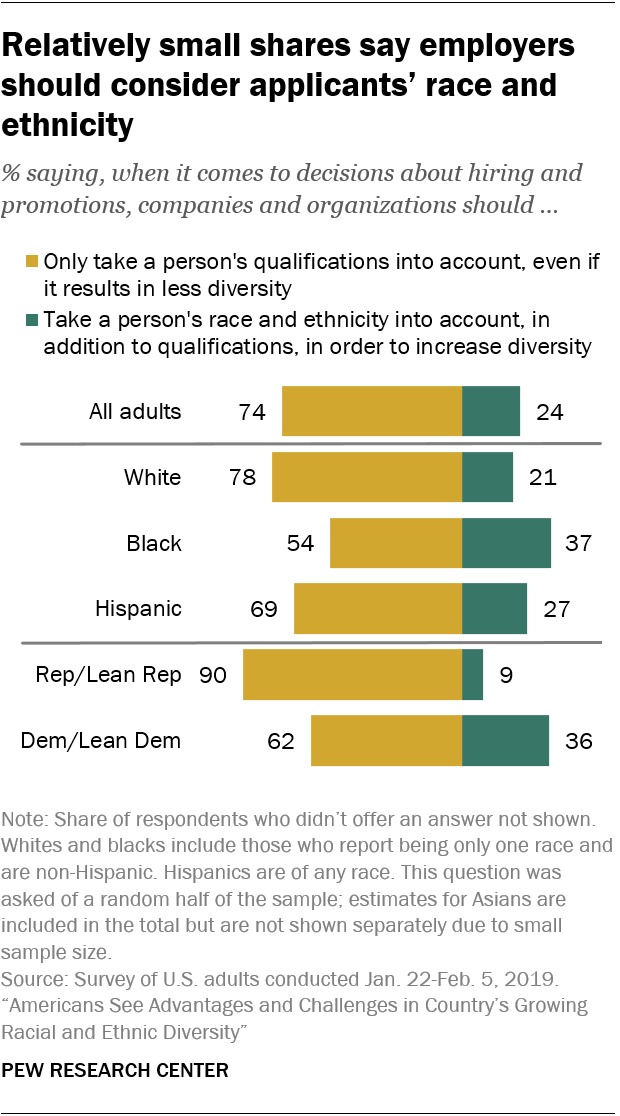
Another example is racial preferences in education and hiring. It’s the pet project of white liberals and their allies. The majority of non-white Americans, including Black people, oppose express racial preferences for both college admissions and hiring. (E.g. https://www.pewresearch.org/social-trends/wp-content/uploads...)
https://www.wsj.com/articles/anticompetitive-woke-law-school...
I'll save you some trouble, the ABA replied here: https://www.wsj.com/articles/american-bar-association-aba-la...
Edit: also unclear whether you realize I'm agreeing with the comment I responded to or not. /shrug
I’d be interested in a fair (i.e. not overly critical or fawning) book length history of the Federalist Society and how it’s evolved.
(EDIT: this is in all likelihood true for every political party everywhere - that in practice not every decision comes down to strict application of some theory - but the American right often makes fairly strong claims to some inherent pureness of principle that cannot be backed up by the facts of their behavior.)
Of course it is. And of course consistency is not the point. Hypocrisy is just good politics. "It's bad when you do but good when we do it" is optimal strategy.
Check out Schmitt for the "friend/enemy distinction" in politics [0]. All political factions plays this game, this is fundamental to democracy [1]. Holding your opponents to standards and principles you yourself don't follow is how you win. And of course speech rules within social media platforms is fundamentally a political issue.
[0] https://youtu.be/0d3aRYlSHDU "The friend-enemy distinction"
[1] https://youtu.be/HqgLlYO4JSo "Carl Schmitt On the Contradiction Between Parliamentarism and Democracy"
This ruling countermands that: the (implicit) right to not be compelled to speak would seemingly no longer apply to corporations or, more accurately, the people within them.
Edit: It's important to note that corporations' rights to moderate their online holdings does not rely on the CU ruling.
A more charitable way to put this: you don't lose your First Amendment rights just because you joined with other people for commercial or other purposes.
You have never lost your First Amendment rights in the context of a corporate venture. Citizens United goes substantially beyond affirming that fact: it establishes a separate notion of 1A personhood for the corporation itself.
Corporations are also entitled to other rights that can be exercised by groups, like not having their property searched without a warrant or seized without just compensation, or their contracts broken. They are presumed innocent in court unless demonstrated guilty.
The actual Citizens in question were getting together (uniting, if you will) to spend money and engage in overtly political speech in a tradition that goes back to Thomas Paine. They used a non-charitable not-for-profit corporation to make and to show a stupid movie about Hillary Clinton. They used a corporation because that’s what you’re supposed to use for things like this and the alternative is sending the money to one private person’s individual bank account and that’s got all sorts of problems. And the court found that was a valid way for the people who contributed to exercise their rights to free speech, because of course it is.
I am also not convinced that use of a personal bank account was a significant problem here, unless you mean in the sense that the FEC (rightfully) prohibits excessive individual contributions.
Assuming it was, however: it stands to reason that everyone (including myself!) would be content with a legal structure where N people can pool their money into a publicly auditable political contributions account. I would happily support a law that makes that easier! But that wasn't the intended goal with CU -- the goal there was to channel extraordinary donations from a very small handful of individuals in a manner not accountable to the public.
But don’t use your personal bank accounts to run businesses or charities, and don’t let anyone at the business or charities you might some day run do that either. That’s a massive red flag, the IRS will come auditing and looking for money laundering, and besides that there’s just an ocean of ways that can go wrong.
And the mechanism for sharing your account like you want already exists. It is called “incorporation”. That is like 85% of the point, easily. (That and doing things with the money, like entering into contracts or owning property.) You’re reinventing the corporation.
Anyway. The goal of CU was to air a movie (a stupid political hit-piece movie, I wouldn’t watch it, but it’s plenty politics).
A 'foundation' in the Netherlands (where I am from) would serve perfectly. And it seems to make sense to me to bar for-profit organizations from influencing elections because of the inherent conflict.
Hmm. Technically yeah, but corporations tend to gag their own employees more than the government gags corporations. The corporation can say just about anything it wants about politics and faces no repercussions from the government, but if an employee says the wrong thing about politics, they'll be shitcanned very quickly.
I can find another job corporation must have its relationship with the government. Basically choice
That's my point! That's the political financing world as established post-CU.
Too many people think CU was some sort of this-changes-everything moment when it was actually a fairly narrow, technical decision based on prior rulings.
I agree that CU was a culmination of decades of jurisprudence. But that doesn't meaningfully change the fact that it has had a substantial effect on corporate money in politics.
Citizens United affirmed that it was ok for corporations to use corporate funds to make political speech via financial contributions. Not allowing that would not imply that people who work for a corporation have lost their individual first amendment rights.
Companies allow individuals to limit their liability.
Now I'm sure there are people who abuse this, but it also allows good people to not risk their life getting involved in a political process where they could be sued for their personal assets.
Perhaps it would be better if the government created a separate category though to separate regular businesses from political liability protection "businesses".
I'm still not entirely sure that would be for the best though on a practical level. Businesses do advocate for themselves with lots of money but that money also prefers a stable boring economy... meaning without those actors, we might start seeing laws and lawmakers that are crazy on both sides more than we are now.
How can a corporation do any of these without natural persons being actually the ones deciding on and performing these actions? Corporation is, after all, just a form of organization of natural persons, and cannot do anything on its own.
In Citizens United, government argued that the government can ban you from publishing a book, unless you’re completely self funding it: if any corporate funds are used in book publishing process (as they typically are with books where authors are paid royalties, it is likely that no books you ever heard about have been completely self-funded). Are you also supporting this position, that government can suppress your speech if any at any point corporate funds are used?
A corporation is a synthetic legal object: beyond basic restrictions on its form, it's allowed to legislate itself internally according to whatever bylaws and structure it pleases. There is no requirement (and no particular precedent) for them having a democratic structure.
This produces a fundamental tension between the people who comprise the corporation and the decisions that the corporation makes: the corporation can choose to do things that are overwhelmingly unpopular with its employees without significant recourse, since the corporation does not operate according to the will of its members.
In other words: corporations are naturally susceptible to undemocratic power concentrations, where a small number of executives or board members use the financial heft of the corporate body to achieve their personal goals. Allowing those concentrations to then seep into our democratic system is fundamentally corrosive.
> Are you also supporting this position, that government can suppress your speech if any at any point corporate funds are used?
No. I'm not obliged to defend whatever argument the USG's lawyers presented during the particulars of the CU case.
Sure, but it’s still natural persons who are actually making those decisions, no? After all, a “synthetic legal object” cannot actually make any decision. You seem to be conceding that the Citizen United did in fact protect the speech right of natural persons, you just complain about the technical aspects of how this speech act was performed.
> In other words: corporations are naturally susceptible to undemocratic power concentrations, where a small number of executives or board members use the financial heft of the corporate body to achieve their personal goals. Allowing those concentrations to then seep into our democratic system is fundamentally corrosive.
So you are only against Citizens United as applied to big and powerful corporations, but are totally fine with it with less powerful corporations? Say, you totally support the actual plaintiff, the Citizens United organization, in its right to publish the movie that was the subject matter in the case?
Also, given that you seem to believe that the government should be allowed to block speech by powerful corporations, what about speech by powerful and rich individuals? Should government also have a right to restrict speech of individuals if they are rich and powerful enough?
CU does nothing to protect the free expression of individuals; it has markedly diminished the expressive power of individuals in the political sphere in favor of opaque and legally established (rather than natural) entities.
> So you are only against Citizens United as applied to big and powerful corporations, but are totally fine with it with less powerful corporations? Say, you totally support the actual plaintiff, the Citizens United organization, in its right to publish the movie that was the subject matter in the case?
I don't know if this is intentional on your part, but you're dropping a key piece of context: Citizens United (the organization) is a PAC, with extraordinarily wealthy corporate financiers. It's not some kind of scrappy outfit with a handful of unpaid undergraduate interns, and it would not exist independent of the corporate interests that use it as a more palatable front for political influence ("Koch Interests Action Campaign" just doesn't have quite the same ring to it, I think).
> Should government also have a right to restrict speech of individuals if they are rich and powerful enough?
Frankly, there should be no private financing of elections at all. But that's not realistic.
Realistically: rich and powerful people have the exact same right to engage in electoral politics as everyone else, and there is no immediately feasible way to stop them from dominating those politics via their wealth and power. What we can do is make those attempts at domination as transparent as possible. Rulings like CU directly stand in the way of electoral transparency.
> (...)
> Citizens United (the organization) is a PAC, with extraordinarily wealthy corporate financiers.
So what is your complaint here, exactly? That wealthy corporate financiers can do everything that Citizens United tried to do, as long as at no point any of the funds pass through any corporation or a non-profit? Seems like you're just trying to make the speech of the wealthy corporate financiers difficult. I don't think people should lose their rights just because they are wealthy.
My "complaint" is about civic integrity and transparency: you are (presumably) a member of the same society as me, so you should have an intuitive (and civically gained) understanding that sunlight is the best disinfectant. Our country is better off when those who engage in our political processes, especially disproportionately, cannot hide behind corporate structures.
https://www.thetimes.co.uk/article/no-10-chief-of-staff-in-f...
Here's a structure that I think would be fairly unobjectionable: Citizens United works collectively to raise funds for political causes. Once funds are raised, the money -- in its entirety, minus administrative and other overhead costs -- is distributed to all the employees of Citizens United itself. That money is taxed, as it should be. Then the employees are free to voluntarily choose to contribute that money -- up to individual contribution limits -- to whatever candidates they so choose.
The same should be the case if an ordinary corporation (one that doesn't exist for political purposes) wants to donate to political causes: they should be forced to distribute the sum total of that desired contribution as salary to employees, who could then choose to make (or not make) those contributions.
Obviously there are flaws to this plan, and it needs more scrutiny and fleshing out, but I think it is much more democracy-preserving and -- critically -- transparent than just allowing corporations to act as "people" and fund political campaigns directly, or via shadowy means.
Or on the personal level, I can't actually tell if it's illegal for me to pay you $3000 to sign a contract saying you will donate $2600 to a particular candidate. And if it's legal for me and you do to that, why shouldn't it be legal for a corporate entity to do that at scale?
And it's certainly legal for you to hire me to handle the minutia of donating money to a political candidate.
It is a small handful of natural persons (or corporate board or executive team) deciding for the entire corporation full of people who have zero say that the fruits of their economic output (under the auspices of the corporation) are being used to support a particular political party or candidate.
If we look at individual political campaign contributions, then it's one person deciding that some of their hard-earned cash should go to support a particular candidate or cause. But with a corporate structure, it's five people deciding that the collectively-earned cash of thousands of people should go to support a particular candidate or cause.
To put it another way, an individual campaign contribution is "one person, one vote". A corporate contribution is "one person, many votes".
And no, most people do not have the realistic option to quit their job because they don't agree with the political contributions the executives have decided the company will make.
> Should government also have a right to restrict speech of individuals if they are rich and powerful enough?
Governments already do this: individuals are subject to political campaign contribution limits[0]. This unfortunately gets muddied by PACs and the like, which was the issue at hand in Citizens United.
[0] https://www.fec.gov/help-candidates-and-committees/candidate...
There are many cases of well funded candidates (be they self-funded or funded by small donors) failing to win elections; e.g. Michael Bloomberg and Bernie Sanders on the national stage. Despite tremendous advertising, these candidates were deemed inferior by enough voters to lose.
For precisely the same reason that advertising works: people in general are susceptible to psychological manipulation, subtle or otherwise.
Also, I think that one of our mistakes was to not require limits on the duration of a company (because they used to be shut down once their goal was accomplished?). In comparison, even the richest human has a well-limited lifespan...
It's like speed-limits. You can only drive so fast. Similarly we should limit how many dollars any single person can spend on manipulating public opinion.
With corporations I guess we should divide the amount they spend on political adds by the number of share-holders, and put a limit on that.
Does this apply to all advertising, or just "political" advertising? Is "Enjoy Coca Cola" the acceptable kind of "manipulating public opinion", or the bad kind that is limited? Who draws the distinction?
Is Shell or Exxon allowed to advertise their products? Are they allowed to advertise their products in a positive light? Are there spending limits on their just, like, normal product advertising?
Can I air anti-oil and pro-clean-air advertisements? Are these "political" even if Shell's aren't?
But advertising for who should be elected to run the government is a different ball-game. Why? Because government is not just a product you could refuse to "buy".
Government should represent us. But it should not represent rich people more than anybody else, which is what happens if the rich can choose the government based on political advertising and misinformation.
But that is conservatism though. I can't help but see the whole attempt at renaming it "regressivism" is to avoid "conservatism" from taking the fall when people look at it's outcomes. No one that would be "regressive" today was not a conservative yesterday.
There’s tens if not hundreds of millions of them and same for you guys. We are all stuck together in one polity.
If we are ever going to achieve a synthesis and get back to a healthier place it’s not going to involve the kind of rhetoric you are indulging in here.
As far as synthesis and reconciliation, for a long time I viewed the answer as that of respecting individual liberty. Each party seems to get its constituents excited about a desire for individual freedoms on topics that matter to them, and then transmutes that energy into enacting authoritarian regulations that benefit their commercial sponsors. I had hoped that over time the liberty would be an attractor that gained ever more ground. But the flare up of grassroots authoritarianism, specifically in the Republican party where it has gone mainstream, has shown this was too optimistic. So I'm left hoping that there are enough actual conservatives horrified by these developments that will end up voting for the actually conservative options (which now seems to be mostly in the Democratic party) to keep the off the rails reactionary populism from causing too much damage.
Wow that took a turn to a hot take really fast. You don't find the rise of the green left, the authoritarian self-described socialists like "The Squad", etc to be the equivalent on the left? Or do you only view things through the lens of the party you like? Yes, the green energy, banning ICE, defunding police, anti-liberty left is just as bad as the deep right wing that wants to ban abortion and all the other things they do. There's no question and there is no ambiguity. Both want control of what you do in nearly every aspect of your life. Waking up involves realizing both of the extremes (left and right) would happily put you against the wall.
Extremism begets extremism. Authoritarianism begets authoritarianism. The horseshoe theory of politics has reached its peak in the last 6 years and opinions like this are part of the reason why. It's always "Them". Never "Us". If only "They" could wake up they'd finally love "Our" version of big brother.
How exhausting it must be to constantly find a way to simplify a vast group of people down into the absolute edge cases and judge them entirely on that edge case.
These are not positions of the mainstream Democratic party. The Democratic party is still basically constrained to its traditional function of channeling constituents frustration into boring status-quo corporate-first policies, much to the chagrin of people who do support the things you've listed.
> green energy
I don't know how you're saying green energy is authoritarian. If it's the economic meddling with subsidies, I'd say it's disingenuous to focus on that when fossil fuels, and overproduction in general, have been so heavily subsidized. I'd much rather the government did not print trillions of dollars and give it away as corporate welfare, but if it's going to, I'd rather it go to forward thinking technologies rather than just lining the pockets of existing industries.
> It's always "Them". Never "Us". If only "They" could wake up they'd finally love "Our" version of big brother.
I'm not an "our". I routinely get into arguments with Democratic friends advocating bureaucracy-centric corporate-first policies that their politicians have convinced them are genuine attempts at reform. I've read plenty of reactionary writing and think it has fantastic critiques about the Cathedral and the deep state. I think those structures are ultimately at odds with personal liberty and enlightenment. However this does not mean that I view every attempt to attack those structures as a good thing.
While constituents, we the people, agree on most points like personal freedom, individuality, respect of human life, and liberty etc., politicians of both parties, out of necessity, must paint their opponents as the authoritarian regime, set on revoking personal freedom and individuality, and devaluing human life.
If you dislike either party, it's not because one is more authoritarian than the other. It's because we lack the mental capacity to retain all the information that makes up the world around us, and must therefore make easier to process, generalizations to survive; Republican, Democrat, grassroots, mainstream, Black, Hispanic, White, etc. And it's obviously no secret that this necessity to generalize is very much exploitable.
What you don't like about the Republican party is all the things that are also the Democratic party, but only in a generalized view that the opposing parties' electorate has succeeded to exploit in your mind.
The only 'generalized view' is the one being created by Republicans, which I see pushed by Republicans and supported by Republicans. You don't have to look far to see some of the dreadful things they're pushing, and trying to pretend both sides are equally bad is not only intellectually dishonest but it's also argumentally lazy.
Generalizing by nature requires the ignorance of certain truths or anecdotes, in favor of others in order to simplify and conceptualize complex ideas about the world around us.
Read that again. Generalizing requires ignorance.
When you generalize, which you just did, you are, if only by definition, wrong. You must be, logically. If you need help gaining some understanding of logic systems, I'm happy to oblige, because I'm not "argumentally" lazy. (That's not a real word by the way.)
Not all Democrats make up words. Not all Republicans hire bounty hunters.
In summary, when you generalize people as a group to be of a particular belief or characteristic, you must by definition ignore the vast majority of ideas that are intrinsic to the humanity and individuality within the group. That is dehumanizing; it's factually wrong, and it's frankly immoral.
You're effectively taking the stance that you cannot ever criticize a political party for its actions because some small portion of its constituents may disagree which is like I mentioned before, the easy way out. It's avoiding arguing against the actual critique in favor of moving the argument somewhere entirely different.
Let's assume you voted Democrat sometime before 2018.
SC Justice Kennedy, a Republican made it illegal to prosecute gays for sodomy.
Kennedy was on the bench so if you voted Democrat, I guess you're anti-gay, you sick bastard! (Me too apparently! Since I did.)
Sure, Democrats are fighting for civil liberties, right? Unless you want to talk about how they are actually anti-gay, and opposed Trump's rules that federally prevent discriminating cross dressers at work. Didn't hear about that one? Well, that might be because you're busy listening to Democrat politicians YELLING SO LOUD about how they are pro gay rights. Pro civil rights. While they go sit in Congress and vote, just like everyone else, for the corporation who gave them the biggest campaign contribution. Check for yourself at Congress.gov what your Democrat politicians are voting for. Should we brand you with all of those horrible things they voted for like Intuit's grip on the complexities of the tax system? It's your fault taxes are hard to file, I guess! Surely that's a Democratic ideal! I blame you! I should, right? Isn't that what you're saying? That we blame you for your politicians?
And if anything I just said about you isn't true, well, it's just a generalization, isn't it? So by your philosophy, I'm right. Whether you're anti gay or not, you aren't an individual so you don't actually have any opinion except what the Democratic party says your opinion is when they vote in Congress. You are anti-gay now and I don't care how much you want to defend yourself you can't because you voted Democrat. You're a gay hater bro. That's that. That's just who you are.
At least by your philosophy.
Which I very clearly disagree with.
Politics is so full of contradictions, that you can't simply take an inversion and use it to argue much of anything. I'm sure you could come up with a good example to illustrate the individual-vs-collective distinction, but this isn't it.
Also at a certain point the policies of the collective do matter, especially when people choose to label themselves as being members of a specific party/movement/etc, rather than merely voting for a politician carrying those labels as a least worst option.
You've thrown out "effort to prevent people from saying that which is undesirable" as an example of Democratic authoritarianism. However, this is not a mainstream grassroots view. Rather it's the status quo agglomeration of power by politicians, the government grabbing power while entrenching the big tech oligopoly. Democratic voters in general don't seem to be sitting around going "Biden is going to shut those deplorables up", rather it's more like lament and resignation when the topic of social media censorship does come up.
We can of course point to authoritarian policies enacted by politicians from both parties, because politicians are inherently authoritarian, and enacting authoritarian policies that enrich their sponsors is their bread and butter.
However, the cults of personalities around Republican politicians, the rejection of intellectualism, overtly excepting politicians from the rule of law. These all indicate an authoritarian-flavored organizational structure, supported by the grassroots. If fronting as a strongman and pulling stupid stunts didn't work to get votes and donations, Republican politicians wouldn't do it. And the recent state level pushes to prohibit fundamental medical care (ie straight up individual liberty-destroying dark ages authoritarianism) is policy that doesn't enrich any corporate sponsors (as legislation usually must), but rather seems to be completely at the behest of their perceived constituents.
And so, I no longer consider the two parties symmetric. The Republicans have seemingly made their mainstream platform to dismantle our institutions in favor of regressing to some sort of good-old-days theocracy, while the Democrats still basically represent the corporate/bureaucratic status quo. And while I find that status quo repugnant from a position of wanting to reform it in favor of individual liberty, I'd much rather have the imperfect institutions we've come to take for granted, like the rule of law, than have them destroyed from the top down.
For me, the off ramp for my benefit of the doubt was the Republican's Covid response, where political nonsense came up against cold hard non-mediated reality. Let's hamstring federal departments precisely when we need them, 2+2=5, don't bother wearing a respirator to protect your family it's all made up anyhow, all merely to feed egos large and small. The fact the party and its constituents continue to double down on an a President that overtly damaged our country are at least two pillars of fascism - party over country, and cult of personality.
And sure, we can apply similar judgements to help us critique the Democratic party. But there is a stark difference in degree and effect, and it's utterly foolish to ignore that.
However, that would mean a ton of lawsuits for all the defamation and harassment that happens on those platforms.
The idea that corporations were given First Amendment rights by a recent Supreme Court decision that made them people is very frustrating to me. Corporations were deemed "people" in 1882, in San Mateo County v. Southern Pacific Rail Road, but it doesn't matter even slightly what they are with regards to the First Amendment, which doesn't specify who is speaking. Whether you're a citizen, noncitizen, undocumented immigrant, visitor, or soulless capitalist entity, if you can speak, Congress shall make no law.
Citizens United isn’t directly on point. That was a question of positive corporate speech while this law, if it’s struck down will be struck down under the corporate compelled speech doctrine. But they are both part of the same body of Constitutional law that the federal courts very much have jurisdiction to enforce.
That's unlikely, as such an argument is a complete non-starter.
If I were arguing against the law, I suspect (shooting from the hip without researching it) that the most fruitful line of reasoning would be that the federal government has preempted the field of interstate communications transmission by a combination of the FCC's organic statute and the CDA. This is a better argument because, despite what some on HN believe, there is a half-century of Supreme Court precedent that compelled hosting is not compelled speech, and because of the doctrine of constitutional avoidance.
As an interesting aside, Justice Kagan had some involvement in one of the issues underlying one of the cornerstone cases in this area. Though she was not a party and does not appear to have been among the amici, when she was Dean of Harvard Law School she opposed military recruiting on campus due to the Don't Ask, Don't Tell policy. The Solomon Amendment required non-discrimination in hosting speakers for recruiting purposes, under threat of the loss of federal funding. That compelled hosting was challenged and upheld in Rumsfeld v. FAIR, 390 F. 3d 219 (2006).
I ask because there are so many examples of compelled speech that have not been struck down. Witnesses are required to testify. Various companies are required to print warning labels, nutrition facts, country of origin, and such on their products. Politicians are required to say "I approve this message" in advertisements. Doctors and pharmaceutical companies are required to describe side effects of medications. Police are required to give Miranda warnings. Professors at many state universities are required to add a few paragraphs of mandatory text to their syllabi, including a notice that they are mandatory reporters who are compelled to tell the government what they know about certain events.
It's so common that I wonder (despite frequent claims in these discussions) whether a prohibition against compelled speech actually exists at all.
The Court tends to defer to history as a way of understanding how the framers viewed an issue so things like compelled testimony would likely be safe. My pet thought experiment is challenging the requirement to answer the census, particularly with it's much-expanded survey questions. Perhaps I can be compelled to say where I live and who lives with me, but can I be compelled to answer questions like whether any of us are gay?
"Because the First Amendment would not prevent Congress from directly imposing the ... access requirement, the statute does not place an unconstitutional condition on the receipt of federal funds." (emphasis added). Rumsfeld v. FAIR, 547 U.S. 47 (2006).*
I'm not sure where you're getting the argument that this is inapplicable, but it sounds like some of the talking points coming from the Internet outrage machine (e.g., the OP). I strongly encourage you to read the primary sources.
* This is the correct citation. The one I entered yesterday is no longer editable but refers to the Third Circuit case preceding the Supreme Court case; switching tabs on my phone is a little harder to keep track of than on my computer, and I apologize.
Believe it or not you aren’t the first person on the internet that went to law school. Granted most of us have come to regret it …
Wiki
It's also interesting to compare the tone of the two opinions. The majority is theatrical. That's not what I want to see from a court. Unfortunately, it's hardly unique to this court.
Given the past decades of highly coordinated--and completely politically motivated--court-stacking, it's probably most accurate to put the political definitions ahead of the legal definitions of conservative.
What we are talking about here is judges ignoring the constitution, the law, past precedent, the will of the people, and the facts of the case, in order to make up a logically incoherent "argument" that happens to promote the judges’ pre-decided zany partisan outcome. Such rulings are profoundly corrosive to the rule of law and the legitimacy of the court system.
Yes, and this in fact happens in every court, that's my entire point. I can provide endless examples of outcome-oriented rulings from every single appeals circuit, and from SCOTUS too.
First, nothing in constitution talks about abortion. Second, when Roe was passed, it forced states to allow actions that previously have been illegal in every single one, i.e. it ignored the law. Third, it ignored the precedent that saw limiting abortion as perfectly kosher. Fourth, it ignored the will of the people, who at the time were decidedly against abortion being allowed to the extent Roe requires (and in fact, they still are to this very day, if you ask them if abortions should be allowed in 6th month of pregnancy). Finally, the argument in Roe is completely incoherent as a matter of law, being based on the “emanations of the penumbra” of what is being said in the actual law.
I do think that abortion should be legally allowed, up until 15th week. Nevertheless, Roe is the clearest example of extremely bad judiciary.
The Roe v. Wade decision was joined by 1 Roosevelt-appointed justice, 2 Eisenhower justices, 1 Johnson justice, and 3 Nixon justices, and opposed by 1 Nixon justice and 1 Kennedy justice.
Abortion was not a partisan issue until afterwards when a group of GOP activists decided it would help them politically to spin abortion into a moral panic they could organize around in churches (which, except for the Catholic church, had mostly been ambivalent before). This is hard to remember after 4+ decades of intense partisan propaganda about the subject from the GOP.
The Supreme Court was not really a partisan institution at the time, and justices regularly split in their decisions in every imaginable configuration. (After the ignominious end of the Nixon administration, a different group of GOP activists started a decades-long conspiracy to stack the court with corrupt partisans with no regard for the collapse in the court’s legitimacy and the rule of law. That plan has been highly successful, Leonard Leo and Mitch McConnell’s great masterpiece.)
Abortion is a question of fundamental body autonomy (Can my state use my body in order to preserve the life of another person[1][2]), and all the other rights enumerated in the constitution aren't worth a rat's ass without body autonomy.
[1] It pretty immediately follows that if the state has the power to do so, it should also have the power to take you apart for your organs, because I will die without an organ transplant.
[2] Or, as the case may be, another person-to-maybe-be.
One comment I remember reading on Twitter which makes sense: "Funny how what the 1st Amendment means seems to align perfectly with currently fashionable conservative (MAGA) social views."
But any instance that creates a brand new legal situation does not qualify.
your definition of conservative seems to be "obeys Newton's second law", or going further, "synonymous with hysteresis": "resists change, but thereupon resists changing back"?
that's just not how people use the term.
That strikes me as a pretty clear distinction.
My hair is not blown back at all here.
The opinion fails at this very basic fact because they want it to be false. Not because there's any law suggesting it is false, nor has there been in a hundred years, but because they dont like it they just decided to make it up.
The states do not get to change this. If you want something else pass an amendment, don't try to get a bunch of crazy unqualified judges to make a mess.
> Ownership does not always mean absolute dominion. The more an owner, for his advantage, opens up his property for use by the public in general, the more do his rights become circumscribed by the statutory and constitutional rights of those who use it.
Even setting aside this opinion, this is false, at least according to the Supreme Court. See the PruneYard case that this court repeatedly cites https://en.m.wikipedia.org/wiki/Pruneyard_Shopping_Center_v....
> the federal constitution's First Amendment contains only a negative command to Congress to not abridge the freedom of speech
Which is why Texas has to pass a regular law to protect us from the corporation, as the Constitution fails at that.
Anti-speech pro-corporate-authority advocates always try to put these monopolistic, unescapable megacorporations in the same category as some local mom-and-pop operation. It's a massive intentional category error; megacorps are not little companies you can just walk awawy from. There is a point where a corporation's influence becomes so unescapable and so capable of greatly degrading your life that it must be treated in some ways like a government, for the same reasons we treat government differently from just another company or citizen.
The same reason that the phone company or a company that owns all the local roads or water mains can't decide to "stop serving" you because they don't like your religion.
Because it's hard to impossible to get alternate services for roads, water and electricity, i.e common carriers. But there are plenty of neo nazi forums, Gab, Truth Social, Parler, 4chan for racists to express and spread their views.
These are unmoderated, just spam filtered. Forums, social sites and video sharing sites are typically not one of these, and the distinction is important. The most important distinct piece is ownership. Shen you signed the Terms of Service with say YouTube, you granted them rights that vastly exceed ones a common carrier has.
It is analogous to creating your own postal service or phone company that only lets you send letters to users of the same postal service or phone company. The service is only useful due to network effects.
I've had SMTP servers which have extremely high deliverability rates hosted for <$100/mo for over a decade.
The capital expenditures are nowhere near comparable. The regulatory burdens are nowhere near comparable.
Email providers are not common carriers. Its very easy to just sign up for a different email provider. Its easy to buy a domain name and update MX records across literally hundreds of commercial providers eager to have your business. And even if every single host bans you (you really should then question what you're doing if nobody wants your business) its still technically possible to go it on your own. And once again, as long as you're not being generally abusive its possible to have good success.
Comparing getting banned from Gmail might as well be the same as comparing getting banned from McDonalds. McDonalds isn't a common carrier no matter how much you like Big Macs. There's plenty of other restaurants available.
You are omitting telephone service, which is also a common carrier despite being arguably more competitive than the Big 3 cloud providers.
That's where I personally would come down. This decision is ridiculous; social media companies are highly competitive. But I am much, much less comfortable with AWS kicking off Parler.
If Comcast owned practically the only ISP in my area then yes they should be considered a common carrier and shouldn't be able to discriminate traffic that isn't trying to break their stuff. In that case they would be the company that owns the roads or the water mains. Facebook isn't like that in the slightest.
Could you explain how these two things are identical?
They already have taken away your liberty to speak your mind in the common public square of our society - social media - because you know they'll ban you if you say any of a wide variety of things, leading to the consequences described above.
Trump doesn’t seem to have any issue getting his message out or getting people to come to his rallies.
Before the internet existed, the entire civil rights movement was organized by leaders going to churches - even though the locations were actively being bombed, leaders were being arrested, water hosed, lynched, bitten by police dogs, etc.
Cry me a river that some conservatives can’t post on Twitter.
If I can’t use Facebook, I can use Reddit. If I can’t use YouTube, I can use Vimeo. If I can’t use Instagram, I can use TikTok or Snapchat. If conservatives get banned from Twitter, there’s a bevy of conservative-leaning Twitter clones. Plus Mastodon, which you can’t get banned from because you can just set up your own instance.
> The Texas law forbids social media companies with at least 50 million monthly active users from acting to "censor" users based on "viewpoint," and allows either users or the Texas attorney general to sue to enforce the law.
From the law (https://capitol.texas.gov/tlodocs/872/billtext/html/HB00020F...):
> This chapter applies only to a social media platform that functionally has more than 50 million active users in the United States in a calendar month.
Also, IIRC moderation rules are allowed, and if your rule is "no politics on the forum" and someone talks politics, they can be banned. Same with "no racism" or "no antisemitic comments."
No, only by a reading of a made up text that some people wish was in section 230. If you're bringing it up I'm sure you've had pointed out before that there is no publisher/platform distinction in it.
> Also, IIRC moderation rules are allowed, and if your rule is "no politics on the forum" and someone talks politics, they can be banned.
The first person you ban is going to argue with you about the definition of "politics". So many people have been through this idea before, and it always leads right back to "we reserve the right to refuse service to anyone".
Do you think this is unclear?
> No provider or user of an interactive com- puter service shall be held liable on account of—
> (A) any action voluntarily taken in good faith to restrict access to or availability of material that the provider or user considers to be obscene, lewd, lascivious, filthy, exces- sively violent, harassing, or otherwise objec- tionable, whether or not such material is constitutionally protected;
To be clear, I don't agree with those interpretations of section 230 - and neither do many judges.
To pretend that it is when it actually isn't is a lie.
So trim the conversation all you like, just don't pretend that you aren't doing it.
An "accounting of all trimming" might be appropriate here, right up front.
Or, alternatively, some kind of "untrimmed" certification.
If you're going to say social media is like a telephone, I think you have to at least consider in what ways it actually isn't like a telephone.
That's not why people write on social media. There are very many "telephone wires" that have nobody listening on the other side. What every contributor is after is the audience. But there is no legal right to an audience.
I understand why people hate that opinion, because they want civil discourse and nearly free access to media online. Uncensored content pushes normal people out.
Those things are great, but are ultimately out of alignment with a commercial revenue model. The result is social media imposing an algorithmic bias to increase engagement, the results of which are often toxic, and that toxicity ultimately pushes normal people out anyways. You can’t have your cake and eat it too.
Why? This is seems like a total non-sequitur. It's pretty obvious that the individual posting illegal content is the person responsible for it and not the platform it's posted to, unless the platform is soliciting or refusing to remove said content. The anti-230 reasoning seems purely motivated by punitive thinking rather than what actually makes sense in reality.
> Those things are great, but are ultimately out of alignment with a commercial revenue model.
I would say it's out of alignment with the ad model specifically. Currently, there exists a financial incentive to curate content in a manner that pleases advertisers and the internet mobs that patronize their businesses. However, if social media companies were somehow forced into a subscription model, they would have a financial incentive to avoid banning users because it would hurt the bottom line, it would also eliminate the incentive to curate content to the prerogative of advertisers, and it would make the user experience much better due to lack of ads and the need to create better user experiences to maintain retention.
It is a non-sequitur only from the perspective of a social media company protecting its media business, but not from any other perspective. If I, as not even a user of the given social media service, were to receive numerous death threats as a result of content published and republished on that social media service I should have the ability to sue them for libel. This, of course, also ignores the numerous criminal liabilities faced by that social media company had they not been shielded by something like section 203, such as depraved indifference harm. There are numerous examples of this scenario both large and small, for example pizza-gate conspiracy theory and various online conspiracy theories attributed to Alex Jones.
At the moment harmed individuals get neither the ability to sue to recoup their harms nor a vote to censor content that is clearly illegal and/or harmful in the immediate to their person. This immunity does not exist for any other communication venue in the US irrespective of first amendment concerns, for example if a radio show or newspaper allowed such conspiracy theories you could sue them into bankruptcy as did Hulk Hogan versus Gawker.
I think everyone intuitively understands you can't assert 4A rights on contraband held by the police while also denying owning that contraband to dodge criminal responsibility. This thing with social media is the same thing but with 1A instead of 4A.
I would consider myself a first amendment absolutist; and yet I don't have a 1A problem with the concept of this law [0] insofar as social media companies choose the position that user speech isn't their speech. The problem is that they won't come out and state that position, they intentionally flipflop on whose speech their websites host exactly depending on what is most convenient. So of course it looks like this is a massively overreaching law when the position flops to "company speech". And if a company came out and said okay we accept responsibility for what's posted on our platform, then I'd be the first in line to say that the government can't force them to publish certain content.
Contrast traditional publishers who definitely have first amendment rights to publish or not to publish things. Well, yes, they do, but they also have legal responsibility for what they publish. The rights follow the responsibility.
[0] Saying nothing of the wording; because I'm sure it was drafted by censorious assholes, like every other law.
Now, would an alternate universe in which freedom of association was actually a robust right on its own be a better one overall? Would I happily trade that for this social media thing? Quite possibly, quite possibly.
At the time, websites were mostly just hosts of content. The individual is posting on the website but otherwise the website is a tool.
This changes with recommendation algorithms. Nearly all social media is based on some kind of recommendation algorithm. Should that be covered by 230? It could be argued that it starts to get closer to an endorsement of certain content (and indeed, some of that recommended stuff is ads.)
But we know that isn't actually the case. The algorithms are designed to drive engagement, what they show you is a function of your behavior on the site, it's not an "endorsement" by the site creators, they're finely tuned machine learning systems optimized for ad dollars - that's it.
Once again, this is just another example of how the ad model incentivizes pernicious behavior. If these sites were under a subscription model they'd be happy to offer you the option to sort your feed with a purely chronological algorithm because they'd still be getting paid regardless of your engagement behavior.
There are also active efforts to remove “bad” content from such recommendations, which is effectively un-endorsing it.
You can take HN as an example of a recommendation service - while they remove things that are off topic, you'd have to argue that YC endorses whatever is in the #1 spot on HN.
HN has more active, hands on moderation than most social media sites, and there's a stronger argument that dang "endorses" the front page of HN than that Steve Huffman "endorses" the front page of reddit.
Edit: Why is that objectionable?
Downvote trolls responding to a comment in less than a minute on a thread buried in other comments nearly 24 hours old. Feels like a bot.
It's a bit more insidious than that, as they can still go and say "we don't censor it, see, it is not removed", all while the content is blacklisted from recommendations.
Still works essentially as censorship as nobody can see it until they look at channel directly but it is not technically censoring.
> I understand why people hate that opinion, because they want civil discourse and nearly free access to media online. Uncensored content pushes normal people out.
Nope. It pushes ad revenue out. Youtube, aside from not allowing porn and other 18+ stuff was for long time basically uncensored, you could post anything and algorithms wouldn't punish you.
Got to be biggest video platform regardless of that.
They started with demonetizing or lowering monetization for "controversial" stuff because of ad money, and companies not wanting to see their ads on the more controversial stuff for fear of being associated with it. But it wasn't for people, it was to please other corporations that gave them money.
Recommendation system makes sure that generally if you don't search for something and don't watch it, you won't get it, so the fact some content that might offend them is on the platform is irrelevant.
And after Trump won, the companies just used same systems to push the topics they don't want on the margins of search results
Same thing. Ad revenue is a result of eyeballs looking at it.
You say moderation is about “editorial control” but that’s exactly the debate. Is Facebook moderation equivalent to the NYT deciding what to publish and not publish?
When someone reads a Facebook post, does anyone think that Facebook is the speaker? That legal fiction is attractive for various reasons, but I don’t think it’s such a slam dunk. I think there is a fair argument that Facebook is a pipe for someone else’s speech.
A better foundation for this seems to be property rights—it’s facebook’s pipes, and their business what they do with it.
I do, in a sense. By the nature of its design, Facebook has a feed of virtually every opinion in the world and can show any of them to any user. Facebook could express any opinion it wants by choosing what content gets shown.
As a sort of analogy, let's say I want to say "I like dogs." If I read from a random character generator until it says "I like dogs" and then I send that to the internet, have I published it or am I merely a pipe for the random number generator?
Technically the random character generator "created" the content, but it would be a totally different work without my involvement.
It's not really relevant, though, because Section 230 applies regardless of whether FB is a publisher or not.
Wow that's just made up! All the amendment says is "Congress shall make no law...".
These are supposedly originalist judges but really they're just culture warriors.
Note, it does not say anything about corporations. It simply says the government cannot put you in jail for freedom of expression. Ergo, it's totally within any establishments rights to ask you to leave if they don't like what you have to say. That is very different from the police coming in and arresting you.
But the Supreme Court is more likely to agree with the other appeals court, or otherwise modify the scope of the texas law
I don’t think this court buys the idea that the platforms exercise editorial control. For example:
“But the more fundamental problem with the Platforms’ reliance on Herbert is that they do not have an “editorial process” that looks anything like a traditional publisher’s. See supra Part III.C.2.c. Herbert involved discovery into how an editor selected, composed, and edited a particular story. See 441 U.S. at 156–57. But the Platforms, of course, neither select, compose, nor edit (except in rare instances after dissemination) the speech they host. So even if there was a different rule for disclosure requirements implicating a newspaper-like editorial process, that rule would not apply here because the Platforms have no such process.”
Or:
“ The Platforms are nothing like the newspaper in Miami Herald. Unlike newspapers, the Platforms exercise virtually no editorial control or judgment. The Platforms use algorithms to screen out certain obscene and spam-related content.8 And then virtually everything else is just posted to the Platform with zero editorial control or judgment. “Something well north of 99% of th[is] content . . . never gets reviewed further. The content on a site is, to that extent, invisible to the [Platform].” NetChoice, LLC v. Moody, 546 F. Supp. 3d 1082, 1092 (N.D. Fla. 2021). Thus the Platforms, unlike newspapers, are primarily “conduit[s] for news, comment, and advertising.” Miami Herald, 418 U.S. at 258. And that’s why the Supreme Court has described them as “the modern public square.” Packingham, 137 S. Ct. at 1737; see also Biden v. Knight First Amend. Inst., 141 S. Ct. 1220, 1224 (2021) (Thomas, J., concurring) (noting Platforms are also “unlike newspapers” in that they “hold themselves out as organizations that focus on distributing the speech of the broader public”). The Platforms’ own representations confirm this.9 They’ve told their users: “We try to explicitly view ourselves as not editors. . . . We don’t want to have editorial judgment over the content that’s in your feed.”10 They’ve told the public that they “may not monitor,” “do not endorse,” and “cannot take responsibility for” the content on their Platforms.11 They’ve told Congress that their “goal is to offer a platform for all ideas.”12 And they’ve told courts—over and over again—that they simply “serv[e] as conduits for other parties’ speech.”13“
They kind of have a point. The platforms seem most interested in minimizing financial costs like the hiring of moderation staff and loss of advertising and reputational costs like PR damage and pissing off sensitive users. They don’t seem to have any particular editorial mission. They seem to mainly want to grow and profit. I actually wonder if they would have a stronger case if they were avowedly advancing a leftist agenda. IANAL
I don't think you have to have an editorial mission, as you say. But one could easily say our editorial mission is outlined in our terms of use.
> They seem to mainly want to grow and profit.
CBS News wants to grow and profit too? I don't know if there is anything wrong with the social media "editorial process" being different from the newspaper editorial process, because they are different things. For example, someone in a comment above said something like -- "Social media is obviously like the telephone system." Which just ignores the multitude of ways it's just extremely different, and perhaps even less like social media than a newspaper.
My point was to the question (paraphrasing) - how can the courts rule that corporations are entitled to opinions expressed via donations but then take away their right to express opinions through moderation?
This court’s answer, which I find entirely plausible, is (paraphrasing) that the opinions tech platforms express through moderation at least do not constitute a real coherent viewpoint. Instead they are haphazard and fairly random responses to stimuli, for example, they are sometimes the side effects of algorithms designed primarily to promote engagement, and they are sometimes the result of pressure from members of Congress or other politicians, and they are sometimes the result of attempts to mitigate bad PR. I think the court is essentially saying something most people can largely sympathize with: that Facebook and YouTube don’t actually have anything resembling a genuine point of view, they are just out for their own growth and profit, and are claiming editorial coherence right now because it suits them, but will say the opposite tomorrow when they need a different legal shelter in a different court case.
CBS News tried to make money but there is no question the driving force of that division was to gather and present accurate news of some high minded importance. 60 Minutes had its flaws but it had miles more integrity than say Facebook. At what point are we going to allow just any old company to claim to be essentially a journalistic enterprise? Do you genuinely believe Facebook has a point of view to justify its moderation? If so, what is it?
And this 5th Circuit opinion has very idiosyncratic reasoning [0, just the first few pages will blow your hair back]. A sample:
How the 1st Amendment might protect a corporation's religious POV but not its exercise of editorial control is a very good question. I'm not saying this very conservative SCOTUS won't adopt the 5th Circuit's reasoning, but it still seems unlikely. In my view -- much more likely is that they resolve the Circuit split by adopting the 11th Circuit's view wholeheartedly.[0]: https://techfreedom.org/wp-content/uploads/2022/09/2022-09-1...