My headcanon is that it's tied to the fact that our life spans are limited and we've evolved to derive the most satisfaction when we're working on a task that is difficult for us individually or has vague success criteria, which seems to match up in part with the article's takeaway. It's also how I reason that not only fucking things up, but also complaining about it and trying to fix it are all required for people to feel happy. I see this ethos in a lot of old religions as well - humans striving towards the same qualities as a godhead but never quite getting there no matter how awesome their abilities become, or how our 'perfect' state was when we were ignorant of the consequences of our actions.
Learn to appreciate beauty. Learn to create beauty. Learn how to get better at both.
Along with these, sustainability. Imagine finding balance and peace, but seeing clearly that the tools and techniques used to get and stay there are temporary. Pretty unsettling. We have to get there in ways that are long lasting and unlikely to change radically.
The ecological kind, misery path for sure.. Until entropy can be reversed at least.
Thanks for stating it so clearly
Long term life satisfaction is the correct goal.
For example, having children decreases the former yet increases the latter.
For you, maybe. This is not true for everbody.
(fwiw, I'm not saying you're wrong)
People who want to have children should have them, and people who don't want to have children shoudln't have them =)
Simply compare the two curves. Those with children vs those without.
Your comment stands if you look at outliers, GP stands if you take the curves.
And you are adding other factors if you think people who do not want kids are somehow the outliers. Same as if people wanted kids might be if you actually looked closely, for most people its not a very well thought out choice.
Would that be bad? How?
> People who want to have children should have them, and people who don't want to have children shoudln't have them =)
I think it's fine either way! People who want to have children are often disappointed when it's not all roses as they imagined. Conversely, people who don't want to have children are often surprised at the little joys they bring...
How?
And that's my fear when I get older (without kids). That the happiness of being single now and not dealing with kids and having more disposable income, etc. etc. will only go so far but that I'll be depressed about being lonely in the future when I am a senior.
I can definitely see how my siblings with kids will be way happier as grandparents.
But yeah, I'm content now without kids cause I get to sleep whenever and my disposable income is enough. lol
Also though, I'm never arrogant in making proclamations that people with kids are miserable.
They might have tough times in the beginning, but the older I get the more at peace they seem as parents.
I disagree with happiness not being important. It is important, but it is not something that you can have all of the time, because human mood, emotional state and the experience itself is always a wave, going up and down, constant fluctuation. A person needs to learn to identify where in the curve they are and not allow the curve to rule their life. Once your able to be aware of the curve you can start taking steps to decrease the down trend of the curve so that you can spend more time in the up trend.
Humans notice change - diff, if you will. Meaning if you were to be in absolute happiness for extended period of time, your frame of reference would slowly fade and you would no longer know what is happiness for you.
That's why, it is my personal opinion, that you should just sit down, drink a hot beverage of choice, acknowledge the Yin-Yang nature of reality and choose happiness.
No curve goes up or down for ever. I'm not a financial adviser.
Don't try to be happy, try to be free.
Meaning that you should not focus on the ending, you should focus on the process. And try to get it so you get the most options
The closing sentiment takes the cake for me. A neat little shanty of the mindset of the communist smart men.
I understand the quotation (and only partially agree), but only because I've seen the same thing expressed much better, and without the absurd parts, in... the Unabomber manifesto. Basically, people need sensible difficulties to overcome.
I can guarantee that there exist several data points that refute this.
Definitely can guarantee many cases where doing this to excess for some people is a net negative.
Can certainly show cases which led to divorce (i.e. always trying to make spouse happy was unstable, and the marriage would have been much better off with randomly ignoring spouse).
Helping others can make you happy. Just don't do it at the expense of self care.
I guess my own realization is that there usually are many satisfying goals or outcomes and those change more often than you'd like. That's why "the path is the goal" is also a great quote.
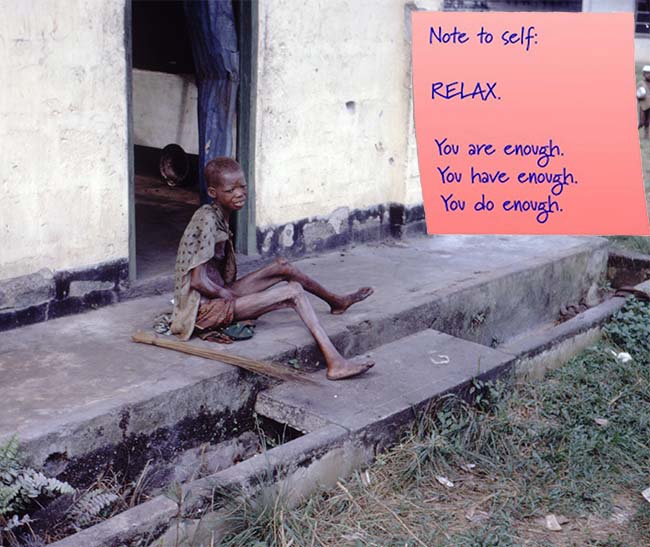
A great example of focusing on the positive in any and all situations!
Slavoj Žižek (someone who does seem to be especially smart):
“Happiness was never important. The problem is that we don't know what we really want. What makes us happy is not to get what we want. But to dream about it. Happiness is for opportunists. So I think that the only life of deep satisfaction is a life of eternal struggle, especially struggle with oneself. If you want to remain happy, just remain stupid. Authentic masters are never happy; happiness is a category of slaves.”