pdamoc
I wish more people would take his ideas seriously, especially his "Collective Code Construction Contract".
If ease of use is targeted, signals might not be the best approach. I distinctly remember things becoming easier when they went away.
ø is so easy to type on a mac, just alt+o and it would look so much prettier.
Learn to appreciate beauty. Learn to create beauty. Learn how to get better at both.
Most schools today are still stuck into the factory model of 200 years ago. They are still trying to take uneducated peasant children and discipline them to mindlessly follow a 9-to-5 factory work schedule. Applying Montessori principles would be an improvement to most.
Regular people severely underestimate how outdated and unscientific the current model is. Everywhere.
And we know about this for more than 50 years and we've done very little to improve things.
One of my sisters made sure that my nephew was in a Montessori kindergarten. He went to a regular school afterwards but those Montessori years can still be felt. There is a kind of emotional stability that still permeates his behavior. A level of presence and calm that brings me joy and gratefulness.
[1] https://en.wikipedia.org/wiki/How_to_Read_a_Book#Reading_lis...
Apple is very good at maximizing "consumer satisfaction". This means giving consumer the best deal for their money considering as many of the consumer needs as feasible. Other brands ignore a lot of these needs and then they wonder why people don't buy their products when, on some details, they are much better than Apple at a lower price.
The only things better than that program can be found in science backed endeavors from something like Psychological Self-Help[1] to the entire field of Positive Psychology.
Programming is draining on the brain and you need a way to disconnect from your project in order to rest your mind. Tango will provide you with the much needed balance.
This way, you can code during the day, socialize/move your body during the evening at tango classes or practicas and maybe have a great time at a milonga (tango party) once a week.
When you get back to US, you will also come back with a great body skill.
We all have beliefs about reality and these beliefs generate a lot of emotions. We also interact with our beliefs as if they are the reality and seldom question them. This is true for both more conservative or traditionalist beliefs and for ultra-progressive beliefs.
When the beliefs about reality clash, as they inevitably do, people sometimes find it hard to take a more inclusive perspective and try to find our shared humanity. Unfortunately, most of the time they activate the old ingroup-outgroup distinction, Us vs Them and the Them must be destroyed.
Just because someone don't share ALL of your beliefs does not mean that they hate you.
You have to be big enough or brave enough to move back to reinventing the whole universe.
In theory, any large company could use projects like Oberon and "STEPS Toward The Reinvention of Programming" as an inspiration and create a full stack that runs GUIs on all platforms.
In practice this is a monumental undertaking that not even companies like Apple could do. They still reused BSD for macos and KHtml for Safari.
This is biologically preconditioned. We have brain wiring for identifying "Us" and "Them".
BigThink put up a compilation video [1] on this topic.
In Elm, the Model can be updated faster than the DOM. In other words, the view is rendered at the speed of requestAnimationFrame but the model can change in between animation frames. This means that if you handle model changes inside the view you might get out of sync with the model.
Here is a program [1] that shows this problem. If you click "SnapShot" you will sometimes get the same number but sometimes get different numbers.
The way I see this is that it might be one of those tests that, if they come back positive, indicate that further analysis should be made. A general practitioner might ask for this test and then recommend to the person to see a specialist.
Here is an article detailing the topic of the book. https://quillette.com/2020/09/26/the-bias-that-divides-us/
I'm seeing this get worse in my own country for very different reasons. There is a profound lack of reasonable people that take a moderate position where the other side is not demonized.
> I have always done my work in the context of a group that is set up to maximize a wide spread of talents and abilities. Just as “science” is “a better scientist than a scientist”, such a group is “a better programmer and systems designer than any individual”. Really learning to program — etc. — is really learning about how to be part of a scientific/engineering/design team. As with a sport like basketball, there are lots of fundamentals that all need to do extremely well, and there are also “special abilities” that not every member will have, but which the whole team will have when it is functioning well as a team.
I fear that very few people really spend the time needed to really learn the fundamentals and very few people learn a scientific mindset that would allow them to cooperate effectively with others without getting their ego in the way.
Unfortunately, for that to happen at the level it needs, there needs to be a change in how Education works everywhere.
We are still using a 19th century tool designed for a very different context.
Maria Montessori tried to bring the tool into the 20th century about 100 years ago but who is trying to do the same for the 21st century?
The way I found it explained best was in an Alan Kay presentation where he spoke about the insight Francis Bacon got into the fact that the brain works in a faulty way and what to do about it.
Scientific thinking is how we get around the very well documented [1] array of cognitive biases. Learning about those biases in ways that a) makes them obvious, b) provides ways to compensate might make a person able to detect them early and to approach them in the proper way.
Another wonderful tool I found is Chris Argyris's Ladder of Inference. Trouble is that this kind of tools need to be inculcated at a very early age so they get used and become second nature to the person. Learning them later in life is a heck lot more difficult, especially when they conflict with fundamental aspects of one's identity.
[1] https://upload.wikimedia.org/wikipedia/commons/6/65/Cognitiv...
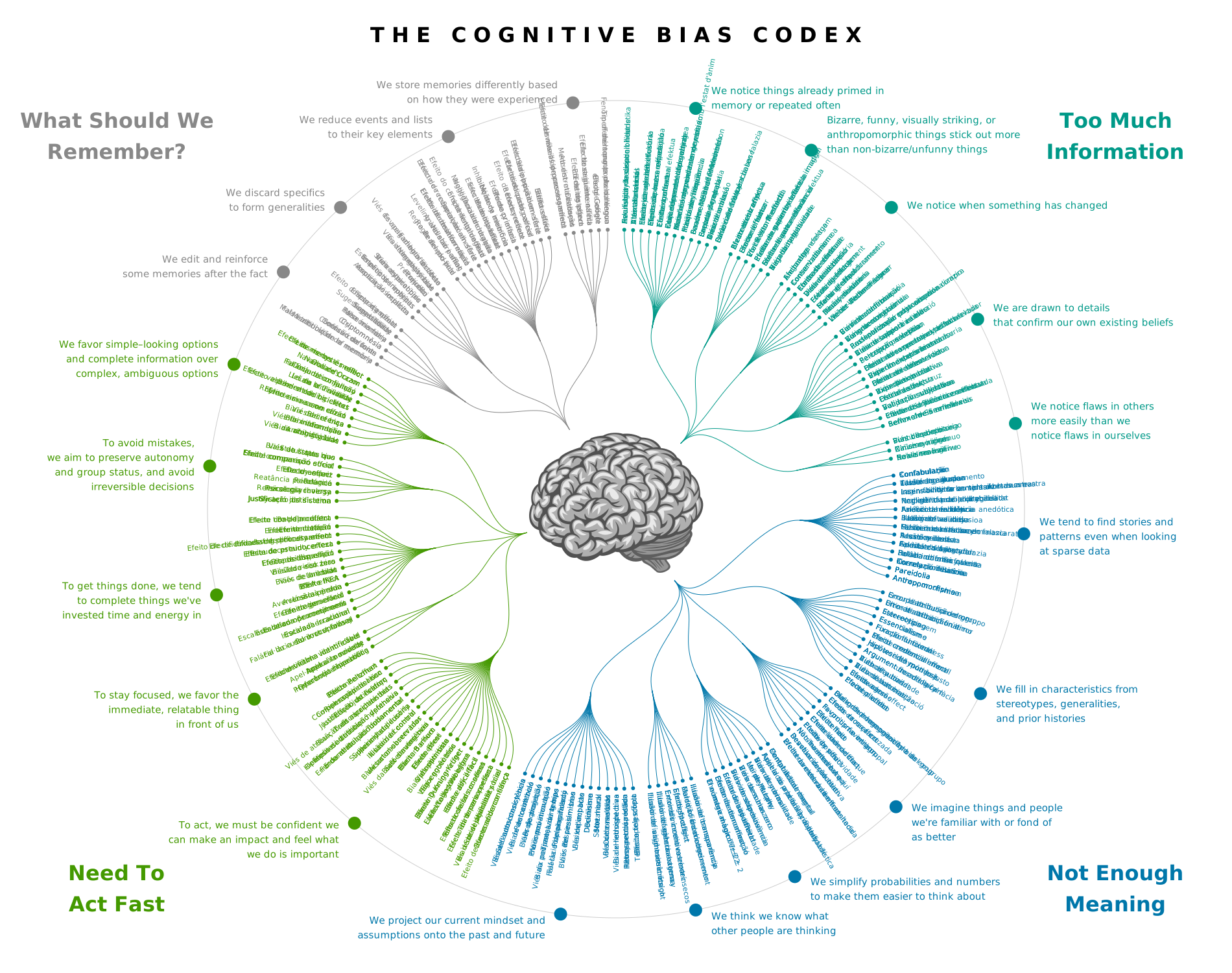
Mindful meditation has been proven useful and has helped me too. What also helped me was writing exercises (like the Self Authoring program [2] )
[1] https://upload.wikimedia.org/wikipedia/commons/6/65/Cognitiv...
A design system should reduce decisions out of both.
Layout is far more impactful and difficult to get right than colors and fonts.
This is why I love Every Layout [1]. I just wish that there was some open source version of those ideas.
Jung's ideas are quite attractive, I'll give you that. We all love a good story, especially if feels so full of meaning.
That being said, I would point out that there are stories and good research that might be a lot more helpful. I would suggest: Chris Argyris work on management, especially his ideas around defensive-reasoning vs productive-reasoning. Toyota Kata work by Mike Rother might also be helpful. This is about switching to an evidence backed mode of thinking (scientific thinking).
Next would be Robert Kegan's work on constructive developmental framework and immunity to change. His work presents both a vision about human development and the obstacles we have in the way.
And finally, Carol Dweck's recent work on the foundation of personality. Here is a summary of that work.[1] It might be useful to understand how your own BEATs got entangled in your identity, which of them are useful, which are sabotaging you.
[1] http://www.progressfocused.com/2017/11/carol-dwecks-new-theo... Her