News for hackers. Stuff that matters.
Re:James Webb first images – complete set of high resolution... by chaps on Tuesday July 12, 2022 @12:26PM (#32072271)
Direct links --

Stephan's Quintet (NIRCam and MIRI Composite Image):

https://stsci-opo.org/STScI-01G7DB1FHPMJCCY59CQGZC1YJQ.png

Southern Ring Nebula (NIRCam and MIRI Images Side by Side):

https://stsci-opo.org/STScI-01G79R28V7S4AXDN8NG5QCPGE3.png

“Cosmic Cliffs” in the Carina Nebula (NIRCam Image):

https://stsci-opo.org/STScI-01G7ETPF7DVBJAC42JR5N6EQRH.png

Webb's First Deep Field (NIRCam Image):

https://stsci-opo.org/STScI-01G7DDBW5NNXTJV8PGHB0465QP.png

Exoplanet WASP-96 b (NIRISS Transmission Spectrum):

https://stsci-opo.org/STScI-01G7NBXDHYYSVBP2M476PRGG3A.png

Re:James Webb first images – complete set of high resolution... by j0e1 on Tuesday July 12, 2022 @02:21PM (#32073829)
> “Cosmic Cliffs” in the Carina Nebula (NIRCam Image):

> https://stsci-opo.org/STScI-01G7ETPF7DVBJAC42JR5N6EQRH.png

Is this for real?! It looks like it came right out of a Sci-Fi movie/book. Could anyone explain how much of this is post-editing magic?

Re:James Webb first images – complete set of high resolution... by sbierwagen on Tuesday July 12, 2022 @02:42PM (#32074086)
Image stacking to remove noise and optical artifacts, careful use of color filters to enhance contrast and pull out detail. The press release says it used Red: F444W, Orange: F335M, Yellow: F470N, Green: F200W, Cyan: F187N, Blue: F090W. The N filters are narrowband. F470N is only 54 nanometers wide: https://jwst-docs.stsci.edu/jwst-near-infrared-camera/nircam...

Almost all the light in this image is way off the red end of the human visual spectrum, of course. The shortest wavelength filter is F090W which has a center wavelength of 902nm, about the same color as the light coming out of a TV remote infrared LED, which is barely visible in pure darkness.

This is what it looks like through a film SLR, without the detail enhancing filters: http://www.phys.ttu.edu/~ozprof/3372f.htm Here's a 20 minute exposure through a telescope: http://www.phys.ttu.edu/~ozprof/3372fk.jpg Maybe what you would see with your own eyes through binoculars at a dark site well away from city lights. A dim red smudge, hints of finer detail.
Re:James Webb first images – complete set of high resolution... by supernovae on Tuesday July 12, 2022 @10:52PM (#32078519)
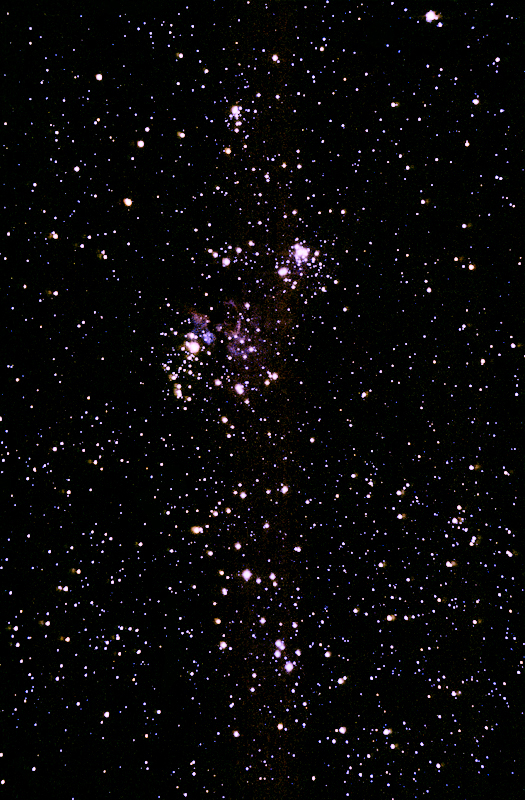
While the JWST uses the red end of the human visual spectrum and narrow filters these objects are still broadband and can be imaged as such. Adam did an excellent job on widefield https://www.adamblockphotos.com/ngc-3372-carina-nebula.html and there are lots of deep field images in RGB on Astro imaging sites. The detail is phenomenal with JWST but a lot of people are saying one wouldn't see this with their eyes or with a color cam - and they're "wrong" (its complex). Your eyes just don't "collect" photons like a camera, but a color camera would see this nebula beautifully... We use NB in hobby Astro imaging a lot just to reduce the impact of light pollution.
Re:James Webb first images – complete set of high resolution... by jvanderbot on Tuesday July 12, 2022 @03:22PM (#32074512)
How does this "blueshift" compare to what we'd get if we just corrected for the relative-speed-induced redshift?
Re:James Webb first images – complete set of high resolution... by sbierwagen on Tuesday July 12, 2022 @03:29PM (#32074592)
NGC3372 is inside our galaxy, just 8500 light years away. It's not redshifted by metric expansion to any appreciable degree, (A calculator I just checked gave me a z of 0.000000617) and radial velocity is a sedate ~34 km/s. (z = 0.000000115)

The redshift on the other JWST images is because most of them are of objects that are much, much, much farther away. Infrared telescopes are great for observing those, but that's not the only thing they're used for.

Re:James Webb first images – complete set of high resolution... by jvanderbot on Tuesday July 12, 2022 @03:44PM (#32074738)
Maybe my question would be better asked for other objects images then, but I can just google how far things are redshifted at extreme distances as well.
Re:James Webb first images – complete set of high resolution... by ehsankia on Tuesday July 12, 2022 @03:55PM (#32074854)
My understanding is that the IR here is used to see "through" the "smoke", so you can see more details that would normally be obstructed.

A good way to see this is comparing it to Hubble [1], a lot of the extra detail you see is thanks to IR letting you see the stars behind.

[1] https://johnedchristensen.github.io/WebbCompare/

Re:James Webb first images – complete set of high resolution... by jvanderbot on Tuesday July 12, 2022 @04:34PM (#32075297)
Understood!

What I was asking is: Is the target's normally-visible light redshifted into the same bands that JWST is measuring, higher? or lower frequency?

That doesn't have anything to do with why JWST uses IR.

Re:James Webb first images – complete set of high resolution... by sbierwagen on Tuesday July 12, 2022 @05:00PM (#32075624)
Redshift refers to how the wavelength of a photon can change if the observer is moving relative to it, (Doppler shift, redshift if you're moving away from the photon, blueshift if you're moving towards it) or cosmological redshift. (The fabric of the universe expanding, reducing photon energy)

NGC3372 is a cloud of (relatively) hot gas and dust. It's emitting broad spectrum blackbody radiation: it's emitting on all wavelengths. You can look at the same cloud at different wavelengths and see different things, telling you what parts of the cloud are at what temperature, or relative chemical composition, or what parts are ionized: http://legacy.spitzer.caltech.edu/uploaded_files/graphics/fu... Nothing here is redshifted, Spitzer is just capturing different light entirely.

In the side by side of JWST and Hubble https://pbs.twimg.com/media/FXecm6vXwAMPhoc?format=jpg&name=... https://pbs.twimg.com/media/FXecnp2XkAE4Rs5?format=jpg&name=... you see broadly the same thing, but Hubble is almost all visible-light while JWST goes deeper into infrared and sees cloud structure that Hubble doesn't.

Re:James Webb first images – complete set of high resolution... by heisenzombie on Wednesday July 13, 2022 @01:20AM (#32079264)
Ok, disclaimer: I am not an astronomer and this might all be rubbish. I suspect I'm neglecting relativistic effects that might be important, for example.

The NIRCAM instrument on JWST has a wavelength range of about 600 - 5000nm [1]. The human eye is sensitive to around 380nm - 700nm.

To shift blue light (380nm) down to the upper frequency range of NIRCAM (600nm) requires a redshift of:

z = Δλ / λ0 = 0.58

This is related to the velocity of the object by:

z = v / c

and the velocity is related to distance (approximately) by the Hubble constant (H0 ~ 71 km/s / Mpc):

d = v/ H0

So we can rearrange and solve for distance to get:

d = z c / H0 = 8 billion light years.

The southern ring nebula is more like 2000 light years from us, so not even vaguely far enough that NIRCAM would see "originally-visible" light. The deep field image might actually be far enough... the faintest galaxies there might be something like 12 billion light years away [2].

[1] https://www.stsci.edu/jwst/instrumentation [2] https://www.nasa.gov/content/discoveries-hubbles-deep-fields

Re:James Webb first images – complete set of high resolution... by Hedepig on Wednesday July 13, 2022 @02:09AM (#32079487)
> to see "through" the "smoke"

What causes this "smoke"?

Re:James Webb first images – complete set of high resolution... by dredmorbius on Wednesday July 13, 2022 @05:27AM (#32080519)
Different wavelengths of light scatter more or less as they pass through gas or dust. This is why the Earth's sky is blue on a clear day, and sunsets are red --- the red light scatters less, blue scatters more.

In smokey or smoggy air, the red light is also scattered.

The "smoke" in a nebula is mostly gas and dust. It's either left-over primordeal matter (hydrogen gas, some helium), or ejecta from novas and supernovas --- star-smoke if you will, though it's created by nuclear fusion rather than chemical combustion.

JWST's IR sensors can cut through that dust more readily than Hubble's optical-range sensors could, and pull out more detail on the dust to boot (based on my own viewing of comparative images).

I'm not sure if the dust is reflecting light or glowing from heat, though my hunch is it's mostly reflecting. Stellar gas that gets hot enough will also glow in infrared (or higher) wavelengths, and that might also be picked up by JWST. I suspect there will be targets demonstrating this in future.

Re:James Webb first images – complete set of high resolution... by Retric on Tuesday July 12, 2022 @02:33PM (#32073983)
It’s real light, just color shifted as the JWST is designed to look at severely very distant and thus red shifted objects. The nebula is however much closer than that.

Anyway, that looks like science fiction because science fiction borrowed that look from astronomy. https://en.wikipedia.org/wiki/Nebula

Re:James Webb first images – complete set of high resolution... by aaroninsf on Tuesday July 12, 2022 @05:39PM (#32076024)
I have been wondering,

how does the scale of color shifting relate to the red-shift present in deep-field subject?

Idly wondering: are the furtherest objects being captured, so red-shifted, that the translation for human viewing done in these images more or less balances that out, so what we see in the translated images for some thickness of distance-bubble, is what we would see from a much closer perspective with the naked eye, akin to "true color." (I.e. so close that the relative red-shift would be insignificant...)

Re:James Webb first images – complete set of high resolution... by Retric on Tuesday July 12, 2022 @09:48PM (#32078112)
It’s not a 1:1 color mapping to correct for red shifting. Each color represents a wavelength, but the mapping is arbitrary and chosen to maximize contrast.
Re:James Webb first images – complete set of high resolution... by dredmorbius on Wednesday July 13, 2022 @05:42AM (#32080586)
I'm suspecting that there's no hard rule for what colours are assigned to what frequencies, though "more red" in processed images probably corresponds to "longer wavelengths" in captured imaging data. There's no specific red-shift interpretation, though for viewing of distant objects (and galaxies particularly which have reasonably uniform emission spectra) "redder" -> "more distant, receding faster".

What you'd want to see specifically are the emission spectra showing absorption lines for well-known spectral bands. This shows specifically how red-shifted the light is, and is how red-shift was initially detected.

I doubt that there's an intentional mapping of red-shifted appearance + spectral sensitivity to near-and-unadjusted appearance. Though that might be possible.

In practice, I suspect the bands JWST is receiving don't map well to the RGB sensitivity of the human eye, but insteat JWST's sensitivity is tuned to scientific interests and value.

Re:James Webb first images – complete set of high resolution... by The5thElephant on Tuesday July 12, 2022 @02:50PM (#32074171)
It's all real, but you would not be able to see it with your bare eyes even if you were relatively close to the nebula. The world around us would look very different if our eyes could perceive more of the infrared and ultraviolet spectrum.

The coloring is usually done to indicate different temperatures or wavelengths detected, so it can be a bit misleading.

Re:James Webb first images – complete set of high resolution... by DougBTX on Tuesday July 12, 2022 @03:43PM (#32074727)
Maybe a similar but different question then, but what would a photo on Earth look like with this filter?
Re:James Webb first images – complete set of high resolution... by vanattab on Tuesday July 12, 2022 @04:11PM (#32075009)
The color mapping of these images is not the same as the what is used for JWST but this will probably give you some clue.

https://images.app.goo.gl/9gqtdbcsBxY6RonY9 https://images.app.goo.gl/pG7sfjLGU9nqmAvH7 https://images.app.goo.gl/JGebDZ7V5EamKoY89

Re:James Webb first images – complete set of high resolution... by LargoLasskhyfv on Wednesday July 13, 2022 @11:19PM (#32091590)
I'm waiting for https://en.wikipedia.org/wiki/Pillars_of_Creation made by Webb. It's not the same object, but similarly awesome. Maybe the article gives you an useful overview of how different telescopes 'see', and how that is translated into pictures for us.
Re:James Webb first images – complete set of high resolution... by randyrand on Tuesday July 12, 2022 @03:29PM (#32074590)
Does anyone have a simulated image of what it would look like in visible light without red shifting?

i.e. If we were moving at the same velocity of the Nebula looking with our own eyes.

i.e. What it would look like "in real life if I actually went there"

Re:James Webb first images – complete set of high resolution... by yaakov34 on Tuesday July 12, 2022 @04:51PM (#32075509)
These objects are much too faint to see much of anything with human eyes. We can see them in astrophotography because the exposures are hours long (or weeks even, sometimes), and because telescopes gather more light than the eye per unit time, as well. This is why these nebulae look like billowing clouds - they are huge (light years across), so some light is absorbed as it crosses them, and some of the infrared light emitted by them adds up. And then we enhance the effect by taking very long exposures. If we actually went and stood near or even inside these nebulae, we would still be in pretty hard interstellar vacuum, and we wouldn't see anything.
Re:James Webb first images – complete set of high resolution... by randyrand on Tuesday July 12, 2022 @05:14PM (#32075784)
Very nice description. Thanks for your time and effort.
Re:James Webb first images – complete set of high resolution... by supernovae on Tuesday July 12, 2022 @10:54PM (#32078534)
Visible light looks like this: https://www.adamblockphotos.com/ngc-3372-carina-nebula.html

But that's with a telescope and long exposure & image stacking. But still in RGB as humans would see it.

I guess there would be a point that if you were not so far away, but still far enough away - it would light up the sky. This is emission nebula after all.

BUt if you were in it, it would be so diffuse that you wouldn't know it... perhaps a weird glow if you were near some of the forming stars.

Re:James Webb first images – complete set of high resolution... by BurningFrog on Tuesday July 12, 2022 @04:40PM (#32075383)
Much of it is in infrared light we can't see, so it's "transposed" to the visible spectrum.

Not much weirder than looking at an X-ray image.

Re:James Webb first images – complete set of high resolution... by est on Tuesday July 12, 2022 @10:52PM (#32078523)
I am wondering what size of the "cosmic dust" are. It looks like the size of stars but without emitting light?
Re:James Webb first images – complete set of high resolution... by pwned1 on Tuesday July 12, 2022 @01:15PM (#32072991)
My god, look at the background of the first image at full scale.
Re:James Webb first images – complete set of high resolution... by jcims on Tuesday July 12, 2022 @01:49PM (#32073444)
I really wish astronomers would come up (or use) a standard mechanism for indicating the field of view of an image. The scale of this one in the night sky is much larger than the deep field one.
Re:James Webb first images – complete set of high resolution... by racingmars on Tuesday July 12, 2022 @02:09PM (#32073682)
The image details do have the dimensions listed in a standard measure down under the "Fast Facts" section; I assume this will be included for every image release.

The deep field image says it's about 2.4 arcmin across[1], Stephan's Quintet image is about 7.4 arcmin across[2], etc.

[1] https://webbtelescope.org/contents/media/images/2022/035/01G... [2] https://webbtelescope.org/contents/media/images/2022/034/01G...

Re:James Webb first images – complete set of high resolution... by jcims on Tuesday July 12, 2022 @03:00PM (#32074301)
I know that's usually there. I'd just love to see a little map scale bar or something in EXIF.

[-----------] °

[--------] '

[----------------------] "

[----------------] ,,"

Super easy.

Re:James Webb first images – complete set of high resolution... by jacquesm on Tuesday July 12, 2022 @04:20PM (#32075118)
Nice idea, really, and very easy to implement.
Re:James Webb first images – complete set of high resolution... by oAlbe on Tuesday July 12, 2022 @02:18PM (#32073787)
Is there a way to rapport an arcmin to a measurement that would be more easily understandable? Not necessarily as a multiple of grains of rice.
Re:James Webb first images – complete set of high resolution... by jcims on Tuesday July 12, 2022 @02:54PM (#32074213)
Your thumb at arms length is ~2 degrees or ~120 arcminutes wide. The fingernail on your index finger at arm's length is ~1 degree or 60 arcminutes wide.

The moon is about half a degree or 30 arcminutes wide. This doesn't make sense but give it a try tonight if the moon is out.

FWIW many of the galaxies and nebula you see in astrophotography are actually bigger in the night sky than one might guess. Andromeda for example is about 6 times wider than the moon at ~3 degrees across - https://slate.com/technology/2014/01/moon-and-andromeda-rela...

Re:James Webb first images – complete set of high resolution... by BurningFrog on Tuesday July 12, 2022 @04:36PM (#32075322)
I propose we use Moon Diameters (MD) as the official HN unit for sky distance.
Re:James Webb first images – complete set of high resolution... by sbierwagen on Tuesday July 12, 2022 @02:33PM (#32073981)
A minute of arc is one sixtieth of a degree. (A "minute", get it?)

The moon is between 29.4 and 33.5 arcminutes wide, depending on where it is in its orbit. So about a tenth of the width of the moon.

Re:James Webb first images – complete set of high resolution... by leeoniya on Tuesday July 12, 2022 @02:52PM (#32074195)
> So about a tenth of the width of the moon.

this is so much more digestible than "grain of sand at arm's length", and those two metrics dont feel at all equivalent -- the moon is not ten grains of sand at arm's length wide, right?

Re:James Webb first images – complete set of high resolution... by sbierwagen on Tuesday July 12, 2022 @02:58PM (#32074270)
The moon is pretty darn small. Half a degree wide. Imagine gluing ten grains of sand together, balancing it on a fingertip, then stretching your arm out. Around a degree wide? Depending on your grain of sand, of course.
Re:James Webb first images – complete set of high resolution... by leeoniya on Tuesday July 12, 2022 @03:12PM (#32074410)
hmmm, about the size of an asprin tablet or pea at arm's length, seems to agree with somewhat smaller than thumbnail [1]. maybe i should find and measure some sand now :).

in either case, 1/10 the width of the moon is so much easier to comprehend. when is the last time anyone tried holding a grain of sand at arms length? what a weird comparison to make when everyone on earth already has a stable/familiar reference in the sky.

[1] https://astronomy.com/magazine/stephen-omeara/2010/01/stephe...

Re:James Webb first images – complete set of high resolution... by zola on Tuesday July 12, 2022 @02:33PM (#32073977)
I always translate it in my mind to full moons. 30 arcmin == diameter of full moon as seen from earth.
Re:James Webb first images – complete set of high resolution... by yvoschaap on Tuesday July 12, 2022 @02:21PM (#32073831)
7.3 arcminutes = 16 light-years
Re:James Webb first images – complete set of high resolution... by mwint on Tuesday July 12, 2022 @02:26PM (#32073895)
Wait, but it’s a ~cone, right? So it must be 16ly across at some specific distance from us?
Re:James Webb first images – complete set of high resolution... by agrajag on Tuesday July 12, 2022 @02:33PM (#32073973)
That's the distance of an object away that has a parallax of 7.3 arcminutes and a baseline of 1AU. The 7.3 arcminutes referenced here is the width of the image on the celestial sphere.
Re:James Webb first images – complete set of high resolution... by DrBazza on Tuesday July 12, 2022 @02:28PM (#32073916)
Grain of sand at arms length for yesterday’s deep field.
Re:James Webb first images – complete set of high resolution... by luqtas on Tuesday July 12, 2022 @03:26PM (#32074564)
is not lovely it reached internet just after 80% of the planet being able to see the sun?
Re:James Webb first images – complete set of high resolution... by dredmorbius on Wednesday July 13, 2022 @05:50AM (#32080620)
In the Ring Nebula image, the two galaxies just kind of casually hanging out on the left side (just above midline), one square on, the other edge on, is pretty impressive.

There are a few others to be found (I suspect image duration is much shorter than for the Deep Field).

Even as far-from-primary-interest-objects, amazing detail.

Re:James Webb first images – complete set of high resolution... by rootusrootus on Tuesday July 12, 2022 @12:44PM (#32072515)
Thanks for the direct links!

> Webb's First Deep Field (NIRCam Image)

Is this image distorted in any way at all? It feels like the galaxies are somehow oriented around a center spot. Not all of them, but enough to give the image a distorted feeling. Probably it's just my mind pattern matching against something that doesn't really exist.

Re:James Webb first images – complete set of high resolution... by bcherry on Tuesday July 12, 2022 @02:10PM (#32073691)
Something missing from this discussion that's worth pointing out:

This image shows profound "gravitational lensing", which you know. But what you might not know is that is precisely _why_ they chose to photograph it.

This galaxy cluster (SMACS 0723) may be the most well known and powerful gravitational lens we have observed. The galaxies shown distorted around the edges are actually behind the lens, but are magnified by it. This means we can see even farther in this region of space than normal, because we compound the power of the JWST with the power of this natural lens.

It all adds up to providing the "deepest" view of the universe yet, allowing us to see galaxies at a distance of more than 13.2B lightyears. This lets us see structures formed in the infancy of the universe, that wouldn't be possible looking at most other points in the sky, or even anywhere else in this deep field besides the perimeter of the lens in the middle.

Re:James Webb first images – complete set of high resolution... by supernovae on Tuesday July 12, 2022 @11:02PM (#32078578)
The mind blowing part is that many of those smeared galaxies are the same galaxy just "smeared" around the curvature of space so it shows up in multiple places as we perceive it since its been warped by the gravitational mass/dark matter so strongly.
Re:James Webb first images – complete set of high resolution... by t9999999999999 on Tuesday July 12, 2022 @04:16PM (#32075066)
The elongated double lensed galaxy to the right of centre shows lots of point sources. These look like globular clusters or maybe satellite galaxies (maybe these are the same thing in the early universe?).
Re:James Webb first images – complete set of high resolution... by t9999999999999 on Wednesday July 13, 2022 @05:10AM (#32080426)
The two lobes of that elongated lensed galaxy are mirror images of each other (slightly distorted). You can match up the point sources between them.
Re:James Webb first images – complete set of high resolution... by palmtree3000 on Tuesday July 12, 2022 @12:45PM (#32072535)
Gravitational lensing. From the description[0]:

Other features include the prominent arcs in this field. The powerful gravitational field of a galaxy cluster can bend the light rays from more distant galaxies behind it, just as a magnifying glass bends and warps images. Stars are also captured with prominent diffraction spikes, as they appear brighter at shorter wavelengths.

[0] https://webbtelescope.org/contents/news-releases/2022/news-2...

Re:James Webb first images – complete set of high resolution... by samstave on Tuesday July 12, 2022 @12:59PM (#32072762)
So, would that mean that the gravitational lensing over how-ever-many-light-years is ALSO coupled with the convex/cave aspect of the pico-adjusting of the JWT 'lens' such that even our JWT's pico-adjustments affect the NORMAL of the photons to the image?

Can this be adjusted for?

Wouldnt the pico-arc of the overall array affect the image output due to the distances involved such that we receive "false gravitational lensing, simply based on distance from the sensor"

?

I wonder if a more precise version(s) of the hex lenses could be made such that they can 'normal-ize' on a much more refined basis.

I know that each JWT is already capable of mico-flexes to each cell... but if we can develope an even further refinement (Moores law on the JWTs hex lenses resolution) we will be able to make thousands of images with varying the the normalization to each receiving area and comparing image quality.

Also, I am sure there are folks who know the reflective characteristics of photons from each wavelength that would allow for orientations for each wavelength.

--

Do ALL 'light' wavelengths, particles bounce off the reflector materials in the same way? - meaning do infra waves/photons bounce in the exact same way as some other wavelength with the exact same orientation of the sensor?

---

Do they do any 'anti-gravitational-lensing' correction calcs to 'anti-bend' a photons path to us to 're-normalize' the path that we should have seen?

Whats the current science behind such?

Re:James Webb first images – complete set of high resolution... by qwertywert_ on Tuesday July 12, 2022 @01:26PM (#32073150)
The gravitational lensing matches exactly how it looked in Hubble's deep field overlay, so I would guess no the JWST lens is not causing any "false" gravitational lensing? If that's what you are asking.
Re:James Webb first images – complete set of high resolution... by samstave on Tuesday July 12, 2022 @01:32PM (#32073239)
Thanks!

I worded that poorly ;

Wouldn't one be able to adjust the perceived path of the photon after time, to adjust for re-normalizing the path of the photon based on the understanding of the gravitational arc imposed on such -- meaning the astro equivalent of "ZOOM. ENHANCE!" :-)

Re:James Webb first images – complete set of high resolution... by 8note on Tuesday July 12, 2022 @02:05PM (#32073624)
Depending on the orientation, you wouldn't have the right pixels to put for the angle of view from straight on.

Eg, you'd normally see the side view of an object, but the lensing gets you the top and bottom views

Re:James Webb first images – complete set of high resolution... by qwertywert_ on Tuesday July 12, 2022 @01:57PM (#32073537)
Ah right, good question yes it seems like it could be possible..
Re:James Webb first images – complete set of high resolution... by samstave on Wednesday July 13, 2022 @04:00PM (#32088050)
The normalization I was thinking of was :

Lets assume you have a 'straight' vector of line of sight pointing your Earthly-Bound-Lens [hubble/jswt/whatever] at the object of interest.

you also have an idea through previous observations of gallaxies on the line of sight, which will have gravitational impact on the trajectory of the photons of interest...

the arrival photon's wiggle represents a wobble in time to get to earth. Meaning it changed phase multiple times between our sensor receiving it, and its origin.

If one could look at the path and the grav-lenses it went through, one may be able to extrapolate a more clear picture at various distances(times)....??? /r/NoStupidQuestions

( I am picturing a straight shot - but the photon traveled between many other celstials - and those

Re:James Webb first images – complete set of high resolution... by samstave on Tuesday July 12, 2022 @04:18PM (#32075095)
I'm convinced we are receiving "Wobbly Photons"

Meaning that no matter waht, when we speak of gravitational lenses, we could, usting JWST account for the "wobble" of a photon, nased on the accurate knowledge of where a body was, via measuring through multiples of JSWT observations... (ideally through actually multiple JWSTs, in differnt locations)

The idea being that if we can triangulate a more precice location between earth [A] and galaxy [N] - set of all galaxies/bodies/whatever,

We may be able to calculate the influence of gravity lens upon phont differentials based on when they came from and how far...

Ultimately making adjustments to the output of an image \based on super deep-field focus which is effectively selecting to the phtons of interest... and we can basically "carbon date" the accuracy of an image with a higher resolution?

Re:James Webb first images – complete set of high resolution... by supernovae on Tuesday July 12, 2022 @11:14PM (#32078658)
We already calculated the gravity and mapped it out. Here is a paper on some of the research: https://www.kiss.caltech.edu/papers/darkmatter/papers/the_da...

What i think is pretty cool is that the gravity lens actually allowed hubble to see galaxies it may have not ever seen had there not been a gravity lens and now that we have JWST we see many more distant galaxies (and more of the same galaxy reflected in more positions)

Re:James Webb first images – complete set of high resolution... by samstave on Wednesday July 13, 2022 @02:53PM (#32087155)
Why have we not seen results of these scopes pointing at near bodies?

What does jupiter, PLUTO look like from these lenses???

THE FUCKING MOON

WE SPENT *BILLIONS* -- Why dont we have live streams?

GO FUCK YOUR NSA

--

WHO PAID FOR IT.

The data should be global. define a SINGLE national defense trope. and back it up.

Re:James Webb first images – complete set of high resolution... by rootusrootus on Tuesday July 12, 2022 @12:51PM (#32072641)
Ah, that makes perfect sense. I guess I should have RTFM rather than just gawk at the pictures. Thanks for the ELI5!
Re:James Webb first images – complete set of high resolution... by russh on Tuesday July 12, 2022 @03:45PM (#32074758)
Oh, that makes sense. I was wondering about the odd shapes.
Re:James Webb first images – complete set of high resolution... by april_22 on Tuesday July 12, 2022 @01:07PM (#32072873)
Will the JWST be able to make photos of black holes, similar to the ones the EHT made? And if yes, can the JWST be used to study black holes?
Re:James Webb first images – complete set of high resolution... by nullc on Tuesday July 12, 2022 @01:37PM (#32073313)
Producing an "image" of a black holes requires astronomical, ahem, resolution because they're so far away (thankfully). To achieve this kind of resolution you need an aperture of thousand of kilometers.

The EHT images are created using synthetic aperture techniques to create an effective aperture with a diameter of earth's orbit around the sun. But this is only currently possible at radio frequencies due to our ability to capture, store, and coherently combine the phase information. It's essentially SDR beam forming across space and time.

We can also study black holes though visible and IR observations through their effects of the things around them-- lensing from their mass, matter heated up by falling in. Here is an image I took of the relativistic speed matter jet believed to originate from black hole in M87: https://nt4tn.net/astro/#M87jet ... and Webb can do a lot better than I can with a camera lens in my back yard. :)

Aside, there is some controversy about the EHT black hole images. A recent paper claims to be able to reproduce the ring like images using the EHT's imaging process and a simulated point source-- raising the question of the entire image just being a processing artifact. https://telescoper.wordpress.com/2022/05/13/m87-ring-or-arte... Though it's not surprising to see concerns raised around cutting edge signal processing-- LIGO suffered from a bit of that, for example, but confidence there has been improved by a significant number of confirming observations (including optical confirmations of ligo events).

Re:James Webb first images – complete set of high resolution... by pja on Tuesday July 12, 2022 @02:18PM (#32073798)
> The EHT images are created using synthetic aperture techniques to create an effective aperture with a diameter of earth's orbit around the sun.

Small correction: The EHT is a synthetic aperture telescope the size of the Earth, not the size of the Earth’s orbit around the Sun.

Synthetic aperture telescopes need both amplitude & phase information from each observing station & have to combine the phase of simultaneous observations in order to create the final image. We can’t do this on the scale of the earth’s orbit, because we don’t have a radio telescope on the far side of the sun!

Maybe one day ...

Re:James Webb first images – complete set of high resolution... by chrisweekly on Tuesday July 12, 2022 @02:53PM (#32074205)
> "Here is an image I took of the relativistic speed matter jet believed to originate from black hole in M87: https://nt4tn.net/astro/#M87jet ... and Webb can do a lot better than I can with a camera lens in my back yard. :)"

You, sir, have just contributed a prime example of HN comments at their best. Your astrophotography is outstanding. Thank you for sharing! :)

Re:James Webb first images – complete set of high resolution... by april_22 on Tuesday July 12, 2022 @01:53PM (#32073490)
Thank you!

Another question: are they already planning a successor to JWST? Is something better even possible? If it took more than 30 years, we should start sooner than later :)

Re:James Webb first images – complete set of high resolution... by btilly on Tuesday July 12, 2022 @03:22PM (#32074509)
The next better thing won't likely take 30 years.

https://caseyhandmer.wordpress.com/2021/10/28/starship-is-st... is correct. No NASA planning, including for space telescopes, shows any understanding of how much Starship changes the game. Instead of one, we can put up a network of telescopes. And try out crazy ideas.

Here is a concrete example. https://www.researchgate.net/publication/231032662_A_Cryogen... lays out how a 100 meter telescope could be erected on the Moon to study the early universe with several orders of magnitude better resolution than the JWST. The total weight of their design is around 8 tons. With traditional NASA technologies, transport of the material alone is over $30 billion and it had better work. With Starship, transportation is in the neighborhood of $10 million. Suppose that precision equipment added $40 million to the cost. Using Starship, for the cost of the JWST, we can put 200 missions of this complexity in space. Using a variety of different experimental ideas. And if only half of them worked, we'd still be 99 telescopes ahead of the JWST.

So where is Starship? It is on the pad, undergoing testing. They have a list of 75 environmental things to take care of before launch. Which means that they likely launch this month or next. At the planned construction cadence, even if the first 3 blow up, by Christmas it should be a proven technology.

Re:James Webb first images – complete set of high resolution... by ceejayoz on Tuesday July 12, 2022 @02:36PM (#32074022)
https://en.wikipedia.org/wiki/List_of_proposed_space_observa...

https://en.wikipedia.org/wiki/SAFIR is the closest to a proposed JWST successor; the others largely serve different purposes.

Re:James Webb first images – complete set of high resolution... by coldpie on Tuesday July 12, 2022 @12:46PM (#32072549)
Yes, it is distorted by a gravitational lensing effect of a massive galaxy cluster. Each image has a short discussion at this link, and a longer discussion linked via "Learn more about this image" for even more info: https://www.nasa.gov/webbfirstimages
Re:James Webb first images – complete set of high resolution... by mrandish on Tuesday July 12, 2022 @12:45PM (#32072539)
Thanks for posting these links! It was frustrating that the main NASA PR pages linked photos that were 1280x720. I guess that's to protect their bandwidth costs since much of the general public is probably viewing on mobile anyway and higher res would not only be slower but wasted bits.

I just wish NASA had provided a link at the bottom of their low-res image pages to intermediate sized images (~4k) for desktop viewing.

Re:James Webb first images – complete set of high resolution... by coldpie on Tuesday July 12, 2022 @12:47PM (#32072571)
I believe this page has what you want: https://www.nasa.gov/webbfirstimages Click on the image, twice, to get to a large-but-not-crazy resolution photo.
Re:James Webb first images – complete set of high resolution... by epistasis on Tuesday July 12, 2022 @02:01PM (#32073578)
Mobile is actually a great platform to get Hugh resolution, since you can zoom in really easily and navigate the full image.

However, after spending 10 minutes on mobile this morning, I was unable to find any high resolution images, and many images had that anti-pattern of a BS HTML gallery that severely restricts interacting with the image.

Re:James Webb first images – complete set of high resolution... by collaborative on Tuesday July 12, 2022 @05:27PM (#32075914)
Past a certain resolution, mobile devices automatically scale down images. This is hard to see in real-world images like pictures/galaxies. But try to open a really large image with some text in it and you will surely see how the text has turned blurry
Re:James Webb first images – complete set of high resolution... by Wowfunhappy on Tuesday July 12, 2022 @01:18PM (#32073029)
Not that I'm complaining since I hate jpeg compression, but you'd think that if they were concerned about bandwidth, they wouldn't use png...
Re:James Webb first images – complete set of high resolution... by yread on Tuesday July 12, 2022 @12:58PM (#32072746)
you can also download full res (even uncompressed) images from ESA site (they developed two of the IR instruments)
Re:James Webb first images – complete set of high resolution... by vishnugupta on Tuesday July 12, 2022 @12:56PM (#32072726)
If it helps others like me, I found it easier to download the images through wget and then open the local file through browser.
Re:James Webb first images – complete set of high resolution... by samstave on Tuesday July 12, 2022 @12:55PM (#32072717)
May anyone please ELI5 how to interpret the WASP-96 water spectrum graph above?
Re:James Webb first images – complete set of high resolution... by coldpie on Tuesday July 12, 2022 @01:01PM (#32072791)
Elements absorb light at certain frequencies. Given a spectral analysis of the light that passes through the atmosphere and another of the light that doesn't pass through the atmosphere, you can take the difference and see what frequencies were absorbed by the atmosphere. This tells you what elements make up the atmosphere. The H2O sections in the graph are the light frequencies that are absorbed by water molecules ("amount of light blocked" on the Y axis), indicating that the atmosphere contains water.

More here: https://en.wikipedia.org/wiki/Absorption_spectroscopy

Much more about this particular graph here: https://www.nasa.gov/image-feature/goddard/2022/nasa-s-webb-...

Re:James Webb first images – complete set of high resolution... by ndm000 on Tuesday July 12, 2022 @01:05PM (#32072845)
I know nothing about optics. What is the effect that causes the 6 or 8 points of light of come off of bright objects? Does it have to do with the hex-shaped mirrors on JWT?
Re:James Webb first images – complete set of high resolution... by arianvanp on Tuesday July 12, 2022 @01:08PM (#32072885)
it's called a point spread function; and is an artifact that occurs in any mirror telescope. https://bigthink.com/starts-with-a-bang/james-webb-spikes/ explains it pretty well.
Re:James Webb first images – complete set of high resolution... by PavleMiha on Tuesday July 12, 2022 @01:07PM (#32072876)
Yes, and also two of the trusses to the secondary mirror (these are the two additional horizontal lines). The Hubble Space Telescope gets 4 lines because of its 4 trusses.
Re:James Webb first images – complete set of high resolution... by supernovae on Wednesday July 13, 2022 @06:46PM (#32089686)
The simple answer is simply because of the physics of the scope, the support arms cause diffraction spikes. The hubble has them too but is a smaller mirror and different support arrangement. Super common on consumer scopes such as RCs, Newts and big tube scopes that aren't RASAs
Re:James Webb first images – complete set of high resolution... by Keyframe on Tuesday July 12, 2022 @01:08PM (#32072883)
Aperture shape, so in this case I guess the answer is yes?
Re:James Webb first images – complete set of high resolution... by anshumankmr on Wednesday July 13, 2022 @01:54AM (#32079417)
Anyone have the gigabyte size image of this?