… and how much larger they are than Sojourner from the Pathfinder mission. Perseverance was sent with a metal plate depicting profiles of all five Mars rovers to date: Sojourner, Spirit, Opportunity, Curiosity, and Perseverance. [1].
[1]: https://spaceplace.nasa.gov/mars-rovers/en/mars-rovers_metal...

To be fair, Perseverance looks as big as I imagined it would be, about the size of an SUV but wider (because even in 2020s, they still don't have streets in mars, what a bummer): https://www.nytimes.com/2020/03/05/science/mars-2020-rover-n...
Or did my googling fail me? :)
edit: direct image link around paywall: https://static01.nyt.com/images/2020/02/18/science/18mars202...

https://earthlymission.com/size-comparison-generations-mars-...
Keck was the first one bigger - 1989.
The next one Keck 2 was 1997.
https://en.wikipedia.org/wiki/List_of_largest_optical_reflec...
There were 11 classified (ten successful) DoD space shuttle missions:
https://www.space.com/34522-secret-shuttle-missions.html
That's roughly 8% of shuttle missions.
Since the earth is rotating under the orbital plane of the shuttle, this requires a large amount of cross-range maneuverability on reentry so it could land back in California rather than ~22.5 degrees west of Vandenberg in the pacific ocean, and this required large wings.
I don't believe it's known for certain outside of classified circles what was to be brought back. One theory was that it was to snatch a Soviet spy satellite out of orbit, but it's entirely possible given the timelines that the classified requirement was to pull a film cartridge from a US spy satellite in polar orbit and return it quickly to earth for processing.
Given that many details of the keyhole program were recently declassified [1], is there any chance we'll get to know the true nature of the shuttle program? (And if so, when might it happen?)
[1] (a decade ago) https://en.wikipedia.org/wiki/KH-9_Hexagon
No, we never got the Vandenberg polar launches we were promised.
And I don't think anyone anticipated just how quickly miniaturization and automation were going to advance when it was designed in the 70's or even as missions began in the 80's.
Even autopilot was a controversial cutting edge technology that was excluded because of the focus on human centered missions.
But back to military- it's not a coincidence that Hubble fit so perfectly in the shuttle cargo bay.
(Hubble being a spare keyhole spy satellite body, with borrowed mirror fab tech.)
But it would be interesting to know just what else the military had in mind, besides their not-so-secret ambitions for militarized manned space stations.
I assume Hubble was built that size because it would fit? No coincidence indeed. And what does that have to do with the military?
Hubble is a military spy satelite design.
An unfunded project that never gets built is objectively worse than a military-funded project.
[0] https://en.m.wikipedia.org/wiki/PGM-11_Redstone#Redstone_der...
But it was the direct predecessor to microwave communications. It was just portable military distance measuring equipment (like the model-99 dme w/ ~1cm @50km) that used a signal they found easy to piggyback voice and data on. And included that in the field units.
AND 2nd, after a dozen or so more hugely expensive projects (ranging from failure to moderate success to "achieves objectives"), it led to the Airforce NAVSTAR program, which you know as... GPS.
So the question becomes: What was the actual "objective" value provided by those expensive initial radar experiments, despite failing to achieve their direct objective?
And it's moot for both these cases because the technology was needed for direct military applications anyway.
What's the practical or ideological benefit of industry-industry R&D when the military is going to be the only customer, or at least the only paying customer for the first years/decades of use?
I agree with you in general, with it being better for governments not picking the winners of markets or deciding who gets research money.
But military is such a unique (yet universally needed) type of market, that practicality here means treating them as a large customer with unique product needs ( products unlikely to be revenue generating on the public market), even if you don't treat it as direct government allocation or a fixed/manipulated market.
The only way I can think of to avoid that entirely would be some libertarian version of an all private, defense-by-contract type military.
And then you'd have concerns about whether that could hold up to peer adversaries, and dozens of other wildcard concerns.
Space X does better work in part because it can make its own decisions and focus on long term goals.
We're talking about just one of many successses on this page.
E.g., my astronomy professor mentioned to me in a conversation that the original design for the Hubble was smaller due to expected budget, but that it got up-sized because it turned out that they could piggy-back off of other relevant military development, and iirc, that went beyond just the larger available size of the shuttle bay.
The X37s would like a word. Also, "Rods from God" has something to say
https://en.wikipedia.org/wiki/Boeing_X-37
https://endwar.fandom.com/wiki/Kinetic_Strike
---
Rods from god may be the source of "jewish space lasers" <-- the comment by a senator on how the wild-fires have been started in US and AU, meaning that a tungsten rod from space rained down molten tungsten to start fires...
Fun stuff to speculate on.
The original NASA spec had a smaller cargo bay and wings because it would have mainly been a crew ferry. As a result it would also have been launchable on top of a rocket instead of strapped to the side, giving better safety. Significant cargoes would have been launched independently.
So the "classified DOD project xyz" tasks are listed right there on the published official mission lists and schedules, and quite easy to look up on both Wikipedia and straight from NASA.
But the thing not achieved was Vandenberg launches, which would allow more N-S polar orbits that are often more useful to the military.
The less official but still obvious thing not achieved was the Airforce building a manned military space station (as far as we know...).
The Soviets (at the time) didn't "copy" it. They stole the plans and made it from them, adding in a few alterations, although the plans they stole were purposefully flawed.
If you're up for it, you can visit the Buran's in their final resting place in Baikonur. They're just sitting there rotting away. Here's a video of some kids who broke in and had some fun exploring: https://www.youtube.com/watch?v=-q7ZVXOU3kM
Article about the Soviet's espionage to get the plans: https://www.19fortyfive.com/2021/12/buran-how-russia-stole-t...
The US Space Shuttle was the (heavy) inspiration, but the Soviets put their own spin on it.
My point is that they aren't capabilities, just specifications and promises for a cutting edge, developmental technology.
[1] https://en.wikipedia.org/wiki/Space_Shuttle_design_process
There were several. A couple of examples: the shuttle could delay release of a payload, maneuver while in orbit, release the payload, then maneuver again. So conceptually, you just put a satellite into an orbit and your enemy doesn't know exactly what orbit its in. I'm sure eventually they would find it, but the military still wants stuff like that.
Another example is the ability to grab a satellite and bring it back to Earth. To my knowledge, this was only ever used with the "long-duration exposure facility" because it'd probably be considered an act of war to steal another country's satellites but here again, it's the kind of thing the military would ask for.
So the idea is that the shuttle launches with a secret payload, and every 90 minutes you see it pass overhead. This goes on for days or weeks. Eventually it lands.
What happened? Well what you don't know is that on day 2, while it was over the Pacific and you weren't tracking it, it fired the OMS, deployed a payload, then fired the OMS again to return to it's previous orbit.
There's a whole other satellite out there and you don't know about it until you find it by some other means. And eventually you will find it. But the military is happy to pay for that short window of subterfuge.
[1] https://en.wikipedia.org/wiki/Boeing_X-37
[2] https://www.thedrive.com/the-war-zone/36440/this-is-our-firs...
[3] http://www.spacesafetymagazine.com/aerospace-engineering/spa...
According to wikipedia those things cost around $6 million to manufacture and spacex was the first to ever bother retrieving them.
HEXAGON KH-9
You can get really close to it, in the current temporary building. Wonderful. You can almost touch it, and you can smell it, and see the scuff and scorch marks. Go before they raise the money for a bigger building and stand it up.
Both Endeavor and Vasa[0] are super, super cool.

https://icdn2.digitaltrends.com/image/shuttle-948x1500.jpg?v...

https://www.nasa.gov/centers/armstrong/news/FactSheets/FS-01...
Also, the comparison with the Statue of Liberty is also misleading. The Statue of Liberty is on a huge pedestal that makes it stand much, much higher; the orbiter and boosters wouldn't reach the top of the SoL.
Not sure what size you'd expect the shuttles to be, but being in the same ballpark as the statue of liberty (without pedestal) seems a great deal larger than my expectations.

[0] https://external-content.duckduckgo.com/iu/?u=http%3A%2F%2Fc...

[1] https://www.astronomie.nl/upload/750x498/images/Telescopen/J...
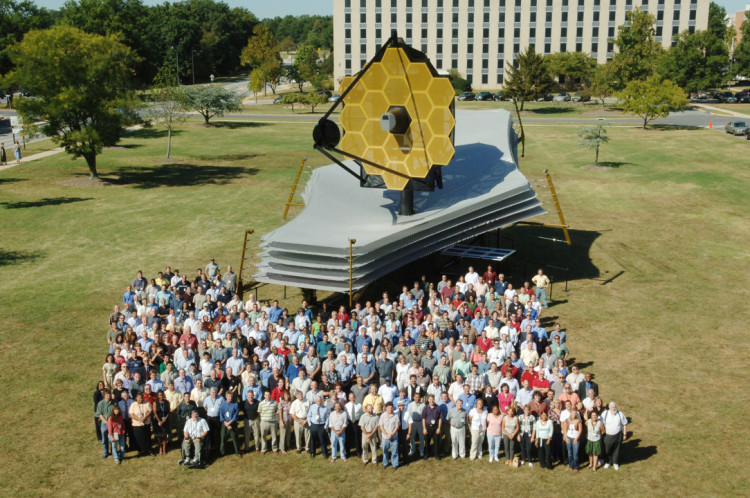
Also, FWIW, this thing has 100+ points of failure along its route to being fully deployed and getting to the L2 spot. A lot of people thought for sure at least one area would malfunction, would have easily doomed the whole launch. After this successful launch, it’s possible we’ll see discussion on building another in this design, but there is already a telescope in the planning stages for a 2027 launch, as well as four other concepts being developed for the future.
https://en.m.wikipedia.org/wiki/Nancy_Grace_Roman_Space_Tele...
https://space.stackexchange.com/questions/57407/are-they-alr...
? They seem to fund it quite a bit, for generations.
https://www.nasa.gov/audience/forstudents/k-4/stories/nasa-k...
https://www.sciencefocus.com/space/hubble-space-telescope-ho...
I mean *WE* /paid/ for them... I would like to access the data provided in real-time.
Where can one get the raw images?
Hubble's all went up (in raw as well as processed form) at https://hla.stsci.edu/, http://hst.esac.esa.int/ehst/, and several other places. Expect the same for JWST.
(Same for any other NASA mission. Here's the Curiosity rover: https://mars.nasa.gov/msl/multimedia/raw-images/)
What you say is true but with an asterisk. They grant time limited exclusive access to the data to whatever science team is using the telescope. It's basically an embargo agreement. That way the science team gets the first chance to do their research and publish it. Not all missions fall under this and in some cases you'll see what is going on right away. Eventually all data will become public.
I'll just quote their policy[1]:
Access to science data from most active missions is often limited to the Program Investigator Team during a period of exclusive access immediately following the observations. The duration of the exclusive access period ranges from a few months to as much as a year, depending upon the mission, the program category, and other factors. Some other data, such as those obtained during facility commissioning, or those that are found to duplicate concurrent observations by a Guaranteed Time Observer (GTO), may also be embargoed for a period of time. Data falling under exclusive access can be discovered via MAST public interfaces, but may not be retrieved except by authorized and authenticated persons. Following the expiration of the applicable exclusive access period, science data become available for public use without restriction.
    [1] https://archive.stsci.edu/publishing/data-use
[2] https://jwst-docs.stsci.edu/jwst-opportunities-and-policiesBut in regards to the James Webb: I don’t think you’re going to find the raw images to be particularly compelling. It is imaging in the infrared spectrum. So it’s going to require a fair bit of processing to get a reasonable monochrome image out of that data.
I never ended up building anything from it quite yet (maybe soon), but the possibility is there, and the data is free to obtain. You have to register for an API key, but again, it's still free. The photos are updated quite frequently if I remember correctly.
Same thing can be said about the National Weather Service. You can get your weather forecasts in nice JSON formats from NOAA, all whilst not having to sell your data to The Weather Channel, or whatever alternatives exist for weather apps on Android.
Telemetry is unencrypted. You have access to the data in real time. Have fun getting useful data out of it.
> Where can one get the raw images?
Online ,its all public. You might need a pHD to figure out how to make it useful to the mark 1 eyeball
https://www1.udel.edu/udaily/2009/may/cool051509.html
Then it should not be surprising that a telescope is about that size.

It looks the same to me.
About 1.6m or 5'3". That's a dry short adult human.
Not sure where it is now or if there are multiple full-sized mockups, but I wouldn't be surprised if one ends up in the public collection at Udvar-Hazy Smithsonian Annex where many big NASA toys end up.
https://phys.org/news/2008-07-james-webb-space-telescope-ful...
I guess I never saw one pictured next to a human. I've only seen pictures of satellites being worked on so I expected something more human sized? It seems so stupid now, especially since earth telescopes are huge.
[1] https://svs.gsfc.nasa.gov/vis/a010000/a013500/a013522/JWST_v...