To me this is a diversion of resources from productive use. Managers get to feel powerful, important, smart. But neither investors nor customers benefit. At the team level, it's often just wasted hours here and there. But as you scale up, it gets worse. I've plenty of expensive corporate projects that were really just resume-builders for some executive.
How much more productive would each of us be if the management chain was reasonably effective and reasonably selfless?
See: The Mythical Man-Month
I agree that making sure that your work is observable is important, and usually Management's attention needs to be called to where the observed changes are being made. This is not the same as holding you hostage in a meeting culture where you need to sit through everyone else's reports on their progress. Instead of people taking five minutes to write out their progress report to their manager, who can then skim the progress reports and the work for a full team in fifteen to twenty minutes, instead we hold everybody hostage for thirty to sixty minutes. Typically this is a syndrome of a culture where labor is not expected to document their work, and nothing will scale without pulling senior engineers off their IC work to synchronously bring people up to speed. This necessarily reduces engineering velocity to a crawl.
Nobody can speak as fast as a progress report can be read. Verbal meetings cannot be indexed or searched. All meetings should have a product - a decision, language that is agreed upon, written out, saved to a knowledge base. If you call too many meetings, it's a sign that you're not delegating authority enough.
Thus, some work may be immediately taken off your plate, without you having to dedicate your own time to training, etc.
Meetings suck. However they absolutely have a purpose, and really, sadly, you are never "held hostage" in a paid-for scenario.
Not everybody's time is worth the same, and it's a classic organizational fallacy to treat your employees' time as having equal worth. Simply put, five minutes of a senior engineer's time is worth more than five minutes of a junior engineer's time. This is clearly obvious even if you only compare their salaries (and not the value that each worker brings to the company). If their time was worth the same amount, we wouldn't hire juniors in the first place.
Thus, it's inherently unreasonable to use five minutes of a senior engineer's time to save five minutes of a junior's time. I expect juniors to struggle with something for at least a few hours before asking a senior for help.
This is besides the point that, if employees are documenting their work properly, there is less need to synchronously synchronize. "I don't remember, read the documentation, that's why I wrote it."
The Mythical Man Month was also not saying adding manpower to a project makes it slower, simply that it potentially could and there's limits to parallelism.
Everything else mentioned rings true though.
And let's not forget obviating the need for status reports entirely. I've been part of teams that got solid work done without ever having to give status reports to anybody. We'd ship early and often; our "report" was frequent results.
Use that time to read or browse HN or something.
Lets say one hour meetings per day. This means 8-1 = 7 hours of real work. If you work the 8 hours + the meeting, if you ever have to go back to the office, either you will have to work 9 hours to produce the same as WFH (since now you have to sit on the meeting), or drop in productivity and get scolded by a manager (you are producing 12.5% less)
The management situation you posted is also a bad management decision: https://blog.devgenius.io/why-adding-more-people-to-a-projec...
But i digress, fractally, outwards, not really caring..
I have never seen this happen in my entire life, nor would it be useful
Reporting does have value but has become way overdone.
Companies also have different ratios of managers to employees. If managers drag down productivity wouldn't you expect to see much flatter orgs in successful companies.
By your theory, all companies should be pretty efficient and managers pretty effective. But how many people would say that about their companies? If that's how most of your friends talk about their bosses, let me know where they live and I'll move there.
One good example to look at here is the notion of bullshit jobs: https://en.wikipedia.org/wiki/Bullshit_Jobs
[1] E.g.: https://hbr.org/2018/03/is-lack-of-competition-strangling-th...
[2] This is a good book on the topic: https://www.amazon.com/Confronting-Managerialism-Business-Ec...
Once you achieve a certain amount of success and market share success stops being driven strongly by quality fast execution and you can spend decades in a slow decline unless you’re lucky enough to have a disrupter targeting you which you can usually just buy.
Employ a lot of people to inefficiently maintain what you already have and you’ll be fine for a good long time. A lot of this work doesn’t need to be done but nobody gets a promotion for doing more with a smaller team.
It’s like the problem with the Navy buying ships, big ones are less useful and more vulnerable but captains and admirals feel more important with bigger ships and drive decisions that way.
A lot of what happens is to make middle management more money, look more important, and keep busy.
Most people I know do seem to like their manager, if they don't they switch jobs. But tech jobs are also plentiful here (SV).
Eventually, others start to do the same. Granted, there will still be a couple of "long talkers".
In my labor intensive business processes, I’ve used technolgy to control cost. My CFO doesn’t give a rats ass about headcount, just dollars. The people we hire or contract are dumber and cheaper today than they were in 2005.
Whole industries run like this. Hotels, government, manufacturing, etc. You might have a company with 3,000 people where key decisions are made by 5. Smartphones and services replaced supervisors and dispatchers with text messages. Many of those labor hours are inefficient as a result, but very cheap.
Exactly, a distribution warehouse is a fixed size, it has a maximum capacity (floor space & racking), so despite being able to bring in more boxes and also hire more (agency) staff Hours to process the Units in and out, at some point that warehouse will grind to a halt and become like a traffic jam caused by too many people and too many Units much like we see with too many vehicles on the road at peak times.
Automated distribution warehouses (computer controlled conveyor belt systems) also have this problem, as do theme park rides, rail networks and airlines as other common examples. In the 90's automated warehouses in one company I was familiar with would also crash at peak times, namely Xmas because it couldnt handle the increased volume. When it crashed work was distributed to other warehouses in the network to balance the workload amongst the remaining operational warehouses. However with automated warehouses, management/board know its maximum handling capacity and just accept it, unlike human manned warehouses where management keep pushing for more until workers revolt!
This is why the Reddit AntiWork subreddit is interesting right now, we are seeing a country wide revolt which could spread to neighbouring Western countries. The spooks will be watching this like hawks. During a UK fuel protest in the UK, a protestor who was also a small business in the run up to his attendance at a second protest had a visit from 4 big burly guys in a new expensive Black Range Rover, one of the guys got out and told this small businessman, if you go to the next fuel protest, you wont have a business to come back to. Thats how the security services and others operate here in the UK! Its the security services job to protect the country which includes the economy and other things, thats also why the illusion of privacy and tech security is just an illusion!
So other factors that can affect productivity in a country is poor transport networks, if people are spending more time travelling to and from work, then that country will be facing problems in years to come unless changes are made.
Look at commute times dropping during covid lockdowns. It was like getting to work 20 or 30 years ago, less traffic on the road yada yada yada.
Now changes in legislation can offset some of this which is in the hands of a Govt, like sunday trading (being open on Sundays) and also 24hr trading (being open 24hrs a day), internet shopping can also offset some or redistribute the demand on infrastructure but even the internet retailers have their problems and inefficiencies but these are now offloaded to the consumer, so legislation has created a cost saving for internet retailers in some countries.
I do agree that management are largely detached from the situation on the ground and you can see this in many ways with the problems that exist, but either they dont care or they dont know, some really are detached from the reality on the ground. Its also cheaper to address these on an ad hoc basis when intelligent consumers complain, management rely on stupidity and laziness to get away with poor goods or services. Remember inflation only measures the cheapest price of a good or service, it does not take into account the decline in quality or life span of a good or service.
how big is this movement, actually? personally, i quit my job without knowing about “anti-work”, and without the goal of making any point. then i was very confused when multiple people IRL told me they respected me for it, and learned about anti-work. it happens that there’s some overlap between their complaints and my reasons for quitting… but their complaints cast such a wide net that it’s not surprising. so i’m not yet sure how much the anti-work label or the community actually affects things on the ground v.s. just showcases popular sentiment and actions that people would have taken anyway.
https://finance.yahoo.com/news/antiwork-movement-may-be-long... The subreddit is about a tenth the size of the WallStreetBets thread of GameStop mania fame, but Goldman points out that Antiwork now ranks above WallStreetBets in comments per day."
Its English speaking, so it can spread to 5 Eyes country's easily and other country's especially if native news outlets run with it. US social media dominates so it will have an impact in other country's.
Its aimed at the millennials which is why its on Reddit.
Lots of factors or trends could be influencing it even sock puppets, however my belief is it is an attempt to stimulate inflation short term to get interest rates up. BBC mentioned Bank of England could see interest rates going upto 5% by the middle of next year!!! Who can afford debt repayments where the base rates gets to 5% and the lender has added a few % more on top for them??
We havent seen anything like that in at least a couple of decades.
Inflation also forces people back to work after the Covid lockdowns but the effect is, some businesses have realised some staff can work from home and save money on expensive premises like office blocks, such is the technology today namely the internet, voip and remote working in general. Others are realising that some sectors are best avoided for employment because of the way they laid people off during COVID lockdowns. Karma I guess!
However GameStop is also an indication of a rebellion which is why GS have mentioned aNTIwORk, even the regulators know they need to write a more honest fairer rule book and their inaction and coverup is angering some, which is why Gamestop got popular.
You can measure this sentiment by analysing the use of words and phrases used in comments across different social media platforms. People give away so much meta data on social media, its getting easier to predict when someone might sneeze! LOL This is also what Goldman Sachs hinted at when they mentioned how many comments its getting now. GS monitor social media comments for insights into financial trends which would be entirely expected of them in my opinion, just like many other big companies will be monitoring social media for trends, including this site.
Is that really surprising considering that the gamestop mania has fizzled out?
>Lots of factors or trends could be influencing it even sock puppets, however my belief is it is an attempt to stimulate inflation short term to get interest rates up.
Are you saying the government/central banks are doing this to "attempt to stimulate inflation", or that the readers/commenters on the subreddit are doing it?
When some parts of the world have a deflationary economy due to the boomer population hump flattening out as they retire and die out more quickly, and you have been printing money under the label of Quantative Easing since 2008 so need to cancel out this money printed for liquidity reasons otherwise you risk killing your currency, a way to do this is to stoke up inflation and blame the public & businesses as its always been one of the ways to cancel out debts.
When the financial crisis in 2008 kicked off, the velocity of money dropped sharply as you can see here. https://en.wikipedia.org/wiki/Velocity_of_money#/media/File:...

This was called a liquidity trap so QE money was used, like grease on wheel axles, to get transactions increasing which then helped get the economy move again. However all of these different actions, just like different types of taxation has a range of effects, some become ineffective over time, so the default "reset" is generally to stoke inflation as its erodes debts more quickly.
So if I was a young person just leaving education right now, I'd be taking on debt to purchase assets like property, mindful that population numbers in some countrys are shrinking which will create a surplus of property and drive down prices now. Over a decade or two, their wages will be significantly higher in a high inflationary period than their wages over a decade or two in a stagnant or low inflationary period, because they wont have external factors to justify going to their boss asking for a pay increase.
Likewise Reddit AntiWork is another way to give these young people ideas to ask for better pay and conditions when they perhaps wouldnt have got it from the older generation who tend to carp on about their poor pay and conditions whilst ignoring the fact that back then one wage could buy a reasonable sized house and support a family unlike today where two wages are need to achieve the same results.
The existence of this subreddit also makes it easier to quantify negative sentiment towards current pay and conditions when one didnt exist previously so it also becomes an intelligence tool for law enforcement, policy makers, investors, and traders.
TBH I'm surprised its taken this long to appear on the radar, but I guess other subreddits have served their useful life span.
Edit. You also have this https://en.wikipedia.org/wiki/Maslow's_hierarchy_of_needs evolving as people age because we dont stop wanting things but these things we want change as we age unless we stop aging!
It's not that simple: https://www.brookings.edu/wp-content/uploads/2015/03/finalin...
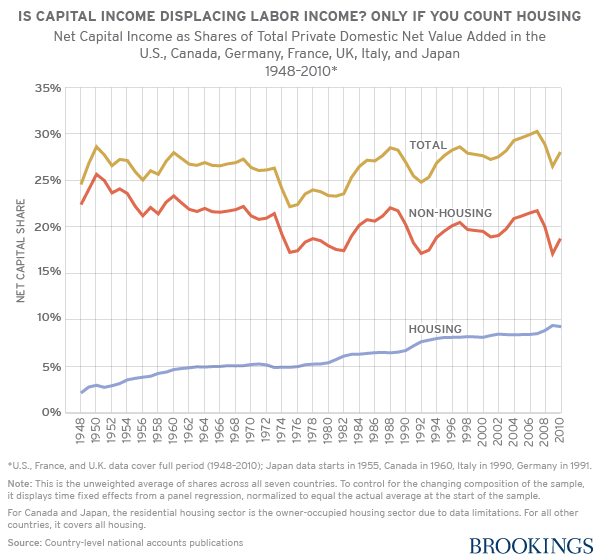
(From https://www.brookings.edu/bpea-articles/deciphering-the-fall...)
The takeaway is that these additional gains in productivity are being captured by land (as expected based on the law of rent). The problem is that this is popular when the majority of voters (or at least, the ones active in politics and making their opinion heard) are homeowners.
FYI 'Productivity' is not 'How Hard We Work' - it's a measure of profit/hour.
If profits go down for any reason, including more leverage by consumers due to increased competition, productivity will go down.
'Low Productivity' does not mean the economy is doing poorly.
One other theory, is that consumers have more power then ever, consumer surpluses are greater than ever (through lower prices) and that the money is not going into the companies and therefore not recorded as productivity.
Facebook, Google, Web Browsers, News, email. So much free content.
My favourite Video Game is free to play.
You can buy at Wallmart today what would have cost a lot of money in the 1960s.
Travel is cheaper than ever, more people are travelling, Airlines are always teetering on bankruptcy.
All of that means the productivity numbers are going to be lower than otherwise all things being equal.
Productivity is revenue/unit of time (generally hour).
Or more like 'How much stuff/value is created with what amount of money per hour'
What makes you say that?
> Why increase productivity when your pay doesn’t increase?
You're conflating two things - industry-wide pay changes (which any individual worker's productivity-related decisions have ~zero influence on) and individual pay changes, which are in fact determined (partially) by individual productivity.
I believe (through observation/experience) that workers are the key because without their buy-in and support, none of the business strategies or technological innovations management can introduce will matter. Individual workers have a lot of control over the economic output they choose to contribute. This is, IMO, very much about motivation.
RE your second point, I'm not sure if I'm conflating the two vs using a micro example to extrapolate a macro trend.
They're motivated by not being able to get a job if they don't know how to do the job. There's an equilibrium state where workers and employers are both investing some amount into training.
Or are you saying workers have become less engaged and less productive at work but maintain they're jobs? That might be plausible
Which was contrasted with engaged employees, who sharing in more of the profits, have an incentive to increase productivity — eg, by inventing a tooling improvement for the assembly line.
I think the overall point was employers are “penny wise, pound foolish” in that small productivity “gains” caused employees to disengage which is causing long-term slowdowns in improvements — improvements typically driven by employees stepping up and doing more.
Empowering line workers makes sense when there's growth and healthy margins to pursue. If the industry is mature or even shrinking then there's a heavier focus on cost cutting and metrics/Taylorism to maximize free cash flow and pay it out as dividends and stock buybacks.
Edit: also see: https://www.epi.org/productivity-pay-gap/
IE if warehouse box-stackers productivity has tripled since 1950, it is because companies have invested in forklifts for the workers to use, not because the box-stackers are just way better at stacking boxes than their 1950s counterparts.
If the driver was going to capture all of the upside of the productivity gains of the forklift, the business would never invest in a forklift in the first place.
That part of the process could just as easily use robots. Or - potentially - genetically modified chimpanzees.
Value is contextual. If productivity is dropping instead of increasing, one possible reason is because the friction in value chains is increasing and both intelligence and efficiency are decreasing.
Another is because returns are being measured in the wrong ways, and the contextual element is being disguised or lost by current accounting practices.
These systemic issues are more plausible causes than any suggestion that front line workers are all somehow becoming less good at their jobs.
Does it? I have no idea whether this is true or not, but there have been plenty of counter examples throughout history. The spinning and carding machines during the industrial revolution, automated checkouts, ... Even in your example, the next step in an automated warehouse where the employee is just there to make sure everything is working correctly.
this employee is going to require more skill than the original box stacking employee.
The savings to the company is in the form of a lower number of employees, making the total cost lower. AKA, one maintenance engineer, replacing 10 manual stacking employees.
In this case, productivity per employee grows, and it required capital investment, both in the form of machines from the business, but also from society in the form of education (presumably, the maintenance engineer needs to understand how the machines work to make sure it works correctly). The business doesn't really pay the education cost directly.
Because the neoliberal belief is that pay should remain largely fixed and the productivity bonus comes through as reduction in prices or increase in function.
So this season's iPhone does more than last at roughly the same price.
Which then leads to the paradox of productivity - since profits cannot then grow either unless there is ever greater leverage from banks.
But, meh. My belief is that this is just measurement error. The linked article is a bunch of yelling about a perceived drop in what amounts to the second derivative of per capita GDP. It's just not a well-characterized "problem" to be solved.
Exactly that. This is characterized as a loss but productivity has actually grown every single year except 2011 (which had zero growth, so not a "loss" either).
Maybe 1998-2004 were just exceptional. My guess is that's when computers started to take over larger swaths of the most productive industries.
> above-average growth of the late 1990s and early 2000s
On top of that, the article (at least to me) reads like there was about a decade of above-average growth whereas it was really more like 6 years.
Edit: This reads a lot like this: https://xkcd.com/605/
Of course there is a matter of growth in what too - product count and quality (utility value) in some combination or profit. It is a known irony paradox that sectors which grow more efficient become less paid relative to what is produced. Part of the general economic trend of diminishing returns via saturation.
The Bureau of Labor Statistics is not in the habit of doing a bunch of yelling. This is a scholarly report, and is commenting on a widely reported phenomena, namely the productivity slowdown. If you don't like this analysis, there are many others that draw similar conclusions. The reason why this analysis is interesting is that it breaks down the productivity decline into component factors and identifies which factors have slowed down (MFP).
The idea behind capitals returns were that it took great risk as capital is rare and hard to get. If capital becomes easier to get, that alters the risk/reward ratio. I think we are just watching the reward part shift to where it belongs in contrast to the lower risk.
Yeah, if the receiver of the capital is already rich and/or well-connected. If you're not in the top 10%, all you get is 10%+ APR credit cards, payday loans and other usurious crap.
Government subsidizes home loans, student loans, and small business loans to the tune of hundreds of billions of dollars a year through the Fed's asset purchase program. The reason broke people can't get anything better than a 10%+ APR credit card is because they're so unlikely to repay the loan that the issuer has to charge that much interest to break even.
I actually took a look at my banking app and I'm offered "personal loans" up to $20k at under 6%, which is actually incredible considering this is an unsecured loan to a random person.
Even with the federal loan systems you mentioned, they’re making a profit each year.
Of course since the government made it so you can't discharge student loans in bankruptcy that market isn't functioning anymore.
But it's not obvious that incentives in individual jobs are affecting overall productivity (can one factory worker really make the conveyor belt move faster?). A plausible explanation could be that it's becoming easier (and profitable) to hire more low-wage workers than systematically increasing productivity.
which would encourage even more automation - filling those jobs with immigrants aren't the only option. I would garner that using immigrants for cheap labour is a form of exploitation which should be discouraged too (tho i dont think it's likely).
On family wage income, yes. However, moving that stuff offshore also reduced wages as service jobs became the norm. For many, buying power dropped.
As wealth has become concentrated and the wealthy have openly and arrogantly adopted a philosophy of taking as much as they can - that it's what capitalism is about - rather than producing and contributing and thereby earning, it's no surprise that workers might not feel they should do more than the minimum.
We could massively expand immigration, but we won't.
Probably the same deal with quick serve. They already automate individual tasks as it makes sense, they aren't trying to automate the job.
Say we have all these artichoke picker people, they get replaced with machines. Those people can now do other work while the artichoke picking output remains the same.
Especially when transitioning from a low-skill job to a high-skill one.
If you think there's a big productivity slowdown now, then oh boy are you going to be surprised when you start massive retraining programs.
While importing cheap labour and working them hard is a road to prosperity - probably quite a good one for all involved - it is hard to see how there can be a pure labour shortage with that many people, that much wealth and that much history of advanced manufacturing.
There is probably an organisational problem here somewhere.
For example, when Orlando had a sudden influx of people move there from PR after Hurricane Maria: "we find that employment in Orlando increased, especially in construction and retail, and find positive aggregate labor market effects for non-Hispanic and less-educated workers. While we find that earnings for these workers decreased slightly in construction, this was balanced by earnings growth in retail and hospitality. These results are consistent with small negative impacts on earnings in sectors exposed to a labor supply shock, offset by positive effects in sectors impacted by an associated positive consumer demand shock."
https://www.nber.org/papers/w27718
Instead what you have is a sudden negative supply shock, due to the pandemic, while simultaneously having a demand shock for goods because of stimulus. Of course prices for the labor demanders will increase.
But that's not really relevant in thr current labor market... it seems clesr enough that we're way over at the other end of the scale.
We celebrate quickly giving citizenship to pro bball players (Enes Freedom, who btw I think he's awesome and congrats). But it's inaccessible for so many that would be net contributors to our country!
I firmly believe it's rooted in racism & the electoral benefits of Republicans rather than an actual policy/economic debate.
Doesn't help when one political party and their news media empire catastrophize and fear monger dangerous, gun toting, drug muling, cartel infested, caravans of chain migration invasions every October on the dot. But perhaps now I'm the one politicking ;)
right now there is a lack of this 'underclass' labor for farms and other intense, low pay industries. they can't function with covid restrictions on that non-U.S. citizen migrant labor pool. So they aren't stealing jobs they doing jobs that otherwise go unfilled [1]
your comment also just writes off an entire class of people and their contributions. America is built on the skill & labor of the 'underclass' and historically there has been movement up the economic ladder.
This article and top comment points out that this economic improvement is currently lopsided against low income workers who are producing the net productivity gain for the owners/corps.
Housing shortage doesn't have anything to do with immigration. But that's a separate and worthy policy change to discuss as well.
There is a lot of research that shows current undocumented immigrants are a net benefit to the US purely economically speaking. Plenty of sources here [2]. I'm agreeing with parent comment in it would also solve our population growth & entitlement problems.
another interesting point in this artificial distinction between skill and unskilled: there is a talk on HN of tech corporations exploiting the high skilled tech migrants which you seem to advocate for.
using the really harsh immigration laws - for instance can't legally be unemployed or between jobs - to get lower than market price labor at the expense of US citizens on this board. Not as bad as holding passports but it is effective
[1] https://www.nytimes.com/2021/10/25/business/economy/foreign-...
[2] https://en.wikipedia.org/wiki/Economic_impact_of_illegal_imm...
It does if immigrants want to live in housing. (And I say that as someone who is overall quite pro-immigration.)
Unless you are retired or a recepient of passive income chances are that if housing in an area is very cheap, you won't be able to afford it. That is the reason prices got so low is a lack of either income generation or demand from those well enough off (vacation homes do not need to be within commuting 'distance-factored-as-time').
American poet Emma Lazarus wrote “The New Colossus,” which now hangs in bronze in the Statue of Liberty’s base. The end of the sonnet goes:
“Give me your tired, your poor, Your huddled masses yearning to breathe free…”
America remains competitive by keeping the door open.
If we slam the door shut, we could be missing out on the next Steve Jobs.
We already have millions of tired, poor and huddled masses. Drive down the street in San Fran, LA, Philidelphia or virtually any other big city in America and you'll see their tents on the sidewalks. The idea that its somehow a good idea, let alone necessary, to import millions of poor, unskilled foreign laborers while we have millions of poor Americans already here is wrong and offensive. The somewhat widespread idea that opposing immigration is racist rather than a show of support for the millions of poor Americans we are allowing to languish is similarly offensive.
The use of “possible” and “hold the potential to” are telling.
My belief is that as the profits and shareholder compensation have risen disproportionately to wages, the workers who are the key to unlocking the productivity growth have lost their incentives. Why increase productivity when your pay doesn’t increase? This is obvious with the current anti-work movement and labor “shortage”.
If the wealth and growth was shared more evenly, and greed was kept in check, I believe we could easily be at the 2% rate.