After Macron's speech in July to put vaccination requirements for the medical industry, there was a major surge to the vaccination centers. Meanwhile Germany was in pre election mood.
https://ourworldindata.org/grapher/daily-covid-vaccination-d...
You can see the effect of Macon's speech clearly on this graph: it led to a major surge in per-day vaccinations in mid July 2021 while Germany stayed in steep decline, and the "corona is over" mentality spread. Germany has reduced its distance to France in the last few weeks, but France still has more vaccinations than us, and it's far away from european leaders like Portugal.
At the start of covid, everyone in europe admired Germany for its good covid response. They flew ICU patients from Italy to Germany as the italian hospitals were way beyond their capacity. Now we might have to fly Germans the other way.
Yes, you can say that there has barely been public support for vaccination requirements up until the start of the current wave. And indeed it's been quite unpopular in the autumn. But if politicians had been more courageously trying to sell vaccination requirements, maybe it'd have worked out.
Vaccines work.
History will show that the only right choice was to let this thing rip. Come to this thread in 10 - 20 years. Unless an actually deadly virus hasn’t wiped us out by the
Can you elaborate? That does not make sense to me.
source: https://www.worldometers.info/coronavirus/country/france/
source (German): https://www.tagesschau.de/inland/rki-zahlen-corona-125.html
But yes, there is a strong west/east and north/south gradient in terms of incidence.
It probably wasn't. There have been 2 major studies on the effects of covid-lockdown measures, they show a small increase in total mortality. So we should have done as the Swedes and kept everything open from beginning to end.
Take a look at this graph - cumulative deaths since, I don't know, start of 2021 or something.
https://ourworldindata.org/explorers/coronavirus-data-explor...
Sweden is just barely worse than other Scandinavian countries (definitely not 5-7x). Germany is 50-100% worse than Sweden.
So while you might use "total deaths" as an argument that the Swedish "no lockdowns" strategy was worse at the beginning of the pandemic, it's clearly superior now.
You realise how nonsensical (and callous) that sounds?
Rightly, Sweden decided it was a bad idea to do go about business as usual at nursing homes. After this, their relative difference to other Scandinavian countries is much smaller.
Almost ~3200 people died in nursing homes in a couple of months at the beginning of the pandemic. There's ~95k people in nursing homes. That's 3.3%...
These deaths still account for ~1/5th of all Sweden's covid deaths.
Hence, when people say 5x as many people died in Sweden - a full 1x of that is from the early nursing home no-strategy.
Everyone knows death rate was high in peak covid. As it always is in peak flu season, so what, the year was well within standard deviation
https://www.euronews.com/2021/02/17/eu-excess-deaths-in-2020...
The comparison with neighbours is to gleam the effects of their differing mitigation strategies.
Also it looks like they are doing the comparison month by month which doesn't make much sense since this will vary a lot of course...
Deaths aren't evenly distributed throughout the year. High-traffic seasons will cause a spike, very cold or hot weather, etc. So month-by-month comparison is reasonable. Doing that also shows in the graphs when the waves hit various countries.
I agree, it's missing the standard deviation though. (But again, look at the graphs, you'll see a difference of 10, perhaps 20% fluctuating around zero, and then suddenly a wave of 60,80,100% more deaths. It's unlikely a coincidence.
Just seeing that the temperature is below average outside doesn't say anything about the question: do we have abnormal weather? Is there a crisis? And even if this years winter is colder than the last three years, still doesn't mean that it's abnormal.
It needs to be a statistical outlier to be abnormal, it needs to be statistically significant. Why are they not showing previous years? Why are sample sizes deliberately small when we have more data? Why don't we see basic required numbers such as standard deviation, median, percentiles? It's all clickbait bullshit
You don't even need to make any calculations really, just take a quick look at the table to see that the death rate was unusually low 2019 and only slightly high in 2020 (Edit: sorry, almost compensated by 2019's low numbers, not completely). And if you go back in time, you can see that in fact every single year between 1999-2012 had a higher mortality rate than 2020.
Yes, I see that. I calculated the mortality rate for all years, then the average and standard deviation for the last 10 years preceding 2020.
The average is 0.92%, standard deviation is 0.03%. The mortality rate in 2020 was 0.95% or exactly one standard deviation above the average for the last 10 years.
There is also another clear trend from the data which is slowly but steadily declining mortality rates. Obviously since 1749, but this trend is especially noteworthy during this century (since 2000). Then only one year has increased mortality (by more than one least significant digit) which is 2020.
2020 saw 10% higher mortality than 2019.
So to conclude: I'm by no means a statistician but I'd say this is probably not a random fluke.
Yes, it did. The statistics are pretty obvious: https://www.cdc.gov/nchs/nvss/vsrr/covid19/excess_deaths.htm
What stood out the most in the statistics, actually, was that 2019 had an unusually low death rates, if you add up 2020 and 2019 they basically even out to an average death rate.
I bet mortality has been abnormally low during 2021 so now we have a bunch of dry tinder again which will cause another "crisis" and lockdown as soon as weather is cold and viruses making the rounds again. Never ending cycle of panicking when old people die.
Culture is also very similar between Scandinavian countries and much different from western Europe, with people much more isolated (which is tough to adjust to for immigrants there actually).
I got the stats from here: https://www.indexmundi.com/factbook/compare/norway.sweden/de...
We found a sweet spot between "business as usual" and "everybody stays at home". For example, big gatherings and sport events were not allowed. Schools were open only for younger kids.
Following you reasoning, how many more death did the US have compared to China? would you advocate to lock up people like China did?
I know that I would prefer 1 month hard lockdown than 1 year soft. But idk how it actually went there (curious to know!)
Sweden indeed has a worse z-score compared to Norway or Denmark, but better compared to France, Netherlands or Belgium (or Germany, for that matter). And much better than Italy or Spain. I say they indeed found a sweet spot and escaped lockdowns.
huh?
Really?
1. https://coronavirus.jhu.edu/data/mortality
EDIT: I stand corrected - I confused the case-fatality-rate number with the mortality rate, which is much worse for Sweden than its neighbors.
Total per-capita covid deaths in Sweden covid are indeed about 3x those in Denmark, and closer to 5-6x those in Norwan & Finland. Sweden did a little bit better than the USA (about 50% higher still), but not relative to its neighbors:
https://91-divoc.com/pages/covid-visualization/?chart=countr...
So all other things being equal, you'd expect CFRs to rise with case load. Probably not linearly, but measurably.
The GP was comparing raw mortality counts, which isn't meaningful without dividing by population.
The difference in mortality rates is complex, but public policy around masking and gathering in groups has a significant effect. Sweden's relatively lax restrictions probably play a big role in their higher mortality rates and case fatality rates
https://www.reuters.com/article/idUSKBN2841CG
It was a reckless betrayal of the elderly population of sweden.
I'm all for the freedom of self-euthanization, if a person longs for that and no, this can not be compared with what went down.
Which can be best described as a remnant from a horrific pre-worldwar 2 "survival of the fittest" mindset being dragged into the light.
The lockdowns were imminently effective.
In Canada, when we had big waves, we shut things down, the wave faded, we opened up gradually, if another wave hit we cloistered again and the numbers came down.
If you look at 'Our World in Data' graphs you can see any number of 'spikes' for various countries, most of which were handled with lock-downs, which brought numbers down drastically.
Here you go [1]
In almost every case when there is a spike up, there are serious measures put in place, and the spike comes down.
My mom was telling me a story of her colleague's husband who resented her for going to work because he thought she was going to get him killed.
Are unreasonably strict lockdowns a good idea? Does it drive unnecessary fear? What if it causes more people to disregard rules later on?
If this is true, it's some pretty impressive science denialism - it's pretty obvious that there's an extremely low chance of transmission outdoors (assuming that you're not, you know, breathing right into someone's face, or next to 20k people in a stadium).
> During a news conference at Toronto city hall Wednesday afternoon, Mayor John Tory said the three main concentrations of cherry blossoms at High Park would be fenced off to “discourage” people from gathering.
to be fair the park closures might not have been as general as I made it sound in my original comment but there were definitely some degree of closure of parks in addition to general sentiment of people being afraid to even go outside
https://www.cbc.ca/news/canada/toronto/horseshoe-resort-ski-...
> Ontario ski resorts were closed for seven weeks from Christmas Day 2020 through to February of this year. Ontario was the only jurisdiction in North America to close its slopes, according to the Canadian Ski Council. The province had said the closures were needed out of an abundance of caution and at a time when cases were soaring and vaccines were new.
In hindsight, they probably didn't need to go that far, but that's hindsight.
Along with the vaccine denialism, the other thing that has surprised me among the concerns of the plebes, is how they have difficulty grasping what an emergency implies.
There is a term called 'Fog of War' that military people are aware of, hinted at in the term 'No Plan Survives Contact With The Enemy'.
Running government is like running a company - it's operational. But governing in an Emergency is more like running a startup but where all your personnel are 9-to-5 functionaries not used to such situations. It's managed chaos at best, nothing will be optimized.
I live in western Germany. Home office mandates in my country were for a large part to stop people from commuting in crowded trains every day, even if their actual workplace might not have had a high infection risk.
I live near a busy shopping street. Back in march 20, there was a blanket order to close everything in that street - cafes, malls, mom&pop shops, etc. The street consequently was deserted for a few months. Later, restrictions got more targeted, with an overall goal to keep untested and unvaccinated persons out. And this may lower the infection risks for individual stores, but I can just observe that the street itself is as busy again as before the pandemic.
Senseless "do something!" edicts like that give a lot of rhetorical ammunition to the denialists and antivaxxers, while doing nothing to address the spread of COVID.
Ok, so mandating work from home and closing down public parks is too heavy-handed but shutting down all public transport is fine?
COVID spreads poorly outdoors. That was understood well before they reopened the public parks in my area.
If part of your job is to sit there and watch the numbers come in, and hear the reports fro the Health Officers, it's visceral.
It's managed chaos at best.
Personally, the 'no parks' thing was a bit much, and they should have encouraged 'strong distancing' at the same time encouraged people to 'get out'.
But lockdowns are ham-fisted and crude in every way but if we can bring a national emergency down to something more bearable, so be it.
If COVID strikes again this winter, hopefully we can be more nuanced about it (i.e. probably encourage people to get outdoors).
???
If you look at the data fro Our World in Data you see exponential spikes, implying any group facing them is on the precipice of disaster.
The lockdowns decisively killed the spikes and prevented untold harm.
That for a few weeks 'you couldn't go to the park' is relevant, but not hugely material, neither is that they caused a bit of fear.
The 'no parks' bit is maybe an excessive feature taken in an emergency context but it's not a big deal.
Whatever we want to call them and whatever the mechanism, they were mostly useful.
> The lockdowns decisively killed the spikes and prevented untold harm.
I don't think that is definitively true. Florida hasn't been locked down at all with zero mandates since last June and while it's certainly not rainbows, it's not nearly "untold harm" either.
Did it "kill spikes" or just delay them to some degree?
'That you can't visit some parks' is not material in the face of the fact that you 1) cannot go to work 2) cannot gather with people 3) must wear a mask 4) cannot go to restaurants or cinemas 5) numerous other restrictions and especially 6) Must stay at home unless you have a reason to leave.
Most of those restrictions are legitimate in the fact of a drastic spike in COVID cases, which makes the 'Don't Go To A Park' a footnote in that context.
"The lockdowns decisively killed the spikes" -> "But Florida didn't have Lockdowns"
"Hey, I didn't wear a seatbelt, and I have never been hurt in an accident!"
Every situation is a bit different, and the data is not perfectly clear, but the evidence points to 'the total social changes due to lockdowns' do actually work, moreover, none of that was known in May 2020.
We had no examples but the crisis in China and Europe back then.
Given a state of emergency in the early stages of COVID, the close downs were within reason even if they erred a bit too much on the side of caution here and there. 'That we cold not go to parks' just isn't very relevant. If we have to do another lockdown, we will probably be able to go to the park.
Disagree. Being in California I was grateful to comfortably meet with friends to go for a hike. The risk was trivial and I value social interaction. The fact that I cannot go to work or gather with people made things that you regard as immaterial in this context a lot more important to me.
> Given a state of emergency in the early stages of COVID, the close downs were within reason
Certainly, but it was clear within a few months (Jul 2020) that being outdoors was reasonably safe, especially if you are decently distanced. But you still had places restricting people from laying on a beach, or swimming in a beach. There was no scientific support for either of these stupid policies.
> "Hey, I didn't wear a seatbelt, and I have never been hurt in an accident!"
this is a silly analogy because health policies have multivariate outcomes, it's just about deaths, etc. and it's not something you can readily experiment on scientifically; these are people's livelihood, wellbeing, and prosperity. Optimizing for a single variable is foolish.
This is total BS. I live in Toronto and I've never seen so many people in parks as I have during COVID lockdowns. What was discouraged is big companies having party in the parks.
I cycled every day in various Toronto's parks so speaking from experience.
Lockdowns were called because hospitals were at capacity and immediate risk of failing to keep up service - as is currently again the case e.g in Germany.
Remember, the first lockdowns in Europe were mandated after hospitals in Italy were forced to conduct triage. (The "who do I have to let die" kind of triage)
Why did that not happen in whatever control groups the studies were looking at?
The "we should have never shut anything down" contingent doesn't seem to understand this.
I'm curious how those studies would disentangle the effect of "COVID damages your health, and severe COVID damages your health more so you're more likely to die in the next year" from the effect of "if you are in worse general health, a COVID infection is more likely to be severe, and also you are more likely to die in the next year". Even if you try to control for factors like age, sex, smoker vs nonsmoker, BMI, etc etc you're likely to miss something. But maybe they did something clever with their control group that serves as a good proxy for "people who would have had severe covid and survived, but didn't get infected".
I'm interested to see which study you're referring to.
However if you think about it logically from a health perspective - if your respiratory system goes under severe stress that will likely exacerbate any respiratory issues that were in your system beforehand. It is surprising that the risk is so great for the following year, but not shocking considering how taxing this disease is on peoples health.
https://www.cidrap.umn.edu/news-perspective/2021/12/severe-c...
Their methodology doesn't look super sketchy when it comes to COVID vs no COVID, but I am not sure what they're trying to do by comparing mild with severe COVID without even controlling for counfounding factors.
[1] https://www.frontiersin.org/articles/10.3389/fmed.2021.77843...
[2] https://www.frontiersin.org/files/Articles/778434/fmed-08-77...
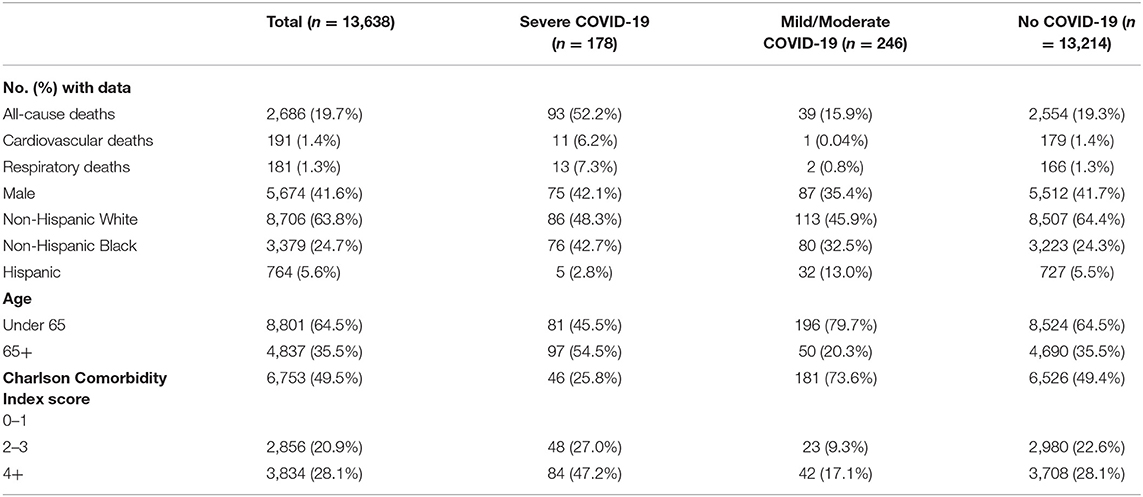
Even if I use your position that people were to die without being infected due to their health already being somewhat compromised (which isn't the case here but I will suppose it for your trollish statements) - the point is that COVID-19 has serious and significant impacts on the cardiovascular system beyond your immediate infection and more so than we previously thought.
Naw. Masks need to go away.
Masks reduce the amount of aerosols a person emits, thereby reducing the distance and amount of viral particles an infected person can spread in any given situation.
As a side benefit some masks protect the wearer to an extent, particularly N95s, but the main purpose is to reduce spread from infected people in the first place.
Vaccines, similarly, are not a magic shield that protect you from even getting COVID. Instead, they dramatically reduce your likelihood of getting severely ill and being hospitalised and reduce the duration of disease therefore also reducing transmission. But that only works if enough people are vaccinated that the cumulative effect of that reduced transmission can meaningfully bring down the R0 value.
This pandemic has exposed how few people are able to consider issues or questions at a broader community level versus merely how it affects them directly.
There are no very good choices. But the high cost of lockdowns should dictate that they only be used when the alternative is extremely large numbers of people dying (at least in the UK, this was probably met at some point last year but hasn't been met for the majority of the Covid period).
* COVID itself
* its funding and delivery model making it vulnerable to politicians acting in bad faith
far more than restrictions on gatherings.
By the way, an "elective" surgery is one that can be scheduled in advance. Most elective surgeries are not optional. https://www.hopkinsmedicine.org/health/treatment-tests-and-t...
My comment about electives was for the US audience. The US does a huge amount of quality-of-life, elective surgeries that don't happen in the UK (i.e. giving an 85-year old a knee replacement). So when you write something like: the waiting list is long, people from the US might not understand that the mix of surgeries in the UK is very different from there, and it largely represents people who need prompt care (for example, I have a relative who is a high bowel cancer risk and needs a regular screen, in the US this would likely happen annually but hasn't happened for about three years now because they were overdue in early 2020 and then everything stopped).
Or to put it another way: Would you be okay to go, while we keep everything open? How about your parent, or grand-parent?
If you were old and had little time left, and had a compromised immune system that made any slight infection possibly lethal, and you had the choice to close down society to lower your risk of infection, would you do it?
My own country alone has seen nearly 300 000 excess deaths compared to the annual average, with the waves of excess deaths neatly tracking those of known COVID infection waves.
"The temperature outside is 2 degrees higher than average". Ok what conclusions can you draw from that? Very little. Just because you make a big scary number without reference, doesn't allow you to jump to a conclusion out of fear, it's just manipulative misleading misinterpretation to make it look as scary as possible, to disable people's critical thinking and support a point that actually doesn't have any basis.
That is, not just the number of people who died, but the number calculated to have died over and above the normal seasonal average.
If those excess death calculations are perfectly acceptable to calculate the effect of bad flu seasons and other mortality-affecting events, why are they suddenly not okay now?
Why not just show standard deviation, median, average, percentile. Show the standard deviation in the graph.
For that, each country maintains an official group that has access to death certificates and other records when preparing statistics. The figure I quoted, for instance, is from the South African Medical Research Council, who publish their methodology. There's also EuroMOMO and many others.
Did you really think that statisticians and scientists have just magically forgotten about how to do basic statistics, for decades, when preparing these reports?
Instead of using the normal measures of mean, average, standard deviation and percentiles, we just used "formula" and voila, here is answer. Ok I'm going to continue to be sceptical of such results..
I'm now convinced you just want to be a contrarian, rather than learning about a system you don't understand.
Excess death tracking is hardly a new thing, most countries have been doing it for decades to measure the effect of things like flu outbreaks. Therefore when those same statistics being done using the same approach suddenly show huge climbs in 2020 and 2021 it means something.
Stop trying to minimise the pandemic. If your arguments about how to deal with it are rational they should stand up to the reality of how serious it really is, rather than a pretend reality where people haven't been dying in large numbers and filling up hospitals for two years.
Another example from the media (now I am shifting goal posts, but defending my point of proving that it's exaggerated and manipulative): Why are they reporting running totals of number of deahts? And making big headlines of when they reach "new grim milestones"? How is that not a completely irrelevant manipulative misinterpretation? A running total of deaths, really? When will that ever go down? And using that to support a case that "things are getting worse" somehow.
I'd recommend you spend some more time learning how the scientists and statisticians calculating these figures actually work, and maybe speak to a few, before commenting further.
It isn't reported because it takes more explanation than the media likes to give, and direct COVID-19 death counts are less complicated, not because “there is none” which is just false:
https://www.cdc.gov/nchs/nvss/vsrr/covid19/excess_deaths.htm
Again, as stated in GP (with supporting data) in neither Germany (the context of the article) nor the US (the context and source of much of the political debate in the thread) is it true that actual deaths are not higher than expected from pre-pandemic experience.
Yes, no issues at all. I support lockdowns and have had relatives who became very ill because of lockdowns (delayed/ineffective hospital treatment, I am actually not well myself either for the same reason). I think trying to argue that someone should only support/oppose something because they have something to gain personally is the reason why politics in some countries is totally fucked (the UK is probably the worst for this, somewhere around 2017/18 most of the media became tabloids and every politics story contained some hyperbolic bullshit from some random person claiming their life would be destroyed by X minor policy change...it is just a waste of time and energy for all involved).
Summer of this year was close to normal again, though it is of course easy to imagine it wouldn't have been in a zero-restrictions scenario.
It expects death rate to be constant over the year, which is wrong.
You need to take the total number of deaths per capita, for 2020, and compare that to the same number for 2019, 2018, 2017 etc. And look at the standard deviation.
You can clearly see bumps due to flu season in previous years, but because flu season happens every year since before 2013, this becomes a regular seasonal effect and don't show up as 'excess' except in late 2018. We also happen to know that flu was greatly suppressed by anti-Covid measures these last two years.
But I'm still not sure what I'm looking at, overlaying a single year over an average is always going to look "excessive". I want to see previous years as well, why not just extend the graph? That's the one single most important number that you never get so see. Here they have buried it in a complex algorithm which looks honestly suspicious at first glance, upper bound for excessive death is basically the same as average. Is standard deviation really that low?
EDIT: I just want to see how many people died per capita in 2020, 2019, 2018, 2017 and so forth, why is that not shown anywhere?
Because that statistic makes the whole thing seem very mellow. Same thing as average life expectancy by year; the change from 2019 to 2020/21 is very slight.
In other words, Is the emperor actually naked, or are you simply fishing for the conclusion you want to hear?
I do believe some people will have lingering respiratory problems, as is the case for all viral respiratory illnesses. But I don't think there is much more to it than that, and I think most of the complaints come from the sort of people who always think they have the latest trendy affliction.
Source?
https://evidence.nihr.ac.uk/themedreview/living-with-covid19...
> There is a widespread perception that people either die, get admitted to hospital or recover after two weeks. It is increasingly clear that for some people there is a distinct pathway of ongoing effects. There is an urgent need to better understand the symptom journey and the clinical risks that underlie that. People, their families and healthcare professionals need realistic expectations about what to expect.
Of course, these days, anyone can link to a "study" about anything that says anything you want it to say.
What you linked may be valid, but so far has zero citations and various critical discussion going on in the comments. Is this already published at all or is it a preprint?
I don't have enough time or knowledge to assess the validity of the claims, but based on that, the study I found on Wikipedia seems more trustworthy to me.
Conversely another very real phenomenon is fear induced immunosupression, to which all of these overreactive measures and constant media bombardment are greatly contributing.
"Opening up" would have killed more people than it killed in the UK.
The people driving this wave, who are getting seriously ill and dying are the unvaccinated.
It is not going to be a crime to be unvaccinated just a lot more inconvenient.
* Sweden: 1,485
* Denmark: 500
* Finland: 244
* Norway: 199
* Iceland (not really a neighbour, being a 1000 miles away, accross an ocean): 102
Some more random cherrypicking:
* USA: 2,414
* Italy: 2,221
* Belgium: 2,322
* UK: 2,124
* Russia: 1,901
* Peru: 5,984
Deaths per million capita, as of 2nd december 2021, from[1].
[1] All numbers from https://www.worldometers.info/coronavirus/
The lesson here seems to be that nursing homes probably cause some amount of excess mortality, and need special attention during epidemics/pandemics.
If things unfold more slowly, you have more time to develop treatments. A lot of the deaths in NYC occurred before we figured out that just laying people on their sides reduced the risk of dying significantly.
Moreover, now that we have the ability to rapidly produce vaccines, it isn't a forgone conclusion that everyone will necessarily "get the virus eventually anyway."
No such thing happened.
Cumulative death per 100k for Sweden in Covid is about 1500, compared to 1750 for France and 1200 for Germany. And far worse then the neighbouring countries.
I would not say anything "worked" but rather that the policies were not worse than other bad policies.
https://ourworldindata.org/explorers/coronavirus-data-explor...
As opposed to the rest of EU where everyone is pretending to wear masks but only as chin diapers.
I really hate mask religion. Especially the branch of it that likes to gaslight and minimize the idea that masks suck.
Maybe we have to agree to disagree on "inconvenience" of mask wearing. It is, clearly, an irrational but very powerful standoff. Masks have a marginal effect on protection (11% relative reduction in transmission, according to best recent study? So the abs risk reduced from, say, 20% to 18%) while having an enormous symbolic meaning, made even bigger by turning into political token. Washing hands is not even in the same league of religiousness. We'll see how it goes when it is made mandatory with govt-appointed "hygiene inspectors" at every workplace and fines up to a few grand...
Surely, fogging glasses and alike are minor things, but instinctive revulsion, panic, "brain shutting", "blood boiling" and suicidal tendencies aren't something to dismiss. I'm not particularly proud to be having such reaction, and I honestly tried to rationalize myself out of it, but to no success. At this point I also try to avoid seeing masked faces. I close articles or posts where author's photo is masked, blacklist YT channels and switch off TV when masked reporter or anybody pops up. That's the only thing I can do to keep some sanity before it overcomes me. And it will, because the mask mandates are looking to be with us for years...
The analogy you don't have to accept, but may help to illustrate how we (people, resisting "minor" inconvenience for "greater good") feel. Consensual physical intimacy is a great thing, very pleasant, absolutely harmless if practiced with proper care and contraception. People always sought it and it is still very much a driver of life, and will be forever. In wild nature our close relatives, bonobos, practice it widely and casually for stress relief, and it works great for the cohesion of their society! They known to have much less aggression than their bigger bros or humans. Surely the solid rational case can be made that adopting such practices could improve human society as well, maybe in major way. How would you feel if such "minor inconvenience" is mandated, with proper rules and protocols, of course? It must bizarre and unreasonable that the foolishness of "muh freedumb" standing in the way to "Greater Good"? How foolish it is of humans to make non-consensual intercourse a crime, sometimes worse than murder!
I would follow any mask mandate, but the experience here (from my point of view) is that they don't seem to help that much. Otherwise we should have an absolute explosion of cases right now, compared to other European countries. My personal theory is that people don't use them properly; look at people on tv, constantly adjusting them, or wearing them under the chin, reusing single-use masks, etc.
There's been an uptick in cases during the last week or so[1], but compare it to eg. Germany[2] that have had a strong mask mandate for a long time. I don't understand it either.
[1] https://www.worldometers.info/coronavirus/country/sweden/ (do note that when looking at the chart for deaths, we have always been lagging a couple of weeks)
[2] https://www.worldometers.info/coronavirus/country/germany/
They're at about the EU average. 8-10% above the US average, 5-7% above California, but a few percent below New England, for example.
My conclusion from this is that, in this area, regulations are path dependent. In some countries, people will make the right choices themselves. In others, they won't. I am in the UK, in 2020 it was evident that the hands-off approach really wouldn't work. But it did work this year.
Also, I don't think there is any question about fixing it. You have to test (most countries still don't test enough), you have to give people the information to make a choice, and you have to keep vaccinating. Imo, and I thought the opposite in 2020, lockdowns/heavy regulations aren't a long-term strategy (outside of China).
People's willingness to comply with lockdowns over time has waned, because the government's response to covid has been pretty incompetent. The thing that has finally started turning things around is the high rate of vaccination.
At the beginning of the pandemic, where I was, people mostly stopped going to restaurants before regulations said they couldn't. When restrictions have been relaxed, I couldn't really observe any changes in behavior.
The handling of those people in the media and the way their opinions are presented equally with scientific facts result in this reluctance politicians displayed in this crisis. Now we all have to suffer because of it. I hope we finally mandatory vaccinations...it's overdue.
Recently moved back from Germany after five years there, homeopathy depressingly common and accepted there, even by many medical professionals.
We still have homeopathic pills and "treatments" which are being paid by the health insurance. Something which goes back to some politicians wife who believed in it and was able to influence the political process. The huge Steiner tradition in here is catastrophic. We just recently had COVID running wild in a Waldorf school. Turns out, faked vaccination certificates were very popular...
It's quite embarrassing and it's actually the first time the side effects of this madness come up in public discourse.
Just in this thread alone, we can find people saying:
1. Vaccines would let us wipe out COVID (wrong).
2. Even harsher lockdowns would let us wipe out COVID (wrong).
3. Vaccines stop people transmitting it (wrong).
4. Vaccinated people don't end up in ICU with COVID (wrong).
5. Sweden had unusually bad outcomes (wrong).
6. That it's "very normal" for people to take yearly flu shots (wrong, only ~35% uptake amongst at risk patients in 2019).
And that's not even a full list. There's not only a large set of factually incorrect beliefs amongst vaccine mandate fanatics (and that's the only word for you guys now), but also a generalized incorrect belief that it's the other side who are badly informed.
Vaccines don't stop being from transmitting, but it reduces the length of infection by about 2 days, it drastically reduces the likelihood of infection, which drastically reduces the transmission rate, and recent studies have shown that it does also reduce the likelihood of transmission directly.
Vaccinated people with breakthrough cases may end up in the ICU, but the rate of hospitalization, admittance to the ICU, and cases of death are considerably lower than those who haven't been vaccinated.
Using the extreme example, and pointing out that each argument is wrong, rather than extreme, while not discussing the facts is just another form of misinformation.
The reasonable choice is to disallow all fanatics, but the world is too polarized on this topic. The center cannot hold.
Regardless, whilst these claims are "extreme" in the sense of being phrased in absolutes, they aren't "extreme" in the sense of being rarely believed, are they? Not only do they crop up all over this thread but in the very article the thread is about, Angelas Merkel, not exactly famous for being the Queen of Extreme, says "The fourth wave must be broken and this has not yet been achieved" which is simply another way of saying (3) and strongly alluding to (1) and (2).
Also:
"it drastically reduces the likelihood of infection, which drastically reduces the transmission rate, and recent studies have shown that it does also reduce the likelihood of transmission directly"
Let's break this down:
1. Infection rates. Health agencies claim it reduces the likelihood of infection, and at first it genuinely seems to, but the only one that is willing to show the actual raw data before they wildly alter it using statistical techniques, is the UK HSA. Their data shows that by now the rate amongst vaccinated people is actually a lot higher than among the unvaccinated for some large age groups! This sounds like it should be impossible, but it turns out to have been observed in pre-COVID times with other vaccines.
They have been reduced to claiming that comparing case rates between vaccinated and unvaccinated people isn't a valid way to determine if the vaccine works, due to vague behavioural differences that they speculate must exist but have no proof for.
2. Rate of transmission. Not for the first time, we find that epidemiological studies aren't worth much. Can you cite yours, so we can see when it was written? Because once again UK data contradicts it (or it does now at least):
https://www.thelancet.com/journals/lanepe/article/PIIS2666-7...
"In the UK it was described that secondary attack rates among household contacts exposed to fully vaccinated index cases was similar to household contacts exposed to unvaccinated index cases (25% for vaccinated vs 23% for unvaccinated)."
No real difference in transmission at all. Actually slightly higher for vaccinated people but let's assume that's not really significant.
On the other side we have anti-vaxxers here too. Who's more harmful?
While most of those points you made here are just overblown generalisations (and probably not even stated in this fashion), none of them are completely wrong. On the anti-vaxxer side we have claims which are not only completely wrong, people literally die because they or others around them believe in them. So again: what's your point?
Seriously - how?
Let's start by agreeing that hospital overload is definitely a bad thing.
Vaccination should help reduce the load, but has anything else been done? Hasn't staff in hospitals decreased over the course of the pandemic? Aren't we funneling tons of money to pharma instead of Frontline workers? What about setting up field hospitals? What about altering the priority access to emergency health care of the unvaccinated?
Hospital overload has been a liminal crisis for the past 2 years, but has yet to materialize as a real issue.
Have we just been getting lucky? narrowly avoiding disaster each wave?
Because this is almost starting to look like a boogeyman that pops up on a regular basis that reminds us that we need to live in fear.
People can go and get a jab. This is easy. Can be done in minutes. No harm done.
You can't build a hospital like that or get personal cloned from some pool of educated personal. Even if we'd have started 2 years ago. Wtf do you want with a field hospital? Those people don't need bandages...what are you talking about??
I know this smokescreen it just came up all over the anti-vaxxer scene. It's a hilarious attempt to cloud their own responsibility and divert the anger away from them. It won't work because it's so cheap and stupid. Especially coming from people who refuse to accept the easiest and fastest solution.
And NO, hospital overload is the only valid point. By spreading and keeping the pandemic running you also ruin peoples lifes economically. People who depend on crowds coming to their store for example or doing sports with them. Than there is long COVID...
Man...this topic is not new. All those ways this is harmful has been presented in the media over the last years. How can you still be so ignoran December 2021????
Field hospitals were proposed early on in 2020, they even sent the medical ship to NY up the Hudson. Its not my idea and it's not a new idea. If you're not aware of that, then I'm sorry for assuming the extent of your awareness.
We don't have to clone anyone. We can do 2 very easy things: 1. Rehire the unvaccinated that were let go. 2. Pay our front line workers more.
Everyone should support this. It's an easy win.
As someone who's unvaccinated and had covid, I honestly don't know what long covid is or why we should be afraid of it anymore than the long term effects of the vaccine.
Though if you fell for one boogeyman, it makes sense that you'd fall for another.
Covid is out of the box, economic damage is inevitable. How much is up to us. If you look at Florida, Sweden, or even the Amish, it's clear lockdowns do more economic harm than covid does.
Last but not least, I'll say it again.
Hospital collapse has been a liminal crisis for 2 years.
We have more vaccinated than ever before yet were still somehow on the brink of collapse. Nothing has been done about it except to scape goat the unvaccinated. People are going to be unvaccinated. The vaccine is going to wear off. Try doing something about it instead of dehumanizing people you disagree with.
Enough is enough.
So this ship was manned by robots or where is the connection to what I wrote?
> We don't have to clone anyone. We can do 2 very easy things: 1. Rehire the unvaccinated that were let go. 2. Pay our front line workers more.
Why would you hire somebody who is unable to do the most basic stuff to protect their patients (get vaccinated). Those people are obviously not suited for their job and I'm happy they are gone. There should be a list so those people never ever end up in a responsible job like that or at least need to get some MPU before they attempt it.
@2 you still won't magically conjure them out of nothing just because you pay them. You need to learn that stuff. It takes time.
> As someone who's unvaccinated and had covid, I honestly don't know what long covid is or why we should be afraid of it anymore than the long term effects of the vaccine.
I can't imagine how somebody can write such a thing December 2021 and still expect to be taken seriously.
You've made up your mind. You have complete confidence and conviction in the vaccine.
That's fine. I respect your right to choose based on your own risk tolerance.
So of course you and other fanatics won't take these points seriously, you think the alt premise is completely illegitimate.
It's a fool errand to try to change the mind of someone who's certain they can't be wrong, so I'm not going to try.
What I am trying to do is explain that after 2 years of worrying trends, events, and numerous unknowns.. it's reasonable to believe we're not getting the full story about the vaccine.
But you know what, I hope I'm wrong. Let's chat again in 5 years, and then we'll know for certain.
Just because YOU didn't have it, doesn't mean nobody else didn't.
I've seen zero convincing evidence of "long covid".
Mostly I see it defined as vague psychological effects .. hard to imagine any universal confounding factors that might result in everyone having a poorer psyche in general in recent history.
The effects last a few weeks on average, 3 months in rare cases. While its odd an ominous for the effects to last that long, there's no reason to believe it will last for years.
And while there are some real permanent effects, like loss of smell + taste, these are extremely rare. Like vaccine induced myocarditis rare, maybe even more so.
Meanwhile, "all cause of death" rates are on the rise, despite ATH vaccination rates. Is that definitely because of "long covid", and definitely not because of the vaccine? That doesn't make sense to me.
Sad.
> There was a rush last summer to open everything up despite it being relatively clear it was way too early and a lot of people really understood it as "corona is over"
I totally agree. Last week saw a dentist and this morning (10:02) two sales ladies at a baker's embedded in an EDEKA supermarket with no mask, one of them coughing. When pointing out politely that they should really put their masks on, my comment of mine was ignored. The unfair thing is that it won't be these people dying, but likely third parties that did nothing wrong (like the elderly couple behind me in the queue).
There is a huge debate focusing on vaccination, about forcing people to do it etc., but schools are open, kindergardens are open (every parent knows that's where stuff spreads), people shop, socialise, eat together, work together almost if there was nothing going on.
The government failed to point out that vaccinated people can still get CoViD because they were afraid it would stop people from getting the jab, so they assumed they were safe and went back to pre-CoViD behavior patterns. The government is reducing the testing regime, so future numbers will be less reliable.
Public TV station ARD/Das Erste started to lose credibility with me when they claimed on Twitter that medical masks don't protect. That is false/"fake news": the truth is they are designed to protect the patient when worn by staff, so their protection is asymmetric and biased against the wearer and in favor of the person talking to the wearer. But they do provide a little protection even for the wearer, as the larger droplets get caught by them, and catching a virus also depends on the amount and concentration of viral material exposed to. (The reason the posted the tweet was because at the time, there was a shortage and they did not want that non-medical staff buy them up so there was enough of a supply for medical staff. It's okay to ask people to stop buying them for that reason but not feeding them with false information to make them stop.)
The new government put a general in place to run a task force and instead of saying "fantastic, why didn't the previous government think of that?" the press questioned why leaders who all declined military service on the grounds of conscience appointed a military man (the candidate seems to be a supply chain expert, so not a bad choice - although I personally would pick a paramedic because pandemic training is part of one's education, at least it was back in the 1990s when I did mine).
Despite all of this, in fairness the situation in Germany is much better than in other countries (I can only say that from personal knowledge about the UK, France and the US), and I would say that at the beginning, the government did a good job in absolute and relative terms.
1.) We just had our federal election so politicians were super cautious not to alienate anyone with though measures. Because we didn't have the transition of power to the new chancellor yet, this is still holding us back.
2.) If vaccination rates would just be another 5% higher (meaning 20% less unvaccinated people), the speed of the 4th wave would have been so much damper that we would have gotten through this winter without any hard restrictions (see France). I think there was a lot of wishful thinking involved that thought that those 5% would come around eventually.
Much of the measures have been justified by saying they're temporary in place under the emergency. Two years of temporary measures, and now people are saying they need to be permanent.
Its terrifying, over here in Brisbane, Queensland. We've had one locally acquired case from Covid in the last few months.
We're going to pubs, no masks, No Covid. But we're sorely missing our freedom. /s
However, I don’t understand the US-centric (satirical) perspective in a comment like this. The article is about Germany, the person you replied to made no specific mention of the US as far as I can tell, and their view is not unusual in many other regions of the world (such as the one I live in). Does the radicalism of Fox News really need more attention or notoriety?
I am also starting to think this country is not really built to work in a crisis like this. Regulations are maybe good in general, but this tendency to regulate every possible detail does not work when you have to change the rules every month because almost nobody really knows how to fix this.