These facts came from a BBC Radio 4 programme called More or Less [1]
In France, Italy, Spain, and Germany, approximately one third of the land is covered in forests. Finland has an impressive 73% forest cover.
Forest cover has always been small in the UK for the past few hundred years. The Industrial Revolution was not the cause of the small forest cover in the UK.
An estimate from the Forest Commission (a UK government department) is that forest cover in England in the 1100s was only about 15%. After World War I, it dipped to its lowest point - 5%. It's currently about 13% in England (similar in Scotland, Wales and Northern Ireland).
Why is forest cover so small in the UK? About 5000 years ago, people started cutting down forests to use the land for agricultural use. Even in Roman times, Britain had a reputation for growing lots of produce.
One of the reasons that other European countries have retained greater forest cover is because they have mountain ranges which makes it much harder to convert that land into agricultural use.
[1] More or Less: Behind the Stats: https://www.bbc.co.uk/programmes/p09x66st (The discussion on forest cover starts approximately at the 24-minute mark.)
---
Edited to add:
The BBC radio programme cites it's source for statistics on forest cover as the UN Food and Agriculture Organization. Their 2020 Global Forest Resources Assessment is another source of fascinating stats:
- Forests cover nearly 1/3 of land globally
- More than half (54 percent) of the world’s forests are in only five countries: the Russian Federation (20%), Brazil (12%), Canada (9%), the USA (8%) and China (5%)
- Rest of the world makes up the rest (46%)
Link: https://www.fao.org/forest-resources-assessment/2020/en/
The other big example is the rapid extinction of all that tasty, tasty megafauna.
https://news.utexas.edu/2015/09/03/clues-from-ancient-maya-r...
So saying "their practices were relatively scalable, since they were at a small scale" sounds wrong, which is why I think you are being downvoted.
Same way "I use gas to drive my truck" isn't sustainable, even if I'm the only one with a truck. The practice isn't sustainable, even if emissions from one person might not have a large impact.
Maybe if it was more like "if everyone in similar circumstances lived this kind of lifestyle".
If a forest can safely supply 1000 trees a year, and a certain lifestyle has 300 people depend on that forest and each use two trees per year, then that's sustainable. It doesn't matter that 3000 people per forest wouldn't work. And if a million people all live this way, then they're splitting three thousand forests, so that's fine too.
It's not reasonable to worry about infinite population density, because then nothing is sustainable. And prehistoric practices weren't using up fossil fuels; trees grow back if you let them.
Though even the sustainability of gas is more complicated than "it's not". As far as CO2 goes, there is an amount that could be safely released per year. And if we were at that level, oil reserves would last a long time.
First, on a regional level, civilizations could heavily deforest their surrounding ecosystem to the point of devastating it and themselves with long-term consequences. A couple examples are the Romans, pre-modern Britain and of course, the Maya.
Secondly, the productive practices of pre-modern times were far less efficient in many ways than they are today, meaning not only heavy dependence on forest or at least wood resources, but also a much more impactful destruction of forest land for needs that in many societies today are handled without resotrting to wood.
Increase in efficiency directly leads to increased consumption:
> The ecological impact of pre-modern iron production was also significant. We know, for instance, that Elba was almost totally deforested during the Roman period to fuel the bloomeries smelting the ore and Pliny notes in his Natural History that smelting (not always of iron) had substantially reduced forest-stocks in parts of Gaul and Campagnia. Roman iron production in the eastern High Weald of England may have deforested something like 500km2 over the course of three centuries and there is reason to believe that Roman-period iron production in this area stopped because of scarcity of fuel, rather than ore. Iron-working was hardly the only factor in the steady deforestation of Europe, but it was a major factor.
[1] https://acoup.blog/2020/09/25/collections-iron-how-did-they-...
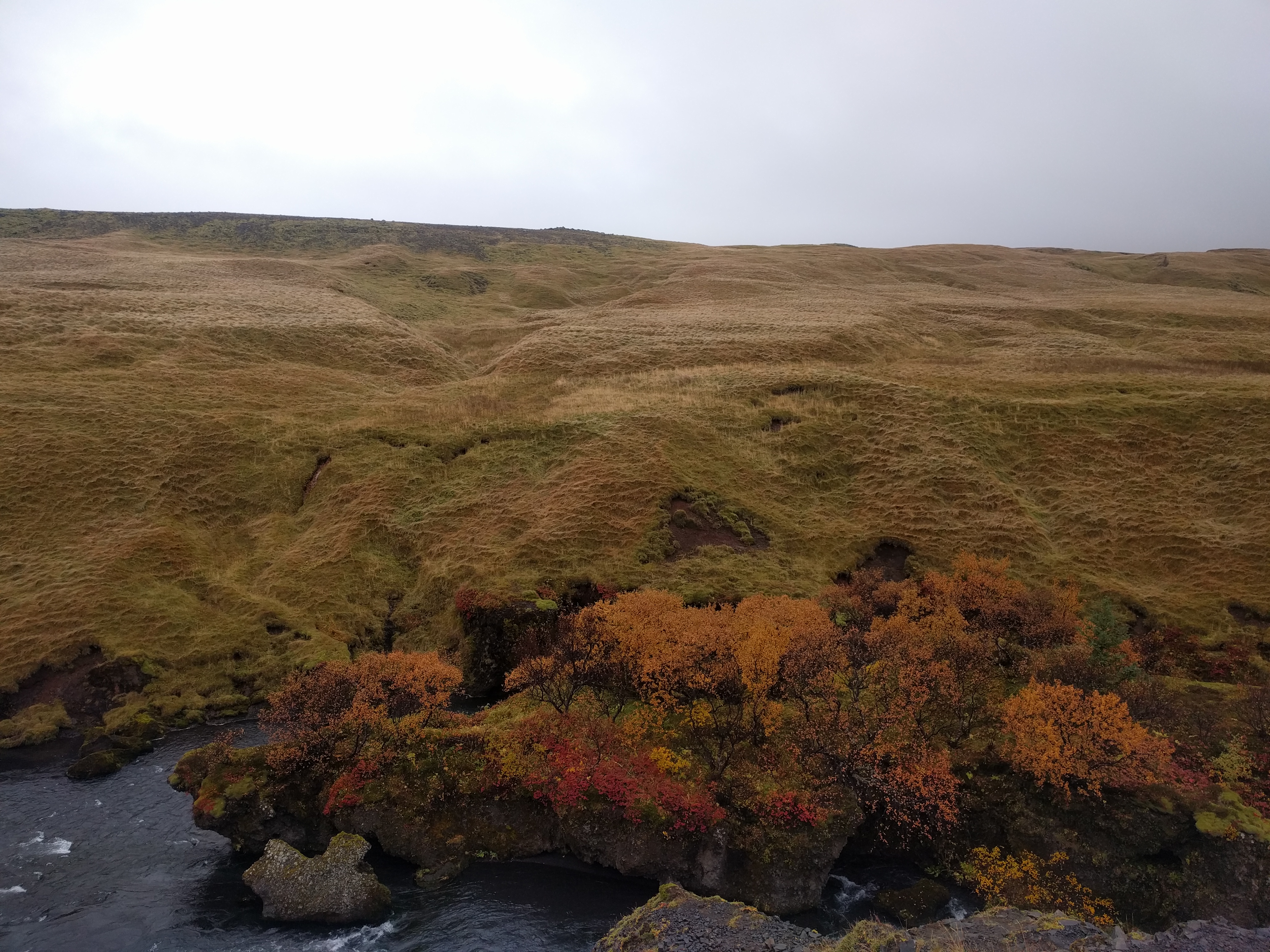
Iceland used to have 25% of its territory covered in trees... until the vikings came, some time in the 900's. Now, it's nearly entirely devoid of trees.
https://www.geographyrealm.com/icelands-long-road-to-refores...
Superficially Iceland looked forested like Scotland, so they continued their existing animal grazing practices, which along with logging then destroyed the thin topsoil layer of Iceland.
I think it was Jared Diamond who summarized it like that, but in the context of Greenland, where the Viking immigrants suffered and even worse fate, but the patterns are similar.
[1]https://njarboe.com/iceland/IcelandTreeIslandSkogafoss.jpg
That is how it works now because there are very few large foraging animals in Europe today but to reintroduce them would also need the introduction of their natural predators to keep things in balance and most people are not keen on wild wolves or large cats!
I would be happier with knowing that the UK has "wild cover" rather than forests specifically but I suspect we score even worse on that!
I get the feeling that the Gov doesn't care, and the local authorities have their hands tied or are just overruled when it comes to trying to keep green spaces
The backlash to introducing even modest by-right zoning in the UK last year was immense. The UK's housing regulatory scheme is somehow even worse than California's, it's just that the demand isn't as high and so the crisis isn't as acute.... yet.
There definitely is NIMBYism, but I'd say taht at least half the time there is a valid reason for it - usually the infrastructure is not going to cope with the developments, but then that is always promised to come after, you know, once they run out of money ;)
Also, just because a parcel of land is green does not necessarily mean that it is a valuable ecosystem. Intensively farmed agricultural land can be degraded already. A well designed development will leave the hedgerows, introduce gardens and have wild areas. It can and should be better for wildlife.
The bit about woke is a no true Scotsman fallacy. And it is ironic how you use the environment to push your own blinkered political agenda.
This simply is not the case - there is building throughout these areas, sometimes whole new towns. And I do walk. It's a struggle to get away from traffic noise unless one travels out of the South East.
> The bit about woke is a no true Scotsman fallacy. And it is ironic how you use the environment to push your own blinkered political agenda.
We can all throw slurs around, not sure it gets us anywhere in particular - though I'll note it does seem to be the first resort of the left.
[0] https://en.wikipedia.org/wiki/The_National_Forest_(England)
I'm surprised it isn't more tundra-like in its geography. I know the Gulf Stream helps moderate temperatures but the sunlight level to me seems like northern Canada.
New York is at 40.7 deg latitude North, which is only slightly North compared to Madrid. Miami is 25.8 deg North, which is more South than the Canaries Islands...
China is also actually mostly to the South of Europe, with Beijing actually slightly South of both Madrid and New York.
I'm rarely as concerned about northern forests though. Fir trees count for half, or less, IMO. Without beech, silver birch, oak and yew the forest is fake.
https://www.gov.scot/publications/scotlands-forestry-strateg...
There's plenty of land further south being reforested tho.
The literal meaning of "England" in norse languages is something like "meadow land".
The fact that English 'meadow' is 'eng' in modern Norwegian is misleading.
Yes, places were also named based on the tribes living there ("goth land" or "scot land" for example), but people living in a region were named by that region, like how we say "the icelandic people" today.
"English" people living in "england" is consistent with both perspectives.
(Other place names like Zealand in denmark also have undetermined origins, but regardless of origin the literal meaning has been close to "sea land" for many speakers in the region.)
This is pretty well explained by population density, though which is cause and effect is debatable. (OK UK and Germany are ballpark similar)
NL: 421 UK: 272 DK: 135 FR: 118 IT: 200 ES: 92 DE: 232 FI: 16
Wiki>"Only 3,090 square kilometres (760,000 acres) of ancient semi-natural woodland survive in Britain – less than 20% of the total wooded area. More than eight out of ten ancient woodland sites in England and Wales are less than 200,000 square metres (49 acres) in area, only 617 exceed 1 square kilometre (250 acres) and only 46 are larger than 3 square kilometres (740 acres)."
>"There are about 11.1 million hectares of old growth forest in B.C. Old growth forests make up about 20% of B.C.’s publicly managed forest areas." https://www2.gov.bc.ca/gov/content/industry/forestry/managin...
You forgot Iceland, at about 2%.
Part of the reason why English joinery was so advanced is that they cut down all the trees everywhere. Consequently, they were left with tiny trees which grew quickly and had to make up for that with advanced joinery.
As for the Thames, that was terrible even as far back as Shakespeare (presumably even further back than that).
You would do better directing you ire against the British upper classes, who just removed the tax on internal flights, and block any attempt to provide alternatives to driving -- to give two examples that come to mind.
Bit of a weak and snarky straw man, friend. I'm absolutely not against immigration - what I am against is immigration to the UK, and any other already overcrowded place for that matter, when it necessarily results in destruction of the environment else destruction of quality of life for the population. Pod life will be miserable (intentionally miserable?) when it comes.
I agree with you on the ruling classes - who are ethnically distinct from and apparently contemptuous of the indigenous population, dating back to Norman times.
unless born there
> which is even more crowded than the UK
at least for now (0.37% growth vs. 0.48).
Or are you against people moving from the countryside to London too?
Ah, so you'd like emigrate...off the Earth? /s
Short term I think we have to find a way to allow more sustainable small multi-polar village life happen so we don’t all crowd into the same dozen or so mega-cities on the planet
I think the current impact on the environment demonstrates that we need to (slowly) reduce our population - UK included.
However, according to the statistics, we can maintain a certain level of immigration while also reducing our population - and in fact need to do so to avoid an age pyramid that is so far inverted such that it causes great economic problems.
So while I agree with you that immigration ought to be restricted such that we don't continue population growth, we don't actually need to reduce it by much to make that the case.
https://www.ons.gov.uk/peoplepopulationandcommunity/populati...
I highly doubt immigration is affecting our population that much. Plus, as recent news has shown, UK is nothing without our migrant workers.
If the UK replaces all its farmland with forest then they have to import all their food, right? That's not great for the environment, or the UK. A balanced approach seems reasonable.
Insofar as the presence of humanity is the enemy of biodiversity, the problem is suburban sprawl and excessive rural development, and the answer is urban density. Immigration is only a facet of that larger paradigm.
i.e. live in the pod?
They say that if everyone lived like a New Yorker, you could fit the world population in Texas. I imagine that if everyone in the UK lived like a Londoner, you could fit the non-London population in a London 2?
But before you come back and say "yeah well not everyone wants to be an urban hipster" and this turns into an "urban elite" conversation, have you ever thought about the flip side of that, a sense of "rural elite"? Land is limited. Space is limited. There's something odd about people with all the property in the world saying "this is all mine, keep everyone else out, there's not enough to go around, mine." And they don't have as much space as the average citizen, they have THE MOST SPACE.
Like, if this isn't a race or nationalism thing, would [parent] be cool with a mass exodus of Londoners who suddenly developed a taste for, I dunno, fox hunting or whatever? If not, why?
At any rate: living in the country and worrying about immigrants is ridiculous. They come to the cities to look for work, everyone knows that. Regarding biodiversity, I wouldn't support any kind of program that forced people to move to pods in the city, but we should certainly work on making cities more appealing so that people will make more sustainable choices.
I think there's definitely a percentage of humans who are just hard-wired not to live in cities. I for one can't stand urban living, I'd be a depressed alcoholic within months of moving to a place like London I think. Don't get me wrong I'm not one of those "I hate cities and everyone who lives in them" sorts, I visit cities fairly often and appreciate their qualities but after a while I literally start tasting the air and feel gross for it. There's nothing that could make dense living in a concrete environment appealing to me long-term, and I think there's a bit of a presumptious attitude in some parts of this discussion* that we can just coerce, gaslight, or "nudge" people until they're mentally ground down enough to grudgingly live in a city. Personally I'd emmigrate long before we reached this point - I've had enough "nudges" for a lifetime over the last two years!
Remote working has been a real blessing for me, and hopefully things like Starlink will be even better for people who fall into the "knowledge workers who instinctively dislike urban life" category. I also recognise that this is an enormous privilege though, most of society isn't in a position to take advantage of these things and there's all sorts of issues caused by people moving to less well-off areas and driving up house prices and other services out of the reach of people who've lived their lives there. I'm not sure what the solution is really, but I definitely think there's shades of grey.
* not your post by any means, I think you make good points
That also avoids us all taxing the same few nearby hiking trails like I see in some urban areas.
There is very little land on earth that doesn't meet this standard; even areas with very low population density.
It's almost like anything optimistic is a threat that needs to be immediately dealt with.
Have they visited developing countries?
This an absurd statement.
Yes, "developing" countries have more litter, but they are also less "developed" -- by which we really mean, the land has not all been converted to farms and cities and industrial buildings and pavement.
Britain is not Mordor, but the shortage of trees and animals is real. Too much of it is an empty green lawn.
Whereas really it should be a temperate rainforest, fuelled by the Gulf Stream. It is a wet, lush, and fertile place. It just needs to regrow.
Ahem, I believe industrial Britain is meant to be Isengard.
Edit:Format
Would you have expected it the other way around?
When your entire population shits into the main river that does a pretty good job of killing biodiversity even with minimal industrialization.
Yes, but enough about the UK
1) https://www.theguardian.com/environment/2020/sep/17/rivers-i...
Failed tests is nowhere close to “so much shit nothing can survive”.
Goes to show how out of touch that metric is.
Source? If you're talking about semi-modern countries like India or China specifically it makes sense because they are torn between very poor and very rich areas, both having access to some level of industrial capitalist comforts (eg. people in slums have cell phones and industry-produced clothing).
But, the matter central to this question is that these "developing" countries are in fact the ones producing all the shit we use in the "developed" countries. Production has been outsourced there not only for price of work, but also with the clear conscience that it would reduce pollution in the global north. [0]
> When your entire population shits into the main river that does a pretty good job of killing biodiversity
Yet that's not the only solution. Poop makes for very good compost.
[0] Industry pollution is a well-known problem on a big scale since at least the 19th century, when English/French cities (or at least their popular districts) were filled with acid and lead and other industry byproducts killing the population very fast.
I’d expect the opposite.
Have you? Most places in the world have huge swathes of wilderness. Britain has close to none. It's not so much about how "bad" the human populated places are. It's about how much space is left for the rest of nature.
Obviously it depends on what things they measured. If it's "Number of people named Cumberbatch" the UK would probably be ranked no. 1, so they could've also designed a study to make the UK look bad. But if I can guess, I don't think you read the study and its conclusions.
/s
We actually want to help developing countries to develop without ending like Europe.
>'The UK is one of the most depleted countries in the world in terms of biodiversity. The Natural History Museum has calculated an index of biodiversity intactness. Using this measure of the health of our natural environment, we rank 189th in the world, and we are bottom of the G7 countries. In the past 10 years, 41% of our bird species have decreased and 15% of our wildlife is threatened with extinction.
>'The dreadful state of our nature is at least in part a result of living in a densely populated country in which nearly three-quarters of our land is used for farming or the built environment. We have simply squeezed nature out of its home.'
>Lord Krebs, zoologist and Member of the House of Lords, in the debate on the Environment Bill, 10 June 2021
It's great that the Thames is improving, and the recent stuff about the wild bees is amazing, but these stories lack the wider context.