News for hackers. Stuff that matters.
Re:London's Thames, once biologically dead, has been coming ... by open-source-ux on Friday November 12, 2021 @08:07AM (#29198900)
I recently heard some startling facts about forest cover in the UK. (Forest cover is the amount of forest covering the land.) The UK has only approximately 13% forest cover. In Europe, only Denmark and Netherlands have similarly low coverage.

These facts came from a BBC Radio 4 programme called More or Less [1]

In France, Italy, Spain, and Germany, approximately one third of the land is covered in forests. Finland has an impressive 73% forest cover.

Forest cover has always been small in the UK for the past few hundred years. The Industrial Revolution was not the cause of the small forest cover in the UK.

An estimate from the Forest Commission (a UK government department) is that forest cover in England in the 1100s was only about 15%. After World War I, it dipped to its lowest point - 5%. It's currently about 13% in England (similar in Scotland, Wales and Northern Ireland).

Why is forest cover so small in the UK? About 5000 years ago, people started cutting down forests to use the land for agricultural use. Even in Roman times, Britain had a reputation for growing lots of produce.

One of the reasons that other European countries have retained greater forest cover is because they have mountain ranges which makes it much harder to convert that land into agricultural use.

[1] More or Less: Behind the Stats: https://www.bbc.co.uk/programmes/p09x66st (The discussion on forest cover starts approximately at the 24-minute mark.)

---

Edited to add:

The BBC radio programme cites it's source for statistics on forest cover as the UN Food and Agriculture Organization. Their 2020 Global Forest Resources Assessment is another source of fascinating stats:

- Forests cover nearly 1/3 of land globally

- More than half (54 percent) of the world’s forests are in only five countries: the Russian Federation (20%), Brazil (12%), Canada (9%), the USA (8%) and China (5%)

- Rest of the world makes up the rest (46%)

Link: https://www.fao.org/forest-resources-assessment/2020/en/

Re:London's Thames, once biologically dead, has been coming ... by foobarbecue on Friday November 12, 2021 @09:29AM (#29199555)
Yes. It's a common misconception that major human impacts on the world started with the industrial revolution. We've been shaping nature globally for hundreds of thousands of years. Another misconception is that prehistoric / native practices were sustainable. As always, the reality is far more complicated.
Re:London's Thames, once biologically dead, has been coming ... by FooBarBizBazz on Friday November 12, 2021 @01:12PM (#29202610)
Supposedly the moors used to be forests, and got the way they are today because of soil depletion in prehistory, as a result of slash-and-burn agriculture.

The other big example is the rapid extinction of all that tasty, tasty megafauna.

Re:London's Thames, once biologically dead, has been coming ... by twiddling on Friday November 12, 2021 @10:36AM (#29200279)
Yeah, there was great work done on the impact on Mesoamerica from the Mayans.

https://news.utexas.edu/2015/09/03/clues-from-ancient-maya-r...

Re:London's Thames, once biologically dead, has been coming ... by adrianN on Friday November 12, 2021 @09:41AM (#29199667)
Prehistoric practices were relatively sustainable because population was extremely low compared to today. It's perfectly fine to cut down some forest to feed your village, it's not a problem as long as global population is less than a hundred million people.
Re:London's Thames, once biologically dead, has been coming ... by Tyr42 on Friday November 12, 2021 @10:53AM (#29200520)
I agree, but I also think that by saying a practice is not sustainable, they mean that if scaled up and run for a long time, it would eventually cause an impact. You can swap out sustainable and scalable and it reads pretty much the same.

So saying "their practices were relatively scalable, since they were at a small scale" sounds wrong, which is why I think you are being downvoted.

Same way "I use gas to drive my truck" isn't sustainable, even if I'm the only one with a truck. The practice isn't sustainable, even if emissions from one person might not have a large impact.

Re:London's Thames, once biologically dead, has been coming ... by Dylan16807 on Friday November 12, 2021 @04:19PM (#29204660)
Talking about "scaling up" seems like a very misguided definition of sustainable to me.

Maybe if it was more like "if everyone in similar circumstances lived this kind of lifestyle".

If a forest can safely supply 1000 trees a year, and a certain lifestyle has 300 people depend on that forest and each use two trees per year, then that's sustainable. It doesn't matter that 3000 people per forest wouldn't work. And if a million people all live this way, then they're splitting three thousand forests, so that's fine too.

It's not reasonable to worry about infinite population density, because then nothing is sustainable. And prehistoric practices weren't using up fossil fuels; trees grow back if you let them.

Though even the sustainability of gas is more complicated than "it's not". As far as CO2 goes, there is an amount that could be safely released per year. And if we were at that level, oil reserves would last a long time.

Re:London's Thames, once biologically dead, has been coming ... by helloworld11 on Friday November 12, 2021 @04:55PM (#29204989)
Perhaps globally, but regionally, you're flatly wrong in at least two ways:

First, on a regional level, civilizations could heavily deforest their surrounding ecosystem to the point of devastating it and themselves with long-term consequences. A couple examples are the Romans, pre-modern Britain and of course, the Maya.

Secondly, the productive practices of pre-modern times were far less efficient in many ways than they are today, meaning not only heavy dependence on forest or at least wood resources, but also a much more impactful destruction of forest land for needs that in many societies today are handled without resotrting to wood.

Re:London's Thames, once biologically dead, has been coming ... by dTal on Saturday November 13, 2021 @03:15PM (#29212809)
>the productive practices of pre-modern times were far less efficient in many ways than they are today

Increase in efficiency directly leads to increased consumption:

https://en.wikipedia.org/wiki/Jevons_paradox

Re:London's Thames, once biologically dead, has been coming ... by foobarbecue on Friday November 12, 2021 @11:47AM (#29201379)
I agree with @adrianN (impact correlates to population density) with the obvious caveat that the real question is the ratio between the rate of removal and the rate of replacement. In my initial post when I said prehistoric practices were not sustainable, I should have qualified it -- "not ALL prehistoric practices were sustainable." If you live on an island eating moa, a few thousand of you can drive a species to extinction.
Re:London's Thames, once biologically dead, has been coming ... by MattGrommes on Friday November 12, 2021 @02:52PM (#29203799)
Even with a low population, a society's practices can still be devastating to the environment. There are multiple cases of early Native American cities being abandoned because they got too big relative to their previous size and used up all the resources in the area. This is with populations of 5 and rarely 6 digits.
Re:London's Thames, once biologically dead, has been coming ... by foobarian on Friday November 12, 2021 @05:19PM (#29205214)
One major lumber sink before the industrial revolution (especially then!) was iron production. The "How did they make it" series posted on HN earlier has wonderful detail on that topic [1]. Apparently the supply chain even in Roman times required a staggering amount of trees to the point parts of the UK ran out.

> The ecological impact of pre-modern iron production was also significant. We know, for instance, that Elba was almost totally deforested during the Roman period to fuel the bloomeries smelting the ore and Pliny notes in his Natural History that smelting (not always of iron) had substantially reduced forest-stocks in parts of Gaul and Campagnia. Roman iron production in the eastern High Weald of England may have deforested something like 500km2 over the course of three centuries and there is reason to believe that Roman-period iron production in this area stopped because of scarcity of fuel, rather than ore. Iron-working was hardly the only factor in the steady deforestation of Europe, but it was a major factor.

[1] https://acoup.blog/2020/09/25/collections-iron-how-did-they-...

Re:London's Thames, once biologically dead, has been coming ... by brabel on Friday November 12, 2021 @11:00AM (#29200634)
> Why is forest cover so small in the UK? About 5000 years ago, people started cutting down forests to use the land for agricultural use.

Iceland used to have 25% of its territory covered in trees... until the vikings came, some time in the 900's. Now, it's nearly entirely devoid of trees.

https://www.geographyrealm.com/icelands-long-road-to-refores...

Re:London's Thames, once biologically dead, has been coming ... by danans on Friday November 12, 2021 @11:58AM (#29201577)
IIRC this is attributed to the fact that the Vikings came to Iceland from Scandinavia via Scotland, a place with very thick soils capable of regenerating forests.

Superficially Iceland looked forested like Scotland, so they continued their existing animal grazing practices, which along with logging then destroyed the thin topsoil layer of Iceland.

I think it was Jared Diamond who summarized it like that, but in the context of Greenland, where the Viking immigrants suffered and even worse fate, but the patterns are similar.

Re:London's Thames, once biologically dead, has been coming ... by njarboe on Friday November 12, 2021 @01:40PM (#29202956)
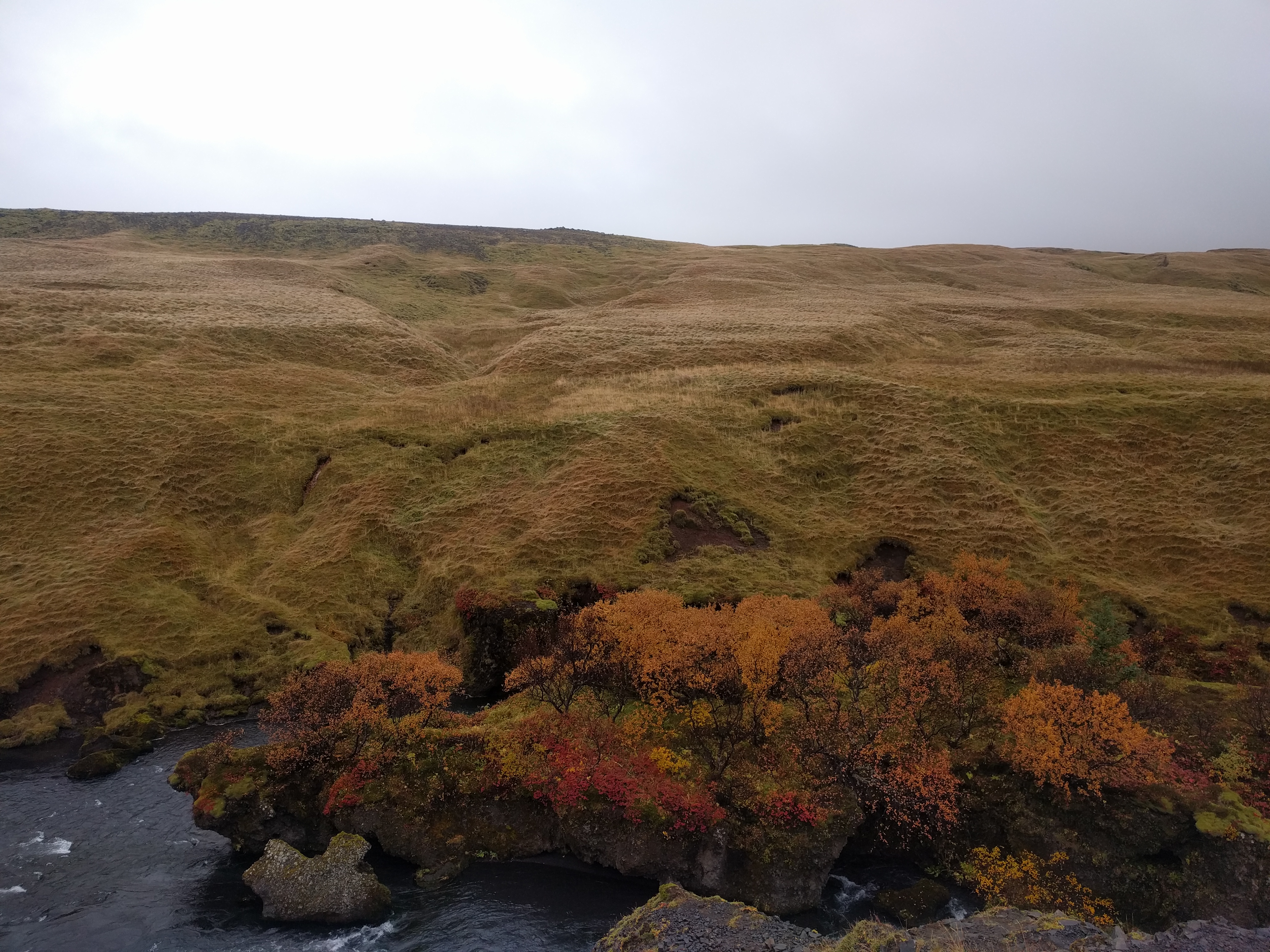
Iceland certainly does not have many trees outside of settlement areas. But I noticed this island in the middle of a river that was growing a little forest[1]. I thought at the time that it must be all the grazing of the numerous sheep and horses I saw, that kept the forest from returning.

[1]https://njarboe.com/iceland/IcelandTreeIslandSkogafoss.jpg
Re:London's Thames, once biologically dead, has been coming ... by avastmick on Friday November 12, 2021 @09:01PM (#29206667)
The impact of sheep is under estimated. On Dartmoor in the UK sheep roam freely and there are very few trees. However, there are pockets of fenced areas that are thickly grown with upland oak and ash that would have presumably been what the whole moor would have had.
Re:London's Thames, once biologically dead, has been coming ... by tuatoru on Friday November 12, 2021 @03:06PM (#29203956)
Turkey, Greece, and the Eastern Mediterranean generally also used to be forested, until people came with goats.
Re:London's Thames, once biologically dead, has been coming ... by brabel on Friday November 12, 2021 @02:18PM (#29203426)
Nice! But the little island seems to be next to slopes on both sides, well protected from the elements... maybe that helps?!
Re:London's Thames, once biologically dead, has been coming ... by vkou on Friday November 12, 2021 @07:54PM (#29206316)
Counterintuitively, the existence of a forest provides protection from the elements for the trees that make it up. Forests shape their own climate in other wonderous ways - for another example, they tend to make their biome more humid.
Re:London's Thames, once biologically dead, has been coming ... by Ndymium on Friday November 12, 2021 @09:05AM (#29199339)
Note that Finnish forests are overwhelmingly young growth forests in forestry use, i.e. tree farms. They may not look as depressing as regular fields, but they are not diverse like natural old growth forests. It's a good thing that we manage our forest cover and grow more trees than we cut down, but it's not like we are a paradise either.
Re:London's Thames, once biologically dead, has been coming ... by lbriner on Friday November 12, 2021 @11:27AM (#29201020)
I read a book about Wilding recently that challenged the assumption that ancient landscapes were dominated by forests. In a fully unrestricted system, megafauna would be responsible for keeping the number of trees relatively low and certain not like the "closed canopy forest" that we all assume would be the default.

That is how it works now because there are very few large foraging animals in Europe today but to reintroduce them would also need the introduction of their natural predators to keep things in balance and most people are not keen on wild wolves or large cats!

I would be happier with knowing that the UK has "wild cover" rather than forests specifically but I suspect we score even worse on that!

Re:London's Thames, once biologically dead, has been coming ... by bennyp101 on Friday November 12, 2021 @09:17AM (#29199428)
Here in the South East, the local councils are approving housing all over the countryside to meet the governments housing targets - even though there is brownfield land that would make more sense - but that doesn't get the developers money.

I get the feeling that the Gov doesn't care, and the local authorities have their hands tied or are just overruled when it comes to trying to keep green spaces

Re:London's Thames, once biologically dead, has been coming ... by xxpor on Friday November 12, 2021 @09:46AM (#29199722)
I seriously doubt the issue is developer profits, but NIMBYism instead.

The backlash to introducing even modest by-right zoning in the UK last year was immense. The UK's housing regulatory scheme is somehow even worse than California's, it's just that the demand isn't as high and so the crisis isn't as acute.... yet.

Re:London's Thames, once biologically dead, has been coming ... by bennyp101 on Friday November 12, 2021 @09:51AM (#29199773)
Developer profits as in, there is more to made developing on green, than there is developing brown.

There definitely is NIMBYism, but I'd say taht at least half the time there is a valid reason for it - usually the infrastructure is not going to cope with the developments, but then that is always promised to come after, you know, once they run out of money ;)

Re:London's Thames, once biologically dead, has been coming ... by throwaway1777 on Friday November 12, 2021 @11:56AM (#29201533)
They’re surely not running out of money.
Re:London's Thames, once biologically dead, has been coming ... by 7952 on Friday November 12, 2021 @05:26PM (#29205261)
People tend to overestimate how much brown field land there actually is. And what does exist is often more suitable for commercial or industrial development anyway. A disused power station site (for example) could be better for a data centre, distribution center or another power station than residential housing.

Also, just because a parcel of land is green does not necessarily mean that it is a valuable ecosystem. Intensively farmed agricultural land can be degraded already. A well designed development will leave the hedgerows, introduce gardens and have wild areas. It can and should be better for wildlife.

Re:London's Thames, once biologically dead, has been coming ... by an9n on Friday November 12, 2021 @11:30AM (#29201072)
You just have to drive around the SE for an hour or two to realise it's everywhere - massive developments in some places, virtually whole new towns, and where this is not permitted creeping development of every single tiny postage stamp of land on which planning permission can be gained. It breaks my heart. I remember when there used to be hedgehogs everywhere. These days, it's remarkable. Absolutely tragic. If the woke mob in this country genuinely cared about the environment (as opposed to merely using it as part of their 'nice totalitarianism' agenda e.g. BLM/eco/trans etc.) they would be fiercely anti-immigration. The fact they are not tells you all you need to know about the true agenda.
Re:London's Thames, once biologically dead, has been coming ... by 7952 on Friday November 12, 2021 @05:11PM (#29205143)
Driving through the south east is going to give you a very distorted perspective. Roads are busy and new development tend to be built around roads. Leave you car and walk a couple of miles and it can be completely different. The South East is also ringed by AONB, National Park and historic parkland that prevent development.

The bit about woke is a no true Scotsman fallacy. And it is ironic how you use the environment to push your own blinkered political agenda.

Re:London's Thames, once biologically dead, has been coming ... by an9n on Monday November 15, 2021 @06:52AM (#29226339)
> AONB, National Park and historic parkland that prevent development

This simply is not the case - there is building throughout these areas, sometimes whole new towns. And I do walk. It's a struggle to get away from traffic noise unless one travels out of the South East.

> The bit about woke is a no true Scotsman fallacy. And it is ironic how you use the environment to push your own blinkered political agenda.

We can all throw slurs around, not sure it gets us anywhere in particular - though I'll note it does seem to be the first resort of the left.

Re:London's Thames, once biologically dead, has been coming ... by tonyedgecombe on Saturday November 13, 2021 @07:08AM (#29209221)
I don’t know why you are complaining about the “woke mob”, this is entirely a Conservative party policy.
Re:London's Thames, once biologically dead, has been coming ... by dukeofdoom on Friday November 12, 2021 @09:18AM (#29199443)
People think of Canada as this pristine environment. But Southern Ontario is really bad too. Only 5% forest cover, and some areas as low as 3%. And it has to do with the land being flat, and great for farming. So pretty much everything was cut down. If they just left a narrow strip of a connected forest would have been great for wildlife. But nope.
Re:London's Thames, once biologically dead, has been coming ... by pseudolus on Friday November 12, 2021 @08:50AM (#29199217)
It should be noted that steps are being undertaken to increase forest coverage in the UK. One of the most prominent efforts being the creation of the National Forest which will link up two other existing forests in the Midlands. [0][1]

[0] https://en.wikipedia.org/wiki/The_National_Forest_(England)

[1] https://www.nationalforest.org/

Re:London's Thames, once biologically dead, has been coming ... by janj on Friday November 12, 2021 @12:35PM (#29202109)
There's a great book that covers this a bit, it's a fun and interesting read, very accessible. https://www.google.com/books/edition/Tree_Story/Q4_TDwAAQBAJ...
Re:London's Thames, once biologically dead, has been coming ... by dghughes on Friday November 12, 2021 @09:43AM (#29199688)
The UK is quite far north, just London a southern UK city is about the same latitude as Goose Bay Labrador in Canada.

I'm surprised it isn't more tundra-like in its geography. I know the Gulf Stream helps moderate temperatures but the sunlight level to me seems like northern Canada.

Re:London's Thames, once biologically dead, has been coming ... by gadders on Friday November 12, 2021 @09:56AM (#29199822)
My mental model was always that here in the UK London was roughly level with New York. My mind was blown when someone from the US called us the the Far North and a I realised all of the UK is further north than all of the US.
Re:London's Thames, once biologically dead, has been coming ... by mytailorisrich on Friday November 12, 2021 @10:26AM (#29200145)
Yes, the US as quite South compared to Europe.

New York is at 40.7 deg latitude North, which is only slightly North compared to Madrid. Miami is 25.8 deg North, which is more South than the Canaries Islands...

China is also actually mostly to the South of Europe, with Beijing actually slightly South of both Madrid and New York.

Re:London's Thames, once biologically dead, has been coming ... by pratik661 on Friday November 12, 2021 @07:15PM (#29206096)
My mind was blown when I realized NYC and Barcelona are at the same latitude.
Re:London's Thames, once biologically dead, has been coming ... by SllX on Friday November 12, 2021 @10:28AM (#29200165)
Well, except Alaska.
Re:London's Thames, once biologically dead, has been coming ... by twiddling on Friday November 12, 2021 @10:39AM (#29200334)
more people live in the city of Seattle than the entire state of Alaska
Re:London's Thames, once biologically dead, has been coming ... by SllX on Friday November 12, 2021 @12:37PM (#29202148)
Yes. Is this topical or trivial?
Re:London's Thames, once biologically dead, has been coming ... by kkjjkgjjgg on Friday November 12, 2021 @08:15AM (#29198950)
Maybe sheep are a factor as well? Just a guess.
Re:London's Thames, once biologically dead, has been coming ... by omegant on Friday November 12, 2021 @08:19AM (#29198987)
In the highlands it seems to be the case. Also lack of predators for wild deer. New trees get eaten and none reaches maturity.
Re:London's Thames, once biologically dead, has been coming ... by ddek on Friday November 12, 2021 @12:06PM (#29201688)
Wild deer are the big issue. There's a small but vocal community pushing for wolf reintroduction, but that has it's own challenges. Scottish land law is extraordinarily complicated and archaic, it remain solely to prevent extinction of a far more damaging animal: the Edinburgh Lawyer.

I'm rarely as concerned about northern forests though. Fir trees count for half, or less, IMO. Without beech, silver birch, oak and yew the forest is fake.

Re:London's Thames, once biologically dead, has been coming ... by Nux on Friday November 12, 2021 @08:26AM (#29199039)
Bring back the wolf, I say.
Re:London's Thames, once biologically dead, has been coming ... by mattowen_uk on Friday November 12, 2021 @08:27AM (#29199041)
Farmers, then Vikings, then Weather, Then MORE farming, then the English, then World War 1.
Re:London's Thames, once biologically dead, has been coming ... by smcl on Friday November 12, 2021 @09:19AM (#29199454)
Is that 13% not for the UK overall? I've read (below) that Scotland's is around 18.5% and England is about 10%.

https://www.gov.scot/publications/scotlands-forestry-strateg...

Re:London's Thames, once biologically dead, has been coming ... by abcc8 on Friday November 12, 2021 @09:26AM (#29199531)
Also, many outlying islands on Scotland's costs aren't that amenable to forestation, as prevalent high winds can prevent growth of large trees (or re-growth if the land was at one time cleared).
Re:London's Thames, once biologically dead, has been coming ... by bazzargh on Friday November 12, 2021 @09:55AM (#29199818)
there's also landscapes that shouldn't be forested https://www.theflowcountry.org.uk/flow-facts/flow-fact-1/ - in the past, tax breaks led to attempts to drain and reforest the flow country (an enormous peat bog in the north of scotland). This would have released CO2 when the peat was damaged.

There's plenty of land further south being reforested tho.

Re:London's Thames, once biologically dead, has been coming ... by smcl on Friday November 12, 2021 @09:52AM (#29199788)
I think they probably included those islands when they calculated the forest cover. I’d be very surprised if they didn’t actually
Re:London's Thames, once biologically dead, has been coming ... by toyg on Friday November 12, 2021 @09:35AM (#29199611)
not just in Scotland. The Forest (eh) of Bowland, in the North of England, is continuously swept by strong winds. Other areas like the Goyt Valley seem to struggle in a similar way: they can be prettly lush inbetween hills, but as soon as the landscape opens a bit they become very raw.
Re:London's Thames, once biologically dead, has been coming ... by open-source-ux on Friday November 12, 2021 @09:46AM (#29199718)
In the BBC radio programme they cite the source of their stats as the UN Food and Agriculture Organization.
Re:London's Thames, once biologically dead, has been coming ... by yobbo on Friday November 12, 2021 @09:12AM (#29199398)
> About 5000 years ago, people started cutting down forests to use the land for agricultural use.

The literal meaning of "England" in norse languages is something like "meadow land".

Re:London's Thames, once biologically dead, has been coming ... by kwhitefoot on Friday November 12, 2021 @09:50AM (#29199764)
Not really. It is named after the Angles. See https://www.cs.mcgill.ca/~rwest/wikispeedia/wpcd/wp/e/Englan...

The fact that English 'meadow' is 'eng' in modern Norwegian is misleading.

Re:London's Thames, once biologically dead, has been coming ... by yobbo on Saturday November 13, 2021 @05:33AM (#29208864)
This might also be true, but to speakers of norse languages (predecessors and old dialects of norwegian/swedish/danish/old english), the literal meaning of the word is still "meadow land" - among other names such as "ice land", "green land", "north land", "small land", and so on.

Yes, places were also named based on the tribes living there ("goth land" or "scot land" for example), but people living in a region were named by that region, like how we say "the icelandic people" today.

"English" people living in "england" is consistent with both perspectives.

(Other place names like Zealand in denmark also have undetermined origins, but regardless of origin the literal meaning has been close to "sea land" for many speakers in the region.)

Re:London's Thames, once biologically dead, has been coming ... by bencollier49 on Friday November 12, 2021 @01:42PM (#29202984)
Do the Norse call it England then? I think he means they use a different name which means "Meadow Land".
Re:London's Thames, once biologically dead, has been coming ... by kwhitefoot on Monday November 22, 2021 @08:52AM (#29306274)
Eng land in modern Norwegian would mean literally meadow country because eng = meadow and land = country. But England derives from Angle land, the land of the Angles.
Re:London's Thames, once biologically dead, has been coming ... by zz865 on Friday November 12, 2021 @12:06PM (#29201687)
> The UK has only approximately 13% forest cover. In Europe, only Denmark and Netherlands have similarly low coverage. > In France, Italy, Spain, and Germany, approximately one third of the land is covered in forests. Finland has an impressive 73% forest cover.

This is pretty well explained by population density, though which is cause and effect is debatable. (OK UK and Germany are ballpark similar)

NL: 421 UK: 272 DK: 135 FR: 118 IT: 200 ES: 92 DE: 232 FI: 16

Re:London's Thames, once biologically dead, has been coming ... by ska on Friday November 12, 2021 @12:22PM (#29201919)
UK population density is very uneven; e.g. SE vs Scottish highlands.
Re:London's Thames, once biologically dead, has been coming ... by Angostura on Friday November 12, 2021 @06:40PM (#29205816)
On the plus side, we have about 13.2% wooded cover now - up from 12% in 1998 in the UK.
Re:London's Thames, once biologically dead, has been coming ... by monkeybutton on Friday November 12, 2021 @09:21AM (#29199487)
As someone living in Canada it was mind boggling to read about the concept of ancient forests in the UK: https://en.m.wikipedia.org/wiki/Ancient_woodland
Re:London's Thames, once biologically dead, has been coming ... by smcl on Friday November 12, 2021 @10:01AM (#29199880)
I’m curious what is mind-boggling about this
Re:London's Thames, once biologically dead, has been coming ... by monkeybutton on Friday November 12, 2021 @04:57PM (#29205012)
We have such vast amounts of old growth forests and pristine/untouched land that it is not held in the same regard.
Re:London's Thames, once biologically dead, has been coming ... by smcl on Wednesday November 17, 2021 @05:38PM (#29259760)
I don't think it's that surprising that a large, sparsely populated country has far greater quantity of this type of land than a much smaller, more densely-populated island.
Re:London's Thames, once biologically dead, has been coming ... by sprocket on Friday November 12, 2021 @12:20PM (#29201897)
Presumably because many provinces in Canada have logged most of the old growth forests in the last century or so.
Re:London's Thames, once biologically dead, has been coming ... by nickff on Friday November 12, 2021 @12:36PM (#29202137)
I would guess it goes the other way, as all the forests in England seem tragically small compared to those in Canada. British Columbia alone has about thirty times the amount of old-growth that all of England does.

Wiki>"Only 3,090 square kilometres (760,000 acres) of ancient semi-natural woodland survive in Britain – less than 20% of the total wooded area. More than eight out of ten ancient woodland sites in England and Wales are less than 200,000 square metres (49 acres) in area, only 617 exceed 1 square kilometre (250 acres) and only 46 are larger than 3 square kilometres (740 acres)."

>"There are about 11.1 million hectares of old growth forest in B.C. Old growth forests make up about 20% of B.C.’s publicly managed forest areas." https://www2.gov.bc.ca/gov/content/industry/forestry/managin...

Re:London's Thames, once biologically dead, has been coming ... by eyko on Friday November 12, 2021 @02:01PM (#29203213)
> In Europe, only Denmark and Netherlands have similarly low coverage.

You forgot Iceland, at about 2%.