There's a bunch of potential solutions, but no-one directly benefits from them in the short term.
Any attempt to fix it will be met with sob stories about old ladies in multi-million dollar homes being "forced out of their homes".
So we'll all just sit and watch as things slowly spin out of control.
These are just excuses. These aren't real problems.
The real problem is artificially low interest rates, artificial scarcity caused by NIMBYism, low downpayments (backed by Fannie & Freddie), tax breaks for home owners but not for renters, high income taxes, low property taxes, etc...
The vast majority of homeowners are just everyday regular homeowners, almost twice as many as everyday regular landlords. Little old ladies and short term rental operators make up <3% of the market. You can only blame them for much.
Nimbys are simply protecting an investment. In a captalistic society we have to change the incentives to drive action.
Allow renters vote on local zoning regulation. Hell, remove stringent zoning regulations in general. At the same time, put limitations on what HOAs and local.commitees are allowed to impose.
Remove the exorbidant costs/regulations towards building multi family homes. This has been driving the rise 'premium condos' because affordable housing isnt affordable to build.
Impose larger taxes on rent collected on 3rd+ homes. Impose large taxes on vacant properties. Start gently discouraging additional housing as an investment.
Lastly, I strongly support sensible gentrification. Give long term renters first dibs and zero-additional-cost pathways to home ownership.But after that, gentrify and gentrify heavily. A revitalization of innercities is the easiest way to solve the housing problem in our current political climate. (For those who complain that condos arent suburban single family homes.....thats how we got here in the first place)
These are just some ideas .
What does this mean? If any zoning regulation comes up for public vote, everyone elegible to vote gets to vote on it.
Or are you suggesting renters should have special access to vote on these issues?
There's little to no regulations on flippers. They can be DIY people that have never swung a hammer or people that cut every corner possible to squeeze out every cent of profit. Often, buyers of flipped properties are doing major repairs in the first 2 years as things behind the walls was not done correctly. It's a very common tale of people completely renovating their newly renovated bathrooms and kitchens (yes, the most expensive rooms in your house) because the flippers did not take the time to properly waterproof behind the tiles. Or they did not properly mortar the tiles for adhesion and they are now popping up.
That's not quite how it works though. How much the investor spent in changes is not relevant. What matters is how much the next buyer values those changes.
If the investor bought the place for 300K and spent 50K on giant pink flamingo statues all over the yard, the next buyer will likely offer less than 300K.
Only if they spent 50K on improvements that the next buyer feels are worth it an increase the value, then they'll offer more. But in that case, value actually was added.
The next buyer usually feels like the home is over priced. Because it is. They know it is, but they lack optionality because a majority of the active MLS listings are flipped homes. Think of it as they are forcing the next buyer to pay as much as they can possibly afford. Sure, low interest helps the "afford more" but it doesn't mean they are comfortable or happy spending that amount. It doesn't mean they necessarily value it either. They may have been happy with the original condition at $300K but they never saw that option. It was an off market transaction.
> Only if they spent 50K on improvements that the next buyer feels are worth it an increase the value, then they'll offer more. But in that case, value actually was added.
Sure they feel $50K was added. But not another $100K of profit for the flipper who only held the property for 8 weeks before re-listing it. The $100K, 20% of the new "value", is completely intangible and not real. This is supposed to be real estate after all.
Flipping doesn't really exist when appreciation is low. Remember how no one was flipping houses in 2010? And then in 2012, suddenly everyone in their mom started flipping houses again?
It only makes sense when asset appreciation is high. You'll find that most of the "value added" is simply them holding the house for 6 months and capturing appreciation (on leverage).
In my opinion, the "value added" is more correlated with what new construction on the similar land would cost. As lumber prices went up last year, existing homes went up too because the cost of building became higher. Essentially, a flipper wants you to feel like you have a new home at a discount and you'll pay the optimal amount for it.
If they are willing to pay more for better housing, what's the problem?
Of course, they're not willing to "pay more". Interest rates get lowered, and they can keep the same payment and buy more house.
The reason flipping is attractive is because Central Banks push up house prices - which flippers capture on leverage. If it weren't for house prices artificially appreciating so much (by constantly lower interest rates) - there wouldn't be any profits to be made flipping houses. Transaction costs are too high.
The time that flippers spend "improving" a house is time that the house isn't on the market at all for a potential resident.
Don't think of flippers as individual actors on small scales repairing and reselling a house here or there, think of companies that literally buy whole neighborhoods (hundreds of houses) and rent some of them out while they tear down or "improve" the rest. They can afford to keep the rental price high and/or let it sit vacant because the real money will be in the eventual sale.
You're right that they "gain" partly from inflation, but that's only one piece of the puzzle. It's a combination of large operations (and a large number of smaller operations) that essentially act as a cartel that effectively limits the supply of available homes for purchase.
However, the quality of work topic is a major issue and extremely common. It raises the cost of ownership going forward.
People want to buy "nice" houses. But too many houses for sale need a lot of work done for them still. Enter flippers to make the market.
The average person does not want to buy a house and renovate it for a year while living in it so that they can save $30k. Most people don't have the skills, time, risk appetite, or desire. Let alone all 4. With 2.75% 30-year fixed rates, it's only a savings of $120/m.
If capital is so cheap, why is there no convenient vehicle that allows the buyer to buy an ugly home and hire a contractor to fix it up before moving in? (Construction loans are a joke). The $300K house with $50K fixes now cost $350K which is the value that was added. The flipper added $100K of fake value. I don't see that as real value just because some sucker came and paid it. People overpay for houses even in hot markets, all, the, time. People are motivated by all kinds of things. They have time constraints, moving for a job, kids starting school, etc, etc and sometimes they just pay what they have to to get what they want. It doesn't mean it's right and having so much of people's income going towards a mortgage isn't good for anyone except the flipper. So while I understand they play a part of today's real estate industry construct, I feel like we'd collectively be better off without them.
When flipping reaches a high level of market penetration (eg. a majority of listings are flipped homes) it gets more perverse. The pricing is completely made up, borderline or outright collusion is taking place, and the prices do not reflect value. Housing is a need, so somebody is paying the price and thus meeting your definition of "value add" but it's not real.
> How is this different from the middle man at the grocery store who makes pre-made salads and sandwiches and soups, so that you don't have to?
It's not. But his prices likely reflect something reasonable. And if not, I have infinite optionality. Without optionality, it turns into the ballpark where a hotdog cost $15
How is this different than Mercedes and BMW vs Honda and Toyota?
It's not like people are only allowed to pay more for things that you think are actually worth more.
People regularly spend lots of money on what many people consider waste. Why shouldn't they be allowed to do it on housing? New construction is just as rife with this problem, I think.
Houses are built with a ridiculous set of boxes that need to be checked by buyers. They are not built to be actual livable houses. They're built to be sold.
The flipper is just making money via arbitrage. The 'profit' they make is simply: (holding cost + holding risk) * time + value of improvements + cost of hassle of renovating
Here's one of the papers: https://www.sciencedirect.com/science/article/abs/pii/S10511...
It shows that AirBNBs do push up rents - but even in desirable parts of Boston with a lot of AirBNBs - it's /only/ responsible for a 0.4% increase.
Keep in mind that rents have been increasing by >4% per year for 20 years in Boston. A .4% increase is 10% of that. General inflation is /at least/ 50% of it. The other ~40% is coming from elsewhere.
Unless AirBNBs make up a substantial portion of new sales - it is hard to blame them for the majority of price increases.
Oh they are real - it's just that 90% of them reside in Zürich, Switzerland.
From my understanding, it appears there is NOT a government agency backing them, though. I don't think the 3.5% downpayment market be very big in the US if not for Fannie and Freddie (it basically doesn't exist outside of conventional loans Fannie & Freddie will buy).
I don't know how big the market is in the UK - maybe it's not much of an issue?
I'd love to hear from someone who knows more about this part of the UK market.
>Between July 2019 and June 2020, the average down payment for a home amounted to 12% of the home value. In the first three months of 2021, 48% of home buyers made a down payment of at least 20% of the home value. 21% of home buyers in that same period made an all-cash purchase. [1]
It sounds like 69% are >= 20% down or all cash. I don't think enabling lower income access to housing is hurting our housing market at all.
1. https://www.fool.com/the-ascent/research/average-down-paymen...
Housing is very much at the margin and a small increase/decrease of demand will have an outsized effect on price. However, I'm not going to argue that everybody poorer than me shouldn't have access to a house just so I can get one at a cheaper price ...
[1]: https://inhabit.corcoran.com/new-york-city-residential-renta...
What's wrong with renting? Why are poor people entitled to home ownership when most of the young middle class isn't? Why can't they rent?
There would be no problem with rent if home-ownership wasn't a massive handout from the government by guaranteeing that home prices appreciate more than interest rates. This is extremely unfair to poor people as it is currently - because they can't get in line to get massive amounts of free money. Best they can get is SNAP.
Meanwhile, your local millionaire is getting >$20k per year in asset subsidization.
I don't think that even more manipulation is the solution to the problem. If the government could get out of the business of pumping up house prices while keeping benefits like SNAP, that would go a long way toward fixing inequality.
House prices aren't that tightly linked to incomes. House prices are more strongly influenced by interest rates and availability of credit. And, of course, supply/demand fundamentals (ie: population change vs. number of housing units in an area).
I believe banks in the UK don't lend you more than 4.5x - 5.5x of your income, regardless of interest rates.
As a result 5x and 6x income mortgages tend to be easier to get the more you earn.
If I was, then I'd say a system where the government basically gives you free money/tax breaks if you buy a home, is the root cause behind the things you mentioned which then drives house prices.
The point is, without fixing that issue, you can't solve it by wage rises.
People who don't even want homes are buying them, either as outright investments that they can sit on for years, or as something they also live in, but need to treat as an investment, rather than a home.
Such as? MIRAS was abolished 20 years ago. Homes are arguably under-taxed (no US style property tax), but that's not really a "break".
What is this mythical 'housing issue' we hear so much about. A housing shortage? I dont see that, if you want a house, you walk into one of the estate agents, they are every second shop on the high street, and you give them money and they give you a house.
'But I want a 12 bedroom house on Park Lane with a 50 foot garden for 100k.' Yes there are issues there.
This distorts the market and forces people into buying property. If someone could just rent for a few years then they probably would, and then we could write laws that support rrenters and owning and renting buildings would just be a boring business.
Instead, people do the sums and realise they are rewarded for buying that property and getting the free money as the area is developed. So we are all nudged into buying property and then we get laws that benefit people with property.
If there was a land value tax, then people living in low density homes in amazing locations in cities would be taxed out and high density homes would be built in their place. These would likely still be expensive, but by splitting the tax among several people, would be able to afford the land tax.
This works for a while, but we are now at a point where 100's of prime location studio appartments are built and the price tag is the best part of $1mil. Here we hit the mismatch of affordability and function - if you have a mil for a property, you probably dont want a studio appartment. If you do want a studio appartment in central city, you probably only have 1/2 the money you need (if you are lucky).
The only real function of a land tax would be to depreciate the present value of the land by the future libaility of those taxes. In theory this just changes the cash flows, but also might have a dampening effect on growth which would be desireable / undesirable.
For many people, 100% of the available properties in that estate agent's window are too expensive, not just the 12 bedroom places. These people will probably never be able to buy anywhere useful, and they are not renting the places in the window either. They rely on a less formally advertised market of lower price rentals.
Then there are the people for whom a maxed out mortgage would only just cover the bottom rung prices if they could get such a mortgage, but they can't so they have to rent, perversely at a monthly price higher than the mortgage would be. They don't gain equity for their payments, which harms their financial and housing security later in life, and limits their access to other credit. They don't know what they will do at retirement when they can no longer afford the rent, which is currently 50% of their income.
Then there are a few people who can afford the not-bottom prices. These people mostly already have a home, and are a minority.
For the first two groups, renting is their only option, and renting in some countries sucks for many reasons. Insecurity, no location stability (random evictions are common and new options limited), no equity, regular home inspections, often not even allowed to decorate, no home improvements (solar, windows, kitchen etc).
Off base opener, becuase that is exactly how buying property works in the majority of cases.
Ohterwise we agree the problem is people are too poor, it is affordability that is the issue. There are plenty of houses, but not enough money.
Building more studio flats in battersea that cost 750k solves the 'supply' issue, but it is supply that is really useless.
I think it's not really about not enough money, because if everyone at the bottom had more money, prices at the bottom would increase to compensate, ensuring it stays just out of reach for many, and just at the edge of achievable for others.
I'm not against injections of money, I think it's a good idea. But I don't expect it would solve the housing affordability problem, unfortunately.
Historically in Australia, it's seemed like houses have doubled in price every 10 years. More recently, it's seemed like every 5 years. A house I bought 10 years ago would now be 2.5* that as land value alone. A building I bought has apparently doubled in value in five years.
The government has absolutely no desire to do that. Their voter base is predominantly home owners who think of their house as an asset that should only go up in value.
I just don't see the current Tory party touching it with a barge pole.
See https://en.m.wikipedia.org/wiki/Land_value_tax#Tax_incidence
That's how you get high streets lined with charity shops. Not that I have anything against charity shops, but is that really what you want to see?
Probably an unviable business no matter the wage. People cannot be depended on to subsidize someone's business by accepting crappy wages.
The answer is no lockdowns, no bailouts, and no quantitative money printing to oblivion.
Let the everything bubble pop and start over with sound first principles. We will get there, but not before politicians make it worse and delay the inevitable defaults.
- Property prices have shot up 10% during the pandemic, bolstered in part by the Government cutting stamp duty on sales.
- A few days ago the Government raised National Insurance (which is an income tax) on all workers to pay for social care while protecting property wealth with a contribution cap.
Nobody in power is popping the property asset bubble in the UK any time soon. It's a sacred cow.
I'm in the top 2% of earners by income in the UK and I'm still completely priced out of wrt to buying a modest family home (or flat) a humane, commutable distance of central London. Price/Income ratios are too high even for me because I'm competing with my peers. It's a supply problem, and a problem of foreign investment and bad incentive schemes.
[0] https://www.mirror.co.uk/news/politics/boris-johnson-clingin...
Hitchin is 33 minutes to Kings Cross on Thameslink and I could definitely do my commute from Hitchin station in ~50 minutes, which is roughly 10 minutes more than it takes me from Zone 3, door to door, now.
If you look around on RightMove, 2 bed flats going near Hitchin station (Purwell) are ~£335K and a 20 minute walk away, so my commute would be up to 70 minutes.
Then factor in that you're dropping £5K/year for a season ticket (roughly the equivalent to adding ~£100K to your mortgage at current interest rates), giving up a lot socially, still don't have a garden, still have a pokey little flat, is it worth it?
I respect your life choices, but it's not for me.
> People seem to think they have some sort of God-given right to live in central London.
I think anyone earning in the top 2% should be able to do this, yes. After all, central London contains 2.3% of the UK population. If they're all at the top then by definition it should be possible.
In any case, I don't want to get too personal. My partner works all over London also so being in London makes sense for us. I also respect that this is a nationwide issue affecting a lot of people worse off than me.
Ok but if you're barely in the top 2% that would sound like you'd afford the worst in London - is it the worst you're going for or are you expecting to be the quality of what you'd get other places?
Obviously I don't know if you're barely or not, just since you said top 2% and not top 1% it might be you are just at the edge.
If they are all in the top, then you are in the bottom 11% of londoners.
For non-UK people: yes of course I'm joking, however Luton is the home of both a large immigrant population and the "English Defence League", the closest thing we have to the KKK.
Nice embedded class based bias by the stiff upper lip crowd.
Make the minority that hands itself free money subject to the same open market and you have a point.
It is not even a case of living where you want to, nor is it a case of supporting a particular lifestyle. It is a question of quality of life. If your commute is 30 minutes door-to-door, you are losing an hour a day. That hour could be better put to use to improving your skills, working paid hours, taking care of your personal well-being, or leisure. It is also worth noting that most people measure commute time as time in transit with a private vehicle, this incurs additional costs (meaning working additional hours) and the only way to get around it involves a significant tradeoff for time.
There are many people who do not want to live an elitist lifestyle and would be happy to live somewhere other than where the elites live. What they don't want to endure is a quantitative and qualitative diminishing in their quality of life.
Something that is hard to understand is how taxes influence the price of homes and land. People have a fixed budget. The rule of thumb is that they will spend at most 30% of their income on housing. Popular cities usually have an inrush of educated people getting high paying jobs. The existing residents see their % rise beyond 30% as a result but the rule of thumb still applies.
When you have a fixed budget then adding more taxes won't lead to spending more, it means the government siphons money off the purchase of the home. That money cannot be used to purchase homes. When people talk about how taxes make housing expensive they are dead wrong. Taxation does not change your budget. When the government drops taxes on housing what happens is that a bigger chunk of the budget is being used for actually purchasing housing rather than paying taxes. This means house prices will rise and you will not be better or worse off than before. However, the rise in home prices fuels speculation. People buy houses expecting that they go up. The reduction in taxes created a gap and speculators simply insert themselves in that gap and take their profits.
The problem isn't the speculation in itself but rather the expectation that housing will always go up. It's not only investors that want to make money. Homeowners see an opportunity to create a big gap by voting for restrictive zoning or making new construction a legal minefield. The real problems begin when even grandma and her dog are speculating.
If property taxes were raised to 100% annually of the cost of the home, the price of the house would instantly drop to somewhere near the annual rent cost. "Buying" the house would end up being close to a security deposit. It goes without saying though, that 100% annually is not a good number. It would disincentivize building, which is something we really need right now.
The right number is a Land Value Tax such that the cost of the property equals the cost of the building. So if you have two properties, one in downtown SF, and one in the middle of Montana, and each are the exact same house, but the Montana house sells for $200k and the SF house sells for $1M, really it's the land in SF selling for $800k. So that SF market price should move to $200k. To do so we need to tax the property at increasing rates(per sqft of land) until they match. When we tax enough, the new price will reach its improvement value.
In the short term this will have devastating effects on the Net Worth of individuals who took out loans or otherwise bet their income on owning a home, so I advocate for a one time tax break(that for exceptional cases like the elderly would be transferable for straight cash upon sale of the property) equivalent to the drop in market value of the home. So in the SF case, they would get a $800k tax credit.
Once this system is in place being a NIMBY will no longer be a profitable stance, and will instead cost that area money in taxes. As it will no longer be a perverse incentive, the population will mostly switch to becoming YIMBY's, and advocate for better Zoning rules and to ease up on silly restrictions. The tax money can be spent on high value improvements to the area that will boost everyone's quality of life, and if none are found, can be simply given back equally to all.
Once this system in place and the tax credits have been used up, we can even go further and get rid of income taxes, sales taxes, corporate taxes, and capital gains taxes. The value of the land tax will be enough to replace all of them. All from a tax that because land is at a fixed supply, is completely non-distortionary and results in no dead weight loss.
Housing can either be an investment or affordable long-term, it can not be both.
It's a bad mad, especially considering how much the Tories have relied on there being homeowners. Their whole thing is that that group is the sensible middle, who work for a living, but also appreciate that suppliers of capital have limits.
Odder still to not protect flat owners with cladding (I'm not one, FWIW). Higher-density housing is happening, and you've just told your next cohort of supporters to a) never invest in this asset class, we will render it worthless, b) never vote for us either, even as homeowners we won't support you.
Only allow resident citizens to own the one property they live in, and have the government handle rentals like the old council housing / Folkhemmet homes.
I am not sure what to suggest...
Young people are already screwed, and unless they all show up to vote in marginal constituences (unlikely) then they'll continue to get screwed, unfortunately.
How can you say you "own" something if you're not allowed to sell or rent it to anyone you want?
And because you can live in it, and don't pay anyone to do so.
- Buy-and-hold rental property investors buy properties using Excel, and are vastly less susceptible to hyped and emotional pricing than the public.
- More landlords = more capital available for home-builders = more houses built
- Supply and demand - more houses and more landlords, with the same number of tenants, shifts pricing power to the tenants
Instead people are investing in housing as a "store of value" against inflation, maybe not even renting it out and just hoping it appreciates. This is driving prices sky-high.
Meanwhile local politicians and boomers support NIMBYism and oppose all housing developments, leading to a massive shortage in housing. Landlords love this as it increases the value of their properties, and developers don't care as they can sell the fewer houses they build for greater profit.
Whilst at the same time national leaders support mass immigration leading to a huge increase in demand.
Overall this rewards property owners and hurts working people and the economy (when people can't easily move to economically active areas, and have less disposable income). Ultimately harming social mobility and destroying faith in capitalism and private property as a whole (it becomes to resemble feudalism, destroying the idea that you can work hard and have a good life).
>Meanwhile local politicians and boomers support NIMBYism and oppose all housing developments
This is 100% the issue. Build more housing. Allow smaller units and efficiencies for lower income residents. Get rid of some of the bureaucracy around building, so much of it is just implicit NIMBYism.
This is the problem - artificially constrained supply. Fix this and the lower prices will follow. Fix other things and you’ll just create further distortions and frustrations later on
Renting houses simply shouldn't be such a profitable endeavor. There have been stories posted where hotels snap up apartment units for AirBNB because those make more money than hotel rooms. That should never be the case.
If there are more units than renters, prices WILL drop, and fast. Landlords compete against each other, which is why you want many of them.
However, in today's world where AirBNB is unbelievably profitable, more houses than ever can be put up for rent at extreme prices. It heavily restricts the housing supply in a way that wasn't possible before AirBNB came around.
But I don’t think there’s either an infinite pool of AirBnB demand or that every landlord is willing to put up with running an AirBnB regardless of profit (doing AirBnB is more a business than a passive investment).
Maybe limiting AirBnB in residential zones will contribute to the solution, but neither limiting the capital flow into housing nor limiting the number of new units built will ever work.
This.
Every boomer thinks he's a genius investor for simply blocking all residential development and looking at the price of his house go up. The government knows it and wants to keep the votes coming in so they prop up real estate as much as they can. Notice the same parties will simultaneously try to push some sort of virtue signaling (pro-diversity or whatever) to the younger demographics at the same time. They can't afford to pander to them via housing policy so they have to find something else...
This isn't creating any kind of value, nor innovation. Apple, Google and Facebook, like it or not, created a tremendous amount of wealth for the country. Housing didn't.
And ironically the more you create policies like lower deposit amounts for younger people, or subsidised mortgage payments, the more you drive up house prices making these policies hurt the next generation of young people more.
Perfect example of government intervention making things worse creating more government intervention etc etc
The falling of interest is purely market driven. There is no government intervention there. Interest rates have been falling for a long time, far longer than 20 years and the reason is pretty simple. There are people out there who do not spend their money. The interest rate simply moderates between saving and investment. If saving is going up relative to investment then the interest rate must drop.
https://news.ycombinator.com/item?id=28373304
You say higher and higher mortgage amounts have driven up prices but if you spend $360k what is wrong with getting a $360k house out of it in the end? What's so good about paying interest?
For businesses perhaps, but this doesn't happen much at the personal level. Most people will save in cash, rather than invest, even if interest rates are zero or negative. Most people are risk adverse.
Source: https://www.ft.com/content/2bcd4367-ef4c-4d1d-a69d-df2126b0f...
> While the annual ISA tally showed high levels of saving, most of the money went into cash ISAs, which offer low rates of interest and could leave savers vulnerable to rising inflation.
> Some 300,000 new subscriptions went to stocks and shares ISAs, compared with 1.2M new subscriptions for cash accounts.
So that's only ~20% of savers investing in to stocks in the most tax efficient way possible in the UK, even when the Bank of England base rate is at 0.1%
The phrase is usually used to stop people fixing problems like this, which are the kind of collective action problem that only government action can solve.
The government intervention you mention is actually just the voters with property using their vote to protect their wealth. And that worked exactly as intended.
Standards of living have increased the most at the bottom of society.
- Labourers used to work seven days a week (12 hour days), then six, now five times eight is standard, with some exceptions.
- Workplace safety have gone from a laughable concept to the first priority.
- 100% of Western populations can read and write. This used to be a rich-person thing
- How many poor kids have you seen lately with their faces covered in coal dust from the mines?
- There are thousands of other examples. Poor people today live longer and better in many important ways than rich people even a hundred years ago, never mind a "couple hundred years."
Ah yes, conflating 150 years of history like the 60's and the 2010's were comparable in a stable stream of progress.
Remember even further, when we were forced to dress in animal furs and sleep in grottos? How amazing progress we made since then... I wonder why the serfs are complaining.
Only if every single minute is better than the last by the exact same amount is capitalism working!
Try harder.
Central Banks can easily knock interest rates down a few points and take away all gains in labor wages (plus more).
Why would Central Bankers (who answers to no one) stop giving themselves (and other asset owners) more and more pie when it's so easy to take it?
What's the incentive to stop? The West is on a 20-year trend to lower interest rates. Japan's on a 30-year trend.
Have you stopped to consider how hard it is to maintain a life a leisure in a low-growth environment without slave labor? /s
You can get anything you need delivered these days, including groceries, and I’m within walking distance of a train station if I need to head to an airport or go anywhere bigger.
It’s seriously worth considering.
I looked at Durham as well, and when it comes to buying, if I spot a good one there, that’s where I’ll go for sure.
The town I live in is nice, quiet, the people are super friendly, there’s literally no downside if you’re a remote worker.
These places aren’t a scam, they just don’t have high paying jobs available, but that isn’t a problem if you come with your own job.
For me at least, between rent, bills, and not having access to the same expensive habits as in a big city (Uber Eats and ease of going out), means that this year I stand to save about £20K compared to the previous year. Even if it was just rent+council tax I’d still be saving about £10K.
That makes a huge difference, especially when the move itself was only about £2K (moving company and a few other bits). Even if I had to move again next year I’d still be coming out ahead.
Obviously it’s not for everyone but the savings are too big to dismiss something like this, in my opinion.
I agree that if you're not locked in to a well below market rent, then this would definitely make sense.
This is way too much. We just finished paying off our current house and our payment was around 14% of our net. We are high earners in a low CoL area so the house is really nice, but wasn't very expensive. I can't imagine being "house poor" after this.
The second thing to do are reforms to make it much much easier to build new housing, as demand far outstrips supply.
Raising wages in not in the best interest of share holders.
Given the cost of land and building, we should consider Western nations 'full' and only allow immigration 'swaps' from other highly developed countries.
Why do foreign countries not simply develop themselves instead? Build your own ladder, so to speak!
1.) You cannot have a nation of college degree high skilled workers. At least until robots and AI are widespread. Being rich is a lot less fun when you cannot spend it anywhere, because none of those places have a staff.
2.) Since people aren't having kids, and we love to saddle the future with liabilities, someone has to fill that void.
All the hot shot AI inventory management software in the world is useless without grunts actually executing it's guidance on the ground.
https://www.cedefop.europa.eu/files/images/graph_month-stat_...
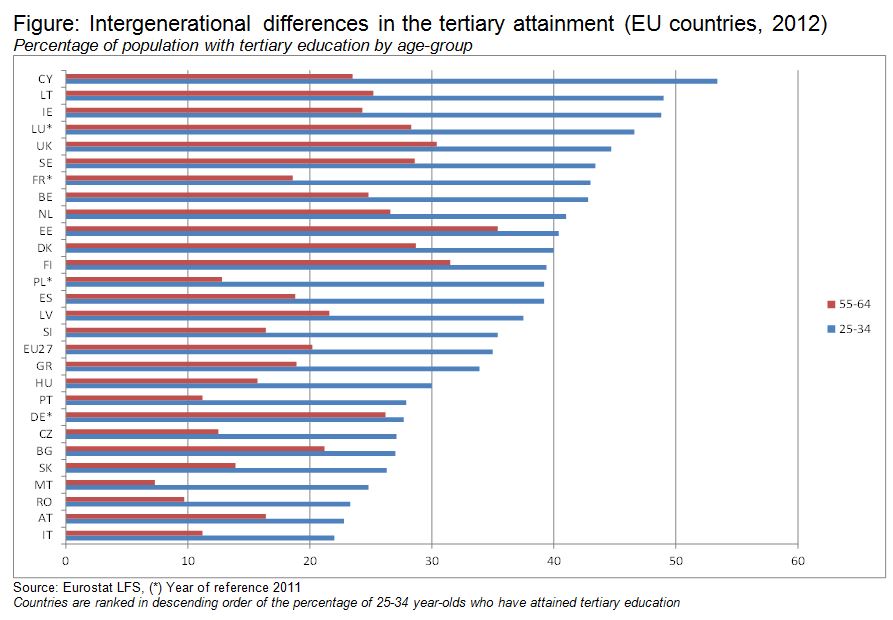
2) Fertility is heavily influenced by the availability of housing. Without immigration, house prices will fall and wages will rise, providing a boost to fertility until the population equalises.
https://www.nber.org/digest/feb12/impact-real-estate-market-...
With mass immigration you shortcut that, and simply end up replacing the original population, probably with negative overall effects if the incoming population is not genetically (average IQ, predisposition to violence) or culturally (respect for women etc.) aligned.
You're advocating for internal passports and residency permits:
Either wages need to rise or house prices need to fall.
[0] If you look at somewhere mundane like Essex the median 'affordability ratio', as measured by the Office of National Statistics ( https://tinyurl.com/x5jatcx8 ), was 4.5 in 2000 but is now north of 10. And yes, low interest rates help with monthly affordability but house prices have gone up ~4 fold in the last 20 years while the multiple of your income banks will lend has not, and peoples capacity to save a deposit that is 4x bigger has not.
[1] https://www.thisismoney.co.uk/money/buytolet/article-9969349...