If finding something that otherwise carries no symptoms is best left untreated, then the fact that you found it should make no difference to the decision. The doctor should say that the best course of action is to do nothing. More information can never be harmful. If you know information is best not acted on in the abstract, then you also know you should not act on it in particular.
So what you really mean but have left unspoken is one of two things.
First, that doctors are untrustworthy people who make recommendations and decisions based on concerns other than their patient’s wellbeing, such as covering their asses from lawsuits or making more money.
But rather than fix that, you would rather keep patients more ignorant and away from the doctor in the first place. Which actively harms people who do have honest doctors. That is, your approach of not testing hurts people with honest doctors to protect people with dishonest doctors.
Or second, if you take dumb patients as the problem, you are willing to hurt people with good decision making ability (who would heed their good doctor’s advice to leave the possible ailment untreated) so you can protect people with bad decision making.
Because many times, these tests will uncover things that obviously need treatment. They will save many lives. But because more stupid people will hurt themselves, then no one should have access to them.
The political and moral assumptions built into these positions are immense and yet the medical field tucks those away and pretends that this is just a purely scientific truth, that someone running more harmless tests is actually inherently harmful.
That is a lie! And a very nasty one at that.
>If finding something that otherwise carries no symptoms is best left untreated, then the fact that you found it should make no difference to the decision. The doctor should say that the best course of action is to do nothing. More information can never be harmful.
Absolutely and demonstratively false. There is an entire field of health policy that destroys this harmful idea. First of all, just because something doesn't carry symptoms NOW doesn't mean it won't carry symptoms LATER, but doctors can't always predict this and aren't perfect decision making machines. Many times the patient will push them for further tests and treatment (or the doctors will advocate for it to ease the mind of the patient) which leads to potential harm from unnecessary treatments. And this is just ONE of the ways patients are harmed by unnecessary screening. There is also the psychological damage of having a condition you wouldn't have otherwise known about, and living with that knowledge (take aneurysms for example). Psychological stress has a real physical toll on the body. Then there's the COST associated with unnecessary screening and treatments, which (especially in the US) can run into the thousands quite easily for even simple interventions as a result of unnecessary screening.
Even after that, a screening process can also find something that could be bad, but in some patients doesn't actually decrease their lifespan or quality of life. If we have no way of adjudicating between these cases or predicting which cases will end up bad if left untreated at the present moment, what do you think will happen? People will ask to be treated anyway, and iatrogenics will rear its ugly head.
You cannot ASSUME that screening is automatically good. It must PROVE itself as such in a randomized clinical trial. This trial must show that people live longer and/or better as a result of this intervention. In many well documented cases, this turns out NOT to be the case, which entirely destroys your original rebuttal.
So mass screen healthy people, collect the data, run models, and get better at it. People like you would rather not try, and this is the same reaction I get from doctors. Applying the same tech that we use to improve ad targeting to disease prediction is a no brainer to anyone whose cushy job doesn't depend on the current medieval state of medical technology.
What do you think the entire medical, pharmaceutical, bioinformatic, etc. industries have been doing for decades? Are you really so arrogant to think that other people are too lazy and stupid to think of your brilliant idea and that you are simply more intelligent than everybody else? Do you really think people haven't been trying?
Or, if they are doing this from quality samples of the population, then we have data to show that, for example, "Yes, Mr. Function Seven, your scan shows elevated levels of Widget-5a enzymes. This is often a precursor to Gadget Cancer, but 30% of the population shows this elevation, while only 1% develop the cancer. It's best to do nothing at this time unless we see further elevation. Have a good day, see you next year"
So either we have this data and we can give accurate advice, or we don't have this data because we're afraid of over-diagnosing non-problems.
I understand the fear, but it's still burying one's head in the sand to not even look.
They are getting quality samples from the population. But it's not a simple as "high enzyme = maybe good chance of cancer". How are you going to get those enzymes from their blood in a way that can be applied to the general population? Before that, how do you know there's not confounding factors (of which they are a LOT)?
> So either we have this data and we can give accurate advice, or we don't have this data because we're afraid of over-diagnosing non-problems.
It's not that easy.
Look at this pathway: https://www.pathwaycommons.org/guide/workflows/rna_seq_to_en...
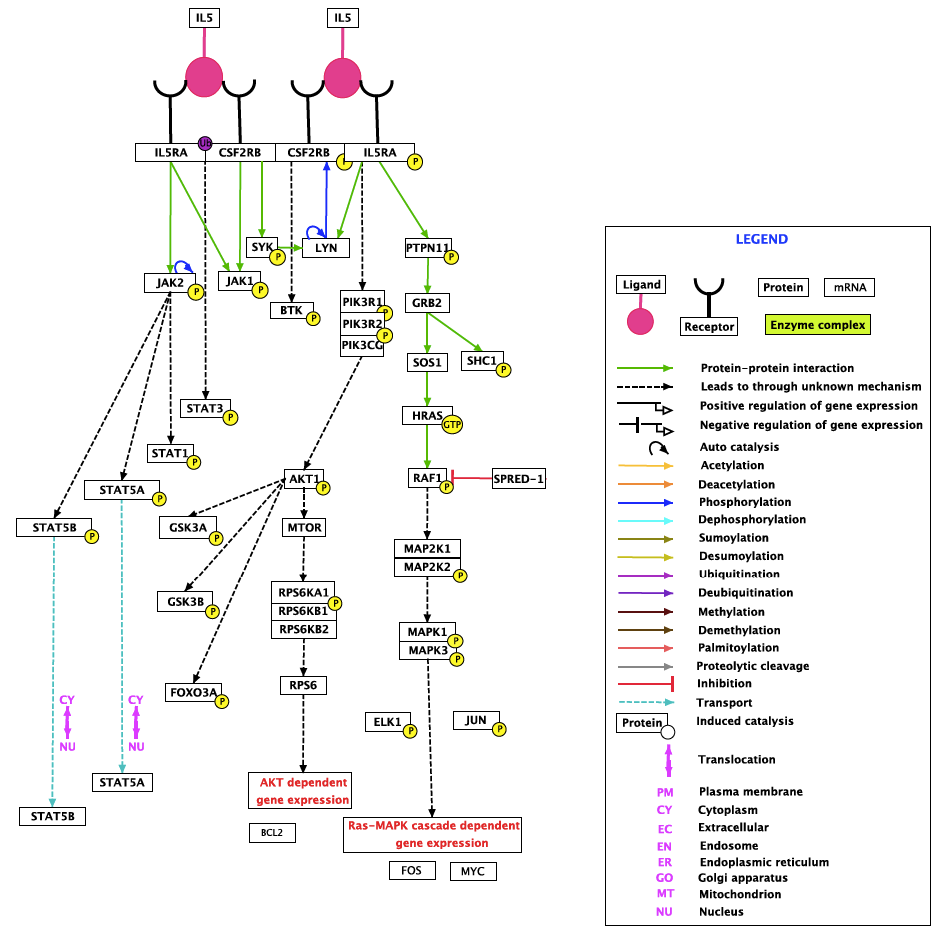
From here: https://www.pathwaycommons.org/guide/workflows/rna_seq_to_en...
This is what people think the activation of genes is. What they THINK the activation of genes is.
Note the following:
- They don't know all the genes. They are constantly identifying new ones. The number of gene pathways people are pretty sure are complete is small. I don't know if this one is one of the "pretty sure" ones.
- Gene pathways are not just complex in terms of size, they are also non-linear. This is not a computer program, this is a horrible biological mess where biological components constantly and probabilistically emit chemicals.
I don't even think that the pathway I gave you is super representative - it doesn't feature the ridiculous non-linearity and uncertainty that many pathways at the bleeding edge have. They can get much worse.
People are not burying their heads in the sand. They are trying their almighty to dig up from bedrock and reach the sky.
To give people a sense of this, it is not unheard of for large scale bioinformatics platforms to set off alarms and/or zone-level capacity issues with the large cloud providers.
I find it hard to believe I'm reading this sentiment on HN. Do you realize nearly any disruptive idea has do the "arrogant" thing you are speaking off.
Big companies go out of business all the time, industry disappear or wane all the time, big companies/industries with lots of smart people do stupid stuff on the regular. Characterizing the desire to do something other than status quo as "arrogance" is just the bottom of the barrel. I'm glad Semmelweis didn't think the way you do.
Arrogance definitely can play a big role in success of many startup entrepreneurs. Because they think the answer is simple and their arrogance shields them from not trying. So they go down the road and find out the solution is actually quite complicated, but a small percentage succeed in accomplishing the goal.
But it's still arrogance, nonetheless.
Not OP, but yes, I do.
I've had some runins with the health system. At least the parts that I've seen are worse than the dark ages. Especially endocrinologists have absolutely no clue what they are doing. The ones I met don't even have superficial knowledge about their full-time job which they've performed for ~20 years.
And yes, this sounds arrogant. I've tripple checked whether I'm just tripping. Their knowledge is not simply outdated, but never correct to begin with.
I think it's a cultural problem which shows in a lot of areas. Medicine doesn't value human life as much as f.e. air transport
Nothing could be further from the truth. People coming in to "disrupt" only add noise. Eventually those people either understand this and put the effort in to understand the domain or they wander off.
I am skeptical of the “more data is bad” meme of screening hesitancy. It cannot be scientifically true in the strictest sense, and to the degree it’s an accurate assertion, it really seems to reveal an unscientificness to how screening data is used today in practice rather than that in principle more data is bad.
The issue in this subthread was the notion that the only thing between the current state of affairs and high quality screening is a bit of disruption. The problem is hard, smart people are working on it, more smart people are always welcome, it'll still take a while.
It's that 1) sometimes collecting the data itself is harmful at scale. E.g. mammography can cause breast cancer, or cause it to spread. 2) the patients actions as a result of the data can, and does at sufficient scale, cause further harm.
Well, let's remember that the AlphaFold team at Google solved the protein folding problem with a relatively small team in a relatively small number of years after extremely large, well funded companies whose primary business was drug development failed to do so for decades.
So yeah, it's been demonstrated to be possible that the current leaders in a field might be significantly less capable than a different team.
Google's research arm has made leaps and bounds in a particular field (deep learning) and then managed to apply it successfully to a very, very hard problem (protein folding). That other companies failed to adapt Google's successes in deep learning faster than Google is not surprising at all to me.
One might argue that the impact of academic-big pharma collaboration (in the form of funding for research projects related to CASP) is what enabled a company like Google, with no independent desire to collect the massive amounts of wetlab data required to evaluate or develop a tool like AlphaFold, to even participate.
More importantly, AlphaFold hasn't really solved the protein folding problem well enough for drug development. So, the entire debate might be moot.
Did they though? They did extremely well at CASP14, and much better than competing groups. But does this solve protein folding? Deepmind's marketing department would have you think so, but for those of us that work in the field we know that this is not the case.
Furthermore, does protein folding solve the relevant problems of drug design? It solve the forward problem, given an amino acid sequence predict its 3d structure. But for drug design we need the inverse problem, given a specified structure predict an amino acid sequence that produces that structure.
Note that DeepMind drafted off the work of a protein folding guy from academia who had been doing this for decades.
Here's a report of a person whose wife had seasonal affective disorder. He
- deduced that a powerful enough lightbox should be able to cure SAD - didn't find any examples of such treatments in literature - spent $600 to build "LUMINATOR" - "And as of early 2017, with two winters come and gone, Brienne seems to no longer have crippling SAD—though it took a lot of light bulbs, including light bulbs in her bedroom that had to be timed to go on at 7:30am before she woke up, to sustain the apparent cure."
https://www.lesswrong.com/posts/zsG9yKcriht2doRhM/inadequacy...
>People will ask to be treated anyway, and iatrogenics will rear its ugly head.
I just want to say that you are in agreement with my position here.
Your point about psychological problems is interesting, but as long as people know what they’re signing up for, it’s okay. Some people aren’t prone to anxiety. Why should they pay the price because other people are? Part of my original point was that implicit in your argument is that people capable of handling it should be denied something because more people incapable of handling it can’t be stopped from hurting themselves. I think many people do not agree with that moral reasoning, so medical people hide it behind objective looking statistics.
And as for cost, I don’t take any arguments from medical people about cost seriously. The reason why costs are so high is because doctors and the medical field as a whole run a massive protectionist racket to keep the supply of medical professionals low.
How fresh of them to say that because they’ve limited the supply of medical resources to enrich themselves, patients must pay by having less access to care.
In the engineering world, you are almost always rewarded for being extra safe and testing, fixing, and investigating anything that might seem a little off. If you do blood tests, MRIs, and cancer screens for every mole, cough, and stomach pain, you will go insane and develop hypochondria.
Some might go the other way, and their anxious personality might help them think about everything, but also make them a stress case.
I think the first type tends to last longer in the industry, at least for my coworkers.
Whether or not a doctor prescribes/advises a certain treatment is still firmly in their domain. The amount of biomarkers/biological evidence a patient has shouldn't sway a doctor's decision to alter a treatment plan. As a reasonably smart non-medical professional, I would rather have more data than less data, and it's paternalistic and a little condescending to say "no, you shouldn't actually take diagnostic tests because 'having that information might freak you out'"
How people use information varies, so the data might not have external validity - it’s culture specific, and cultures differ. Cultures can also change through accumulated experience.
So do the people studying these things try again with different and possibly better decision-making, or do they conclude that the test itself is no good?
That statement alone shows blatant ignorance of basic properties of the human psyche which makes reading the rest of your long reply rather pointless, as thought-through as it might have been from your perspective.
Humans are not the perfectly rational machines you seem to make them out to be. You need to deal with people in the real world, not some dream utopia that does not exist.
In my particular field of biomedical research, there has recently been a push for "Diagnostic Stewardship" because more information has demonstrably been harmful to patient well-being.
I would say most medical decisions are made either due to statistics, or due to experience. What treatment has the highest chance of making the patient better, extending their life, or giving the best quality of life? You'd "just" have to adjust the tables for the new test.
I mean in a contrived example, you could have the lab technician themself look up the numerical result (xyz > 100, abc < 10 whatever) in some table, and then there would be the rule to throw the result in the bin and report "don't treat" because this results in the best outcomes. I don't want to have all that extra diagnostic information, but I want my doctors to use it conditionally to improve my treatment if possible.
Can you see why some people might be hesitant about basing medical treatment on "That's what the data says, but it doesn't conform to my priors, so it's probably wrong"?
People are terrible at ignoring information. Clinicians are people. We know this.
Can you?
That is to say: you can try, but I don't think most people are very good at consciously choosing not to think or worry about something that they know, if that's even possible.
If your tests are for conditions that are rare enough, and where early detection does little enough to improve outcomes, even a tiny risk like that becomes a problem.
This is an extremely naive viewpoint and in some situations quite dangerous.
It seems like we've made this decision with covid-19. Dr. Fauci has been canonized, but we know that he's been intentional misleading the public through misinformation (starting from telling us that masks aren't effective in order to preserve the supply for medical providers, and later mis-stating herd immunity numbers to manipulate people into getting the behavior he wanted).
This is easy to say but hard to do, just need to imagine
PTC is a very survivable cancer, with a near-100% survival rate (death usually only occurs in rare cases where the disease is diagnosed very late, the progession is atypical, or there are comorbidities at play). It is very easy to screen for and diagnose: a neck ultrasound identifies thyroid nodules, and if the nodules look suspicous they are biopsied in a 20 minute procedure performed under local anaesthetic.
Treating papillary thyroid cancer is also relatively straightforward, as far as cancer goes: depending on the size of the lesion and the features, either half or all of the thyroid gland is removed surgically. In cases where the whole gland is removed (which is the majority), the patient is given a course or two of radioiodine therapy to nuke anything left over, and in many/most cases, it's a done deal.
The vast majority of thyroid cancer survivors have to take thyroid replacement hormones (all patients who had the whole gland removed have to do this, and about half of patients who only had half the gland removed still need a small dose to keep up). I'm relatively lucky: the oral hormone seems to work just fine for me. I take a pill every morning and then go about my day. I will need to do this for the rest of my life, but hey, that's life.
However, there's a substantial minority of patients who aren't so lucky: even with oral hormone replacement, they suffer from long-term sequelae including weight gain, low energy, brain fog, hair loss, and other hypothyroid symptoms.
And there lies the crux of the issue: it turns out that even with increased diagnostic capability (thanks to the ubiquity of relatively cheap ultrasound exams in clinical practice), the number of people dying from thyroid cancer has stayed pretty much flat for decades (mostly due to more aggressive types than papillary, such as medullary or anaplastic). Yet, we take out a lot more thyroids now.
The reason this happens is pretty simple: if you see something, you have to do something about it. So you're removing thyroid glands from people where the cancer might never have actually grown big enough to be a problem, and then subjecting those people to a lifetime of hormone replacement therapy. Something like 10% of all cadavers at autopsy have thyroid cancer: it's a cancer that very commonly develops, but only becomes a concern in a few patients. As of now, we don't have a good way to differentiate between "thyroid cancer that's a problem" and "thyroid cancer that'll be fine."
The clinical guidelines have changed a bit in recent years: if the cancerous nodule is really small, they'll now do "watchful waiting" and monitor the nodule to see if it grows. But you're still subjecting a patient to potentially many years of worry and regular testing. And good luck getting life insurance if you have a microcarcinoma! Yeah, it's highly unlikely to kill you (especially when monitored), but try telling an insurer that.
The medical profession is well aware of these concerns. That's why they avoid testing for thyroid cancer unless there are symptoms, such as thyroid hormone disturbances or a lump in the neck. If you were to make a thyroid ultrasound a regular test, you'd quickly overwhelm the system with cancer patients who probably never needed to be treated in the first place, and who may now have to get their thyroids removed and be dependent on pills for the rest of their lives.
There simply isn't a profit motive right now, and there aren't a ought resources, so unprofitable, minor things like thyroid cancers and other, small, mostly non-fatal things fall by the wayside. If we could massively increase the resources and time spent of solving health issues, we'd have a lot better solutions. There only exist a certain amount of cancer researchers, oncologists, and clinical pharmacologists that can profitably exist. Lots of diseases will never be cured because there are too few people affected by them. Until we decouple medical progress from profit, there's a only a certain amount of progress we can make. Unfortunately, it seems like tying profit to medicine is the most efficient system we have, so it may be centuries till we get there
Nope. TaupeRanger's overall observations seem spot on.
Assuming the 0.5% FP rate holds (again, I know that's optimistic), would you still regard universal testing with this method to be harmful?
[1] https://jamanetwork.com/journals/jama/article-abstract/40935...
I.e., higher FP rate, and it wouldn't be rolled out.
Another aspect of cancer screening is that detecting cancer earlier can improve key statistics like 5 year survival without affecting the actual disease in any way. Which can make screening sound more effective than it is.
Yes, if every lump were treated and excised then it would be problematic. But CANCER is different. The only cancer that you might be able to leave alone is prostate because it grows so slowly. Everything else is a risk.
And if we can treat cancer at early stage 1, then maybe people won’t be as afraid of it because it has such a high rate of cure. We don’t know that until we do it.
Read this and learn something: https://www.bmj.com/content/352/bmj.h6080
My wife went to urgent care twice in three months because of a pain in her side. She was turned away with cough medicine. She finally went to the ER where a CT scan revealed massive tumors in her abdomen that had gone undetected for likely years. Genetic and semi-annual CA125 screening could yield quite a few false positives, but combined with her physical symptoms she may have had more cause to press at an incomplete conclusion and possibly could have had a different outcome. She underwent nearly $2M in medical procedures over the course of 26 months and died at 45 years old last year.
A few years prior to that I was spring cleaning one day and found a glucose test kit at the house. I had the whole family test their blood glucose. My youngest was 240mg/dL. We waited a day and tested again, same thing. We took her into the hospital and they actually admitted her for two days because they had no idea what to do with a child presenting with Type 1 diabetes that hadn't gone into full DKA. That's harmful, gross, and embarrassing. And this is a major children's hospital that was recently in the top ten in the nation for endocrinology.
In both of these situations, preventative screening could have or did have positive outcomes. I don't disagree with the effect that has been observed, but the conclusion being drawn from it is revolting to me. People should be permitted to make their own decisions about their level of knowledge of the state of their body. We only get one trip as far as we know, and I just find it unacceptable that people are willing to categorically deny diagnostic technology or bemoan its development because they they don't know how to support people trying to navigate the information it brings.
The level of arrogance in these responses parroting what they’ve read in a paragraph online approaches that with what we saw early in the pandemic with masks.
“Masks don’t work! Fauci said so!” And the level of confidence they said it was shocking along with the self-righteousness.
Yes, maybe people can’t put on N95 masks properly... but maybe we can teach them? Is that so mind blowing? We teach people how to wash hands for 20 seconds, is it not so hard to believe you can’t teach people to wear masks properly? Maybe make masks that are easier to put on?
It’s sad how people with no vision are Karen’ing people to not think ahead or think of the future. It’s scary that it’s happening on hacker news.
We give blood glucose level tests and cholesterol tests to everyone every year at the physical because they are cheap and easy to administer. Even though the effects of both may take decades to have any effect and have no correlation to ultimate death. It’s about trade off of cost and convenience.
If you detect pancreatic or colon cancer in a 20 year old patient via $1 blood test, that is immediately actionable. Cancer is ALWAYS actionable unless you’re talking about prostrate which grows slowly. But even in a 20 year old, you would want to treat that but maybe not a 70 year old.
And we’ve never had the ability to detect stage 1 cancer of the deadliest types of cancer. Imagine the new treatments that might save lives if we could.
Honestly, the number of people here who think they know better and citing unrelated research is bordering on anti-maskers parroting the surgeon general saying masks don’t work when they do.
If all 300 million Americans get blood tested each year, that is 1 and a half MILLION people who are falsely told they have CANCER. One and a half MILLION people whose life gets turned upside down, WRONGLY, due to a blood test -- at least, until they take a second one. Or a third one. Or maybe they get unlucky never learn they don't have cancer, and mess up their life treating a disease they don't have.
Now, OBVIOUSLY not all 300 million Americans are going to get tested each year. But you are completely ignoring the ethical concerns surrounding telling literally .5% of those who don't have cancer that they have cancer, and the non-insignificant proportion of people who will never learn they don't have cancer (we NEED to consider even the "miniscule" probabilities at this scale), and that makes you seem like somebody who "think[s] they know better".
Culture adapts. Getting a cancer diagnosis today is a huge deal because testing is infrequent, usually in response to a problem, and the diagnosis tends to be late and accurate. If 1.5mm healthy people get a false positive every year, the general response will be stress until a second test confirms a false positive.
The lack of public trust in health policy doctrine, and the support for start-ups that can operate outside those channels, comes in large part from this type of thinking.
Getting a cancer diagnosis is a "huge deal" because getting cancer is one of the worst experiences a human can go through.
Getting cancer carries the weight of imminent death, obviously. But some cancers can be cured with high survival rate, so what's the big deal? The deal is that these cures are often brutal chemotherapy or radiotherapy or whatever treatments that destroy your body, your sleep, your appetite, your ability to go to the bathroom yourself, your ability to do chores by yourself, your ability to do anything a normal human being can do. They DESTROY you.
THAT'S the "huge deal". NOT the frequency. Cancer RUINS YOUR LIFE for the period you get treated, IF you survive the treatment at all, let ALONE the cancer. And you are proposing we tell sub-1.5 million people EACH YEAR that they might have to go through that, while STILL ignoring the proportion of the population that will never learn they have a false positive because they got unlucky (which, AGAIN, we need to consider, since even miniscule probabilities matter at this scale.)
So until the day we figure out a way to make getting rid of cancer as easy as popping a pill (we're getting closer thanks to gene therapy, but patients may still receive the destructive treatments in the meantime), culture will not "adapt", it will remain a "huge deal", and we will keep "this type of thinking".
I’ve never been given a cancer diagnosis, but I’d imagine it’s much, much worse to be told you have stage 4 cancer versus stage 1. As the other person stated, the culture would adapt and people would learn to not immediately sell their house and go on a Vegas bender just because a yearly preventative test said they might, possibly, perhaps have stage 1 cancer. If you are one of the people with a false positive, you schedule a follow-up and move on accordingly.
Your position is anti-progress just for the sake of being against accidentally scaring a few people. Indeed, we should let more people develop cancer and discover it at a later stage due to a small amount of false positives. Not scaring a small amount of people is more important than revolutionizing cancer screenings.
It's bad all the way.
> If you are one of the people with a false positive, you schedule a follow-up and move on accordingly.
People already do schedule follow-ups and additional tests and second opinions when they get a positive.
> Your position is anti-progress just for the sake of being against accidentally scaring a few people.
No, it is cautiously ethical because:
1. You probably shouldn't tell sub-1.5 million people who don't have cancer that they have cancer
2. There are more false positives than you think, if you are suggesting regular blood tests
And having a memento mori can be a positive thing.
Heart disease is a huge deal. It ruins your life. (Maybe not in all caps.) Nevertheless, we regularly test for it, including with techniques with high rates of false positives. Few panic because almost everyone knows someone who got a false positive and didn't promptly keel over and die.
If healthy adults are screened for cancer, there will be cultural memory of people who got a false positive. The response to a positive test result won't be chemo. It will be further testing, if non-invasive, or suggestions of lifestyle changes and increased monitoring of the suspected system.
People aren't too stupid to understand an early test with a high false positive rate. People with family histories of cancer don't wake up every morning screaming. Some may. But barring everyone because some people will overreact is why orthodox health policy is losing public trust.
People already get further testing. People already get second opinions. In the time you are changing your lifestyle (a good option for helping treatment, I agree) and increasing monitoring you could already be progressing beyond treatability.
You can argue about whether it's alright to tell sub-1.5 million people each year who don't have cancer that they have cancer (I don't think it is, but whatever). But again you can't disregard the non-insignificant number of people who get false positives.
edit: Actually, not "whatever". You probably shouldn't tell sub-1.5 million people each year who don't have cancer that they have cancer.
It just doesn't need to be as dire as what you are projecting.
That's actually a very good argument for early testing.
And needlessly scaring a some people into eating better and exercising more is about as bad as not screening them at all to avoid needless anxiety.
I think this leans more towards the "the needs of the many outweigh the needs of the few" and less towards "tyranny of the majority".
You should read up more on growth mindsets. People and technology aren’t fixed. They change and improve over time.
If people had your attitude about AIDS we would have let all AIDS patients die because “oh well nothing we can do.”
Luckily those with growth mindsets and optimism didn’t listen to people like you and now AIDS patients take a single pill a day.
The same could happen with cancer to, but not if people like you are in charge.
No, if people had my attitude about AIDS they would say "Jesus Christ, don't tell 1 and half million people each year who don't have AIDS that they might have AIDS." I am talking about diagnosis, not treatment.
Early diagnosis means new ways of treating cancers like liver and pancreatic. You don’t seem to understand this. Right now there is practically no treatments for either because it’s detected so late. Maybe after 20 years of early diagnosis we can treat pancreatic cancer the same way we do others.
Let me guess. You were telling people in early 2020 that N95 masks don’t work.
I agree if we had a test that was 100% accurate (literally never gave a false result either way), only detected dangerous cancers, and cost $1 then that would be a game-changer, but the screening and tests so far are not that.
False positives are a concern, but one that is manageable. People should get regular checkups, if something comes up we just do more testing as needed.
Though that makes this discussion completely worthless - without trial results we have no idea if it is a useful test. Once we have those results we will know something about how useful/useless might be.
You mean like the PSA test? It's pretty bad, in the scale of these things. It's used because there isn't a better screen, not because it is more specific.
I weight myself everyday. Some people tell me not to do that but its honestly pretty good at keeping me in check and because I weigh myself everyday I know that sometimes I just get super bloated and put on four pounds of water and it will be gone in a couple days. When you get more data you learn to adjust how you interpret it and make better decisions.
Likewise, if getting a false result 50% of the time becomes common (this assumes we never improve the tests) then people will know to adjust their priors. After all - I've had to go to specialists a few times for extra tests. I wouldn't say we ban those.
I meticulously tracked every calorie I ate for several months. Now I know how much of different types of food is how many calories, how many calories I eat per day, and most importantly what my different hunger levels mean in terms of the number of calories ingested. Combined with my weight tracking, which tells me my set weight / weight variance over a day or several days / food intake to gain or lose a certain amount of weight, I can easily control portions to hit my weight goals without thinking about it.
I would imagine more health data would allow me to optimize in this fashion as well. If I can correlate health markers to my lifestyle often and directly, I can make better and more informed choices. Advocating against easy access to health data because some people can misuse it is the same kind of nanny state thinking that says encryption shouldn't be available to the masses because criminal enterprises can use it to hide their activities.
I think your claim (based on sibling posts) is that in the current medical system, if we just added more screening, we'd not necessarily get net benefits. But I think that ignores the fact that, if we had cheap and high-resolution screening, we could fundamentally restructure many aspects of medical care. The BMJ article you linked in a sibling[1] notes that cancer screening may reduce cancer mortality but increase all-cause mortality. That's an unexpected and problematic result of getting referred to a cancer specialist that might not have (or be incentivized to care about) a wholistic picture of health when you screen positively for cancer. But if we had higher-resolution data, and conceptualized medicine as primarily preventive instead of curative, then it seems likely to me that overall mortality would be your target, we'd have richer data to be able to track that endpoint, and so we'd be more likely to catch the cases where an intervention caused unexpected harms (because we'd be tracking more indicators).
In other words, the problem you're observing is that adding a bit more data to the current system can produce negative outcomes. But that problem would be fixed by adding even more data. (With the remaining question being, how much data would we need to add to reach the "net positive" regime?)
I think you're arguing against a change that looks like a harm from the perspective of a local optimum that we're currently working towards, without considering the dramatic paradigm shift into another higher-utility region that would have been brought along by this sort of technology.
In summary, I am much more optimistic that if we had orders of magnitude more data, we'd make better decisions, not worse. But I agree with your caution that it's not as easy as it seems.
Perhaps it is true - in the US, anyways - that there's a tendency to overly prescribe more aggressive interventions (read: more expensive ones), but my understanding is that the US model is the exception, not the rule, when looking at the rest of the world.
This example also shows how screening can be recommended against because that's better for public health. The US Preventive Services Task Force (indirectly decides what Medicaid/Medicare covers) has different recommendations than the American Cancer Society for how often women of certain ages should have mammograms. USPSTF recommends against routine mammograms for women aged 40 to 49 if they don't have other risk factors. ACS recommends biannual mammograms start at age 45.
The reason they differ is because of how they weigh the reduction in deaths against the harm of false positives. Routine mammograms will prevent breast cancer death, no doubt about it. But notice neither recommends routine mammograms for all women below 45, even though they accounted for over 10% of breast cancer diagnoses in 2014-2018[0].
The math is tricky when comparing a risk of death against quality of life and economic costs. Public health is a matter of public policy as much as health.
And something to be on the back of your mind as a worry forever. I'd rather not know.
A deep round of blood testing would have saved everyone a lot of time and money and suffering.
Or I could have waited many years until the organ damage was so extensive that diagnosing was easier. Oh wait, that’s what ended up happening.
But you don't know they're healthy. They might be sick but (so far) asymptomatic. That's why you screen, if you have a sufficiently accurate test available and you can make a useful intervention if the test gives a positive result.
If we applied your argument consistently, we would abolish all cancer screening programmes, resulting in many extra deaths because early detection and treatment didn't happen. We'd stop checking up on heart health as people age, resulting in many extra deaths because people continued to live unhealthy lifestyles without realising what it was doing to them. We wouldn't be using rapid testing for COVID-19 to detect and isolate probable asymptomatic carriers who might spread the virus to others who wouldn't be so lucky. The list goes on.
Good screening programmes save lives. It's as simple as that.
Just a made-up example: Let's say someone has an advanced test for cancer run, and it comes back positive. You know from studies that treating people the same way as before with the advanced test leads to worse outcomes because of unneccessary treatment etc.. So what you could do is you do the simpler test afterwards. If it comes back negative, you don't treat -> you are in the same situation as before, only you can be more vigilant in future and see if the cancer grows. If the simpler test also comes back positive, you do the treatment.
It's all about getting data (statistical and otherwise) on what the best treatment is, and acting on that.
Would a very large representative sample of volunteers doing this kind of hitherto unprecedented level of medical monitoring help improve this technology while limiting the unintended consequences? If we could get to the point where the technology was very highly predictive of specific outcomes and even had the ability to test early interventions on those outcomes, that would both allay the psychological cost of a population-wide roll-out and drastically improve outcomes across the board, would it not?
I wonder if people would rather continue to live care free, spending most of their waking hours commuting and at work, or if they'd rather learn the truth and face the harsh reality that their time is about up and adjust their priorities accordingly?
I would rather live my life as it comes, for whatever length of time fate has given me.
The fact is that many things that could be detected will never result in symptoms or other noticeable problems. Further, for many things that can be detected we can't really do much about, so by detecting it early you are just reducing the amount of life they have left without worrying about their disease, or causing unnecessary treatment (which includes unnecessary damage, cost, stress, etc.)