They are getting quality samples from the population. But it's not a simple as "high enzyme = maybe good chance of cancer". How are you going to get those enzymes from their blood in a way that can be applied to the general population? Before that, how do you know there's not confounding factors (of which they are a LOT)?
> So either we have this data and we can give accurate advice, or we don't have this data because we're afraid of over-diagnosing non-problems.
It's not that easy.
Look at this pathway: https://www.pathwaycommons.org/guide/workflows/rna_seq_to_en...
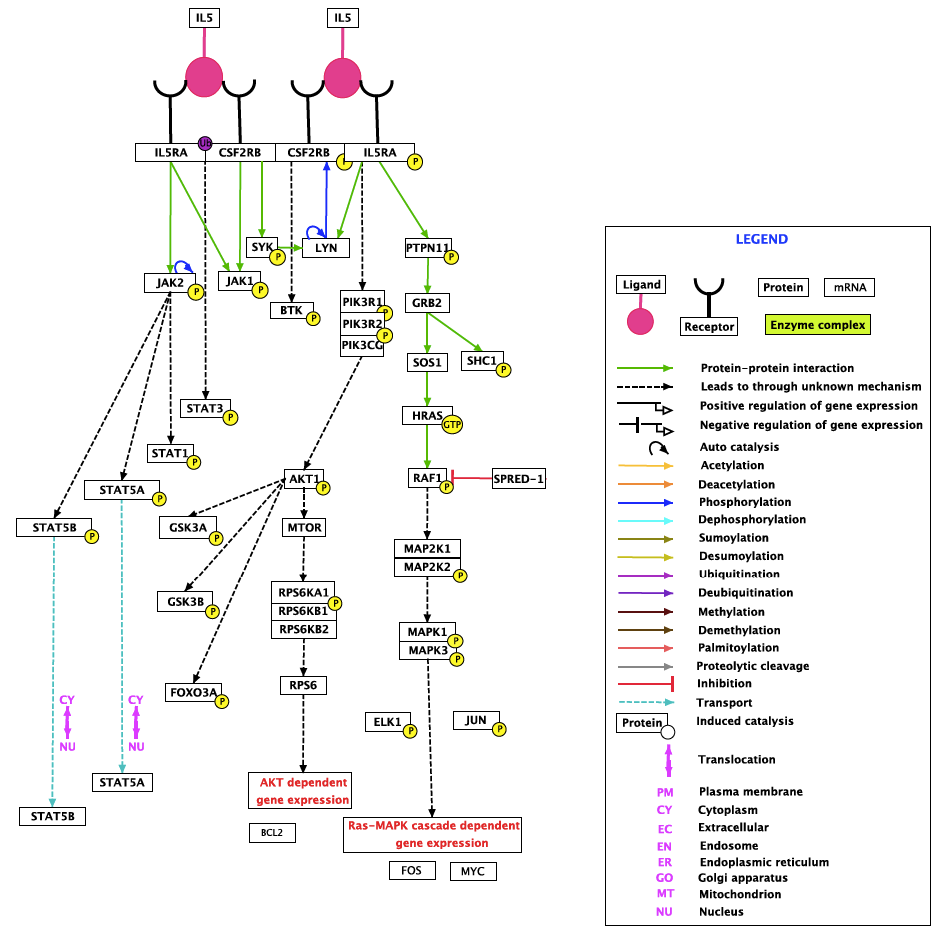
From here: https://www.pathwaycommons.org/guide/workflows/rna_seq_to_en...
This is what people think the activation of genes is. What they THINK the activation of genes is.
Note the following:
- They don't know all the genes. They are constantly identifying new ones. The number of gene pathways people are pretty sure are complete is small. I don't know if this one is one of the "pretty sure" ones.
- Gene pathways are not just complex in terms of size, they are also non-linear. This is not a computer program, this is a horrible biological mess where biological components constantly and probabilistically emit chemicals.
I don't even think that the pathway I gave you is super representative - it doesn't feature the ridiculous non-linearity and uncertainty that many pathways at the bleeding edge have. They can get much worse.
People are not burying their heads in the sand. They are trying their almighty to dig up from bedrock and reach the sky.
To give people a sense of this, it is not unheard of for large scale bioinformatics platforms to set off alarms and/or zone-level capacity issues with the large cloud providers.
Or, if they are doing this from quality samples of the population, then we have data to show that, for example, "Yes, Mr. Function Seven, your scan shows elevated levels of Widget-5a enzymes. This is often a precursor to Gadget Cancer, but 30% of the population shows this elevation, while only 1% develop the cancer. It's best to do nothing at this time unless we see further elevation. Have a good day, see you next year"
So either we have this data and we can give accurate advice, or we don't have this data because we're afraid of over-diagnosing non-problems.
I understand the fear, but it's still burying one's head in the sand to not even look.