So mass screen healthy people, collect the data, run models, and get better at it. People like you would rather not try, and this is the same reaction I get from doctors. Applying the same tech that we use to improve ad targeting to disease prediction is a no brainer to anyone whose cushy job doesn't depend on the current medieval state of medical technology.
What do you think the entire medical, pharmaceutical, bioinformatic, etc. industries have been doing for decades? Are you really so arrogant to think that other people are too lazy and stupid to think of your brilliant idea and that you are simply more intelligent than everybody else? Do you really think people haven't been trying?
Or, if they are doing this from quality samples of the population, then we have data to show that, for example, "Yes, Mr. Function Seven, your scan shows elevated levels of Widget-5a enzymes. This is often a precursor to Gadget Cancer, but 30% of the population shows this elevation, while only 1% develop the cancer. It's best to do nothing at this time unless we see further elevation. Have a good day, see you next year"
So either we have this data and we can give accurate advice, or we don't have this data because we're afraid of over-diagnosing non-problems.
I understand the fear, but it's still burying one's head in the sand to not even look.
They are getting quality samples from the population. But it's not a simple as "high enzyme = maybe good chance of cancer". How are you going to get those enzymes from their blood in a way that can be applied to the general population? Before that, how do you know there's not confounding factors (of which they are a LOT)?
> So either we have this data and we can give accurate advice, or we don't have this data because we're afraid of over-diagnosing non-problems.
It's not that easy.
Look at this pathway: https://www.pathwaycommons.org/guide/workflows/rna_seq_to_en...
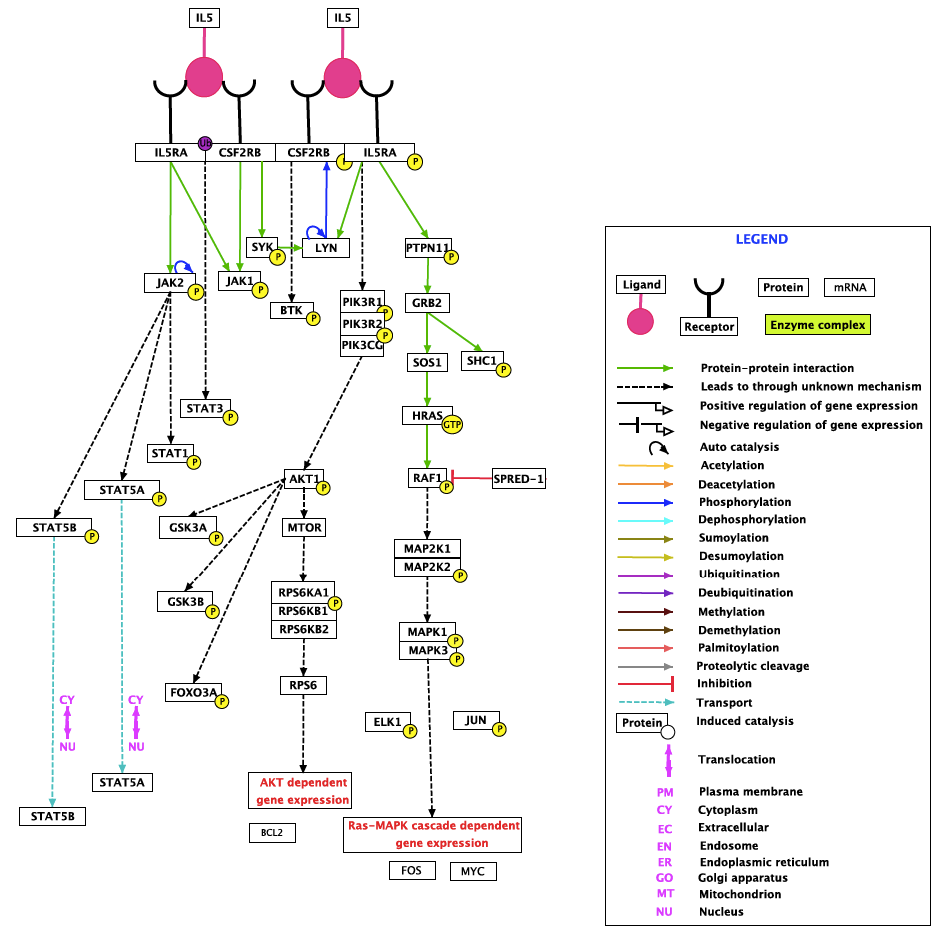
From here: https://www.pathwaycommons.org/guide/workflows/rna_seq_to_en...
This is what people think the activation of genes is. What they THINK the activation of genes is.
Note the following:
- They don't know all the genes. They are constantly identifying new ones. The number of gene pathways people are pretty sure are complete is small. I don't know if this one is one of the "pretty sure" ones.
- Gene pathways are not just complex in terms of size, they are also non-linear. This is not a computer program, this is a horrible biological mess where biological components constantly and probabilistically emit chemicals.
I don't even think that the pathway I gave you is super representative - it doesn't feature the ridiculous non-linearity and uncertainty that many pathways at the bleeding edge have. They can get much worse.
People are not burying their heads in the sand. They are trying their almighty to dig up from bedrock and reach the sky.
To give people a sense of this, it is not unheard of for large scale bioinformatics platforms to set off alarms and/or zone-level capacity issues with the large cloud providers.
I find it hard to believe I'm reading this sentiment on HN. Do you realize nearly any disruptive idea has do the "arrogant" thing you are speaking off.
Big companies go out of business all the time, industry disappear or wane all the time, big companies/industries with lots of smart people do stupid stuff on the regular. Characterizing the desire to do something other than status quo as "arrogance" is just the bottom of the barrel. I'm glad Semmelweis didn't think the way you do.
Arrogance definitely can play a big role in success of many startup entrepreneurs. Because they think the answer is simple and their arrogance shields them from not trying. So they go down the road and find out the solution is actually quite complicated, but a small percentage succeed in accomplishing the goal.
But it's still arrogance, nonetheless.
Not OP, but yes, I do.
I've had some runins with the health system. At least the parts that I've seen are worse than the dark ages. Especially endocrinologists have absolutely no clue what they are doing. The ones I met don't even have superficial knowledge about their full-time job which they've performed for ~20 years.
And yes, this sounds arrogant. I've tripple checked whether I'm just tripping. Their knowledge is not simply outdated, but never correct to begin with.
I think it's a cultural problem which shows in a lot of areas. Medicine doesn't value human life as much as f.e. air transport
Nothing could be further from the truth. People coming in to "disrupt" only add noise. Eventually those people either understand this and put the effort in to understand the domain or they wander off.
I am skeptical of the “more data is bad” meme of screening hesitancy. It cannot be scientifically true in the strictest sense, and to the degree it’s an accurate assertion, it really seems to reveal an unscientificness to how screening data is used today in practice rather than that in principle more data is bad.
The issue in this subthread was the notion that the only thing between the current state of affairs and high quality screening is a bit of disruption. The problem is hard, smart people are working on it, more smart people are always welcome, it'll still take a while.
It's that 1) sometimes collecting the data itself is harmful at scale. E.g. mammography can cause breast cancer, or cause it to spread. 2) the patients actions as a result of the data can, and does at sufficient scale, cause further harm.
Well, let's remember that the AlphaFold team at Google solved the protein folding problem with a relatively small team in a relatively small number of years after extremely large, well funded companies whose primary business was drug development failed to do so for decades.
So yeah, it's been demonstrated to be possible that the current leaders in a field might be significantly less capable than a different team.
Google's research arm has made leaps and bounds in a particular field (deep learning) and then managed to apply it successfully to a very, very hard problem (protein folding). That other companies failed to adapt Google's successes in deep learning faster than Google is not surprising at all to me.
One might argue that the impact of academic-big pharma collaboration (in the form of funding for research projects related to CASP) is what enabled a company like Google, with no independent desire to collect the massive amounts of wetlab data required to evaluate or develop a tool like AlphaFold, to even participate.
More importantly, AlphaFold hasn't really solved the protein folding problem well enough for drug development. So, the entire debate might be moot.
Did they though? They did extremely well at CASP14, and much better than competing groups. But does this solve protein folding? Deepmind's marketing department would have you think so, but for those of us that work in the field we know that this is not the case.
Furthermore, does protein folding solve the relevant problems of drug design? It solve the forward problem, given an amino acid sequence predict its 3d structure. But for drug design we need the inverse problem, given a specified structure predict an amino acid sequence that produces that structure.
Note that DeepMind drafted off the work of a protein folding guy from academia who had been doing this for decades.
Here's a report of a person whose wife had seasonal affective disorder. He
- deduced that a powerful enough lightbox should be able to cure SAD - didn't find any examples of such treatments in literature - spent $600 to build "LUMINATOR" - "And as of early 2017, with two winters come and gone, Brienne seems to no longer have crippling SAD—though it took a lot of light bulbs, including light bulbs in her bedroom that had to be timed to go on at 7:30am before she woke up, to sustain the apparent cure."
https://www.lesswrong.com/posts/zsG9yKcriht2doRhM/inadequacy...
>People will ask to be treated anyway, and iatrogenics will rear its ugly head.
I just want to say that you are in agreement with my position here.
Your point about psychological problems is interesting, but as long as people know what they’re signing up for, it’s okay. Some people aren’t prone to anxiety. Why should they pay the price because other people are? Part of my original point was that implicit in your argument is that people capable of handling it should be denied something because more people incapable of handling it can’t be stopped from hurting themselves. I think many people do not agree with that moral reasoning, so medical people hide it behind objective looking statistics.
And as for cost, I don’t take any arguments from medical people about cost seriously. The reason why costs are so high is because doctors and the medical field as a whole run a massive protectionist racket to keep the supply of medical professionals low.
How fresh of them to say that because they’ve limited the supply of medical resources to enrich themselves, patients must pay by having less access to care.
In the engineering world, you are almost always rewarded for being extra safe and testing, fixing, and investigating anything that might seem a little off. If you do blood tests, MRIs, and cancer screens for every mole, cough, and stomach pain, you will go insane and develop hypochondria.
Some might go the other way, and their anxious personality might help them think about everything, but also make them a stress case.
I think the first type tends to last longer in the industry, at least for my coworkers.
Whether or not a doctor prescribes/advises a certain treatment is still firmly in their domain. The amount of biomarkers/biological evidence a patient has shouldn't sway a doctor's decision to alter a treatment plan. As a reasonably smart non-medical professional, I would rather have more data than less data, and it's paternalistic and a little condescending to say "no, you shouldn't actually take diagnostic tests because 'having that information might freak you out'"
How people use information varies, so the data might not have external validity - it’s culture specific, and cultures differ. Cultures can also change through accumulated experience.
So do the people studying these things try again with different and possibly better decision-making, or do they conclude that the test itself is no good?
>If finding something that otherwise carries no symptoms is best left untreated, then the fact that you found it should make no difference to the decision. The doctor should say that the best course of action is to do nothing. More information can never be harmful.
Absolutely and demonstratively false. There is an entire field of health policy that destroys this harmful idea. First of all, just because something doesn't carry symptoms NOW doesn't mean it won't carry symptoms LATER, but doctors can't always predict this and aren't perfect decision making machines. Many times the patient will push them for further tests and treatment (or the doctors will advocate for it to ease the mind of the patient) which leads to potential harm from unnecessary treatments. And this is just ONE of the ways patients are harmed by unnecessary screening. There is also the psychological damage of having a condition you wouldn't have otherwise known about, and living with that knowledge (take aneurysms for example). Psychological stress has a real physical toll on the body. Then there's the COST associated with unnecessary screening and treatments, which (especially in the US) can run into the thousands quite easily for even simple interventions as a result of unnecessary screening.
Even after that, a screening process can also find something that could be bad, but in some patients doesn't actually decrease their lifespan or quality of life. If we have no way of adjudicating between these cases or predicting which cases will end up bad if left untreated at the present moment, what do you think will happen? People will ask to be treated anyway, and iatrogenics will rear its ugly head.
You cannot ASSUME that screening is automatically good. It must PROVE itself as such in a randomized clinical trial. This trial must show that people live longer and/or better as a result of this intervention. In many well documented cases, this turns out NOT to be the case, which entirely destroys your original rebuttal.