Then for 20 years you couldn't really get a road bike with tires larger than 23 mm, which is totally illogical in places with less than perfect roads such as here in Canada.
Really happy that gravel bikes have brought back some sensibility to the sport, and that they provide a nice "all around" option in a market where manufacturers had been using "super specialization" of products to entice customers to buy more products.
Now I'm waiting for a similar trend to take over XC skiing!
Their distinguishing feature was that a "mountain bike" comes with gears (normal bikes don't), which was very popular. The city edition came with fenders, luggage racks, a nice bell, stand, etc.
Big fat tyres, comfy geometry. The tires usually had a slick strip in the middle and grooves on the sides so you had slicks running on pavement and got massive grip turning on gravel.
As it got cheaper, they even started having front suspension.
Looked kinda like this:
https://www.bolha.com/image-bigger/gorska-kolesa/mosko-gorsk...

https://www.velo.si/modules/uploader/uploads/s_product/pics_...

https://www.bolha.com/image-w920x690/mestna-kolesa/mestno-in...


Very similar to cycle cross (a wide range of gears) https://upload.wikimedia.org/wikipedia/commons/thumb/c/c7/Fo...

The hybrid has straight handlebars https://upload.wikimedia.org/wikipedia/commons/thumb/2/22/AE...

Mountain bikes, gravel bikes, are slow. Gearing is for climbing a mountain. https://upload.wikimedia.org/wikipedia/commons/thumb/1/1f/No...
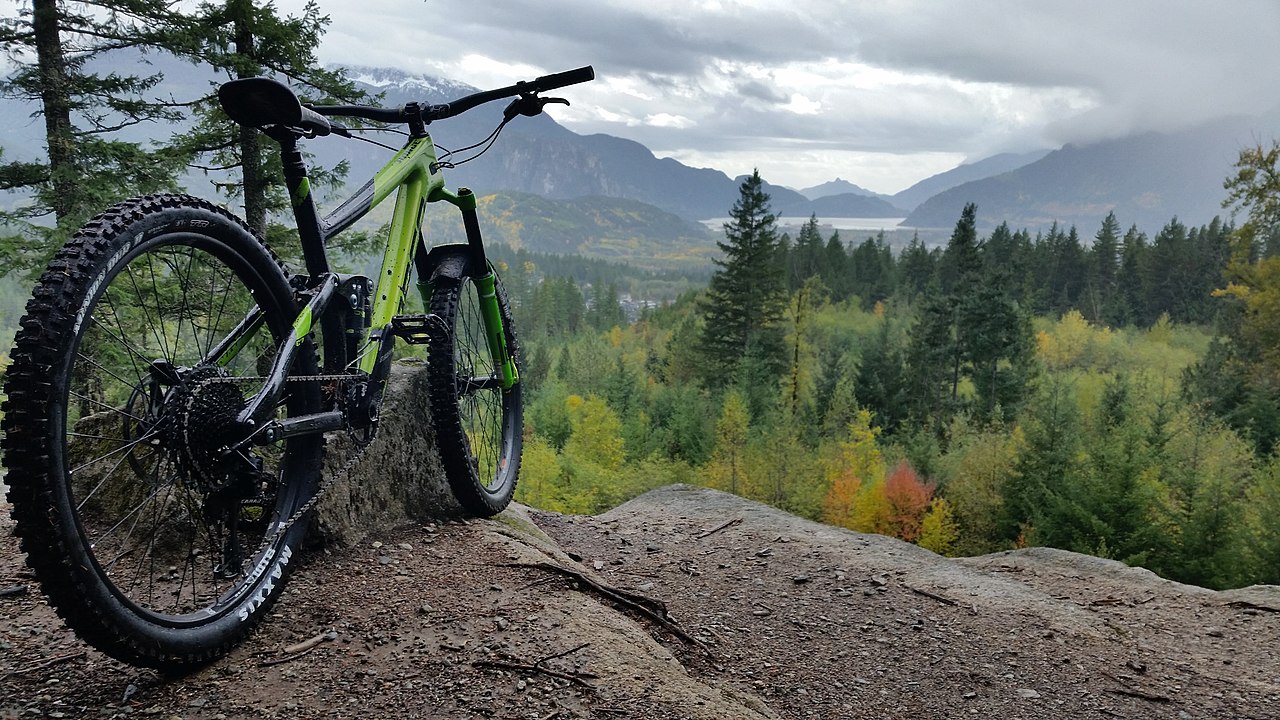
Given the huge difference between the 2 I'm not sure what you mean? Also because these days 'mountain bike' is an umbrella term, whereas gravel bike is still rather specific. E.g. that last link shows already a rather specific segment of maountain bikes: dual suspension, quite a lot of travel on the front suspension, totally suited for going down the hill fast as well.
Many touring/adventure bikes will double as way better commuter than a road bike I feel. They are set up for comfort, long hours in the saddle, and usually have with luggage mounts.
I ride 40mm tires on my Long Haul Trucker.
My experience with 1-by drive is that the simplicity and (hopefully) fewer opportunities for derailment are totally worth it.
My all-road bike has 23 (30/34·26.5", 650bx45 wheels). I don't race.
It's not a perfectly fair comparison because I did upgrade to a nicer bike in the process, but my previous bike was already into the territory of significant diminishing returns for someone who doesn't race and doesn't actually care about saving seconds.
They even note this in the article "If you ride much faster, then it’s possible that wider tires have a little more wind resistance, but the difference will be so small that it’ll get lost in all the other factors that influence your bike’s speed. On the other hand, if you ride slower, then the advantage of wider tires will be even greater."
You can compare gearing ratios on 99spokes, e.g. https://99spokes.com/compare?bikes=scott-speedster-gravel-20...
My own road bike is nothing particularly fancy, but it's very light. Just because those bikes may be made to take more of a beating than a road-bike, they may be heavier. I'm thinking in particular tougher wheels and front work, possibly the whole frame.
And Cannondale even has a carbon frame with a front suspension and rear flex on the frame for a near-full-suspension behavior.
Shockingly, road race vehicles of any variety generally are not built for comfort or ability to handle less than ideal conditions. Stop acting like you think you're in the TdF and get a bike that makes sense for where you ride.
Where would I find enough leather To cover the entire surface of the earth? But with leather soles beneath my feet,It’s as if the whole world has been covered.
Just replace leather soles with sufficiently wide rubber tires
My former housemate had some kind of race bike with a carbon fiber frame, it weighed next to nothing but he was constantly in fear of road debris, couldn't hop curbs, etc. It was a terrible choice for where he was actually riding.
That said the idea that more air cushion space doesn't lead to greater comfort is absurd. A tire that has room to compress doesn't bottom out.
I got Cannondale's recall email as I was flying to Kenya, with my CAADX, for a cycling trip. Was a bit nervous riding the bike, especially given the terrain, but in the end decided to risk it as I didn't want to curtail the trip.
At the time I was wondering whether I was overreacting, and decided that I probably was. It is quite shocking to come across someone who personally suffered an accident due to the fault.
Canyon Grail here, yes the one with the weird cockpit :)
For me it's al about having the freedom to go where I feel like going in the moment and not having to worry too much about gear. For me this bike is like the golden mean, but there are other gravel bikes with slightly more clearance or better shock absorption if you're looking to take it on slightly more intense trips.
Here's a quirky gravel-centric YouTube channel I came across a while back: https://www.youtube.com/channel/UCV9WtB_q5sJfe3Rev5PWy-Q
If anything the opposite trend makes more sense, the motard / supermotard style where a competent off-road bike is retrofitted with road tyres and suspension tuning. They look like an absolute blast.
>At least they're not as silly as the trend of sticking knobbly tyres on road bikes for that "scrambler" look.
FWIW I've got a mid-weight streetfighter that I'd love to put some 50/50 tires and a skid plate on. But I already take it into the dirt so it would be an improvement.
And yes, supermotos might be the ultimate motorcycle.
A buddy of mine dropped his s1000rr coming out of a right turn at a traffic light and was up for around $8k in damages... He was only going ~10mph. I envy those who can fix their bikes after dropping them for $20 when they didn't even have frame sliders etc.
660cc single-cylinder that you could just beat on all day without breaking the law too much, plus super long suspension travel and fat sticky road tires made for a bike that just ate up speed bumps and rough roads. I pulled some gnarly wheelies over bumps and cresting hills, so much fun.
And it was obnoxiously orange, I loved that bike. It was a shame someone else decided that he liked it more and cut though a massive Kryptonite chain to get it.
I think the most interesting take-away is that there is a segment of people who value being given an excuse for something rugged— I heard lots of "I just like the peace-of-mind that I could go anywhere if I needed to" whether they believe themselves or not.
Single track is hard work but there's nothing quite like ripping open the throttle on a 100hp dirt bike and throwing up a tornado of sand. I owned an XR250R for a few years and just found it boring.
Not a motorcyclists but I assume these adventure/dual sport bikes perform much better over say unsealed roads, and are at least workable on fire roads.
So yeah, ADV would seem to be useful for something other than wanting to look rugged.
I've always had full-on road-bikes (skinny tyres, etc). While those are great for a ride out on the hills around my parents' house, I now live in the city where the roads are in a pretty bad shape, and more importantly they're very often paved with cobblestones (probably the very same ones laid down by the Romans).
I'm looking to buy an electric bike for my commute, and most bikes have the "upright" geometry. Maybe it's because of my habits, but I don't feel as safe on those, I find them less manoeuvrable and less efficient if I need to pedal hard (though with the electric motor that last point might be less important).
I'm happy those new "all-track" as they're called here exist, with disk brakes and all the creature comforts of regular "city bikes" but with a more familiar-to-me riding position. I'm less happy with those bikes always having a suspended fork, which I've always seen as useless for road bikes, but oh well...
Didn't realize what I was missing till I tried a nice set of hydraulic discs, I'll never go back.
I don't agree with the "gap is much smaller than people would expect". Have you tried a decent hydraulic brake? I raced on and off road, was a bike messenger, designed and built (from tubes) a mtb frame, and bike commuted nearly every workday of my life. Disc brakes have significant advantages over any rim brake.
Don't knock them till you try them, I was dubious myself.
I actually just sold my carbon wheels and downgraded back to aluminium until I buy a disc bike for the long term.
The worst problem is after a few minutes of constant breaking, which you have to do if you're descending a mountain carefully and care for your life, the rim brakes on carbon start to squeal and you lose a lot of braking power. You also used to risk delamination but that isn't that big of an issue on the newer wheels.
One thing I love about my brakes is having a second set of brake levers inline on the top of the bar - I believe the Shimano GX (gravel) series has that now for hydraulic. If I ever have to buy another gravel bike, it will have this feature.
[0] https://www.renehersecycles.com/myth-12-disc-brakes-work-bet...
Sure I get it, a stoppie shows that the brakes are not a bottleneck, it's the traction. So sure, sometimes, on some bikes, with some riders, under some conditions you get perfect braking.
However in the real world there's various rim surfaces (aluminum, steel, carbon fiber), with a variation of water, grit, sand, snow, ice to complicate things. Cable have friction and slack. Rims sometimes are not perfectly round/true in both horizontal and vertical directions. Brake pads are rarely perfectly aligned (the alignment changes as the pads wear), rarely nice soft rubber (they glaze over with heat and/or age), and are rarely braking on perfectly clean rims.
So yes, I've done a stoppie with rim brakes, but the average performance of average hydraulic disc brakes greatly exceeds the average performance of rim brakes. Their other complaint about being grabby is highly brand specific, plenty offer great modulation. Not only to discs brake better, modulate better, and tolerate temp changes better better, but they also tend to apply more even pressure. Even small differences in trueness tend to create spots on the wheel that brake less or brake more.
I didn't realize how big the difference was, or the habits I had with rim brakes. Took me awhile to unlearn dragging my brakes when ever I hit a puddle, waiting for them to catch again.
Sure if you have a pro mechanic realign your pads before every ride you'll rarely run into an issue that rim brakes handle well. However if you spend more time riding than maintenance discs will serve you well.
There's a reason even the road racers, the most conservative of the bicyclist, are switching to discs.
That's just not true, there's plenty of braking in the mountain stages. I sincerely doubt that going 90-100Km/h into a hairpin is easier with rim brakes.
Ineos had two accidents this season on descents, first with Moscon in the Giro and then with Thomas in Criterium du Dauphine and even if they might have been just flukes, I'm sure the team is asking themselves questions.
Brake pads on rim brakes are a nightmare. They follow a 3-d arc as they approach the rim, which is itself a very complicated 3d surface. Ideally the front edge of the brake pad hits slightly before the rear edge, to avoid squeal... but not too much or it will engage too softly. Even minor wear changes the engagement point. Cables need maintenance, they wear, get kinked, require lubrication, and it's easy to get the tension wrong.
It's all a mess, and even when perfect, and it's dry, not too cool, not to hot, not dusty... they still get worse with every use.
On discs it's more like replace the pads when worn (no adjustments, just remove the pin, pull the old pads, push the cyclinders in, put in the new pads, and put the pin back in). Sure there's occasionally a need for replacing brake fluid and/or bleeding. But generally way less maintenance, and you get like 90% of perfect braking all the time instead of 10-90% depending on temp, wetness, ice, grit, state of tune, etc.
Also MTB's generally accommodate the widest tires, except for fat tire bikes and generally wider tires can be very helpful when commuting for comfort and making things like a random rock or walnut much less exciting when you hit them.
Commuting with rim brakes inevitably destroys the rims, try commuting for 3-5 years then closely inspect your rims, little micro cracks are not uncommon, and will get worse right up until you have a rim failure.
It's also really nice if you do hit something hard enough to knock a wheel out of true, that you still have two working brakes.
Myself, I'm not getting rid of my rim brake bikes any time soon, but it's interesting to observe how different people experience cycling.
Do yourself a favor and try out some decent hydraulic brakes. Now only are they pretty amazing, but amazingly consistent. Even in rain, heat, cold, etc. Also it's MUCH rarer to have to undo a brake, just because your wheel went out of true.
Try to track your use, going downhill and hit a puddle, do you drag your brakes? Why? Wait till they grip again? I had no idea I had such habits.
I've tried hydraulics on friends bikes, definitely nicer, but again not enough to motivate me to switch.
That's how it is with all of these improvements. Someone will always have newer, slicker gear than me, but I keep riding. ;-)
Roads are far from clean, and if anything the debris is more abrasive than you'll find off road. I'd rather have normal dirt than tire and disc dust you'll find on the road.
Also, the disc is a consumable on both types. I have worn down rims to the point where I was scared to use the wheels.
The initial setup can be a bit annoying with hydro discs, but it's a tradeoff I'm happy with.
It served me well, but I am still somewhat cautious when descending since then.
So cable-pull disc vs rim brakes is less clear, more susceptible to case by case differences.
However hydraulic discs are always (AFAIK), double sided, and almost always better than even the highest end rim brakes.
Not to mention who wants to destroy their nice rims by dragging brakes on them, leading to relatively short lives as the rim walls get ever thinner, right up till they start cracking. I'd rather replace a disc than a rim after 5-10k miles.
The Topstone shipped with some pretty knobby WTBs that definitely had an impact on rolling resistance. If your tires are knobby/optimized for off-road, putting a slicker tire (the GK slicks are quite popular for good reason), I suspect you’ll notice quite a difference, but I’d look more at the knobbiness than the fatness if you’re considering a change.
Also worth noting that some knobby tires have a hard line down the middle that keeps resistance minimal until you start to turn, at which point you hit the high traction portion of the tire. Takeaway: even if it looks knobby, it might not be as slow as it looks.
32mm+ is already getting into “fat” territory for a road bike, and for me personally, 38mm seems to be my sweet spot.
They're pretty smooth overall, perhaps why I never really had an issue commuting with them, but I'm always looking to go faster!
- [0] https://www.wtb.com/products/nano-40c
- [1] https://www.panaracerusa.com/products/gravelking-slick-foldi...
- Good on the road, even cornering is decent which was unexpected with light tread.
- Great on gravel: flat, uphill, downhill, and cornering
- Decent on single track
I think maybe they get a bad rap because they are on the heavy side for the price? When the time comes for new tires not sure if I will get another pair or try out something different.
Gravel bike is just a new marketing term.
You’ll also find gears to accommodate more speeds and inclines, typically a single chainring with an 11 speed lightweight derailleur vs 3 to 9 speed heavyweight (but clean and easy maintenance) hub gears.
Out of curiosity, do you know this to be true, or believe this to be true? I ask because the perception of speed with skinnier tires is one of the things the article touches on.
I felt similarly when I put GP5000 28mm slicks on the gravel bike, but when I looked at my ride history, I couldn’t really back that feeling of speed up with actual data, and evidence shows that at least in my case, there was no major difference between 28mm and 38mm.
(Not saying this is the case for you, but I’m just curious).
When I rode the same regular routes on my gravel bike on slick 38s vs my road bike on slick 25s (up from 23s, as big as I could fit!), the road bike felt faster but GPS data didn't really back it up over the course of a whole ride.
The road bike is a bit more nimble with twitchier handling sure, but the more jarring ride of the skinny tires gives the illusion of speed. But in the real, non-racing world the data tells a different story. At the limit I have no doubt the road bike is ultimately faster, but that's not most of my riding.
I'm not a racer but am an avid and reasonably fit recreational rider, so I ditched the road bike entirely and enjoy my more comfortable and practical gravel bike, with minimal speed penalty. Plus I can ride on dirt roads and broken pavement with ease and comfort, to boot.
I think most riders are better served by gravel/endurance bikes than pure road bikes.
Could be the same speed, but you need to peddle harder to maintain it
However the bike feels lighter with road tires. At low speed I accelerate faster and I can keep a higher speed for a longer time. The 42 mm tires have a shallow sawtooth tread so they can't be as fast as the slick 28 mm ones.
And the bike is really lighter with road tires. One 42 mm tire is 600 grams, plus a larger tube. I don't remember the weight of the 28 mm tire, but it's less and the tube is smaller.
[1] https://www.bicyclerollingresistance.com/road-bike-reviews/c...
Who the hell uses suspension on a road bike, or are they talking about something else?
I ride in Chicago (shitty roads, potholes & construction are everywhere), and love that I can put nice 38mm+ GravelKing Slick tires on the bike, and still have no problem keeping up with most road bikes. I've gotten funny looks from folks who're unfamiliar with the concept, but it's such a great setup.
Comfy/soft ride too.
Edit: Cannondale Topstone if anyone is curious.