Why do you think 100 mW/cm^2 is 'safe'? You must know from experience this is enough for tissue heating, even from sidelobes many dB down.
Over what ranges do you think this is feasible? With, say 20 km of free space path loss in the 2.4 GHz ISM and 40 dB antenna gain at each end you're going to be at least 50 dB down. Doesn't this mean for things like transmitting power to islands this tech is not useful?
Even if you start at 1 KW in (60 dBm), over 20 km the receiving antenna is going to get about 0-10 dBm, or milliwatts.
With the same generous setup at 1 km and 1 kW you get 10 watts at the far end.
This just doesn't work out.
There are no sidelobes. We are using near-field and catching close to 100% of the radiated energy.
Range is only limited by line of site and an antenna size which is practical. Mind you, we can reduce antenna size and increase range by using passive relays.
Using a phased array, operating in the near-field. strictly point-to-point between Tx/Rx.
At the moment we are working with about 60% end to end efficiency so sending 1kw means you will get 600w at the far end… not 1w :)
Can you link me to reading material explaining how an antenna can have no sidelobes?
E.g. The radiating near field of a 2.4GHz antenna about 8 meters long would extend about 1km.
[1] - https://www.giangrandi.org/electronics/anttool/regions.shtml
Or is there some metamaterial "magic" going on even at the transmitter that I'm not accounting for?
Right, and anybody who knows enough to ask you about sidelobes likely also knows enough to know that too.
That's why, if you reply that "there are no sidelobes" you're only harming your own credibility.
A good reply is something like "there are sidelobes, but they peak at -{believable number} dB and are contained to within {small area}. We believe this is more than sufficient to address sidelobe concerns because of {standards}".
That's a reply that earns trust.
Whereas the question-train you're on is at a pretty interrogative clip ..
Very feasible.
Hypothesis A: they don't want to share basic performance metrics because they contain special secret sauce!
Hypothesis B: they don't want to share basic performance metrics because they suck.
We'll see!
> There are no sidelobes
Or are you creating a generic lens that is factory tuneable to the needed characteristics?
Suffice to say that you are on to some of our more interesting IP ;)
At the moment we are working with about 60% end to end efficiency
There's spread over distance. If you've found a way to prevent spread it's either not free space or a change to the electromagnetics fundamentals. It's a really bold claim to make. But maybe I'm misunderstanding something.
I know bullshit when someone spells it out for me.
This company can say all they want about near field tech, but the beam waist diameter relative to wavelength determines the diffraction spread. And that aspect of path loss is proportional to the distance in wavelengths even if there's no "absorption" by the air components. For any reasonable link at 2.4-5.8 GHz the length in wavelengths will be tens of thousands.
Unless of course we are beaming directly at a coms antenna, which we don't plan to :)
For micro-power IoT, maybe there's a play, but bulk power delivery this seems a stretch.
In case anyone's wondering, 40dB antenna at either end is reasonably some 14ft across at 2.4GHz, so no small thing.
All I'm saying is I hope you have a background in EM. There's lots of stuff that sounds great in approximation and models, but breaks down in reality.
[1] G=4piA/lambda^2 - I tacked on 70% eff which is mid-high for a parabolic dish
for instance. Put in a 3 by 5 meter aperture, and bam, 40dB on the nose.
If someone else is making false claims, show how the claims are false, so we can all learn something. Don't just tell that they're false and especially not in noxious ways like this. Not only do you poison the community when you post like this, you also discredit any truth that you're trying to defend: https://hn.algolia.com/?dateRange=all&page=0&prefix=true&sor...
Other commenters have expressed skeptical reactions while staying within the guidelines. Please be like them in the future.
By the way, the claims in the OP probably are too good to be true, because most claims are too good to be true. But if we're to have an interesting forum in the long run, people need to correct bad information by respectfully providing good information, not by bashing each other in uninformative ways. Perhaps you don't owe someone who is making false claims better (I'm speaking only of the general case here, not the OP)—but you definitely owe this community better if you're posting to it. Please do better from now on.
> The system uses a net of lasers surrounding the beam to detect obstructions, like a bird or person, and it automatically shuts off transmission until the obstruction has moved on.
...which seems to be proof that you're aware of it's dangers and have taken steps to mitigate it. This is a good sign in my book.
I also note that the beam is controlled by
> relays, which are like “lenses” extending the beam beyond line-of-sight by refocusing it, are nearly lossless
If you've not reached coherence, how do your control diffusion? Do you have plans to have 'relays' at very regular intervals in order to constrain the beam to an (cross sectional) area so that it remains safe for organic life?
The interval between relays largely depends on topographical, regulatory, and environmental conditions.
In any case, all our systems are designed to be absolutely safe for any organic life form.
Despite initial perception (mostly driven by the 5G frenzy I presume), if you do the research you'll realise that it is the most environmentally friendly solution out there. This is how EBDs can go green! No ELF, no people or animals immersed in RF or electrocuted, no carbon emission, no cutting through forests and rivers with huge pylons and no underwater cables disturbing marine life.
I hope this addressed your concerns?
We don't have high capacity (centralised nor distributed) grid scale batteries in many places yet.
What it boils down it is, even if this works, which I doubt, 20% transmission loss makes this a niche market at best.
NZ is proposing to go fully renewable by 2030 as well as promoting higher EV targets for 2023. We already import many right-hand drive Nissan Leafs reaching their 7-year EOL from Japan, so re-purposed batteries for off-grid storage will become very cost effective in short order.
Our aluminium smelter is also slated to close in a year which frees up about 10% - 15% of national electricity, and we have pumped storage for day/night loads separate from hydro.
Given the political climate here, niche opportunities abound imo.
As mentioned in a top-level comment, this could be incredibly dangerous, depending on the properties of the microwave generator. Can you say what the maximum level of power density experienced outside of the laser boundaries will be? Can you give attenuation figures?
The Powerco project is listed as "a few kilowatts." What range of distances do you intend to test?
How do you expect weather to affect efficiency? Have you tested the transmission in a driving rain? Or will you turn off the system in inclement weather?
The distances we are looking at are progressive from a few hundred meters to a few kilometres. Range is only limited by line of site and an antenna size which is practical. Mind you, we can reduce antenna size and increase range by using passive relays.
At the moment we are working with about 60% end to end efficiency. This is not influenced by weather as we are using near-field atmospherically agnostic frequencies.
There is real people who have real concerns that if they accidentally pass thought the beam of power then they will be cooked.
If the safety of you technology is based on it being installed in such a way that no one would accidentally pass through the beam then you need to explain how that is done.
if the safety is because it is just not dangerous to pass through the beam then you need to explain why that is and if there is a time limit on how long it is safe to stay in the beam.
If you are incapable of addressing safety concerns to a technical crowd like hacker news then I don't see how you would convince the general public to be cool with this.
Just to keep beating a dead horse, stating something is safe because "science and engineering" is pretty much the modern day way of saying because "magic".
Agreed. I have significant experience in this field and I’m having difficulty making heads or tails of half of the company’s explanations here. I can’t tell if it’s an attempt at watered-down explanations assuming a non-technical audience, or if they’re simply trying to change the subject whenever the difficult questions come up.
Now that they’re resorting to ad-hominem (“lazy” comments to legitimate questions without even attempting to answer the questions) I’m becoming even more skeptical.
I guess this goes into the same bucket I have had for new battery/energy storage technologies for the last 10 years: until there is an actual, working prototype fulfilling ALL of the promised features, it doesn't exist for me.
Having been working with IoT hardware for over a decade, I used to get so excited that new advances in energy storage would solve some of the problems. Yeah, I'm still waiting :)
There's nothing wrong with creating an account to post a comment about a situation you have some personal connection to. On the contrary, we want people to post about what they know—and if they wait for a topic they know something about, so much the better for the rest of us.
I think this is the case. The founder, or whatever PR employee is handling these comments, has misjudged hackernews and assumed that it is used by the same nontechnical crowd as facebook or twitter.
Pretty sure lots of top researchers use this forum. Talking down to them with a "It works using science and engineering :)" won't go down well.
That's not really fair. High powered microwave transmission is dangerous.
You're claiming near field, non radiating, and so, safe.
Fair enough, but you're also claiming long distance. That requires a little more explanation. They call it "near field" for a reason, right?
So it says something that even I can tell that this poor guy is out of his depth. He shows up to HN (a community of smart people who are willing to listen to the unorthodox), solicits questions, and gets defensive when people ... ask him questions.
This won't end well. I'll get some popcorn.
PS: brother, it's "line of sight". I know spelling well doesn't change the world but sheesh.
(Though I don't think you have to be a subject-matter expert to judge human interactions. Just wanted to point out the invalid line of reasoning.)
When someone says "I'm not an expert and even I can see that...", they are presumably implying that even without the technical knowledge required to spot an obvious 'fake' or 'quack', perhaps an impostor, they can still identify said impostor.
In this case that seems to me to be a valid statement. Albeit one of relatively low value, since nothing much has been added to the discussion. All we now know, is, that the impostor has overreached and even laypeople can call their bluff (and an additional audience member has confirmed this to us). But that's it.
I want to see how this is often the preface of someone missing something non-obvious though? What is the non-obvious thing in this case, that the parent commenter is missing?
So even if the conclusion is right, the fact that the person drawing it is uneducated is not a justification for it. After all, the same justification could be given in a case in which that conclusion did not hold.
So, if I am getting this right, we have the following factors: Person A makes a statement (this could be an impostor or not-impostor), Person B observes that there is an impostor at work (or not) and Person B could either be educated or not and lastly, whether they agree or not.
So we have the following possibilities:
1.) A -> non-impostor -> B educated (B trusts A based on shared knowledge, easy)
2.) A -> non-impostor -> B uneducated (B has to trust A, A made argument well enough to convince B, but B has nothing but a 'feeling' to rely on)
3.) A -> impostor -> B educated (B immediately figures out A is a sharlatan based on knowledge, argument ensues...or it's just obvious A is no good)
4.) A -> impostor -> B uneducated (B has figured out A is an impostor, but that could be for who-knows-what reasons and is therefore less valid)
And the conclusion here is that in case 4.), the person has used their lack of education about the subject matter as a way to add weight to their statement (or to embarrass the impostor further), when, in actuality their lack of education just indicates that they have little reason to participate in the discussion in the first place.
Am I now kind of getting it? I feel I'm being slow today, but it bugs me when I don't understand something.
There are two relevant cases:
1. A is a non-impostor, B uneducated -> B has to trust A, but A's argument seems flawed because B doesn't know of the non-obvious feature that fixes the apparent obvious flaw in their argument.
2. A is an impostor, B uneducated -> B has to trust A, but A's argument seems flawed because their is an obvious flaw in their argument that even B can spot.
From the point of view of B, there is no way to distinguish between these two situations, and so their being uneducated doesn't help them spot the impostor.
That sounds major alarm bells to me of either serious technical issues or, perhaps more likely, fraud.
If the tech IS actually working and safe, a proposition which grows increasingly doubtful with every comment you make, you are NOT the right person to be running this thread, and you are doing serious damage to Emrod's PR.
How is this being handled?
See: http://gsp.humboldt.edu/OLM/Courses/GSP_216_Online/lesson2-1...
And, do you know for certain that it won't interfere with your laser safety system?
Presumably there would be forward scatter and back scatter to deal with I don't see how you could avoid that.
Furthermore, comments about beamforming and that it uses a phased array isn't surprising with regards to the application but you will still have sidelobes, even with a very tight beamwidth / high gain.
And then you have path loss etc, I have no idea how this would actually work - it sounds unfeasible on many fronts.
(I guess this idea can no longer be patented if it is novel, as this comment has just established prior art!)
Not sure if this is as big a problem in NZ but in Canada beavers and squirrels can and do shutdown sections of the grid - as can falling trees and large frozen branches in the winter. I can see a rural hospital benefitting from a redundant dedicated power source.
Wouldn't you agree that replacing fossil fuel based generators with a cleaner and cheaper alternative is worthwhile?
This is due to the fact that there is no way to reliably forecast when a bird will fly in front of the link and shut it off. Since the receiver will still need storage or generation, it's probably more economical to just do that in the first place.
A transient object like a bird would not have a significant affect on continuity of supply. it is very small compared to the Tx/Rx surface and doesn't linger in the beam path.
Wouldn't you agree that replacing expensive imported polluting fossil fuel generation with a cleaner and cheaper locally sustainably generated energy is worthwhile?
You cannot guarantee this. The bird could decide to fly directly down the beam path and there's nothing you can do.
Directly from the article:
> The system uses a net of lasers surrounding the beam to detect obstructions, like a bird or person, and it automatically shuts off transmission until the obstruction has moved on.
Since there are so many possible obstructions that could occur, I suspect that the link will continuously turn on and off. This will be worse than before so you'll need local storage or generation to account for these unplanned outages.
This sounds like the kind of thing that is technically possible but in practical probability a once in a millennium event
But the birds moving around...
Guess we shall see. That's what field tests are for.
70% efficiency is the current state of the art limit for solid state based Tx. we loose close to 0% in the atmosphere and our Rx is well beyond 90% efficient.
What end-to-end efficiency are you getting and at what distance?
For example, we are currently looking at powering an island across a distance of 30km with an end-to-end efficiency of around 60%.
I bet Musk will be your best friend if you brief him with such project ;)
Is the patent application still unapproved and thus unlisted, or has it been rejected?
The major exceptions are if the inventor files for nonpublication along with withdrawing the application (usually because they think it won't be patentable) or the US Government classifies it.
Also curious, what are the advantages over a maser?
This is technology that not everyone is familiar with. Some questions people want to know are surely:
1.) What makes it safe? Is it that the beam itself is harmless? Harmless for long term exposure, too? Or is it that the beam isn't harmless, but the system has systems in place to break the beam if obstructed?
2.) Will other technology be affected? Would drones, etc, interacting with the beam be adversely affected?
3.) HOW is this relatively unaffected by distance? So far I've heard you say that it isn't impacted by the atmosphere, but I think people are still curious to know more.
4.) How is this not impacted by rain/humidity? You linked an article regarding water not absorbing radiation, but didn't address the subsequent claims regarding refraction.
The point is. This is a technical place, please answer some of people's questions and stop just dismissing everyone as ignorant skeptics.
I'd imagine they'd never get approved blasting 400w per kW erratically.
We are using a strictly point to point collimated beam that is expected to meet nothing but clear air. It shuts down if/when any transient object is about to enter the beam path.
Also, don't forget that the important figure you should be looking at is power density rather than total power
You also claimed it's unaffected by rain.
Which is it?
Rain will trip the laser screen, as will fog.
Ergo, this will only work in clear air. Rain and fog will shut it down.
Thanks for answering questions here!
Here is a chart of transmission losses from the source to the end user across US states: http://insideenergy.org/wp-content/uploads/2015/11/State_Los...
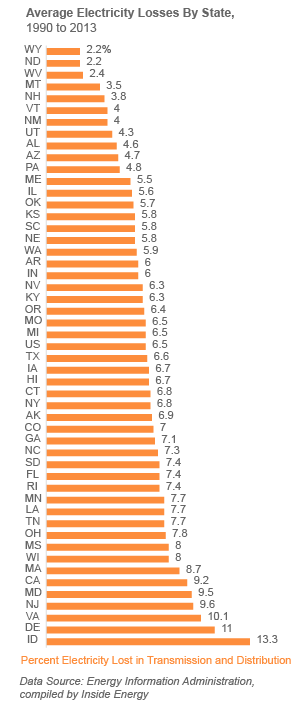
Beyond delivery loss, don't forget that there are other CAPEX/OPEX considerations.
For example, an underwater cable from an offshore wind-farm might be a more efficient means of energy delivery but it's installation and maintenance cost would be much much higher and require more time to deploy than a wireless solution.
That is inevitably a significant part of any economic benchmarking.
When an actual expert shows up they often waste effort on the first comments before the good comments have shown up. This was a good effort from an expert and answering questions in no way damages credibility or disproves the efficacy of the technology or any of the other nonsense that has been asserted by a community in decline.
I am excited and humbled by your support.
At Emrod we have safety and environmental considerations at the core. I’m happy to explain why our tech is not only safe but also has a far smaller environmental footprint than any powerlines, communications antennas, etc.
As with any new transformative technology, there will always be sceptics. All we can do is rely on solid science and engineering, listen to the public and address their concerns.
I invite you to engage us in an open honest conversation. We would love to hear your concerns, thoughts about possible applications, or even just drop us a line to say what you think about wireless power.