Imagine if a publicly traded company announced that in 1 years time, they would buy back half of their outstanding shares (not a great analogy but its the best I can think of). What would happen to the stock price?
All securities prices in publicly traded markets are essentially priced as discounted cash flows over the next 20-30 years. The current price reflects all available public information about those cash flows.
I'm not saying efficient markets is 100% true all of the time, of course the world demonstrates that it isn't, but the level of disbelief you have to have in the hypothesis to believe that a well-known public event affecting Bitcoin will result in a 3x price increase is lunacy, IMO.
Orthogonal, but I do enjoy how every time I see a statement like this, it comes with a different year set of years. This one is 20-30 years, saw one yesterday at 50 years, Investopedia will tell you 5-10 years is the standard [1].
[1] https://www.investopedia.com/investing/pitfalls-of-discounte...
For example, a cash flow with a 10% discount rate will return about 90% of all it's discounted future cash flow by year 20.
The discount rate depends on the investor, and as for when you stop counting cash flow on the way to infinity, I guess that's up to you.
You can see that it's BS by just looking at Warren Buffett's investment returns, all collected from exploiting long term market inefficiencies.
"Imagine if a publicly traded company announced that in 1 years time, they would buy back half of their outstanding shares (not a great analogy but its the best I can think of). What would happen to the stock price?"
The irony is that a bunch of companies are and did do EXACTLY this with trillions of dollars designed to bail out the economy.
Think of it like a differential equation where a steady state is changed... like a spring that has been held in a certain position is released. There will be a shock as the system seeks to find a new equilibrium.
The fact that the system has been shocked means that there is some predictable craziness that will happen soon. It is basically guaranteed fun no matter how it turns out.
I've been following bitcoin a long time, and was excited for the halving. But I'd never heard of the model you described and could care less about it.
After all the last halving was in July 9 2016. Since then the production has been reasonably constant while the price has been a complete rollercoaster.
With logarithmic scales and big enough error bars you can fit anything into anything.
>If you're wondering why your friends who are into cryptocurrency are in a tizzy
Being into cryptocurrency is reason enough to be honest.
- John von Neumann
I'm not here to argue that the model is good or bad, but I will say that it's surprising, and interesting.
- George Box
-- Anyone who has watched people apply technical analysis to Bitcoin charts as a source of amusement over the last decade
I think just properly accounting for wins and losses can be good at instilling a sense of humility; I'd recommend he calculate his track record if he hasn't already. I enjoyed the book Thinking in Bets by Annie Duke, which is about the psychology of developing some habits around making bets and the cognitive biases we have. A Random Walk Down Wall St. is also a classic that is good at instilling a sense of humility in you as an individual investor.
Miners engaged in mining before I arrived would have the same costs they had before, but now with fewer BTC to cover them, this would force them to sell at a higher price or operate at a loss until they drown the competition.
There are two ways to look at it.
My dreams of being a millionaire are forcing me to sell this orange for a million dollars. Ergo, oranges will now retail for a million dollars.
If there were only 12 oranges produced on all the trees in the world every hour & it cost $500 an hour to operate your orange farm. You therefore have to sell your oranges for at least $42 to cover costs and make a small income
However now there are only 6 oranges produced every hour (not 12), what can you do to maintain profitability?
Bitcoin production is perfectly inelastic, and Bitcoin itself has no consumption value. You need a different analogy.
Nope.
Miners have costs to cover, mining unprofitably and holding makes no sense whatsoever (you're literally better off turning off your rig, buying on the market and holding at that point)
You're better off buying them from others at that point.
First of all, you regularly consume items where the price is determined by demand, not production cost. Cars, housing, and premium products regularly sell for multiples of what they cost to produce.
Secondly, just because something’s expensive to produce doesn’t mean that it’s valuable to anyone else. This is a common problem in customized products, but also happens when market demand either fails to materialize or collapses. Your ultra premium buggy whip might be incredibly expensive to produce, but if nobody wants buggy whips you can’t sell it high enough to make a profit.
Mining is public evidence that someone is willing to burn $X in electricity to acquire a Bitcoin. For an intrinsically worthless monetary asset with no government support, social proof is the only real source of data on possible valuations. See also: Mises’ regression theorem.
many multiples! this is incorrect. the luxury versions of those products you listed certainly have higher margins, but id be surpised if you could find anything with 100% proft margin, much less 3x and beyond.
Price is a function of supply and demand and because most markets are fairly competitive, the market-clearing price can be predicted roughly from the cost of production.
'Cars' do not sell at multiples they cost to produce, once you factor in all of the overhead of sales and distribution, margins are fairly thin. Those are 'real costs'.
Almost every single good ever produced is commoditized on some level, and therefore market prices are predictable from the cost of production.
BTC is no exception: if it costs $1 to make $2 in BTC, you can be sure a lot of people will be 'making' BTC until the cost of making BTC and it's market value start to merge.
The remaining demand for BTC ... given the fact it has no use, it's not a currency or a generally accepted store of value ... is speculative in the purest sense. It's whatever a bunch of dudes holding it want to buy and sell them as. Like baseball cards.
What’s interesting is that you reinforced my point at the very end. Baseball cards are a fantastic example of a product that’s sold in a way that’s completely disassociated from the cost of production.
Bitcoin is weird though because no matter how many miners there are, it's still minted at the same rate globally. If it cost a miner $1 to make $2 in Bitcoin, what would not happen is new miners joining and flooding the market with more Bitcoins until the price of Bitcoin falls. Instead, new miners would keep joining and the miners would be cutting into each other's profits until it cost them all approximately $2 to make $2 in Bitcoin.
But that's not really the point.
Let me put it differently: if it costs $1 to mine $1000 worth of BTC ... then, new miners will flood the market until the cost of mining reaches parity with price. This is not a BTC specific or controversial statement here.
I think this is what you meant, but just to clarify: the cost of mining will go up, not the cost of Bitcoin. (Miners joining or leaving shouldn't directly affect the price of Bitcoin. The same number of Bitcoins exist and get minted regardless of the number or activity of miners, as long as it's nonzero anyway, so miner activity doesn't directly affect the supply and demand of Bitcoin.)
(Or we are both wrong)
They can be mined at a loss temporarily, in order to drive out competition, but at some point, a miner operating at a loss will go bankrupt. This is no different from the oil industry, where capital outlays so high that most players continue to produce at a loss, temporarily. But long-term, the price must at least match costs of production.
Bitcoin is minted at a predefined global rate; the amount minted doesn't depend on the number of miners. Miners compete with each other for a share of the predefined minting action, so some dropping out does not decrease the minting rate of Bitcoin, but instead makes it more profitable for the remaining miners.
Remember, production is built right into the protocol. 10 miners could keep the network going at the same pace.
A network with only 10 miners could easily be attacked with minimal effort. The only thing stopping the attacker would be the fact that it's a waste of time, because a cryptocurrency with only 10 miners is worthless.
Wiping out too many miners at once is dangerous business.
There's a Reddit comment here[0] with links to them, but it's up to you to decide if they're worthwhile or not. I have some doubts, but I would not go as far as to throw the word "discredited" in so casually. The comment also includes links to research against the "LTV".
[0] https://www.reddit.com/r/badeconomics/comments/fht0ti/marxs_...
It's fairly trivial to reason from any given intrinsic value theory to absurdities, this is basically the foundation of marginalism and the last 150-odd years of economics.
The fact that products have prices is an empirical fact; Marx's argument is that this fact is only one premise in his 'proof' (using the term loosely) of the "LTV". According to Marx, a good does not have "intrinsic value" any more than it has "intrinsic price". We still say that price determines what goods sell for (even if that sounds tautological).
It's exactly that products do not have prices that is the problem. The apparent 'price' of a product is an epiphenomenon of a particular market, a side effect of the unequal subjective values of the participants (and it's trivial to observe that these clearing prices are determined at the margin, not on average, which makes aggregate LTV even wronger than the regular kind)
In a well-functioning market all products have clearing prices that are easily measured and compared to one another, but this is a mirage that requires constant arbitrage to maintain. The slightest change in unrelated market conditions turns dirt into ore or crude oil into toxic waste, with no objective change in the material itself, only changes in the subjective needs of the participants.
Edit: it’s literally the second sentence in the Wikipedia article:
> LTV is usually associated with Marxian economics
The irony is in a Bitcoin investor and Marxists sharing some economic common ground for their beliefs, since otherwise those groups rarely have much in common.
Given this feedback loop, how do you establish what's the proper equilibrium? What's the total amount of hardware bitcoin is supposed to stabilize on? As a thought experiment, if BTC stabilizes at $30k, that means that the total value of all bitcoins will be about half a trillion dollars. How can that work if Bitcoin becomes the new dollar? Clearly the entire world ecomony is more than that.
Normally I'd assume that I'm missing something and the people who came up with that model know more than I do, but then again we're talking about cryptocurrencies so...
If people overall wanted to purchase enough Bitcoin to have more than half a trillion dollars in Bitcoin, then demand would outpace the supply and the price of Bitcoin would go up, making it possible to have whatever amount of value in Bitcoin. It's nonsense to presuppose the price of Bitcoin staying still while demand outpaces the supply. No one sets the price of Bitcoin but supply and demand.
If the price were somehow fixed at $1000, the difficulty would eventually be adjusted so that miners would barely break even.
Same if the price were somehow fixed at $100,000.
This is a pretty good visualization: https://i.redd.it/qfekfq88qwp31.png
Keep in mind that this is logarithmic and error bars are generally .1 to 10x the actual price.
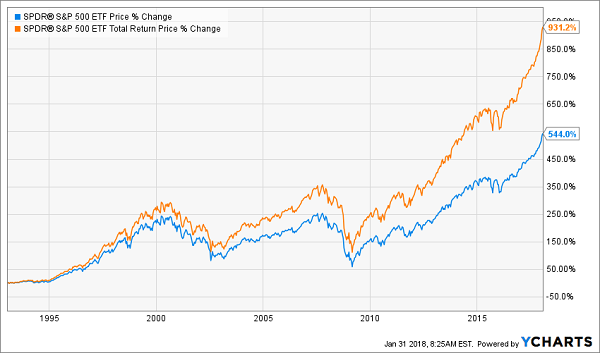
> Between January 1, 1963 and December 31, 2014, 1,186 index components were replaced by other components.
You can know an index of 500 large companies will go up but not know what companies will be on that index in the future.
https://contrarianoutlook.com/wp-content/uploads/2018/02/SPY...
Also, there are different risks than equities. Equities have the risk of the company failing or being significantly impacted by many different things happening, while there are existential risks with BTC I feel these are often ignored or accepted as not applicable to most BTC investors.
No, it predicts it will be at $30k at the end of this year, and $100k this time next year [0]. I'm pretty comfortable saying that no, it wont. If I though there was a reasonable, legitimate way to trade against that outcome occuring, I absolutely would. For reference, in the past year, BTC has increased in price by ~$1450 or 20% - getting to $100k would be over 1000% increase.
https://docs.google.com/spreadsheets/d/1qgqvFR6HeVNkw2fxLgdr...
Apple stock has increased 100x in the past 15 years, but that doesn't mean it will increase 100x in the next 15 years (which would put its market cap at approximately 5x US GDP).
I usually just go long on stocks, securities.
My own prediction is to observe that the price has been in a wide band around $10k for the past year, so will continue to hover around that, with gradual upslopes and sudden dropoffs of 5-30% for no apparent reason that cannot easily be post-hoc linked to events.
You have my curiosity. What is the prediction that Stock-To-Flow made about the effect of the halving?
2) I'm forced to cut my security budget in half.
3) ??????
4) I'm now twice as secure.
Basically it is a way to show that there is similar movements in the value even when the ranges they move in are completely in different scales.
I'm not wondering that, because none of my friends are in a tizzy. Are your friends in a tizzy? Am I just outside the social connections to the tizzy club?
https://m.youtube.com/watch?v=64R918K-3L8
With the extreme uncertainty globally, this model cannot be reliable.
https://share.cryptowat.ch/charts/bqsr58eein8u9uevh370-krake...

Proposed by PlanB [1] it is a source of constant derision/hope/skepticism/dismissal by the Bitcoin community, and the halving of the reward gives it its first non-backtested novel prediction.
Roughly it predicts [2] that the price will settle into a band around 30,000 USD sometime next year.
[1] https://twitter.com/100trillionUSD
[2] https://cointelegraph.com/news/bitcoin-halving-will-be-make-...