"Must act quickly!" Ya think? Hopefully the fire department in Paris, France is listening for gems like that from out here in the boonies / the ghetto hemisphere. How many medieval churches are there on our whole continent? Call us if you want a church bombed.
(edited slightly in response to child comments)
EDIT: I added a few words to the grandparent post to try to make my intent clearer.
Actually I think I was, if anything, charitably conferring tons of undue respect on that guy, by calling him "our president," thereby not only acknowledging his office but accepting him as "ours," both of which are more than some are willing to do. Ya can't please some people I guess.
However, I'd like to use this opportunity to plug Valee's "Womp Womp". Check it out on Spotify!
Makes sense. French fire departments are branches of the military.
Edit: just the Parisian and one other fire service are set up this way.
(The news networks are pretty much as clueless to the situation as everyone else, so take with a grain of salt)
Edit: They are now spraying the stone structures.
They're not going to take huge risks. Any environment that would be extremely dangerous would be an area where any art has already been destroyed.
How many human lives and human energy went into Notre Dame? How many lives would its continued existence inspire? Humans are far more temporary than art and culture. Art and culture connects us to the people that came before us.
It's a pretty personal question. I admire the archaeologist you described, but I believe no one should feel obligated to do the same thing.
How much risk would you be willing to take to save the artworks of Notre Dame?
If there's even a small but significant risk to one's life then nobody should feel obligated to do it.
I think that's the best explanation I've ever heard for why art and culture are so important.
PS: I had no idea it was so controversial to forgive people for not risking their lives for an inanimate object.
Some people will categorically shy away from any perceived risk to their own safety, even if the estimated chance of saving a valuable object is very high. At the other extreme, some people would endure suffering and death to save what they recognize as priceless artifacts of history and culture.
If your argument is that we shouldn't criticize people for choosing not risk their for inanimate objects, can you point to such criticism in this thread? I haven't seen any.
Put it this way... would you run into a burning building to try to save the Declaration of Independence? (Assuming you're an American) Would most firefighters? Seems reasonable to me. The art inside the Notre Dame is on that level of importance, to France and to civilization itself.
What matters about the DoI are the ideas, not the original piece of paper.
no piece of paper/art and especially national pride is worth someone's health
I live in fourth most visited city in Europe and I couldn't care less if most touristy church burned down, it's just church, people are overly dramatic, most important it's nobody died and whatever will be outcome life will go on tomorrow and in two weeks nobody will remember about it in news
Just because you don't feel that way doesn't mean they're all wrong.
any sane parent would think twice risking his life over a THING. risking life to save other (strangers) lives it's questionable, risking life to save things it's just stupid
There's nothing unusual for being willing to die for a THING. Hell, people have sacrificed themselves in the millions for mere ideas. People fight to the death over tiny scraps of symbolic land.
It may seem stupid to you. It's stupid to me, too. But that's what people do. That's what people are.
as for saving someone's else child I would most likely not do it if I would calculate it's too risky for me (unless I would be stupid by instinct), if their own parent/guardian font care about their lives why should I? I don't expect other people saving my children. though it's not fair comparison,I am sure you have minute to decide if you save some piece of art work compared to split second decision to save living being
I also worked in past in insurance companies, after dealing with thousands of accidents my advice it's always run over animal, don't try to save it by avoiding it (unless it's boar or something similar comparable to concrete block/tree), try to fight your instinct, saw way too many dead people or in serious injury because they tried to save some stupid dog/fox etc and then crashed into some tree/building etc
If entering a burning building (which isn't actually _that_ risky) to salvage one-of-a-kind historic artifacts isn't something you would chose to do, that's fine. Don't label the actions of those that make a different choice "stupid".
Notre Dame is...was...a medieval Roman Catholic cathedral in a postmodern secular country, desecrated rather than revered by the revolutionaries who built modern France.
The country and government being secular does not mean that the people left their Catholic roots behind. Atheist and religious French people share similar values and the past is very important to both.
To flip your point around, they'd save it because it's symbolically important. Same with the art in the Notre Dame.
I’ve literally been explaining that this whole time. Please try to read and comprehend things before issuing these vacuous replies.
---
Edit: Someone on Reddit wrote a very interesting comment about its historical significance:
"Napoleon's coronation is incredibly recent in terms of Notre Dame's age. The amount of time between then and now represents less than 25% of the cathedral's existence.
It was built in 1163, one year after Genghis Khan's birth (or at least our best guess of his birth). Notre Dame predated Marco Polo and the founding of the Ottoman Empire by more than a century. It predates the creation of Islam. At the time of its construction, the best estimates for the global population are ~300 million (less than the current population of the United States). The cathedral was almost 200 years old when the Black Death destroyed a third of the world's population. The USA is currently younger than Notre Dame was when the Forbidden City was constructed in Beijing. It was 3 centuries old when Machu Picchu was built and Leonardo Da Vinci was born. It was over 400 years old when Shakespeare's Globe Theatre was built. It predated the original King James Version of the Bible by 450 years."
---
Among other relics, a piece of the Crown of Thorns was inside the Cathedral. I don't have a hard time picturing someone braving a blaze to save that.
And we are talking a building that has survived the French history, the Revolutionaries didn't destroy it, the Communards didn't destroy it (and the destruction in this event were quite extensive http://paris1900.lartnouveau.com/paris00/commune_destruction...). It's a testament of the culture importance of the building and the fact it far exceeds its religious function.
Disclaimer: French and living in Paris (I've not seen the fire however).
I imagine even the most reticent would be jumping in on this one.
Patriotism is like caring for your family.
"The desire to compete with other nations; nationalism."
Patriotism is a better fit for this use, as there's the first definition:
"Love of one's country; devotion to the welfare of one's compatriots; passion which inspires one to serve one's country."
Generally, if we're not using literal dictionary definitions, in a political context, nationalism is overpowering patriotism where you want your country to be better than others at all costs. Patriotism is a love for you country and your people.
Sydney J. Harris
Either way: how did France (the nation) make any of these artworks? You could argue it was made by anyone in the spectrum ranging from "the artist" to "the humanity". Stopping at France seems arbitrary and a bit... nationalistic.
If any institution "made" them, it's the Catholic Church, not France.
[0] - https://www.cia.gov/library/publications/the-world-factbook/...
https://en.wikipedia.org/wiki/La%C3%AFcit%C3%A9
https://en.wikipedia.org/wiki/Dechristianization_of_France_d...
Americans are some of most obnoxiously nationalistic people I've ever encountered. Note: I've lived both in Paris, and also NY and California (14 years in the US). Only in the US do you hear mobs of nationalistic folk chanting "USA USA." I've never been in France or the UK and seen similar things. Think about things like Americans boycotting French Fries and calling them "Freedom Fries" when France decided not to join the illegal and immoral Iraq War.
Very fine people on all sides of course.
I must admit, you’re the first person I’ve ever heard refer to a USA chant as enchanting.
I go back and forth between HN and Reddit, I guess I'm used to Reddit, will pay more attention.
This type of art is irreplaceable and art cannot walk away from the fire. At least we know it has zero chance of doing so, unless someone shows up
If they get 8 months of training before employment, I kinda hope they spend more time on the theory and practice of firefighting than being a soldier.
That's only like six fire engines, looking up the stats. (But I don't know anything about fire fighting.)
Even if you had that pumping capacity on site, there's no way the municipal water supply could deliver that much water.
You're absolutely right though, if you want big water, that's the way to get it. It's just that "big water" doesn't even begin to approach the scale of the water that would be necessary to directly fight this fire.
SFFD trucks have that capability, and it was used in the 1989 earthquake. It's intended for pulling water from the underground cisterns marked by a big ring of bricks in SF intersections.
Terrible for the equipment to run salt water, but they had to.
For anyone else confused: this earthquake was in San Francisco and this is about their Fire Department. It doesn't mean that French fire trucks have that capability 30 years later.
My understanding, which is probably quite out of date, is that it's mostly harbor firefighting boats which had this ability.
A coworker of mine points out that many of the San Francisco manholes are actually covers for cisterns of water, which exist primarily for fighting fires after an earthquake possibly takes out the water mains and starts many fires. I should hope that San Francisco fire trucks can draft water to use these.
Park the truck next to the cistern. Connect a length of hose to the pump supply, drop the hose into the cistern. The pump will move water until it loses suction pressure.
London Fire Brigade for example has nine special pumps that can draw 2000 gallons a minute each from river or lake supplies. So that's 18,000 gallons a minute just from them.
And that's a smaller fire brigade than Paris.
The real world is complex. It's not all like software or taking multiple choice exams. Again the devil is in the details. Pay really close attention to the map legend. It looks like there's nearly 200 feet of distance from the closest water shown on that map and the nearest side of the cathedral. I really doubt that all fire trucks carry 200 feet of hard suction hose, or have pumps designed to draft through 200 feet of hard hose.
"The NFPA 1901, Standard for Automotive Fire Apparatus – Requires pumpers to carry: 15 feet of large soft sleeve hose or 20 feet of hard suction hose"
In real life, if you were going to draft in an environment like this, (leaving aside any reference to fire boats for a moment), you'd drive an engine to within 20' or so of the water, have it draft, and then relay water to the fire scene using (usually) 5" LDH. But sometimes even getting an engine to within 20' of the water can be a challenge, based on the geography and circumstances.
If the body of water you're drafting from is (strongly) subject to tides, that adds another complicating factor as your water source is now moving around, which could require constant re-positioning of the apparatus.
Lay people always see fires near large bodies of water and think "Why is water supply a problem, they're surrounded by water?!?" But it's often more complicated than that.
Source: was a firefighter and firefighting instructor for about a decade in a former life.
There were notable logistical issues to get enough firefighters on-site given it’s an island, and there were a ton of people around when the fire broke out. They wound up having 400 firefighters on-site until midnight to get it under control and save the structure. I’m pretty confident they did all they could, and HN’s armchair firefighters aren’t likely to have done any better.
First, it's the temperature. A fire is extinguished in the first minutes; after a few hours, you can do nothing but contain it. It's the problem with roof fires: they burn for a long time without being seen, and are therefore powerful when visible.
The aerial tankers are at Nimes. Helicoptors are a little closer, but more in the south. If you use one or the other, it would take several hours.. After the detection of the fire, by which time it has grown in power.
Specific complication today: the discovery was at the end of the afternoon. The planes can't operate in night (experimentation is ongouging), especially in an environment as complex as Paris. Even if we send them, they couldn't intervene until tomorrow.
Second point: access. A roof, it's waterproof. An aerial tanker would douse the tiles or copper cover, but not a drop would arrive on the file except at the stage where the roof has already began to fall. Then, the plane could douse the flames. But it's much, much too late: by the time the first tiles fell, the carpentry would already be gravely weak. In fact, these fires only become visible when the damage is already profound.
Sending the aerial tankers over a building, that's already done. But for exterior fires. Under a roof, that isn't useful until the roof has already fallen. That's why these planes don't service this kind of fire. In fact, at the moment where one can still save the roof, these fires are only accessible by the interior.
That's the difficulty with the work of firefighting. If they could, they would love to intervene without plunging into the flames... But while it burns under a roof, it's necessary to go find the fire.
Correction after several reactions: when I speak of aircraft without precision, I think especially of helicopters. Canadair is clearly excluded by effect of its backwash, which can provoke a collapse of the carpentry, already severely weakened.
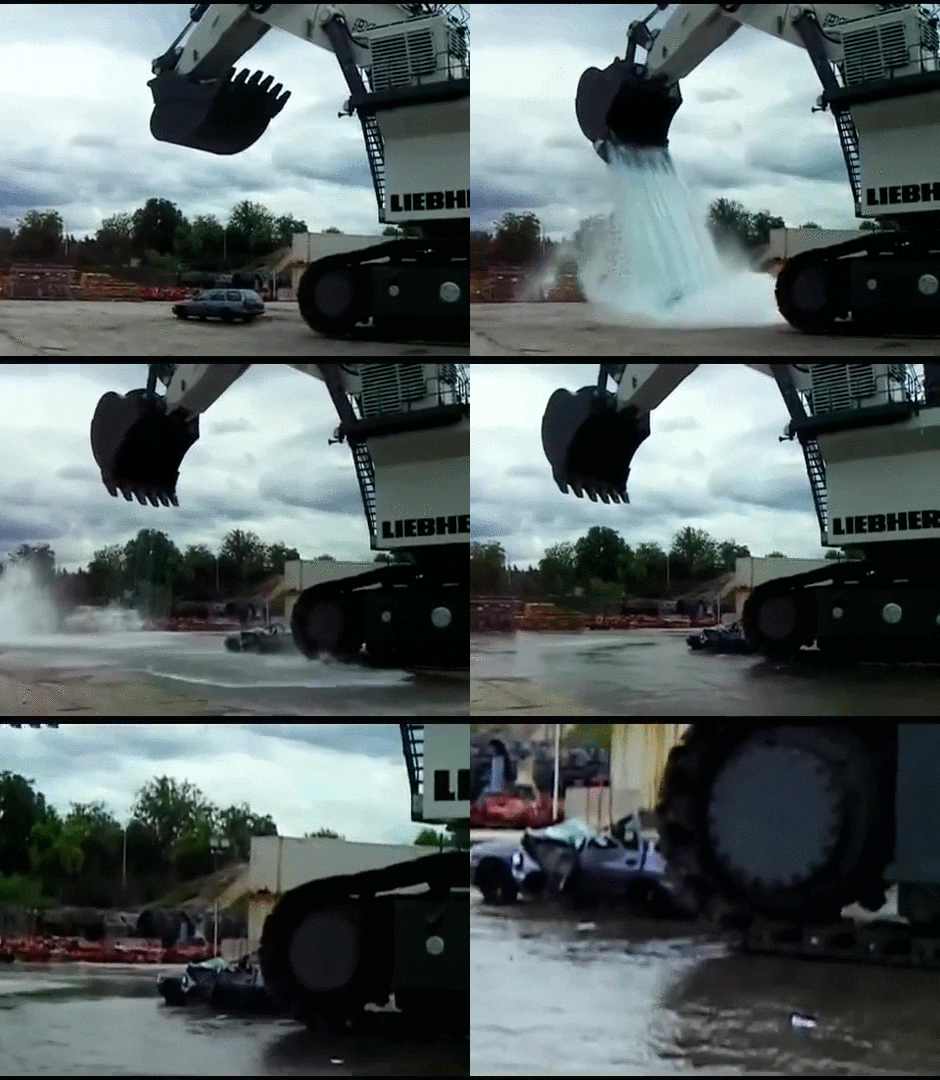
People also should know that simultaneous fires on multiple floors of multi-story buildings typically aren't possible to fight either, reducing possible efforts to containment and damage mitigation.
1. Cool an outer structure rapidly with lightweight/gently-applied, inert, high specific heat material from above.
2. Thixotropic gently-applied, inert, high specific heat material inner structure (possibly same as 1.).
> As a rule of thumb, the water flow necessary to extinguish a burning structure is the volume of the structure (in feet) divided by 100. The resulting number is (in rough numbers) the amount of water you need, in gallons per minute. For a fire this size, you're looking at tens of thousands of gallons of water per minute. It's just not possible.
I wonder if the fire could be covered with a huge tarpaulin or alike to try to suppress it.
If you have a large amount of material be moderately hot, you'd need a lot of water to cool it. The thermal load is high.
There are four major phases in the life of a fire, incipient, growth, fully developed, and decay. Sprinklers are designed to keep a fire from progressing from incipient to growth. Once it makes that transition, the battle is lost.
I wonder if injecting large amounts of CO2 or N2 inside the structure would be feasible.
Water-soluble foam, which is much lighter weight and easier to produce in large volumes, is also known to be used to contain large fires, especially of oil / fuel.
Getting 10 engines there wouldn't be the issue. Supplying them with water would be. Given that it's an island, they would be limited to the capacity of the water main serving the island.
“Look, having nuclear — my uncle was a great professor and scientist and engineer, Dr. John Trump at MIT; good genes, very good genes, OK, very smart, the Wharton School of Finance, very good, very smart — you know, if you’re a conservative Republican, if I were a liberal, if, like, OK, if I ran as a liberal Democrat, they would say I’m one of the smartest people anywhere in the world — it’s true! — but when you’re a conservative Republican they try — oh, do they do a number — that’s why I always start off: Went to Wharton, was a good student, went there, went there, did this, built a fortune — you know I have to give my like credentials all the time, because we’re a little disadvantaged — but you look at the nuclear deal, the thing that really bothers me — it would have been so easy, and it’s not as important as these lives are — nuclear is powerful; my uncle explained that to me many, many years ago, the power and that was 35 years ago; he would explain the power of what’s going to happen and he was right, who would have thought? — but when you look at what’s going on with the four prisoners — now it used to be three, now it’s four — but when it was three and even now, I would have said it’s all in the messenger; fellas, and it is fellas because, you know, they don’t, they haven’t figured that the women are smarter right now than the men, so, you know, it’s gonna take them about another 150 years — but the Persians are great negotiators, the Iranians are great negotiators, so, and they, they just killed, they just killed us.”
-Donald J Trump
Using aerial tankers would be unsafe (flying planes are very low altitudes through a city), and would result in a net reduction in firefighting efforts on scene.
Dumping actual water would be a bad idea both for the people and the structure, simply because dumping heavy things from high places is generally dangerous.
These planes have to fly extremely close to the ground to deliver their payload (which is spread over an area far too large to be effective in this case anyway btw) and too often the plane can lose control, whether from sudden unweighting or the turbulence from the fire and crash. This can kill everyone on board and usually starts a new fire to boot.
Dropping tons of water on Notre Dame's roof would likely just expedite the collapse.
We also have a form of firefighter called a Smoke Jumper that's the equivalent of a Paratrooper for fighting fires. They're deployed in these remote areas to clear out areas ahead of fires to constrict or redirect fires.
Widely used in Canadian firefighting, mainly forest fires. These fires are huge, covering 1,351,314 hectares in BC alone in 2018[0].
[0] https://en.wikipedia.org/wiki/2018_British_Columbia_wildfire...
""Truly weird Senator Rand Paul of Kentucky reminds me of a spoiled brat without a properly functioning brain. He was terrible at DEBATE!"" & another:
"".@FrankLuntz is a low class slob who came to my office looking for consulting work and I had zero interest. Now he picks anti-Trump panels!"" - who do you think vetted these? Which professionals?
The obvious and sad truth is; Trump watches TV, and randomly reacts real time on twitter with his own words. You can figure out what he is working (and NOT working on) by simply looking at what TV shows, channels, and people-on-TV he refers to as he continues to tweet throughout the day.
As a rule of thumb, the water flow necessary to extinguish a burning structure is the volume of the structure (in feet) divided by 100. The resulting number is (in rough numbers) the amount of water you need, in gallons per minute. For a fire this size, you're looking at tens of thousands of gallons of water per minute. It's just not possible.