So are public schools, public hospitals and national defence. But they are enablers of everything else that we do and the actual purpose of government and taxes.
Public transport needs to be as efficient as it can be while providing the services needed. There are additional benefits like providing a training environment for trades, ensuring that a heavy engineering skillbase is maintained, social cohesiveness and equality of opportunity to remote populations etc.
If they want to run a jobs program then fine, run a jobs program. Don't pretend your jobs program is an infrastructure program though.
I have no problem with the government spending tax money on things, that's kind of its job, but resources are not infinite (eventually you run out of other people's money). I know this is a much hated opinion among the HN demographic and I won't win internet brownie points for saying it but government should not be spending taxpayer money on services private entities are willing to provide. Government should spend its money on things private industry won't do (like social safety nets, education and funding R%D for things private industry doesn't care about).
Like the private train companies that run around handing free rides to everyone?
Well good for them that they've found an alternate way to be profitable.
If said profitability comes from a poorly spec'd out contract that somehow lets them screw the government out of money instead of charging people for the service then that's a corruption and integrity of public officials problem
What if private entities are willing to provide an essential service, but due to effects like lack of effective competition or economies of scale, most/all people wind up paying more direct to the profit-making private entity than they would via tax to a publicly funded service?
Arguably, all public rail should lose money. Quality transportation is a huge economic driver of regional economies. If a rail service is making money, it likely means governments are underinvesting in their own economies.
Full article: https://asia.nikkei.com/Editor-s-Picks/Japan-Update/JR-East-...
JR East annual report: https://www.jreast.co.jp/e/investor/ar/2018/pdf/ar_2018-all....
Something distinctive about the Japanese rail culture is that they build lots of communal facilities right next to their stations. For example, people routinely stop and do their shopping on the way home from work, even though they're getting home by train (though this idea isn't just about shops).
Compare that to typical Western railway stations, where a huge amount of the prime real estate right next to the trains is used for giant car parks, and you can see that the success of their model is no accident. Of course, we couldn't trivially adopt the same strategy in the West. Unlike the Japanese, we haven't been designing our towns and cities around this principle for a long time, and as the parent comment notes, we also don't have the same density. That means we do need ways for people to get to the station from the surrounding area.
Often good alternatives to the car are still lacking in the West, which then creates an unfortunate chicken and egg scenario. But that doesn't mean the Japanese model isn't potentially better than ours, if only we could find a viable path from one to the other.
I grew up in the Alps and I can guarantee that certain very profitable touristic locations wouldn’t even remotely work if there was no affordable and reliable train network that connected them to a airport, unless you want to turn some alpine area into a huge parking lot. On the same line that connects that spot to the cities there might be ten completely uninteresting villages whose population kinda relies on these trains to e.g. go to school, go shopping in the city etc. Some lines might not have any touristic benefit, but they raise the value of the whole network because it increases the destinations you can reach via train.
In nations that have high petrol prices and where train networks already exist, train networks can be unprofitable and still boost economy as a whole.
The question is: should everybody finance everybody elses mobility to a certain degree when it benefits economy as a whole?
For me the answer is quite clear. I grew up in small village in some valley in the alps. Without affordable public transport I would have been devastated as a teenager. A profitable train network usually takes that profit from somewhere and that somewhere is typically public.
I’d rather have an unprofitable train network that works, paid by my taxes than a profitable that doesn’t work even if I were prepared to pay for it. Same goes for Internet, Mobile networks, Water, Electricity.
The point was not to debate whether this is a good move or not, if it stimulates an economy or not, etc. I live in a country here the rail system is heavily subsidized and I'm happy for it as it is.
Sorry if I misrepresented your post.
So I don't think this is fair or accurate: "rather than addressing the fundamental issues (inability to fire people, change cost structure"
French politics must stop playing with trains and grow up. And fire the management that's been there for 10 years and made it worst.
The reality is that the economic side effects of connecting cities with each other such that people can travel easily between them facilitates a lot of business to happen. Having access to infrastructure such as working internet, good housing and health care, public transport, etc. are per-requisites for running any successful business.
In France, the high speed rail network which has been there for decades now has meant that a lot of business trips to major French cities can be done in a single business day without requiring lots of planes to fly. That makes a lot of difference for cities that are far from Paris. Also it means that getting to Paris from anywhere in France is typically easy and straightforward.
Passenger volumes have more than doubled since privatisation, after a long period of stagnation under nationalisation. While walk-on fares have increased above the rate of inflation, advance fares are substantially cheaper. The supposed problems of the British rail network resemble that Yogi Berra quote - "nobody goes there any more, it's too crowded".
https://www.bbc.co.uk/news/magazine-21056703
https://www.stagecoach.com/media/insight-features/the-facts-...
Privatisation came after nearly 20 years of Tory under investment and far from adequate under several administrations previously. It was, by the time of Major, a very predictable and well-worn trope. What better way to "prove" your lawn needs a private mowing service than barely mowing the lawn for a decade or two? It's quite easy to see why rolling stock was far beyond expected life.
There was plenty wrong, many of which would have been resolved with adequate funding for newer rolling stock, routes, electrification and capacity. Investments that have come painfully slowly outside the South East, mostly with public funds, since privatisation. The cliche of terrible sandwiches was often true - well if you're being deprived of funds better to keep the train running than the sandwiches fresh. The meals in dining cars managed to stay pretty damn good. Far better than having a trolley service only, for instance.
Major's privatisation was a case of "anything but this". Separating track, rolling stock and station building into three different companies was nuts. Public subsidy plummeted after privatisation, until inadequate maintenance was identified as cause of the Hatfield crash. Then reached never before seen peaks. They're still fiddling around to try and remove the systemic consequences of how it was privatised. Nothing that even slightly resembles the integrated transport The Netherlands can manage.
Season tickets have increased in line with inflation, only because they were pegged by statute to inflation +/- 1%. On the day tickets, which didn't get that protection, have increased vastly in real terms. Don't forget the UK rushed to the car far more than European neighbours - Beeching etc - it's little surprise to see rail growing faster now we have gridlocked roads, having been pruned to almost non-existence.
After 20 years it's not the disaster it might have been - mainly "thanks" to Hatfield - but it's far from a success. Especially outside the South East and on prices. Heaven help you if you ever use the trans Pennine.
Seeing as this is on an article about TGV, just how is UK doing with high speed rail? Northern Powerhouse? Double decker trains?
Just curious, what are they doing in the Netherlands?
One argument I've heard from people who seem to know more about railroading than me (not a very high bar to meet, but...) is that superficial similarities aside, tracks + trains as a business is very different from roads + vehicles. The track-train "interface" is much tighter and there are much bigger advantages to vertical integration (same entity owns and operates both tracks and trains). For a simple example, what is the "optimal" penalty that the train operator should pay to the track operator if a train breaks down, causing chaos in the entire network? I.e. how do you structure the incentives for the different companies so that the outcome for the entire system is optimal? For roads this isn't much of a consideration, if a truck breaks down other traffic can pass it.
If so, it would mean the EU & UK approach of separating the track and train companies is very foolish.
Yet it works fine for air travel, where the airports, air traffic services and airlines are all separate and charges are transparent.
The Netherlands has a tracks company (ProRail) and several railroad companies, by far the largest one being National Rail (NS).
That said, that's one of the most criticised points of the Dutch construction, and whenever something's wrong, there's a lot of finger pointing going around (although that seems to have lessened a bit recently). NS and ProRail would like to merge though.
UK still happily has bus, train and tram routes that only sort-of join up, sometimes, often by accident. The bus might arrive at the station 5 minutes after the express leaves, etc.
> tracks + trains as a business is very different from roads + vehicles
I'm no rail expert either, but I'll waffle on a bit. :)
It's much closer to air than road - you can't just throw more trains out there, they need slots, separation and compatible timetabling with the others. On a road you can just put out another bus and see which survives, they can even have the same timetable if you like.
The problem I see with UK privatisation is the competition is a myth, but it's been made bloody complicated for the sake of it - for example "what is the "optimal" penalty that the train operator...". A single train operator gets a single regional franchise, yet at least three companies are involved in every route (track, train, buildings). The old train builders, station hotels, and catering had already been sold off.
The old big 4 (GWR, LNER, LMS, SR) owned track, station and train, a train builder, the station hotel and caterer too - if they want to add a new route it wasn't a nightmare of inter-company contracts, or trying to persuade another company to keep the building staffed another hour, or to put new sign on a station wall. No penalties or silliness, just service embarrassment, maybe a government requirement or two. Only when you got to an interchange station did it become multi-company. Course that meant there wasn't much competition - well no kidding. Before the big 4 there was more competition, often from duplicate lines. Also more than one company running trains on lines, though one rail company always owned the infrastructure and rented a slot. So more coexistence than competition.
We missed an opportunity several times to get the main lines electrified - West coast main line was asking for electrification for about 40 years before it got it. Same for expanding to 4 lines so slow and fast can run together more easily, and freight can expand. Beeching destroyed a lot of the joined up nature of our rail, and much of the branch network. We bought in too heavily to the car as the only answer. Thanks to the curse of being early, we may never get double decker trains - that would need countless bridges and tunnels being modified or rebuilt.
The timetabling is partly by accident, I suspect -- or rather, it's a consequence of having high-frequency routes. Most inner-city buses and trams have a ride every ten minutes or less, so there's always an option that joins up. The NS (railway) does invest a lot of effort in matching their arrivals and departures with the most-used transfers, and I suspect regional bus services do the same. But I'm not aware of any timetable coordination between different operators.
On the other hand, it's very rare for train stations not to be serviced by at least one other type of public transport, and that's definitely by design. Even inter-city bus routes have their termini at train stations rather than the city centers of the cities they connect.
The Netherlands is a very small country, almost half the size of Panama, with a mostly dead flat geography. It is also one of the most densely populated countries in the world.
The distance from Paris to Marseille is close to 800km, you'd better have a bullet train if you don't want the trip to take a full day.
I'm not sure about this: the sandwiches are an easy daily income; you've got a captive audience, why not make them awesome? In this situation you still have to pay the person making them and selling them, why not make them good?
Can you imagine "I take the train, it has the best sandwiches!". Why can't that be a thing?
>The meals in dining cars managed to stay pretty damn good. //
Presumably because the "fat cats" ate in the dining cars.
Why should taxpayers subsidise a mode of travel that is inherently used primarily by the wealthy?
Thanks, I just spat coffee up a wall!
Well, the same goes for roads. Some people don't even have a car, and wealthy people move around a lot more in cars.
But it turns out wealthy people do a lot more of a lot of things, especially move around, because they have money to do so.
And were travel cheaper probably more people would do so.
So, taxpayers basically pay for the ability to have a network that allows them to travel a bit.
In some countries low income folks get cheaper tickets. Also high income folk pay a lot more taxes.
All in all, it'd be great to merge the high speed rail and ordinary road bus networks, and just maintain and subsidize that one, and have more socially fair pricing.
As an Austrian in Germany who used trains regularily to go back and forth I can assure you that it is not rare to see workers in full clothes with toolboxes and stuff in trains. Most regular people look like office workers, families and you will always spot a few upper class managment people.
The mixture depends entirely on your timing. If you use the train only during the holidays or weekends, you might get a very distorted image of who uses these trains on a day to day basis.
But trains as a mode of transportation for the wealthy? Might be that way in the UK (I wasn’there a lot), but certainly not in the other parts of Europe.
In Germany and Austria you will see a mix of people that sort of represents the society as a whole (in terms of wealth.
In the rest of the country, I've never felt surrounded by wealth on trains. Mostly it just seemed like the same mix of regular people you'd see anywhere.
Manchester to London doesn't receive subsidies, it makes a lot of money which is plumbed back into (for example) the south wales valleys lines
South West Rail for all those affulent bankers going into London also makes a profit that's reinvested in say services in Cornwall
> Rail travel is inherently more expensive than other modes and always will be, due to the massive infrastructure cost.
That's not nescersarilly true, I suspect you aren't accounting for externalities like polution, the military cost of oil, etc.
Really this is a "yes and" situation. We should also have decent low-cost buses, which in the UK are only available in London, Edinburgh and a few other places.
Going by air is an alternative to rail for some journeys [eg within UK] too. Edinburgh-London for example.
There's about 12,600 train seats
How do you propose to fit in another 145 flights a day between the two cities?
You're right re city centers, perhaps I gave a bad example - in UK for longer journeys I like the train but flying is superior (for my use-case) usually - cheaper, faster.
I think they should use subsidy to make shorter local journeys free or very cheap. Include bus travel also. Ramp up the prices on longer journeys. They could also help out regional airlines to take strain of the rail network.
Barry Doe covered this in a recent Rail issue.
Inflation in this context is RPI, because that's what rail salaries are based on. Walk on fares are regulated and thus kept relatively cheap (Vrigin off peak returns are 6% higher than they were in 1995, after RPI for example. Service is now nearly twice the speed and twice the frequency). RDG want to get rid of this protection though.
But you're right that advance fares are both cheaper and easier to get.
The biggest winners are season ticket holders - many have risen by less than inflation (Chiltern, c2c, EMT, Great Northern, Sourther, Thameslink, South Western and Virgin)
I think this is mandated by the EU. And it could be a good thing. I'm personally fed up to be treated like a thief when I forgot composting my ticket (which happen because there is not gate to access the rails) or when I could not buy it in the first place (some station doesn't have have vending machines).
Also the price lottery for TGV tickets is infuriating (price goes from 14€ to 140€ for the ride I take the most) and the commercial strategy of the SNCF is to offer cheap TGV which lacks any confort to kind of punish you not buying the more expensive option.
But actually I would even be happier if we import all the working staff from Japan and make them the whole thing working smoothly under a join JR-France company.
(again in [1]) "compositore" from italian is equivalent to "compositeur" in french which can mean "a person that writes music" but can also mean "a typographer or compositor".
[1] : https://fr.wiktionary.org/wiki/composteur
[2] : https://www.larousse.fr/dictionnaires/francais/composteur/17...
I was wondering why the OP would be treated like a thief for not throwing his ticket away to be composted.
Even crazier I can't figure out how we arrive at the modern meaning of decaying vegetables to make soil...but I can arrive at how we got to "composite" which seems to have different but similar roots.
The etymology I see all mentions "composte" as "mixture of leaves, manure, etc., for fertilizing land", which suggests that it started as people using a *composita of manure and plant detritus together to ferment for fertilizer and the word sense shifted from referring to the specific mixture to the general composting process.
Not really, the EU is democratic, and generally there's skeptisism in the EU about a liberal rail market.
The Fourth Railway Package explicity allows tracks and trains to be owned by a single holding company. The main point of the package was things like harmonising safety standards across europe (so if you wanted to run a train from london to warsaw you wouldn't need to get safety certification from UK, France, Belgium, Netherlands, Germany and Poland).
It will mean that a given EU government can't use the rail industry as a way of hiding state aid to people/industries. If SNCF are good, that's fine, they continue. If DB come along and say they can run France's network for half the cost, then DB get the job.
> I'm personally fed up to be treated like a thief when I forgot composting my ticket
That's because you're not traveling with a valid ticket. Try driving off from the petrol station without paying, or boarding a plane without showing a boarding pass.
> Also the price lottery for TGV tickets is infuriating
It's demand led, like planes.
> the commercial strategy of the SNCF is to offer cheap TGV which lacks any confort to kind of punish you not buying the more expensive option.
So buy the more expensive one if you value the comfort.
that's not even remotely close. I don't know exactly how it is in France but in Italy (and I suspect it's similar) I may have a monthly ticket clearly stating the validity FROM-TO, having my name on it and yet still if i don't time stamp it at the start of month i'm treated like a thief because bureaucracy says ALL tickets must be timestamped. WHY? how could i cheat with a named monthly subscription ticked? Ticket controllers not having to fear for their job don't even try to think and treat passengers with respect.
Now that we have a private Operator the situation is a little bit better but still until we have laws that dictate nobody must do any effort to maintain the job it's not gonna be pretty.
Now You may ask Why I don't simply time stamp it at the start of the month. Maybe i'm late and I miss my train But most of the time and in many stations the stamping machines do not work. courtesy of the same guaranteed monopoly Company.
Dunno about France (OP gave no indication he was talking about a period ticket), but in the UK monthly tickets last a month from the time they begin (which is printed on the ticket at time of purchase). Most train tickets I've bought on the continent are undated - if you don't composte them then you could use them time and time again, which would be theft of service.
In the UK we have carnets which must be dated (albeit with a pen rather than a machine) before boarding the train. They give very little discount and users are often accused of fraud.
> Why should the passenger be penalised when there are no working stamping machines in the train station? how is that the passenger problem?
It's the passengers problem as they presumably can't board the train without a valid ticket. I'm not sure how competition or changing ownership would help, what you need are strong laws making the train company liable if it's not there.
Again in the UK we have "penalty fares", which are on the spot "fines" for "honest mistakes". Sadly the same doesn't apply to train companies, when they deny boarding despite a valid ticket, or you get threatened with legal action despite a valid ticket, you have to fight it, but they don't get fined.
Competition always helps. It would be as simple as putting a stamping machine inside the train like they do on the buses. I mean it doesn't cost anything and the only reason it is not being done is the same reason machines in stations do not work. The train company has a monopoly and they don't care to try offering a decent service.
I recently went to London in the Eurostar, and they'd managed to make the train experience feel like a plane. Very disappointing.
Regarding the Eurostar, it works like that because the UK is not in Schengen. As such, border control needs to happen. Not to mention the potential issues with terrorism. And the Eurostar is net inferior to any of the Shinkansen trains.
I also found the bullet trains to be great value, especially when compared to the expensive, uncomfortable, over-crowded, slow, dirty, late trains here in the UK.
Not that privatisation is the answer, nor that being public was at fault, but I'm not sure rewriting history is helpful.
Looking at UK water companies being privatised so their owners can stuff them full of debt to get around the profit caps is probably a better case study.
Profit percentage caps are silly because the obvious way to make more money is to make the entire service more expensive by wasting money, this increasing turnover, thus increasing the size of that 4%.
Monopolies being privatised doesn't seem super helpful either, but hey, that's the UK for you.
What happens is that companies focus on the most profitable tracks, so the other ones are not well maintained.
An example: https://www.theguardian.com/commentisfree/2017/dec/05/the-gu...
But, as a counter: https://www.ft.com/content/d192b1b4-458b-11e5-af2f-4d6e0e5ed...
Now indeed, the terrible service in the past was most likely due to underfunding, but recent history suggests we'll consistently vote in a Government that starves national infrastructure then sell it off to it's mates, so it's hard to see public ownership lasting and resulting in success.
You can just as easily point to a number of other metrics that 'private' or whatever you want to call it British system has actually improved.
The people dislike of anything to do with privatization ends up people and journalist just looking for the problems. But the problems they find are not actually that much worse then the problems they had before.
There are no caps on profit.
The reason why companies carry large amounts of debt is that debt finance is much cheaper than equity. Given that a utility has stable cashflows, it makes sense for it to use a high proportion of debt finance.
https://www.bbc.co.uk/news/business-41152516
https://www.theguardian.com/commentisfree/2013/aug/03/water-...
https://www.ft.com/content/5878de66-9c7d-11e7-8cd4-932067fbf...
Now obviously we live in a country of outrage, and fairly poor reporting, but the reporting does make it seem like we regularly get privatised profits and socialised losses.
Why don't other cities do this?
If so, then it doesn't really seem to help the city to capture the gains that may have accrued over those years. If not, what happens if the lease now costs much more and you can't afford it? Do you get kicked out of the house?
There are also arrangements where you pay this lease every month or every year, rather than paying it off for 50 years at once. If you can't afford to pay the whole thing at once, you can probably take a mortgage to pay for it, but you may also be able to switch to a monthly or yearly payment system.
This estimated value of the house (the WOZ value) is also used for property taxes and you can appeal the estimate if you think it's wrong.
In any case, it ensures that the city benefits to some degree from the rising value of the land.
If you were due for a renewal, and you didn't have the funds to pay the fee, you'd remortgage. If you were very wise, you'd take out an insurance policy when you moved in to pay for it.
> In the UK, usually you negotiate for the occupier to refresh the lease before concluding the sale
is a requirement your mortgage lender will impose. Yes, it puts a burden of a few hundred pounds of solicitor's fees + lease renewal to get the leasehold reset when your executors/inheritors dispose of the property.
On the other hand, build a new bypass, land prices drop, and nearby land owners get compensation for their inconvenience.
[0] https://www.theguardian.com/uk-news/2015/mar/18/house-prices...
No harassment, just homeless people pissing on the platforms etc.
Paris is a dive though, give me Berlin, Munich, Rome, Prague, etc any day.
- track maintenance is lacking (at least by journalism investigation reports)
- regional lines have shrunk, causing systemic back pressure on cars (partly fueling the yellow vest protests)
I love the new TGV (regen braking) but it seems that holistically it's not a sure bet for the whole nation:
I'm guessing this is being imposed on SNCF by national and European government.
In their defence they seem to be doing the right things. They're preparing for competition by lowering their costs etc.
The proposed system of giving each region the power to grant a monopoly seems a bit ill considered though.
No, that's not what that means. "public" is just the only place a money-losing venture can continue in perpetuity.
It's very easy for governments to have self-sustaining programs. They are still "public" but they bring in enough money to pay for themselves.
A good public train network returns a lot of money indirectly, because it keeps all sorts of people mobile and therefore makes it easier for them to fill free positions. And in some areas (e.g. in the Alps) a good rail service is a huge multiplicator for tourism which means a whole industry profits from a cheap and well working train network.
The most important aspect of a public transport system is that it works well, is affordable and without disruptive changes can be so in 20 years time. The goal should be to reach these targets with efficiency.
I am not convinced that privatized railways offer any benefit for the public — they tend to grab all sorts of public money while closing lines that leave part of the public isolated, because there is not much profit to be made. In practise this can be observed in multiple nations. And public train networks have competition: busses.
In nations where people don’t rely as much on public transport (e.g. the US) it is only natural to come the conclusion that railways should be lead like private companies. People have cars anyways, gas is cheap, there is no real public transport network you need to compete with.
Not in Russia. They had a $2 billion profit in 2017. It's also the third-largest rail company in the world, so yes, it can be done.
Much lower margins, of course, but still profitable.
This certainly didn't help in the UK. It's been a shameful saga with multiple failures and no clear rationale. The theory was: privatisation -> ??? -> uber efficiency. Ignoring the fact that the economic theory which usually fills in the ??? requires free entry and exit into the market. That doesn't exist in the case of natural monopolies like rail.
People take rail to go somewhere, therefore the market is transport.
The options for say Glasgow to London are
Drive Coach (2 operators (national express, megabus) Fly (2 operators I think) Train (2 operators)
That's 7 different options, each has pros and cons
I thought we did effectively renationalise a portion of the network on the East Coast, and it was better [for users] and profitable in some sense [for the exchequer]?
https://www.theguardian.com/uk-news/2013/oct/26/east-coast-m...
We have a lose-lose system in the UK AFAICT, we have a private system, and we subsidise it from taxation. So private companies get paid dividends, that they didn't earn, from tax money and we still get a fragmented and under-invested system.
East coast made £100m a year for the exchequer Stagecoach promised £400m for the exchequer
Clearly the latter is better for the exchequer, it means more subsidy can be spent on other areas of the network.
The problem is that Grayling let stagecoach off their promises, undermining the whole point of privatization.
What about Japan? Aren't they running the best rail network in the world with 0 subsidies?
1. Cut costs. Lay off workers where possible. Cut wages and salaries across the board.
2. Increase taxes. There just isn't enough money. I've seen a lot of people jump the turnstile.
I think we can't emulate Japan's model in the US. Japan is very homogeneous from what I can tell. We are decidedly not. Any attempt to strict enforcement will lead to hiring people who are attracted to such jobs and think it is their duty to rid society of "scum".
I remind you, that we're talking about France here, where firing people is very, very hard. And we're talking public sector here, which would be a huge offense there. Protests would be massive.
Why ? I wish connectivity to airports here in India would improve and railways would just die
Yes, it's hard to manage, yes it needs "roads" (tracks), whereas planes have the air, but planes are very much a luxury.
* Half an hour to go to the airport
* Half an hour passing security and waiting for boarding
* 20 minutes between boarding and stable flight when you can start working on your laptop
* One hour and 40 minutes when you can work cramped in a noisy environment with terrible air quality
* 15 minutes descent and landing
* 15 minutes deboarding and getting out of the airport
* Half an hour to get where you need to be
Same trip by train:
* Half an hour till you are on the train
* 3 hours working comfortably in a usually bigger space with ground level air pressure and very little noise
* Half an hour to get where you need to be.
Travel in reasonably modern trains is by far the best kind of business travel you can have today, IMO.
Only 30 minutes sounds optimistic. You also didn't count the time to recover luggage. I've seen people bringing huge suitcases on high speed trains. They couldn't take them in cabin on a flight. Planes are good past the 2 hours flight time IMHO, or across countries where there are no interconnected high speed networks (I'm writing this with Europe in mind.)
My ticket told me where to stand on the platform. When the train pulled to a precise location, I did not have to move any distance. One door for boarding, one for deboarding, passengers did not bump or block each other. Luggage storage located immediately inside train, pass a sliding door to my assigned seat.
The train seemed to stop for less than a minute, we were moving before I took my seat.
No security in boarding station (Morliax), a little over 3 hrs to Paris, 450km as the crow flies.
Perhaps our French colleagues could chime in and let us know if this is a typical experience.
Baggage security in France and other EU countries is quite efficient, not everyone carries bags.
In the rare occasions I checked luggage I'd arrive about t-45 and have a beer in the lounge.
Never missed a flight. To get to west london it was far faster than the train and tube, although most of the time I was changing at Heathrow onto a longer distance flight.
(i.e. the climate.)
In Italy, the Milan-Rome (570km, 2.5/3 hours) fast trains have been making a killing for years.
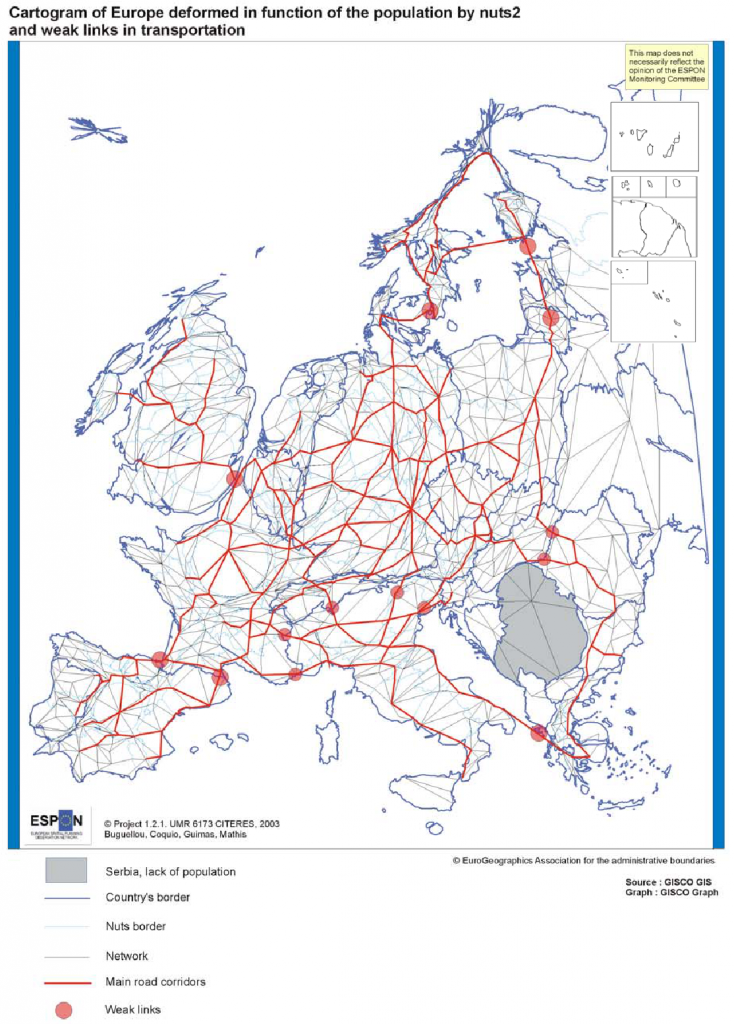
The maps on the ESPON project are interesting in this regard:
http://mapfinder.espon.eu/?page_id=31&category-name=115&proj...
Though I seem not being able to find a more recent version of this "classic" anamorphic (deformed) map (I find these the easier way to visualize the abnormalities in connections):
https://calomelano.it/wp-content/uploads/2013/11/05_populati...
It doesn't need to separate train operations from rail track network maintenance. It doesn't need to open up the network to competition.
What it needs to do is cut the number of excessive public sector workers, reduce costs, and stop running the business like a political arm of the government.
I can bet that the reason they think they need to do all these things is that cost pressure is rising on them, and they think they need to branch out / cut off compartments of the business to make it better. But this is tinkering rather than addressing the fundamental issues (inability to fire people, change cost structure, etc. due to political interference).
Public rail is a money-losing venture, in every country (except Hong Kong). That's what "public" means. But it's important to have. Just how much money-losing depends on the political environment and skill of the management. UK tried this sort of thing and it left everyone with a shittier experience, though they could claim that they successfully privatized the industry -- everyone knows that's a total lie.
At least France has a history of pride in the speed of the trains, so that will keep things in check a bit. They'll pay through the nose for it though.