We give children close to zero financial autonomy, no idea of work, of making money and losing it, then ask them to make one of the largest financial decisions of their lives at the age of 18. The background to this is a massive amount of messaging that your education is worth it.
It's not surprising they feel this way.
For the record, I didn't go the traditional college route, and I never had a penny of student debt, so if anyone has a right to feel smugly superior, it'd be me. However, I only avoided student debt by the dumb luck of making poorly thought out decisions that happened to work out in the end.
The second time around, I made way better choices, I was far more proactive about my education and internships, I chose a degree that fit me much better and was more financially appealing, and switched to another state school to maintain lower costs.
I lucked into my situation, too. If someone tried to tell me at 18 the lessons I'd later learn, I'm not sure I'd have listened.
This person has a bachelor's in economics and is about to finish a master's in finance. We conflate "an education" with "being educated" far too much.
I graduated 6 years ago with zero debt and no help from parents, because I actually looked into costs / benefits before starting school, picked a cheap school, and worked the whole time. I really don't know how we think it's acceptable for people to be 18 and not capable of making these decisions. You can vote and join the military, but you can't recognize financial servitude like this. They're being failed long before they get to college.
Long ago, if you wanted to become an attorney, you could go through an apprenticeship with a practicing attorney. Not many states still allow that, and I'm sure there are good reasons for requiring all aspiring lawyers to go to law school instead. But the old system did have one thing going for it: It kept the supply of lawyers from becoming completely detached from demand. As a great many people who who are trying to pay off their JDs on Starbucks pay can attest, the same is not true under the current system.
There isn't. Law is the same profession it was 150 years ago. (There are new tools, of course--electronic research, e-discovery, etc.--but you don't really learn to use them in law school anyway.) The JD requirement is just one instance of the larger capture of American society by academia.
Your point about supply and demand is astute. The JD requirement didn't replace the apprenticeship requirement, it supplemented it. Today, lawyer supply is still limited by the opportunities for new lawyers to go to trial, handle deals, etc.--nobody would hire a lawyer who has only academic or theoretical experience in those areas. But the winnowing process happens after a whole bunch of people have taken six figures in non-dischargeable debt.
In my view, there are two good reasons.
First, the legal job positions that only require a mechanistic understanding of the law have been automated. The days of needing a "country lawyer" whose practice consisted of basic family law like wills are gone, thanks to LegalZoom and similar services. The jobs that were best filled by these people have been automated away. In the jobs that remain, it's not enough just to know the law, but you must learn to think in a legal/analytical way. This is not a skill that comes easily just from reading statutes and some case law under supervision.
Second, the size and complexity of the American legal regime, including the administrative state, has made it necessary for lawyers to (a) specialize; and (b) be able to issue-spot in areas well outside their expertise, to know when to look for help. Although a mergers and acquisitions attorney might be able to apprentice a young aspiring lawyer in that area, they're unlikely to be able to transfer all the latent knowledge they have of other areas of law. As an example, I have about a decade of experience in my practice areas, and would be wholly incapable of apprenticing an aspiring lawyer in the area of, say, commercial paper to the point of being able to pass the bar exam. The first requirement (depth in a specialty area) makes most practicing attorneys ill suited to train someone to standard in the second requirement (latent breadth).
Given the high cost of lawyers, and the general understanding that you avoid going to court as much as possible, as it can easily bankrupt you before achieving any good, its hard to imagine that's actually true. The current options are to pay a huge amount, or give up entirely; I'm sure there's a market for the middle ground (inexperienced but cheap lawyers), and a reason no one can access (eg regulation)
There is no such regulation. A fresh graduate could theoretically argue a case in the Supreme Court--it just requires a pro forma application and payment of a $200 fee to be admitted to the Supreme Court bar. A JD you hire for $20/hour on Craigslist can, legally, represent you in almost any proceeding, as long as she is upfront with you about the fact of her inexperience (and is willing to shoulder the malpractice risk).
There is no market for inexperienced but cheap lawyers, at least for business litigation. If you're a plaintiff, you can get experienced lawyers to work on contingency. If you're a defendant, you have huge potential exposure if you lose the case. If you really have no money, the plaintiff will realize it can't get blood from a stone and will settle cheaply. It would be incredibly risky to roll the dice and try to fight with a lawyer who lacks experience.
Caveat there - there's room in the boiler room, at least on the bigger cases.
Not exactly the kind of work kids dream of when they apply to law school, though.
We bitch about people going into debt, but turn around an are fine with companies being picky as hell about having a specific degree, as if that's everything about a person's ability or background. We also bitch about healthcare costs, but then act like the sky will fall if we start discussing the possibility of pharmacists, optometrists, or psychologists prescribing or offering more services. Your observation about law is equally astute.
I'm going to beat a dead horse until it rises from the grave, but this is the situation with liberal arts degrees as well: they're from a time when it was assumed that you could major in, say, philosophy, and take comp sci classes, do work in that area, and build up a career in comp sci without anyone questioning it. Now your local HR department uses that comp sci degree to screen you, as if you are your degree.
Everyone knows that these degrees are helpful but imperfect indicators, but we treat them as perfect indicators because it's easier to maintain the myth, and it benefits those who benefit from rent-seeking and overregulation.
This person has a bachelor's in economics
Man, of all people that ought to know about the "sunk cost" fallacy...
If you accept that middle-income, professional jobs are decreasing relative to lower-income and higher-income positions, then many students with a non-trivial amount of debt are in a trap. For example, say you graduate with a B.A., $120K in debt, and the only job you can get out of school pays ~40K, but low upward mobility long-term (pay-wise).
Your options are (for this hypothetical):
(1) Take the ~40K job with low upward mobility long-term.
(2) Purchase a $120K graduate degree that offers a 65% chance at a six-figure job out of school (and high upward mobility long-term) and a 30% chance of a ~$60K job (and medium upward mobility long-term) and a 5% chance of ending up in outcome (1).
Which is more rational?
Now, we could get into questions of how well this maps to reality, or what the expected value of each outcome is, or how to even compute expected value in a situation with myriad messy variables and reductionist assumptions, etc. Regardless, I think we can say that if income and upward mobility resemble a barbell distribution more than a normal distribution, then we have defeasible justification for believing the following:
(Proposition) A non-trivial number of students face decision traps which lead to a choice less akin to the sunk cost fallacy than a non-confident choice when living between 'a rock and a hard place'.
At times, people will say something about having invested so much already that their decision is pretty much pre-determined even though they're attempting to convey having made a non-confident choice after being stuck between 'a rock and a hard place'.
In fact let's look at it: what's the probability that given your inability to gain one of the lucrative jobs at this level of education you can gain one with a higher level of eduction? Well we can speculate, a higher level of education can be sought for two reasons: you're acadmically gifted and genuinely want to get more education, or you're not academically gifted and you want the magic fairy wand to wave to get into Brothers and Brothers LLP. Well let's face it, you're in group number 2, and it's the people in group 1 who are the actual successful candidates. So given that your pay off looks way off. You won't get the top jobs - you're not good enough, you won't get the medium jobs - you're overqualified, and you won't get the cheap jobs - you can't afford to work for that amount.
(2) Even assuming your argument goes through successfully, it is irrelevant to whether the person committed the sunk cost fallacy, which is the issue under discussion. Now, you could argue that subjective assessments of expected value always track the true underlying expected value (i.e. the actual expected value for any individual's objective abilities). In that case, all non-academically-gifted students who chose further education would likely be committing the sunk cost fallacy. That's not the case though, and you know that. Or you should, because it is prima facie absurd.
(3) It is relatively uncontroversial that there is a substantive disconnect between the supply of graduates and the number of jobs paying a salary justifiably commensurate with the debt-levels we are seeing. This has a couple of knock-on effects. For example, an across the board devaluing of degrees, which unjustifiably increases hiring requirements for lucrative professional jobs, further exacerbating prestige whoring, etc. This turns high school seniors deciding to attend elite private schools into even greater gamblers as the cost of an initial degree rises. Maybe they are or maybe they aren't rational to take that gamble (Are gambles by definition irrational? If so, pick a different term.). However, after having taken that gamble and come up short, they don't automatically become irrational in taking it again. Or, at least, the irrationality wouldn't necessarily have anything to do with the sunk cost fallacy.
So given that they'll just not even get back to zero net worth if they stop, the "better" option is to continue. Despite the negative dollar value standing next to it.
That's something that's just not considered here. When it comes to net worth, -$1000 has exactly the same consequences as -$99999999999 for that individual. So if you're going to be negative anyway, why not be as deep as possible ?
For society, that is a very negative outcome, but not for the individual. But the individual chooses (even in societies that like to pretend otherwise).
I'm not sure I follow your point... -$1000 could be paid off in a month. -$99999999999 probably couldn't be paid off in 100k lifetimes.
That's one thing people keep forgetting about, for example, take population figures. Species specifically refuse to multiply unbounded. And that's weird the first time you realize that DNA contains a distributed regression algorithm that estimates to what size the population of it's species can grow under the current circumstances and then blocks reproduction, or enables asexual (or otherwise really fast) reproduction. Why ? Because if you get it wrong, population numbers will fluctuate.
And that seems "what's the problem ?". Well the problem is that there is a very special number, called "zero". And if the population of any species randomly fluctuates, it might randomly hit zero. And then it's over. There's no coming back from zero. Then you will realize that the number where that happens is not actually zero but can in fact be quite large a number and you see why fluctuation is an extremely undesirable property.
So for debt you can't pay, "zero" is the magic number. Once you cross it, your mission in life changes. It's no longer to get out of debt, but rather to get in as deep as you possibly can, while refusing any and all attempts to get back out (except of course to deceive others to let you get deeper in debt). That behavior by itself is the only thing that might get you back out of debt (just look at the president)
And in economics in general you should keep in mind that while individual humans are stupid, large groups of humans are incredibly good at finding optimal Nash Equilibria. If large numbers of people "randomly" or "out of stupidity" do something, fact of the matter is that the stupidity is yours, for not seeing the whole picture. Stupidity at large scale only exists at very short timeframes, if at all. Lots of people going into debt is not stupidity.
The way to think about it isn't that to leave would be to throw away 2 years of tuition, it's to consider whether the next 2 years of tuition is worth a 4 year degree. And the answer could easily be, yes, it absolutely is worth it.
I had plenty of experiences where I realized "dude can only do exactly what I say ...".
Hard to know if it is any worse or better than in the past, but man, it was disappointing to see.
What struck me again later was finding out that 24 is the tipping point for the brain. That's about when the majority of brain matter is "gray" instead of "pink" (aka the process of myelination), which seems to be a biological rather than an environmental process. So this has likely been the case for a very long time (like 40,000 years or more).
He has no way to pay his loans, never will, and is unable to discharge them in bankruptcy.
Yeah, there is a "poor me" element to this. However bankruptcy laws exist for a reason, and denying people like him access to bankruptcy forces them into unproductive lives. That non-productivity makes all of us worse off in the long-run.
Since private government-guaranteed loans were discontinued, most private student lending dried up, so “lenders” here basically refers to the federal government.
cost of not continuing - very large chance of being screwed from that point for the rest of your life
cost of continuing - student debt, which at worst gets you into the above situation
So clearly, continuing is the better choice.
Secondly, as they say, when people have to choose between death now or death later, they choose later. No matter the strings attached.
This is only even plausibly true for people who have no family members. That's nearly nobody.
Consider a traditional Chinese or Japanese official who is ordered to commit suicide. Generally the command is obeyed. On your model, such a command would never be obeyed -- you can always just not kill yourself, in which case you'll still die, but later than you would have.
Good on you that you think like this. Try to hold on to it and enjoy it, it won't last.
If it's not too personal: Which major/minor did you choose? Which school was it? Year of graduation? Would you recommend it to others? Any downsides to the school?
Majored in computer science. There's a lot of student-friendly work nearby, especially for software people. I really couldn't stand the local culture and I'm even from a pretty conservative christian home, but I was there to get down to business so I worked as much as I could, maxed out credit hours I could take (12 - 18 credit hours all costs the same), and got out in 4 years with a solid education, no debt and enough savings to comfortably start my real adult life right away. A hard 4 years, but looking back it was clearly the right call compared to my peers. Tuition prices at other colleges have just never seemed worth it. Had I not gotten into BYU I would likely have tried to just get software jobs with no degree, or gone into a trade like welding.
Which indicates a huge part of the problem for a lot of people these days. It's a safe bet that the wages at the jobs you worked then haven't doubled in the last ten years, so someone merely wanting to replicate your path would need to work considerably more hours just to make their tuition payments.
Reliable, accredited colleges cheap enough that you can realistically work your way through them at the wages paid at the kinds of jobs typically open to inexperienced students are increasingly thin on the ground.
1) Does the student have a history of completing what they start? If not, consider a part-time trial at a community college with expectation of finishing with decent grades in courses that will transfer.
2) Will the student need remedial classes? The school gets paid but these courses do not satisfy graduation requirements. They do increase debt!
3) Does the student have a clear goal for a major? College is an expensive place to "find yourself."
4) What are the job prospects for that degree? How likely is it that the student will be high in the distribution of the graduates? Will the anticipated salary permit repayment of debt and self-support?
5) Are the time-to-graduate estimates realistic? A surprisingly low percentage of students complete a degree in 4 years. 5-6 is more common and results in more debt...
6) Has the student learned to live within budget? There are many distractions at college. Spring Break trips add cost...
Except for the fact that they are almost completely non-dischargeable, you mean.
When talking about putting away money for a retirement plan, other 20-somethings I work with are deer-in-headlights about the little known fact that the rest of their non-working quality of life starts right where they're at now, not ten years down the road after the university, home ownership, car, and child-rearing costs are taken care of.
In total transparency, my parents taught my sister and I nothing about interest rates, and co-signed a good amount of money between the two of us. One of us is debt free, while the other is still struggling to pay down a 6.x% variable 55k note, has another house note around 150k, and a car note around 35k. We both have technical degrees and work in technical professions, so what went wrong?
The difference is that a hippie who got bored with a commune could get a job and in less than a year had disposable income to pay for goods and services.
Now take a 20-something today who gets bored playing fortnite and decides to get a job. It's the same as the hippie, except a) they have something like 50K of debt (and rising), b) from day 1 their place of business starts getting telemarketer calls for student load consolidation, c) debt collectors call their employer in an attempt to intimate and harass them, d) at worst their wages are garnished to pay the interest on their loan, e) they are depressed because of a-e. (Aside: when that employee leaves the organization the debt consolidation telemarketers very quickly cease calling, which is super creepy.)
That last point about depression is key. Imagine the existential crisis of a hippie who must challenge their idealism and come to terms with the much more limited (yet realistic) freedom that comes when working for a living. Now for the fortnite player add a sense of interminable dread from a sea of debt that cannot be unloaded even in bankruptcy. The small joy of choosing what to do with the money one has saved is gone when one cannot save any money.
I can't think of any persuasive argument that says the hippies wouldn't have been swimming in debt if college had been funded that way in the 60s.
Upshot-- I can't figure out the source of your mixed feelings. If students today are entitled, they are no more entitled than previous generations of students who didn't deal with this kind of debt crisis.
Anyway, a critique of a human institution almost always involves humans who are not acting responsibly. If every institutional critique devolves into a discussion of how irresponsible a critical mass of the actors are, what's the point of doing the institutional critique?
Maybe we take a 20-year old who worked really hard to move through college and get her degrees while working part time to cover at least food.
She was in fact told that degrees do guarantee jobs , as a part of the for-profit education sales pitch.
She is now facing an economy where every possible job has been outsourced, and wages have laughably low purchasing power, and that’s before you consider the costs of rent in locales where jobs are available.
It’s an employers market, in a post-crash (and of course pre-crash) economy where employers have “trimmed the fat” as much as possible and in many cases left their existing employees to cover for multiple jobs.
I can’t see any entitlement here apart from the expectation of livable wages set by the education industrial complex and the low unemployment numbers based on a gig economy and non-livable wages requiring holding multiple jobs to survive.
Lastly, are you using “hippie” in light of the government propaganda effort to paint anti-war activists as unclean, undisciplined and confused? Repeating the frame enforces it.
https://www.amazon.com/Kids-These-Days-Capital-Millennials/d...
"Is it okay if we use your telephone?"
To which the man answers that the phones are out. To which the hippie replies,
"Water?"
You might think this the source of the "Get off my lawn" and similar references people on HN use. I mean, what could be more of an embodiment of entitlement?
But what does this townsperson do? You should watch the documentary to find out. But I'll give you a hint-- it isn't to say, "Get off my lawn." Nor even, "I'm conflicted because on the one hand this is now a national disaster area, but on the other you knew that if you and 100,000 others come to a small town and stress the infrastructure there was a possibility that this could happen, and I wouldn't want to set a precedent of..."
The individual concert-goers didn't know there'd be far more people than expected and that local infrastructure and the organizer would be overwhelmed.
They saw there was a concert and decided to go, just like every other show anyone attends.
Upon arriving, they were stuck in a situation they didn't expect and which people don't expect when they head to a large event that's supposedly "official" .
At that point (gridlock, overwhelmed infrastructure), they're without any options beyond asking others for help, because they weren't prepared for a situation that shouldn't have happened. They came to attend a concert, not a survivalist retreat.
Aside: Unless something really odd is going on, I can't help but think you meant "intimidate"...
Syntax errors are not allowed. Thus, in place of "intimate" I obviously meant `rm -rf /*`
Let me edit tha
At the end of the day it falls to parents to educate their children. The assumption that the world at large has (or will ever have) your family's interests in mind is horribly naïve and negligent. Schools can mostly be trusted to educate in an academic sense, but reality is not best learned through an iPad.
I would argue that most people in college are not following their dreams, but rather following a defined path.
Is there some part of US society where they hire non-college graduates for a good career and bright future I don't know about? Because from what I hear even people who move to fairly large small cities with cash in hand get disappointed by the small city core, the career opportunities and rising housing costs.
As far as I know people aren't doing what they are doing because they are inspired, but because if they are going to get screwed over anyways they might as well try to have a say in how it happens.
Many called Ross Perot a nutjob when he coined the phrase "The great sucking sound of jobs leaving the country." I watched it happen.
We also watched the ratio of the highest paid employee/ lowest paid full time employee skyrocket. I understand that there are high performing employees, but economies need a large middle class who have income to buy products (without running up debt) for the economy to prosper.
Now we see people trying to support families on what were after school jobs for high school students... Times changed when offshoring became easy...
Look at the steel mills of the early 20th century. They had groups of people hoisting around huge pieces of steel on chains.
Look at a modern steel mills. All that hoisting is now done by heavy machinery control by one guy in an air conditioned operator cabin.
By offshoring or just the advancement of technology, those jobs are gone.
People just have to invent new ways to contribute to society - to say it’s “easier said than done” is understatement though; but there is really no other way.
When my dad gradutated high school in the mid 1970's, you could get a decent job with a high school diploma. Not having a HS diploma meant you were flipping burgers, but you could still find work. My uncle lived with my father (and mother) while working on his GED, which really didn't give him HS diploma status but was good enough to find slightly better work.
College basically meant you could make sure you had a steady salary for life and could definitely find work. You had much more than the minimum schooling.
As soon as you are legally allowed to be bound to a contract, our own government swoops in and tries to steal your future life savings before you even have the knowledge to know what's happening.
It's predatory lending at it's finest. And the loans come directly from the government. AND they're the only loans you CAN'T default on.
I wonder if any government in history has ever been good to its people. But, man, does it really seem like governments now are really fucking the 90% over.
Getting off topic, but I'm from the Nordics, grown-up, and still have this naïve view that governments are for the people and aim to do the best for all citizens. It not all roses here either, but I'm quite happy to pay my share of taxes to keep the civil society running.
It's infuriating. You like civilization? Pay some goddamn taxes. But alas.
I've wondered about this: is this "conventional wisdom", or are there actual cross-country comparison studies?
Insurance companies and hospitals are being as inefficient and wasteful as possible because it makes them more money.
That is to be expected for young people right? So these young people rely on authority figures to give them advice, all of which beat the drum of "go to college, it's the only way".
Why do we expect these young people to be wiser then these authority figures in their lives?
Of course, very few parents didn't want their kids to go into higher education of some kind, and I think for about 99% of parents with college education, their children going to college was already a forgone conclusion for them.
I wouldn't put the blame entirely on the parents or the kids though- practically every school I've seen advertises job placement numbers; don't forget about the lawsuits over law schools artificially inflating their numbers to get more students. If you're a parent seeing that, why wouldn't you push your kid into college?
In my upper-middle-income family and peer group, not going to college was unthinkable. Debt wasn't really a consideration since few of our parents were struggling with debt and we based our future expectations on their past. Then it turned out the game had changed dramatically in 25 years.
I had a couple lower-middle/upper-lower income friends, for them college was much more of a goal than a given, but also one that they were very aware of costs/risks around. But not one that didn't seem worth the upside.
From what I've read of people growing up in poverty, it's very different there. Many people check out well before the end of high school, and college is seen as something for other people that's not a realistic option for most.
Community college, especially in larger cities, definitely is underrated.
edit: redundent wording.
So, uhhh... It sounds like you got exactly the experience you're claiming you didn't get, but are blind to the alternative: That more schooling (even a trade school) wasn't the only option.
Or take a big life risk and unknown, likely pass up the ability to take student loans (for the small aspects of benefits they do extend), and risk a long term disadvantage at accessing the same higher paying markets.
It's no surprise there is a lot of bad feelings about this choice, especially when other first world nations have this mostly sorted out.
On top of that, as a society, it would be far cheaper for us to fund this on a social basis (by public funding low/no cost tuitions for public universities - with closed loop cost controls) instead of an individual account basis (with loans and an open-loop tuition inflation mechanism).
FTA: "Delinquency is at crisis levels for borrowers, particularly for borrowers of color, borrowers who have gone to a for-profit and borrowers who didn’t ultimately obtain a degree,”
As counterintuitive as it sounds, it wouldn't make sense for these individuals to quit and do something else unless that something else is also obtaining a degree, preferably from an institution that is not for-profit.
An article which covers this in significant detail from about 8 days ago: "The Bermuda Triangle of Wealth"
"If get a journalism degree, I could be a side-line reporter for the NFL on TV " compare that to: "If I get an IT or CS degree, I could make over $15/hour in an IT department at a company."
My point is that there are a whole lot of careers that fall into the middle of these extremes. And just googling the average salary for those careers may not give you the full story. Maybe only the top 10% of architects make good money, so the average is OK. If that is the case, you cannot give broad advice to people. You don't want to tell the people who would be in the top 10% not to be architects and you don't want to tell the bottom 10% that they should go for it. How do you even know unless you are in the industry yourself and know the person well?
Everyone from my millennial cohort fully understands how long and difficult the job hunt can be. Also how completely dehumanized and demoralizing the process sometimes is. Even the smarter of my cohort fully plan to spend at least several weeks tailoring their resume and at least 6 months for the actual job hunt.
And it's very common for it to take longer.
This leads to some other nasty 2-nd order effects, like, for example, people being too afraid to negotiate with their employer for better conditions - for fear of having to endure the job hunt again.
These are 17-18 year old kids we're talking about...so it IS possible that they felt like they had no choice.
https://collegescorecard.ed.gov/search/?name=university%20of...
https://www.theatlantic.com/education/archive/2015/09/obamas...
The present administration seems to be more interested in rolling back rather than building on the Obama-era accountability efforts, though.
Even students that "worked non stop" are likely graduating with debt unless they had external assistance (either parents or scholarships or both) and even having done everything "correct" there's a high probability the only option after graduating is a job you hate in a career unrelated to your major (this is as applicable to S(T)EM as it is to humanities in my experience. The previous generation got everything for nothing then pulled up the ladder on the rest of us, don't act surprised when people are a bit salty.
It's kind of amazing that this is still being perpetuated. When I graduated high school 20 years ago, this was the mantra. Even then, it was a bullshit line. I got a degree in graphic design after high school, and there was a large portion of that class who did not find work in that field. I was near the top of our class, and I struggled to get interviews.
While it is ultimately an 18 year old's job to make this decision, parents and administrators are apparently still shoving "college solves all problems" down the throats of high school students. Is it because they don't know what else to tell these kids?
Anecdote time. Say Shameless Joe A quit college, got a physical labor job at ok-ish wages, worked his way vigorously through the ranks, and fought each step of the way to secure a better future for his next-of-kin, which in his mind was bypassing the 4-Noon, tough labor conditions he had to endure. He is absolutely going to recommend college, or the military. Others who graduated in his frame of reference got to the six figures quicker.
Say there's Successful Joe B, who graduated from college, got that nice position at the too-big-to-fail company, in a time where the pension and the wrist-watch at 25 years was still a thing. Successful Joe is going to insist Maybe Successful Mark that 'college is the one true way to fulfill all his dreams and desires', despite what those dreams and desires are, because it worked in his frame of reference.
Are both wrong for hypothesizing the rational decision to insist on higher education in this light? No, I don't think so.
But. Now let's look at the money.
Shameless Joe A isn't going to help Most Likely Successful Luke with college. Luke knows this, hopefully. Luke is then forced into figuring out how to make it happen, if it's even possible. Likely Successful Luke is now responsible for funding his education. If he's a white male with parents who make decent enough money, who have some college experience, Luke realizes pretty quickly he is seriously screwed. Luke will likely a) insist / fight on not going to college, b) join the military and have them foot the bill, or c) accept fate, and be smart about his financial choices. Even with help from the state, rising education costs will put Luke in debt at least a bit right out the gates.
Successful Joe B is smart. He set aside a nice fat account for Maybe Successful Mark, and it's grown gradually over the years. Mark is looking at minimal impact to his bottom line given that this fund is huge - books, tuition, and 4 years living-on-campus huge, as long as it's expended through his university account. Mark is flying high as a kite - no debt! Mark after graduating with the same degree as Luke now has options: a) rapidly go into debt to get all the things, or b) see the gift-horse he received for what it is, and attempt to avoid debt at all costs.
At the end of the day there is advice and choice. Developing a sense of scrutiny and critical thinking is the aim of education. If either Luke or Mark don't develop that sense, they've expended resource for nothing, and should've avoided higher education altogether.
Anecdotally, I've noticed some of this as well. When I took a leave-of-absence from my degree, some college students flat-out ignored me when I mentioned it. I find it ironic that institutions who are supposed to broaden peoples' minds still gravitate towards their own tribes/cliques.
</end rant>
Part of the problem is that high school doesn't teach students a lot of the things they really should know for the real world. For the most part, the first two years of college are spent covering topics my parents learned in high school. The average student doesn't get to the real meat of their degree until their third or fourth year, which I think is a real problem.
But somehow this is how it works. Except in extraordinary cases, this is the path young people need to take to get a decent job.
Another positive about CCs is since they are so cheap you can actually take your time a find the right major for you. I tried a bunch of different stuff before something stuck and with the exception of opportunity costs that extra exploration cost me about $500. I consider that a pretty good deal.
I went to school for Computer Engineering and paid for the first three years of my education with financial aid and student loans.
Then I got an internship that paid well, lived frugally, stopped taking loans, and paid off my loans with my income. I graduated with no debt.
Of course, I was fortunate that I was able to get financial aid and that I was getting a degree in something that could land me an internship that paid well.
And I think that a sane and successful society should help its citizens to do smart decisions.
This seems like an interesting and wide-open market since they are taking on traditional debt instead of getting some kind of education-focused loan product.
You seem to imagine that a generation of kids should be happy going to trade school and working as plumbers.
I know for a fact that at the vast majority of Fortune 500 companies you aren't even getting past the HR screen without a degree. What are those people supposed to do?
We tell every kid to go to college, but the reality is that many of them simply aren't cut out for it. They _should_ be developing a trade skill, but they don't, so they end up with a near useless degree (or not even that), a mountain of debt, and no real skills to speak of.
What's wrong with being a plumber, or an electrician, or a carpenter? They are absolutely required functions and I imagine many degree holders aren't entirely happy with their shitty office jobs paying less than they would make on a job site.
Then everyone wants to do it, and suddenly big companies get their pick ivy league applicants, Podunk U gets a pile of cash for selling a dream, and the young adult is left on the hook.
Then reality hits and the debt doesnt go away.
Pretty much for the 20 years prior to me going to school, it was a great field to get into. I looked into success rates for previous graduating classes, checked out available positions and starting salaries. Worked for a few years before going to school to save a bit of money. Made, what I thought was, a fairly decent plan ended up taking out loans and going to school.
The first year was great, everything seemed positive for prospects after school me and just about everyone else got summer jobs in a related field. Then the government changed and suddenly funding for science and the environment was gone. We got to spend the rest of the time in school getting visits from federal and provincial departments telling us about all the awesome opportunities we would have had...if it had been last year...instead they told us they'd been cutting positions and we'd be lucky if we'd get hired sometime.in the next ten years.
We also got to go to a lot of different places where they showed us the work they used to do, when they were still getting money.
By the end I think less than half the people I went to school with ended up getting jobs in the field. I worked for a few years doing it, but wasn't making enough to really live or pay my loans back so I had to look for something different.
Going to a specific college for a specific degree can be a really bad choice, while going to another for a different degree can quickly pay off. What high school graduates need is the ability to make these sorts of judgments.
For starters, they should consider getting two degrees in a 4 year period. Many students take more than 4 years to get a single degree which significantly increases loans while having less job prospects. By aiming at two degrees, a person can choose to learn something that fulfills them while also finding something they are decent at that they can tolerate for making a living if their dream job doesn't materialize.
Second, consider that some degrees are far less valuable unless you go past the undergraduate level, and so they need to take into account the cost of earning a graduate degree to see if it will pay off or not.
Third, consider scholarship offers and out of state/in state tuition costs. The cheapest college is rarely the best, but a university that will require 10k loans a year is likely to be a far better deal than one that requires 50k loans a year.
Fourth, learn to network and build references while in college.
All of these are things high schools could be better teaching their students about that would make what ever college they eventually pick a much better deal.
I think quadrupling the work load of a student is only going to pan out with extremely talented individuals. This sounds entirely too unrealistic to be practical advice.
It will require a few things. For starters, from the first semester the student will need to know what degrees they are aiming for and plan accordingly with their advisers. It will require sacrificing some of the fun of college for a more practical approach. It will require giving up any hope of having no classes on a Friday. That's not about being talented though, but about discipline.
If the student will be taking out possible $100,000 or more and they can't do this, then they need to evaluate what they are about to do. Are they about to risk life long debt for an education or for a college experience? If they don't know if what they are studying is what they want to do, should they really be paying someone to teach them how to do it?
Also, if following their passion is something that is extremely difficult for them to learn, then perhaps college is not the right path for them to follow that passion. There has to be some realism on focusing on what you are good at.
This is all much easier when high schools adequately prepare people for college. I wonder how much of the increasing problems at the college level are a result of high schools providing educations of lowering adequacy.
Source for enrollment in humanities falling https://www.insidehighered.com/news/2015/01/26/where-have-al...
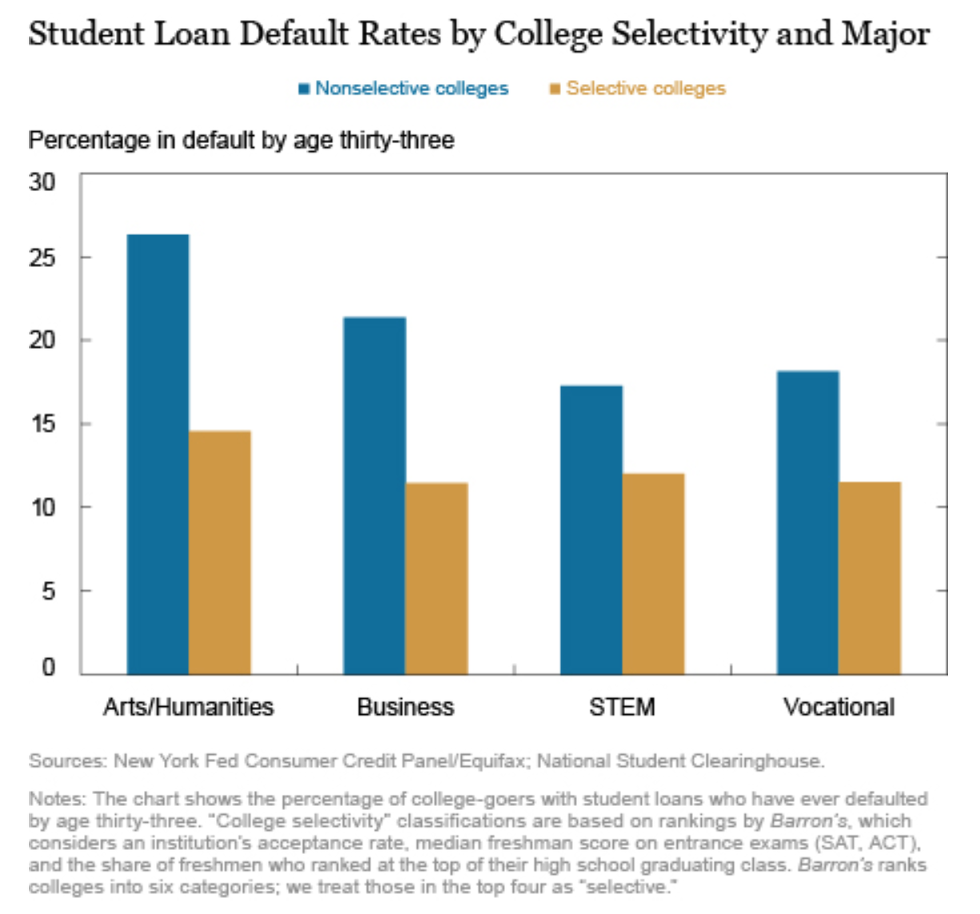
It is worth noting that the difference between selective schools and nonselective schools is even larger; so going "somewhere" to get a shitty degree seems to be not a good idea as well.
I did it via the military. There are other options - that's just one.
Doesn't this line of reasoning assume that right now there is a big misallocation and some are way over capacity while others have lots of space capacity? I would assume that whatever the current situation, capacity distribution is about equal to how it is. So any big shifts would not be possible short and even medium term. And if the needed shift happens, would the result, the new equilibrium, really be different, or would we still have a similar situation, just with he pieces shuffled around?
The problem with solutions that individuals like to come up with is that they only work for individuals. I try to always imagine my idea(s) on a large scale, what if everybody really does it? Lots and lots of "good advice" does not actually scale. When you change only a few things the big picture remains constant, so many of those ideas work. But as soon as there are large scale changes there are feedback effects and the context changes too, what used to be a constant environment will have changed too.
Ultimately I think the crux of the problem is that in the United States a lack of a college education is seen as a serious character flaw. A lot of Americans understand this, but I think it's important to illustrate this for non-Americans. A lack of a college education is seen a such a flaw that it automatically invalidates the prospect of marriage for many people [1]. Democrats (and I count myself among them) often tout the fact that they regularly win most of the vote among college educated voters - how this is supposed to be a positive unless one views the opinions of non-college educated as lesser is a mystery to me. Outside of low-class neighborhoods, a child failing to get admitted to university is an embarrassment. I personally don't agree with these things, and they're likely far from universal, but I do think they illustrate
The result, I think, is a large segment of the population taking on debt to get an education that won't actually yield much of a return in the labor market. And the messed up thing is that in a way they are making a sound choice because the stigma of being uneducated is so strong. Whereas in many places like the aforementioned Germany getting an apprenticeship and becoming a skilled worker is respected. I've heard stories about this shifting and the requirements to attending gymnasium (the college-bound educational track) are loosening, but it's still probably nowhere near the level as in America.
1. https://www.theguardian.com/lifeandstyle/2015/nov/10/dating-...
Also, if you look at Germany, there are "Universität", "Hochschule" - but also "Fachhochschule".
Enrollment is at almost 60% - according to the text on the right that's the share of those who begin a study on the entire population born in the respective year: https://de.statista.com/statistik/daten/studie/72005/umfrage...
These statistics are from an Economist article, which I can try and track down if I have the time.
Edit: Didn't track down the economist article, but here are sources on US and German enrollment rates:
https://nces.ed.gov/fastfacts/display.asp?id=372 reports 19.9 million students. About 6 to 6.2% of the US population.
https://www.uni-bonn.de/studying/international-students/coun... reports 2.8 million germany university students. About 3.4% of the population.
Not to mention that Germany has an extensive professional education system ("Facharbeiter" to "Meister") that he US does not have, so what's the point of only looking at one part of the education system?
I would not even be sure if we are actually counting the same thing on both sides. When the US means "higher education", not all institutions are MIT and Harvard grade. Is all that you counted in your number actually comparable to what Germans mean when we count higher (university) education? See my 2nd paragraph, is some of that kind of education possibly counted in your US number, while in German it is a whole extra branch?
The figures given are for all postsecondary education. I'm not sure why this is a controversial statistic. The younger US population would mean that even if the same percentage of graduating secondary school students go on to university, the US enrollment percentages would still by higher. Coupled with a higher percentage of students that seek university degrees after finishing secondary education (~70% for the US as compared to ~50% for Germany as per some quick Google searches) and a total enrollment figure of twice the rate of Germany is about what one would expect.
Did anybody here dispute the statistics? I must have missed that.
I think you ignored about 2/3 of what I wrote (yes, I edited my comment, if you used a notification service you may have missed it)...
Not at all.
What’s interesting is the proportion of people without any college education at Google has increased over time as well. So we have teams where you have 14 percent of the team made up of people who’ve never gone to college.
https://www.nytimes.com/2013/06/20/business/in-head-hunting-...
My 50,000 foot view of the problem is that it is far to easy to obtain a huge sum of money to go to school for a career with no job prospects. My solution would be to factor in degree and ability to repay, making loans much harder to get.
The purpose of a degree is just to make it easier for highering managers and HR to sort through the thousands of applicants. For the person getting a degree, the purpose is to get a good job and earn more money, so yes, it should be evaluated just like a business decision.
You should always be asking yourself who you are a slave to.
First I don't think you should have to incur a huge amount of debt to go to school, it's terrible.
At the same time I worked with a lot of students at a past job where we did internships and gave them experience and I was kind of shocked by their attitude about them, mostly by how much a victim they were of it all... while incurring more and more debt.
There was very much what I interpreted as a sort of "I was told I'd make a ton of money if I did X, and so I had to take out all these loans, and this sucks.". The level of victimization they felt was immense, like they had no choice but to sign on the dotted line.... and yet here were many of them seemingly choosing to keep at it incurring debt, not really curious about any other options / didn't want to do anything else. Many straight up didn't even have a job / many never had one ... this was kinda surprising to me as I never stopped working during school (to be clear I'm not saying anyone has to do it my way).
There was another attitude that they felt life was like "If I push button X" (that would be go to school) "Then I get Y" (job, money, etc) and if it didn't work that easily then it was just terrible.
Something needs to be done about the situation over all but it strikes me that many students perspective is way off as far as how the world works career wise (it's not push button get thing for most of us) and while they seem to feel they are victims... they also dive head long into the situation / debt and many don't acknowledge their own participation .... I worry that if participants aren't "participating" (with finances and even career) not much will change.