We tell every kid to go to college, but the reality is that many of them simply aren't cut out for it. They _should_ be developing a trade skill, but they don't, so they end up with a near useless degree (or not even that), a mountain of debt, and no real skills to speak of.
What's wrong with being a plumber, or an electrician, or a carpenter? They are absolutely required functions and I imagine many degree holders aren't entirely happy with their shitty office jobs paying less than they would make on a job site.
Then everyone wants to do it, and suddenly big companies get their pick ivy league applicants, Podunk U gets a pile of cash for selling a dream, and the young adult is left on the hook.
Then reality hits and the debt doesnt go away.
Pretty much for the 20 years prior to me going to school, it was a great field to get into. I looked into success rates for previous graduating classes, checked out available positions and starting salaries. Worked for a few years before going to school to save a bit of money. Made, what I thought was, a fairly decent plan ended up taking out loans and going to school.
The first year was great, everything seemed positive for prospects after school me and just about everyone else got summer jobs in a related field. Then the government changed and suddenly funding for science and the environment was gone. We got to spend the rest of the time in school getting visits from federal and provincial departments telling us about all the awesome opportunities we would have had...if it had been last year...instead they told us they'd been cutting positions and we'd be lucky if we'd get hired sometime.in the next ten years.
We also got to go to a lot of different places where they showed us the work they used to do, when they were still getting money.
By the end I think less than half the people I went to school with ended up getting jobs in the field. I worked for a few years doing it, but wasn't making enough to really live or pay my loans back so I had to look for something different.
Going to a specific college for a specific degree can be a really bad choice, while going to another for a different degree can quickly pay off. What high school graduates need is the ability to make these sorts of judgments.
For starters, they should consider getting two degrees in a 4 year period. Many students take more than 4 years to get a single degree which significantly increases loans while having less job prospects. By aiming at two degrees, a person can choose to learn something that fulfills them while also finding something they are decent at that they can tolerate for making a living if their dream job doesn't materialize.
Second, consider that some degrees are far less valuable unless you go past the undergraduate level, and so they need to take into account the cost of earning a graduate degree to see if it will pay off or not.
Third, consider scholarship offers and out of state/in state tuition costs. The cheapest college is rarely the best, but a university that will require 10k loans a year is likely to be a far better deal than one that requires 50k loans a year.
Fourth, learn to network and build references while in college.
All of these are things high schools could be better teaching their students about that would make what ever college they eventually pick a much better deal.
I think quadrupling the work load of a student is only going to pan out with extremely talented individuals. This sounds entirely too unrealistic to be practical advice.
It will require a few things. For starters, from the first semester the student will need to know what degrees they are aiming for and plan accordingly with their advisers. It will require sacrificing some of the fun of college for a more practical approach. It will require giving up any hope of having no classes on a Friday. That's not about being talented though, but about discipline.
If the student will be taking out possible $100,000 or more and they can't do this, then they need to evaluate what they are about to do. Are they about to risk life long debt for an education or for a college experience? If they don't know if what they are studying is what they want to do, should they really be paying someone to teach them how to do it?
Also, if following their passion is something that is extremely difficult for them to learn, then perhaps college is not the right path for them to follow that passion. There has to be some realism on focusing on what you are good at.
This is all much easier when high schools adequately prepare people for college. I wonder how much of the increasing problems at the college level are a result of high schools providing educations of lowering adequacy.
Source for enrollment in humanities falling https://www.insidehighered.com/news/2015/01/26/where-have-al...
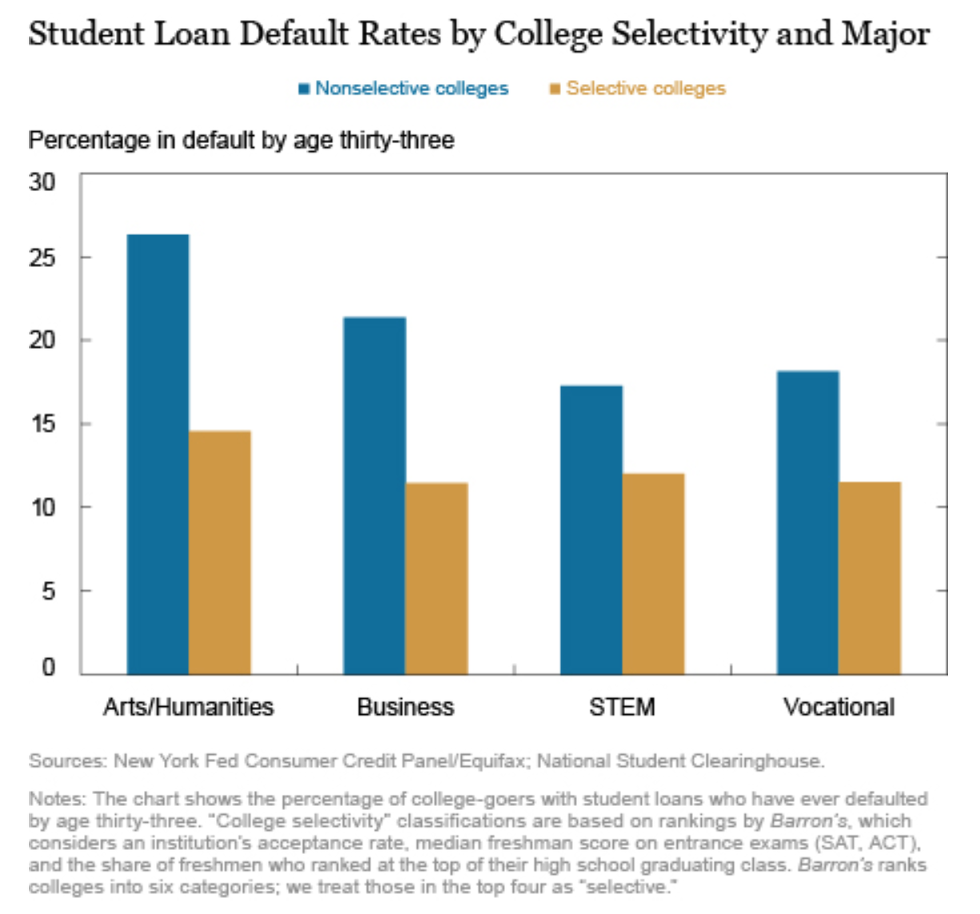
It is worth noting that the difference between selective schools and nonselective schools is even larger; so going "somewhere" to get a shitty degree seems to be not a good idea as well.
I did it via the military. There are other options - that's just one.
Doesn't this line of reasoning assume that right now there is a big misallocation and some are way over capacity while others have lots of space capacity? I would assume that whatever the current situation, capacity distribution is about equal to how it is. So any big shifts would not be possible short and even medium term. And if the needed shift happens, would the result, the new equilibrium, really be different, or would we still have a similar situation, just with he pieces shuffled around?
The problem with solutions that individuals like to come up with is that they only work for individuals. I try to always imagine my idea(s) on a large scale, what if everybody really does it? Lots and lots of "good advice" does not actually scale. When you change only a few things the big picture remains constant, so many of those ideas work. But as soon as there are large scale changes there are feedback effects and the context changes too, what used to be a constant environment will have changed too.
Ultimately I think the crux of the problem is that in the United States a lack of a college education is seen as a serious character flaw. A lot of Americans understand this, but I think it's important to illustrate this for non-Americans. A lack of a college education is seen a such a flaw that it automatically invalidates the prospect of marriage for many people [1]. Democrats (and I count myself among them) often tout the fact that they regularly win most of the vote among college educated voters - how this is supposed to be a positive unless one views the opinions of non-college educated as lesser is a mystery to me. Outside of low-class neighborhoods, a child failing to get admitted to university is an embarrassment. I personally don't agree with these things, and they're likely far from universal, but I do think they illustrate
The result, I think, is a large segment of the population taking on debt to get an education that won't actually yield much of a return in the labor market. And the messed up thing is that in a way they are making a sound choice because the stigma of being uneducated is so strong. Whereas in many places like the aforementioned Germany getting an apprenticeship and becoming a skilled worker is respected. I've heard stories about this shifting and the requirements to attending gymnasium (the college-bound educational track) are loosening, but it's still probably nowhere near the level as in America.
1. https://www.theguardian.com/lifeandstyle/2015/nov/10/dating-...
Also, if you look at Germany, there are "Universität", "Hochschule" - but also "Fachhochschule".
Enrollment is at almost 60% - according to the text on the right that's the share of those who begin a study on the entire population born in the respective year: https://de.statista.com/statistik/daten/studie/72005/umfrage...
These statistics are from an Economist article, which I can try and track down if I have the time.
Edit: Didn't track down the economist article, but here are sources on US and German enrollment rates:
https://nces.ed.gov/fastfacts/display.asp?id=372 reports 19.9 million students. About 6 to 6.2% of the US population.
https://www.uni-bonn.de/studying/international-students/coun... reports 2.8 million germany university students. About 3.4% of the population.
Not to mention that Germany has an extensive professional education system ("Facharbeiter" to "Meister") that he US does not have, so what's the point of only looking at one part of the education system?
I would not even be sure if we are actually counting the same thing on both sides. When the US means "higher education", not all institutions are MIT and Harvard grade. Is all that you counted in your number actually comparable to what Germans mean when we count higher (university) education? See my 2nd paragraph, is some of that kind of education possibly counted in your US number, while in German it is a whole extra branch?
The figures given are for all postsecondary education. I'm not sure why this is a controversial statistic. The younger US population would mean that even if the same percentage of graduating secondary school students go on to university, the US enrollment percentages would still by higher. Coupled with a higher percentage of students that seek university degrees after finishing secondary education (~70% for the US as compared to ~50% for Germany as per some quick Google searches) and a total enrollment figure of twice the rate of Germany is about what one would expect.
Did anybody here dispute the statistics? I must have missed that.
I think you ignored about 2/3 of what I wrote (yes, I edited my comment, if you used a notification service you may have missed it)...
Not at all.
What’s interesting is the proportion of people without any college education at Google has increased over time as well. So we have teams where you have 14 percent of the team made up of people who’ve never gone to college.
https://www.nytimes.com/2013/06/20/business/in-head-hunting-...
You seem to imagine that a generation of kids should be happy going to trade school and working as plumbers.
I know for a fact that at the vast majority of Fortune 500 companies you aren't even getting past the HR screen without a degree. What are those people supposed to do?