Not only that, but the specialized infoboxes at the top of Google's search results were an almost direct response to their competitor Microsoft doing exactly the same thing and promoting it at the main advantage of their search. Microsoft's comparison shopping subsidiary which they used for their search results was one of the companies complaining to the EU about this. Now that Microsoft have convinced the EU to ban Google from doing this, they can once again point to the fact that they offer this extra contextual information as a reason for using them and Google cannot compete.
1. The EC is not asking Google to make their user experience worse.
2. The EC does not have a problem with sponsored search results.
Google's user experience is the generic algorithm that determines what is the most relevant result. Google deliberately did not subject its own comparison shopping service to that algorithm while subjecting competitors' to it. Furthermore, Google took the FIRST result position.
Why would they do this if they have the best user experience and it should come up first anyways?
Contrast with Bing, when I search for "baseball bat": The first 3 results above the fold are organic unpaid SERPs. (Nothing from Bing in the top three spots.) And their shopping ads are displayed to the right of the organic search results.
If Google would've treated these products like ads, then the EC wouldn't have had a problem. But they didn't. And they have a dominant share of the general internet search market.
Google deliberately tried to exploit its market dominance to enter into another market in which it was not competitive.
There's nothing scary about this fine.
If you think those rules and laws have a negative impact, then work to fix them.
[Google's response][1] to this ruling suggests they have data which confirms this:
> While some comparison shopping sites naturally want Google to show them more prominently, our data shows that people usually prefer links that take them directly to the products they want, not to websites where they have to repeat their searches.
[1]: https://www.blog.google/topics/google-europe/european-commis...
This is an opinion which I don't feel the need to convert anyone to but I really don't understand the opposite view. Can someone explain why they believe google and other "emerging" power centers saveguard their interests better than the EU?
They have acted against "what people usually prefer" many, many times before when it was beneficial to their own interests.
Additionally, "what people usually prefer" is completely orthogonal to the EU antitrust ruling, which is about holding companies responsible for the power that comes with market dominance.
Companies don't really have ethics or humanity (the way people do), unless we force them to. "We" in this case refers to the whole of society, including the people making up the company. In particular as companies grow very large, even if the people making up the company are ethical, humane and good, THEY are still tasked to wrangle a wild beast that is mostly just hungry for profits, and try to steer it to do Good and not Bad because it doesn't see there is a difference. But even then, they can use help from the rest of society, and regulations can be part of this help.
It's so refreshing to see checks and balances on US multinationals, and I say that as a US citizen.
https://en.wikipedia.org/wiki/United_States_presidential_ele...
They live under some sort of bubble of selfishness, where they believe others have to change in order to do to what is best for them. Guess what, as long as Google is committing no crime, why should them?
1. Because it's in their long term best interest to have a customer for life (No political cycle) so they are more incentivized than a politician would be to support the interest of the consumer.
2. They have a more insight into user desires and actions on a day to day basis, meaning they can predict and "nudge" users in directions that are mutually beneficial.
It's in Google's best interest to make money. A large userbase and ubiquitous brand is part of that. User happiness is only one possible means to that end.
Finally, you seem to think that search users are Google's customers - as they don't pay anything to Google, they are a resource, or product - not a customer.
Google search is a loss-leader for Google ads - if there's no competition (say paying for product placement at these other sites) - Google gets a bigger share of the ad revenue.
I don't see what magical mechanism there is that would strongly push Google to care for the Google search users "best interest".
That set of users though is what this whole action from the EU is trying to protect. It's only marginally about the other businesses - the end goal is making sure the population of the EU is benefiting.
To that end I have yet to see where or how Google has proven they have the population's interest at mind than the government itself. Google has a much better track record than any government does at listening to the majority of a population's demands based on their behavior (yes even with the deprecation of groups/reader etc...) and responding with their products.
The EU or any other government does less for the population (relative to capabilities, obviously Google doesn't pave roads yet) than Google.
http://europa.eu/rapid/press-release_IP-15-4780_en.htm
> (...) systematically favouring its own comparison shopping product in its general search results pages. The Commission's preliminary view is that such conduct infringes EU antitrust rules because it stifles competition and harms consumer (...)
> (...) [Google] may therefore artificially divert traffic from rival comparison shopping services and hinder their ability to compete on the market. The Commission is concerned that users do not necessarily see the most relevant results in response to queries - this is to the detriment of consumers, and stifles innovation.
The EU is concerned with regulating the market to favour competition. It's true the underlying implication is that a Free market is a Good market - and so by defending completion it's theorised that the consumer profits. (in my opinion that's a non-seqitor - but that's the principle underlying the EU).
Now you could argue for other models, claiming that the proletariat will be better off - under a strict redistribution model, under an unregulated market, under a monopoly - but don't put EU's cart in front of the horse: it has one principle, a regulated free market.
And I'm saying that not only does the government have a terrible track record, there is no evidence that this actually makes any difference to competition. All it does is show that the government can throw their "weight" around.
Nothing in the historical record of antitrust should make us confident that the court’s dismemberment of one of the most successful companies in history would increase competition.[1]
[1]https://www.brookings.edu/opinions/if-it-aint-broke-dont-bre...
Centralised power generally means a departure from direct democracy, and that's one reason why I'm not a fan of the EU.
For a great view into why a regulated market might just be better than an unregulated one, have read of:
https://www.amazon.com/Gangster-Capitalism-United-Globalizat...
Google long term interest is to increase the margin of their product by increasing their dominance in multiple markets over multiple tiers.
If they do this by using their monopolistic power then they are in violation of the law even when by doing that they provide a service that some of their users see usable.
No, Google users are suppliers of a product (ad views) that Google sells to their customers. But they are suppliers that are paid via in-kind exchange (with Google services) rather than cash, which is exactly equivalent to being customers of Google services that pay with in-kind exchange rather than cash. So, in a very real sense, those users are customers.
Chickens in a farm aren't situated similarly, with respect to the farm, as users are with respect to Google services.
Chickens can't freely choose a different farm, or to use no farm at all.
In addition - open air held chickens could run away but they choose not to.
What if all that happened on chicken farms was one of their feathers got plucked once in awhile?
So the question is - what are the sufficient conditions for a chicken to be raised to the customer status from the equipment status?
Even if chickens would have choice, all they can choose from for their actual survival is another chicken farm.
Over time they have downgraded their ability to survive without support of the chicken farm.
Even if they had some money to pay for the entrance into the chicken farm then collecting their eggs would be much more lucrative business.
1) They are a quasi monopoly. The word you use to describe searching on the internet is "googling". Most of the phones on this planet run on their OS. So please...don't fool yourself.
2) Who's creating those desires? You think that the desire for millions of useless shit products that drive the global market are created by some neccesity deeply in our DNA? Or maybe by your free will? Or is this just the ad-industry stealing the attention from you and fitting you into a pretty tight frame of the optimal customer while preaching to you: "everybody/your idol loves this, you have to love it too".
Prediction in the age of advertising is just like advertising itself. A convenient lie.
Ok, and? The idea that monopoly is bad - ipso facto - is silly and monopolistic abuse of consumers is largely theoretical. Governments don't like monopolies because they challenge their power, and don't forget nearly every "bad" monopoly was the result of a government license to monopolize. The whole "Trust Busting" trope that underlies the anti-trust act was not because consumers were being hurt, it was a pissing match between the Government and Northern Securities Company [1]. Milton Friedman covered this well [2]
Who's creating those desires?
Companies, friends, acquaintances, media etc... it's not Google.
Or is this just the ad-industry stealing the attention...
Sure, are we debating the existence of an ad-market or Google? Cause I can assure you an ad market will exist irrespective of whatever Google does.
[1]https://books.google.com/books?id=klEeBQAAQBAJ&pg=PA6#v=onep...
What?! Monopolies always abuse their power because they can. I live in a country where we still feel the bad influence of a former monopolist ISP (Telecom/T-Online). THEIR influence on the government hurts the customer and even customers of other ISPs. It even hurts the tax payer who may not even have internet because his money may flow into subsidies for them. For example: they recently started eating up net neutrality in Germany. Because they can.
One of the most misused powers of monopolies is dictating a price. Just like we had a few months ago also in Germany with the biggest breweries. Millions of customers have been cheated.
IT IS ILLEGAL BEHAVIOR. They pay for this. How you can tell something like that "silly" is beyond me.
That's either some magical advertising that makes people search for things before they've seen it. Or you're wrong.
And when I google for "an item", like "medium sized dog", for whatever reason that means I already...well, what? Want a dog? Maybe, likely not. Want whatever that particular ad is trying to peddle me with whatever shoddy means and rhetoric, because it might have to do with dogs, or merely claim it does? Nope.
The biggest argument I've seen is that people don't like that they aggregate the data you give to them.
This goes to the broader point though that Google wants to service the end user better based on their feedback (most sites are too big/load too slowly), so they created something simple that gives end users a faster, better and cheaper (lower mobile data cost) solution.
In fact Google seems to be moving faster here because companies keep creating large websites to serve rich content that users find annoyingly slow.
https://www.theguardian.com/media/2015/oct/11/google-amp-fac...
There are also many people that actively support Chrome. Does it mean that Chrome dominance is therefore beneficial to the future?
Google is not a utility, it's not the water company nor the electric company, or even your ISP, it's essentially a website one which you are free to use or not and the price of admission and switching and opportunity costs are nil, same as for all competing websites, so dictating what Google's website can display and declaring it's contents illegal and worthy of billion dollar fines makes zero sense.
The same people that brought you that idiotic cookies warning?
See http://ec.europa.eu/ipg/basics/legal/cookies/index_en.htm#se...
I suppose the Guardian shouldn't alert people that the NSA listens to their telephone calls, either. (Because every spy agency does it?)
> There are also high barriers to entry in these markets, in part because of network effects: the more consumers use a search engine, the more attractive it becomes to advertisers. The profits generated can then be used to attract even more consumers. Similarly, the data a search engine gathers about consumers can in turn be used to improve results.
Simply put, the EC believes that Google is a barrier to any viable competition, so there's no ability to develop a competitive service to Google's own.
Search has been Google's core competency since their inception, they were much smaller than the existing Search engines when they started out but were able to create a better product that users preferred and since that time they've been able to amass a wealth of knowledge, experience and resources. Of course any company is going to have a hard time trying to compete with them now, but I don't see why they need to be punished for executing so well on their core mission.
It's not about "punishing" but it is about holding dominant companies responsible for handling the great power that comes with this dominance.
Companies don't usually do this by themselves because like you say, their goals are orthogonal to this.
Doesn't mean it's contrary to their goals (which would be "punishing", in a sense), but "commercial success" or profit just isn't a force that drives ethical behaviour and responsibility. It's not. Things would be so much easier if they were.
Step 2: "more attractive to advertisers"
Step 3: "profits generated can then be used to attract even more consumers"
Wait, why were consumers attracted by the product (search engine) in the 1st step, but were convinced by the profits in the 3rd step?
Just like Toyota in the unintended acceleration problem was quickly found guilty of not being GM or Ford.
Wut?
One monopoly is no more moral than another simply because the first one has guns and the second doesn't.
I would encourage a "follow the money" train of thought when thinking about this.
My question then becomes: if this money (the $2.7bn) did not accrue to the EU, or was not levied at all, do you still think the EU would still pursue this as ferociously as it has, just to protect the consumer?
The websites could have just stopped using tracking cookies.
But that is not what google does. I just did a search for "samsung galaxy s8". Instead of the first result being a link to a Samsung page I got 3 results that where ads (one of them being for the new oneplus). How does that match the "show what people searched for"? The results where sorted by "how much money did google receive" instead of "what the user intended".

Regardless of what you're seeing though, ads are a necessary part of Google Search; it's how they make their money. IMO it's a little strange to be complaining that Google is showing you ads in your search results.
I'm not complaining about ads and this fine is not about ads. It is about Google favoring Google Shopping links instead of competitors even though Google Shopping was inferior when it started. Google basically pushed their product no matter how shitty it was.
If it were not for Google being a near monopoly in search this would not be a problem, but Google is a monopoly, so special rules apply to them.
Google Shopping links _are_ ads though: https://i.imgur.com/m5rGqLa.png

Compare MS and the bundled Internet Explorer: Yes, it was more convenient for people not to be required to download a browser after installing the OS.
But imagine if MS had been successful, and Internet Explorer had emerged as the only browser: Do you think that would have been in the common interest? (hint: around that time, they tried to get .doc established as the standard, replacing HTML)
That was a non-issue, as OEMs were able (and did often) pre-install any number of software packages on top of Windows. The issue was MS telling them "if you preinstall Netscape Navigator, you won't get any more Windows licenses from us". Among other things that were unequivocally harmful to consumers.
The thing about anti-trust is that being a monopoly is allowed. What's not allowed is using a monopoly position to get a large advantage in another market.
What should or shouldn't come with an OS is not up to bureaucrats to decide.
Going back in time, you can just as well argue that bundling Notepad in Windows is "illegal" or "anticompetitive" or what have you because it might have killed the market for third-party text editors.
Isn't one of the big refrains here that competition always benefits the consumer?
This situation makes me think of the larger markets: We're wanting the short term benefit (Google prioritizing their results over others) at the expense of the long term benefit (healthy competition in the travel space).
Google is really smart, right? They've done some amazing things with search. Do we believe that Google doesn't know how to display those comparison search results page in a carousel like their own? Or is it that they don't want to?
Think about it for a second. What if Google did that, and they subjected their own comparison search results page to the same generic algorithm that they subjected everyone else's too?
Maybe it's too hard for Google. But they like standards: see AMP. So why not create some standard tags so everyone has a fair chance?
I don't know, it certainly looks like Google was exploiting its market dominance in general internet search to get a leg up in another industry without actually competing. That's not fair.
Which is great for google, not exactly great for my interests however.
So is the EU going to fine Apple for not allowing iPhone users to access third-party browsers?
At least Google doesn't force any lock-in with their platform here (the browser or search engine) - you're free to use any search engine you want.
They are not dominant in the market, but if they were I would hope so.
...what?
Google doesn't force any lock-in on their platform, yet the EU fines them. Apple does, but the EU hasn't taken any action.
Also, note that Bing doesn't lock you into their ecosystem in those boxes the way Google does. Take a look at "Uptown Funk":
https://www.google.com/?gws_rd=ssl#q=uptown+funk - Links to YouTube and Play Music
https://www.bing.com/search?q=uptown+funk - Places YouTube up top, then links to Groove AND Amazon MP3 (If you search "The Cure Lady Gaga" it also offers iTunes. Apparently it doesn't know that iTunes has Uptown Funk as well. Oops.)
This is a live example of how Google violates antitrust law, but it's competitors do not.
Not necessarily. I read this as saying that if other players have well marked up content, they should have their listings appear in infoboxes, perhaps alongside Google's. Not that the infoboxes be removed.
See https://commerce.googleblog.com/2012/05/building-better-shop...
Maybe if they tried again they could do better this time; I'm a little skeptical though.
https://2.bp.blogspot.com/-nw0uS-CN17o/T8cd822KTBI/AAAAAAAAA...
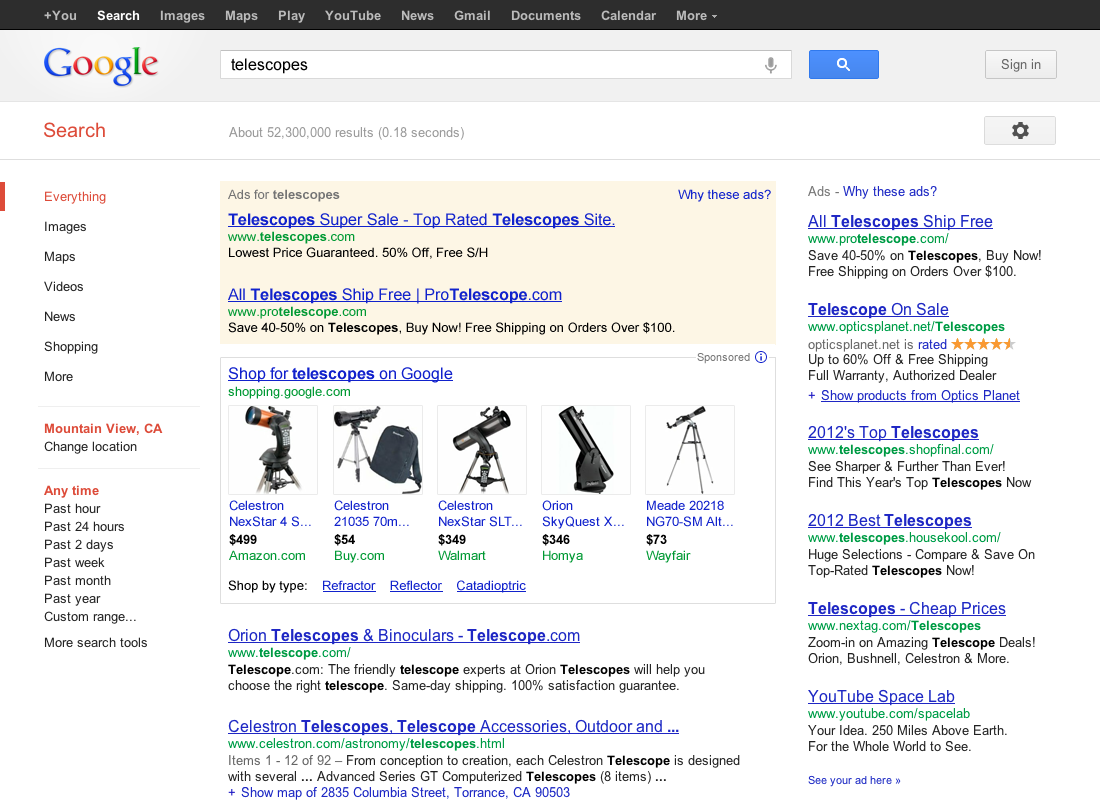
It's really quite simple, if Google's user experience hinges on them abusing their market dominance then they have no business in the EU.
Even if it means we can't have certain "nice things", I am perfectly okay with that.
Companies have power. Companies with market dominance have a disproportionate amount of power. Why should a company be allowed to wield all that power without being held responsible for it? So if you're gonna be a dominant company in the EU, you're going to have to take responsibility and not abuse your power to stifle competition.
It's not like the "before" situation you sketch couldn't have been improved in any other way. It just so happens that this particular way also ("conveniently") stifled competition in shopping sites by abuse of Google's market dominance in Search.
Why is this bad? Because abuse of market dominance doesn't always result in a better user experience or product. And we can't even be sure that was actually the case now, because of this market dominance, no other company got a chance, the only way was Google.
Also, the problem in your "before" situation was Google serving its users search results that were spammed to death with low quality SEO crap. This was Google's problem (sure it's a really hard problem, but it's theirs). That shit could only thrive because of Google's popularity. Any real competition, like normal price comparison sites, were already suffering because of this (or worse, forced to join this dark side).
The thing is, this problem had nothing to do with the actual competition. But Google chose the solution (abuse market dominance) which drove them into obscurity. Eventually SEO-spammers (whose core business was never price comparison sites) found other ways to game and abuse the system.
If Google would've done nothing, people would have stopped using Google for finding price comparison sites (and back then, Google was really very good for many other things) because the SEO spam isn't useful. Then competing price comparison sites would have had a chance, and who knows, maybe Google's actual web-searching user experience (which is terrible today) would have remained better. I mean that's what we lost when Google tried to become the sites it linked to, instead of helping people find them. Not saying this would be the only solution, it's obviously not as profitable as Google has been while abusing their market dominance, maybe they could have found something responsible in between.
Also, we gotta be consistent. If the EU Commission on antitrust could say "we'll allow it this time because we kinda like the end result", THEN you should be scared, really really scared. Arbitrary application of the law is very bad, every time you encounter it, no matter what.
The Commission established that they've been abusing their market dominance since 2011 (or 2008). Market dominance put Google in a special position of responsibility, they are now being held to that.
Damn, I hate this trend of making you comments appear more controversial.
> What's next?
You really should not argue this point. We need to stop "big" companies doing "anti-consumer" practices. The reason why those terms are in quotation marks is because when you are discussing antitrust and monopoly laws those terms are not well defined. You should only look at these rulings per-case basis.
If on the other hand you believe in the benefits of the "free for all market", you just have to be aware that this is not an opinion shared by EU citizens.
It doesn't work like that. Because of their market dominance, there really are no alternatives. This is a combination of companies simply giving up on competing with Google, but also in terms of SEO, Google is the only one that matters for publishers and advertisers drive profits towards Google as well. Mobile? They now own it.
And btw, if you'll mention DuckDuckGo or Bing, the there's a high probability you're not living in the EU, since those are really, really bad at local or non-English searches.
Then don't use any. You are not entitled to it, nobody has any obligation to have a service that does what you want.
Google isn't entitled to doing business in the EU either. If they do, then they need to follow the law.
Pure pragmatism.
Point is, representative democracy doesn't mean the action of the representative is the one the population agrees with.
I don't have the freedom to use another search engine with the scale and access to user data that Google has because the barriers to entry in this market are staggeringly high.
Staggeringly high barrier to entry == utility
>stealing money
Google has the freedom to not pay the fine and shut down operations in the EU.
I take it as a way of saying "this will probably be a controversial opinion here, but..." which is totally fine.
https://en.wikipedia.org/wiki/Common_law#Alternatives_to_com...
Be sure to also check out the coloured map at the top :)
[0] it's a bit more subtle, distinctions have blurred a little over time, either legal system adopted some parts of the other. see the wikipedia link for more details (especially the heading "Alternatives to Common Law systems")
What other websites need to be wary of the same ruling and at what point do they need to focus their efforts on giving their competitors virtual real-estate on their website at the expense of growing their company?
The US just oddly decides not to enforce it, then the EU gets shit on for being anti-American when they correctly enforce things that are illegal in both the EU and US.
They enforced it for Microsoft in 2001. Since then tech behemoth political donations have shot up.
No, they are being forced to give their competitors equal prominence.
The press release literally says: "the Decision orders Google to comply with the simple principle of giving equal treatment to rival comparison shopping services and its own service"
From the Wikipedia summary of United States v. Microsoft Corporation[0], "Underlying these disputes were questions over whether Microsoft altered or manipulated its application programming interfaces (APIs) to favor Internet Explorer over third party web browsers, Microsoft's conduct in forming restrictive licensing agreements with original equipment manufacturers (OEMs), and Microsoft's intent in its course of conduct."
I feel like this detail is being lost in a lot of the comparisons I've seen made between Google now and Microsoft then. Google promotes their own services on their own website, sure. At the same time, they haven't changed Chrome to not load competing services. They have done nothing to prevent users from using competing search engines in Chrome. They don't prevent competing web browsers from loading Google sites. They don't force web sites that use Google ads to block competing browsers.
So the parallel doesn't work for me. The EU decided these were different markets, I disagree. I'm a user, I use Google to find things on the internet. I use other sites. I search Amazon directly from inside Chrome, I visit other sites without issue... I'm just not seeing the anticompetitive actions.
[0] https://en.wikipedia.org/wiki/United_States_v._Microsoft_Cor....
(Though google does set up special APIs for Chrome first, like SPDY. But that's done in a responsible way.)
It didn't have to be a ballot box but I think users should be able to decide what default browser they want to use on first use. I'd prefer to only be install what browsers I want to use.
IMO Microsoft is just as hostile now, I can't uninstall Edge from Windows 10, I keep getting nagged to use Edge as my default browser, my preferences to never ask again are not honored. my defaults are lost on each upgrade, despite setting my default browser to Chrome the Windows Search box still opens up results in bing with Edge, I need to use my spam hotmail account to log into Windows 10, I tried using a local account but it broke everywhere that launched a Sign Up page which crashed after 1s of an empty screen, which I needed in order to get the latest version of WSL with the bug fix I needed. In the end I had to reinstall Windows 10 and adopt their stupid Internet account policy. Windows 10 has been the most user hostile OS I've used that I'm planning on switching to using a Windows 2016 Server OS on my next install.
Doesn't seem that different from the case against Microsoft over Internet Explorer and Windows Media Player?
The other is a web page with tons of competitors, many of which work well, deciding what their own computers after you specifically requested them to do so.
While whether you can switch might be important from a user standpoint it's not necessarily a factor from a market standpoint. It's more about how much power you have and how you use that power. It might be very easy to switch to Bing, but Google still have power over >90% of the search market.
Type bing or duckduckgo in and you have switched, how is that hard?
Walmart has a hair salon in many of their stores. Walmart's primary business model is not hair but product sales. But obviously Walmart wants you to get their hair cut at their salon. This is similar to the government stepping in and saying that the store must allow other Salon's equal placement in their building. They own the building.
It would be anti-competitive to do something to prevent other salons from opening down the street or lowering the prices in their salon to bellow cost to push out competition. But I don't buy that they can't do what they want in their own store.
Then you're unfamiliar with anti-trust law.
Oh right, no, and what they have in their website promises no expectation of doing what you need.
And what happens if Google says, "f* it, we're not providing a utility, we're not taking traffic from European IPs anymore"?
I am no anarcho-capitalist, but I really think more folks should read Atlas Shrugged.
Nothing much. Someone else would step in. Greed and free markets makes the "Atlas Shrugged" scenario nonsense. I'm sure there are millions of smart people who would love it if all the other smart people stopped producing. All it means is more market share for them.
I'm guessing you're posting this as someone who is fully sucked into the Google ecosystem. I was too. But the only Google product I use anymore is Google maps. No more email, no more search, no more android.
Google is very far from indispensable.
I use Google fairly heavily through work and my personal email, but IDK about "fully sucked into" - I have no smartphone, don't use GCal, etc.
Rather than lauding Google, I meant to criticize the idea that the public has a right to a private service.
Very rarely does acting like a child and "taking your ball and go home" work out.
I disagree with Rand on many important issues.
I think your reply is tantamount to an ad hominem fallacy.
Nope. It's crazy. You don't go to the most popular restaurant in town and have them tell you to go get desert across the street because the superior food and experience hurt their sales.
Even looking at the commissions fact sheet (Search Engine market share) [0]. 3 of the 4 other companies are billion dollar enterprises. Microsoft decided to make it difficult to switch to Chrome/Google in Windows 10 (no more 1 click). With this consumers are still switching back.
Out of all the bad shit google does, this shouldn't even be on the radar.
For the other end of the story this is an interesting read [1].
[0] - http://europa.eu/rapid/press-release_MEMO-17-1785_en.htm [1] - http://www.foundem.co.uk/Foundem_Google_Timeline.pdf
Which is why they determined Google's market dominance in Search, not shopping sites.
Your analogy should be about the single most popular restaurant guide in town, opening up their own restaurant and then only writing reviews for that.
The quality of Google's in-house shopping business didn't factor into the EU Commission's rulings at all. Which makes a lot of sense because, given Google's market dominance in Search, it is impossible to know if their shopping business is in fact superior or not, because they abused that power (gained from Search, not building a superior shopping business) to stifle any competition.
As the article clearly states, market dominance is not illegal (like your restaurant analogy suggests), irresponsibly abusing the power that comes with it is.
The website is theirs, but the content they scan through and link to is not theirs. Google Search is of incredible value (to us in form of service _and_ to Google in form of an asset), but it's been built on top other people's content. They took that content for free. Perhaps it gives those "others" some rights in deciding what kinds of things can be done with such a service. It could be done through law, conversation, or applying a fine when a large enough group of representatives of a large market decide that maybe they do something a bit off.
Because it was freely available. As I understand it, Google feed its database with robots surfing the web. Those robots don't steel anything. Moreover, if I'm not mistaken you can explicitly forbid access to those robots with a robots.txt file or something. If you don't, it arguably means you give away your data to everyone.
Are you serious? By this logic Microsoft could do whatever they wanted with Windows. Yes, when you're big enough to absolutely dominate a market you can't just use that to make rules that kick out everyone else.
That's not a significant difference - Google's site renders on your machine too. Google's servers send you computer code (HTML, Javascript) and Microsoft's servers also send you computer code (Windows binaries).
> [Google's site] is free to visit
The use of API calls in Windows is also free. Would you be OK with Windows servicing Chrome and Dropbox several times slower than Microsoft products? There was a huge antitrust case about this in the '90s.
2) Their search algorithm ranks google products at the top of the results.
3) They cannot prove that their products are being held to the same standards as everyone else, because the algorithm they use to rank results is not public.
I think Google could have any two of these, without being in anti-trust domain.
When a company uses a monopoly in one field (web search) to boost their other businesses.
It's the same when Microsoft were convicted in the US of using the desktop OS monopoly to boost their web browser business.
That's the case here, and it was the case when Microsoft got in trouble for bundling IE with Windows.
I'm actually glad to see this ruling. It's nice to know there's at least one place in the world where the government still cares a little bit about not letting giant corporations take advantage of their citizens.
You can't regulate a company that is bigger than the enforcer of the regulations.
> Google has demoted rival comparison shopping services in its search results: rival comparison shopping services appear in Google's search results on the basis of Google's generic search algorithms. Google has included a number of criteria in these algorithms, as a result of which rival comparison shopping services are demoted. Evidence shows that even the most highly ranked rival service appears on average only on page four of Google's search results, and others appear even further down. Google's own comparison shopping service is not subject to Google's generic search algorithms, including such demotions.
> As a result, Google's comparison shopping service is much more visible to consumers in Google's search results, whilst rival comparison shopping services are much less visible.
Your comment reads like you haven't even read the EC press release. I suggest you do that first.
It actually seems to match the definition of public utility perfectly. The infrastructural cost of building another Google is incredibly high and people rely heavily upon it.
You can "just build another google" the same way you can "just build an electricity network" for a large town.
http://www.politico.com/magazine/story/2017/06/15/how-a-stre...
That would scale just about as well as your crappy elastic search thing would.
I absolutely cannot decide I want to install some poles to run electricity through a town without permits, insurance, inspections, and a ton of capital. I can't decide I want to build my own power plant and sell energy to my new grid without jumping through a lot of hoops, some of those hoops only a mountain range of cash can solve (compared to the merely large pile you'd need to run a credible regional alternative to google search for some segment of the population).
How exactly would a credible regional alternative to google work and why are there exactly zero of them if it's so easy?
A user of bing's search index with extra features sprinkled on top. It's comparable to one of these:
https://en.wikipedia.org/wiki/List_of_United_States_mobile_v...
They did not build the necessary expensive infrastructure for a search engine, they lease it. This actually kind of proves my point.
A company called Cuil tried to do exactly what you're suggesting. The reason you're probably saying "who?" now kinda proves my point too.
I would say Google is as close to a natural monopoly as the Bell System was in 1956. If you came to me and said “Hey, I want to start a company to compete with Google in search,” I would say you’re out of your mind and don’t waste your energy or your time or your money, there’s just no way. Classic economics would say that if there’s a business in which there are 35 percent net margins, that would attract a huge amount of new capital to capture some of that, and none of that has happened. That tells you there’s something wrong.
From: https://promarket.org/google-close-natural-monopoly-bell-sys...
Water companies are a utility because there's a high cost to laying the pipes and the more pipes you lay, the more people you service, the more pipes you can afford to lay. It's near impossible for an upstart water company to come in and displace the incumbent.
Search companies should be a utility because there's a high cost to gathering the data needed to drive good results and the more data you gather, the better results you give, the more data you gather. It's near impossible for an upstart search company to come in and displace the incumbent.
Maybe I'm wrong about that--I'm sure ML has become increasingly important in how Google ranks results, but I'm unconvinced that it's a severely anti-competitive factor.
(That said, I do still use Google over DDG largely because of the personalization and the integration with their other services.)
Where are the someones then? Look through Show HN and you'll see all sorts of cool projects and upstart companies. How many of them are search? We've got a huge flood of companies trying to take down the taxi industry, where's the flood to take out Google? It doesn't exist because everyone knows they can't win.
Here's the Show HN for search: https://hn.algolia.com/?query=show%20search&sort=byPopularit...
Do you see any of these dethroning google? Almost none even bother to compete in general search, just in small specific areas.
Making a kickass image editing application like Adobe Photoshop is difficult too (as anyone who has had to suffer GIMP would attest), but that doesn't mean Photoshop forms a natural monopoly.
There's a high cost to building a store and the more stores you build, the more customers you serve, the more stores you can afford to build.
There's a high cost to making a movie and the more movies you make, the more people pay to see your movies, the more movies you can afford to make.
How did Google displace previous search engines?
Building roads is an example of a natural monopoly. Consumer internet is an example of a natural monopoly. Growing corn is not a natural monopoly.
In the absence of a third-party with IP rights on seed, dominating corn growing means you dominate the seed supply and have the most variety to select from for improved traits (whether yield, hardiness to particular environmental stresses, etc.)
Seems to have a pretty clear feedback loop where dominance breeds dominance in the same way as with network effects. Sure, the source of the feedback loop is different, but it's very much there.
This applies 100% to Google. Even it's closest "startup competitor" hangs off bing's index.
Did your price comparison site at any time seem likely to be able to dominate the entire EU market? (you can find the exact criteria on the EU site)
If no, you got no problem to worry about.
If yes, that's a kind of nice problem to have I think.
> What's next? Having to give equal ranking to Yahoo! search results in their search page?
Why would anything be next? We have this rule, it works well, has worked in the past, what's the incentive to make it worse?
Your Yahoo!Search example doesn't make sense to me. Not in context of this ruling, any way. How would Google abuse their market dominance in order to ... what exactly, because you didn't specify any wrongdoing, just a crazy sanction pulled out of thin air.
It's not the market dominance itself that is illegal. It's just that if you do it, dominate a market to such an extent, you are held to special responsibilities not to abuse that dominance. Which totally makes sense.
From the article:
"""Market dominance is, as such, not illegal under EU antitrust rules. However, dominant companies have a special responsibility not to abuse their powerful market position by restricting competition, either in the market where they are dominant or in separate markets."""
It's just like that famous Spiderman quote.
Also the ruling is not about a particular party (like Yahoo in yours) that got wronged by an illegal abuse of Google's market dominance, it's about all of them, about the responsibility not to actively stifle competition. You can still be better than the competition, Google is obviously allowed to "hurt" Yahoo by providing better search results, that's what it means when they say dominance is as such not illegal under antitrust. It's just that, in some (but not all) cases of market dominance, it comes with additional power by virtue of dominance (not product), that allows a company to stifle competition (not because they're better but because the competition is not dominant), and antitrust law states that companies in such a position have a responsibility not to do this. Yet Google did. I'm not really seeing how Google could do something similar that involves Yahoo in your example.
About your One Box (that's the Google instant result thing yes?) example, if Google were in the theatre business, I'm pretty sure the Commission would investigate that case for antitrust as well. How that ruling would go, will depend on the specifics of that hypothetical situation, and whether it qualifies along the guidelines as stated partially in the article, and fully in EU regulations on antitrust (which you can click to for yourself).
It bites everyone, every kind of group where some competition is involved, even smaller companies, and we all agree on that.
However, when Google is touched, we all feel that we don't live anymore in a free world, that communism has won, etc - at least that's the kind of feeling I perceive every time they have to pay for something.
Why the break up of the Bell System [0]. Afterall it's their business, right?
Why was Microsoft forced (back then) to let people choose which browser to install? Same reason.
I don't know if you have ever read the book "Thinking in systems - D. Meadows", there is an interesting chapter about this which explains why such regulations are important.
[0]: https://en.m.wikipedia.org/wiki/Breakup_of_the_Bell_System
Then, if in future, lets say Google will be the only search engine that is still alive and used by 99% users and Google will choose to get your site/business out of their site/search results (based on what you wrote - it's their website so they can do whatever they want) it will be fine also?
People writing things like this really should read why anti trust laws were introduced in the first place.
Article 102 of the Treaty on the Functioning of the European Union (TFEU) and Article 54 of the EEA Agreement prohibit abuse of a dominant position.
Being able to dominate one market enables you possibilities to dominate other markets as well by abusing your dominant position.
In many ways, they are. They didn't sign up for it, yet here we are..
The smart play is to skim off the top, maintain some fiction of competition, and horde the loot.
Easy: when you have a dominant market position.
While it made me angry when Google put their results above ours, I never questioned that they had a right to do that. It is their website. They are not a utility. At what point does a company cross the line and become one that the EU feels can no longer promote their own product?
After all, the actual products here are the products being sold not the comparison sites. If I search for baseball bat the product is the bat not the competing search results.
What's next? Having to give equal ranking to Yahoo! search results in their search page? It sounds extreme but I would have also thought this was extreme until 2 minutes ago.
Or perhaps more accurate... having to completely do away with One Box entirely. After all, when I search for a movie it displays the actor information and movie times before it displays the link to the theater website or IMDB.