Can someone help me understand this? How is doing something without safety equipment that you can do with with safety equipment climbing to live, but not about cheating death? What is the point of foregoing safety if not to somehow eke something out of the increased danger, whether it be adrenaline, or a period of increased focus, or fame?
If it's not about someone being addicted to adrenaline or looking for fame, then I just don't understand it. At all. As in it's so foreign to me that I can't even begin to understand it.
1. Alex Honnold's brain is atypical. His amygdala simply does not respond to stimuli the way that it does in most people. To learn more, read this (excellent) article:
http://nautil.us/issue/39/sport/the-strange-brain-of-the-wor...
2. While I am (at best) a mediocre climber, the section you quoted rings true to me, particularly this section - "Climbing is an intimate relationship with our world’s most dramatic landscapes, not a self-boasting fight against them." There is something incredibly natural and sensual about climbing on rock that I can't describe without sounding like I'm talking about sex. And...that's traditionally where people tell me to give them my keys because I've had too much to drink. :)
3. Climbing is a deeply meditative activity, particularly when you get into a place where each movement flows into the next. When I am there, my mind shuts down and it is just a rock and me doing the most natural thing that I have ever found (see #2). That flow is deeply beautiful, but when you climb with ropes, you have to be in near constant contact with your belay partner. When I am with my regular belay partner, it interrupts that flow. When I am with a new belay partner, I never get close to it.
I suspect that if my amygdala worked like his, I would free solo simply to avoid having to communicate with a belay partner.
1. I wonder if amygdala responses in meditators would be similar. The Nautilus article mentions the control of his prefrontal cortex as a possible way he mediates the amygdala's response, and meditation often shows modulation in PFC activity. As a meditator, I also have a strange lack of fear response—for example, it's almost impossible to startle me.
2,3 I have only climbed a few times, and I too felt an unspeakable relationship with the rock itself that I have rarely felt while doing anything. The closest I can relate it to is indeed a deep meditative state, but one that comes with motion. Totally understand these points.
http://www.bbc.co.uk/science/humanbody/mind/surveys/sensatio...

https://en.m.wikipedia.org/wiki/Dean_Potter
https://www.outsideonline.com/1981591/dean-potter-killed-bas...
Edit -- Added a second, better link.
http://www.alpinist.com/doc/web08x/newswire-potter-eiger-fre...
With that kind of exposure, I'm pretty sure that the Yosemite rangers would have an easy time catching an El Cap freebaser and confiscate all the jumper's gear.
Thanks for the YouTube link! I hadn't seen that before, but holy shit, do I ever miss sharing a planet with someone like Dean Potter.
This is why I prefer bouldering these days.
“I am not a death-wish person,” he said to me. “I want to live very old. It is true that death is part of the frame—that it frames such activities as bullfighting and tightrope walking. My world is a dangerous world, sure, but I am very safe in knowing my limits. I am not playing with words when I say I don’t take risks. The danger becomes so narrow that it is a novel companion with whom you travel. It is not an enemy.”
I know this isn't an answer, but if you've never seen the documentary about Petit, "Man on Wire", perhaps it would help to understand the mindset.
However you can also imagine a justification along these lines: There are certain things we humans can do which give us access to unique highly desirable mental states. Some of these are familiar things like falling in love or having children. These are risks but usually perceived as having obvious upsides. There are also other behaviors like drug use or underground fight clubs which also give access to unique mental states but are usually perceived as too risky to encourage. It's easy to put judge free soloing climbing as something like drug use or bareknuckle boxing. But try to imagine that when done correctly and carefully that it could be something much like having a child or working on a math proof for years.
Sure. If cheating death is the path to that state for some people, that's understandable, and not really something new. I'm not judging him, this isn't some roundabout way to say people shouldn't free-solo. I'm literally trying to figure out if there's something else to it I'm missing, because the way it's stated makes it sound like there's something other than risk that's inherently different about free-soloing.
People are responding as if I said I don't understand why someone would do a risky behavior. I understand the high from cheating death. I don't understand doing something as risky as this if you aren't necessarily looking for that high, as the statement implied to me.
The alternative as I see it is that the author is reluctant to admit, or in denial about, some of the real reasons to free-solo. I didn't want to assume that without first checking my own assumptions.
For me, the best way to describe it is that I strive to feel in control in progressively more difficult environments. That's the mental state I'm looking for. The progression of the mental state goals are easy to follow:
Top Rope (rope already set up above you): "I feel in control despite me being 40' off the ground"
Lead climbing (bring the rope up and clip into the wall as you go): "I feel in control despite me having to take a big fall if I fail"
Outdoor climbing: "I feel control despite me climbing real cliffs outside"
And you can follow this all the way to free soloing, where you can feel in control despite having no safety net at all. I'm not going to pretend that I understand Honnold, and I don't free solo, but this line of thinking makes sense to me.
The other off topic reasons I climb are:
1. Getting better at a sport, just like any other sport/hobby.
2. I like the outdoors and adventure, climbing is a great way to see things from a perspective most can't.
3. Fitness
I love driving (shifting with manual transmission, steering, car maintenance, safe driving, etc). Some of that is controlling metal and machine; some of that is controlling your environment and the safety of your life. Same with riding a motorcycle, except I spend a little more on the safety part of it. Some might think I do it for the thrill of cheating death. Yes, staying alive is a goal, but that's not the reason I ride!
Although I think the simple thrill of it has to factor in at least a little bit, the climber is perhaps mainly motivated by the idea that not living like this is actually a form of death in itself or a very risky behavior (in the sense of wasting your life). It's similar to the ancient idea that a life of servitude is not a life at all. I can't say I necessarily agree but it's not such an outlandish concept either.
If you listen to Alex talk -- he climbs a huge amount of "easier" terrain and he often describes those experiences in similar terms. It's just for him "easy" is waaaaaaay harder. I can indeed imagine how cool it would be to run up 5.11 (or in honnolds case more like 5.12) with the same fun casualness that I have experienced when running up 5.4 -- and it really does sound like it feels that way for him often.
Pushing the difficulty of his soloing as he has is partially about the specific challenge of doing a harder route and partially about moving up his comfort zone so that he increases the range of "easy" terrain that he can go casually solo. His expanding comfort over time has given him access to a huge range of terrain that he could comfortably free solo - which is a huge part of the reason why Caldwell asserts that Honnold has probably climbed more technical rock mileage than anyone else ever.
I think one thing that's interesting (mystifying?) about the way Honnold treats risk -- he doesn't really acknowledge that the longer he solos the more likely he is to have an accident. Instead he focuses on how fear in some of the situations he pursues can only ever have a detrimental effect on performance -- and that setting aside that fear is actually a required part of the task of minimizing the risk involved for what he wants to pursue. I think this is probably true though the mathematician in me still struggles with the first part -- and actually if you look at Alex talk, it sounds like he's starting to change his tune a bit too. Free rider was one of his top life goals related to soloing -- and it sounds from his interview that his next goal at least is more focused on climbing harder routes than on pursuing harder soloing.
Up until that slightly exposed bit where you suddenly get buffeted by some wind and spend 30 seconds panting slightly whilst re-organising your thoughts. It is, without question, the most pure/fun form of climbing. To my simple brain staying calm and on point for a 4 hour free solo is just inconceivable
To put it into perspective, if you went to a busy indoor climbing gym, there'd maybe be one or two guys climbing at that level. And they'd probably be "working" a route, falling off it repeatedly, resting on the rope and learning the moves.
The idea of climbing at that technical level, for that length of time, with that level of risk just defies belief. I can't wrap my head around it.
[0] http://danmcmanus.blogspot.co.uk/2016/03/a-guide-to-freeride... [1] https://www.rockfax.com/wp-content/uploads/2011/06/trad_grad...

The fact that it happens to be extremely dangerous means you take more care, but that is not the source of the pleasure. It's the cost of admission. Some won't pay it. Some will.
I really like that you are not judging him. I have seen people dismissed as stupid, as if they don't understand the risks. That's like calling a person stupid if they smoke. They aren't cheating death, they are enjoying cigarettes (and they are addicted, probably). But not stupid or ignorant.
I first read about free climbing in an issue of National Geographic almost a decade ago. I never once recall thinking that it was "stupid": on the contrary, it quickly jumped up my list of interesting sports (below chess boxing).
What Honnold has done is free soloing which is climbing without rope for protection.
They sound similar but are significantly different.
However, you can climb mountains in different ways and people want to explore the possibilities. Some climbers think bolts are OK, some don't. It's their personal philosophy. They don't get the satisfaction they want if they use bolts, and think they desecrate the climb. So they don't use them. Not because they want to tempt fate, but because they would prefer not to climb things in that way.
The reason you ask for is: It's what they want to do. Reinhold Messner climbed mountains without oxygen, without seige tactics, because that's how he thought mountains should be climbed. Not because he wanted to tempt fate by eschewing "safety gear".
Wingsuit BASE is much more dangerous than regular BASE. Putting on a wingsuit is the opposite of safety gear - it's dangerous gear. However, it's not done to tempt fate, it's done to gain a different experience. That's what I think Honnold is doing here. He thinks it can be done, he thinks he can do it, and he turns out to be right. Same as Messner.
Sure... I wasn't implying that taking part in dangerous sports is something only adrenaline junkies do; I meant to say that doing so _without taking simple safety precautions_ puts you into that category.
"Motor racing without a helmet" = "stupid and pointless", we can probably agree on that.
"Climbing Everest without oxygen" != "Climbing Everest as an adrenaline junkie as I have deliberately foregone a safety related item".
"Free solo" != "Free climbing as an adrenaline junkie as I have deliberately foregone a safety related item".
My family have different risk tolerances and desires than me, but they know me and don't consider me an "adrenaline junkie".
I guess we just disagree :)
That's the part I don't get though. That said, I'm not a climber and I'm trying to logic my way through it as an outsider with zero experience, so I fully admit I may be wrong.
Driving a motorcycle is not something you do to get an adrenaline high, yet from a strictly transportation perspective, it's a bigger risk than driving a car.
I think it has to do with priorities. Death is not the worst that can happen to me, hence I don't chose the safest option in every decision, because even though a long life is desirable, it's not the most important thing.
The sense of freedom is often worth more than the safest option.
As a rider who's done a fair bit of social riding over the years, I have only met one rider for whom the thrill of it is not a factor.
Overall I agree with you that most of the feat seems to be about the risk, but there may be more to it (I'm not a climber).
Considering that Honnold completed the free solo in around 4 hours, I would suppose it is an experience of a similar nature, albeit with greater personal risk involved.
– My old squad leader on NPR
Interviewer was aghast.
We're like ¯\_(ツ)_/¯
An orgasm isn't called a little death (la petite mort) for nothing. I didnt know what it meant to live till I almost died. I'm definitely not a thrill seeker compared to free solo climbers. So call it what you will, I'm happier feeling life through the new senses I now have.
For the same reason why many would spent hours catching fish over a lazy weekend when much better fish is available for $5 in super-market.
For the same reason why someone would spend 5 hours trying to solve an interesting algorithms problem when one can easily find a solution on internet.
I am not a climber. I have fear of heights but I can understand it.
I think that a better way to express it for many people is we're not afraid of heights, we're afraid of falling and dying. Removing the falling aspect "cures" the phobia.
Free-soloing (climbing without ropes) is the purest form of climbing. Not stopping to place protection, not having to bring up your partner, not having to haul a bag... It's just you on the wall. It takes most climber multiple days of painstaking climbing to summit Freerider. Alex did it in 4 hours.
Beyond all else it's just a unbelievable feat of human ability.
If you really want to understand just how impressive this was:
1: climb something (even if it's just 40 feet in a climbing gym) 2: Go to Yosemite and stand at the base of El Cap
I have no doubt it's impressive. I'm impressed. I'm not trying to diminish that in any way.
> you could say the same thing about top-roping vs lead climbing (placing protection from the ground up). Yes, top-roping is much safer, but the experience & sense of achievement is just not the same.
My question is why is the sense of achievement not the same. Is it because of the danger, or because it's inherently harder when you abstract danger from the situation?
> Free-soloing (climbing without ropes) is the purest form of climbing. ... not having to bring up your partner, not having to haul a bag
That's the closest I've seen to a an actual differentiation. Here's the question: If you could Free-solo the same wall but with without (or greatly reduced) danger? That is, hypothetically assume there's tracks installed vertically in the wall, and a robot that you are attached to ascends with you, so if you fall the robot keeps you from falling far and getting hurt. Does that somehow dampen the feeling of achievement when completed? If the answer is yes, then I fail to see how it's not about cheating death in some part.
Which is fine! Just own that shit.
I'm not making a value judgement about people doing this, I'm just trying to understand that statement. Either it is about cheating death to some degree and the author is not being truthful to someone (us or himself) for whatever reason, or it isn't about cheating death and I don't understand it at all, so I'm asking for clarification. Either I understand it, even if I don't practice it, or I don't understand it, in which case I want to. It sounds like it's about cheating death (even if just to get to some desired state easier).
In your hypothetical scenario the answer is yes, if there is no danger, the achievement of climbing without ropes is lessened.
The experience of free soloing is to small degree about cheating death, at least as much as watching a movie is about seeing moving colors and hearing sounds. What one really gets from free soloing (or risky rock climbing, which I have some experience with) is a unique clarity of mind, a change in ego, a confidence game, where you need to quash your own doubts about yourself to succeed. The consequences of falling are a necessary but insufficient condition for the resultant feeling of achievement. In my opinion, AH, and his ability to control his mind, is the closest living example we have to a Jedi.
The time spent being especially careful that you don't fall, adds a bit more time than racing up with ropes.
Fun fact, Alex Honnold holds the speed record on El Cap.
If it's within my abilities/condition, I get into a much more zen/like zone doing trad leads vs coming up second. Or even leads in a gym. I really don't like falling, so that focuses me up and the world just fades away. It's all managing foot position, burn, effort level, pace, etc.
On the other hand, if it's outside my ability/condition and I'm shaky with failing energy... It's the worst experience in the world(overcoming it feels nice though lol).
It seems to me with no consequences of falling, that ultimate level of focus and control is impossible (hard?) to achieve, although one can get close with varying levels of more risky but less deadly climbs (lead climbing with a super long run-out and so on).
It's a good question...but I think only Alex could answer that question for himself.
I can say that the feat would not be as impressive because fear management and mental control are a huge part of climbing. As you move from top roping to sport leading (clipping your rope to preplaced hangers) to trad leading (placing your protective gear into cracks or other features in the rocks and trusting it to hold you if you fall) the risk increases and the fear start to become more of a factor.
I've seen climbers that have been perfectly physically capable of making a move but have been so gripped with fear that they couldn't move (and I've been that climber). I've done multipitch climbs (where you climb multiple rope lengths) where at the end of the climb I'm completely exhausted. Not from the physical exertion, but rather from the mental exertion of keeping fear at bay and from the sheer focus that climbing takes.
And honestly, I can see the appeal of free soloing. Protective gear is a giant pain in the ass. It's heavy. It's noisy. On lead the weight of the rope can become a very present annoyance, especially if you're on a long pitch. I would love for there to be the magical robot of your hypothesis that allowed me to climb without all that shit. But such a thing doesn't exist and my personal risk envelope has not expanded to free soloing (nor will it).
There are certainly climbers who COULD repeat the climb in the same style, if they were guaranteed they couldn't fall to their death (Tommy Caldwell being one of them). And yes, without the risk the achievement definitely doesn't seem as impressive (moon landing?).
But I don't think Alex see's it like he's "cheating death". Instead more of "confidence in mastery of ones skill and mind" to a point where the crazy & impossible seems realistic.
The game is just different. The mental state is different. The focus is different.
Look, ignore the utility differences between scooting around on your butt and walking, running, or cycling. The sense of agency involved is simply different. They are also, possibly, more risky than scooting around on your butt.
Bowling without bumpers has a different feel to it than with; even if you never touch them. It's not so much about cheating the gutter; the agency, the feel, the game is different.
It's hard to explain why free solo > trad > sport > top roping for some. But it has everything to do with risk while having nothing to do with risk.
I would suggest that the difference between protected and free climbing would be the same as the difference between hiking with a full backpack and hiking with a small day pack with only some food/water and maybe a warm pullover. Your plans are the same, to travel somewhere, your methods and the level of encumbrance is very different. Your enjoyment would also be different, with significantly less sweat and exhaustion but depending upon your environment maybe less enjoyable sleep and more restricted food. In my subtropical environment I know which I prefer, as long as it does not rain.
Falling from the wall and surviving through freak luck would be cheating death.
I think what you mean is "does the fear aspect make a difference?". Not "cheating death". Your repeated use of the term I think belittles climbing as some kind of crazy stunt.
Imagine you completely reproduced a famous climb indoors with a 3D printer. Surely you can understand the difference between climbing that and climbing the real thing, even if the physical difficulty is identical.
I've pondered this.
For me personally, the answer is: yes.
I think part of the sense of achievement after success comes from knowing what you invested (effort, risk, ...). I'd like to say that for me the fun of climbing would be about "oneness with nature" or some such thing, and that's partly true, but in reality daring to take a calculated risk, and succeeding, gives it a big extra something.
Maybe compare it with heli skiing vs backcountry skiing. Let's say both are equally non-risky. The sense of achievement (and exhaustion) after making the summit is quite different, even though it's the same summit. And having come up by chopper you might be able to benefit from the fresh powder on the way down more (because you're not exhausted), but the feeling of elation is just not the same -- at least for me.
Free soloing versus geared climbing is almost comparable to free diving versus scuba. It's less safe, but removes so much overhead that it's a qualitatively different experience.
Honnold's free solos in Yosemite are frequently world speed records - often by a factor of 2 or more. He's climbing with a directness and lack of complication that's really hard to attain any other way.
There's the banal meaning, which is the opposite of dead.
Another meaning, which I think the article meant, is to explore the outer limits of your ability and ambition during your incredibly brief period of existence in the universe. That's living. :)
Edit: formatting.
Not too different from deciding to run a startup - small probability of success, certainty of exhaustion, possible alienation from family, etc. SV provides ropes for when you fail. Doesn't happen everywhere.
Climbers climb for the enjoyment of the experience, and to get to the top--not just to show that they can avoid falling. Alex is a rare elite climber, so he reaches for rare elite experiences and accomplishments.
"When I decided that I too must pass through the experience of a parachute jump, life rose to a higher level, to a sort of exhilarated calmness... The thought left me a feeling of anticipation mixed with dread, of confidence restrained by caution, of courage salted through with fear.
It was that quality that led me into aviation in the first place — it was a love of the air and sky and flying, the lure of adventure, the appreciation of beauty. It lay beyond the descriptive words of man — where immortality is touched through danger, where life meets death on equal plane; where man is more than man, and existence both supreme and valueless at the same instant." [1]
[1] "The Spirit of St Louis", C. Lindberg, 1954. Quote was lightly edited for brevity.
Honnold's no thrill-seeker, he just prefers doing things alone.
Caldwell isn't just making a pretty-sounding claim, he's drawing a distinction between Honnold and other free soloists who were much more attuned to death, who seemed to be free soloing precisely for the adrenaline rush of survival. (Dean Potter is the classic example.)
So I think this is a claim that Honnold is soloing for the purity and experience of the thing, specifically as compared to some other soloists who are more focused on adrenaline and risk.
You say safety equipment. Others might say encumbrance, or unnatural performance enhancer, or laziness cheat. An apparatus that enables a lessening of difficulty, which eases the challenge.
When the goal is to engage a challenge, anything that renders the effort less challenging is a dilution of the very challenge as a whole.
Of course one must use safety equipment to examine the possibility of a raw attempt. But one builds on the experience, removing the unnecessary, wherever possible.
Of course it's easier to climb with a helmet and ropes, because those are the things that provide for obvious leverage to control the outcome. But who ever climbed a mountain because they wanted to do an easy thing?
The harder the task is, the better, in this context. The satisfaction of accomplishment is the goal, rather than the stress or all of the physiological byproducts or recognition that come as part of the package when completing the task.
Trying to do something, based on an intuition that an outcome is possible, when others lack the same intuition is the goal here.
This is not the same as fame. Fame is a derivative of the behavior of others, as outsiders to the activity.
To trust in one's intuition, and find that it is correct, is a fundamental aspect of human existence.
To divorce oneself of maximizing challenge, is to lie in bed all day as a shut in, and have your food delivered to you, in the most exaggerated sense of the comparison.
1. The sheer pleasure of doing something unaided - people enjoy doing crosswords without referring to computer screen that will tell them all 7 letter words ending in g-something-t.
2. The pleasure of feeling yourself as part of nature. The walk in the woods wearing shorts and a T-shirt, rather than racing through it on a motorcycle.
Basically different sports, rather than being about safety
With safety equipment, climbing El Cap takes 2-4 days, and you have to pull up several bags of equipment behind you with pulleys.
Without any safety equipment (i.e. free soloing) climbing El Cap takes a few hours and you just bring your body and some chalk.
Plus it's just a cool thing to do (at least IMO). It's like, the dude is so good at climbing he doesn't need ropes.
It takes hannold 4 hours. It will likely never be tried successfully by anyone else.
https://www.youtube.com/watch?v=OusYaNWBy08
In a typical Rogan style, it's a pretty relaxed and "real" chat, about girls, shitting your pants, purpose etc. Gives a little more insight into how top athletes like Alex think and approach their craft.
Most people don't, because we want to live life not be scared of it.
He's the same as the rest of us just on a different level.
I find it kinda easy to understand even if it's not my thing.
It really illustrates what a professional Alex is and how in-tune he is with his skills and his craft.
I'll offer a counter anecdote to yours: I was talking to a guy this weekend who had been a serious hang-glider for over a decade when he was younger. Every time a friend would have a problem, he analyzed it and saw that because of the way he operated he wouldn't make the same mistake and could therefore rationalize his continued participation in the sport. Eventually though, he had a problem, he made a mistake, it scared him, but it took fully two years of continuing to fly before he finally worked through it and decided that he could never eliminate enough risk and quit flying.
EDIT: I may have mischaracterized his response and removed "error-free" language and clarified with "eliminate enough risk".
We engage in that kind of analysis continually, and collectively. Our conversations are like 80% post-mortem, all the time. Somebody gets hurt, the whole community analyses it in minute detail, the pilot writes it up, we watch video of the incidents. We check in with ourselves about whether we would make the mistake, whether we have the knowledge/skill/pre-flight routine to avoid it. Contrary to the other commenter, constant self- and peer- assessment is extremely useful. It's just that the goal isn't to assure ourselves that we won't get hurt. The goal is simply to improve our odds. That's all.
Most of us know multiple pilots who died unexpectedly, sometimes very good pilots in benign conditions. I'd guess every one of us knows someone who broke their back. We're very conscious of the risks, people who think their skill puts them above it are in the minority. We only talk about odds, and increasing our time between incidents. Those few of us who have been unscathed know that we're due. It's worth it. I've seen a paraplegic come back and fly again.
EDIT: Yes, "eliminate enough risk" sounds much more like para-talk to me. My instructor always harped on about high-percentage vs low-percentage decisions. He was downright gleeful about responding to ubiquitous "Is flying safe?" questions by popping catastrophe reels into the DVD player.
* I'm not a paraglider, so apologies if the terminology is off.
http://publications.americanalpineclub.org/
It's a great supplement to experience,
Austria, Switzerland and Germany have a very long rock climbing history (unsurprisingly), and their respective climbing associations are obsessed about safety.
In the early chapters of the book The Right Stuff, Tom Wolfe says that this was the normal attitude among test pilots about their brethren who crashed and died. "How could anybody fail to check his hose connections? And how could anybody be in such poor condition as to pass out that quickly from hypoxia? ... One theorem was: There are no accidents and no fatal flaws in the machines; there are only pilots with the Wrong Stuff. (I.e., blind Fate can't kill me.)"
Maybe he's right, but... self-assessments of skills are rarely useful. Survival bias and all that.
With climbs like El Cap, a tiny mistake could be something as simple as letting momentum carry you a few degrees too far, losing your focus for an instant, or even losing strength. Climbing is a cross between chess, long distance running and gymnastics and to free solo something like El Cap, you need to be world class at all of those...simultaneously.
Several years ago, when I had a total of three hours of climbing experience (one hour in a classroom and two hours on an indoor wall), I made a mistake ice climbing that could have been fatal if I had not been properly roped in. I was incredibly inexperienced, got incredibly scared and started gripping onto my tools for dear life. I was so scared that I put all of my strength into my grip. My forearms spasmed and I lost my grip. I was an ugly climber, so my belay partner had given me a little too much slack, so I fell about six or seven feet, thus leaving a very experienced climber's very expensive tools in an ice wall several feet above me. Rather than get lowered and try to recover his tools the proper way, I decided to use crampons and my gloved hands to climb the ice like I would climb a rock. It was an incredibly sunny day, so the waterfall was a little wet and that was likely the most miserable seven feet that I have ever climbed.
In retrospect, it's a funny story about a noob getting scared and I had to buy several rounds of beer when we got back to civilization. But, that's an example of losing focus and doing something incredibly foolish that could have had tragic consequences.
The particular route Honnold climbed (Freerider) is hardly "cutting edge" (at 5.13-, it is roughly eight or nine grade levels below the absolute hardest rock climbs in the world), but the most difficult section (the "crux" in climbing jargon) is notoriously insecure, meaning that even skilled climbers find the movement difficult. Honnold himself spent time on the route on a rope learning this sequence (and others).
I seem to recall him saying in it one of the big risks is suddenly being overcome with fear or vertigo from the height.
Granted, I'm a mediocre climber (can lead 10c/d), but falling every once and a while is pretty common for most of us.
The rock can break off ("chossy" climbs, Pinnacles is notorious for this), but that's a less common occurrence than Hollywood would lead one to believe.
A doctor from our local hospital died from, as far as we can tell, exactly this while climbing Discovery Wall. He was an excellent climber, and was using appropriate gear. He just was in the wrong place at the wrong time, and his safety equipment wasn't enough.
Heck, a few years ago, a 2000 ton slab of rock fell off of Half Dome, which is a famous granite dome in Yosemite. I can't find the article now (of course), but I read a great article about how rock expands and contracts with the heat of the sun, water gets into cracks and plates will break off.
This article is okay, though it isn't the one that I'm thinking of. If I can the correct article, I'll edit this answer.
http://www.livescience.com/51490-yosemite-half-dome-rock-fal...
Rock fall meanwhile is dangerous to all climbers, whether or not they're using ropes. Sure, it's more dangerous to a solo climber - you might get lucky and just get knocked out, something a rope can save you from - but we're talking about a moderate risk vs. high risk comparison, not zero-risk to high risk. That 2000 ton slab you gave isn't a very good example, because something that big has a pretty good chance of killing you rope or not.
FWIW, I do a lot of cave exploration, and in caves the "already broken off" effect is a very powerful one. Virgin passage that's never been explored before can be a very scary place to be because everything can be loose and ready to fall. This is particularly true in areas that undergo freeze-thaw cycles, such as upper parts of alpine caves - I've been in places where every single bit of rock, including the ceiling, is heavily fractured due to frost. Breakdown piles are also a big problem - they're huge piles of rocks and boulders, generally due to ceilings gradually collapsing, and you have to be really careful around ones that haven't been visited frequently because pretty much anything you stand on could be unstable. Lots of cavers have been trapped in breakdown piles that shifted unexpectedly.
The underlying cause of this problem in caves is simple: caves can be very static environments with no weather, increasing the chances that the force you exert on a rock will be the largest force it has ever experienced in that position.
It occurs to me that this phenomenon will also be a big risk factor in lunar exploration, if people ever go back up there.
Oh, is http://idlewords.com/2007/04/the_alameda_weehawken_burrito_t... yours? That's basically my favorite blog post ever.
10% of El Cap accidents are falling objects http://www.climbingyosemite.com/portfolio/danger-zones-nose/
For example, I've personally done quite a bit of what's actually free soloing in cave exploration, but that style of climbing is done in confined spaces with rock on every side. You're much less dependent on individual holds as you'll usually be supporting yourself by pushing against the rock with your whole body, so it's a lot safer than most free soloing - even if you do fall you have a good chance of self arresting by, and if you can't you can at least slow your fall significantly and just slide to the bottom.
I was highlighting the sudden surprises that tend to catch a climber off-guard. If someone is climbing on wet sandstone, they should already be cognisant that it may crumble. (They should also avoid climbing it when wet so that they don't break holds, but that's another topic on stewardship.)
If true, that would explain a lot.
http://nautil.us/issue/39/sport/the-strange-brain-of-the-wor...
[1]: https://blogs.scientificamerican.com/guest-blog/what-does-mi...
Considering you and I have a 100% chance of death anyway, I see the attraction.
People like Honnold are pretty rare.
Nobody really knows exactly what type of risk he's taking, but my rough guess is that he's probably on the order of ~10x an average mortality rate (which is 1.5% / yr among males his age).
Whether that's insane or not is up to an individual. For me, it's a rare combination of crazy and rational, which I find fascinating.
https://www.cdc.gov/nchs/data/dvs/mortfinal2007_worktable23r...
- How do you become the greatest climber in the world?
- You become the second greatest climber and wait for #1 to die.
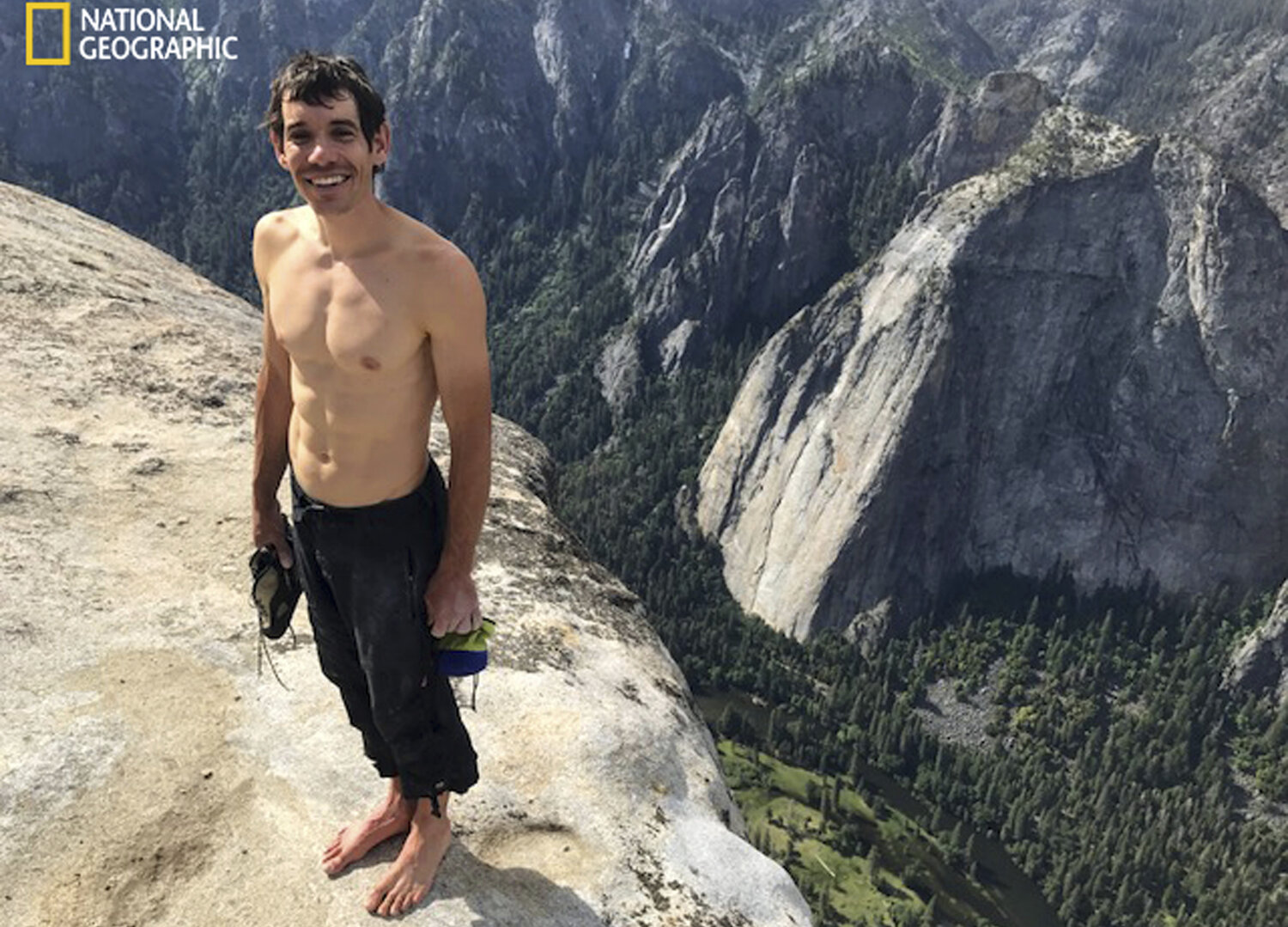
He seems to have a lot of lean muscle (http://media.npr.org/assets/img/2017/06/05/ap_17155772401614...)
gangly, adj., \ˈgaŋ-glē\ : long and thin [1]
It would be rude to call him a mutant, but that's pretty much what he is, for better or worse.
or the 80ies oldschool classic; wolfgang guellich in a german gameshow: https://youtu.be/rugoETlUAVI?t=22m47s
http://escalade9.wifeo.com/par-nationalite.php
i think what's so special about him are his mental abilities, not his physical.
He completed the Fitz Traverse with Tommy, who referred to him as the greatest climber of our generation(perhaps a bit of hyperbole, but still).
He is the current speed record holder with Hans Florine for The Nose.
Alex is the top ultramarathoner of rock climbing. Not only is his endurance of effort incredibly high, he is able to continually execute moves at an extremely high level with an almost non-existent error rate. He has admitted to feeling fear, and has mentioned that he free solo's stuff he feels very comfortable with. I'm positive his AMAZING physical abilities, particularly in the area of climbing endurance, are a contributing factor to his success in this area.
It may be true that his grade is not as high as 350 other peoples, however I would say that dismissing his "physical abilities" as not so special is perhaps not so accurate.
Usually my eyes dry out and I end up with smeared vision and halos around light sources until the eyes regain their moisture.
http://nautil.us/issue/39/sport/the-strange-brain-of-the-wor...
http://elcapreport.com/content/elcap-report-6317-special-edi...
As a climber, there are very few people that I trust to have a more useful opinion on all this than Tommy Caldwell, a close friend and long time climbing partner of Honnold. It's so out there for most people that most jump to conclusions without proper knowledge of the subject.
Caldwell is in an interesting position of having to balance supporting his friend, and trying to get over the fact that he very well could die doing these attempts. His article does a great job expressing this.