The way i see it, Uber is half price because it is sustained by VC money and ever-decreasing pay for drivers. Taxis or Ubers are in theory your own private vehicle or limo. It should be special occasions. Because you're late to the meeting. Or have to go the airport. Or because you had a drink too much. Having a private vehicle for everyday transport is a luxury and it shouldn't be an easy or sustainable option. Unless you are wealthy.
I've been to 20 out of 30 world's mega cities. None that I've seen has a "reliable public transportation" that covers all the edge cases like what OP raised and yet have more than decent availability and punctuation. NYC's the closest and best of the bunch with 24/7 MTA subway/bus services together with LIRR/Metro North rail services. However, there are tons of pockets of places where public transit doesn't reach or VERY inconvenient to get to. This is true for tourists and visitors as well as regular commuters.
I've been a commuter riding America's third largest public transit system NJ Transit bus/rail for almost 14 years. And I have many many stories to tell you that public transit is far from perfect and it NEVER WILL BE. But for the 80% of the time when it functions well and punctuate it gets the job done. When it doesn't, I picked the lowest fair of ride for hail service, be it Uber or Lyft or anyone else who can help me get my commute's last-mile problem done. That's the consumer's perspective.
I found that the public transportation in most of Japan was well enough, such that I never thought to myself "If only I had a car/rental right now..."
Not to mention how punctual the transportation is. Compared to where I live, where delays of 10-45+ minutes are expected, the trains in Japan would apologize for being even a single minute late. The three weeks I took the JP Rail I never had a single train be late.
On the Yamanote Line, the longest I had to wait to catch a train to another part of town was 4 minutes. To me, that's absurd. My local station only runs a train once every few hours and if you miss your train you're waiting 3-4 hours for the next one to arrive. Missing a train in Tokyo is a mild inconvenience instead of a waste of most of your day.
There are myriad reasons why Tokyo's metro outpaces (for one example) NYC in reliability and sanitation, but not having a 24/7 schedule is a big one.
Which made me wonder whether that kind of loss is OK and can be waived off as a govt. benefit in lieu of private car ownership. I don't know how the economics would work out, but it would be interesting to see how they compare.
It also happens to be the case that the lines with "that kind of schedule" are the most profitable lines. That's why they run so often.
JR East (All of Japan above Kanto) finances: http://www.jreast.co.jp/e/investor/ar/2016/pdf/ar_2016-02.pd...
According to Wikipedia Tokyo Metro made ¥63 billion in 2009.
Tokyo also has the biggest Taxi economy in the world, but as a parent said, they're more for special occasions, and cost about as much as you'd expect to pay someone to be your personal driver.
They shouldn't lose too much money or be too expensive to run, but that's the conversation to have, not how much profit they generate.
https://slatestarcodex.com/2017/02/09/considerations-on-cost...
And with how much Japan has innovated and improved their railways over the years I don't think this really applies to them. Maybe more of an American thing where we've spent $400,000,000,000 (and expected to spend $1,500,000,000,000) on a "one size fits all" fighter jet for our military that's been a complete failure in nearly every regard.
NYC subway is actually amazingly convenient despite being run down and disgusting. There's no reason to take an Uber in NYC unless you're drunk late at night, want to feel fancy, or are going to the airport.
The Airport is the Train Station so you catch the airport shuttle to there!
Also, Uber is a just a taxi hailing app in Tokyo... so what are you trying to say? They are $4/min, which is an outrageous $300 to Tokyo...
This is called a car and the vast majority have one.
Ride-sharing is actually less luxurious than your own car. It's still shared transit, designed to lower costs and increase affordability by pooling resources and increasing total utilization. It is not meant for only the wealthy.
Not if the vast majority don't live in the USA.
I got by with taxis for the last 9 years before moving back to the states.
What? There are plenty of people living in the suburbs (in the US) that own a car (even 2) and use it for daily commuting and they are not 'wealthy'. And public transportation isn't even an option in those places.
For instance "I want to get from A to B when I want and in comfort" is not one of those problems in a large number of cases.
Public and private transport have different tradeoffs. I use both when the venn diagram of my requirements and the provision of the transport variety overlaps most.
Eg.
Car to the next town because a bus would be too slow/costly (once you own a car in the NW England busses cost a lot)
Train when I go to Manchester (faster, parking is a problem)
Train when I go to London (faster, though perhaps more expensive, comfortable, parking again)
Car when I go climbing. I don't have much gear, but I do tend to not know in advance exactly when I want to go.
Taxi when I stay out past my last train in Manchester.
You can make public transport better, but it's going to be very hard to make it on-demand, or with the same comfort level as a private car.
Except, you know. Less drunk driving, less traffic, less pollution, fewer road fatalities, and less tax money spent on road maintenance. Those little things.
And what "many millions of people?" Public transit is mostly paid for by municipal taxes, not federal. Federal taxes paid for a bloated highway system that negatively impacts many people even though we have long since hit the point of diminishing returns on more highway infrastructure.
How do people who are not served by public transit feel any of these effects?
> And what "many millions of people?" Public transit is mostly paid for by municipal taxes, not federal.
My point exactly, this is how it should be but municipalities are rather cash strapped at the moment so you likely won't see increased spending on anything. Thus "more public transit" isn't really possible without federal intervention.
> Federal taxes paid for a bloated highway system that negatively impacts many people even though we have long since hit the point of diminishing returns on more highway infrastructure.
This ignores the positive impacts. If only local roads existed very little trade would be able to take place vastly lowering GDP. Can the system be run in a more cost effective manner, certainly but that would require pushing out the public sector unions that demand unrealistic wages. Pick your poison.
What? You realize air tends to circulate right? And people tend to know other people in their lives who get hurt by accidents? And less traffic on roads is an externality that benefits people who drive. As does giving drunks a safe way to get home.
>My point exactly, this is how it should be but municipalities are rather cash strapped at the moment so you likely won't see increased spending on anything. Thus "more public transit" isn't really possible without federal intervention.
Road infrastructure and sprawling development are the reasons they're cash strapped. If they had adopted more transit-centric development patterns they would have raised their tax base to pay for it rather than exporting the people who use their infrastructure to unincorporated 'bedroom communities' where they don't pay into anything.
If we subsidized transit to the extent that we subsidize sprawl this wouldn't be a problem.
>This ignores the positive impacts. If only local roads existed very little trade would be able to take place vastly lowering GDP. Can the system be run in a more cost effective manner, certainly but that would require pushing out the public sector unions that demand unrealistic wages. Pick your poison.
Please review what I wrote. I didn't say not to have highways. I said we hit the point of diminishing returns long ago and additional spending in this direction is no longer beneficial.
Multi billion dollar subsides subsidies. Markets are only rational when left alone, toss more than $425 billion dollars just to build something and then maintain it with government funds and efficiency takes a back seat.
FYI: a great deal of the funds for highways come in the form of tolls or gasoline taxes. A great deal of the cost of public transit on the other hand is subsidized by state and local sales taxes and income taxes. It is public transit that is subsidized in the real world not the other way around.
Anyway, public transit is not what I am talking about, the US rail system continues to exist due to efficiency not subsides. Passenger rail is currently a tiny and largely ignored minority of overall traffic.
Exactly. Why do you assume it can scale to the point that it can replace all other forms of transportation? Rail is only cheap and efficient because those are the markets they selected to service, it won't scale up.
If it can why not get some investors and prove everyone else wrong?
https://en.wikipedia.org/wiki/Urbanization_in_the_United_Sta...
The public transport is much more developed and to me seems like a much better mass transportation alternative. More ecological, cheaper, less cars overall.
This exact sentiment is echoed by many in the US as a reason to not expand public transit. When asked about criminals driving cars to commit crimes, they were not open to bulldozing the roads over. It's gross.
http://www.nationmaster.com/country-info/compare/Netherlands...
Whether irrational or not, any public transit paradigm has to take the realities of crime and the citizens' perceptions of crime into account if it's going to be successful. And if the crime rate was as low as it is in Europe, it might be easier to get European levels of support for public transit. This implies the need for better policing, earlier social interventions, etc.
http://nypost.com/2014/01/05/odds-that-youll-be-killed-by-a-...
...Or are engaged in a criminal enterprise (for murder, not rape).
If you have strong public spending you have more educated and less desperate people and better public transport.
https://pedestrianobservations.wordpress.com/2013/06/03/comp...
In the US, public spending is generally a way to funnel money to cronies of the inner party (e.g. transit worker unions, construction unions, politically connected consultants). Various other interest groups - mainly NIMBY homeowners - will also demand their pound of flesh.
We need to fix our social technology ( http://thefutureprimaeval.net/social-technology-and-anarcho-... ) before we can build such things. Luckily we have people like Kalanick taking baby steps in that direction.
I could say, equally (if not more) fairly, that all spending (public and private) is generally a way to funnel money to cronies of the capitalist system (e.g. CEOs, shareholders).
Maybe a more useful thing to discuss is what the money does in the process. Transit workers do provide labor that makes today's transit systems possible, after all.
If you want to claim that the US government spending $2-4B somehow funnels money to the capitalists, it's tangential to my point. Wherever the money gets lost, the point is that the US is simply not capable of building transit the way the rest of the world does.
This is why the (Boston) red line doesn't extend to Arlington.
When I lived in Atlanta a suburban city official explained that "we all know the sort of people who hang around bus stops" while killing plans to expand bus service.
Here's a quote from 1971
Wilson gave to the media at the time, which said, “People fear that rapid transit would give Negroes greater mobility and consider the $0.15 fare as a gift to ‘a certain segment of the population.’”
If you read up on the history of public transportation in the US, you will be gobsmacked by the racism at play.
To wit: in NYC, the highway to the beach was explicitly designed with overpasses too low to accommodate buses, to keep blacks from the beaches and the white suburbs that surrounded them: http://www.hopesandfears.com/hopes/now/politics/216905-the-l...
Please don't assume racism where none has been proven to exist.
I absolutely refuse to cease challenging unsubstantiated statements because of this conceptual boogeyman, and so should you.
If this were an attributed quote, you could go look up the source and argue context. It isn't.
http://www.mdjonline.com/news/marta-s-expansion-remains-cont...
Arlington is indeed not such a bad area. But folks in Arlington and Lexington (the planned terminus for the red line) were the ones that objected to the expansion. They didn't want increased traffic (all the people trying to park to take the train would make their towns less quaint and all), and they didn't want the urbans/poors/etc to be able to easily visit.
A fathom is the distance between fingertips. "To fathom" in a literal sense is either wrap your arms around an object to measure its size, or to drop a weighted rope to the seafloor, and haul it up, counting one fathom for each double-arm-length of rope hauled in. "To fathom" in a figurative sense is to acquire more than superficial knowledge of a topic--to attain a full depth of understanding. To be unable to fathom something is literally being unable to wrap your arms around it, and figuratively unable to wrap your mind around it.
A phantom is an intangible apparition like a ghost or specter. It is not usually used as a verb, but if it were, the meaning would probably be similar to "to ghost", which is either to work invisibly or to vanish suddenly, without warning or explanation. As an adjective, it means that the modified word does not truly exist.
People in the US are still very class-aware, even if they are not obviously racist. Anecdotally, at a pool party in her suburban McMansion subdivision, I overheard a black grandmother express dismay at the possibility that someone might build a high-density apartment building in the neighboring cattle pasture, because they attract (literal quote) "that kind of people." Nobody wants poor people in their neighborhood, because it is presumed that even if they don't steal anything they can pick up, they will crash all the property values in the surrounding area.
As someone not particularly fond of driving a car, I would love to be able to get around on public transportation, like I did in Chicago. But that requires density to be cost-effective, and for too many people, density equates to too many poor people living near their stuff. So it's more of a two-part process. The mass transit and the housing density go hand in hand, and the NIMBYs are afraid of both.
I agree that buses are more ecological, but doesn't this just mean that we should combine Uber and public transport? In the future I see a fleet of larger vehicles combined with a Uber Pool type app working really well. And even further in the future these vehicles would be self driving.
Certainly in London, unless you're taking a route that cuts across the city in one of the outer districts, during quiet times of day, these services are rarely materially faster than public transport. If the traffic info is inaccurate you can end up in a journey that's many times slower, without expecting it.
It's still great as an option; it expands the utility of taxis tremendously, since previously the arrival latency was unknown and potentially quite high. With a mature marketplace, the QoS for taxis as a whole goes up tremendously.
But really it's a simple competition with the QoS of the local public transport, and in my experience (in the UK) the Uber QoS is somewhat correlated with the QoS of the local public transport, so it is rarely (if ever) objectively better. It just offers different characteristics that are sometimes worth the cost.
This already exists. Or it existed anyway. NYC used to have "Chinatown buses" that ran underserved routes for a fraction of the price. NYC and the MTA prosecuted them and got rid of them. Furthermore, innovation and competition in busing is great in Latin America.
But we're waiting on regulations to change, not for innovation to happen.
I agree that a fleet of self driving mini buses sounds great for efficiency and even housing prices (the pool of commutable properties goes up and the price of rent goes down). Even a fleet of buses with drivers that are allowed to innovate on the business model (monthly subscriptions? scheduled pickup windows? flex pricing?) would be better than what the U.S. has now.
The implication in your comment seems to be that the MTA went after the Chinatown buses because they were anti innovation and competition.
I'm not sure if you ever took the Fung Wah bus from Boston to NYC, but one reason the DoT and MTA worked so hard to get rid of them was they had a tendency to burst into flames by the side of the road.
Taking the bus from my home to work, I get to skip the bridge toll plaza, I get a nicer view (being up higher than an individual car), and I can get a seat with space enough to comfortably get work done.
Taking BART home is substantially faster than waiting in traffic out of the city, whoever is driving.
Uber, Lyft, et al are often a better user experience on balance than public transit. Calling them "strictly better" is an exaggeration.
A bus can transport about 60 people in footprint of 2-3 cars (which would transport about 15). There is no way a transportation system that revolves around everyone getting into cabs is going to match that sort of efficiency. The "user experience' of such a service that ignores externalities like forcing people to sit in traffic (raising travel times and prices) is not a good analysis.
Also, many people don't think that having to walk a few blocks as part of a journey is some kind of crazy physical burden.
If _everyone_ used lyft line/uber pool, the vehicles could be larger and more efficient. Uber/Lyft know where people are going; at scale ("everyone") they can aggregate rides more extensively.
That's called a bus. If I have to ride in an efficiently routed, high capacity vehicle I'm essentially just riding a bus service with an app that tells me when the next bus is coming. What you're describing is just an upgrade to a public transportation system. There is no reason a well administered city government couldn't do all of this.
Hell, a city could develop an app for getting around in it that serves multi-modal transit. You could have an app or a card that works as a single interface for riding buses and trains, renting out a car-share or bike-share, and hailing cabs. There is no concrete benefit to tying their city transit to the whims of a private corporation when they don’t have to.
>Uber/Lyft know where people are going; at scale ("everyone") they can aggregate rides more extensively.
Not "everyone." Just people with smartphones at the moments when they happen to have smartphones with them. It’s also dubious to claim we would realize that many benefits from eking out microefficiencies in aggregating rides. What's the real upside there? Well maintained bus lines in walkable city plans do just fine enough on their own.
> There is no reason a well administered city government couldn't do all of this.
It would be great if they did, but I'm surely not holding my breath for everyone to get a well administered city government. In the hypothetical that we're discussing (uber/lyft usage that's high enough for most rides to be aggregated) the cost of using uber/lyft would be much lower per-rider. In that world, cities would be better off giving residents subsidies for private ride-hailing use.
As long as there's a competitive market with multiple entrants, the cities wouldn't be at the mercy of the private corps. The concrete benefit of the private companies is much more competent technology development, and the option to switch if they're not giving you what you want.
> Not "everyone." Just people with smartphones at the moments when they happen to have smartphones with them.
"Everyone" was the premise of the comment I was replying to. But seriously, smartphone penetration is quite high. And how many smartphone users don't carry their phone with them when they go out?
Buses aren't a good choice for "everyone" either--they only help people whose trips align with bus lines and schedules.
Hail a cab? You can even use a cab-hailing app? There is nothing magic about Uber/Lyft's service that a municipal taxi service couldn't use.
And an aggregated bus service through Uber isn't going to be any better. Once the VC funding subsidy runs dry and the dream of cheap, point-to-point ride hailing is going to die. You're going to have to learn to walk a few blocks every now and then.
>As long as there's a competitive market with multiple entrants, the cities wouldn't be at the mercy of the private corps.
If you're talking subsidization then it will have to be. Administering tax subsidies or credits for using ride-hailing in lieu of actual public transit would be a nightmare to implement if the market is truly open to any entrant to the market. And there is no reason a city government should want to allow a private corp to skim off the top either.
>But seriously, smartphone penetration is quite high. And how many smartphone users don't carry their phone with them when they go out?
More than you would think. Young people, old people, poor people, mentally handicapped people, people who have been away from power outlets for a while. Foreigners who don't have domestic SIM cards yet.
>Buses aren't a good choice for "everyone" either--they only help people whose trips align with bus lines and schedules.
Bus lines and schedules aren't exogenous. They're put together based on estimations of where the demand for the bus line is. You think people aren't at the mercy of Uber and Lyft's schedules? You call a car and it says you're waiting 15 minutes for the next ride, that's no different than going to the bus stop and seeing that you'll be waiting 15 minutes for the next bus.
Are you arguing for or against ride-hailing apps, here? The original comment you replied to was that ride-hailing (as exemplified by uber/lyft) is a much better experience than existing public transit.
> And an aggregated bus service through Uber isn't going to be any better.
Compared to existing public transit (on a set schedule/route), uber/lyft are better because they're demand-dispatched based on where people want to go and when.
> Young people, old people, poor people, mentally handicapped people, people who have been away from power outlets for a while. Foreigners who don't have domestic SIM cards yet.
Many of those people will also have a hard time figuring out which buses (with which combination of transfers) will get them where they want to go. Assuming that public transit even goes where they want to go in the first place.
You're concerned about excluding people, but you're ignoring all the people who are excluded by transit routes/schedules.
> Bus lines and schedules aren't exogenous. They're put together based on estimations of where the demand for the bus line is.
Those estimates are exactly that, estimates, and the resulting routes are subject to lobbying. Plus, the bus lines don't change very often--if they did, it would be very confusing.
But demand-dispatched transportation like uber/lyft know exactly where people are starting from, exactly where they're going, and exactly when. If there's a popular show at a music club, the bus lines aren't going to adapt to that in real time.
> You call a car and it says you're waiting 15 minutes for the next ride, that's no different than going to the bus stop and seeing that you'll be waiting 15 minutes for the next bus.
The difference is that I'm waiting at home rather than waiting at the bus stop. And that the car is going where I want to go, without transfers.
I never said to ban hailing apps. I said they’re not useful as cornerstones of a transit system. You’re bringing up edge cases to argue against transit when, in fact, the edge cases are where the alternative options make sense. But they’re edge cases. You don’t build general infrastructure around edge cases.
And once the subsidization schemes end, those services will wind up being prince according to the real cost, illustrating just how much of an edge it is.
>Compared to existing public transit (on a set schedule/route), uber/lyft are better because they're demand-dispatched based on where people want to go and when.
You’re comparing existing public transit to a hypothetical future ridehailing service. Of course it doesn’t have problems, not existing has that advantage. If you wanted apples to apples, you should compare it to an idealized future public transit system, which winds up looking very similar, except without some Silicon Valley VCs skimming significant amounts of money off the top.
>Many of those people will also have a hard time figuring out which buses (with which combination of transfers) will get them where they want to go. Assuming that public transit even goes where they want to go in the first place.
And yet they do. Have you ever lived in or near a transit-oriented city before? It sounds like you haven’t.
>You're concerned about excluding people, but you're ignoring all the people who are excluded by transit routes/schedules.
This is some weird pretzel logic here. I'm talking about building out transit to include more people.
>Those estimates are exactly that, estimates, and the resulting routes are subject to lobbying. Plus, the bus lines don't change very often--if they did, it would be very confusing.
People make their decisions about where to live based on transit access. This is why people like fixed-rail streetcars over buses where routes can be changed. The permanence is a feature, not a bug. It raises housing values for the people near it since they can plan their lives around it being available to them.
>But demand-dispatched transportation like uber/lyft know exactly where people are starting from, exactly where they're going, and exactly when. If there's a popular show at a music club, the bus lines aren't going to adapt to that in real time.
It’s becoming extremely clear that you have no experience of a transit oriented city. In most cities, the baseline capacity is generally enough outside of rush-hour to accommodate moderate increases in traffic from local events. For larger ones that fill up a part or stadium the transit systems generally know when large events are happening and increase capacity accordingly. They can do this because those things require organizers to book reservations and file for permits weeks or months in advance to alert them.
I don’t know why you think having 2 minutes of warning when people start booking rides are going to enable ride hailing apps to be more dynamic than the actual municipal government’s permitting data. No system is dynamic enough to respond that quickly except with hand-fisted nonsense like surge pricing.
>The difference is that I'm waiting at home rather than waiting at the bus stop. And that the car is going where I want to go, without transfers.
As long as you’re okay with spending $11 instead of $4 there is no reason both options can’t exist. But for most people’s everyday travel, they’ll settle for the $4 instead of expecting technology to solve all the issues by magic.
Ride-sharing apps are much simpler and standardized compared to the incredibly complexity of public transit options and schedules when traveling. I've seen first-hand all those people (except those without working phones) have an easier time with uber/lyft.
Poor/affordability is a different issue.
And that's not getting into how the drivers might tank their ratings over time for inconveniencing them by being disabled.
In my experience Uber is vastly superior than all other available transportation options.
(compared to SF, compared to rest of EU not so much)
Still, you get in places where waiting for a bus to come is longer than just walking to the U/S-bahn station.
The NY metro area is much more populous than London, and the LA metro area is very slightly less populous.
San Francisco's Bart is hated by almost everyone but it is much faster[1]. In fact, I have never taken a slower subway than NYC subway.
That's a bizarre example. Of course it takes a long time to go from one corner of the city to the other. No reasonable person would be making that commute regularly.
Lots of people work in Manhattan and commute from Brooklyn. It's a 1.5 hr train ride to Columbus Circle + 0-60 minute random slowdown where you may have to take the train in the opposite direction for a bunch of stops.
Sometimes they actually tell you to get off the train, take a shuttle bus and get back on the train. Other times the train stops 8 subway stops from where you have to be with an inaudible message from the conductor. As a result, you are stuck the middle of nowhere at 8 PM on a Saturday. Only option is to take a local bus (that tends to be much more reliable) or Uber. This kind of treatment is unheard of in any European country including Russia.
It could have been a 45 + 0-5 variation minute ride if trains ran as fast and reliably as they do in almost every other city.
Well, 14 million vs 20 million is not such a big difference. And the definition of metropolitan areas is somewhat arbitrary in any case.
This can be solved on a small scale (build "pockets" of livability), but mass transit will have a harder time surviving without other urbanization changes
That was a very loaded word to use. The problem is many people consider dense urban neighborhoods to be unlivable..
That's not even NEAR true.
Los Angeles metro is 12,562 sq km, whilst "Greater London" is 1,569 sq km.
The LA Metro has 12.8m residents, while GL has 8.6m.
So, by either metric, they're much smaller.
(I lived in Cambridge, MA for many years and this wasn't rare with the #1 bus)
When I started in uni in Sweden, before I found a local apartment I had to commute from my parent's place. The commute basically crossed a county with a population density of 120 ppl/km2. They lived in a village of 4000 ppl, and I commuted through farmlands, connecting in a city of 100,000 ppl to the student town of 90,000 ppl. It was about 70 km (43 mi) and 50 minutes each way (1 regional bus, 1 train, 1 city bus). Despite this, there were interlocking combinations of these trains+buses about every 20 minutes.
It'd be slower and more expensive in some parts of the UK, easier in others and in some countries I assume you'd be expected to just cycle the 6 miles.
6 miles is 10 km, that's a nice ride but I've never heard of traffic planners that expect 10km rides.
For another unrepresentative sample, cycling commuters on strava average a bit over 10 miles: http://www.cyclingweekly.co.uk/news/latest-news/10-stats-pai...
I can't find the stat I want for Copenhagen, they have 1/3rd to 1/2 of people commuting by bike but I can't find out how many journeys of ~10km are completed by bike. I know it's a small number of cycle journeys, as many are shorter, but that's not quite what I'm after.
https://www.theguardian.com/cities/2016/nov/30/cycling-revol...
I can't seem to find mode share as a function of commute distance.
Pure anecdata, but when I worked in El Segundo and lived in Santa Monica, I usually cycled the 12 miles to work. It took about 5 minutes longer than the drive.
I'd be very interested in hearing about any place that uses a value as high as 10km, and the rationale.
The minority cycles. Crowded cyclists are hardly better than crowded cars.
(They certainly have advantages like exercise, noise, and storage space.)
Bicycles are physically smaller, but they still need a substantial safety zone, just like cars. It's easier and faster to stop a 25mph car than a 25mph bike.
> It's easier and faster to stop a 25mph car than a 25mph bike
Really? Is it that much different? Nothing I found was particularly conclusive but didn't suggest much of a difference.
https://bicycledutch.files.wordpress.com/2013/03/amsterdam.j...
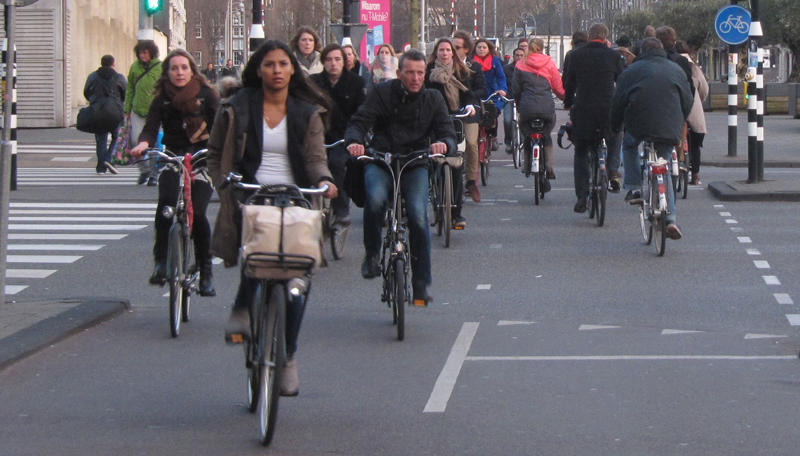
But the pragmatic reality is that in much of the world that has had such a bike culture, you will eventually end up with this:
https://i.ytimg.com/vi/QSXDqDni9VE/maxresdefault.jpg

Cars, although far less dense, are objectively better than the latter case. Safer, quieter, less polluting.
Citation desperately needed. Also, keep in mind there are different ways of defining "safe". Cars are only "safe" inasmuch as they are safer for the occupants and incredibly dangerous for everyone else around. If we considered harm to people _outside_ the car we would view them as much more dangerous (and walking, motorcycling, cycling, etc as being much safer)
You'd also need a road 10x wider for the same volume of traffic.
http://www.bikehub.co.uk/wp-content/uploads/2012/09/Munster1...

> In reality, the effective space taken by cyclist on genera purpose road is bigger than a car — you need a huge safety margin to overtake a cyclis
More than a car? I've certainly not been given more space when people overtake me. Remember a car is 6 feet wide, that's quite a bit of space already that's taken up by a car.
Also, when you have a decent number of cyclists and congested roads they often do travel in packs. See here for an example
https://www.youtube.com/watch?v=h-4ynw8672A
or here
https://www.youtube.com/watch?v=xhuxmiNsHmA
The city in these videos has many cyclists (and one of the most successful bike-share schemes in the world), but rather scandalously provides very little bike infrastructure and even less enforcement (bike lanes are generally used for parking).
Finally, you might wish to note that one generally refers to "riding" a bike in English, rather than "driving". The same goes for motorcycles in most contexts. This is different from some other languages, such as German, where the same word is used for operating all of those conveyances.
http://keyassets.timeincuk.net/inspirewp/live/wp-content/upl...

But that doesn't make the comparison "shitty", it just means you need to do more than convincing people to cycle to get the advantages.
Perhaps you can enlighten us as to how getting hit by a bicycle is comparable to getting hit by a Land Rover?
Please elaborate; I don't really understand what you mean.
But you are right that the cities are more dense.
That's a problem you created yourself, though. You can't say "this would never work here, because we'd never try".
If you change your cities, it would definitely work.
https://en.m.wikipedia.org/wiki/General_Motors_streetcar_con...
Which Europe? ~$100 pr month seems about par for the course for most major cities I've looked at, and some cities, like London, charge quite a bit more.
http://www.navigo.fr/titres/le-forfait-navigo-annuel-tarifs-...
Plus the train has tables, 240V sockets, wifi (which selects the best from several different providers, so better coverage than my phone), all of that. There are seats available from our station on pretty much every train, and the journey time is more reliable than the car.
The vast majority of people who experience motion sickness in cars will also experience motion sickness in trains.
It took years for me to really understand why so many people don't love trains like I do: motion sickness makes the freedom, relaxation, and ability to focus on work I experience not universally shared.
I'd be genuinely interested to know stats for car and train motion sickness, though: I haven't found any on a quick Google. Motion sickness in general appears to be ~30% of the population. Obviously it's not a simple scale: my wife, for example, will get car-sick (without reading) on a fast, bendy journey more easily than I will; neither of us get train-sick; I get sea-sick much worse than she does.
(Let me just pre-empt someone's example of some billionaire somewhere who loves catching buses, I'm sure there's one out there somewhere.)
For what it's worth, the Dutch Prime Minister Mark Rutte cycles to work just like most everyone else in the Netherlands.
Netherlands, of course, being an example of a place having public transport which is exceptionally good and quite often more convenient and more practical than having a private chauffer.
Also, misses the point: the argument that infrastructure in europe is so much better that there is not a demand or a need for services like uber and lyft contradict the necessity of several cities to ban it. Otherwise they wouldnt have had to do anything and they would have failed.
Uber has not been banned in Germany. They provided an illegal service and have never applied for a permit. They have never been legal. They also had drivers operate without the required health certificates and without the required insurance. (The usual "independent contractor and we're just an intermediary" dance didn't fly either - if you're soliciting an illegal service you're not protected by law just be because you're not directly providing the service.)
Please also note that not all of Ubers services in Germany have been illegal and some still operate. Notably, the classic car-for-hire service is legal, but seems to be making losses, so yes, they failed.
> As a taxi your only (and important benefit) is the monopolization of your business by the local government.
The following describes the situation in Berlin. Since Taxi regulation is partly local, things will differ slightly elsewhere, but the gist applies. Data is from 2012, so somewhat outdated but nothing major changed.
Monopoly is not an important benefit for the local taxi industry. There are about 3000 Taxi companies in Berlin, of which the large majority owns 1 car and only about 10% own three or more cars (about 7000 cars, one per 500 inhabitants). Taxi licenses in Berlin are effectively unrestricted. If you want one, prove that you're not convicted of a crime that makes you ineligible, fill in a 6 page form and hand proof of insurance and some papers, pay a fee, wait. Drivers need to pass a health check every few years (vision test etc) and a one-time knowledge test. All in all, a few hundred to a low thousand EUR and you're in business.
However, Uber didn't even consider applying for a local license here, well, "because". They consciously chose to run an unlicensed Taxi service and spin it as if they'd be unfairly treated by authorities. (Eine Runde Mitleid)
Licenses may be restricted in other jurisdictions or even - since it's a part of the public transport network, Taxis may even be subsidized (Ruftaxi for example)
Benefits that Taxis enjoy is that they're allowed to use lanes restricted for public transport (they are public transport) and may stop on any road at any time to pick up passengers. There are restricted parking spaces at airports, train stations and in central locations that are reserved for taxis.
My experience in berlin was that all uber drivers were taxis and as such the rates they had were comparable if not the same to taxi rates. There could be conditions that I did not see as a tourist, but if Uber could freely move its prices it would have been substantially cheaper that regular taxis. It is so even in argentina, where the service is outright declared illegal.
> The following describes the situation in Berlin. Since Taxi regulation is partly local, things will differ slightly elsewhere, but the gist applies. Data is from 2012, so somewhat outdated but nothing major changed.
Monopoly is not an important benefit for the local taxi industry. There are about 3000 Taxi companies in Berlin, of which the large majority owns 1 car and only about 10% own three or more cars (about 7000 cars, one per 500 inhabitants). Taxi licenses in Berlin are effectively unrestricted. If you want one, prove that you're not convicted of a crime that makes you ineligible, fill in a 6 page form and hand proof of insurance and some papers, pay a fee, wait. Drivers need to pass a health check every few years (vision test etc) and a one-time knowledge test. All in all, a few hundred to a low thousand EUR and you're in business.
However, Uber didn't even consider applying for a local license here, well, "because". They consciously chose to run an unlicensed Taxi service and spin it as if they'd be unfairly treated by authorities. (Eine Runde Mitleid) Licenses may be restricted in other jurisdictions or even - since it's a part of the public transport network, Taxis may even be subsidized (Ruftaxi for example) Benefits that Taxis enjoy is that they're allowed to use lanes restricted for public transport (they are public transport) and may stop on any road at any time to pick up passengers. There are restricted parking spaces at airports, train stations and in central locations that are reserved for taxis.
Thanks for the specific Berlin regulations!
I only saw what I saw, didnt look much into it. If the licenses are relatively unrestricted (cheap, easy to obtain and unlimited) then there is very little stopping a regular person from going through that process and joining Uber. Uber could assist in abiding a very easy regulation and i attest that they tend to not even follow the easy ones (In argentina, they didnt even get a tax id). They deserve and it is just that the law applies to them.
Still, prices are still regulated in berlin, meaning that you cant have the business model of uber work the way it usually does, by combining low-earning drivers with consumers. Also, do taxis require to have car identification? That is another way to restrict low-earning drivers into the market. Etc etc.
If it only were doing basic, cheap and unrestricted access to taxi licenses, then anyone would do it and join uber, without uber needing to do much.
Maybe that's what it'll take for the US to improve its public transportation. Having good ol' fashioned private enterprise instead of the government paying for it.
To be fair, these drivers would be out of jobs without Uber. They are not qualified enough to find better paying jobs. Being underpaid is still better than not being paid at all. However, there's a limit to how little Uber can pay its drivers before they start looking for better paying jobs elsewhere. Uber needs to balance this with their need to be profitable in order to keep existing. And they're not profitable already in spite of these low wages. If anything, it's Uber who needs to worry about its existence. Drivers will find jobs elsewhere.
I think Uber started as a high margin business, which is always a great place to be but they quickly turned into a (very) low/negative margin business because of competition which requires exponential growth and constant injection of money to pay for the growth. The amount of pressure on the ceo must be insane, glad I'm not in his shoes (doesn't justify him being a-hole to his driver though obviously).
Any serious driver who is full time will most likely move up to the black cars and get private clients over time.
I had a driver in a brand new Mercedes Benz. He was an older gentleman, that owned three existing companies, and drove for Uber for fun, donating his paychecks to a local community organization.
Friend of my brother bought a van specifically to use for Uber. He is a married stay-at-home dad, and his wife is a practicing MD.
Uber is already hiring lobbyists with the goal of boondoggling municipalities into providing Uber subsidies in lieu of investing in public transit. They talk a big game about how self-driving cars are what's going to make Uber profitable, but that's just marketing to earn some 'cool points' because that tech won't be ready before the VC funding runs dry. They're banking on public subsidies.
Alas I'm driving my own car most days (3-4 days a week) and that's about $20 in toll fees and fuel, not including finance, insurance, reggo and maintenance. It takes from 40-60 minutes each way, so a bit but not significantly faster than riding.
Still if I used uber I'd be looking at $50 each way, easily making car ownership have lower TCO. There's no Lyft in Melbourne, Australia.
That's also not getting into weather changes. It's unequivocally true that biking in winter can be more dangerous and less enjoyable than biking in warmer temperatures.
I personally quite enjoyed biking in beautiful Melbourne, especially along the Portsea Return. But in my home city, the infrastructure is decades behind a truly safe environment for cyclists. Despite the fact that the city is constantly growing and the mass transit system is barely making ends meet, the city council still bickers over the merits of creating more bike lanes which only add to the "War on the Car."
Right now you're spoiled with cheap and fast, which will change eventually; I'd recommend planning for this.
>Sure I want to support those who work for a company that respect them
Do you really? Clearly not to the tune of an additional $250 for daily private car service or additional commute time on the buses.
I think this is the big picture with Uber right now; Uber subsidizing the costs cannot continue forever, or at least it really doesn't look like they can; if public transit isn't an option for you, then you need to be prepared to accept that your costs right now are not reflective of the actual cost to provide the service.
The Uber/Lyft model is very cool and it does meet an important need for many US cities, but unfortunately what is offered now doesn't represent the full cost of supporting such a service. I really appreciate the difficulty you have with your commute - before I moved abroad, I lived in a smaller US city which had tragically experienced a catastrophe with its public transit that resulted in it being even further underfunded. An 3 hour total commute each day does take it out of you, but it's the cost of cities in the US being underfunded for public transit and for cities being designed around everyone owning a car.
You can continue to live off Uber for as long as it lasts, but if you're going to have the same commute long term, it might be better to start putting your money and effort towards trying to improve the public transit; most cities have public transit boards/committees that are happy to have people join them, and the more people they can get to assist, the more influence they can have on local and state governments to improve the situation. Being reliant on Uber pretty much means you're reliant on public transportation, so your choices are either be ready to start paying the actual cost, or work to improve the cheaper public transit alternatives.
More companies that lower transaction costs (these are all the rage in Silicon Valley these days apparently) for this sort of trade would help, as maybe that guy giving you your ride would be better used (and thus slightly better paid) tutoring your kid in math, but the transaction cost of him moving into that line of work is too high. If nothing else exists or can be found that's a good use of their time I'm afraid that's just the breaks. Back to school, or lower your standard of living so that the amount you make is enough. I'm all for a basic income type proposal by the way, but that's a whole other story.
For me to go to work it would be
Uber: $1000 a month, 15 minute drive. Train: $75 a month, takes 5 minutes
If I want to take a train downtown, I can take one of three bus lines to one of two different train lines, all without walking much more than a block. The buses have GPS on them so I don't even have to leave my house until the bus is nearly at the stop. There's also a bike path that gets me 90% of the way from my house to one of the stations. I'm sure I'm not the only one who doesn't want to pay 5-10x more for Uber to avoid 5 minutes of walking.
You are beholden to the bus schedule. Your choice of where to live greatly affects your commute. You have to combine multiple transportation options. If the weather is bad, you are exposed to the elements.
Uber remedies all of the above, and yes, for a price, but not wholly unreasonable. Sure there will always be less expensive options, but Uber appears to be quite reasonable when you consider the big picture. Is it sustainable? They'll show us.
It also has the neat feature of being able to continuously optimise and become more efficient. Most other public transportation does not, is heavily subsidized, and extremely difficult to change.
Typically, whenever I want to go downtown for a big event, I'll find a busline that goes to that area, then trace its route to the outskirts. I go ride/drive there and take the bus in. Much cheaper, less parking hassle.
A great idea for lyft or uber would be judging by your case and thinking your not the only one doing it, to have a "commute to work" service or something similar, where they arrhythmicaly merge people like you that commute from around your location to town etc putting in minibuses with certain stops. The data is there, I mean they can clearly see that you are using Uber at a specific time going from A to B repetitively, if they can find another 15 people doing it around you going to the same place as you, why not put a minibus and then charge you a bit less or a monthly fee? (Of course the downside would be that this would reduce uber jobs around).
Note: I am a country bumpkin who grew up in the sticks and still lives in the sticks, I had to learn how to bus as an adult. Forgive my ignorance.
Summer Lyft driver here.
As a passenger you get the option to choose to get a ride alone, just you and the lyft driver, to your destination like a taxi. This is the default option and it's the most expensive one.
The new option that Uber have and Lyft is doing is pooled rides. Instead of having the Lyft car to yourself, you're willing to share that car with other passengers. Lyft can stop the driver and pick up more passengers that are opting for the pool ride along the way.
The one trick to save money is just do the pool ride option and maybe you won't have a passenger to share with if Lyft can't find any other passenger to pool with.
Club goers such as a bunch of guys or girls wanting to get a lyft ride to the same destination and are friends usually do the first option. It doesn't count as a pool ride. You're all friends not stranger going to the same place and such. There's other trick but that's not as important. If those club goers or group of friends went pool option that won't work because iirc it's meant for single passenger sharing the car with other passenger.
The rates goes down when they pick up the 2nd and 3rd rider, but then at the same time they are gaining more fares. So shouldn't that make up for the rate drop? It's pretty obvious why doing pool for one rider is a huge loss, but I'm not quite sure how it is more of a loss if a 2nd or 3rd rider joins in.
http://therideshareguy.com/how-does-uberpool-pricing-work/
Basically they are paid the same way as an UberX ride, by mile and by time, at a lower rate (0.75/mile vs 0.85/mile). But they are also paid for going out of their way to pick up new people in between, which in uberX they are not compensated for. Some math nerd in the company probably calculated it as equivalent using their historical data, said eureka, and made the business case for uberpool.
But that is way too complicated to understand, so natrually people feel like they are ripped off. If they just made it same uberX rate and just told drivers you get paid for distance and time and do not show them anything else, I don't think they will care. To them it's would be another uberX
I don't know if this is still the case, It's even better because if you get a line at surge/primetime, the whole line is at the elevated rate, whether or not the subsequent riders are. One time, I got a three successive rides that extended a 150% primetime ride on lyft for about an hour and 20 minutes (I'm sure they fixed it so that doesn't happen anymore, ha).
The driver in a pool ride gets paid (not exact figures) 0.8x for passenger 1, 0.7x for 2 and 0.6x for 3 (and so on). Uber/lyft keeps the difference. Genius from ubers end.
Wasn't this the whole point of Uber.
The very reason why people even use Uber is because of this model. A lot of drivers signed up for this because they didn't need to go through the taxi license process or the medallion business.
Now complaining the same doesn't work because there are too many driver driving sending up the supply and lowering demand is some what wrong here.
What were these drivers thinking. Those regulations existed for a reason.
It's kind of shocking to me how bad the public transit is in San Francisco when I go there. I think from a consumer perspective, your best bet is to get involved in politics.
You can't boil all possible use cases of "transport" down to a single implementation. You can't boil all possible traveller budgets down to a single pricing model. etc. etc. There are many axes for determining the appropriateness of a given mode of transport, for a given person.
On top of payments, when you factor in insurance and parking fees(stupidly expensive in some cities), taking Uber/Lyft can work out cheaper.
Motorcycling in the winter on a street motorcycle with summer tires, on the other hand, is extremely dangerous.
I also believe this type of consumers may be less inclined to think about decisions, they themselves or companies they work for, have made to pay that rather handsome salaries.
Btw, couldn't you ride a bike sometimes? 6 miles sounds doable and would, likely, benefit your health.
I didn't mean the op personally, but all who use such a service which imho exploit drivers. One chooses to use such a service and has to shoulder part of the responsability of the bad things that happen at uber atm.
The op would have the lyft alternative (which afaics) has (slightly) better conditions and/or use the bus (or the bike, maybe).
The consumer cannot have that responsibility, because the consumer doesnt agree with the employee what the employee salary is as much as the employee doesn't dictaminate how much the consumer can pay.
Plus its reasonable to react to the best incentives you have, and doing otherwise is actually negative: if uber is cheaper for the same its better to use it. This coming from someone that usually takes Lyft, because i dislike Uber, but if i knew i could get a cheaper ride i would use Uber as I have.
You dont do anyone a favor by staying unreasonable :)
A typical round trip pass for the day costs $23 ($11.50 each way).
You guys had me double check. Where I live (750K city in Europe), you get an unlimited pass for 27€/month. It's your fares that are just unbelievable.
In this situation I'd prefer letting the market decide the prices for drivers. They had jobs before Uber, and if Uber starts paying too little then they can try going back to those kinds of jobs.
Ultimately though, as we run out of unskilled jobs, we may need to implement some sort of living wage the government provides to everyone to give society a floor.
... maybe they should be subsidized by taxes.
Uber: $250 a month.(Majority)
Lyft: $500 a month (Whenever Uber is too expensive)
Bus : $100 a month (1h:15 for 6 miles and 3 buses... No)
Politics and all internal conflicts aside, there is a need for these services whether we like it or not.
When I need to make a decision in the morning I take whatever is the least expensive and more convenient. I don't want to spend hours on the bus and I do not want a good chunk of my paycheck to go to simply getting to work.
Speaking with drivers everyday, I understand their frustration of driving all around town only for very small profit. Just today, I took a ride with a driver that seemed very frustrated. I didn't want to intrude but he ended up tell me how much he hates UberPool (that's what I use). 70 cents per mile, and when a second rider joins the rate goes down, and for the next even lower. We were 3 different riders.
In the riders perspective, we want the cheapest and most reliable. Sure I want to support those who work for a company that respect them but at the end of the day it is not a charity.
What is the answer in the consumer's perspective?
Edit: Formatting