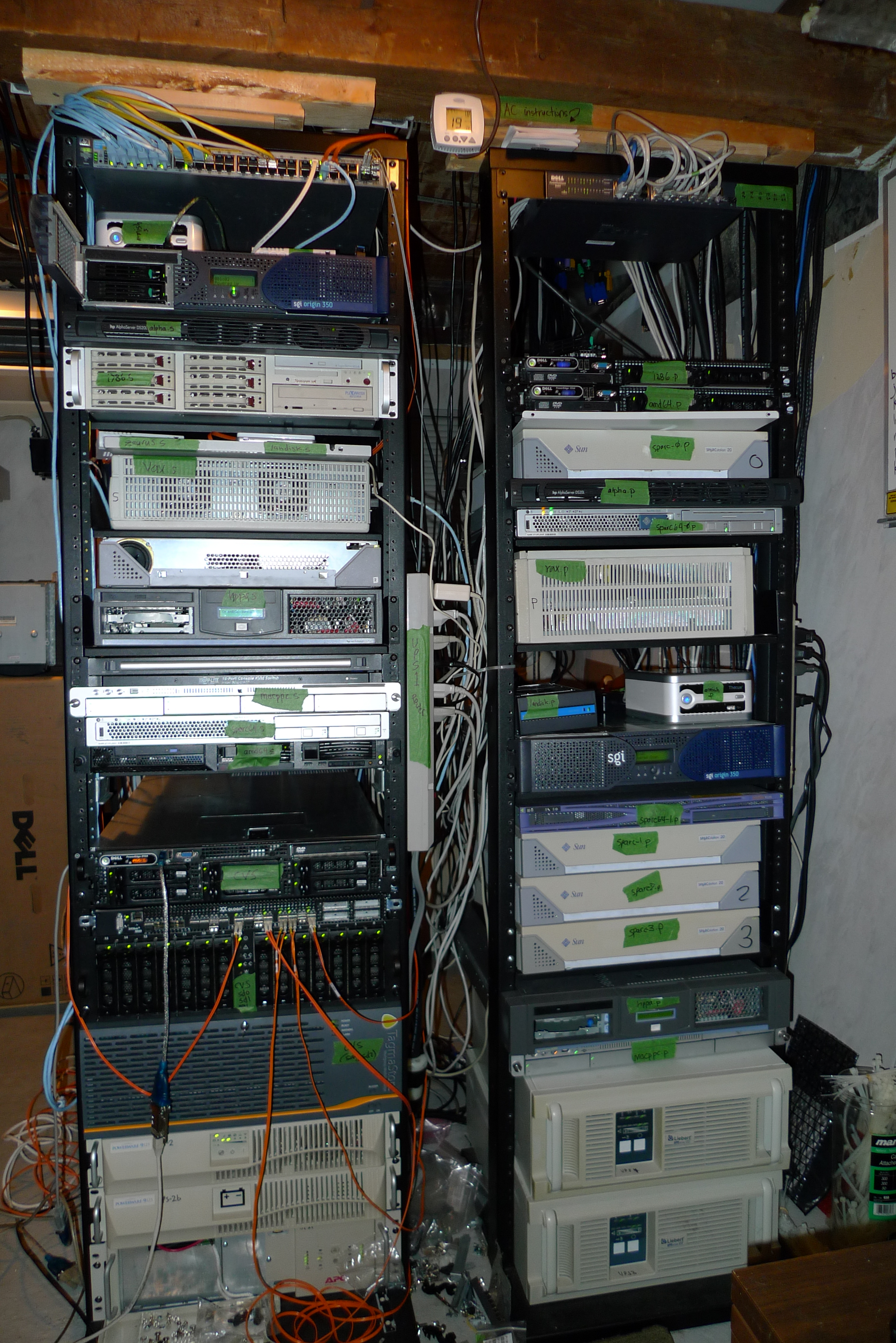
Many of the machines do not have LOM. They have hardware failures instead. They hang because they get trashed building OpenBSD and ports pretty much 24/7. There is debugging and serial cables going on. Someone needs to push that NMI button and check the LEDs flicker like they should. Reboot them. Constantly update to the latest development version, making them panic quite a bit. Diagnose that. Installation procedure requires console access, monitor adapters, weird keyboards, ... They don't fit in racks properly. There are security concerns. Etc, etc.
It's wrong to think of the machine room as rack space than can be had for cheap somewhere else. It's much more like a lab (with the mad professor living on top, controlling the experiment).
I have donated to OpenBSD a number of times because I believe the project is of great value. In all cases where I used a release (for firewalls mostly) I purchased a CD set.
- Is there a significant amount of people with high security standards and an interest in SGI workstation hardware?
- What about people who have high security standards and Sharp Zaurus hardware?
If these groups aren't as important, as say, ARM and x86 users, perhaps it could be worth dropping some of these platforms?
  On a regular basis, we find real and serious bugs which affect all
  platforms, but they are incidentally made visible on one of the
  platforms we run, following that they are fixed.  It is a harsh
reality which static and dynamic analysis tools have not yet resolved.I think Theo could probably thin down the cluster and still be good but maybe I'm wrong and he'll show up with examples that require all of that hardware. That would be interesting because in our case we've sorted out the problems and rarely see things blow up on the RISC boxen.
Personally, I do wish OpenBSD could somehow regain the popularity it once had and that support for modern hardware like 10GBE and scaling PF throughput w/ multi-core CPUs would improve. I don't know what it would take to bring people back.
If there is an argument that maintaining this will somehow improve security overall and not just on ancient hardware then I would love to see it. But if the Devs working on it could care less of what the rest of us think, then maybe those Devs should pay their electricity bills to support their toy platforms because I could care less about what they think too ...
Some of the architectures also have different endianess and incredibly complicated peripherals to the cost effective host machines as well meaning that it's actually more power efficient to run native. A headless 100MHz VAXstation for example draws less power than the equivalent host that would be required to provide a full, accurate emulation with peripherals. These aren't arcade machines.
Portability issues is where real hardware benefits. It's where you have battles of unusual register sizes, endianess, host/network order differences, different memory models and memory protection, different performance characteristics, different timings and different exploits.
Unless the emulation is 100% accurate, including timing, which is a really difficult thing to do (look at the effort MAME goes to), then the benefits over real hardware is moot.
Emulators are also expensive to write due to the above, have their own bugs and don't always recreate the bugs in the real hardware (which are sometimes exploitable).
Also, using emulated hardware could cut down the usage of the real pieces, which could then be better studied and preserved. Doing less builds on vintage hardware is, actually, a good idea.
Then again, it's possible that emulation could surface other edge case issues. That's completely orthogonal to the value of non-emulated archaic architectures for this purpose, however.
If it's worse for the rest of the ecosystem, there's a point.
I'd be interested to hear whether or not this is the case from people closer to such a condition, though (ie: OpenBSD, NetBSD, ???).
This is like saying "I don't care if my arcade goes out of business, I'm going to keep the power hungry cabinets alive even though they only get used once every 3 years."
Sounds good to me. Many times (actually most times) I have no need for a "desktop" metaphor on my screen in order to get things done. I actually get more done big jobs done faster without the desktop metaphor in the way.
"... the devs working on them probably could care less what the rest of us think."
That's what makes them so special.
Perhaps in the long run the most "powerful" and sought after computers will not be the ones with the latest chips, but the ones that the user has the most knowledge of and control over.
Can you imagine the old-timer reminiscing: "Remember when computers didn't have backdoors built-in?" or "Remember when you did not have to pay for a license to write programs for hardware you bought?"
http://www.openbsd.org/sgi.html http://www.openbsd.org/octeon.html http://www.openbsd.org/loongson.html
A mips32 port would also be very desirable for all those shitty little routers with their ancient Linux kernel, but sadly nobody is working on that at the moment.
So, should the network and firewall OS that many people claim OpenBSD is, slash its support for MIPS devices?
But OpenBSD could be testing on an embedded MIPS development device at any data center they want.
Sony Bravia EX series televisions are MIPS and Linux based for example.
MIPS SoC licensing is less expensive than ARM licensing at the smaller volumes inherent in low-end routers (.vs phones and tablets).
"I really love how we keep getting advice. Anyone want to suggest we hold a bake sale?"
He clearly says things like "that's not up for discussion", "I'm not going into details", etc.
If anyone ever truly deserved the title BDFL...
What OpenBSD foundation really needs is a tactful and charismatic person to act as firewall and pf between Theo and the people with overflowing bank accounts, who are more accustomed to dealing with obsequious salesdroids than a person who is not only ten times smarter than their entire golf group put together, but also so aware of it that he cannot hide how much of a waste of time it is for him to suck up to any one of them, no matter how much he could use the cash.
Do you think Apple would have gone anywhere if Wozniak was the one talking to all the investors?
Not that I don't understand those feelings. I've spent enough time lurking on openbsd-misc to have seen Theo and friends be beastly. But never without some provocation. And one might wish better impulse control on any number of online personalities.
(And if you find this rude, note that I'm not involved with OpenBSD -- not even on the mailing list anymore -- so blame me, not 'the OpenBSD community'.)
Change is hard, but I think it's worth a shot. And you never know maybe spending more time focused on real needs will create a better product from all the extra attention given to things that are work worthy.
And, the OpenBSD development team has contributed a lot to the software community, so it's extra frustrating not to get enough support back.
I'd expect that at some point it just stops being a fight you want to keep fighting.
a) Shut down OpenBSD
b) Shut down Amiga support in OpenBSD
I mean, is it even a hard choice?
Besides, if there are many developers who like developing for Amiga, surely they would be able to find a replacement?
There are two important points that shouldn't be forgotten about aggressively pushing cross-platform: it retains developers and exposes bugs. There's a great deal of usefulness behind it, beyond simply making it obvious that the workstations we get today are shit.
I am not suggesting all legacy platforms need to be cut. I'm suggesting that it's possibly an acceptable risk, and also if a replacement UltraSPARC simply cannot be sourced, there can't be that many developers working on UltraSPARC anyway. (Just as an example)
the fact is right now, OpenBSD will shut down if we do not have the funding to keep the lights on.
suggests the necessary $20k (cash) has not been forthcoming.
P.S. I understand it's not a threat in the sense of ransom etc, but the most correct word is not coming to my mind.
All three options exist, but the maintainers pretending that option b doesn't exist at this point in time increases the probability that option c will succeed.
If the pretense doesn't work, be very much assured that they will go with option b.
It reminded me of a post-it I left in the company lab with a diagram for how to do proper gigabit cross-overs. I could still find it there five years later after they rearranged the lab several times.
Here's a link that does not require IEEEXplore access: http://www.scribd.com/doc/46141801/802-3ab-1999
It seems likely that they don't trust anyone else to have physical access to the machines for security reasons. Their threat model probably includes national governments.
My first "real" job was in the mid-90's; I was the first technical hire at a small Chicago ISP (EnterAct) that grew into a relatively large ISP (when I left, we were default-free peered to several tier-1 providers and had more POPs than I can name). It was great, and the team that started it --- two Big-5 accounting firm programmers --- was inspiring, particularly when it came to business strategy.
Anyways, very early on, EnterAct managed to maneuver into a reputation for premium customer support. We got that reputation by doing some concrete things differently than our competitors: we staffed an appropriate number of CSRs, trained them to be nice to customers, did a lot of gratuitous tech support for basic computer problems, and were flexible about resolving billing disputes. Sadly, a lot of those things were differentiators at the time. A couple years in and we were essentially able to hang "best customer support" on our list of features, and eventually we became the most popular ISP in Chicago largely based on that.
But something I came to notice pretty quickly: the things we were doing to earn that support reputation stopped being empirical differentiators pretty quickly. Our largest competitor, run by Karl Denninger, did us a continuing series of favors by pissing off their customers. But other large regional ISPs pretty quickly learned not to set fire to their customer base, and, by the end, I think our customer service was pretty much at par for the whole area; we were no longer truly different based on support. The reputation, however, never left.
That observation has stuck with me for my entire career. I think about it all the time. It's banal, I know: "early impressions count a lot", but there's a little more to it than that: you can weaponize an early impression by turning it into your market positioning and having some message discipline.
I left EnterAct for a job in Calgary with a company called Secure Networks (SNI), doing development and security research. For the year prior to leaving EnterAct, I had also been working with the OpenBSD project, mostly by writing all their security advisories, but also doing a bit of part-time security research. SNI operated the world's first commercial vulnerability research team, and had a very close relationship with Theo; we had a full time employee who had essentially led the first OpenBSD security audit. I went drinking with Theo many times, and vividly remember hanging out in his basement with Tim Newsham eating bad pizza and trying to find vulnerabilities in Daniel Bernstein's qmail (we found one that would work if integers were 128 bits, but ironically missed the LP64 bugs that Georgi Guninski found; it was 1997, though).
This is all a long prelude to a simple point, which is that I think OpenBSD's reputation for security works in a very similar way to how EnterAct's reputation worked. OpenBSD started doing something very different than FreeBSD, Linux, and (particularly) NetBSD: they did an OS-wide audit for vulnerabilities, and aggressively fixed apparent bugs whether or not we could demonstrate that they were exploitable. That was a great move. But it was so obviously great that pretty much everyone (with the possible exception of NetBSD) quickly adopted the practice.
Among security research insiders, OpenBSD's reputation became a little bit farcical. Not that OpenBSD was comically insecure --- it wasn't --- but that its reputation so far outstripped its actually differentiation. People found a bunch of vulnerabilities in OpenBSD and laughed as the claim at the top of the OpenBSD changed from "no vulnerabilities" to "no remotely exploitable vulnerabilities in the default install".
And at some point in the last 10 years, didn't OpenBSD's distro servers get owned up?
I'm sure the OpenBSD project would like its threat model to include NSA. But OpenBSD is not a meaningful ally in a contest between you and NSA. NSA wins that fight. OpenBSD's userland was much stronger than FreeBSD's in 1999, but I'm not sure I think their kernel is stronger in 2013, and that's probably what matters more.
Let me wind this bloviation up with a caveat: one thing a reputation for security gets you is a feed of talent that is interested in working on security problems. OpenBSD certainly got that. So for instance, OpenBSD's developers designed and built privilege-separated OpenSSH. There is a lot of good security work that has started inside the OpenBSD project, and I don't mean to talk any of that stuff down. I'd just be careful about taking the project's overall reputation to the bank, especially if you have serious adversaries.
Sorry for hanging this sprawling comment off your (simpler) point; I just don't want the root comment on the thread to be me talking down OpenBSD.
Back when I was in high school and I had a lot of free time and all that, the various incarnations of Linux were a delight. Even after that, I still went with it out of inertia and spent many evenings tweaking Gentoo.
I eventually just goddamn gave up. I got sick of every upgrade breaking something in my system and then especially got sick of deciding between figuring out how to use wpa_supplicant and installing NetworkManager which screws up my network settings as soon as I plug in the Ethernet cable while I'm still on my wireless. In a flight of rage I thought ok, I've had enough of this crap, and went the OpenBSD route.
Seriously, it has all the nice parts of Plan 9 while still actually being able to run all the tools I need. I still have Linux and Windows boxes for the odd tools that don't work on anything else (I do embedded systems for a living, and there's a lot of vendor lockdown there), but for my day-to-day workstation, I found nothing better.
In 2009, our development team lost a whole 10 hours to a degraded Linux mdadm RAID1 that wouldn't rebuild due to an obscure error after a digger severed our power and internet connection. No internet access as power came up first so no access to online help. mdadm is buggy. Documentation sucks. Error messages suck. Only recourse was a full restore from tape which took a long time. This was the last straw after over a decade of dealing with this crap from network dropouts, laziness, half-arsed features, distro wars, politics and churn.
Some previous Unix experience in the late 1990s with OpenBSD on an old SparcStation 5 (the only thing that would run on that machine nicely) jumped into my mind on the way home. It had that warm, fuzzy, well-engineered, well-documented feeling about it, like an old HP RPN calculator. Got home, downloaded it and installed it on my laptop, replacing Ubuntu.
4 years down the line: one happy person with the same laptop running 5.4 still with that warm, fuzzy, well-engineered, well-documented feeling.
Not once has it let me down. Not for a minute in the 4000+ hours I've been using it. It just works.
When I got thrown in the deep end with Solaris, many years ago, I'd read the Solaris man page for the options, but first I'd read the OpenBSD man page to work out what the hell the command was for and why.
I don't know if this is common practice anymore...I don't remember the last time I saw a defective man page like this, but I still remember it with great anger. I love GNU, but I hate the kind of condescension it takes to try to force someone to use a different tool because you believe it to be superior to the standard tool (when it's really not; I find info pages to be obtuse to create, and difficult to read).
The problem lies when you want to find something 1% of the time, and it's here that man pages become sprawling unindexed messes. For example, take a look at the man pages for perl or zsh: you'll have no chance finding anything, as those programs are so large that they need a wealth of documentation to go into them. At the same time, the info page for ls contains the things you rarely need to see such as exactly how things are sorted or the minute details of timestamp formatting. If this were all in the man page, you'd complain that you couldn't find anything in it.
Now I no longer have anger management issues
But we have other hypertext formats available. It'd be better if GNU started using some format that everybody already usees and knows how to write.
If you need a complex manual for a complex program, something is wrong.
I mean, the project wants to create an operating system that looks like UNIX, acts like UNIX, smells like UNIX, but from scratch with appropriate license that allows usage and access to source to anyone - so that the project doesn't get into legal trouble from whoever actually owns UNIX?
So drunk Stallman in 1981 says: "hik, let's call this, hik operhikating system GNU, hik, because it's not UNIX hik, but it sure looks like one, hik, but it's not, hik, but it kinda is hik, but it's not theirs hik it's everyone's hik". That's how I like to imagine it happened.
1: My go-to example was always ifconfig, but linux's manpage for ip(8) really isn't that bad, as is actually the linux equivalent. Quality probably varies quite a bit based on the package that supplies the utility though, while OpenBSD's quality is fairly universal.
Any bug numbers? I'm not seeing that on Debian Wheezy or CentOS.
But I have just ordered a CD set to try this OpenBSD to see what all the fuss is about and to learn something.
Yes, a cvs bug I believe. No kernel will protect you from bad user-mode code that really wants to execute everybody's shell script.
> Among security research insiders, OpenBSD's reputation became a little bit farcical.
I spent lots of time looking through the OpenBSD Kernel, togheter with FreeBSD and Linux kernel. It was my job for years, looking for vulns and writing exploits for them.
I still admire the OpenBSD Kernel for their simplicity and tidiness.
No comparision to FreeBSD kernel-side. FreeBSD kernel often have commits of several hundreds of KBs of mostly unaudited code. They still don't enable stack-protection today in 2014. It's a joke. My windows phone had stack protection in 2003.
No comparision to Linux either, the Linux kernel is so huge, so full of code that even if it's way more audited than FreeBSD, there are still vulns lurking everywhere and exploits for linux kernel came out almost monthly. Probably it's the reason it have so many security features, more than OpenBSD nowadays.
Windows, their kernel is a work of art. Microsoft only have to fire the guy that says "hey I got a great idea lets parse some random protocol inside the kernel"
But I disgress. OpenBSD is still very good. Very safe in the default install. It will protect your firefox from being owned by a NSA-sized enemy that really want to hack you? no. But the problem is in the browser, not in the kernel. Don't use a big browser. It's not in the default install :)
Missing entirely the point of the parent post. I can claim anything is secure if I seal it in enough concrete.
That may explain why unlike all other operative systems out there, OpenBSD distro gets smaller as time passes.
Well said.
Sorry for my slightly o/t comment.
Pretty sure that was a solaris box.
Fortunately for me, I never had a CSR interaction with them. I used them until they augured in.
I think I started when it really was only Karl, was Dawn his first hire? Hmm, I probably still have the t-shirt as well.
[email protected] (or .net)
And that was my shortest email ever--11 characters complete.
Isn't he in a better position to decide what's unacceptable than you are?
It's not a big deal, and I don't expect him to go into detail. He just won't get a cent from me without elaborating, and that's OK. I'm not mad, and I understand he has mis-givings. I just don't think that answer is acceptable enough for me to donate, but that's my subjective opinion (and not everyone else's).
The more transparency you have in your discussion, the more supportive people will be.
I think that's total, obvious nonsense and if you need to be convinced, here's an exercise: consider how much money the average nonprofit would raise if people knew where all that money went.
Because every US nonprofit is required by law to do that. You can browse it all on line: http://foundationcenter.org/findfunders/990finder/
The web is bringing a lot of good transparency to nonprofits but there's still a lot of repugnant wastefulness and avarice that often isn't captured well by a 990 form. (publishing salaries is pretty huge, though)
I stand by my point that the more a person learns about the average charity the less they're going to want to donate... transparency doesn't magically lead to supportiveness. And wanting a project to account for every watt of electricity is just completely silly.
edit: transparency is a way for better charities to look good relative to poor ones, yes, but all things being equal, it's a negative for fundraising: as with business and government, a lot of what goes on in ANY organization is ugly to look at and is bound to turn some people off. (none of that is an argument against transparency itself, let's just not kid ourselves about its usefulness for raising money)
Transparency is critical.
I'm sure there are some people with unrealistic standards that would not donate at all. And I'm sure that there are plenty of organizations that take advantage of a lack of transparency to do dubious things. But the solution to that is more transparency. And more analysis of the transparent information, so that people can easily contextualize it.
That being said since OpenBSD is all about security maybe that's the reason they don't want to move the servers to some place where they won't be able to monitor physical access to the machines. That's pure speculation though.
Apparently, there isn't very much documentation/open accounting, and they aren't willing to discuss options to reduce the bill. That doesn't inspire confidence.
It is a lot of work for a small team to itemize and publish every expense, but some rough breakdown of monthly expenses that my donation would be going towards would really help.
OpenBSD releases quality software that all of us use EVERY SINGLE DAY as far as I'm concerned Theo can take the money and buy a yacht with it as long as they keep doing what they are doing.
Also keep in mind that a lot of contributors might not use OpenBSD, yet they might be interested in offering some small amount if they believe it's for a good cause and they know where that money is going.
So your feeling is similar to that toward a homeless dude? You'll give him a sandwich but not cash? If they're saying power is the shortfall, maybe we just need to buy them some solar panels or wind generators or something.
Of course, if an IBM/Apple/Google/etc offers space/power, it may be a less risky proposition.