Source: PhD on aircraft design
> “What actually causes lift is introducing a shape into the airflow, which curves the streamlines and introduces pressure changes – lower pressure on the upper surface and higher pressure on the lower surface,” clarified Babinsky, from the Department of Engineering. “This is why a flat surface like a sail is able to cause lift – here the distance on each side is the same but it is slightly curved when it is rigged and so it acts as an aerofoil. In other words, it’s the curvature that creates lift, not the distance.”
The meta-point that "it's the curvature that creates the lift, not the distance" is incredibly subtle for a lay audience. So it may be completely wrong for you, but not for 99.9% of the population. The pressure differential is important, and the curvature does create lift, although not via speed differential.
I am far from an AI hypebeast, but this subthread feels like people reaching for a criticism.
That doesn't matter for lay audieces and doesn't really matter at all until we try and use them for technical things.
The real question is, if you go back to the bot following this conversation and you challenge it, does it generate the more correct answer?
The video in the Cambridge link shows how the upper surface particles greatly overtake the lower surface flow. They do not rejoin, ever.
> Yes geometry has an effect but there is zero reason to believe leading edge particles, at the same time point, must rejoin at the trailing edge of a wing.
...implicitly concedes that point that this is subtle. If you gave this answer in a PhD qualification exam in Physics, then sure, I think it's fair for someone to say you're wrong. If you gave the answer on a marketing page for a general-purpose chatbot? Meh.
(As an aside, this conversation is interesting to me primarily because it's a perfect example of how scientists go wrong in presenting their work to the world...meeting up with AI criticism on the other side.)
...only if you omit the parts where it talks about pressure differentials, caused by airspeed differences, create lift?
Both of these points are true. You have to be motivated to ignore them.
Funnily enough, as an undergraduate the first explanation for lift that you will receive uses Feynman's "dry water" (the Kutta condition for inviscid fluids). In my opinion, this explanation is also unsatisfying, as it's usually presented as a mere mathematical "convenience" imposed upon the flow to make it behave like real physics.
Some recent papers [1] are shedding light on generalizing the Kutta condition on non-sharp airfoils. In my opinion, the linked papers gives a way more mathematically and intuitively satisfying answer, but of course it requires some previous knowledge, and would be totally inappropriate as an answer by the AI.
Either way I feel that if the AI is a "pocket PhD" (or "pocket industry expert") it should at least give some pointers to the user on what to read next, using both classical and modern findings.
[1]: https://www.researchgate.net/publication/376503311_A_minimiz...
Is it correct? Yes. Is it intuitive to someone who doesn’t have a background in calculus, physics and fluid dynamics? No.
People here are arguing about a subpoint on a subpoint that would maybe get you a deduction on a first-year physics exam, and acting as if this completely invalidates the response.
There's nothing in the Navier-Stokes equations that forces an airfoil to generate lift - without boundary conditions the flowing air could theoretically wrap back around at the trailing edge, thus resulting in zero lift.
It’s not the same thing at all, though. We don’t know what “got life started”, and that’s the realm of faith.
This is more like saying that “evolution is due to random mutation”, which is technically wrong, but close enough to get the point across.
If I lay out a chain of thought like
Top and bottom are different -> god doesnt like things being diffferent and applies pressure to the bottom of the wing -> pressure underneath is higher than the top -> pressure difference creates lift
Not to say they can't be useful tools but they fall into the same basic traps and issues despite our continues attempts to improve them.
It gets complex if you want to fully model things and make it fly as efficiently as possible, but that isn't really in the scope of the question.
Planes go up because they push air down. Simple as that.
Air molecules travel in all directions, not just down, so with a pressure differential that means the air molecules below the wing are applying a significant force upward, no longer balanced by the equal pressure usually on the top of the wing. Thus, lift through boyancy. Your question is now about the same as "why does wood float in water"?
The "throwing something down" here comes from the air molecules below the wing hitting the wing upward, then bouncing down.
All the energy to do this comes from the plane's forward momentum, consumed by drag and transformed by the complex fluid dynamics of the air.
Any non-zero angle of attack also pushes air down, of course. And the shape of the wing with the "stickiness" of the air means some more air can be thrown down by the shape of the wing's top edge.
You wouldn't explain how swimming works with pressure differentials. You'd just say "you push water backwards and that makes you go fowards". If you start talking about pressure differentials... maybe you're technically correct, but it's a confusing and unnecessarily complex explanation that doesn't give the correct intuitive idea of what is happening.
It is not that simple.
The point is that a flat plane with full flow separations is the minimum necessary physics to explain lift. It would obviously make a terrible wing, and it doesn't explain everything about how real wings are optimised. That's not the point.
In any case, I only said the wing pushes the air down. I didn't say it only uses its bottom surface to push the air down.
https://www.grc.nasa.gov/www/k-12/VirtualAero/BottleRocket/a...
The "wrong" answers all have a bit of truth to them, but aren't the whole picture. As with many complex mathematical models, it is difficult to convert the math into English and maintain precisely the correct meaning.
Exactly. The comments in this subthread are turning imprecision in language into all-or-nothing judgments of correctness. (Meanwhile, 80% of the comments advance their own incorrect/imprecise explanations of the same thing...)
They spout common knowledge on a broad array of subjects and it's usually incorrect to anyone who has some knowledge on the subject.
I've always been under the impression that flat-plate airfoils can't generate lift without a positive angle-of-attack - where lift is generated through the separate mechanism of the air pushing against an angled plane? But a modern airfoil can, because of this effect.
And that if you flip them upside down, a flat plate is more efficient and requires less angle-of-attack than the standard airfoil shape because now the lift advantage is working to generate a downforce.
I just tried to search Google, but I'm finding all sorts of conflicting answers, with only a vague consensus that the AI-provided answer above is, in fact, correct. The shape of the wing causes pressure differences that generate lift in conjunction with multiple other effects that also generate lift by pushing or redirecting air downward.
There is no requirement for air to travel any where. Let alone in any amount of time. So this part of the AI's response is completely wrong. "Same amount of time" as what? Air going underneath the wing? With an angle of attack the air under the wing is being deflected down, not magically meeting up with the air above the wing.
If you look at airflow over an asymmetric airfoil [1], the air does move faster over the top. Sure, it doesn't arrive "at the same time" (it goes much faster than that) or fully describe why these effects are happening, but that's why it's a simplification for lay people. Wikipedia says [2]:
> Although the two simple Bernoulli-based explanations above are incorrect, there is nothing incorrect about Bernoulli's principle or the fact that the air goes faster on the top of the wing, and Bernoulli's principle can be used correctly as part of a more complicated explanation of lift.
But from what I can tell, the root of the answer is right. The shape of a wing causes pressure zones to form above and below the wing, generating extra lift (on top of deflection). From NASA's page [3]:
> {The upper flow is faster and from Bernoulli's equation the pressure is lower. The difference in pressure across the airfoil produces the lift.} As we have seen in Experiment #1, this part of the theory is correct. In fact, this theory is very appealing because many parts of the theory are correct.
That isn't to defend the AI response, it should know better given how many resources there are on this answer being misleading.
And so I don't leave without a satisfying conclusion, the better layman explanation should be (paraphrasing from the Smithsonian page [4]):
> The shape of the wing pushes air up, creating a leading edge with narrow flow. This small high pressure region is followed by the decline to the wider-flow trailing edge, which creates a low pressure region that sucks the air on the leading edge backward. In the process, the air above the wing rapidly accelerates and the air flowing above the top of the wing as a whole forms of a lower pressure region than the air below. Thus, lift advantage even when horizontal.
Someone please correct that if I've said something wrong.
[1]: https://upload.wikimedia.org/wikipedia/commons/9/99/Karman_t...
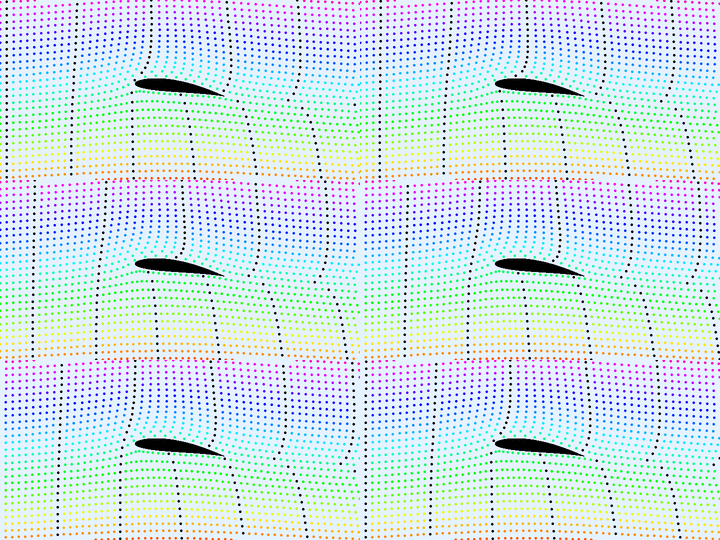
[2]: https://en.wikipedia.org/wiki/Lift_%28force%29
[3]: https://www.grc.nasa.gov/www/k-12/VirtualAero/BottleRocket/a...
The function of the curvature is to improve the wing's ability to avoid stall at a high angle of attack.
Symmetric airfoils do not generate lift without a positive angle of attack. Cambered airfoils do, precisely because the camber itself creates lift via Bernoulli.
And that seems to directly conflict with the models shown by the resources above? They state that cambered wings do have increased airspeed above the wing, which generates lift via pressure differential (thus why the myth is so sticky).
The crucial thing you need to explain is this: why doesn't extending leading edge droop flaps increase the lift at a pre-stall angle of attack? (See Figure 13 from this NASA study for example: https://ntrs.nasa.gov/citations/19800004771)
What is your point? Where do you think lift comes from?
My point is the wing causes a pressure differential by redirecting air. Air speed changes are a side effect of lift not a cause of lift.
The other way around is something (magic fairies?) causes an air speed imbalances, that causes a pressure differential.
The leading edge pressurizes the air by forcing air up, then the trailing edge opens back up, creating a low pressure zone that sucks air in the leading edge back. As a whole, the air atop the wing accelerates to be much faster than the air below, creating a pressure differential above and below the wing and causing lift.
The AI is still wrong on the actual mechanics at play, of course, but I don't see how this is significantly worse than the way we simplify electricity to lay people. The core "air moving faster on the top makes low pressure" is right.
The explanation we're talking about is why cambered wings generate lift when flying level.
(Also, once you've got the 'moving faster' you can then tell a mostly correct story through bernuolli's principle to get to lower pressure on the top and thus lift, but you're also going to confuse people if you say this is the one true story and any other explaination, like one that talks about momentum, or e.g. the curvature of the airflow causing the pressure gradient instead is wrong, because these are all simply multiple paths through the same underlying set of interactions which are not so easy to fundamentally seperate into cause and effect. But 'equal transit time' appears in none of the correct paths as an axiom, nor a necessary result, and there's basically no reason to use it in an explanation, because there's simpler correct stories if you want to dumb it down for people)
“This is why a flat surface like a sail is able to cause lift – here the distance on each side is the same but it is slightly curved when it is rigged and so it acts as an aerofoil. In other words, it’s the curvature that creates lift, not the distance.”
But like you say flat plates can generate lift at positive AoA, no curvature (camber) required. Can you confirm this is correct? Kinda going crazy because I'd very much expect a Cambridge aerodynamicist to get this 100% right.
It could be argued that preventing a stall makes it responsible for lift in an AoA regime where the wing would otherwise be stalled -- hence "responsible for lift" -- but that would be far fetched.
More likely the author wanted to give an intuition for the cuvature of the airflow. This is produced not by the shape of the airfoil but the induced circulation around the airfoil, which makes air travel faster on the side of the far surface of an airfoil, creating the pressure differential.
People seem to overcomplicate what LLM's are capable of, but at their core they are just really good word parsers.
Most of the phd’s I know are studying things that I guarantee GPT-5 doesn’t know about… because they’re researching novel stuff.
Also, LLMs don’t have much consistency with how well they’re able to apply the knowledge that they supposedly have. Hence the “lots of almost correct code” stereotype that’s been going around.
I was using the fancy new Claude model yesterday to debug some fast-check tests (quickcheck-inspired typescript lib). Claude could absolutely not wrap its head around the shrinking behavior, which rendered it useless for debugging
https://www.grc.nasa.gov/www/k-12/VirtualAero/BottleRocket/a...
It’s very common to see AI evangelists taking its output at face value, particularly when it’s about something that they are not an expert in. I thought we’d start seeing less of this as people get burned by it, but it seems that we’re actually just seeing more of it as LLMs get better at sounding correct. Their ability to sound correct continues to increase faster than their ability to be correct.
Sounds like a core skill for management. Promote this man (LLM).
Meanwhile the demo seems to suggest business as usual for AI hallucinations and deceptions.
This is the problem with AI in general.
When I ask it about things I already understand, it’s clearly wrong quite often.
When I ask it about something I don’t understand, I have no way to know if its response is right or wrong.
In fact I'd classify it as downright strange.
This is an LLM. "Wrong" is not a concept that applies, as it requires understanding. The explanation is quite /probable/, as evidenced by the fact that they thought to use it as an example…
I asked ChatGPT for help with Wordle the other day, by asking for a 5-letter word that contained P, M, K and Y. It said:
> Yes, the word skimp contains the letters P, M, K, and Y
Would you say that wrong is not a concept that applies to this answer?
>In fact, theory predicts – and experiments confirm – that the air traverses the top surface of a body experiencing lift in a shorter time than it traverses the bottom surface; the explanation based on equal transit time is false.
So the effect is greater than equal time transit.
I've seen the GPT5 explanation in GCSE level textbooks but I thought it was supposed to be PhD level;)
> “What actually causes lift is introducing a shape into the airflow, which curves the streamlines and introduces pressure changes – lower pressure on the upper surface and higher pressure on the lower surface,” clarified Babinsky, from the Department of Engineering. “This is why a flat surface like a sail is able to cause lift – here the distance on each side is the same but it is slightly curved when it is rigged and so it acts as an aerofoil. In other words, it’s the curvature that creates lift, not the distance.”
So I'd characterize this answer as "correct, but incomplete" or "correct, but simplified". It's a case where a PhD in fluid dynamics might state the explanation one way to an expert audience, but another way to a room full of children.
The hilarious thing about this subthread is that it's already getting filled with hyper-technical but wrong alternative explanations by people eager to show that they know more than the robot.
It's called the "equal transit-time fallacy" if you want to look it up, or follow the link I provided in my comment, or perhaps the NASA link someone else offered.
Pretty much any scientific question is fractal like this: there's a superficial explanation, then one below that, and so on. None are "completely incorrect", but the more detailed ones are better.
The real question is: if you prompt the bot for the better, deeper explanation, what does it do?
The equal transit time is not a partially correct explanation, it's something that doesn't happen. It's not a superficial explanation, it's a wrong explanation. It's not even a good lie-to-children, as it doesn't help predict or understand any part of the system at any level. It instead teaches magical thinking.
As to whether it matters? If I am told that I can ask my question to a system and it will respond like a team of PhDs, that it is useful to help someone with their homework and physical understanding, but it gives me instead information that is incorrect and misleading, I would say the system is not working as it is intended to.
Even if I accept that "audience matters" as you say, the suggested audience is helping someone with their physics homework. This would not be a suitable explanation for someone doing physics homework.
Wow. Thanks for your worry, but it's not a problem. I do understand the difference, and yet it doesn't have anything to do with the argument I'm making, which is about presentation.
> It's not even a good lie-to-children, as it doesn't help predict or understand any part of the system at any level.
...which is irrelevant in the context. I get the meta-point that you're (sort of) making that you can't shut your brain off and just hope the bot spits out 100% pedantic explanations of scientific phenomenon. That's true, but also...fine?
These things are spitting out probable text. If (as many have observed) this is a common enough explanation to be in textbooks, then I'm not particularly surprised if an LLM emits it as well. The real question is: what happens when you prompt it to go deeper?
If this is "right enough" for you, I'm curious if you tell your bots to "go deeper" on every question you ask. And at what level you expect it to start telling you actual truths and not some oft-repeated lie.
The answer got all of the following correct:
* lift is created by pressure differential
* pressure differential is created by difference in airspeed over the top of the wing
* shape of the wing is a critical factor that results in airspeed difference
All of those are true, and upstream of the thing you’re arguing about.
The answer is not wrong. It’s not even “mostly wrong”. It’s mostly correct.
then why ask a bot at all ? they are supposed to be approaching superintelligence, but they fall back on high school misconceptions?
> Air over the top has to travel farther in the same amount of time
is not true. The air on top does not travel farther in the same amount of time. The air slows down and travels a shorter distance in the same amount of time.
It's only "good enough for a classroom of children" in the same way that storks delivering babies is—i.e., if you're content to simply lie rather than bothering to tell the truth.
An LLM doesn't know more than what's in the training data.
In Michael Crichton's The Great Train Robbery (published in 1975, about events that happened in 1855) the perpetrator, having been caught, explains to a baffled court that he was able to walk on top of a running train "because of the Bernoulli effect", that he misspells and completely misunderstands. I don't remember if this argument helps him get away with the crime? Maybe it does, I'm not sure.
This is another attempt at a Great Robbery.
It goes on:
> At this point, the prosecutor asked for further elucidation, which Pierce gave in garbled form. The summary of this portion of the trial, as reported in the Times, was garbled still further. The general idea was that Pierce--- by now almost revered in the press as a master criminal--- possessed some knowledge of a scientific principle that had aided him.
How apropos to modern science reporting and LLMs.
Post-training for an LLM isn't "data" anymore, it's also verifier programs, so it can in fact be more correct than the data. As long as search finds LLM weights that produce more verifiably correct answers.
And I might be wrong but my understanding is that it's not wrong per-se, it's just wildly incomplete. Which, is kind of like the same as wrong. But I believe the airfoil design does indeed have the effect described which does contribute to lift somewhat right? Or am I just a victim of the misconception.
A quite good example of AI limits
This seems like a reasonable standard to hold GPT-5 to given the way it’s being marketed. Nobody would care if OpenAI compared it to an enthusiastic high school student with a few hours to poke around Google and come up with an answer.
Do you think there could be a depth vs. breadth difference? Perhaps that PhD aerospace engineer would know more in this one particular area but less across an array of areas of aerospace engineering.
I cannot give an answer for your question. I was mainly trying to point out that we humans are highly fallible too. I would imagine no one with a PhD in any modern field knows everything about their field nor are they immune to mistakes.
Was this misconception truly basic? I admittedly somewhat skimmed those parts of the debate because I am not knowledgeable enough to know who is right/wrong. It was clear that, if indeed it was a basic concept, there is quite some contention still.
> This seems like a reasonable standard to hold GPT-5 to given the way it’s being marketed.
Sure, I suppose I can agree with this.
Regardless, my claim was not to argue that LLMs are more capable than people. My point was that I think there is a bit of a selection bias going on. Perhaps conjecture on my part, but I am inclined to believe that people are more keen to notice and make a big fuss over inaccuracies in LLMs, but are less likely to do so when humans are inaccurate.
Think about the everyday world we live in: how many human programmed bugs make it past reviews, tests, QA, and into production? How many doctors give the wrong diagnosis or make a mistake that harms or kills someone? How many lawyers give poor legal advice to clients?
Fallible humans expecting infallible results from their fallible creations is quite the expectation.
We built tools to accomplish things we cannot do well or at all. So we do expect quite a lot from them, even though we know they're not perfect. We have writings and books to help our memory and knowledge transfer. We have cars and planes to transport us faster than legs ever could... Any apparatus that doesn't help us do something better is aptly called a toy. A toy car can be faster than any human, but it's still a toy.
Common misconceptions should be expected when you train a model to act like the average of all humans.
These are places where common lay discussions use language in ways that is wrong, or makes simplifcations that are reasonable but technically incorrect. They are especially common when something is so 'obvious' that experts don't explain it, the most frequent version of the concepts being explained
These, in my testing, show up a lot in LLMs - technical things are wrong when the most language of the most common explanations simplifies or obfuscates the precise truth. Often, it pretty much matches the level of knowledge of a college freshman/sophmore or slightly below, which is sort of the level of discussion of more technical topics on the internet.
https://jimruttshow.blubrry.net/the-jim-rutt-show-transcript...
> For an airplane wing (airfoil), the top surface is curved and the bottom is flatter. When the wing moves forward:
> * Air over the top has to travel farther in the same amount of time -> it moves faster -> pressure on the top decreases.
> * Air underneath moves slower -> pressure underneath is higher
> * The presure difference creates an upward force - lift
Isn't that explanation of why wings work completely wrong? There's nothing that forces the air to cover the top distance in the same time that it covers the bottom distance, and in fact it doesn't. https://www.cam.ac.uk/research/news/how-wings-really-work
Very strange to use a mistake as your first demo, especially while talking about how it's phd level.