The former is doing great.
The latter has grown and shifted. I grew up in a rural community that was in the process of unraveling from a prosperous farming and light industrial area to a rural slum. There are zero operational farms in that area today. The one I worked for as a teen was in continuous operation since the Dutch colonial period.
That’s an example of why the nihilism of MAGA is so appealing. The world is collapsing around many people.
These issues are caused by demographics and macro trends. The laws have changed to facilitate generational wealth transfer, and that process will change the way the economy works and further fuel unrest. This stuff is unlikely to get fixed in my lifetime.
https://substackcdn.com/image/fetch/f_auto,q_auto:good,fl_pr...
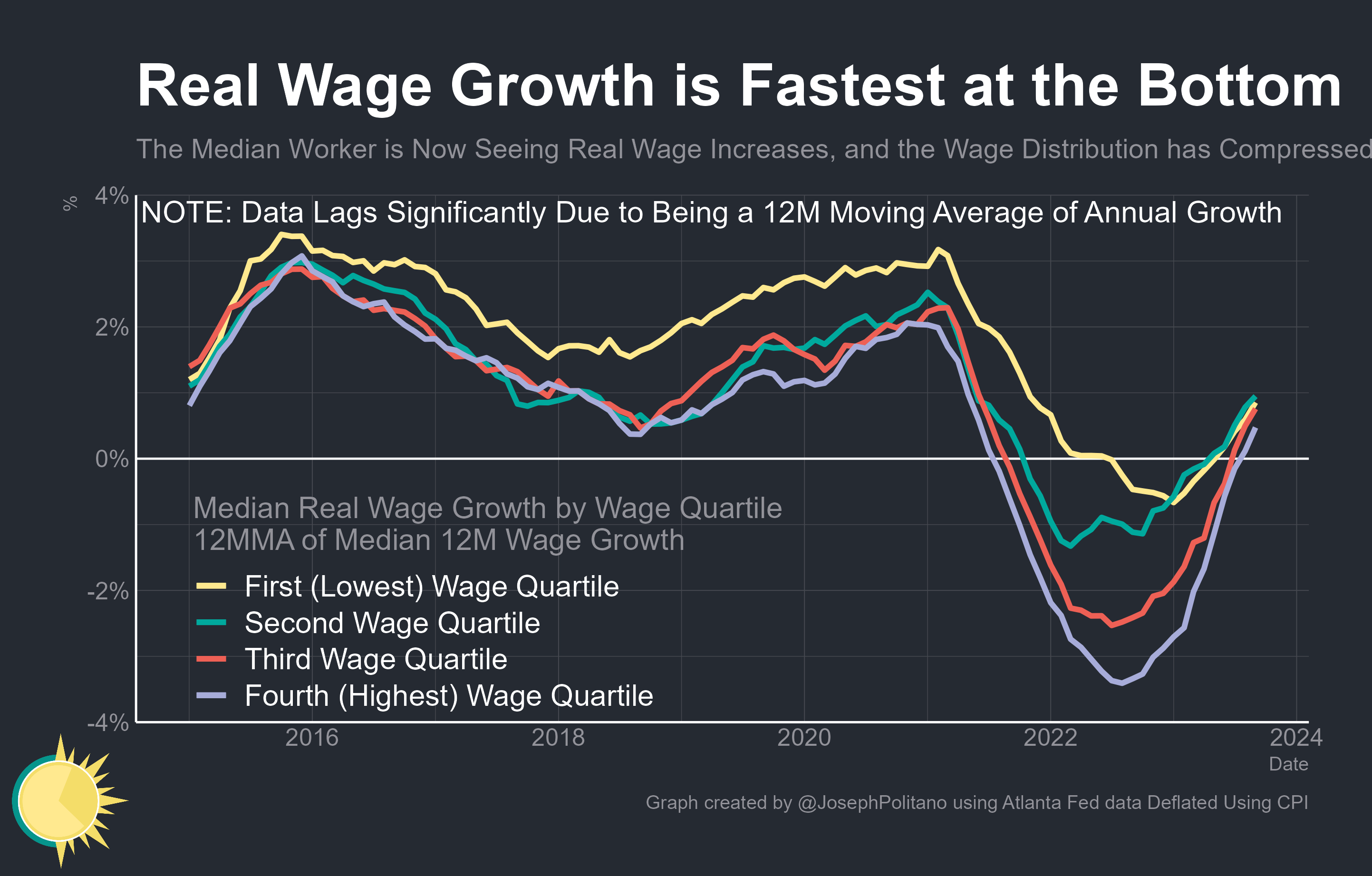
So if your $16/hr job pops by 30%, the net impact on the household is much lower in many cases. For teen workers, it’s beer money. For single moms, it’s a net loss as costs for daycare and healthcare have increased 50%.
All of this stuff is relative. I’m a tech exec in a large organization, and essentially live the same lifestyle as my parents, who were in “lower end” jobs relatively speaking in the 80s when I was little.
(However, I don't have a pension.)
The biggest difference is housing and healthcare. My healthcare expense is equivalent to their mortgage. My dad family healthcare coverage was $0 until I was in high school. The total cost of my, excellent health insurance is about $35k, which is 90% of the salary of my first professional job in 1999!
Our policy with respect to healthcare is essentially a regressive tax on the working public. Rich people have a limited cost exposure, poor people get limited access to poor care, and everyone else gets increasingly expensive, lower quality care.
And I'm not even sure what this graph is supposed to be showing. The biggest difference is when he 1st quartile stagnates while the 4th quartile loses 4-5%. 95% of $200,000 is still a lot more than even a 100% increase in salary for $40,000. my most generous, lazy interpretation of this chart shows a whopping $15% increase in wages for the first quartile.
It is incredible how Internet armchair technocrats will attempt to reduce human existence to a few equations and wonder why broader populations despise the Ivory Tower.
I'm uncertain if I missed the sarcasm or perhaps more likely my lack of comprehension.
It’s not sarcasm, it’s reality
So done with Americans finally getting into boom times and still feeling like it’s 2008. No one here ever wants to admit that they have it good.
> Since 2016, real (inflation-adjusted) wages have risen quickly for people in the bottom quartile
This "quick" wage growth, as you point out with your image, is on the order of 1 or 2% for the past few years, and was massacred by recent inflation i.e. if raising the minimum wage raised your standard of living, you've almost exactly kept up with inflation.
Meanwhile, wealth amongst people who hold investments, a group that often includes upper-income workers, has massively increased during that time. The S&P has had a 130% adjusted return since 2016. The share of wealth held by the top 10% is as high or higher than it was in 2016.
lol.
The whole point of this discussion is that our metrics are not properly measuring things. The reported inflation number is a joke. See: anything in life that matters like - a house - a car - an education - health care - raising a kid - basically any life-milestone
but TVs and electronic toys have never been cheaper so it's all okay! Hedonic adjustment!
The community college in the area I briefly lived growing up was $17 a credit hour in 1997. Inflation adjusted that's $31.67 a credit hour.
It's now nearly $140 a credit hour. Almost 4.5x more than inflation.
For a community college.
> The former is doing great.
This is at odds with what I've been hearing on HN and in adjacent places. For a year or two now, people have been saying that finding a job in tech has become much harder. Some say that it hasn't been this bad in a decade. Some say it hasn't been this bad since the dotcom bubble burst.
None of this is true for the “underclass” mentioned above who have little to look forward to each day; the labor they provide is in various amounts boring/tedious/demeaning/physical, and doesn’t pay enough to give them the middle class lifestyle they feel entitled to (e.g. home ownership, healthcare, etc).
I and many people I know have gone through job searches over the last 18 months. Yes, it was more work than we’ve come to expect over the last 10 years. But ultimately everyone I know has landed on their feet. As an industry we are still incredibly privileged compared to most.
it's 50/50 in my circle. And I got the losing coin toss. Pretty much everyone in my circle got at least a threat of a lay off at some point except one person (and that company is in a very special situation). some got jobs quickly, to various levels of satisfaction. Some got laid off and then went back to the same company when they happened to secure a new project. I'd mostly prefer some stability over how well off I'll be when I'm 65. I'm not even sure I'll make it there at this rate.
>None of this is true for the “underclass” mentioned above who have little to look forward to each day
it's all relative, which is why this is hard to contain to a long term chart of "tech is still better off". No one wants to be caught off guard, doing interviews as a full time job for a year a income dwindles (so underselling it as "it's more work than we come to expect over the last 10 years" is underselling it). And even for the tech workers willing to work in the "underclass" jobs, it's not that much easier getting a job. Especially in my area that seems to have a higher than usual unemployment rate.
For myself, referrals were a huge part of getting a job somewhat quickly. As more people are looking, the slush pile of resumes gets bigger which causes employers to feel they can be more picky. So if you’re relying on a cold application turning into an interview, that will definitely have a very low success rate.
I know only one person who didn’t get a job for an entire year, one of the smartest people I worked with at my last job, but to be honest it seemed like they were having some mental health / mid-life crisis things going on and not actually applying much if at all. I don’t know you and your situation, and I’m not saying this is the only explanation for a long and fruitless search, but if you think you might be like this person then I’d encourage you to reach out to someone who knows you and get the support you need. Marinating in negative thoughts won’t get you anywhere. This stuff has to be addressed because attitude, emotional state, and overall vibes can bleed into the entire interview performance and undermine what is otherwise a solid showing.
I hope something good comes your way soon.
Yup. I was hit in one layoff, 3 months later thought I went into a studio that looked like it had a stable publisher, and then the publisher was in fact not stable. So 2 layoffs in 6 months. By layoff #2, the layoff trend was in full force and the market was closing in. I believe I'm now on month 10 of the job search (or 9, since I simply didn't bother searching in December and visited family).
>For myself, referrals were a huge part of getting a job somewhat quickly. As more people are looking, the slush pile of resumes gets bigger which causes employers to feel they can be more picky. So if you’re relying on a cold application turning into an interview, that will definitely have a very low success rate.
Well that's the frustrating part. It was super thin on January/February, but by April I was getting plenty of interviews. I have 8-9 years of experience and a well known company on my resume, so I can stand out if I get past the Automated Trash Systems. But the technical interviews have just became a free for all of whatever the interview wants to ask. C++ questions, software engineering questions, specific game engine questions, graphics programming questions (I haven't actually gotten a technical interview for a graphics programming position, but I sure have been asked how to render a triangle, oddly enough), leetcode questions, math questions...
I just simply don't know what to study for these days. I can answer all those questions well, but "well" isn't good enough these days. I need to be absolutely confident on on the top of the ball, but I can't do that for every single aspect of gaming. Too many topics to be a master of all ("master" in the context of an interview). At least if I wasn't getting interviews I could just accept the cold market and focus more on maintaining what I currently have.
>but if you think you might be like this person then I’d encourage you to reach out to someone who knows you and get the support you need. Marinating in negative thoughts won’t get you anywhere. This stuff has to be addressed because attitude, emotional state, and overall vibes can bleed into the entire interview performance and undermine what is otherwise a solid showing.
Well there's a lot to be bitter about in my industry, if we're being frank. Game studios are still shutting down or laying off everyweek, no matter how strongly their teams performed, and games are continuing to squeeze on the industry as they push more and more attempts at monetization without necessarily adding more value. No one is feeling very valued in this current state of affairs: not the customers, not the devs, not even the executives.
On a personal note, I did have 2 studios I went assumedly to the end of the process with (6 stages each + recruiter call), only to have no respose whatsoever after the last interviews. Only thing worse than a no at that level of investment is lingering in purgatory as an assumed no. Those would have been surefire offers had I applied 6 months earlier, but alas. I'm truly hitting all the branches on the way down.
Oh, and did I mention the ghosting? There are so many ghosts these days. I remember being contacted by a recruiter for a call, then the call got delayed 1 week, then 2, then cancelled. Never heard from them at all.
I'm usually one to place too much blame on myself, but these days I really don't know what to evaluate from this experiment. It just feels like a circus and I need to keep putting on the clown makeup and doing stunts until someone picks me up. Nothing really feels like it's evaluating my skills and taking my experiences into account past the HR call, so all I can do is throw the dice until something comes out the crapshoot.
------
That's all to say: Sure, I'm bitter. But I don't really let that linger to the next inerview. Quite the contrary. Just a lot of numbness and apathy when beforehand I'd be excited at all the new tech to potentially work on, and all the creativity flowing. It all just feels so sterile these days. So artiicial. Interviews were always superfical, but it feels like no one even tries to pretend to do the motions anymore.
I still have a somewhat healthy social life, and I know how to play the part (I've done it several times before to success). But I definitely do feel interview burnout. one week I'll have 5 interviews where 2 ghost me (very haunting last years, I'll say) past the HR call and 2 others bomb at the technical test, and the week after I would simply just not take any calls. Interviews are way more exhausting than day to day work.
But what you're probably seeing is a reaction to the end of a period when, assuming at least a pulse and some vague familiarity with computers (and maybe some ability to navigate tech interviews), you could walk out of a job on Friday and have multiple offers within a week.
This was basically never the norm with most professional jobs that could take months of job-hunting with no guarantee of a higher salary or not needing to move. I was very lucky over time and it always depended on professional connections.
A lot of people got accustomed to a period that was nothing like the historical norm. I expect very few of them have taken fast food jobs which absolutely happened in 2001.
This was never really the -norm- in tech either. Yes, a small number of very talented, very well-connected software engineers with well-known schools or companies on their resume, could probably leave a job one week and have multiple offers next week, but come on... This has never really been the experience of the vast majority of tech workers.
Sure, if you survey Stanford graduates, working in a hot domain, in top companies Silicon Valley, you're going to conclude that getting jobs has always been easy "in tech."
It's not the norm for most professional jobs to need to study content unrelated to the actual responsibilities for your role, and going through 3-5+ stages of interviews just to get a thumbs up. no other sector is studying interview questions on the side. they either have a standardized license exam to vet their technical expertise, can do a contract/trial period to show their chops ("contractors" in tech aren't really a "downgrade"/less compensated role like in other industries), or otherwise have testing that closely mirrors their day to day.
>I expect very few of them have taken fast food jobs which absolutely happened in 2001.
I was in elementary for 2001, so I can't comment much on 2001 or 2009. I have indeed heard some of those people consider 2023/4 to be even worse for the market, however. Just "being good at your job" isn't enough these days, where it sounds like that sufficed in 2001, and the study space for 2009 was at least manageable. But that's secondhand accounts.
This is a different world from the one where hundreds of thousands are committing suicide with fentanyl.
fully agree, and also taxation, access to credit and leverage for profitable assets, many legal loopholes..
Pickitty says in-part that rewards are disproportionately moving to capital assets, at the same time devaluing the fundamental components of life and liberty .. food stocks, common labor, political freedoms from taxation https://en.wikipedia.org/wiki/Thomas_Piketty
Intuition says that increased surveillance by law enforcement to produce convictions that cost money and time are economically crippling to building a middle class from a labor pool and small-holder individuals. A people without hope and progress become mired in common failure and produce a downward spiral of personal life, as described.
We already shovel in far more tax dollars maintaining infrastructure for a handful of remaining occupants even when the economic activity no longer justifies the spend. What further burden, exactly, do you think the rest of the world owes ex-rural communities that have deindustrialized like this?
I’ve been to places like this around here, where mining towns have dried up and there’s only a few early-20th-century dams marking anything at all. You have to drive into unmarked, un-google-mappable state land through the fire roads (the kind of thing that gets people killed-by-GPS out west) to even get there etc, and there used to be a whole town there once for the mines. Serious/honest question, what does the broader public really owe that miner?
America needs to have some hard talks about what to do in these (extremely frequent) situations, because infrastructure can’t be an indefinite commitment once the communities that sustain it wither and shrivel away. And it sucks for the handful of holdouts who don’t want to leave, but the community itself is really already dead. If there are 30 people who don't want to leave their homes, do we keep paving roads and delivering US mail and maintaining hundreds of miles of power lines for the 30 people who won't leave?
That's maybe viable when it's a rare situation, but it's not, anymore - America is folding back inwards after over-expanding during the railroad and industrial eras. There are a lot of "railroad towns" where the trains no longer stop, so to speak. And once "the mine dries up", and those arteries stop pumping, people move on. What do we do about the ones who won't? Society is probably "in the hole" (net economic activity) to the tune of millions of dollars of infrastructure per resident, perhaps tens of millions in some cases, over their lifetime.
A lot of these places literally have population density of sub-1-person-per-sq-mile, there are whole regions with sub-10. It's gauche to say it, but at the end of the day everyone knows there is a number when it's worth it and a number when it's not - just like statistical value of life. And at some point, if the taxpayer is kicking in tens of millions of dollars of artificial subsidy, it's becoming a lifestyle choice that we choose to subsidize. By all means offer them a great deal to buy their property and bulldoze it... but at the end of the day we can't keep paving roads onto mountains just because 10 people don't want to move. That is an economic termite right there - and they would use far less charitable terms to describe the situation, if the tables were reversed.
I feel for people who have to leave their lives behind etc, but infrastructure isn't a suicide pact either. It's not a permanent, lifelong commitment even when the fundamentals on the ground totally change - and not everyone is a legacy homeowner to begin with.
http://travelthemitten.com/landmarks/redridge-steel-dam-an-e...
https://99wfmk.com/redridge-michigan/
> Nothing beside remains. Round the decay
> Of that colossal Wreck, boundless and bare
> The high and lonely hills stretch far away.
(incidentally, this flow over the base of the dam is new, looks like since 2018 (it normally goes through culverts at the base) and the dam likely won't survive much longer, some of the supports have already broken loose and the water flow is eroding the concrete, probably quite rapidly given the age/neglect...)
https://www.mininggazette.com/news/features/2020/08/survivin...
And this is what I don't get about current US politics. MAGA = Republicans. The Republican party is the party of generational wealth transfer. The Republican party is the party of elite businessmen lording over the working class. The Republican party is the party of all the economic forces that are unraveling rural communities and turning them into slums. They're voting for and supporting the very politicians who are "collapsing the world" around themselves. But why? It's not just idle nihilism. They're one of the most actively engaged political demographics in recent memory. Is the Culture War so important/motivating to these people that they are willing to help implement their own economic destruction?
The people who promise modest, incremental improvement are much less appealing in that environment.
> The Republican party is the party of generational wealth transfer.
I'm not sure what this is supposed to mean. The Republican party is half the country.
"Demographic data compiled in the 2016 and 2020 elections showed that the top 40 percent of income earners preferred the Democratic candidate for president (Hillary Clinton or Joe Biden) over the Republican (Donald Trump), signifying a sizable coalition shift from where the party was in the previous decade."
https://www.newsweek.com/democrats-being-party-rich-could-co...
"Some recent US figures on the distribution of income by party: 65 percent of taxpayer households that earn more than $500,000 per year are now in Democratic districts; 74 percent of the households in Republican districts earn less than $100,00 per year. Add to this what we knew already, namely that the 10 richest congressional districts in the country all have Democratic representatives in Congress. The above numbers incidentally come from the Internal Revenue Service, via Bloomberg, and are likely to be more reliable than if they came from Project Veritas via theblaze.com."
https://www.thenation.com/article/society/democrats-rich-par...
> The Republican party is the party of all the economic forces that are unraveling rural communities and turning them into slums.
All of them?
"For decades, the Republicans were seen as the party of big business. Their support for low taxes and light regulation was manna to executives eager to raise profits and avoid government entanglements, and chief executives and big companies were reliable funders of Republicans up and down the ballot.
"Mr. Trump has frayed those bonds. Four years ago, few major chief executives supported Mr. Trump during his first campaign. And throughout his time in the White House, executives from many of the company’s biggest brands publicly sparred with the president on everything from gun control to climate change to immigration.
"'I can’t remember a time when the business community has spoken out so strongly in opposition to an administration on so many important issues,' said Rich Lesser, chief executive of Boston Consulting Group."
https://www.nytimes.com/2021/01/15/business/republicans-busi...
> Is the Culture War so important/motivating to these people that they are willing to help implement their own economic destruction?
This is the culture war. You're doing it right now.
>I'm not sure what this is supposed to mean.
They oppose estate or "death" taxes in general. That is what they mean.
>The Republican party is half the country.
They're half of voters. They haven't won the popular vote in how many years? 40? They're an obnoxiously loud minority.
>All of them?
Probably not all, but nearly all. The maga tariffs and then subsequent bailouts of farmers harmed comes to mind. reagan's austerity is another easy example.
>>Is the Culture War so important/motivating to these people that they are willing to help implement their own economic destruction? This is the culture war.
>You're doing it right now.
No, they aren't. The republicans bemoaning the 1% of people who identify as trans to distract their uneducated voters while banning books and attacking public education funding, libraries, women's rights, etc, are.
Don't fall in to the bothersider ism trap. Look at republican policy in a red state like texas[0] to see why the comment you replied to is the truth.
[0] https://www.chron.com/politics/article/texas-gop-2024-priori...
“Generational wealth” is generally a myth. The second and third generations burn through any inheritance and sprint back to middle class rather quickly.
Ref? That was definitely not my impression from listening to "Capital in the 21st Century".
In reality, wealth tends to cluster around people who are good stewards of it. They allocate capital efficiently and we are all better off.
The government is NOT a good steward of wealth. They allocate inefficiently (because no accountability) so we should minimize what we give them.
Here is a quick and dirty reference discussing how lazy kids of rich people blow it: https://finance.yahoo.com/news/generational-wealth-curse-cau...
I look at it differently: His ideas are so weak and removed from reality that they can’t even stand up to a Yahoo Finance article.
We should be careful taking policy advice from people who have never had real jobs.
>selling socialism with hand waving
Lol, more like selling it with award winning, best selling, taught in colleges books? If you're convinced that's "hand waving" you're beyond lost
Have you ever actually looked at how large companies allocate wealth, and how much actual accountability there is there? I can't tell you how many billions of dollars the company I currently work for burned with acquisitions whose products they shut down and teams they laid off two years later; and they're definitely not worse than normal, as far as I can tell. How many products has Microsoft attempted and then killed? How big is the Killed By Google graveyard? And in many cases people who make catastrophic decisions are rewarded -- "failing up" with golden parachutes and higher more influential posts.
In my experience, people who say things like this have a double standard. If you judge the government and corporations by the same standards, they come out about the same -- a bit of really good, a bit of really bad, lots of mediocre. The difference is that the government is at least nominally trying to work for the voters, whereas corporations are explicitly only working for their shareholders.
The only evidence presented is assertions by companies selling wealth management services:
> "The “third generation curse” indicates that 90% of wealthy families are likely to lose their [money](404 ERROR) by the third generation, according to AMG National."
The only link to further evidence results in a 404; and the only advice is, "Train your kids not to be stupid", and "Use one of these wealth management services".
I think I'd actually seen that exact article before I listened to Piketty's book; but Pikkety actually provides evidence across many different countries, sometimes going back to the 1700s. Absent other evidence (which again you simply assert without giving a reference to), I'd trust an academic more than a company who has a vested interest in drumming up business by scaring people.
ETA: Even supposing we take the article at face value (which I definitely have doubts about), it makes two claims:
1. Of "wealthy" families, 90% will lose it within 3 generations
2. This can be prevented if children are taught money management skills growing up
Even supposing those are true it doesn't support the statement that "generational wealth is generally a myth".
Why? Because % families != % wealth. It's perfectly possible that 10% of wealthy families who consistently teach good money management to their children control 90% of the wealth.
They're reacting to policy overreach by progressives. There's no good reason why everything that's been set up for women now has to include any male who says he's a woman. Yet this is what's happened in recent years.
Yes it's unfortunate that it has to be the Republicans pushing back against this in terms of introducing actual policy, but at least they're fixing the problem.
You earnestly believe the party voting for children to work longer hours, more dangerous jobs, the party ensuring rape victims and children give birth to their rapists' child and in general remove women's medical autonomy, on religious grounds in a constitutionally secular democracy, are the ones 'defending women'? Shocking position.
They are encouraging ignorance and harassment. They are inspiring people like you to think there is any issue with trans people in the first place.
You have been tricked in to thinking trans people are anything more than a mostly invisible minority.
They lost the "gays and gay marriage is the devil" line and now have simply regressed to even weaker bigotry, the 1% or less I forget the exact % of people who are trans.
They do not, nor has anyone, "demanded everything that's been set up for women now has to include any male who says he's a woman".
These labels, man and woman, are flexible social labels, not the rigorous biological category they've convinced simpletons to believe in as some sort of personal axiom.
> They do not, nor has anyone, "demanded everything that's been set up for women now has to include any male who says he's a woman".
Sorry but you have been misinformed, this is the currently the actual progressive position. And it has led to horrifying outcomes when enacted into law, such as SB132 in California which allows imprisoned men to transfer to the women's prisons if they claim to be women: https://4w.pub/male-inmate-charged-with-raping-woman-inside-...
> These labels, man and woman, are flexible social labels, not the rigorous biological category they've convinced simpletons to believe in as some sort of personal axiom.
No, what you're describing is a sexist redefinition of woman and man. There's really no need for it. It just reifies sex-role stereotypes.
You said "everything". "Everything" is what I'm challenging. No serious effort is made to force women to make any concessions, except by the party that is restricting their medical autonomy. And I guess prisoners? You've certainly got me there, but I don't think I've ever stated a good word about the correctional system.
What you link is a specific law covering a pretty specific category of people, ones already in jail. Not exactly "demanding everything women have be man's"...
You're not going to hear anyone who holds progressive political beliefs tout our countries approach to criminal correction. We house like 20% of the world's prisoners with 4% of the population. Of course prisons are rife with horrible stuff.
>No, what you're describing is a sexist redefinition of woman and man. There's really no need for it. It just reifies sex-role stereotypes
By saying the definitions are flexible I'm somehow reinforcing rigorous gender role stereotypes? That's about as non sequitor as it gets.
At the dr, in prisons, sure, get all biological. But for the rest of us normal people, it does not matter which genitals the person shitting in the stall next to me has. And it never will.
Why do you think that law was passed in the first place? It's because the current progressive position is that any male who says he's a woman should be allowed to access any service or space that was created solely for women.
This isn't just limited to prisons. Another recent instance: Title IX is being redefined in this way, which according to the UN will discriminate against and disadvantage women and girls in educational settings: https://www.ohchr.org/en/press-releases/2024/04/united-state...
> By saying the definitions are flexible I'm somehow reinforcing rigorous gender role stereotypes?
Yes. If you remove the female body from the definition of woman, what else remains besides sexist stereotypes? When a male says he identifies as a woman, what exactly is he identifying with? You can't identify with a body you don't have, so what could he actually be identifying with, if not these stereotypes?
Because misogynist and patriarchal (agree with you there) dumbass dems over correct when they finally pick an issue to do something about? See also: latinx.
It's dumb and bad, but the other side is still way worse.
>If you remove the female body from the definition of woman, what else remains besides sexist stereotypes?
Oh idk, maybe who they are as an individual? What they stand for? What they like and dislike?? such a debate brained take
Your question put another way:
"If the female body isn't what defines a person as a woman, what is left but sexist stereotypes?"
That's you brother, not us. That's what YOU think remains when you take biological categorization out of the picture.
Which is why people caught by the "omg trans people exist and want to be protected too" panic like yourself end up at this weird need for rigid binary gender when intersex and trans people been existing for a long time before you lot were taught to hate/fear them by fox news
Yes, so you agree with me then. As I said in my first comment, this is policy overreach by progressives. They've ended up pushing policy that enables any male who says he's a woman to access any space that was intended to be only for women. This harms women and girls.
> > If you remove the female body from the definition of woman, what else remains besides sexist stereotypes?
> Oh idk, maybe who they are as an individual? What they stand for? What they like and dislike??
I think you misunderstood the question.
At least, I hope it's not your view that likes and dislikes are what distinguish women as a class from men as a class, and vice versa, because that wouldn't make any sense at all.
Yeah, obviously the prison shit is fucked up. And as I've said since the start, democrats are servants of capital, same as the right. But they're not wholly the same.
I also recognize project 2025, red state policy goals (read my link to texas GOP platform in another comment in this thread to see their openly fascist aims) and that red states force victims to sexual crime give birth to the attackers child because of "dur, abortion kills babies". Like nah, some over reach on a small issue that affects 1% of the population is nowhere near worth getting worked up about. We have much much bigger fish to fry. Ergo "culture war distraction"
So while we agree in some aspects I disagree giving trans people basic protections legally a slippery slope like you portray. If anything the trail of progress has been one step forward .9 steps back at best.
I also stand behind pragmatism and voting for the least shitty option we have. Which is obvious to anyone serious.
I'll take over correction to protect a marginalized group over a group that pardoned a man who drove a truck through a crowd of protestors, got out and shot one, because he shot and plowed through the group capital wanted him to. And that's the least of their evils. Gerrymandering, anti education, anti birth control, anti lgbt, buying the supreme court, the list goes on.
I'll take those dumb ass latinx idiots any day of the week, and grind my teeth while i fill in my ballot, but don't mistake my words for "i loooove democrats they're perfect.
> I hope it's not your view that likes and dislikes are what distinguish women as a class from men as a class
This is another place we fundamentally disagree.
The thing I was trying to get across was unless I'm a doctor, or a sports association, or correctional facility, what 'class' you fall in to, by your definition or mine, is moot.
Someone claiming a different gender identify than they "present" as - the real stereotypes btw but i don't got it in me to get at all the disagreements - to be has no bearing on anything to me. So why would any normal human say "uhm akshully due to your penis/chromosomes it's clear you were born this or that gender. I truly could not care.
Therefore, yes, my principle is I respect whatever gender presentation they want to display. I'll call them whatever they want to be called as long as they treat me with respect.
So yes, whether someone likes or dislikes presenting as one or the other label, man or woman, is the sole factor that determines what abstract category I put you in for our conversation.
The only other time I can think of where there is any need for such arbitrary rigidity with categorization is when you're like dating.
Then whatever your views on trans people are wholly and justly on you to define.
BUT, in the public, professional world, I think it's ridiculous to act like it matters which gender you present as outside of very narrow ranges of tasks. The rest of the time I consider it all fluid, because it's immaterial to issues like climate change and pandemics and nukes and real shit. The fact we're even talking at length about this nonsense should demonstrate the artificial push it's gotten from regressive politicians who never even wanted gay marriage.
For serious matters where the biological categorization is necessary, I'll cede to a medical biologist or the sports governing body. that's their choice. But just out in normal every day life? Yeah I stick by my fluid definitions of the social categories "man" and "woman"
I wouldn't vote for the Republicans either. What I'd like instead is Democrats to understood how regressive and corrosive to women's rights this type of policy is. It's so disappointing that they have such a misogynistic blind spot on sex and gender issues, yet can recognize the importance of women's rights in areas like reproductive choice.
This thread is dead at this point but I just wanted to point out that you can't really separate them anymore. They have nominated a MAGA candidate for the top office in the country, three times in a row. The vast majority of their electorate will vote for the MAGA candidate. The party -is- MAGA for all practical discussion.
A simple example would be the hollowing-out of conventional terms everyone believes they hold the same settled definition of, such as "a flight." Instead of transacting according to what consensus suggests "a flight" meant a decade or two ago, when most would have expected this term to have thoroughly matured to the point of semantic stability, instead delivering against the most contextually minimized, stripped down interpretation of the term possible that still qualifies as valid, and attaching fees to all of the other attendant associations of value that used to be included in the scope of general consensus of the term.
I guess I would add that it may only be a Salient as it is with respect to certain things like flights, because there are a couple of outstanding counter examples like cell phones and and automobiles which seem to exhibit the exact opposite trend.
A deeper analysis might reveal that there is a cycle at at work here, wherein the initial novelty of a prodict or service which is destined to become a commodity, means there is not yet a strong set of expectations about what the service or product is "supposed" to provide. distinction in the market has to come from adding context to that essentially commodity utility.
But later on some consumers begin to recognize that some of the additional context may not be strictly necessary or offer a value to them and would prefer compartmentalization of the core product as distinct from its value-added variants.
When flights were a comparative novelty, or at least a novelty in different market segments at different times, distinction between products was through different levels and configurations of service or features rather than price.
This may still be the phase of the product cycle that cell phones (setting aside the fairly stable tiers of product within that category) are in. It's harder to make as direct across the comparison with cars as they are older than both air travel and mobile phones, and because of all the regulation that enforces standardization of non-optional features related to safety.
Economic "models" make assumptions like markets being efficient. Meanwhile in the business classes next door they teach how to avoid competition because it's a race to the bottom. They all learn the prisoners dilemma as an example because it's how you need to think to avoid overt collusion.
I'd like an economic model as powerful as the laws of thermodynamics, where everything is included if not explicitly. But I haven't seen one.
No? You’re thinking of a specific class of models. Generally speaking, prescriptive economics is about characterising what an efficient market would look like and then identifying why reality is not that. (And whether that deviance is good or bad.)
This article could be seen doing that. It seems like domains should be closed to $2, given an efficient market. But they’re nine going on twelve.
They dont appear to be there to simplify complexity because they simulate situations that have never and will never be approximated (never been perfect competition or information, never will be).
It's unlike, say, physics in this respect.
This is wildly inaccurate. A huge amount of economics is focussed on profit. For obvious reasons.
> never been perfect competition or information, never will be
Frictionless surfaces are mostly a fiction, too. That doesn’t mean calculating the expected outcome in a frictionless condition is useless. If the deviance is more than you’d expect from friction, that’s informative.
Unlike physics, a lot of people think their undergrad 101 course plus skimming the Economist an economist themselves makes. It’s a common hubris, albeit one unusually common in tech. (Disclaimer: I’m not an economist. But I know the boundaries of my circle of competence in this.)
As an example there are countless studies looking at the relationship between the minimum wage and employment and off the top of my head I can think of maybe 2 off the top of my head that measure the relationship between the minimum wage and profit.
For obvious reasons. The same reasons.
It's not a great way to get ahead in your scientific profession to point out things which make the people with the money and the power uncomfortable - Galileo discovered that one.
You've more-or-less verbatim described the impetus behind the modern development of behavioral economics. That older sort of classical theory which you describe -- the one which frames the world in terms of "rational economic agents" -- has been out of vogue for nearly two decades now. Sure, you can still find the idea taught in classes... but professors now treat the classical ideas more like a simplified foundation rather than gospel -- much like a physics professor teaches Newtonian Physics before moving on to Relativity.
> I'd like an economic model as powerful as the laws of thermodynamics, where everything is included if not explicitly. But I haven't seen one.
... and this is where you diverge in thinking from the new-school behavioral economists. According to the new-school, economics is a social science, a thing of statistical measurements and probabilities. Most modern economists would probably be inclined to chide you and say that attempting to characterize economics in terms of hard laws would be the same as disregarding the human element -- a reversion to the classical idea of "rational economic agents".
People also don't understand statistics well as a whole, to be sure. But behavioral economics is also not purely about people being irrational.
> Economic "models" make assumptions like markets being efficient.
Open markets require rules and referees.
Freedom Markets™ advocates eliminate rules and refs. Because "regulations discourages free enterprise".
The final result are closed markets.
"free market" is doublespeak for winner-takes-all, anti-competition, pro-monopolies, plantation class, and neoliberalism.
1. "With perfect price/deal information, this math shows economic actors will be super duper efficient."
2. "Since people have the freedom to make secret deals for hidden prices, this prevents cartels by allowing defection."
Unfortunately it feels like rather than addressing the contradiction, they prefer to quietly march under the same banner and in the end we get neither benefit.
There’s probably more ink devoted to the study of market failures in economic literature than perfect markets. Nobody is getting tenure by developing models of perfect markets.
It seems kind of lazy to observe that anecdotes contradict statistics, and then conclude that it's the statistics are wrong without providing any empirical evidence to the contrary. This style of argumentation basically allows you to make whatever "intuitive" claim you want and handwave any empirical evidence to the contrary because the empirical evidence isn't "capturing what [we] all know intuitively".
So now you're at two statistics, one that measures economic activity in jobs and output, and the other that measures peoples' intuitive feel of the economy. I think the gap between them might be that peoples' confidence was shaken by inflation reigniting after 15 years.
[1] https://www.theguardian.com/us-news/article/2024/may/22/poll...
Why are these two things positioned as opposing/contradictory? Why can't those people be wrong but we still try to figure out why they think that way?
Why can't it be true that the economics profession is wrong, or better yet "not even wrong" and not really even talking about anything that has real world applicability?
Given the last few decades that should probably be the starting premise of any analysis.
I'm not ruling it out, only pointing out that it's a lazy argument to handwave away the statistics while not providing evidence that's equal or better than the ones you're trying to refute. This is especially true when the discrepancy is from a group of people who can't get basic facts right. Maybe they're actually right but there's some contrived reason they're not answering straightforward factual questions correctly, or maybe they're just wrong.
Which, in fairness, I didn’t mention earlier and isn’t necessarily something that moves forward a message board discussion anyways.
But like maybe consider the possibility that at this point “mainstream economics” is a lot closer to astrology than it is to science.
Basically every commercial interaction you have these days involves someone trying to cheat you, with basically no way to find recourse to human understanding or help.
It’s every day, every time you interact with a corporation as a consumer. It fucking sucks profoundly and people are completely exhausted by it.
Have you really not noticed?
Why? Who fucking cares?
Some guy calls my phone during dinner with some survey about the economy. I answer every question with a variation on “fuck you and your economy” and then hang up.
I grew up in a family of social scientists and yet it still shocks me how much people actually believe the words “studies say” and “experts insist” when it comes to matters of human sentiment and opinion.
But the question we're asking isn't "how people feel about the economy", it's "how the economy is actually doing". I don't think anyone here is seriously arguing that the public is wrong about their own "sentiment and opinion". They're going to be right almost by definition. What is actually being disputed is whether public's "sentiment and opinion" actually reflects reality. To that question I don't see why we should give unlimited credence to "human sentiment and opinion".
As for "sentiment and opinion" it's the basis for democracy. Of course we should give unlimited credence to it when deciding how to organize society, what's the other approach?
They don't, but like I said earlier it's fair to question the veracity of their statements if they can't get objective questions right. Moreover, if it's really the case as you claim that they don't care about the object level question and only care about "the narrative", what makes you think that the "the narrative" stops at the economy and not at some high level like "the political system" or "society"? In other words what makes you think they actually think the economy is doing bad, and they're not answering dishonestly because they're disaffected about the government/politics/society as a whole?
>As for "sentiment and opinion" it's the basis for democracy. Of course we should give unlimited credence to it when deciding how to organize society, what's the other approach?
Again, you're conflating "how people feel about the economy" and "how the economy is actually doing". Moreover, "sentiment and opinion" might be "the basis for democracy", but it doesn't follow that when it comes to factual and objective questions it should get unlimited credence.
Indeed. And you're suffering from the delusion that there's some kind of distinction here that matters.
There isn't. The economy fucking sucks. It sucks because normal people feel trapped and helpless in the face of corporate power and constant, rampant unethical conduct and cheating that seems to permeate literally every daily commercial interaction. When you ask them about the economy they answer that it fucking sucks, because, it does, for them, daily. This is bad and it keeps making people's daily lives worse.
If you haven't experienced that then congratulations, you're either living a very isolated or minimalist life or you have financial resources that put you above this dynamic. Or maybe you don't live in the US. Or maybe you're building the tools and processes that are inflicting this misery on others. Who knows.
But my argument is that most readers of this article and comment thread should be able to look around and realize what's happening without resorting to regression analysis. I think most people here have cushy employment for the most part so you'll have to look elsewhere. Have you tried to interact with an airline lately? Healthcare billing? A bank?
It's a fucking horror show. Now, extraplolate what that experience would be like if it was every single part of your actual job. Like you actually worked for a company that treats you, the employee, the way Comcast treats you when you want to cancel service?
Ever tried getting someone from Uber to talk to you as a customer? You think they treat drivers differently? What if you're driving for them to feed your children? What kind of mood would you be in? How would you think "the economy" is going?
Did you know that you can apply, get hired, and actually start work at an Amazon warehouse without speaking verbally to a single human being ever? Like you literally go online and fill out forms, go to a building and use a kiosk to check in, and so on, and are on the job without a single conversation.
Can you try to actually really think about what being in this economy feels like to most people?
Now call them and ask them how the economy is doing. Do you think they trust you, an educated social scientist employed at faceless corporation that is calling them to publish some news report on what they think? Do you think they're interested in impressing you with their stock market fluency? To the extent they are willing to talk to you at all it's in the hopes that you'll fucking listen to them when they tell you to fucking do something about this for once.
For half a dozen cycles in a row voters have picked the person they thought was least in service of the assholes who are in charge and inflicting this on everyone, increasingly agitated that nobody actually fucking does anything about it. They'll be doing it again later this year.
>There isn't.
the distinction does matter because policy discussion should be around facts rather than vibes. Voters are the ultimate arbiters for what policy should be, but that doesn't mean we should shrug when their beliefs are objectively wrong.
> The economy fucking sucks. It sucks because [...]
All the points you've made about bad the economy talks past the points raised by mainstream economists. Sure, "trapped and helpless in the face of corporate power" isn't great, but how does that compare to 10% unemployment, or an actual recession? What makes for a economy that doesn't "fucking sucks"? More to the point, vibecession might have started post pandemic, but everything you said existed to some extent pre-pandemic. Has "corporate power and constant, rampant unethical conduct and cheating" actually gotten worse? Or did the perception get worse? That's the problem with going off vibes. Because there's no attempt to quantify it, it's possible to know whether something actually got worse, or people merely thought it got worse. You argue that people "should be able to look around and realize what's happening without resorting to regression analysis", but this comment section is full of examples where people were misinformed about various things (eg. objective economic measures or crime stats). You end up having to come up with contrived explanations to explain their behavior (ie. them being wrong on factual questions shouldn't impact their credibility because they're being wrong to express rage against the system).
You're just suggesting we use different vibes.
There's nothing more factual about a random opinion survey or report from an economic research organization with an agenda than anything else.
Mainstream economics IS all vibes at this point. Not sure how someone could miss it.
(With "I" meaning the average person, not me personally.)
https://www.pewresearch.org/politics/2024/05/23/views-of-the...
The problem is, if that's the case, who's buying all the output? It's not just going into warehouses. So people must be able to buy all this stuff.
An alternate view would be that people have been buying all this stuff, mostly on credit, and are realizing that they're maxed out on credit, especially if interest rates rise.
But ultimately, the "sentiment" view matters. It may not matter as much as the actual output numbers, but it matters, because people are not purely "homo economicus". They make decisions on how they feel about how things are going, and if they think things are going badly, they buy less, and eventually that influences the actual figures.
You figured it out.
Maybe replace "the rich" with "those with capital and market power" but that's mostly a distinction without a difference.
Again none of this stuff is super groundbreaking. Shantytown hills overlooking mansions surrounded by high walls and barbed wire is kind of a global norm.
As America edges closer it only feels unfamiliar to those of us that have become accustomed to something different.
Take cars specifically. The US makes 11 million new cars a month. If regular people can't afford them, are billionaires really buying up all those cars? How many new cars does a billionaire need? Where are they parking them all?
I can believe your explanation with money. I can even believe it with houses, with rich people buying up houses as an investment. But I can't believe it with cars. Regular people are buying new cars, and regular people think they can't afford new cars. How do we make sense of that?
Anecdotes are empirical evidence. Statistics are just collections of anecdotes obtained through systematized processes. As such, statistics are only as good as the process. 1 good observation can be better than 100 bad observations.
Most studies show that no matter what direction crime is going in, a substantial majority of people think their neighborhoods are safer and that everywhere else is basically a war zone that is getting worse. There’s a total disconnect locally/nationally in perception that is also detached from crime stats.
All of this is to say that the anecdotes are basically all but worthless in the case of understanding how bad crime is on any appreciable scale beyond a few blocks of one’s neighborhood.
* https://www.pewresearch.org/short-reads/2016/11/16/voters-pe...
* https://fivethirtyeight.com/features/many-americans-are-conv...
* https://www.vox.com/future-perfect/23663437/crime-violence-m...
* https://www.pbs.org/newshour/amp/show/as-concerns-grow-aroun...
It's similar to Hans Rosling's comments about poverty in the 3rd world. It often sounds like poverty is increasing as time goes by, but if looking at statistics, overall poverty is decreasing and have been doing so for decades.
When I see videos on the internet all the time of criminals just walking into stores and grabbing whatever they want while the security guard looks on and does nothing because the police will side with the criminal if he touches them, it is perfectly valid to assume that crime is worse.
When the police do nothing to enforce the law I do not trust the statistics because they are based on reports to the police.
Maybe the statistics are right, over the whole city, but where I live, crime has gotten worse.
I noticed neither any crime or homeless at that time. But people now seem swear it has gotten to be a big problem.
How many videos have you seen on the Internet of stores just calmly going about business with no shoplifting going on? The number of videos on the Internet is not an indication of any overall trend. The stuff you're seeing makes it onto YouTube because they are outliers.
The measure of the perceived crime level in one's neighborhood isn't really dictated by stats or news, but your own and your neighbours lifes.
I know where I live is quite calm bar some occasional burglar, and I know it because I live in the place and talk to people everyday.
The only crime stat you can trust is murder and that's because bodies can't be hidden (easily).
Everything else gets swept under the rug.
When I wanted to report my car broken into I was hung up on three times because of a poor quality line, which was fine before I told them what I was calling for. When I went there in person I had to wait 40 minutes for someone to take my report and give me a reference number for my insurance.
Crime is absolutely massively under reported.
Seems to be a significant decline since the 90’s, followed by an increase since 2016, and a Covid dip followed by a resumption of the increase. It’s still a lot lower than it was in the 90’s.
Taking a quick glance at the articles you linked shows the same behavior as those reporting on the economy - defining disingenuous targets so they can claim their headline is true. To tie this back to anecdotes, I think it comes down to trust. When my neighbor says they’re afraid to lose their job due to housing, food, childcare being a lot more expensive I dont see any motivated reasoning behind that statement. On the other end, economists (and all the articles you linked) have many incentives to distort the truth. On average anecdotes are going to come from a more truthful place - both because you trust the source and know their biases.
[1] https://www.psychologytoday.com/us/blog/insight-therapy/2018...
[2] https://today.yougov.com/politics/articles/41556-americans-m...
We all know memory is incredibly faulty, for instance. Yet people have a very high perception of their own memory’s accuracy. It’s kind of in the same vein. It’s not that people can’t remember things accurately, it’s that we need to start from a place of skepticism when depending on it. Same thing goes for people’s perceptions of crime, the economy, etc. Their anecdotes and lived experience, insofar as they can even accurately explain their lived experience, needs to be put into context re: its value for determining “reality.”
That being said I would never undermine the value of how people feel. If people don’t feel safe, that is a bad thing too. And we can cite all the stats in the world we want but ultimately feeling unsafe is not a good thing and that perception needs to be addressed.
If the population percieves themselves unsafe and unhappy, your numbers don't really mean much to them because to restore happy society you need to look at *perception* and fix the reasoning behind it. Making the crime stats number go down won't do that by itself.
Many times that perception is shaped by the media we consume, which has no obligation to have any connection to the reality on the ground. At that point whatever is done to improve the reality doesn't have to have any impact on people's perception.
You would think there is some sort of tornado epidemic nationwide based on the way they were acting. Tornadoes happen all of the time, and they are very tragic for those involved, but y’all aren’t hearing about every house that burns down in my city lol
> One theory that came up again and again is that city residents and visitors are, to some extent, conflating actual violent crime with broader indications of urban disorder.
If you are a leader like Bezos or a city politician you need to meet your customers / constituents where they are and fix the problems they want fixed whether or not it they are saying precisely what they mean. The anecdotes are right and the statistics are wrong.
Perception is also in large part the very thing that matters when it comes to crime. That is, do I get to live in peace or in constant worry? Do I get my property priced "fairly" when I sell or dramatically underpriced because of this perception that the area is unsafe? To summarize, in what you describe "crime stats" are ignoring half or two thirds of the problem.
In San Francisco, "crime stats" are further muddied because of massive underreporting and cherry picking the definition. So called quality of life crime might be considered irrelevant because it rarely causes massive loss of property or injury. But it does make life extremely stressful for the locals (depending on the neighborhoods where it might be "tolerated" i.e. left rampant, or might not be tolerated.) In this case, "crime stats" deliberately not measuring anything very relevant.
See also recent discussion of the squatting issue in Spain.
It’s not flawed, economic literacy in the general population just sucks and thus so does the popular discourse. The closer you are to the minimum wage or tech sector, the worse you’re doing; the more you make and more assets you have the better you’re doing [1].
The measures are there. They show a bifurcating economy, and in particular, one fracturing along social lines, thereby inhibiting information permeation. They’re just buried in e.g. the Fed’s Beige Books, which aren’t consumed as vociferously as TV news.
[1] https://www.wsj.com/economy/consumers/economic-data-paint-a-...
[0] https://www.pewresearch.org/politics/2024/05/23/views-of-the...
And I would add with a polarized media whos parent companies fortunes depend on which people get elected. The amount of corporate financed propaganda out there is out of control.
Most everyone I know seems to be living it pretty good with much less concern for the future. Certainly compared to 2023 and even compared to 2019.
I'm a late 20s man who made it into tech, I'm doing great! My friend who got into tech might kind of hate their corporate job lives but they're monetarily at least able to pay their student loans after 5 years of working. A few kids were able to start construction/lawn businesses, i don't know the details but they appear to be doing well. Every single other person that i know, who's finances I'm aware of directly, or indirectly (social media posts, etc. ) is having a hard time right now. I can count on one hand the number of people who feel good about the current US economy that i know, i speak and have spoken to dozens of people about this.
Literally only the comp sci graduates are having a good time right now, and even that's starting to tighten. Jobs are getting more scarce, people have to take pay cuts to be able to actually have a life again, etc. You could say I'm doing well right now and then i could say that must mean everyone is doing well and the whole thing is propaganda. But there's a lot more than just successful people out here, we're on HN anyways, that says a lot about our socioeconomic status and friend groups.
How can that be? Only ~30-35% of Americans rent a home, which means that ~65-70% of Americans either own a home or are freeloading (e.g. living with parents). Only ~3% of homes are considered to be underwater, which means virtually all those who own a home have been able to save over and above their monthly expenses.
So, especially on the high end, if 69% of Americans are unable to save, while virtually all homeowners have been able to save, and even if we assume all renters cannot afford to save, that suggests 34% of Americans are freeloaders. It seems highly unlikely that all renters are unable to save (what about the tech people who rent?), but whatever.
How do we resolve that? The freeloader figure is in the ballpark of what the data suggests if you are counting all the way down to babies. Is that what you've done here? But nobody would ever think that a baby should have an income that allows them to save, so you're kind of being disingenuous if that is the case. I find it hard to believe you would state this figure including children.
Or is it that you mean 55-69% of Americans do not have money in a savings account – as in a specific type of bank account? I have seen reports like that before so maybe that's where you got the idea? If that's what you mean, it is quite believable that the majority do not keep money parked in a savings account. The interest rates in such accounts are rarely compelling, so why would they?
A mortgage that is underwater means the value of the home is less than the loan balance. That can happen for any number of reasons.
It doesn't mean anything about your ability to save money. If you make $5k a month and spend $5k on expenses, you can make all your mortgage payments (whether or not that mortgage is underwater) but still not save.
When outlets report savings of Americans they don't typically mean just in savings accounts.
Indeed. Which means that when a home is not underwater, the owner has savings (or is breaking even, of course, but that is as equally unlikely and is for all intents and purposes considered to be the same as underwater).
> If you make $5k a month and spend $5k on expenses, you can make all your mortgage payments (whether or not that mortgage is underwater) but still not save.
Interest-only loans account for only 1-2% of mortgages. Outside of that small group, and the small group underwater (which very well may be the same group), if you are paying a mortgage, a portion of that is a portion you are saving. Mathematically, that has to be true. There is no way around it.
> When outlets report savings of Americans they don't typically mean just in savings accounts.
So, then, again the numbers don't add up unless we're counting children. Why would you count babies in those not able to save? Is a newborn not making enough money to be able to save a problem or somehow notable?
What? It doesn't mean this at all. You can have savings and still be underwater. If you have a 3.5% for your mortgage, but the market crashes after you bought at the peak, you can be underwater because your house lost value. And it would be foolish to pay down the loan rather than get a better rate for your savings.
Underwater mortgages are totally orthogonal concepts to savings.
> if you are paying a mortgage, a portion of that is a portion you are saving
I think I see your confusion. Yes, money saved into a home is an asset that you are building over time. However it's a non liquid asset, it's difficult to turn back into cash for, e.g., a surprise medical bill.
Repayment of a loan meets the strict mathematical definition of "savings" however it is typically excluded (as are, e.g., investments). For instance, the U.S. calculation of GDP does not consider repayment to be saving.
Savings are typically held in checking accounts, savings accounts, CDs, and money market accounts. Some people take a portion of their savings and invest them in higher risk items like stocks and bonds, but those are investments.
It's important to decouple the concepts of net worth (or even just worth) from the concept of "savings" because you can be taking actions that increase net worth (e.g. paying a mortgage) that don't increase one's savings. (Though, eventually, if you sell the home you could put any proceeds into savings.)
You wouldn't have savings in the house, but it is possible you have savings elsewhere, sure. However, if you are not underwater (or breaking even), you do have savings in the house, which is what the context speaks to specifically.
> Yes, money saved into a home is an asset that you are building over time. However it's a non liquid asset
There is nothing about savings that implies they must be liquid. If you are saving for a near-term purchase then savings for all practical purposes need be liquid, sure, but if you are young and saving for retirement liquidity is not of terrible importance. You have many decades in front of you to convert it into something else.
> Savings are typically held in checking accounts, savings accounts, CDs, and money market accounts.
Okay, but then we're again back to people not having savings because the returns have generally been poor, even basically non-existent in many cases, for a long, long time. Why would most people have savings in that kind of environment? The market has greatly incentivized surpluses to look elsewhere – especially towards real estate, where returns have been tremendous.
> It's important to decouple the concepts of net worth (or even just worth) from the concept of "savings"
That's for the earlier commenter to decide. It is not on us to prescribe their usage of a term. However, insofar as our discussion goes, it there is no such importance as we have already looked at both angles. No matter which direction you choose to go, the math doesn't add up with the presentation.
Here are several examples that disagree. Yes, in a strict Keynesian economic sense it is saving but saving is different from savings, despite the similarity in the two words. (Yes, you are right, this is confusing.)
Examples defining "savings" in personal finance:
https://www.investopedia.com/terms/s/savings.asp
"Savings is essentially cash"
https://www.britannica.com/money/saving
"Saving may take the form of increases in bank deposits, purchases of securities, or increased cash holdings."
https://en.m.wikipedia.org/wiki/Saving
"In terms of personal finance, saving generally specifies low-risk preservation of money, as in a deposit account, versus investment, wherein risk is a lot higher."
Disagree with what? I fail to see the difference from definition two.
It does not match definition one, of course, but that had to exist in an effort to be fair to the original commenter. It is not like you are going to go in like a horribly confused idiot and randomly redefine tillage or something. If the OP is using savings in the sense of the positive net value of a home, rationally one will be accommodating to that.
But it doesn't really matter what definition you choose. The math doesn't add up to what was presented under any definition.
Example: https://www.forbes.com/advisor/banking/living-paycheck-to-pa...
What's challenging for you about these numbers? Your original response included mortgages in saving, which is atypical. If you exclude mortgages, which is typical, do the numbers make more sense?
> It is not like you are going to go in like a horribly confused idiot and randomly redefine tillage or something.
Try to remain on topic and avoid ad hominem, please.
Seemingly not, else we'd have seen the math already. Also,
1. Not having savings (in the personal finance sense) does not mean one is living paycheque to paycheque.
2. The article you link to defines living paycheck to paycheck as a scenario where the family income does not cover expenses. Principal repayment is not an expense. Outside of the 1-2% with interest-only mortgages, anyone who is paying a mortgage unquestionably is not living paycheck to paycheck under the definition you have given. They have surpluses available to spend on non-expenses.
Which brings us back to wondering why – while maybe technically true – you want to include children in the figures? Again, is there some reason we should be aware of newborns not making enough money to save?
> Try to remain on topic and avoid ad hominem, please.
1. It is on-topic. It explains why multiple definitions are present.
2. Ad homiem implies being directed at a person. The statement is not directed at a person.
In the links I posted several comments above, you'll find that it is considered an expense for the purposes of personal savings.
I don't disagree with your definition, btw, it's just not the common one.
1. It does not make clear what the payment is. If it is only to pay the interest portion of the loan, there is little question that it is an expense. That would be outside of the topic of principal repayment, though.
2. If we assume there is a principal portion included in the payment, it is said only with respect to student loans. The product of a student loan retains no value – literally worthless the moment you drive it off the lot. As such, it is not unreasonable to consider the principal an expense. There truly is nothing left. A house, not so much. Unless the house has lost value (an atypical situation), you didn't give up anything.
Are people you know of different ages, social classes, races, upbringings and living locations to capture the sentiment of population?
Or are they all well off people in a few rich areas?
Be that as it may, my point is that the possibility exists and is almost equally as likely. Not that it is correct.
where t f people got that holy image of economists?
* Manufacturers reducing product quality without buyers' knowledge. E.g., Pyrex or some SSD makers.
* Shrinkflation: grocery stores selling slightly smaller-sized packages without buyers' knowledge. E.g., containers that used to be square, staying equally wide (for shelf space facing) but less deep.
* Widespread Terms and Conditions / EULAs that undermine previously reliable consumer protections.
* The sense that privacy-preserving products are now out of my financial reach, due to surveillance capitalism.
I guess the main pattern in these things is a sense of failed consumer protections.
EDIT: I'm ranting about consumer sentiment, which is probably different from economic sentiment. Apologies for going off topic.
It shouldn't be a mystery whether shrinkflation has occurred it should say it right on the product, and be confirmed in a government verified database.
In the UK it feels more like corrupted consumer protections. I suppose that's a type of failed, but it's not because the consumer protections were bad, it's because they were removed by a government who work for (or just are) the capitalists rather than the demos.
The middle class and up is doing well, basically anyone who has mortgage debt and a white collar job. Lower classes were doing well due to pandemic wage gains, but inflation and housing prices have now outpaced those.
https://www.nytimes.com/2024/06/07/opinion/ezra-klein-podcas...
For labor participation, full employment is not great if everyone is working crappy jobs. I dont know if there are better metrics buried in the government's output, but it perhaps would be more in keeping with lived experience to track participation with dependence on supplemental sources of income. if you need a second job, or charity/government help, just to survive, then you dont have a "living job". That sort of thing isnt captured by LFP stats.
To be clear, I do trust the govt stats in places like the UK and US. I just think they are measuring the wrong things.
I don't notice anything off about it.
that is at most an attempt to control the narrative, and throw the growing inequality under the rug as some sort of mass hysteria. lame.
it's claims is that everything really is better, but the "vibe" is to complain. it's a counter to the "silent majority" suffering in red states. it's a inane political spin that did not take on.
> “Of course, as I have talked about throughout the book, there are many real problems with the economy. We have a structural affordability crisis. A housing crisis. A healthcare crisis. A childcare crisis. The list is endless and nothing can hide anymore. The things to be anxious about are numerous. The geopolitical warfare. The walls of any sense of economic safety caving in. The endless political theatrics.”
And here’s a quote from the source document that coined the term vibecession, from her Substack:
> Markets are a profit-maximizing system. That is the point of All of This - the reason that people feel bad, the reason that the vibes are off, part of the reason that people get fired, companies go under, that McKinsey incentivized the opioid crisis - they knew it would kill people, but it would make money. Money is not a moral compass.
How is this claiming that everything’s actually okay and that it’s just that we’re sad about stuff? If the claim was “the vibe is to complain” why did she give at least ten real problems that influence consumer sentiment there.
"When polled, most Americans had a negative perception of the economy, with some saying that it had even entered a period of recession, while data showed that inflation was going down and GDP growing. This pessimism about the overall economy heavily contrasted with Americans' perception of their own financial situation, which they said was mostly positive.[5]"
There is no misunderstanding. In the Soviet Union, the rulers and their media would every day report on how fantastical the economy was doing and how production was beating records etc. Get used, because this will continue for the rest of your life.
What shortages are there in the US?
Food deserts.
Done this literally dozens of times over the past couple of years for myself, kids, and wife and have never had an issue. Even been offered appointments same or next day. Am I missing something?
Something I've been suspicious of for a while now, the farther from the cities the worse it is. Grocery prices, for example, didn't start rising in the city I'm in until a year or more after I started seeing people complaining about it, and a good chunk of them were suburban or rural.
Now that I think about it, that's literal selection pressure for psychopathy.
Yeah because every time a metric looks bad it gets adjusted to look better either by changing the weights or removing items from the calculation which dilutes it's effectiveness
The rental market and the.dojs anti trust is the same: landlorsa making money by limiting units to just the more wealth renters and leaving units empty.
This is just qhat.happens wgen regulatots simply stop enforcing a minimum level of social goods.
Which is funny, because as economist, half of the material is "these metric don't matter, if there's no benefit for the population, but you can't ignore them either". It can be summarized as something like "economic indicators are not perfect measures of general well-being, but you need the indicators to look good to be able to distribute well-being".
The thing is, that the public doesn't get that _nuance_. Good economist know that a growing GPD doesn't mean that everyone is feeling good, but also knows that a shrinking one means that most will fell bad.
I ran into this with NASA. A NASA "scientist" insisted it was proper for them and their colleagues to ignore both valid and crackpot suggestions or questions on the rationale that "crackpots are gonna crackpot and they have limited time so the proper response was to just ignore everyone and everything except their (collectively) narrow research projects." - Which are each extremely specific and grounded in massive piles of internal assumptions as to what matters. There was zero interest in the idea that they were paid by the public and might want to improve their image now and then.
Companies learned the true baseline of what they can get away with and we’re in a new permanent reality of everything sucking right up to the exact line where it would collapse of it sucked more.
Economists don't have a handle on the compromises and adaptations that people have been making over the last decade or more, e.g. moving to the cheaper place further out of town rather than where they want to live, or house-sharing rather than living as a couple.
It seems people are at the limit of the adaptations they can make and are pretty pissed off about it.
That’s why the article author is correct that macro stats aren’t good at capturing the quality of the lived experiences of people - just the quantities.
https://www.ebay.com/itm/165973941939
The pictures all prominently say "100W". The specs says output of 5V 2A (10W). The specs also say max output of 5V 1A (5W). It is nowhere near 100W. Customer rating of the seller is 99.1%. People expect to be lied to? I've been buying lots of stuff, both professionally and personally for many years and this has been a concerning trend. China is selling us childrens toys that contain lead paint and lead based solder in electronics. Laser pointers that can easily blind you labeled as safe at 5mW but really have no IR filter (to cut costs) so they output 50 to 150mW which people can't see and which can invisibly blind them. Electrical products that are not UL certified and are not safely designed (there are teardown channels on Youtube where they take apart products and they'll find AC powered stuff where the ground line is left hanging loose inside, not connected to anything). And our government lets this happen, has been letting this happen for decades. Ebay profits from it. No one is held accountable. What happened to law? Like Truth In Advertising? What happened to UL listing? What happened to fraud prevention? Our government is not fulfilling it's function. Crime is rampant and obvious. This is an obvious and serious failure of government. China is cheating US customers (and Chinese customers also apparently), and is poisoning and harming us. Seems like an absolutely real Chinese plot to attack democracy and it is working and our government is letting it happen. Why? Because "cheap stuff"? eBay profits? I think people see this kind of thing and think that there is no rule of law any more, which influences them and corrupts their behavior as well. Everybody is doing it, so they think they should also. Any thoughts about this? It seems to have been a gradual loosening of standards. It's happened across the business world, in government and in policing. The police won't investigate a crime unless it involves more than $10,000 or harms a person. Business advice for startups is to "fake it until you make it". Hospitals will charge people without insurance 20 times the normal price. Corporations considered fines for breaking the law the cost of doing business. Private equity "extracts value" by destroying companies. It seems like everyone has given up and corruption rules the day and everyone has to watch out for themselves. Are there just too many people now making the world too complex to oversee? Maybe these systems have never worked because they rely on most people complying and a lot of people now cheat? Maybe the internet/web makes it too easy to start a new company identity if reputation is lost? Have corporations captured government and hollowed out law? The level of lawlessness seems to have grown a lot; corporations, government departments, and police agencies all often just disregard demands from higher up for accountability and say they refuse to provide requested data. Go ahead and sue them and they'll pay the fine (years from now), continue doing it, and pass the costs on.
There's a story right now being peddled by all the talking heads that the economy is "great", but consumers keep reporting feeling terrible, so consumers must not understand something.
I think this goes the other way around. Our method for understanding the economy is flawed and is not properly capturing what all consumers know intuitively, things kind of suck, even when you have a job and even when you're still buying things.
We need to start thinking about what information needs to be captured and how it needs to be reported to start making better sense of what's broken and how to fix it.