In an ideal democracy it would.
Its yet again misrepresented interests. And as an extend to my side note: The decades long shift of interest representation went from the public to the private sphere. The distrust in goverment may be justified, but its no counter argument, because the means of democratic participation is the only viable tool we have left.
FUD helps the parasites. Democracies cannot fail, only the people in it do.
Its the only one they have left, we could always start chopping heads off.
I think a violent revolution would only tighten the surveilance state.
What is it about this topic that renders people unable to think rationally? Imagine if software was written with this quality of thinking.
Windows 95 startup music plays
overthrowing the goverment via democratic means is an option too.
The circle of ppl seeing the bogaloos as idiots, preferably nowhere near any position of power is much larger.
Very distorted protortions.
How about Bolshevik? Or Cuba? Or Vietnam? Or China?
If you consider the French Revolution successful (that didn’t work out so well) then I guess you can say the Sudan revolution was successful as we now have South Sudan. Or Libya was successful as Qaddafi is still dead.
I think this is false if only because the premise of Democracy is so poorly defined. What are we voting on? Why? Who is "we"?
Am I allowed to call a vote to strip you of your property? Am I allowed to call a vote to tell you what to eat? Am I allowed to call a vote to tell what to do or where to go?
Why or why not? We have laws today that do all of these things. What does "failure" mean?
I have no ax to grind in this story, I just thought it was pertinent given your questions.
https://www.theatlantic.com/international/archive/2017/01/sw...
I wonder if this is purely organic, because you see clearly delusional claims about it everywhere online nowadays.
This would mean the poorest get to increase their take home pay, without increasing wages.
The recent strike showed this off with the trend of publishing residual checks, all of them are made out to shell LLCs.
Say you’re settling the tab for big dinner at a restaurant, if your rich friend pays for the steak he ordered, is that his fair share? If there’s 100 of you and he pays for 1/100 of the check, is that his fair share? What if he pays for half the tab, is that enough to be his fair share?
Is it reasonable for society, through taxes, to take more than half of what you earn? (e.g., in CA the top brackets out you at 37% federal + 12.3% State = 49.3% tax rate. And that’s before sales tax!)
I have this idea rummaging about that I have never quite seen articulated in these discussions.
The earnings of "rich friends" are often seen as a singular, isolated achievement, and fairness is then discussed as relative to that: "they earned it, so is it fair to take X%?"
It seems to me that society at large facilitates those earnings. The roads that their workers drive on, the water facility that supplies the school that their employees send their children to. The unemployment safety net that lets employees take risks and take the job of the industrialist... The list is endless.
All this is the net sum of what was _also_ given to (taken by?) the person that makes a billion dollars. In this context I think the "fairness" argument against taxation becomes weaker.
- Why isn’t it fair to take 99% of the highest earners’ income?
- Why isn’t it fair to take 50% of the median earner’s income? They, too, drive on roads and send their children to school.
Looking for fairness to me is a fools errand. It’s not even a real thing, nor is it something any 2 people will universally agree on.
Instead we should only look to what a taxation regime accomplishes.
Maybe not from a distance, but there are ways for multiple people to come to a fair conclusion. The most basic example are two children who have to share something, where one cuts the thing to be shared, and the other is allowed choice of which half he wants.
The important thing is: incentives for unfairness must be removed. If someone can get ahead by being unfair, they will do so. The only way to get around this is to make sure the people deciding the rules do not know where they'll end up, so they must be as fair as possible to improve their own situation.
I liked this one:
> ... a humor website later commented on the fact that the stadium where the GOP hosted the "We Built It" theme at the convention was constructed using 62% taxpayer financing.
I disagree. There are models of economics that can project taxation rates that will have better outcomes for society. It's far from being primarily subjective.
Yours is the best in my opinion but it’s still subjective.
I would say it is reasonable, period, per the dictionary definition. People can redefine words as they like, it doesn't mean anything.
It's not subjective when we are using objective standards and theory to produce a result with the goal of objectively leading to better quality of life for everyone.
If the only subjectivity that comes in is because people can define reasonable I don't think that makes it subjective at all.
Some people in society (possibly because of unfortunate mental health issues) like to stand in the streets and fling shit at others. We do not argue over the subjective reasonableness of shit-flinging, because as a civil society we are far past that point.
So long as you have more than enough to live on, absolutely. If you make a billion dollars, then the govt taking 501 million is the absolute minimum that should be expected. Better they take 999 million and leave you the million dollars, as you don't need more than that to survive.
Further, the only reason you made a billion was from not paying the workers a living wage. The government's job is to redistribute the money so that everyone gets a fair share.
What we obviously don't want is people who find a way to dump risk on everyone else so that they cannot fail. Not paying a living wage is a way to do that for example.
A rich friend arguing over the details of a tab is just an asshole.
Also, many are generous to their peers and social circles but malicious anyone they consider beneath them and on the “outside”.
I saw this firsthand in my workplace (after hours)—a company that heavily promotes diversity, etc.—and it left me distraught for a few weeks.
These assholes are the hardest to spot.
A better analogy of today’s would be so: - Your rich friend and his 19 employees order 20 steaks
- Somehow and out of sight the rich friend takes 19 of the steaks, takes 9/10th of each steak for himself, and then replaces them with 19 derived kiddie meals containing 1/10th the steak.
- Your rich friend then points out that he and his employees only should pay for 2.9 steaks.
- The bill and cost remains the same (100 steaks), so the remaining 80 people foot the bill for 97.1 steaks.
I make around $600,000. My effective federal tax rate is in the low-mid 20s. I'd have to make way way way more money for my effective federal + state rates to approach 50%.
No one will be happy if more than half their labour is taken from then. We can talk feel good and helping the community and needy all you want, but once you cross that threshold it will be very obvious to a lot of people that they have no choice in the matter and that it's a few steps away from slavery.
Sales tax adds less than 1% to my overall effective tax rate. Sales taxes are disproportionately low for high earners because high earners save larger portions of their income rather than spending it.
Gift and inheritance taxes don't start until eight figures. Not exactly something I'm especially worried about.
> Same goes for withholding or "Pay as you earn" taxes which serve to not let you see how much taxes you are paying.
???
You can adjust your W4. The very wealthy also have considerably more flexibility with withholding since less of their income is W2 income from an employer.
> No one will be happy if more than half their labour is taken from then.
If I made the 7+ figures annually or whatever I needed to approach 50% effective taxation I'd be pretty damn happy. If my taxes were raised considerably without a change in my income it wouldn't really change my life either. I'd just retire early a little bit later.
> it's a few steps away from slavery
Extremely high earners who have very high effective tax rates have some options available to them. They can change careers or work less to reduce their income. They'd just earn an income that was more comparable to the typical worker. Or they could stop working entirely - extremely high earners have plenty of opportunity to save enough money that they could live off a typical budget indefinitely using their savings. Or they can advocate politically for policies they prefer - even by spending their money to influence elections via nearly unlimited and unbounded political contributions.
Slaves can be arrested, tortured, and murdered for fleeing their captors. Heck, they can be tortured and murdered pretty much for no reason whatsoever. They can be raped and forced to bear their children of their captors. Their children (whether conceived through consent or through rape) can be permanently taken from them and also forced into slavery. They can have literacy denied to them. They can be worked to the bone in extreme conditions. And all this for a fat zero dollars in income over their entire lives.
So I'd say that there are more than "a few steps" between these things.
I'm no where near "well off" or "wealthy", but comfortable middle-class here, and I'm already at the 41% bracket on income only. Effective tax-rate I'm sitting somewhere around 35%, probably higher. And that extra 15% to get us to 50% is easy to arrive to if I take in to account all the various VAT, import taxes, sin taxes, property taxes, etc that are extracted from me by government. E.g. 2% of all my income goes to tax on my modest home, poof.
And that's not even taking in to account all the "public" services I should be getting according to that "social contract" but instead paying the private sector for because they don't exist. Lovely things like fire, health, road maintenance, security, schooling, ambulance services, unemployment, social security for retirement, and who knows what else at this point.
But sure, discard my overall point by making it seem like I said rich people are slaves.
Meanwhile, you're looking at top marginal rates. That's not the total rate. A single person making $500k a year has a total tax rate (federal plus state) of 41%. It gots up to 46% at $1,000,000/yr.
And the rate goes down if they marry, have kids, etc.
We (the people) want certain services of the government we elect — services that cost money.
If you tax the rich less, the poor and working class will therefore have to carry a larger burden. That seems pretty straightforward.
What do you think a reasonable level would be?
Science and understanding cant decide what you want and how much of it, it can only help you decide how to get what you want.
Disagree. It's the realm of philosophy at the end of the day, but that doesn't mean it is subjective. We have very good, very fleshed out reasoned arguments about what would be best for most people.
If it is agreed that there are universal human rights and country specific rights, which is something already agreed upon by society; as is the goal of ensuring rights be equally enforced for each person, that they be respected as they should be - just starting from that is a pretty solid base that would result in real changes and is already consistent with societies desires.
If we had the universal alignment you would talk about, sure we could just put the mathematicians and being counters on the job, but that's not the case.
You keep moving the goal posts. We have enough of a starting point with the UN charter of rights and freedoms.
> If we had the universal alignment you would talk about, sure we could just put the mathematicians and being counters on the job, but that's not the case.
It's the case that for a lot of things we know the best policies for many things. More competent government would go by what they suggest, will of the people be damned.
To be honest, I don't really understand your position. It seemed like you were claiming that Society has already decided what's best and now you say that the will of the people be damned. Who is the 'we' that knows what's best and how do you contrast that with the will of the people.
>We have very good, very fleshed out reasoned arguments about what would be best for most people.
>If it is agreed that there are universal human rights and country specific rights which is something already agreed upon by society
The only way that I can make sense of it is that the 'we' you talk about is simply people that hold your belief system. It seems like you're saying that a competent government would simply do what you want and steamroll anyone who doesn't agree with you.
I get that the idea of a tyrannical government that supports your personal views sounds attractive. You might even think you know what's best for other people. The conceit with this approach is that you don't actually know what other people want, just what you want.
Those things are not mutually exclusive. You absolutely seem to be moving the goalposts. You say your introducing points but each response is "what about the next issue down the line" i.e. moving the goalposts.
> To be honest, I don't really understand your position.
That there are best practices for every field of government, and they should be followed instead of politicians going by what they feel.
You're focusing on semantics and being for example "well define best", and I just don't see that as being a particularly productive avenue of conservation.
You want to try and make the point that everything is subjective, I guess, but it isn't. Again, there are best practices. Best as in the dictionary definition of the word. Context would be, as said, ensuring the UN charter of rights and freedoms is being implemented correctly (should I expect a request to define "correctly"?) It wouldn't be tyranny for a government to rule according to expert advice and suggestion, it would be competence.
If you really want to take the discussion into arguing about different people's definitions for best (or 'reasonable', or whichever word quote me saying), then we don't have anything further to discuss. It's not a discussion I find value in or have an interest in having.
This is generally how conversations or debates go, when people don't immediately agree with you. Asking what about X? Moving the goalposts is quite different. If I said I will believe you if you if you gave an example of Y, then when you showed me Y, asked for Y+Z. In this conversation, I havent set any goals, just asked questions and made counterpoints.
In general think maybe you are misunderstanding me, I absolutely agree there is a best way to go about a given thing. I dont see how you can think what goverment should be doing isnt particularly relevant.
I personally think that many articles of the UN declaration of human rights are garbage, and would oppose my government implementing it in practice.
Again, government competence depends on what you want the government to do.
My fundamental point was people don't agree on what the government should do. It sounds like you have walked this back, so I dont think we have much left to talk about.
We aren't going to hash out an agreement of what governments Should do over HN.
I'm not, I just don't see value in the way you're approaching this.
I'm just going to leave it at that.
Cheers.
People also don't seem to learn from successful examples in history. Islam requires a 2.5% almsgiving/charitable contribution that is calculated on certain categories of wealth, but it seems that no western country is interested in implementing something that is proven to work, and much cheaper for everyone.
Still the stigma remains and all public spending is filtered through a profit making entity.
Good heavens no.
Turn over the bureaucracy every few years, bringing in political sycophants to replace people who actually understand the system (and, by and large, follow the law instead of kowtowing to the current demagogue-in-charge)?
But tbf, after a decade of a many public sector projects, I have first-hand seen really incompetent and wasteful actions on huge scales. Perhaps there should he a whistle blower program for reporting such things?
As others have pointed out, this is independent of whether we're talking about the government or private sector.
Regardless, when I see workers on a road crew standing around I don't think "wasted tax dollars", I think "money going back into the economy."
Of course in my view of a fair society it would be a preponderance of idle, wealthy money that is going back into the economy.
Look at the amount of money wasted on the the war on drugs.
Where do you think wealthy money is if not in the economy?
Being leveraged to extract rents, the very enemy of productivity.
How about tied up in physical assets like artwork, which they then use in a scam to lower their tax liability? That seems like one option, explored within the article under discussion.
being able to boot people is a huge difference. You could make the company millions in one month and be fired the next month by a private company, simply because it gave them an extra dollar for their quarterly earnings statement. There's an actual process for ejecting an incompetent public sector employee, to a point that it's much easier to reassign them instead. Contractors are a whole other issue as well, especially with the ways government signs contracts.
>Of course in my view of a fair society it would be a preponderance of idle, wealthy money that is going back into the economy.
that should theoretically be a function of the stock market... we all know how that ends.
Look at Japan, across the board, as just one example, now look at the US - you genuinely think there isn't substantial incompetence and corruption here?
Watch out for propaganda, it comes in many forms, from a variety of sources. One of those is your own consciousness.*
On any given night 4000 people are sleeping on San Francisco's streets and the government can't solve that with a $636 million a year budget?
The US spends more per student than any other nation and somehow we have worse educational outcomes?
But separately, what does "competent" mean? Is it a measure of waste, as in we could've done what the DoD does for less? Is it a measure of useless spending, as in we shouldn't have spent money on X because X doesn't work? I don't think the (narrowing to the federal government here) the US has a monopoly on wasteful or misguided spending. I think anyone here who's worked for a company can come up with plenty of examples of incompetent spending by their employer.
I think "the US is bad at spending money so it should spend as little money as possible" argument is really weird framing, because it implies that there's some entity out there that's actually good at spending money. But if anyone can find one at a large scale, or even define what "good" means, I'm interested.
Or, I'm sympathetic to a "large entities are necessarily bad at spending" argument, but then I think we need to assail big corporations with the same zeal we assail big government.
No, this is the weird framing. As if the money has to go to some entity other than the individual that earned it. The government is taking money from individuals for their supposed benefit.
Society (that's us) want things for society and it turns out they cost money. We would love to pay for these things with razor-like efficiency but we live in an imperfect world. (The "waste" however still goes into someone's wallet and can be in turn spent at a local restaurant or on groceries.)
The only real issue I see is how we balance the tax burden in a fair and equitable way that also benefits society. (And here the increasing wealth disparity we have been seeing is almost certainly bad for societies health.)
I don't have property. The whole thing that set this entire discussion off was the parent poster that stated everyone that implied the government was wasteful was a paid shill by billionaires.
> The only real issue I see is how we balance the tax burden in a fair and equitable way that also benefits society
Yeah this post is about some billionaire dodging taxes. Billionaires are the obvious scapegoat but the fact is tax increases on billionaires are not enough to fund the multi trillion dollar ambitions of the government. The real tax base of our society is generated by the middle and upper middle class and they will be the ones that will bear the largest brunt of tax increases.
No, it wasn't.
It is a common refrain in parts of the Republican Party that government spending is inherently wasteful, and we should make government more like companies, or alternately "small enough to drown in a bathtub". And this is the myth that is being addressed.
I know it sounds naive, but we are the government. Don't like what services are elected leaders are spending tax dollars on? Replace them. Bernie Sanders as you probably know requested a 10% cut in the military budget — elect more people like him if this is what you want.
> The real tax base of our society is generated by the middle and upper middle class and they will be the ones that will bear the largest brunt of tax increases.
I am much more sympathetic to people who call for, "Lower taxes for the working class!" When you include the billionaire-class as also-victims of high taxation (and they would of course disproportionately benefit from lower taxes) then it sounds to me like you're essentially carrying water for them to the detriment of society at large.
It seems when most people I hear talk about cutting government "waste" they really mean cutting out government services they disagree with — not really streamlining those services.
It could equally well be spent by me if left in my wallet rather than taxed away and wasted.
Because you have to deal with and eventually depend upon other people's kids.
To turn your point around, can you point to any large nation with low taxes and good outcomes? Is your argument that corporate services would outperform government services? I think it's pretty clear that most of those are predatory and enshittified. Are you arguing that corporations that are in no way beholden to us voters would be more responsive to our needs than a democratic government?
Maybe my tone is coming across as too incredulous, but most libertarians I get in front of tend to shut down when I challenge their ideology, so I'm earnestly curious here.
The government is the majority.
> Time and time again people vote for services even if it means higher taxes (especially on the rich and on corporations). This is because some things don't really work if they're only funded by individuals.
Uh, I have a simpler explanation. People vote for things that are good for themselves and come up with contrived arguments for why that's moral.
> To turn your point around, can you point to any large nation with low taxes and good outcomes?
This is overly simplistic.
> Do you have good examples to the contrary, like not one-offs but large, complex societies working via voluntary contribution alone?
Have I advocated for this?
> Is your argument that corporate services would outperform government services?
I have not made that argument once. I've made the argument that government spending is wasteful. Unsurprisingly the government choosing private corporations to execute government services is also wasteful.
It seems you think I'm a libertarian because I don't like giving my money away?
> complex societies working via voluntary contribution alone?
I'm glad you think society is complex, so do I. Can you give examples of large completely centralized successful societies?
>Have I advocated for this?
So, you are advocating for the collapse of society? You don't want a functional society without taxes but also don't want taxes?
How much money have you ever earned all by yourself? If not for the government, me and a few buddies would come and take it.
Hell, I bet you even got all that stuff in the first place from a corporation that only exists due to governmental regulation, who has to follow a contract to pay you because if they don't, you'll sue them in government courts.
This is not universally agreed upon. Military spending has been a deeply controversial topic along political lines given its overall amount and lack of transparency.
As far as examples of competent spending goes, there are plenty but they tend not to get as much attention as the failures do. A big example that most aren’t aware of are the government backed small business loans granted by SBA. Clean energy subsidies are another (Tesla was originally capitalized by a government clean energy grant).
You might not have known that about Tesla, but you’re more likely to have heard about Solyndra, which was funded by the same initiative and tarred in the press as an example of wasteful spending. US gov stimulates a ton of business investment behind the scenes that often goes unnoticed.
Lots of rich people exploited PPP during the pandemic, does that mean the government shouldn’t ever hand out life-saving subsidies like that?
umm... they WERE wasteful spending, in that they went bankrupt. You can drive past that building on the 880 freeway.
If you want to read about government success stories, you have to seek them out.
The theory of privatization solving problems is predicated on the assumption that competition will exist. Competition in the private sector cannot be assumed to always exist.
I also think the relevant question here is “compared to what?”. The built in assumption is that the public sector is extremely wasteful compared to private but large private companies are also extraordinarily wasteful. Think of the amount of money Meta pisses away every year on frivolous stuff that goes nowhere.
Why does it matter when roads were created? They require near constant maintenance, something public funds do. And “our roads suck” is just an absurd generalisation and is obviously not true. Of course parts of the road system suck but it’s an integral part of keeping the country running and by and large works fine.
Because we are talking about how our money will be spent now.
> And “our roads suck” is just an absurd generalisation and is obviously not true.
I disagree and I believe that "terrible roads" is public sentiment. I've never heard anyone praise our roads.
> You’re obviously coming here with a perspective and you have no actual interest in hearing counterpoints
I have a very strong opinion obviously and am open to being proven wrong but I am not going to just accept terrible arguments. The political class of this country is just completely inept. Everyone thinks in terms of "taxing the rich" as if some billionaires are going to be fund all these public mega projects. The billionaires do not have enough cash, the people that will get hammered with taxes are the middle and upper middle class.
Again: how do you think maintenance happens?
> I’ve never heard anyone praise our roads
Which is a great example of why public sentiment isn’t really worth a whole lot of anything. People love to complain. If we stopped maintaining our highways people would very quickly learn to appreciate how it used to enable full grocery store shelves, receiving packages and so on.
Absurd generalisations are absurd. If I said “I worked at Google, they waste so much money, every private corporation is a total waste of money and should be gotten rid of” would you think my perspective was a sensible, measured one?
Good point, let's get rid of all public programs except social security and road maintenance and lower everyone's taxes 20%.
I'm not actually suggesting that but it's absurd to use road maintenance as the reason why the government needs more money.
> Can you actually give examples of competent public spending?
I gave you an example of competent public spending and you’ve somehow transformed that in your head into “we should give government unfettered access to our wallets”. Absurd generalisations are absurd.
You’re very obviously not coming to this discussion in good faith. Feel free to argue against straw men in your own time but I won’t be wasting my time joining you.
> You’re very obviously not coming to this discussion in good faith
I'm not but this is the second time you've stooped to questioning my credibility (which is against the rules of hackernews). For some reason you've fixated on this one phrase of "giving actual examples" when I'm obviously pointing to a wider trend of extreme waste.
far from absurd, it's an extremely good example. The USA is filled with public infrastructure that we collectively decided to create but that we do not maintain adequately, because we choose not to spend money on it.
You say our roads suck, and to whatever extent that is true (not really interested in debating that specific point), it's because not enough is spent maintaining them.
Now of course, it's entirely possible that this situation does in fact represent the actual collective opinion of the population: yes we'll build stuff, no we will not pay (enough) to maintain it. But that has not been established.
So now we are left with firefighters, national parks and local parks which I guess are not good targets for power hungry and incompetent politicians.
I’m sorry, I can’t take any of this seriously. I use my neighbourhood library regularly, take my kids there, it’s a wonderful place. I’m sorry you’ve had bad experiences (have you? Or did you just read online that libraries are full of homeless people?) but don’t extrapolate your experience out to a universal one.
And while they are closed to the public, the employees are still working, they are just working from home. Every week. So their plan is to have remote workers doing library work on Sunday.
But when they are open, they are very nice places.
But drive 30 minutes into the major city and it’s not a nice place. There are many homeless inside so it is messy and not a very safe place, if you don’t want someone yelling at your kid.
I think it’s appropriate to use our own experiences with libraries to form judgements.
I’m glad you (and I) have good experiences, but should we extrapolate our experiences into universal ones? What makes you think all libraries are great like yours?
I’m specifically saying we should not do that!
The OP asked for examples of competent public spending. I consider my local library to be one such example. Someone else’s library being awful doesn’t make mine an invalid example of competent spending, they’re two separate things.
What makes you think all libraries are run as well as yours? It seems the question is “does government do well, in general, at managing money?” And having an example of your local library isn’t very helpful for predicting whether government is good or bad.
I don’t think the sentiment is “every single government in existence is horrible at managing money” and more so “in general, government is inefficient at management so is not a good investment for optimal social benefit.”
I feel like I’m going crazy, I’ve said two times that I don’t think we should be talking in universalities.
Statement #1: my local library is great and is an effective use of public funds
Statement #2: my local library is awful and a waste of public money
Both of these statements can be true and neither contradicts the other. There is no need to come to some universal conclusion here.
The broader point is that you often see this approach taken when talking about public spending: one example of waste somehow invalidates the whole concept. Yet you never see someone say “invest in a private company? Did you not see what happened with Enron?!”
Parks and libraries are pretty well managed, too.
That question, without an agreed-upon definition of "competent," has built-in Schrödinger goalposts. Is it competent? Is it not? Is it the superposition of both?
You have to weigh that against the negative effects of profit maximisation of commercial entities for the consumer. To what extent is "Can I get away with making this product/service shittier and increase profit margins?" cause of a life getting more expensive and difficult for the average person? Take healthcare. It is getting more expensive with an aging population needing more care. But also large chunks of the healthcare supply chain become ever more commercial, with companies exploiting their cozy niche for every penny.
Governments will happily make my life crap if I don't pay taxes. I dislike greed as much as the next person, but the monopolized incarceration powers of governments are not to be forgotten.
For some services, collective funding makes sense, like having hospitals that can stop the spread of diseases, or forcing pooling of money to locally maintain an even standard of infrastructure.
Which phone company do you positively like ? Which internet operator are you paying because you want them to thrive ? How do you feel about Qualcomm and feeding them money ?
Which private military contractors do you want your tax dollars going to?
(Comment is meant to be added on to yours, not contradict you.)
Digitech Mobile is great so far. I think that particular question is very regional. In Switzerland (and Sweden,) the competition between them works well, IMHO.
> Which internet operator are you paying because you want them to thrive ?
I don't have a choice where I live. I.e. it's as bad as a monopoly. It used to be good, but then UPC was bought by Sunrise, and they seem intent on making me leave ASAP.
> How do you feel about Qualcomm and feeding them money ?
Blissfully ignorant.
On Qualcomm, as far as I know any mobile phone sold in the west will have a networking chipset from Qualcomm or pay royalties/patents to Qualcomm for using their technology. Apple was trying to do something about it with their switch to Intel chips, but it didn't end well for them (I think they absorbed the Intel cell modem division and might be trying for a second time at some point in the future ?)
That's an interesting take. Sometimes it's roughly the same, in particular when the cable company has a def acto monopoly in the country (the smaller your country is, the worse it probably gets).
I've talked to a few people who see it as an indicator of the place's quality of life: do they have enough consumer protection to either force the monopoly to provide decent service or not have a monopoly in the first place ? how expensive is it ? (basic lifeline services at crazy price will usually go with other primary goods and services also priced crazily)
Basically, a juridiction that can't do anything about their internet won't be able to do much about a lot of other issues directly impacting their population and economy. Sometimes you just need to leave your state, sometimes your country, but either way getting away from that specific juridiction is often the better choice.
...you get a for-profit corporation providing you overpriced, privacy-invading, poor service that is completely secret and funding lobbying to control your legislators and get whatever they want for legislation.
...because the for-profit corp can't "throw you in jail" for not paying your bill? (which...isn't a thing, really?)
golf clap
OP didn't see the difference between governments and the enterprises they provide the framework for. I explained one big difference, and why I don't think collectivizing everything is a good idea.
Were capitalism regulated, I'd agree with you - however the reality is that capitalism these days has devolved into monopoly and rent seeking:
Unhappy with your phone and especially internet provider? Good luck finding a new one, in most cases there is no competition at all or it's just as bad. Unhappy with your social network, say because there are too many Nazis and conspiracy theorists running rampant? Bad luck, no federation requirement means you'll lose all your followers and they'll lose you. Unhappy with your bank? Competition is just as fucked up. Unhappy with your railroad transport provider? Tough luck, they own the rails so you can't get another company to ship your stuff. Unhappy with your phone or PC operating system? Good luck, in the best case you just have to buy all your applications again (if they are even available at the competitor), in the worst you'll have to live with frankly sub-par open source alternatives. Your email provider banned you because you sent a photo of your naked child to the pediatrician? Even an international media outrage won't help you get your account, your digital life back.
The list goes on and on and on, and the common point is that anti-trust enforcement has gone completely down the drain.
I don't know how a government would enforce this. Nor if we want them to. Yes, you will and arguably should lose your followers if you move sites, and that's because your followers are passive browsers who don't care about you specifically. None of us are Taylor Swift who will have millions follow wherever she decides to go. That's one offset of anonymity in this case.
Also kind of funny that you mention federation as an implciit solution and then complain about email.
> Unhappy with your phone or PC operating system? Good luck, in the best case you just have to buy all your applications again (if they are even available at the competitor), in the worst you'll have to live with frankly sub-par open source alternatives.
Again, yes that makes sense. you acknoledging that they have better OS's seems to be submitting that there's value in their service. Personally, I can replicate 99% of what I use on Linux and a de-Googled AOSP, but it will vary from user to user (RIP to the artists stuck in the Adobe suite). Having a better service isn't grounds for a monopoly alone, that's just plain ol' competition.
Mandate that services over a certain user threshold expose open interfaces to which competitors can bind. That has worked reasonably well in banking and telecommunication.
> Also kind of funny that you mention federation as an implciit solution and then complain about email.
Unlike Mastodon federation or SEPA bank accounts, there is no legal requirement for the old service provider to assist in moving accounts, and I was talking about Googlemail which ties an entire person's identity across a multitude of services to one account. The person in my scenario lost everything from their mail account to the apps bought on their smartphone.
> Having a better service isn't grounds for a monopoly alone, that's just plain ol' competition.
Agreed but there have been many cases where the "better service" just bought up the competition. Adobe is the best example, and up next I'd classify Atlassian. Both of their respective stacks still show the signs of integration after decades.
The reality is that all human organizations - government, for-profit, not-for-profit - suffer from incompetence, corruption and inefficiency.
The story that the right likes to tell us is that because there is (typically) a choice of companies (and that they are subject to competition with each other), it doesn't matter (as much) if a company suffers from these things, because you can "go elsewhere".
Vertical integration in so many business sectors, along with corporate mergers and the waning of antitrust really does give lie to this, in my opinion.
For example, all US cell phone companies are shit, they all have shitty websites, shitty customer service, shitty rates, idiot salespeople ... moving from T-Mobile to Verizon because the former screwed something up solves absolutely nothing.
My observation is that size matters. Generally speaking: The larger an entity is, the more difficult it becomes to be a benefit to the public. The ability to cause harm doesn't diminish the same way (if at all).
Governments and NGOs at least have a realized duty to be a public benefit.
The same obligation is typically not recognized for corporations (eg: Shareholder good is applauded - even while it brings brings detriment to society, employees, the company).
There's also the problem of balance: several UN organizations, for example, do immense good with remarkably limited resources but occasionally they or their cousins fuck up really badly and cause severe harm. Because of the way our media (and our brains) work, we are much more aware of the fuck ups, but this is not necessarily a rational way to assess their overall efficacy.
I do think that the right has a small point in their perspective. It is almost certainly the case that being "the only game in town" does lead to a different set of incentives for public organizations. But I'm not clear that incentives are for worse behavior, at least not overall. Some parts of it are pretty complex to reason about - there's not a lot of potential within (local) government to get wildly rich, unlike in private corporations, but there's enough to keep small time grifters and scroungers happy. So it's certainly different from the private context, but better or worse is hard to say as a general rule.
They very well might. It's what follows that needs scrutiny.
Having been right, there was some pride in adhering to a dumb fallacy: It's that if A is beneficial, then B thru Z must be beneficial. Together, A-Z become an ethics-defining principle.
But it's non-reasoned, lazy even. Only beneficial things are beneficial. B thru Z are only what each is eventually shown to be.
The thing about groups, Zero Want To Clean Their Own House. I mean every bunch of people you can draw a line around. Every group, entity, org, corp, gov, club, lodge, council, society... Poor souls who try to fix things from the inside get quick evidence.
It may be the most universal human failing I know of. And maybe the least discussed.
For most government agencies, it doesn't work this way. They get lots of funding, aren't able to fix the problem, and so the solution is to give them more and more funding. The result is that non or barely functional agencies are getting bigger and bigger, spawn out countless sub agencies and special task forces, and the problems they exist to solve remain. HUD funding for instance has grown multiples, inflation adjusted, since the 1980s, but no American will tell you the housing market or affordability is great right now. And HUD will get another huge increase for the next fiscal year, then again the next, ad infinitum.
This is fundamental problem. Until it's fixed, this fact, or what you term 'stigma' will continue to exist.
Typically, sizable problems that need solving do not stay fixed. Issues that have broad impact are likely either chronic or will morph into new problems.
Downsizing in the face of a chronic problem seems unwise. So does downsizing to ignore the the offshoot (or new variant) of the problem.
It’s much easier for regulators to penalise a private sector actor than a public sector actor. Anything which makes the public sector actor look bad can be perceived as an attack on the incumbent politicians, who’re usually the people who hired the regulators.
Taxes as a percentage of GDP are pretty steady over time. We aren't really taxing less.
The ultra wealthy can shift their assets as they please, the poor cannot. Maybe thats the reason why the graph is steady.
Unless you're arguing that the banks and large companies are breaking the law by avoiding their reporting requirements to the IRS (to what benefit?) that makes no sense.
To tilt these game-theoretic bets overwhelmingly in favor of the wealthy, assert continuous political pressure to defund IRS activity tasked with holding these actors legally accountable while shilling it to the ignorant public with a bullshit title like "Family and Small Business Taxpayer Protection" to curry popular support [2; § 251].
The CBO too is well-advised[3], but the wealthy very much dislike projected outcomes summarized[4] as:
> The proposal, by contrast, would return audit rates to the levels of about 10 years ago; the rate would rise for all taxpayers, but higher-income taxpayers would face the largest increase. In addition, the Administration’s policies would focus additional IRS resources on enforcement activity aimed at high-wealth taxpayers, large corporations, and partnerships.
[1] https://www.nber.org/papers/w28542
[2] https://www.congress.gov/bill/118th-congress/house-bill/3746
And if you look at the percentage of all taxes paid by the wealthy, it's actually grown over time (become more progressive).
Of course that doesn't mean that some rich end up paying less than expected, but overall, the data doesn't support the idea that the rich overall aren't paying a substantial amount of taxes.
To be sure, use of the terms "progressive" and "substantial" in context here is quite misleading at face value, and every time you handwave this federal receipts as a percentage of GDP metric as if it somehow magically supports an argument that the wealthy are paying their equitable and sustainable share, it comes off even more as disingenuous.
We need only disaggregate this total metric and recognize a long declining trend in tax receipts on corporate income as a percentage of GDP[1] to see how such an argument falls flat on its face.
Furthermore, we can see from the CBO report previously cited[2] that at the individual income level, the largest gap in tax liabilities by a massive margin is from underreporting of business income, i.e. flow-through from partnerships, S corps, estates and trusts, rent and royalty, farm, and nonfarm proprietor income...and that doesn't even account for the sophisticated evasion that's happening right under our noses as previously mentioned.
So if total receipts remain flat (as you point out) while receipts attributable to corporate income are clearly on a declining trend, it begs the question: who/what has been shouldering the implied delta?
It should come as no surprise that corporate profits after tax is strongly correlated to public debt as a percentage of GDP[3], of course, with a grift catalyst that comes along every few decades that allows the cart to lead the horse for truly outsized profits before the inevitable reversion to the mean expensed by even more public debt.
It should also be unsurprising that when public debt to receipts ratio[4] is levered over 6x with interest rates as high as they are (never mind the $82+ billion and snowballing negative carry by the Fed[5]), negative sentiment brews as private wealth locks in exit liquidity while the rest of the public braces to "socialize losses" in the long run.
[1] https://fred.stlouisfed.org/graph/?g=17rUd
[2] https://www.cbo.gov/publication/56467#_idTextAnchor018
[3] https://fred.stlouisfed.org/graph/?g=17s68
Speaking of handwaving, showing that corporate receipt are down a percentage doesn't negate the argument whatsoever because: 1) corporations aren't people, 2) corporate taxes make up a small part (6%) of total tax burden.
Take a look at personal income taxes which are 42% of government revenues.
https://taxfoundation.org/top-1-percent-pays-more-taxes-bott...
The percentage of all income taxes paid by the top 1% has increase from ~20% in 1990 to 35% in 2011.
The tax burden has gotten more progressive over time, not less.
https://upload.wikimedia.org/wikipedia/commons/thumb/3/37/Fe...
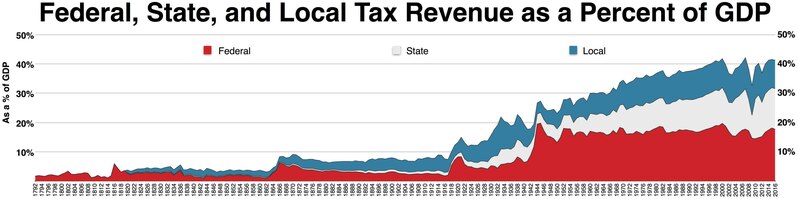
If you compare to a benchmark like the 1940s, tax% of GDP has more than doubled, and GDP has increased ~4x. This means someone today is paying about 10X the taxes (controlling for for inflation!)
They can also hire people to shill in every major forum, so there’s a huge uphill battle just to avoid getting drowned out.
I have no doubt that if we actually raised taxation rates (Corporate Stock Grants is an easy one that everyone on here will pretend is impossible), corporations, and rich folks would start paying more in taxes. Maybe they would still dodge, but until we actually start doing something saying "nothing will work" is like saying "there's no way to hammer a nail all the way into a board" when you haven't actually hit the nail with the hammer.
Edit: Of course it's un uphill battle if you've done nothing. Everything is an uphill battle when you're not doing anything about it.
This outcome isn’t by accident and it’s a huge undertaking to just get past the tribal bullshit just to have a sane conversation.
I get it's hard, but it's not impossible. And it's probably just necessary if we want to survive as a species...
We reduced top marginal income tax rates though, so they moved more money into income and stopped hiding as much in shell companies and inventory.
The top 1% earn 20% of national income, but their taxes comprise 40% of federal income tax revenue.
US Gini coefficient (inequality measure) decreases by a third after accounting for taxes and transfers.
The follow-up is that based on the manipulated income data, wealthy people pay disproportionately more taxes?
Capitalism results in the power coming from capital. Therefore capital taxes should be the primary taxation mechanism.
There are issues with it such as cashflow problems and more, but all systems have issues and they can be overcome.
We’re fortunately at an inflection point where there are some (though not many) governments large enough to challenge mega international companies. Sadly they are somewhat captured by the largest international companies — so it’s hard to see any solution.
Simple example — Australia was trying to participate in the construction of international tax laws. The only companies capable of understanding the existing Byzantine laws were hired as consultants and immediately turned around and marketed their insider knowledge on the topic to their rich clients.
There was nothing remarkable about the story - ie its occurrence was not remarkable. The fact that the media ignored it as a story for 18 months was not remarkable. The slightly remarkable thing is that for a few weeks a small slice of the media reported on it at all.
https://amp.theguardian.com/business/2023/jul/26/pwc-scandal...
Imho, its a shift of the represented interests in policies. We should stop pondering enshitification or greedflation an start seeing it as a systemic issue, that we can observe everywhere.
https://en.wikipedia.org//wiki/Commodification#In_Marxist_th...