I'm not skeptical of replaceable batteries. I think the policy that forces them to be removable on top of working with 3rd party manufacturers is a good idea.
I don't think replaceable batteries or USB-C requirements restrict the industries ability to move forward.
Edit: You can continue to argue in this thread, but the point of this reply was simply to point out that the parent comment was all thinly veiled opinions with no substance.
These ultra thin foldable phones probably couldn’t exist with removable batteries. The thinness required to make it comfortable to use would be hard and so would the structural integrity with a removable backplate.
It would absolutely restrict durability since it’d make waterproof and dustproofing way more challenging, if possible at all.
Removable backs would limit wireless charging hardware like apples MagSafe (which is great!).
I had a phone with a removable back and wireless charging back in 2012. This isn't rocket science.
Modern phones are going for sexy, that's all. They are large in every dimension but Impractically thin even though everybody adds another 3mm - 6mm of case anyway because they're sleek to the point of unusable. I particularly love when we buy a sexy sleek thin phone and then put an otterbox on it :-)
But I'm not a materials engineer. This is just in my lay experience of how thin materials I've encountered perform.
Only if the flap covered the ports…
“Your customers won’t even have to plug anything into their car. FuelSafe just safely hoses down the car with fuel! Over 45% efficient!”
Compelling the use of USB-C will cause stagnation in connector innovation; there's no point in trying to to create new and more durable/water-proof/wear-resistant/faster connectors. The requirements for replaceable batteries may cause stagnation in other innovations; if we imagine that there'd been similar requirements in the alkaline era, we might never have gotten to Lithium-Ion.
What conceivable stagnation could requiring replaceable batteries cause?
This is part of the challenge with these regulations - by definition we're defining a framework based on existential knowledge.
What about batteries that can also be panes of glass that act as the display? What about ultra low-power devices that are powered kinetically by typical human movement or magnetic perturbations?
None of these currently exist in a commercially viable form, but if we regulate based on our current view of technology do we run the risk of making these innovations more challenging to bring to market? That's the challenging balance that needs to be considered.
The answer isn't to abandon policy, it's to design it to be flexible and to respond quickly when problems are discovered.
[0] https://www.vox.com/policy-and-politics/21534416/free-state-...
Or, just make the new port a barrel connector like a headphone jack, just with more segments. Bonus points if you can plug in an actual headphone and it works. Nobody seemed to have a problem with a headphone jack next to their USB port.
I don’t. It’s all Bluetooth now. I like wireless headphones.
But you should be free to buy them and we can both vote with equally with our wallets.
Go buy phones that have the 3.5mm jacks and send the signal that consumers still want plugs invented in the 1950s. If that’s what you want to signal. You have a great way to tell Apple if you like what they are doing! So do I.
Maybe Europeans like wired headphones over wireless? That’s news to me, but they should vote with their wallets. If you like what a company does, but things that company makes. If you don’t, don’t.
It bugs me to see a government meddle with what customers want to buy.
Don’t rig the system so you get a bigger voice than others. That’s not fair.
USB-C wasn't the problem, MFi was. The rumours are that Apple's USB-C implementation will be locked down in similar ways, accessory manufacturers will still need to pay Apple to create certified accessories, and data transfer speeds are going to be restricted to Lightning speeds. USB-C everything is nice, but no non-techies I know like it because it's the new cable that's not compatible with any of their stuff (as much as I advocate for it).
Removable batteries in smartphones just aren't workable. We have too high expectations for battery life, weight, durability, water resistance, and size. It negatively impacts all of these. There hasn't been a mass market smartphone with a replaceable battery in a long time, and if they were that great for customers there would have been. A much better option would be to focus on repairability, it would have almost all the benefits, and effectively none of the downsides.
I'm an Android user, but nearly everyone I know has an iPhone. And not even one of them has an iPhone accessory. So how important is this MFi thing, really? From my perspective, the main annoyance is that my partner (who has an iPhone) needs a special charging cable, and can't use the cables I use for my phone and we both use for our laptops.
And I suspect that's mainly what the EU cared about too: charging cables.
> USB-C everything is nice, but no non-techies I know like it because it's the new cable that's not compatible with any of their stuff
If you're talking about all their current stuff being Lightning, then that problem will work its way out in a few years. If their current stuff is all micro-USB or USB-A, then... what? How is that even possible these days? Even the cheap rechargeable motorized cat toys I've bought on Amazon use USB-C cables to charge.
And if it is micro-USB or USB-A that their other devices use, so what? They'd just be going from one charging cable that only works with iPhones (Lightning) to another that only works with iPhones (USB-C). And as their other non-USB-C devices wear out or become obsolete, and they replace them with new ones that charge using USB-C cables, this problem will also sort itself over time.
Once Apple is required to use USB-C and then uses software to block non-MFI connections then the EU will (a) take them to court for trying to undermine the spirit of the legislation (b) if they lose in court pass a new law requiring them to prevent blocking non MFI connections (although they will probably allow them to display scary warning messages).
Oh wait, that’s entirely not the case today.
Removable battery phones are more difficult to design.
Why would a company do something that's more difficult, absent a mandate to do so?
Modern smartphones are not the pinnacle of technical possibility -- they're an optimization between feature and price.
A feature could be beloved by customers but add another $1 to smartphone build costs, and still be cut by every remaining manufacturer in the market.
i buy used sub-flagship phones two or three cycles behind. they're much cheaper, they do what i need, they're not too slow for modern software.
but the battery is the worst part. i get a day's life at best. a year in i'm camping by outlets all day if i need to use my phone more than incidentally.
all of these phones would be perfectly good on the secondary market if a battery replacement service didn't cost as much as replacing the phone itself.
i used to swap batteries myself. but it's increasingly difficult to do without damaging the screen as you peel it apart, and at that point the phone is totaled.
I do.
But it’s absolutely not a legitimate comparison. An Hermes bag, or a game console are very specialized devices. A smartphone is almost a necessity to live a modern life these days.
Especially if you step out of the U.S. to more developing countries, where many people don’t own computers, or have email addresses. Everything they do, from basic transactions, to government IDs, to receiving govt benefits, etc happens on the phone.
It’s absolutely legitimate for consumers to have different expectations for such essential computing devices, and for governments to step in when the providers of these devices are acting against their citizens’ interests.
Gruber does no such thing
https://daringfireball.net/2016/10/iphone_edition
> Especially if you step out of the U.S. to more developing countries, where many people don’t own computers, or have email addresses. Everything they do, from basic transactions, to government IDs, to receiving govt benefits, etc happens on the phone.
And those people aren’t buying iPhones….
Lithium-ion batteries at the $25 pricepoint come from a single well known place of manufacturing and are usually of the unknown quality. They may or may not be safe to use, and there have been precendents of self-ignition and self-explosion to the point that some airlines have banned or have attempted to ban the Li-ion batteries in the carry-on.
A branded $99 battery (all brands) is not 100% immune to the same problems but occurences are much more rare, and typically each such failed specimen is taken back to the manufacturer for an investigation. The only forensic process in existence for failed $25 batteries is called «throw it into the dumpster».
That said, a better QA process by the phone manufacturer does make the $99 battery reasonable. If all suppliers of $25 batteries could guarantee the same rigid QA process for the $25 batteries they supply, that would make the $99 batteries unreasonable.
i'm currently running a pixel 4, and a battery swap would cost more than i spent on the phone.
not sure where you're getting your prices, but it doesn't matter. the fact that this is even a point of contention indicates that swappable batteries would make a difference.
And while $99 may not be a lot in some regions of the world, but it's a significant amount of people's discretionary income in other regions (they may not be buying iPhones but the situation isn't much better for other brands as far as I'm aware.) $99 is also enough to outright buy a new cheap Android phone.
Are there people that find spending $99 on a battery replacement expensive that are really making the decision to replace their whole phone for 5-10x that amount?
https://www.statista.com/statistics/788557/global-average-se...
And that's the average, likely brought up drastically by the sale of extremely expensive phones. Apple and Samsung's flagships start at $800 and go over double that for their absolute top of the line. Unfortunately I couldn't find the global median selling price of smartphones, but the source above mentions that 58.5% of all smartphones sold during the second quarter of 2019 in Latin America had a price tag of USD$199 or less, and 83% of all smartphones shipped to Africa during the 4th quarter of 2019 had a price tag of $199 or less.
From a quick search, one of the best selling phones right now in India is the Galaxy M13, which is Rs. 9,699, or about USD$118 — barely any more than what Apple charges for a battery replacement in the US (obviously it's not that much for a replacement in India, but it does show how unnecessarily expensive $100 for a battery replacement really is.)
https://www.bajajfinserv.in/insights/best-selling-phones-in-...
In China, those that can afford it seem to buy iPhones (10.7% of sales), but all the rest of the best selling phones seem to be cheaper phones (next best selling is around ~USD$220, and the ones after that seem to be a little above or below that.)
https://www.gizchina.com/2023/03/28/top-10-best-selling-mobi...
In Mexico, 63% of smartphones sold in 2021 were between 3,000 to 10,000 pesos (USD$175 to $585.)
https://expansion.mx/tecnologia/2022/08/04/smartphones-mas-v...
However, if I'm not mistaken that all is for new phones, and most phone sales worldwide aren't new. While used and refurbished smartphones make up only 24.4% of phone sales in North America as of 2020, they make up 75.6% of phone sales in the rest of the world.
https://www.statista.com/statistics/1208609/used-smartphone-...
So the average person worldwide is not buying a new phone at all (and thus spending even less than whatever the median selling smartphone price is, let alone the average.) However, the percentage of phone sales that are used is projected to decrease over time (according to the source above.) Not super surprising, given that while flagship phones have ditched removable backs for a while now, in the past few years more and more budget phones don't even have removable backs, and if you have to spend a significant portion of the cost of a new phone on a battery replacement, then that's a risky decision, as you don't know how long the other parts in the phone will last, and that's a lot of money that you're gambling on it. Sure, 3rd party repair shops in developing countries aren't charging you USD$100 for a battery replacement, but the labor can still easily double the cost of getting a new battery.
At $35 (and that's from iFixit, which if I'm not mistaken doesn't even make the batteries — if the companies sold the batteries directly, it'd be even cheaper), a new battery would be a much smaller risk, and near certainly would lead to less e-waste.
Certainly I can see them buying an iFixit battery and trying themselves, or paying a 3rd party vendor and taking a risk on that. But there's just no line of logic that makes any sense to me that says "$100 to replace my iPhone battery is expensive, better throw it away and spend even more money to get someone else's second hand phone of unknown state"
Not necessarily, as I can't imagine most refurb/used sales worldwide come from individual sellers; most of them are probably sold by businesses, which sometimes provide a warranty and return policy on their used products. Right now, on the Amazon Renewed Store, the unlocked Galaxy S20 FE 5G 128GB is $187.50. Amazon states,
> The product is refurbished, fully functional, and in excellent condition. Backed by the 90-day Amazon Renewed Guarantee.
> - This pre-owned product has been professionally inspected, tested and cleaned by Amazon qualified vendors.
> - This product is in "Excellent condition". The screen and body show no signs of cosmetic damage visible from 12 inches away.
> - This product will have a battery that exceeds 80% capacity relative to new.
> ...
> - This product is eligible for a replacement or refund within 90-days of receipt if it does not work as expected.
from https://www.amazon.com/Samsung-Galaxy-128GB-Cloud-Mint/dp/B0...
So if 2.5 months into using that phone, you feel it doesn't function well, you can return it.
Even for sales from individuals, Swappa (an online user-to-user marketplace for used tech) requires you to list the battery health percentage on iPhones if it's below 80%. They also require that everything functions well and even is in good cosmetic condition. Their standard for "fair" is rather high.
Outside of pawn shops, I imagine most brick and mortar stores aren't selling phones in poor condition. In the US, the phone carriers, Best Buy, and even Apple themselves sell refurb phones, and they don't want to hurt their reputation by selling poor quality products. Apple in particular has high standards for their refurb phones:
> All refurbished iPhone models come with a new battery, new outer shell, are backed by a one-year warranty, have free delivery and returns, and also include:
> - Full functional testing, genuine Apple part replacements (if necessary), and a thorough cleaning
> - The original Operating System or a more recent version
> - All refurbished devices are repackaged in a brand new box with all accessories and cables
I guess anecdotally my iPhone 6S as of recently hasn't been performing well. Would a battery replacement help it? Maybe. But that's not certain (it could be that modern apps are so bloated that its 2015 hardware can't handle it despite most of those apps having essentially 0 new meaningful features in the past 8 years) and I'm surely not going to spend $100 on a nearly 8 year old phone to find out. I've replaced the battery myself before, but last time I broke the screen in the process (something that wouldn't have happened if the phone had a removable back), so I'm hesitant to do it again (I was being careful, and have done plenty of phone repairs at this point, but more than anything the ribbon cables break extremely easily.) But if I could just pop off the back and put a new battery in, I'd be willing to give it a try for $35. But instead I'll probably just deal with it for a little while and then get a different used or refurb phone with better battery health than my own device.
EDIT: another example of an affordable refurb phone: iPhone SE (2nd gen) is $147 in the US from the Amazon Renewed Store and has all the same benefits Amazon guarantees for the Galaxy S20 FE. So for $47 more than a battery replacement, you can essentially try out a "new" used phone for 80 days and determine whether you want to stick with it or return it.
I agree, apple make old phones slow on purpose by software update, apple is evil
The only time Apple made “an old phone slow” was when the battery was too old and couldn’t operate at peak without causing the phone to shut off.
You can have both.
> Having a power bank solves the problem of discharged phone for me
There are cases where a power bank isn't a good solution. They big and heavy. Not being able to swap in a fully-charged battery on demand means that I can no longer use my phone for certain things that I used to be able to do.
3.7V - 1.23V == 2.47V. 2.47V / 0.2Ω ~= 30W (12.5A).
You will be able the find your phone on the seabed from the bubble emanating from it.
Though the battery protect circuitry (which is inside the battery package) will most likely cut power before the battery is risks damages.
I wonder if that's responsible for the experiences folks had way before waterproof phones were introduced: they would drop their phone into water, it would shut off and refuse to boot for a significant amount of time (enough to send them shopping for a replacement) and then they'd try it a week later only to find that it works fine. Accelerated by putting it in a bag with rice or other desiccant.
What's stopping figuring out how the hardware can achieve both battery replace-ability and water resistance?
Phones already have holes in them, e.g. speakers and charger port, and yet are able to survive a water immersion event.
Similar thing with the charger/data port. The outside of the port can be completely sealed up with just the electrical connections going through. The port isn't ever opened, there's no mechanical wear of actually going in and out of the sealed area. Glue it all up but leave the electrical connectors exposed and its sealed.
A battery door is a whole 'nother issue. Starting off, its probably going to have considerably more perimeter needing to seal, especially if its like the doors of yore where you popped off a significant part of the back. Then, you'll need this seal to handle a lot of open/close events and be able to handle the dirt and debris which it will be exposed to. Keeping the device's profile thin gets way more complicated with all of these requirements, and the seal will probably still be less reliable than the seals for the charging port and the speakers/mics.
Nothing, since it wasn't all that long ago that there were phones that did this.
I don't think it's easy to design a phone that would at the same time a) have easily replaceable battery, and b) be waterproof until the first battery replacement.
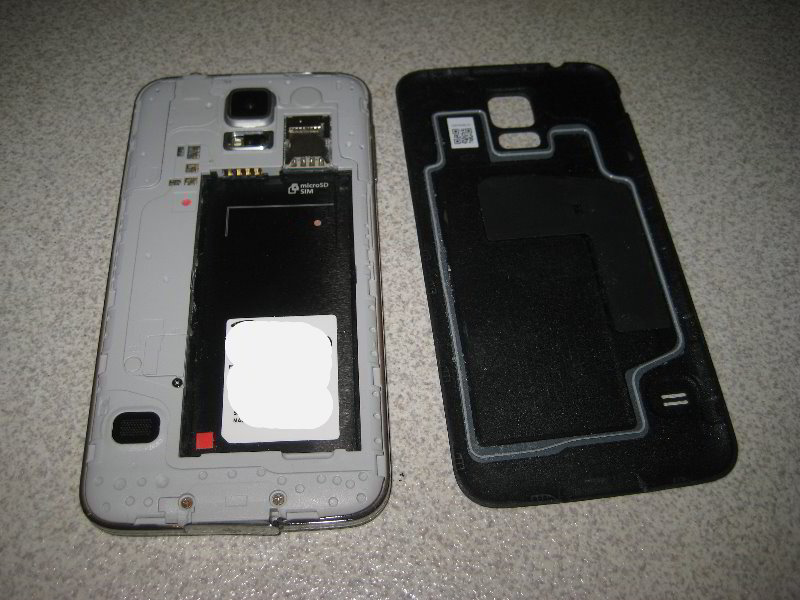
You can clearly see here[0] that the gasket on the flap protects only the USB port from water ingress. The battery and sim are protected by the grey gasket on the rear cover.
The opening for the rear speakers in the back cover reinforces the fact that the flap is there to protect the interface of the USB port and its housing. The rear cover does not contact the USB port at all.
[0] https://www.paulstravelpictures.com/Samsung-Galaxy-S5-USB-Ch...
https://www.gottabemobile.com/samsung-galaxy-s5-water-test-d...
> If you remove the battery, the Galaxy S5 will remind you to make sure the back cover is back in place securely. reply
I don’t deny that this is a valid use case for you, but I’ve absolutely never been in this position.
I carry around a battery phone charger in situations where I’d depend on my phone. If you squint, yes that’s pretty similar, but the big difference is that a USB charger can power my iPhone and my partners android phone without requiring the phones to use standardized batteries internally.
I think batteries should be replacing in a repair sense, but I’m not sure the “pop open the back and swap it on the streets of Tokyo” is a common use case we should legislate against.
Like others said, I would much rather have it be more durable (eg waterproof). Also I’ll add that thinness is a desirable trait (to a point).
Lots of high-end flashlights do this. Mine isn't much larger than the 21700 cell it contains. If you want to go smaller you can get a 1850-based flashlight and still almost double the capacity of your phone.
Plus, it's a flashlight.
And it has the benefit of being sharable.
And it has the benefit of being able to work hot - you don’t have to turn off your phone to charge it.
They're a lot bulkier. Phone batteries are physically very small and light. Good power banks aren't.
For mm^3/Wh, the results are:
Small vendor swag power bank: 96 x 21 x 26
52_416 / 7.4
7,083 <-- worst one
Canon battery: 42 x 30 x 9
11_340 / 4.5
2,520 <-- wow that's way less
10,000mAh dual USB power bank: 139 x 22 x 60
183_480 / 37_000
~5 <-- wow
By volume / energy, the big power bank wins by a mile. And tbh its not that huge, similar footprint to my phone and about twice as thick. Plus, it can power two devices at once, which can be pretty handy. It has a bit over twice as much power as my phone's battery. This logically makes some sense, as phones these days are pretty much a battery and a screen with a small logic board tagging along for the ride.
If I'm on the go, I'd much rather have a large battery bank that provides a good bit of flexibility rather than a battery that only works with a single device. This one battery pack can charge my phone, my camera, my wireless mouse, my keyboard, my headphones, my e-reader, and then all the same list of stuff for my spouse. If I got a fancier one, it could even provide extra juice to my laptop. If I only had a battery specifically made for my phone, I'd only be able to swap out my phone battery and all of the rest of my devices would need their own batteries or just be left dead.
On top of that, if I wanted to then charge that battery outside of the phone I'd have to lug some specific charger for that model of battery. Meanwhile if I bothered getting a newer USB-C power pack the same power cable that charges my laptop and my phone and my headphones can also recharge my spare battery along with all the rest of the devices I mentioned. I'm much happier having a 10,000mAh battery pack in my backpack to recharge when needed than needing to think about having a few different batteries around and their related chargers to keep track of. Once this one dies I'll probably
Such use cases are normally handled by creating specialty products.
My main motivation for only using battery removable phones is privacy, because I know they are really off, when I remove the battery.
But the choice is currently very limited.
With my 14 Pro Max I charge my phone every 2-3 days, and I'm not letting it get down to <20% when doing this, either. I'm obviously not making heavy use of it over this time, but even on days when I am out and about and using it more, I'm never in danger of it running out of battery.
Personally, at least, I'll take the sleeker design vs. an easily swap-able battery. Thankfully, it sounds like the EU law doesn't actually require it be replaceable in a tool-less manner, so it sounds like the type of design the iPhone 14 (non-max) uses will qualify.
Galaxy Note 4
Dimensions 153.5 x 78.6 x 8.5 mm (6.04 x 3.09 x 0.33 in) Weight 176 g (6.21 oz)
iPhone 14 Pro
Dimensions 146.7 x 71.5 x 7.8 mm (5.78 x 2.81 x 0.31 in) Weight 172 g (6.07 oz)
iPhone 14 Pro Max
Dimensions 160.7 x 77.6 x 7.9 mm (6.33 x 3.06 x 0.31 in) Weight 240 g (8.47 oz)
240 g? What did they put into that phone?
That's an interesting idea. It gets me thinking, in the history of computing have patents on hardware and data protocols overall been a net positive or negative?
I normally tend towards being a supporter of market-based solutions and typically patents are seen as an important part of that. But things like the MFi program, mp3s, all the different video formats, various Dolby formats have all been quite annoying for consumers and set back a lot of products. If these things had never been patentable, then maybe companies would have invested less research into them and the protocols we would have ended up with in their places would have been marginally less efficient. But I think open source efforts could have done a good enough job in their place and the upside of more interoperability and more competition built on top of these things would have vastly outweighed the downsides.
Ask yourself what kind of game regulators are really playing?
See how many former banking regulators end up working at large banks, same is true for pharma and without even looking probably many other industries. The regulatory system is in place only partially to safeguard people, it is also in place to enforce barriers of entry and it is in place to act as a nice career pathway for it's participants.
Every time someone says shit like "locked into the Apple ecosystem", god kills a kitten. Lots of people switch back and forth between iOS and Android.
Nobody's going to go for USB-C on their iPhones if they can get Lightning ports. The Lightning port is far superior mechanically (both more durable and easier to clean from debris) and unlike most Android phones, not attached to the mainboard - so it can be replaced if damaged.
Lightning ports may well be technically superior (I can't really judge as I've had dozens of devices using USB-C, 95% of the time with no issues, but relatively few occasions to use lightning ports - thought I do have an iPad that's bricked currently because I can't find a cable for it), but if Apple is unwilling to license the technology to other manufacturers then there's no chance of it ever being any sort of universal standard.
Personally I'd rather hoped that by now we didn't need cables/plugs at all!
Oh please. Enlighten us how it's undemocratic and authoritarian.
I would like to reminder before you start that every country joined willingly (and Brexit proved they can leave), its parliament is elected by the population of the member states, and the council of ministers are representatives of each member state democratic elected governments.
But please tell us all how it's undemocratic.
Experts? <chuckle> In Brussels - just as in Washington - they listen to lobbyists.
https://www.theguardian.com/world/2014/may/08/lobbyists-euro...
https://www.lemonde.fr/en/european-union/article/2023/04/24/...
https://www.economist.com/business/2021/05/15/the-power-of-l...
I hang onto my phones until the software becomes unusable, either because apps drop support for my OS (and I can't update any more) or I get scared into upgrading for security. I've never had a battery fail or even get to the point where it doesn't last a whole day—the software fails first.
My understanding is that it's different with iOS, because Apple is much better at supporting their old phones than most Android manufacturers.
Every single one of my Android phones stopped working as phones 3 to 5 years down the line. Couldn't take calls, the phone never became aware of them. Couldn't call anyone, not even emergency services, the phone never connected despite full bars. It's always the fucking phone modem.
I'm still using an Android, but when this one eventually fails (this one's starting to flake out at not even a year old, bought new...) I might seriously move over to an iPhone simply because every single iPhone I've seen others use has apparently never stopped working as phones. That's even if they fried a couple Lightning cables and whatnot.
I bought a phone, I expect it to phone. God damn.
You do realise that the EU gave the industry (i.e. the "experts") the task of defining and agreeing on a standard for charging cables? The manufacturers worked on this and agreed on USB-C, all except one US based fruit company.
But it was the reason why we moved from the crapfest of earlier 2000's "everybody has a different charger"
I'm glad we're getting USB-C on the iPhone, but it wasn't a huge problem and it was probably coming anyway in the next few years. But replaceable batteries? I'm skeptical, and think it could shrink the market and lower the quality for users.
I feel like a much better approach would be to say that phones must work with third party batteries, and manufacturers can't restrict battery replacements to their own repair centres. That increases competition, helps small businesses, and encourages a thriving batter recycling and replacement market, increasing device lifetime. As for USB-C, similar legislation about increasing compatibility and reducing lock-in (neutralising Apple's MFi program for example) could have had similar impact without the downsides of the industry being unable to move forward.