You're not alone in thinking this way. And kudos for investing the Time to write this up -- the sophists are all-too-often over-represented here, and I'm never really sure that they're always arguing in Good Faith, or if they are, they're often being so short-sighted that it's simultaneously funny and sad.
Calling it property allows for this bizarre concept of a form of "theft" that still leaves you with the thing "stolen" from you.
So, in other words, it's property.
There's nothing that guarantees a particular lump of atoms are "yours" besides a government-granted monopoly to control that lump. The atoms don't care.
That is a different class of concept than so-called “intellectual property”.
"It is a moot question whether the origin of any kind of property is derived from nature at all... It is agreed by those who have seriously considered the subject that no individual has, of natural right, a separate property in an acre of land, for instance. By an universal law, indeed, whatever, whether fixed or movable, belongs to all men equally and in common is the property for the moment of him who occupies it; but when he relinquishes the occupation, the property goes with it. Stable ownership is the gift of social law, and is given late in the progress of society."
So in that sense I don't think it's an altogether misleading analogy, although of course the ability to copy without taking makes it very different from tangible property. But both are ultimately social conventions, and both exist supposedly for the common good. If that common good cannot be demonstrated, and even moreso if there's demonstrable harm, the conventions can change.
You don't own a car, you have a title that gives you a government granted monopoly over that hunk of metal.
You don't really "own" most things without society agreeing you do.
In other words, it's a right.
The original idea was to promote creative works by authors by providing a limited term right to be the sole publisher of a work. This was important in the days where it actually cost money to publish and distribute things, as it ensured you wouldn't eat the cost of that only to have someone else make all the money by doing it cheaper.
Thing is, it doesn't cost money to publish and distribute anything anymore. I think the large number of free and fan works that exist are proof enough that creativity need not be incentivized by money, and to the extent that we want to monetarily reward works we find meaningful, there are mechanisms like Patreon or Github sponsorship to do that.
Will the production quality suffer without large corporations spending ludicrous amounts of money? Yeah, probably. But I don't see how that's something worthy of preserving for all the bullshit that copyright inflicts on our culture.
Creators can still get paid for their work through Patreon if people find it valuable.
IMO pretty much literally anything else would probably put us in a better situation. At this point after several decades of experience, I think even just outright abolishing copyright law could possibly actually be a net improvement (give or take). But surely it should be possible to come up with a better system by now!
===
Even so: to respond to who would create even if copyright law would be abolished:
A lot of people create with the intent of letting everyone instantly get to use their hard work. This is actually rather common. Huge amounts of fan-art, original art, original fiction and original fiction get created every day. Scientific articles get written every day. Wikipedia gets written every day. Open source software gets written every day. And let's not start about AI art and AI text (which currently is all PD) . 90% of this all might be crap, but then 90% of everything is crap. There are definitely gems among the 10%, just like everywhere else. And due to the sheer volume: there are a lot of gems.
Much of this activity would still happen without copyright law. There is clearly sufficient incentive at least. Fun is a common incentive. Sharing back is a common incentive too. Advancing the course of science. Earning fame.
Or you can just earn money. People earn money this way. I earn money this way. In this kind of situation, you pay the bills by "making things that don't exist yet".
Current copyright law has actually often gotten in the way more than that it has helped, I feel. I can tell you stories if you like! This does differ a bit per field and profession, of course.
===
But really copyright law should be replaced:
If you actually want to earn money by depending on copyright law, I feel you're getting short-changed at the moment. AI will "steal" your style; youtube, spotify and amazon will pay you mere pennies, of which apple might will pinch a percentage, your publisher will pinch a percentage, and you get left with ... very little.
Copyright frankly isn't helping many people right now. I don't think anyone is happy. Unless you know a bevy of small creators now living in mansions in Beverly Hills? I'd love to hear of it!
Per a google search, it seems that mainly very famous actors, actresses, and generally people who've contributed significantly to our culture live in Beverly Hills. The google results are definitely biased towards celebrities, but Beverly Hills seems to be a very odd example to choose when trying to point out how copyright isn't helping creators. It's natural to expect some proportionality between a creator's audience and the profit the can make monetizing their work.
This is especially true of small creators afaict.
Can you point to examples of any small creators who would be better off if they had no legal copyright over their works?
I think the site rules do imply you're not supposed to go for the straw man argument that ends a debate, but rather for the steel-man argument that stimulates further curious conversation.
So let's go for that then... :
People often build on each other's work. Can you imagine situations where people can take inspiration from each other a whole lot earlier, or are allowed to borrow ideas sooner and more often?
This does happen in eg. open source and open content. More traditionally, scientists also reference each other's papers. Sometimes there's also times like eg. when sampling first became popular: this lead to a period of creative bloom in music.
Now, I have to take you seriously because the site rules say so. So I will! But I haven't heard a "stealing a car" analogy since last century, so I may be rusty. And maybe you're taking this in a novel direction? Let's see!
==
So a trick people did to me in the late '90s was to redefine "to steal" and not tell me. Sorry, but I do have to check for a minute!
In the case where you have allegedly stolen my car: can I walk out of the house next morning half asleep, put my keys in the ignition, and drive the <stolen> car to $customer without noticing much?
If so, then you have redefined "stealing" beyond my Overton Window and I shall be forced to make rude noises at you.
==
Otherwise: obviously I want to be able to drive my car. Depriving me of my property is bad. Where do you want to go with this?
edit/note: possibly I'm misremembering and people were still using the "you wouldn't steal a car" argument in the very early 2000s?
And yet, MPAA seriously made an advertising campaign that equated copying to stealing [1] . This obviously didn't go down well. (eg: [2] ). It sounded a bit like what you were saying, hence the odd response you got.
Of course in in reality, copying isn't stealing. If you could somehow copy my car, I'd still have my car, so you wouldn't be depriving me of anything.
In general, people collaborating and building and iterating on each other's work is normally considered a good thing. Originally copyright had fairly short terms to facilitate this, but over time the original aims of copyright seem to have drifted somewhat.
Anyway, I'm still left mostly guessing where you're trying to go with your 'If I steal your car and tell you that I'm just "building on your work" to better my life, are you going to feel the same?' comment. Could you elucidate?
* "Can you point to examples of any small creators who would be better off if they had no legal copyright over their works?"
to
* "People often build on each other's work. Can you imagine situations where people can take inspiration from each other a whole lot earlier, or are allowed to borrow ideas sooner and more often?",
it's just completely removing the concept of "copyright" from the question entirely and attempting to inject the false premise that "violating a creator's copyright is the same as sparking inspiration in someone else or citing a paper" (which is, itself, a straw man).
Because creating is part of human nature. Many creators actually enjoy doing what they do.
Now I don't disagree that it is in our interest to make sure that people can afford to create but that doesn't have to mean copyright at all.
The HN community can also be out of touch with technology. If you are an AI researcher this becomes plainly obvious the moment you visit any of the AI threads (if it isn't obvious already from the 6 to 12 month delay on the posting of cutting edge developments here). Sometimes it's hard to argue with zwj.org's assessment [0].

I’ve never been less impressed with the supposed elite class of Ivy League “hackers” than when I’m on this site. Get over yourself. You didn’t just solve AI with your “recursive LLM”. No one with ADHD is going to benefit from your pomodoro app that is…slightly more visible than the other thousands of pomodoro apps? Also - half of you don’t have ADHD. Believe it or not - coding is an attention drain and taking stimulants to gain an advantage so that you can ship in 3 months instead of 12 is toxic as fuck.
Don’t get me started on LessWrong.
FWIW, while I agree with the sentiment - not everyone is prepared to see an unsolicited photoshop of a testicle in a wine glass. Might want to edit a warning in if you still can.
That’s not to undermine the role of the thought experiment, more to suggest that they are more concerned about “peak rationality” than they are about having a useful discourse with other researchers in the field.
I’ve seen others suggest it mildly resembles a cult. It is also apparently strongly associated with the “effective altruism” movement and so clearly caters to the ultra wealthy.
Same for me with Le roi et l'oiseau and Peter and the Wolf by Disney.
Long lost episodes of local shows (super local) are being uploaded by their actors and creators.
So what's the right way to balance the need to preserve artistic/creative works and the rights of the creator to monitize or permit usage of their works? It seems rather gross to just say that the creator has no right to sell their work or object to some source copying their work and distributing it in a way that deprives the creator of profit.
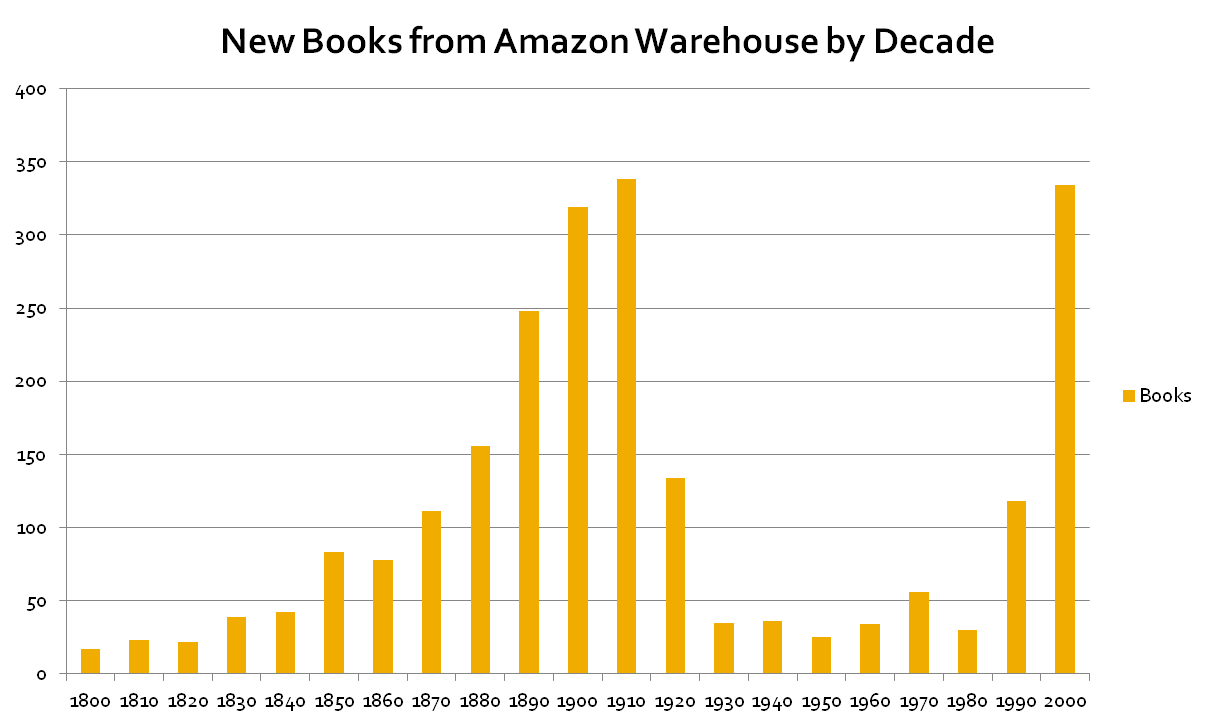
To speak to why we need this sort of thing I would have to harken back to a fun talk that Paul Heald gave back in 2012[0] where he showed this fantastic chart[1] that shows the number of titles for sale on amazon by publish year.
The only thing I can assume from the chart is that either the publishing industry in the mid 1900s suddenly found itself publishing the same amount of books as they did in the 1830, no one cares about the books written between 1920 and 1990, or copyright has caused the loss of an enormous amount culture. According to the chart, and the talk, there are 7 times as many books published in the 1910s than are available from 1930s-1950s.
[0]: https://youtu.be/-DpfZcftI00 [1]: https://cdn.theatlantic.com/media/mt/science/Amazon%20pub%20...
https://en.wikipedia.org/wiki/Copyright_law_of_the_United_St...
I’d love to see some of those treaties renegotiated to limit copyright duration for Works for Hire (e.g., most software out there), but also to reduce the overall length of protection…BUT. I’d also love to see RAND compulsory licensing on copyright materials over a certain age…BUT.
In Europe (not really recognized in the U.S., AIUI), there’s the moral right of the creator in addition to the copyright of the creator. This can be used by an author to prevent their work from being published (say, an author’s private letters that came into a publisher‘s hands) at least while they are alive. I think that’s important.
Practical as it may be, that's not a natural right but merely a physical possibility. More generally, the concept of natural rights - except for a very narrow niche of special subjects closely centered on the individual's own life and bodily autonomy - is a shortcut to total subjectivity at best. And even for that very narrow niche, the "rights" part is a normative civilizational convention/construct, whereas nature conspicuously ignores such "rights" (as do humans for the most part when it comes to other species)
Copyright and IP actually are violating individual autonomy. It restricts what you can say or write.
What is? If you mean the absurd idea of wanting to base those on the murky and subjective notion of "natural" rights, then I fully agree. If on the other hand you mean the reminder that such subjective notions of "natural" rights are a shitty wobbly base for any moral rights (or most other rights as well for that matter) legislation, then no, not at all, quite to the contrary:
The fact of being aware of what rights are (a civilizational norm that grants the individual the protection of their possibilities, as opposed to some inherently subjective notion that a physical possibility would somehow be more special than another because of a subjective view of "god" or "nature") is actually positive for individual autonomy… and a crucial part of enlightenment as far as the legal parts of civilization goes.
In contrast, arguing for concepts based on what they believe to be "natural" is what reactionary forces do in order to restrict individual freedoms. Not so long ago, we had lots of discriminations based on that, e.g. on the idea that black people were "naturally" below white people, that women were "naturally" to obey some role models or that being gay way an abomination against "nature". Arguments based on ideas of "natural rights" have - outside of very narrow special subgect niches directly related to the individual's life and bodily autonomy - always been a major factor against individual freedoms.
Of course that doesn't change the fact that legal systems can also come up with factors restricting individual freedoms based on totally unrelated factors.
> It restricts what you can say or write
so do laws against slander and laws against unconsented divulgation of personal data. Now don't get me wrong, I agree that the domain of copyright does need some reform. But it's clearly not as simple as just to remove everything that somehow restricts (be it copying and sharing of data or other possibilities).
Otherwise any privacy laws and laws for data sovereignty and against unconsented divulgation of personal data would fall as well. They too are based on the legal concept that everyone has an ownership of their data. And more generally, laws about rights are almost always the result of a complex balance to find between the rights and possibilities of many sides.
So, everything has some prot cation, and valuable stuff can be protected for a long time (at a a cost).
This would seem to strike a good balance… obscure stuff will enter the PD quickly, because the publisher isn’t going to pay even $100 for something they’ve forgotten about, while not kneecapping someone who has a massive breakout success.
Note that I'm not for the proposition of revenue-based scaling. That would just be a tax on success.
Ideally copyright would be eliminated and people who choose to create will choose to create. There is development in lots of areas that aren't copyrightable.
If you want to keep copyright, then it should be reduced to the bear minimum to incentivize creative works - that could be on the order of 20 - 30 years.
People can own guns. Is it problematic for the government to limit what people can do with their own guns? I would argue that it's not problematic at all, and I bet you would, too.
I'm open to other systems than copyright to make it possible for creators to afford to create and sell their creations. I think Patreon is fantastic, but I don't think it would work well for things like code (or situations where people don't really care about the creator and just want the product).
Everything will have second,third,fourth order effects.
If [
    1) disputes were decided on the merits and

    2) costs of dispute resolution were

        2.a) deferred until decision-time,

        2.b) born by the decided-against party, and

        2.c) made the decided-for party whole and then some
A) an industry would spring up to identify wronged creators and fund defenses of their IP, or
B) industry would just pay to license the copyrighted work.
But In my experience once money starts to flow in any entity its much harder to dismantle it without sortof letting bleed out. I dont think disney would give up its claim on the works anytime soon. we need to slay the beast by a thousand cuts.
If a politician suggested changing the current term (often over 100 years, depending on the details of creation, publication, and ownership) so drastically, they'd be laughed out of office. Or, rather, defunded out of office by their corporate donors.
I fully concede that wouldn't go to IA to read any full work (it's too slow and the interface isn't nearly as nice as O'Reilly Online or a physical book), I think copyright made it possible for the current highly-convenient distribution models (of spotify, Amazon, and to a diminishing extent paid video streamers) to develop. In the early 2000s, people who had the money were still extensively using Napster/Kazaa/Limewire/etc to get content because buying an entire CD when you wanted one song sucked (although paying $0.99 for a song on itunes also sucked).
I think there should be a carveout for IA as IA is a uniquely valuable resource, I'm just not sure how to make that into a general rule.
Encourage more creative work by exchanging a temporary government granted monopoly now for the promise of it becoming available to society's benefit later.
Current copyright terms are too long. Not everything needs to be monetizable to the nth degree in perpetuity in order for sustainable livelihoods to exist.
> The Berne Convention states that all works except photographic and cinematographic shall be protected for at least 50 years after the author's death, but parties are free to provide longer terms, as the European Union did with the 1993 Directive on harmonising the term of copyright protection.
This is not an American thing.
And the Berne convention was four decades before Disney was founded.
I think the original terms of American copyright are fine to use as a model: 14 years for all works, period. And certainly that's open for debate; even 25 or 50 years would be much more kind to the commons than what we have now. We could even do like we do for patents, and have a relatively short term, with a one-time renewal option for creators who continue to benefit from a work and still care to keep it protected.
The US is part of the WTO and thus a signatory to the TRIPS agreement ( https://en.wikipedia.org/wiki/TRIPS_Agreement )
> TRIPS requires member states to provide strong protection for intellectual property rights. For example, under TRIPS:
> Copyright terms must extend at least 50 years, unless based on the life of the author. (Art. 12 and 14)
> Copyright must be granted automatically, and not based upon any "formality", such as registrations, as specified in the Berne Convention. (Art. 9)
Changing that to a "short term and renewable" would involve leaving or renegotiating the WTO. That is likely a non-starter.
More kind perhaps but really anything that prevents you as an adult from building on the works that your grew up on is a shitty deal for society.
The person you are responding to is writing about American Copyright. https://en.wikipedia.org/wiki/Copyright_law_of_the_United_St.... The first american copyright law is from 1790, which does in fact predate the bern convention, and our life of the author plus 50 years rule is from the copyright act of 1976, 13 years before the US ratified the bern convention.
So yes, it is an 'American thing' as are all issues of law in the US. And if you think that this kind of convention is meaningfully binding, just checkout the history of the US and other major powers with regards to various other international treaties, like the ICC https://en.wikipedia.org/wiki/International_Criminal_Court.
this is important since in developing countries e.g. India, China with regards to DMCA it is commonplace to pirate Americanly-copyrighted media. so much so that it is not even frowned upon. relatively speaking, imagine a choice between paying tensfold what you pay in developed nations vs paying nothing
similarly, for 'freer' countries e.g. France, Sweden, Netherlands - it is very difficult to enforce a law not created by the state whose laws you do obide by
In a world where content producers were financed anyway, because we understood as a society that this is valuable, this waste wouldn’t be necessary and we probably would have less “Avengers Nth the movie”. That was the norm and how the likes of Da Vinci and others got to do their work that are now so much appreciated, so I don’t think it’s that utopian.
This isn't true. Most "content" created is not fincancially rewarded at all.
Sure, it's certainly debatable what the "correct" term length should be, but I think most people could be convinced to value the commons a bit more and agree that it should be significantly shorter than the current "life of creator + 70 years" (or for works-for-hire, 95 years from publishing or 120 years from creation, whichever comes earlier).
For copyright owned by individuals, why should a creator's children and grandchildren (and great-grandchildren?) be allowed to continue to profit off their ancestor's work, depriving the commons of history and culture? For corporate ownership, why should the company be able to profit for longer than the lifetime of anyone around when it was created or published? Hell, most companies aren't even around that long, so ultimately the copyright ends up being passed to several other companies that have no relation to the original owner.
But really... 14 years sounds reasonable to me. I would even say 25 or 30 years would be ok, if the consensus is that 14 years is too short.
We could also go with a limited renewal system, like is used for patents. Say you get 14 years, and if, after those 14 years, the work is still important to you, you can renew the copyright for another 14 years, or something like that. People and companies who still actively gain economic benefits from their work 14 years later will go to the effort to renew it, but otherwise -- what is probably the majority of cases -- it'll fall into the public domain.
Of course, copyright isn't just governed by US law: the Berne Convention, at least, attempts to govern and harmonize copyright to some extent, and it requires minimums of 50 years after the creators death for most types of copyrightable works. But this is all doable, with political will behind it. As usual, that's always the problem.
The political will to change that in 164 countries for for the US to leave the WTO would need to be quite substantial.
If the copyrighted works were still relevant enough to the culture that the creator's descendants are still profiting off of the work, I don't see how it could be lost to the commons. If the commons and culture no longer care enough about the work to offer any money for it, I don't see how the descendants could still be profiting from the work.
I don't have a dog in this fight (outside of me bristling at people acting entitled to disregard terms of GPL copylefts), I just what whatever system will optimize the quantity+quality of creative works, and I want creators to get paid adequate value for their work, even if that means they can sell the rights to their work to another entity.
A truly cursed book cover!
If congress passes a copyright law, and that law can't demonstrate that it actually MEASURABLY does promote the useful arts and sciences, (but rather hinders them, as is often the case), then that law should be overturned, desecrated, and posted on a wall-of-shame as an example to others of what doesn't work.
I think that would solve 90% of our problems with copyright law. But that's just me. I'm not typically a "Constitutional Originalist" but I think this kind of thinking here could help.
How important is precedent..? Roe v Wade was overturned despite decades of precedent. Law right now seems to be as dynamic as tech.
Don't worry, 50 years was only close to the median amount of time that it takes for old laws and old court rulings to be overturned
So it wont undermine your brand to support what might ironically be seen (now) as a rogue court outcome
I'm pointing out that being an originalist is also a sort of appeal to authority to the Constitution. If the authority is then wrong on another topic, it undermines the point of the respect of the authority.
That's why saying "I'm not always an Originalist" while literally making an Originalist argument makes no sense. It would've been better to simply not make that qualification.
Do you really think that someone like archive.org can do a better job of proving the negative than DisneyDiscoveryWarnerComcast will do producing volumes and reams of information demonstrating how they can only afford to keep making new content and supporting small creators if copyright lifetime is extended to 500 years?
IMO compulsory licensing is the way.
The Constitution does not require that IP laws actually or measurably promote the "useful arts and sciences" because the Constitution does not require the promotion of the useful arts and sciences but rather the progress of such. Moreover, the second half of the statement, says how Congress is Constitutionally supposed to accomplish that.
The idea is protecting even the stupid stuff is what lets the actual innovation proceed, the same way protecting Larry Flynch and flag burning protects other forms of speech.
There is a severe lack of appreciation for culture or even an understanding of what constitutes our culture, especially here on HN (which is why I hate discussing these topics here). It's not just a handful books that happen to turn into literature in 100 years. Our culture consists of every medium we interact with today. Allowing corporations to monopolize nearly all of it in perpetuity is quite simply immoral and severely damaging to our continued cultural development.
If you think about how cruel it is to make illegal the way human culture has worked for millenia, to listen to the storys you hear, retell them, remix them and make them your own in a new context. That is against the law now.
Perfectly legal.
Oh, you want to "retell" it and make money off of it? Yeah, that's something else.
I agree with your statement in isolation, but this is in the context of preserving stories (and heck, history) so they can be retold at all.
---
Unrelated tangent, I really miss the distinction of "story" ("estória") and "history" ("história") in the Portuguese language, it makes speaking about topics involving but not exclusively fiction very hard.
Perhaps not having distinct terms isn't the worst thing: it reminds us that history is largely fictional, both on the personal and the society level, and its truthiness and usefulness is derived from our shared belief in it.
On the other hand: why are these public goods services still hosted in infra/protocols exposed to western/us legal arm?
Because you can't host them on thoughts and wishes alone. The capitalist system with its legal constraints is what created it, funded it and runs it.
And yes, hosting incurs costs, but hosting copies of content isn't "retelling" or "remixing", it's copying. And since we want cultural output, we're incentivizing the production by giving you exclusive rights to benefit from your creations.
If you believe that the terms are ridiculously long and should be drastically shortened, I agree. But rejecting the idea of copyright will just remove much of what is created. I don't think we'd be better off in that case.
You might argue that that which wouldn't have been created had there not been the promise of potential profit isn't worth much culturally, but in that case you shouldn't be worried about the copyright restricting access to it, much like you shouldn't be worried about a locked door denying access to an empty room.
I know, many people feel nostalgic for the internet of old before the unwashed masses joined and they wish to return to that time. I don't, I find today's internet much better, I welcome the technological progress and I'm happy that it is serving all of society and is no longer an elite-only thing. Sure, I get annoyed by Spam, Google flooding its index with SEO nonsense and people screeching on Reddit, but I find those to be minor issues compared to the advantages that we get from the internet. And I do believe that commercialization is responsible for most of the development since then.
"bUt tHaTs SoCiAlIsM" whined the masses
For some reason it's ok with extra steps that fuck over everyone else and mainly lead profit towards few middle men though.
On this specific issue, there was very much a fully compliant way to dramatic increase the number of copies in circulation - which was to reach out to all the libraries which were closed, get their catalogues all of which is electronic anyway and administer lending with a much expanded collection. It is just extra work - which likely would have gotten funded. Instead the management irresponsibily tried to score political points.
We need to have the right governance & KPIs in the charters of these critical organizations to prevent extreme people from grabbing their agenda
The emergency library lending seemed questionable, but the current system they're doing—they have a physical copy of the book and lend out a single scanned copy to one patron at a time—sounds legal, and certainly should be legal. Doubly so when it's out of print.
[0] https://www.abebooks.com/servlet/BookDetailsPL?bi=3145733862...
Very much this. Copyright was a hack that was meant to encourage creation. I feel like it often does the reverse, and is robbing us of our public domain and making it harder for people to create.
Yes, while we have a capitalist society we need to enable creating things that can be copied somehow, but I think currently copyright law hurts that as much as it helps.
Creating silos of IP owned by giant companies that rent seek over things made ages ago, encouraged to sit on them and extract value by remaking them, rereleasing old works in new forms to get people to pay again, and stopping anyone else from exploring the ideas without pointlessly recreating the scenarios to avoid copyright violation.
We need to be able to preserve works, to share, to build off others' work, and to explore ideas further after the original creators put them out there. It feels like copyright works for giant companies that can hoarde IP, and the lucky few who make huge amounts from something that blows up, but it sucks for actually encouraging most creators, making living off creation viable for normal people, and most of all: it is terrible for building on other's work.
I think copyright length needs to be way shorter, ideally with some provision requiring source for code being submitted to a copyright office to be released after the duration runs out, as patents require explanation. (In an ideal world also stems for music and stuff, but that becomes really hard to prove and enforce).
I don't think there are easy answers, but I worry we are locked into a system that makes us worse off as a whole.
I see a lot of comments in this thread with what about-isms or "I don't care, we wouldn't miss anything", but these people are short-sighted. And to be honest the hacker news community is frequently the community I loathe to engage in these topics with. Because they are always looking forward with very little respect for the past as well as very little respect for domains outside of technology.
The internet archive is a huge boon in intangible value for communities and the world. It represents a huge cultural fountain that is accessible for anyone so long as they have the ability to access a computer.
A great example of this is that the Internet Archive was the ONLY place where I could enjoy a completely random piece of lost media from a children's television show called Alice's Adventures in Wonderland. There was a lost episode where OJ Simpson was in it and it never aired because of obvious issues. BUT there was a book published from the production called "White Rabbits Can't Jump"
https://archive.org/details/whiterabbitscant00varl
I can't imagine being able to go to any publisher or paid streaming service or god forbid Amazon to find this book, and I sure as shit don't believe in this community to help create ecosystems to support finding things like this.
I am so sick and tired of the copyright laws that play counter to productive creation and stymying efforts to preserve anything. The fact that I have to wait until people die until copyright is up is god awful. And the fact that I have to read people in this community who sound like boot-lickers for corporate oligarchs and their shitty value adds to the world drives me so fucking insane.
I'm only commenting here because I feel it's important to articulate that there are people out there who care, and that the vocal a-holes on this site really miss the point and the intangible value of what the internet archive provides.