News for hackers. Stuff that matters.
Re:Maps show how parking lots “eat” U.S. cities by fnordian_slip on Friday March 31, 2023 @08:18PM (#35395588)
As someone who visited the US as a kid and was even then shocked by the amount of space dedicated to cars, seeing this information on a map still blew me away.

The space needed for these parking lots basically guarantees you can not walk or bike to get anywhere. I believe that unless there's big investment in public transportation, there might be no way for these cities to break out of this vicious circle. And that seems to be politically unfeasible at the moment, for reasons that elude me.

The hyperloop, a ridiculously bad alternative to a subway, garnered so much attention even with its obvious downsides, so having actually useful public transportation should be a no-brainer imho.

Re:Maps show how parking lots “eat” U.S. cities by unsignedint on Friday March 31, 2023 @08:49PM (#35395812)
The concept of a 'big investment' takes on a whole new meaning when it comes to public transportation in the United States, especially considering the vast geographical expanse of many metropolitan areas. In most cases, unless one resides in the heart of a city, public transportation isn't a practical option. This is evident in the fact that a 20-minute drive can easily transform into a commute of 90 minutes or longer when relying on public transit. I truly wish there were a way for me to avoid driving and still get to my destination efficiently.
Re:Maps show how parking lots “eat” U.S. cities by kjkjadksj on Friday March 31, 2023 @09:20PM (#35396012)
Because the US insists transit need to look like a big sexy expensive two mezzanine underground platform, when a decidedly unsexy painted bus lane on the already existing wide arterial would offer most of the same utility for orders of magnitude less money.
Re:Maps show how parking lots “eat” U.S. cities by orangepurple on Friday March 31, 2023 @11:07PM (#35396671)
All of the commenters are missing a huge point. US commuter rail projects are hugely corrupt enterprises. Just look at Honolulu for a blatant example of corruption in infrastructure spending (their train NO-ONE wanted)
Re:Maps show how parking lots “eat” U.S. cities by kjkjadksj on Saturday April 01, 2023 @01:27AM (#35397415)
I’ve heard sometimes metros are forced to contract with certain contractors in particular because they have headhunted all the talent qualified to interpret the metros own requirements. You can imagine how much abuse this situation can lead to.

The US needs to drop the contractor model and just directly staff labor for public works. If there is enough work going around to maintain a contracting company, then there’s therefore enough work to staff a public rail building division, and build out some standardized and therefore cheaper designs for this infrastructure.

Re:Maps show how parking lots “eat” U.S. cities by slaymaker1907 on Friday March 31, 2023 @09:16PM (#35395974)
I think that’s part of the point. This vast sprawl is somewhat caused by our over reliance on private vehicles. Also, a factor of more than 2 for travel times is VERY bad for public transit, even in the US.
Re:Maps show how parking lots “eat” U.S. cities by kjkjadksj on Friday March 31, 2023 @09:30PM (#35396087)
Honestly travel times on transit are bad everywhere. Its hard to beat the car, which is essentially a bus that goes express door to door to your destination, and can leave when you want. People take the alternative only when they can’t afford to take the car in regularly (e.g. bridge tolls and high parking costs in nyc ensure mainly high income people enjoy the convenience of a car). Even if you lived just 15 mins walking from a train station, thats a half hour added to every trip just getting back home, to say nothing of the walking on the other end. Imagine if you were not in walking shape on top of this. Its for the greater good of course to take collective transportation over resource intensive individual transportation, but you sure do pay for it with your free time in most places, not just in the U.S.
Re:Maps show how parking lots “eat” U.S. cities by macNchz on Friday March 31, 2023 @10:09PM (#35396331)
I think one of the issues is that once you start designing places around driving, cars become non-optional for day to day living, whereas many places designed around transit generally do not expect people to use transit for every single outing.

For example: most car oriented American suburbs simply require a car for anything other than visiting a neighbor, whereas in a transit oriented city you might use transit to commute to work, but be able to walk to some local shops and services.

I think many people who are familiar only with car dependent lifestyles make the mistake of imagining a car-free lifestyle that involves replacing all of the car trips they make one-to-one with bus or train trips, which would indeed be really cumbersome, but isn’t really how things work (at least in my experience growing up in a rural small town in the US and having lived in a couple of European cities and NYC).

Re:Maps show how parking lots “eat” U.S. cities by kjkjadksj on Friday March 31, 2023 @10:19PM (#35396389)
Even if you lived out in the kanto plain where the trains came before the highways, its not like people are taking the bullet train to the grocery store thats a 5 min drive with the car you already own. Few places on earth are so dense where the car is actually a consistently losing bet when you account for all your trips. I’m not even sure what building for transit rather than car would look like for a semi urban or rural area, considering the transit with the lowest capital investment, the bus, is also benefited by car oriented development like a road network with more connections between nodes. Even in the times before a car, some people had a horse or mule to essentially play the role of a car today, of an instant express bus.
Re:Maps show how parking lots “eat” U.S. cities by beberlei on Friday March 31, 2023 @10:32PM (#35396457)
You can design a citycenter to primarily benefit bike traffic and then it will be consistently faster than car travel
Re:Maps show how parking lots “eat” U.S. cities by kjkjadksj on Friday March 31, 2023 @10:45PM (#35396532)
I’m a big fan of taking the bike around. Of course you do get those people who can’t imagine biking if theres weather. And it favors more able bodied people for the most part.
Re:Maps show how parking lots “eat” U.S. cities by nayuki on Saturday April 01, 2023 @12:26AM (#35397138)
Bike infrastructure is compatible with mobility scooters.
Re:Maps show how parking lots “eat” U.S. cities by kjkjadksj on Saturday April 01, 2023 @12:59AM (#35397283)
I’m not sure they go fast enough to keep up with bike and ebike traffic
Re:Maps show how parking lots “eat” U.S. cities by pharmakom on Saturday April 01, 2023 @03:09AM (#35397954)
This is how it's done in the Netherlands and it works very well. this is not an issue.
Re:Maps show how parking lots “eat” U.S. cities by kjkjadksj on Saturday April 01, 2023 @04:08PM (#35403615)
Existing bike lanes in the us need a serious overhaul. One of the standard designs runs along the dooring areas of parked cars, and right turning traffic is allowed to cross over it at intersections. The mobility scooters I’m familiar with seem to top out at a brisk walk speed on the other hand. That sort of speed differential is a recipe for danger as the roads and bike lanes are currently built in north america.
Re:Maps show how parking lots “eat” U.S. cities by throw0101c on Friday March 31, 2023 @10:50PM (#35396565)
> […] considering the transit with the lowest capital investment, the bus, is also benefited by car oriented development like a road network with more connections between nodes.

'Improving' car-oriented development has been observed to make things worse:

> It is a paradox in that improvements in the road network will not reduce traffic congestion. Improvements in the road network can make congestion worse if the improvements make public transport more inconvenient or if they shift investment, causing disinvestment in the public transport system.

* https://en.wikipedia.org/wiki/Downs–Thomson_paradox

Improving things for non-car users can actually make things better for drivers:

* https://www.youtube.com/watch?v=d8RRE2rDw4k

* https://fortune.com/2015/09/30/best-country-drive-waze/

* https://archive.ph/S4FKM

Re:Maps show how parking lots “eat” U.S. cities by palata on Sunday April 02, 2023 @05:16PM (#35415323)
I think that you need to realise that the US is not representative of the rest of the world.

If you can't imagine how public transport can work in a big city, just try to visit a big city where it works (there are plenty outside the US). Seems more constructive to me than being extremely vocal about how you think it cannot exist.

Re:Maps show how parking lots “eat” U.S. cities by jltsiren on Friday March 31, 2023 @10:10PM (#35396339)
* Public transport relies on population density. Once the density is high enough, people tend to take transit whenever it's faster and/or more convenient than driving. Which is trivially true for many people, because there is not enough space for wide enough roads and enough parking for everyone to drive.

* If you assume that public transport is only for those who can't afford driving, you basically guarantee that it's going to be bad. If you want good public transport, you must design it for the middle class.

* 15 minutes of walking is a very long distance to the nearest station. If you are in an area served by reasonable public transport, you should be able to reach the next station in at least one direction in that time.

Re:Maps show how parking lots “eat” U.S. cities by Aardwolf on Friday March 31, 2023 @10:12PM (#35396349)
Underground metros can be way faster than cars stuck in traffic.

At least in most cities. The one in NY has slow driving trains compared to any other cities I've seen.

Re:Maps show how parking lots “eat” U.S. cities by kjkjadksj on Friday March 31, 2023 @10:31PM (#35396451)
I have a commute that parallels the freeway for a portion. The train takes 18 mins or so to get through the stretch stops and all. The highway in rush hour takes about 30 mins if its really bad. However, the twist is I don’t work directly on this corridor, I need to transfer. The highway has an interchange with another, making the entire trip even in bad traffic about 40 minutes by the time I park and walk in.

With the train I need to transfer to another train. This could be a 10 minute wait at the platform before the train arrives, plus its an end of the line stop for this particular line so it will sit for another 5-10 mins while it changes operators. Then once it gets moving, another 15 mins since there are a few at grade crossings with this line and then a 10 min walk. I do it over driving because I can zone out half asleep in the mornings.

The transfering and frequencies are where transit enters a world of pain and these are expensive, complex issues to fix compared to an interchange ramp. Anytime I bring someone unfamiliar on the train, they basically swear off the system for good and moan why we didn’t just pay for the surging uber.

Re:Maps show how parking lots “eat” U.S. cities by Aardwolf on Friday March 31, 2023 @10:53PM (#35396593)
In many big asian cities, the nearest MRT stop is less than 5 minutes walking away, there are trains every 3 minutes, they ride fast, and the layout is such that you usually need 0 or 1 transfers to another colored line, can't really beat it imho, except with the public bikes in some cases

EU's metros are a bit dated compared to that, but still very useful.

In the NY one, I was sometimes thinking walking is about as fast if you add up the slow train speed with the waiting time. In SF, there is none?!

Re:Maps show how parking lots “eat” U.S. cities by kjkjadksj on Saturday April 01, 2023 @01:18AM (#35397373)
I’d love to see some maps of good examples, but I think transit with minimal transferring is a really tough network nut to crack. You can build hub and spoke or with a few hubs and spokes but this often requires going way out of your way into somewhere you can transfer between spokes. You can build a grid basically like what is done with busses, but again, the routing demands compromising your personal convenience because you are moving along a grid, versus more as the crow flies. At the end of the day no one is going to be perfectly happy with transit by definition. It serves the average commuter along the given corridor, never you in particular and your particular commute. A lot of car drivers today probably wont accept that, taking a backseat and saying they will deal with waiting if it means second order benefits that aren’t immediately obvious, since for the last 100 years they’ve held the notion that they are in charge.
Re:Maps show how parking lots “eat” U.S. cities by Aardwolf on Saturday April 01, 2023 @11:34AM (#35401077)
taipei: https://www.travelking.com.tw/eng/tourguide/taipei/taipeimrt...

singapore: https://www.lta.gov.sg/content/ltagov/en/getting_around/publ...

beijing: https://www.travelchinaguide.com/images/map/beijing/beijing-...
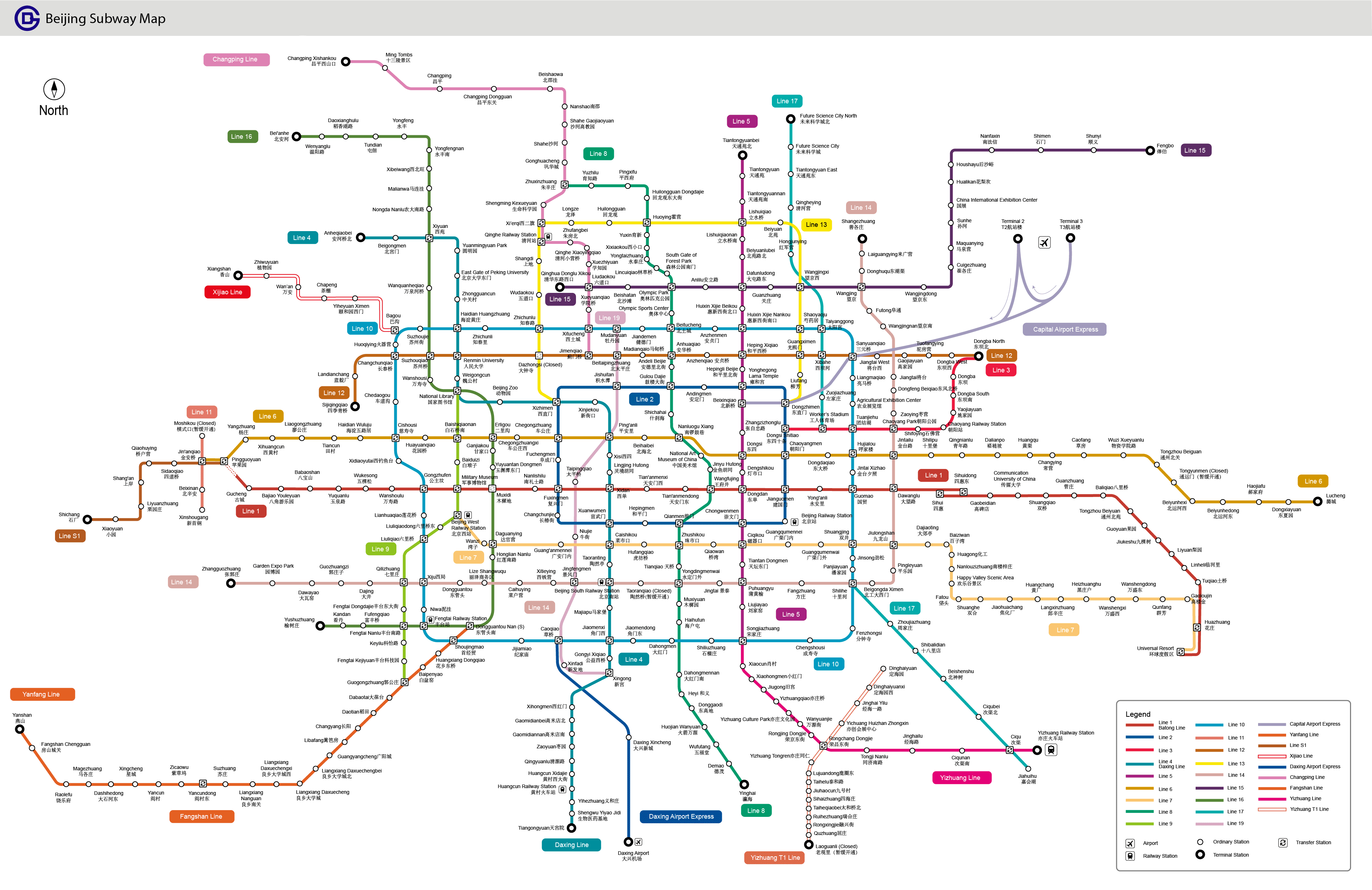
Some grid patterns and some circles. Of course not truly everything is close to a station, but the stations tend to be at important points, and points of interest / desirable living locations will appear around the existing stations.

I just don't understand this whole argument of "A lot of car drivers today probably wont accept that". Sitting in non-moving traffic in a car is truly horrible, I mean it's absolutely the worst, there's nothing fun about it, you're standing still, wasting time, taking 30 minutes for something that can be biked in 10 minutes. When you can instead just walk a few minutes, sit in a train, walk a few more minutes, sit in another train, walk to destination, all in 20 minutes, and you can do stuff on your phone in the meantime.

Even if you love the car so much, having a subway will maybe make driving a car acceptably fun again, since more people taking subway means less cars on the road so a chance you can actually drive instead of stand still all the time.

Re:Maps show how parking lots “eat” U.S. cities by palata on Sunday April 02, 2023 @05:12PM (#35415261)
To me your opinion sounds really US-centered (where public transports typically suck).

It is fine to say that US has evolved for the individual car, and it's very hard to change. But I don't get why you say that it's the same everywhere else...

Re:Maps show how parking lots “eat” U.S. cities by htag on Friday March 31, 2023 @10:46PM (#35396545)
Thirty minutes of walking everyday is a good thing, not a bad thing.
Re:Maps show how parking lots “eat” U.S. cities by kjkjadksj on Saturday April 01, 2023 @01:11AM (#35397345)
Of course but its more convenient when you choose when this time sink has to happen. Its why people go for a run in the morning instead of just jogging everywhere they go in life. Not to mention its a cost you pay more than once if you go down to the station multiple times a day. Take just three trips and your day just turned into a 22 and a half hour one only factoring the walk on the home side.
Re:Maps show how parking lots “eat” U.S. cities by htag on Saturday April 01, 2023 @01:36AM (#35397458)
1. Any commute is a time sink we have little choice when to do it. I found walking as part of a commute with mass transit to be a better use of my time than sitting in a car. My walk was exercise. On transit I could read a book or answer work email/slack. In a car I was sedentary and focused on driving.

2. I don't know anyone that leaves their home for three separate trips on transit a day. Two tops, and usually it's just one. It's rare to leave the home three times in one day with a car if one of the trips is an eight hour workday. Usually people combine trips.

3. Again, walking is good. We should be walking. It's fantastic to have places to walk to. This isn't a bad thing or a chore.

Re:Maps show how parking lots “eat” U.S. cities by kjkjadksj on Saturday April 01, 2023 @12:26PM (#35401538)
In a car you can listen to podcasts or audiobooks at least. If it self drives for you then email and slack is fair game too. 3 separate trips wouldnt be hard to imagine. The commute is trip one. Picking up takeout is trip two. Running to target after dinner is trip three. That sort of thing is tough with transit though. Oftentimes your business is not in the same place, so you might be going all over town running errands or making appointments. The car is of course much faster to pivot between places than tranfers and waiting. Walking is good, but clearly people today have opted for the temporal convenience of driving over the physical benefits of walking, which might be faster to achieve with a more intense gym session. Its not like many rail stations see 100% car free living within their walksheds today. For some they have big lots because many of their riders prefer a few minutes driving to the station in a climate controlled vehicle over the alternative.
Re:Maps show how parking lots “eat” U.S. cities by lozenge on Saturday April 01, 2023 @03:59PM (#35403551)
I also listen to podcasts and audiobooks... while walking and taking public transit to work. No difference.
Re:Maps show how parking lots “eat” U.S. cities by watwut on Sunday April 02, 2023 @09:51AM (#35410473)
I can listen to those while walking. And if that podcast or audiobook gets interesting, it is not interfering with my ability to pay attention. The amount of people who say they are taking their language lessons or other involved listening in car is absurd on HN. But, it explains some amount of causalities.

And no, going to gym is not easier. It costs money, it is time consuming and it does not have the same effect as normal walking.

Re:Maps show how parking lots “eat” U.S. cities by pandaman on Saturday April 01, 2023 @07:13PM (#35405155)
>I don't know anyone that leaves their home for three separate trips on transit a day. Two tops, and usually it's just one.

Is not this the problem with transit? Your traveling is so cumbersome that you seem to be restricting yourself to the bare minimum. Of course, you can also claim "that's a good thing!" but can you talk from the both sides of your mouth and claim that transit is faster and more convenient while also limiting your travel options?

Re:Maps show how parking lots “eat” U.S. cities by watwut on Sunday April 02, 2023 @09:50AM (#35410460)
Walking and jogging are not comparable at all. Jogging is a full on sport, walking is mode of transport with an element of healthy movement. People who frequently walk somewhere dont necessary go for jogging, only determined minority of people jog.

> Take just three trips and your day just turned into a 22 and a half hour one only factoring the walk on the home side.

The exact same thing goes if you go to the same place with a car. But, first, you did not had that healthy factor of walking. Second, if you are tired, overworked, have troubles you need to think about or want to listen some educational tape, you are becoming hazard on road as a bonus.

Re:Maps show how parking lots “eat” U.S. cities by nayuki on Saturday April 01, 2023 @01:38AM (#35397472)
Not Just Bikes preached this concept in "The Gym of Life": https://www.youtube.com/watch?v=KPUlgSRn6e0
Re:Maps show how parking lots “eat” U.S. cities by Retric on Friday March 31, 2023 @10:48PM (#35396554)
Large subways can easily beat cars. The problem is most public transportation sucks in the US so people don’t use it, so it isn’t fixed.

Just look at 248 mi of track in NYC vs 17.4 in LA.

Re:Maps show how parking lots “eat” U.S. cities by rainsford on Friday March 31, 2023 @11:22PM (#35396772)
I agree in the abstract on an individual level. All else being equal, it's very difficult to beat the travel time of your own point to point transport that leaves whenever you want. But the only way that works is with a non-trivial up-front personal cost to obtain that transport, ongoing cost to operate it, and a massive societal investment to ensure you have ample road and parking infrastructure.

There's also the consideration that all those point to point journeys and parking at each end is a fairly inefficient way to enable a city's worth of people to move around. There's no way a city like NYC could exist at all if everyone relied on cars for transportation. A point-to-point personal car journey in NYC may in theory be faster than taking public transit, but it would be impossible for everyone to do that as the car transit times would trend towards infinity as everyone is stuck in traffic. And because of the increased density a non car-centric city allows, you can actually shrink public transit times too because things can be closer together and transit can run more often and have more routes. And the increased density also allows point to point personal transport other than cars to be practical, like walking or cycling.

Re:Maps show how parking lots “eat” U.S. cities by seanmcdirmid on Friday March 31, 2023 @11:30PM (#35396831)
I can often get somewhere fast during rush hour in Beijing on the subway rather than a taxi. But Beijing’s traffic is Superbad compared to the USA. The city is also huge, but they have just done a good job building it out everywhere.

The same with most big Chinese cities (smaller cities have taxis, so you still don’t need your own car). Tokyo’s system works ok as well, although I’m not sure if taxi would be faster since it is too expensive for me to try. The subway/loop lines are good enough to get places as quickly as I don’t think taking a taxi would save much time.

Re:Maps show how parking lots “eat” U.S. cities by cycomanic on Friday March 31, 2023 @11:56PM (#35396952)
Funny I know plenty of places where public transport is faster than a car (maybe with the exception of the middle of the night). You bring up the example of walking 15min to a train station (that's already a longish walk), but somehow ignore the case of having to find a parking spot. I certainly have spend >20min finding a parking spot when I really needed to take a car for some reason (and the often still had to walk 10min after). Sure that's not the case if you consider a vast US City designed around cars where parking makes up a large fraction of the city (incidentally that's the point of the article), but a city like that is not very livable either.
Re:Maps show how parking lots “eat” U.S. cities by kjkjadksj on Saturday April 01, 2023 @01:07AM (#35397327)
I think its pretty easy to park because most american cities are overparked, and as they convert surface lot to 5/1 they end up even more overparked because that usually comes with a subterranean garage and another 300 spaces that weren’t there before.

You’d be hard pressed to lay rail based transit so densely where everyone in the metro area has a 15 min walk to a station much less one going somewhere relevant for them. Simple bussing upgrades are much more realistic for us to see comprehensive transit in our lifetimes. Things like signal priority and a protected lane would go a long way for little cash and time. Too bad the bus is invisible to most people and politicians.

Re:Maps show how parking lots “eat” U.S. cities by noelherrick on Saturday April 01, 2023 @03:01AM (#35397903)
If in your city, cars are faster than public transportation, I would say that's most likely due to poor implementation of it. In my experience in NYC, London, Tokyo, Bangkok, even the Bay Area (TBF, haven't visited in years), metros are much faster and much more pleasant.

Unfortunately, in the US, we let a bunch of politicians who claim the government is bad at everything run the government. They have a vested interest in making sure it's not well run. For goodness sake, we had a president who said, "The nine most terrifying words in the English language are: I'm from the government, and I'm here to help." A sitting US president, who according to Wikipedia, is part of the government. We should have demanded his resignation then and there, and got someone who wasn't terrified of the organization he was a head of.

The most immediate solution to this is stop relying on contractors and let the government at every level build up public planning departments and a construction workforce that doesn't get let go when the project is finished.

Re:Maps show how parking lots “eat” U.S. cities by kjkjadksj on Saturday April 01, 2023 @04:11PM (#35403634)
The metros being faster always is dependent on your destination being favorably connected to the lines you are near. Take a random a to b in any of those cities, and I’d say the car is typically going to be fastest. Here’s a random trip across tokyo, which at the time of writing takes 50 mins by car or an hour and 38 minutes by transit.

https://maps.app.goo.gl/Q17EFxjLKd85PYRv6?g_st=ic

Re:Maps show how parking lots “eat” U.S. cities by nayuki on Saturday April 01, 2023 @04:31PM (#35403793)
Not only that, right now is the middle of the night in Tokyo. If you change the "depart at" time to something like 5 PM, the driving time is estimated to be anywhere from 65 to 125 minutes.
Re:Maps show how parking lots “eat” U.S. cities by dublinben on Saturday April 01, 2023 @01:49PM (#35402311)
We wouldn’t ever expect public transportation to be significantly faster than driving the same trip. If it were, people would switch from driving to the faster option. Decreasing the number of cars would then ease congestion and speed up driving, until a new, faster, equilibrium was reached.[0]

This is how improving public transportation is actually one of the most effective ways to benefit drivers.

[0] https://en.wikipedia.org/wiki/Downs%E2%80%93Thomson_paradox

Re:Maps show how parking lots “eat” U.S. cities by baq on Saturday April 01, 2023 @03:47PM (#35403450)
It’s easy to beat the car if the car isn’t allowed where public transport is… which can be approximated by not building any parking in places where people want to or need to be.
Re:Maps show how parking lots “eat” U.S. cities by palata on Sunday April 02, 2023 @05:08PM (#35415231)
In which big European city is it worse to take public transports than to take the car?

You said "most places, not just in the US", I suppose they were included?

Re:Maps show how parking lots “eat” U.S. cities by sokoloff on Friday March 31, 2023 @09:25PM (#35396046)
I’ve previously written up “what would it take to make a 9 AM meeting at my office?” It’s a factor of 4 or 5 worse via public transit and I live in a probably top 5 (definitely top 10) US city as it pertains to our public transit system (Boston).

https://news.ycombinator.com/item?id=31723197

Re:Maps show how parking lots “eat” U.S. cities by htag on Friday March 31, 2023 @10:52PM (#35396584)
At 8.5 miles a commute by bicycle or e-bike would be cheaper and close to thirty minutes. It would be healthier. It wouldn't require a parking spot.
Re:Maps show how parking lots “eat” U.S. cities by quesera on Friday March 31, 2023 @11:16PM (#35396721)
> At 8.5 miles a commute by bicycle or e-bike

GP said Boston.

Re:Maps show how parking lots “eat” U.S. cities by htag on Friday March 31, 2023 @11:17PM (#35396727)
I've never been. Are bicycles illegal there?
Re:Maps show how parking lots “eat” U.S. cities by quesera on Friday March 31, 2023 @11:20PM (#35396752)
Yes.
Re:Maps show how parking lots “eat” U.S. cities by Dylan16807 on Friday March 31, 2023 @11:52PM (#35396932)
One of the first search results for Boston bicycle declares it the fourth best biking city in the US, so you're going to need to be more specific about whatever criticism you're exaggerating.
Re:Maps show how parking lots “eat” U.S. cities by jen20 on Saturday April 01, 2023 @12:25AM (#35397129)
Boston sometimes gets 2 feet of snow in a single day, and often has sub-freezing temperatures. People just get on with life (but not really on e-bikes).
Re:Maps show how parking lots “eat” U.S. cities by htag on Saturday April 01, 2023 @12:38AM (#35397196)
Do people in Boston drive in 2 feet of snow?
Re:Maps show how parking lots “eat” U.S. cities by inconceivable on Saturday April 01, 2023 @02:36AM (#35397755)
yeah dude they drive through 2 feet of snow, uphill, both ways.

actually there are snow plows, like everywhere else on earth where it snows.

Re:Maps show how parking lots “eat” U.S. cities by sokoloff on Saturday April 01, 2023 @06:20AM (#35399018)
After a 2 foot snowfall ends, secondary roads are usually passable within ~6-12 hours, depending on how much snow was removed during the storm. Major roads will almost always remain passable during the entire snow event. Essential stores and services almost never close as people can move around despite the weather (and except for a few hours immediately after, are expected to).

Sidewalks and bike paths will take days to be down to pavement and some bike paths aren’t salted or plowed at all so become safe to use again when the snow naturally melts.

Re:Maps show how parking lots “eat” U.S. cities by brewdad on Saturday April 01, 2023 @05:32PM (#35404297)
> Sidewalks and bike paths will take days to be down to pavement and some bike paths aren’t salted or plowed at all so become safe to use again when the snow naturally melts.

This is a choice, not an inevitability.

Re:Maps show how parking lots “eat” U.S. cities by sokoloff on Saturday April 01, 2023 @05:59PM (#35404536)
From my perspective as an individual living 8-9 miles from the office, there is no practical difference. It’s not like I’m going to go out and shovel it.
Re:Maps show how parking lots “eat” U.S. cities by throw0101c on Saturday April 01, 2023 @07:13AM (#35399266)
> […] and often has sub-freezing temperatures.

So does Finland. See "Why Canadians Can't Bike in the Winter (but Finnish people can)":

* https://www.youtube.com/watch?v=Uhx-26GfCBU

Also "Why Winter Cities Need to Reconsider Car Dependence":

* https://www.youtube.com/watch?v=kFkI3eglT1M

If things can be taken car of so cars can operate in winter there's no reason why they can't be for bicycles (as someone who lives in Toronto, Canada).

Re:Maps show how parking lots “eat” U.S. cities by sokoloff on Saturday April 01, 2023 @08:08AM (#35399591)
If you slide a front tire 12” to 18” on a car, nothing much happens. If you do that on a bike, something very much happens.

The standards of snow removal needed to permit 2 wheel vehicles to operate safely are quite a bit stricter than those for 4 wheelers.

Re:Maps show how parking lots “eat” U.S. cities by brewdad on Saturday April 01, 2023 @05:30PM (#35404272)
So the three times a year that happens, you find a different way to work or WFH. Don't let perfect be the enemy of the good. Minneapolis gets a decent bike share in winter. If they can bundle up and ride, it's positively simply for Bostonians to do it.
Re:Maps show how parking lots “eat” U.S. cities by quesera on Saturday April 01, 2023 @10:18PM (#35406472)
Search results do not match reality.

Boston is great for recreational biking for part of the year, sure. There are lovely bike trails.

But it is not great for commuting on a bike, nearly ever. And definitely not during winter.

Re:Maps show how parking lots “eat” U.S. cities by sokoloff on Saturday April 01, 2023 @06:08AM (#35398961)
Buying an e-bike to accomplish this commute would not be cheaper as it would not be a full replacement for the car, so I’d be paying for a car and an e-bike.

There is oodles of parking at the office (was built for commuters) and I already have to park the car near home. Eliminating a parking space on either end won’t move any of the existing buildings closer.

Re:Maps show how parking lots “eat” U.S. cities by htag on Saturday April 01, 2023 @11:35AM (#35401093)
The GSA usage rate is $0.585/mile. That is $9.945/day in car usage from a 8.5 mile commute to the office. I understand you can drive for less than this rate, but it would be hard to reach $0.35/mile and doing so would sacrifice dependability of the motor vehicle.

My e-bike is significantly cheaper to maintain than my car. It uses something like .7KWH for a full charge which handles over 30 miles. Thats less than 10 cents for a full charge at my rate. Other consumable goods like tires, chains, tubes, break pads are all similarly 10x-100x cheaper than their car counterpart. The only expensive wear item is the battery pack, which admittedly cost $550. I'd estimate my personal usage of the device to be around $0.05/mile.

It's cheaper to own both and maintain both if you are going to use both. Using simple linear math, the ebike will save you over $2000 in ongoing costs (initial price) within 3850 miles or 235 commutes. A pretty good ROI.

Re:Maps show how parking lots “eat” U.S. cities by rahimnathwani on Friday March 31, 2023 @11:01PM (#35396645)
Most of my journeys here in SF would take 2.5x to 4x by public transport.
Re:Maps show how parking lots “eat” U.S. cities by magicalist on Saturday April 01, 2023 @12:08AM (#35397019)
> This is evident in the fact that a 20-minute drive can easily transform into a commute of 90 minutes or longer when relying on public transit. I truly wish there were a way for me to avoid driving and still get to my destination efficiently

It's not like it's the natural state of things that 25% of the Atlanta city center is dedicated to parking so we just have to accept the downsides.

There's a reason everything is so spread out and so it's difficult to walk places or design efficient public transit, and it's the same reason driving and parking your car is the most efficient transportation method.

Re:Maps show how parking lots “eat” U.S. cities by syntheweave on Friday March 31, 2023 @09:18PM (#35395988)
I feel assured that the transition is going to be pretty quick, watching Waymos and Cruises going around SF and dealing with some challenging traffic situations and weather(Waymo is definitely better at not getting stuck, but the gap is not insurmountable).

As soon as they proliferate at scale, the risk profile changes such that you can bike everywhere safely, and parking is no longer a major urban issue, because the fleet is going to have a more flexible usage pattern whether or not individuals own the vehicles: instead of one space per vehicle per destination, it's going to be compressed down to parking space for the neighborhood plus drop-off zones.

So to me, it's obvious that the market is going at the problem just about as fast as it can, and once the adoption S-curve hits, "need to drive" relaxes because other potential uses aren't being suppressed. You'll still have many instances where mass transit and active transit present a lower cost structure than taxi, and they'll have a lot of leeway to grow.

Re:Maps show how parking lots “eat” U.S. cities by htag on Friday March 31, 2023 @10:56PM (#35396614)
Maybe. From the outside looking in self driving cars are vaporware that are very late on delivery. I wouldn't want to bet my city's architecture on this promise.

It might be nice if they deliver on this promise though.

Re:Maps show how parking lots “eat” U.S. cities by avar on Friday March 31, 2023 @09:26PM (#35396055)
The answer to this particular problem isn't public transportation.

There's places elsewhere in the developed world where there's no public transportation, and everyone uses a car for longer trips.

You can usually still cross the street safely as a pedestrian, and expect to reliably find a sidewalk next to the road.

US roads, intersections, parking spots etc. are also absurdly large by the standards of most other countries, it all adds up.

Re:Maps show how parking lots “eat” U.S. cities by klabb3 on Friday March 31, 2023 @10:41PM (#35396505)
> The answer to this particular problem isn't public transportation.

Public transport is not a self-goal, but it’s the best way by far to reduce the spatial requirements for transportation. In particular subways and commuter trains can move an absolutely insane amount of people for even the largest metropolitan areas, without obliterating the ability to walk.

Others include having motorcycles and bicycles for individual transport. That can work in small cities but usually impact walkability anyways. If you look at south east asia for instance, often lacking in good public transport, but having a lot of motorcycles in large cities making pedestrian movement hard.

Re:Maps show how parking lots “eat” U.S. cities by seer on Saturday April 01, 2023 @12:05AM (#35396999)
As someone who recently experienced hanoi traffic as both pedestrian and motorcyclist - I can attest that it can be scary, but after a certain learning period not that bad.

The big problem there was the lack of sidewalks for pedestrians so you kinda had to go into traffic even if you were just following the streets.

Crossing even the busiest boulevards was actually easy, if a bit nerve racking. The flow of scooters just parts around you as you cross, giving you the “I am Moses” feel - you only have to be visible and consistent with your movement.

Honestly they should just get rid of all the zebra crossings and pedestrian lights - those don’t work anyway, and just build lots of pedestrian islands everywhere and they would be golden, oh and ban cars.

The amount of people those scooters move throughout hanoi is just staggering - even if they are a bit slow, they make up for it being like an organic flow that doesn’t stop for anything as it can just ride around it.

Re:Maps show how parking lots “eat” U.S. cities by ntonozzi on Friday March 31, 2023 @10:48PM (#35396557)
Don't forget cars.
Re:Maps show how parking lots “eat” U.S. cities by xracy on Friday March 31, 2023 @11:09PM (#35396684)
Except that the answer to this is public transportation??

The problem is that people need a place to store their single-occupancy-vehicles. which means that each individual with a car takes up a permanent ~100 Sqft. They also need places to put that car. If you remove the parking lots, and the roads, admittedly, you'll create a more walkable city that means people don't need cars. But people will still want something for longer distances. And that something is public transit.

Re:Maps show how parking lots “eat” U.S. cities by seanmcdirmid on Friday March 31, 2023 @11:27PM (#35396809)
Private shared transport could also solve the parking problem a taxi doesn’t need to hang out and park in the dense area it drops off passengers, except maybe to on board other passengers. In China this works well enough, although the traffic is still atrocious.
Re:Maps show how parking lots “eat” U.S. cities by xracy on Friday March 31, 2023 @11:40PM (#35396876)
lol, you even admit your example doesn't work well enough to "fix" traffic.

Your private taxi cab is never going to compete with the people-moving capacity of a bus, or a train. A road with 100s of cars on it, is a demonstration of how many people are heading in a common direction. If you want them to move faster in that direction, find a denser form of transportation that doesn't take up the space of 100s of cars.

Re:Maps show how parking lots “eat” U.S. cities by seanmcdirmid on Friday March 31, 2023 @11:50PM (#35396919)
It solves parking, I never claimed it solved traffic. Please re-read my comment.
Re:Maps show how parking lots “eat” U.S. cities by xracy on Friday March 31, 2023 @11:54PM (#35396943)
Okay, I definitely misread this. :) That said, I suspect my misread is because...

Is parking an unsolved problem? I think in most cities it's a solved problem, and the consequence is traffic. But I would be curious of your take given that it's the question you asked. What is there to solve for parking?

edit: Also, Public Transportation, arguably, fixes both traffic and parking.

Re:Maps show how parking lots “eat” U.S. cities by seanmcdirmid on Saturday April 01, 2023 @12:00AM (#35396971)
If parking were the only problem, you could call it solved in places where taxis are cheap and ubiquitous, which might happen in the developed world with self driving cars.

But ya, if we could eliminate parking, we have some more space for some nice things, but having lived it, it doesn’t solve the main problem at all if private transportation is still viable.

Re:Maps show how parking lots “eat” U.S. cities by xracy on Saturday April 01, 2023 @12:21AM (#35397102)
> but having lived it, it doesn't solve the main problem at all if private transportation is still viable.

I'm having trouble parsing that sentence, could you clarify?

Re:Maps show how parking lots “eat” U.S. cities by seanmcdirmid on Saturday April 01, 2023 @01:24AM (#35397403)
It is possible for private personal transport to be viable without parking, and in that case, we can still run 80th the too many cars/not enough road problem.
Re:Maps show how parking lots “eat” U.S. cities by xracy on Saturday April 01, 2023 @02:54AM (#35397868)
ah, okay. My counter, if this only solves one of the problems (parking), why would we prefer that over public transit which solves 2 problems.
Re:Maps show how parking lots “eat” U.S. cities by seanmcdirmid on Saturday April 01, 2023 @10:25AM (#35400538)
Personal transport is convenient. I admit to changing my schedule to super early in the morning and leaving work at 3 just so I could take a taxi rather than deal with the subway due to Beijing’s harsh traffic jams. It wasn’t the right choice for society, but it was the right choice for me.
Re:Maps show how parking lots “eat” U.S. cities by xracy on Saturday April 01, 2023 @05:19PM (#35404174)
Good public transit is convenient. Ask anyone in any city with good public transit how they commute. Trains and buses that run all day consistently are even cheaper and more convenient to plan around.

"[A developed city isn't one where poor people take cars but where rich people take public transit.]"

Re:Maps show how parking lots “eat” U.S. cities by pharmakom on Saturday April 01, 2023 @03:06AM (#35397932)
if we solve parking then we have more space for offices, shops, etc, which means more people travelling into the area, which means more traffic. only public transport and walking can properly scale up.
Re:Maps show how parking lots “eat” U.S. cities by dingaling on Sunday April 02, 2023 @05:58AM (#35408921)
US intersections are also pedestrian-hostile with the "right turn through red light" rule. So even when it's indicated as safe to cross the pedestrian still has to account for potential moving traffic.
Re:Maps show how parking lots “eat” U.S. cities by m463 on Friday March 31, 2023 @09:44PM (#35396191)
I know many females who won't park far and walk somewhere because they don't feel safe. This goes 5x at night.

Do folks realize that walking somewhere in a city is like running a gauntlet to some of the population?

Re:Maps show how parking lots “eat” U.S. cities by throw0101c on Friday March 31, 2023 @10:13PM (#35396355)
> Do folks realize that walking somewhere in a city is like running a gauntlet to some of the population?

Which is more of a reason to have more people walk: the more people in area going hither and thither the less isolated and vulnerable a person will feel.

People often feel most vulnerable when they feel isolated, which is what happens on a lifeless street. If a street has a sidewalk cafes, bars, restaurants, and people waiting in lines to get into clubs, then there is a feeling of community.

Re:Maps show how parking lots “eat” U.S. cities by RajT88 on Friday March 31, 2023 @11:03PM (#35396651)
This /\

My wife and I a couple years back moved to the very edge of the suburbs. Like, across the street is forest preserves, and behind us is a river. We have only spoken with fewer than 10 neighbors since we moved in 2 years ago.

Her, and her sisters all talk about it being like a "serial killer neighborhood". Even my fishing buddy nextdoor sort of rolls his eyes about how his wife says similar things sometimes.

But I tell my fishing buddy: You'll never understand how vulnerable women feel. Ever. Honestly, being afraid of a place where nobody is around is statistically safer - people don't lock their doors in my neighborhood. I've started also not locking doors. It's that kind of place. That has been a point of friction for my wife and I too - I have been really diligent prior to this, because I always lived in really populous areas.

My wife, thankfully, has never been a victim of any kind of violence. But she has had experiences where she avoided that. Once time some big guy late at night followed her into her apartment building asking to use her phone to call for a tow truck or some nonsense. She knew it was BS, but gave it to him anyways. He ran away.

Men will never be able to understand how vulnerable women feel. We simply do not experience the world in the same way. I'll give another example to help anyone still reading get it: I once went to a haunted house (the Rob Zombie one in Chicagoland) with my buddy and his wife. Probably 10 times, actors working there tried to jump-scare her, and not me or my buddy. Every goddamned time. Whether she was in front, or behind, or between us. She does not scare easily, so she was just really annoyed. Predatory men see women as easy victims in ways they do not other men.

> females

They prefer "women", just FYI.

Re:Maps show how parking lots “eat” U.S. cities by throw0101c on Friday March 31, 2023 @11:15PM (#35396718)
> Honestly, being afraid of a place where nobody is around is statistically safer - people don't lock their doors in my neighborhood.

I live a city and neither do I, at least during the day. Only when I go to sleep I try to remember to check it to make sure it's locked.

And cities are often measured to be safer than suburbs:

* https://science.time.com/2013/07/23/in-town-versus-country-i...

* https://www.nydailynews.com/opinion/ny-oped-your-children-ar...

* https://www.nationalgeographic.com/culture/article/130724-su...

There's no slam dunk case for either.

Re:Maps show how parking lots “eat” U.S. cities by seanmcdirmid on Friday March 31, 2023 @11:42PM (#35396885)
I have a Yale lock that locks automatically after 5 minutes. This is important because we have unhoused neighbors who will occasional door check our home and you don’t want to wake up in the morning to find someone sleeping in your living room.
Re:Maps show how parking lots “eat” U.S. cities by InCityDreams on Saturday April 01, 2023 @03:51PM (#35403488)
>> females >They prefer "women", just FYI.

Ouch! That bit ruined a good read.

Re:Maps show how parking lots “eat” U.S. cities by vGPU on Monday April 03, 2023 @12:51PM (#35427184)
Go watch videos of the crazy stuff that happens on NYC subways and get back to me.
Re:Maps show how parking lots “eat” U.S. cities by vegetablepotpie on Friday March 31, 2023 @10:11PM (#35396342)
As a man I don’t like the perception that I’m under suspicion of being a threat to half the population. And I shouldn’t be. The vast majority of violence against women is perpetuated by men they know, not strangers [1].

Domestic violence is not a reason why our cities should be filled with 1-ton death machines that spew soot, carbon monoxide, and nitrous oxide. Cars don’t solve that problem.

[1] https://www.reuters.com/world/us/americas-deadly-epidemic-vi...

Re:Maps show how parking lots “eat” U.S. cities by tomjakubowski on Sunday April 02, 2023 @12:43PM (#35412447)
The potential downside for a woman who misjudges a dangerous man is far more severe than the potential downside for a man who is misjudged as dangerous by a woman.
Re:Maps show how parking lots “eat” U.S. cities by donatj on Friday March 31, 2023 @10:20PM (#35396393)
> The hyperloop, a ridiculously bad alternative to a subway

The idea was for the Hyperloop was to do the 400 miles straight shot from LA to San Francisco at speeds up to 300mph. I don't see how a subway could do anything comparable.

Re:Maps show how parking lots “eat” U.S. cities by anothernewdude on Friday March 31, 2023 @10:22PM (#35396407)
I agree with you, but I would add: I don't see how a hyperloop could do that either.
Re:Maps show how parking lots “eat” U.S. cities by SOLAR_FIELDS on Friday March 31, 2023 @10:46PM (#35396541)
Good point! My idea is to have people simply rocket launched via pods from LA to SF over the air about 200-300 meters off the ground on average. Sure, it’s unsafe, and probably has a ton of reasons that it won’t work. But isn’t it an innovative way to solve transportation problems that definitely isn’t a tactic intended to downplay public transit in CA so that my totally unrelated car business has less of a risk of succeeding?
Re:Maps show how parking lots “eat” U.S. cities by bagels on Friday March 31, 2023 @10:44PM (#35396523)
The state can't even build a "high speed" (or as other countries might call it, regular speed) train track between those places.
Re:Maps show how parking lots “eat” U.S. cities by jcranmer on Saturday April 01, 2023 @12:48AM (#35397238)
The CAHSR plans were for ~350 km/h rail speed, which is basically the highest end of high-speed rail. It's the ~200 km/h speed of the NEC that is at best barely-high-speed rail.
Re:Maps show how parking lots “eat” U.S. cities by bagels on Saturday April 01, 2023 @05:20AM (#35398666)
The plans were for that. It's not built, and much of it, if built, is now not planned to support that speed.
Re:Maps show how parking lots “eat” U.S. cities by aeyes on Friday March 31, 2023 @10:52PM (#35396585)
It's not 400 miles and not 300mph but the Hong Kong to Shenzhen XRL line is underground, traveling at up to 350kph.

https://www.hyd.gov.hk/en/road_and_railway/railway_network/x...

Re:Maps show how parking lots “eat” U.S. cities by sublinear on Friday March 31, 2023 @10:29PM (#35396446)
> seems to be politically unfeasible at the moment, for reasons that elude me.

Ever see that monorail episode of The Simpsons? Yeah that's where we're at. There's a strong desire from many people to slow things down and be more deliberate and careful before any more big changes. There's a sense of disillusionment about "progressivism" amongst even those who crave the most righteous of vibes. This is a weird time to be alive and people just don't want to wake up to construction crews ironically destroying their cities to make way for yet another wave of gentrification pretending not to be.

Re:Maps show how parking lots “eat” U.S. cities by kortilla on Friday March 31, 2023 @11:18PM (#35396741)
> And that seems to be politically unfeasible at the moment, for reasons that elude me.

Because the majority of the people in the US don’t actually want to ride public transportation and they like houses. It’s not that difficult to grasp.

Re:Maps show how parking lots “eat” U.S. cities by aquaticsunset on Friday March 31, 2023 @11:26PM (#35396807)
I'll counter this - the majority of the people in the US want to live somewhere and get around in the least difficult method. Due to decades of policymaking, that happens to be houses and cars.

It's very nearsighted to think our model is the penultimate in structuring society. Plenty of people are happy, fulfilled, and productive living in apartments & townhouses while taking trains to work.

Re:Maps show how parking lots “eat” U.S. cities by ipaddr on Friday March 31, 2023 @11:47PM (#35396908)
Why would someone prefer to live like ants? Moving from a large place with a forest backyard to a tiny apartment is a lower standard of living. You live in an apartment and trade away personal space and still have to take a train to work where you get little personal space.

People can be happy in an apartment but most would trade that in for a house they could afford it.

Re:Maps show how parking lots “eat” U.S. cities by nayuki on Saturday April 01, 2023 @12:17AM (#35397077)
> prefer to live like ants

Unnecessarily inflammatory wording. (Don't use the popular "shoebox" either.)

> Moving from a large place with a forest backyard

Most Americans live in suburban houses and over 90% of suburbs don't have a forest backyard. You're painting a sunny caricature.

> tiny apartment

Apartments come in a range of sizes, easily from 300 sq ft to 2000 sq ft. You get what you pay for. With houses, the minimum size is so large that many people have no choice but to overpay for space they don't need.

> lower standard of living

Being in proximity to people, shopping, and businesses, as well as having a shorter commute to work, contribute to a higher standard of living.

Re:Maps show how parking lots “eat” U.S. cities by tssva on Saturday April 01, 2023 @05:16PM (#35404150)
> Being in proximity to people, shopping, and businesses, as well as having a shorter commute to work, contribute to a higher standard of living.

I live in a suburb. I'm in proximity to people, shopping and businesses. In fact, I'm in closer proximity to shopping and businesses than most residential areas in the closest city. Most of the large employers in my area are also in the suburbs so, commuting would be even longer living in the city since it would involve taking public transportation or driving from the city to the suburbs. Even if I lived and worked in the city walking, taking a bus or the subway from residential areas to the employment centers would take longer than my 15-minute commute.

Re:Maps show how parking lots “eat” U.S. cities by alexchantavy on Saturday April 01, 2023 @12:20AM (#35397098)
Eh, people can like different things. I think "most feel house > apartment" is way way too broad of a generalization.

You give up space by living in a dense city but gain walkability and more public amenities, and on the other hand if you lived in the suburbs you would give that up for more personal space and - at least in the case of the US - better school districts. If you're rich you can have the plusses of all.

Re:Maps show how parking lots “eat” U.S. cities by Dylan16807 on Friday March 31, 2023 @11:59PM (#35396967)
> Why would someone prefer to live like ants?

Why would someone prefer to live like a snail?

> Moving from a large place with a forest backyard to a tiny apartment is a lower standard of living. You live in an apartment and trade away personal space and still have to take a train to work where you get little personal space.

A house does not imply a large backyard. Suburbs are the bigger problem, and they don't usually have much forest.

And apartments don't have to be tiny. If you're comparing against a house in a similar location, that buys a lot of apartment space.

Re:Maps show how parking lots “eat” U.S. cities by thomastjeffery on Saturday April 01, 2023 @01:00AM (#35397295)
Forest background? Hah.

Living in an apartment is a compromise. Unfortunately, most apartments in the US do not have much to offer.

Most are not well insulated, particularly for sound. The overwhelming majority are rentals; and most of those are managed by landlords who charge an arm and a leg, only to be less than helpful.

Public transit relies on good apartments, and good apartments rely on public transit. It's symbiotic. The US has largely failed at providing both.

People don't choose what is available in the market. They choose from what is available in the market.

Re:Maps show how parking lots “eat” U.S. cities by angled on Saturday April 01, 2023 @01:22AM (#35397391)
MTR Corp has a great model for this type of development. It would be great to see other governments partnering with them!
Re:Maps show how parking lots “eat” U.S. cities by throw0101c on Saturday April 01, 2023 @07:08AM (#35399239)
> You live in an apartment and trade away personal space and still have to take a train to work where you get little personal space.

You have a limited view of 'urban living'. Want a front yard, back yard, and garage (attached to a laneway)? Plenty of that was built pre-WW2, and there's no reason why it couldn't be again:

* https://en.wikipedia.org/wiki/Streetcar_suburb

* https://www.youtube.com/watch?v=MWsGBRdK2N0&t=1m8s

The Oh the Urbanity channel has a video on the (misguided) idea that "urban living" = Manhattan / Hong Kong apartment blocks:

* https://www.youtube.com/watch?v=BCmz-fgp24E

Examples (Streetview) of urban tree-lined streets which can support transit and where cycling is practical (and where a car is an option versus a necessity):

* https://www.google.com/maps/place/125+Hampton+Ave,+Toronto,+...

* https://www.google.com/maps/place/50+Geoffrey+St,+Toronto,+O...

* https://www.google.com/maps/place/70+Jackman+Ave+Toronto,+ON

See also:

* https://www.youtube.com/watch?v=cO6txCZpbsQ&t=9m28s

Fifteen minutes pedalling in one direction is downtown, fifteen minutes in the other is farm land.

Re:Maps show how parking lots “eat” U.S. cities by baq on Saturday April 01, 2023 @03:42PM (#35403411)
Tokyo and Seul are poor cities full of people just longing for a house, right?
Re:Maps show how parking lots “eat” U.S. cities by tropicalbeach on Saturday April 01, 2023 @09:51PM (#35406290)
If you would travel to those places you would actually realize how depressing it actually is. They have some of the highest depression rates in the world. They overlfowing with people you can barely walk on sidewalks. Someone explain how that is peaceful and enjoyable to live in.
Re:Maps show how parking lots “eat” U.S. cities by Al-Khwarizmi on Saturday April 01, 2023 @06:09PM (#35404622)
I live in an apartment in a city (not in the US). Walking distances from my home:

Pharmacy - seconds (right in the next building)

Bar - seconds

Supermarket - 1 minute

Bakery - 1 minute

Greengrocer's - 1 minute

Children's playground - 1 minute

Beach - 1 minute (OK, not representative of every apartment dweller, I'm privileged) :)

Stationery shop - 2 minutes

Bookshop - 2 minutes

Bank branch with ATM - 3 minutes

Amazon locker - 3 minutes

My son's school - 4 minutes

High school - 4 minutes

Health center - 6 minutes

Park - 7 minutes

Library - 7 minutes

Theatre - 13 minutes

Cinema - 15 minutes

Commute - 3 minutes walk to bus stop, buses every 5 minutes, 15-minute trip

Train station - 25 minutes

For me, moving to a house where I would need a car or much longer walks for most of those things would be a huge downgrade in standard of living, not an upgrade. Sure, I would have more space. Not worth it at all.

Re:Maps show how parking lots “eat” U.S. cities by maximus-decimus on Sunday April 02, 2023 @01:58AM (#35407627)
What about not having to hear your neighbors? What about not having to worry about your neighbors hearing you? Maybe you like listening to loud music at night. Maybe you want a home theater. Maybe you want to play your piano/drum any time of the day.

I think you're underestimating how nice it is to have space.

Re:Maps show how parking lots “eat” U.S. cities by ericmay on Sunday April 02, 2023 @09:20AM (#35410215)
Everything you are talking about exists at least as much in the suburbs and then add in the constant mowing, leaf blowing, and weed eating to it too.

> I think you're underestimating how nice it is to have space.

This isn’t a trade we need to make. You can have space and be able to walk to things if we just build right. Take the suburb you live in now. Pick 5 houses randomly and turn those into some of the things the OP mentioned. Now you have your space and walkability. Throw in an apartment and some variations of housing so young and old and people with various incomes can live there too and there you have it. Now we’ve reduce car usage so you aren’t driving 5 miles in a 2,000 lb machine to get a loaf of bread and you still get to keep your car and your space.

Re:Maps show how parking lots “eat” U.S. cities by maximus-decimus on Sunday April 02, 2023 @06:08PM (#35415792)
The person said they were living in an apartment and would never move to a house. What you're proposing (making 5 random houses into apartments), would probably still have most people living in apartments, so people wouldn't have the room.

Also, I would like to point out people don't drive 5 miles to get a loaf of bread. They buy stuff for the whole week/month in one go, which you just can't do by foot.

Re:Maps show how parking lots “eat” U.S. cities by ericmay on Sunday April 02, 2023 @07:34PM (#35416572)
> The person said they were living in an apartment and would never move to a house.

Yes and I’m keenly honing on on the benefits they highlighted and how those benefits don’t have to be unique to (as they are describing) a dense urban center with apartment only dwellers. Also the OP could just live in an apartment in a mixed-use, medium density neighborhood. They could be your neighbor even!

> Also, I would like to point out people don't drive 5 miles to get a loaf of bread.

Hey there! Yes it’s me. Fellow suburbanite for many years who can tell you first hand as a 100% fact that people do in fact drive distances like this for a single loaf of bread. You can to it for other items too. “Whoops forget sour cream for taco night”, “oh I’m going to make a beer run”, “better grab milk and eggs for that snow storm!”. Etc.

> They buy stuff for the whole week/month in one go, which you just can't do by foot.

You don’t need to do that and they likely do that (most make multiple trips) because you have to go drive a while to make it to the grocery store and deal with traffic. There’s nothing wrong with walking 10 minutes to grab a few things a few times/week. It’s better and healthier. You’re describing “how things are” and not using your imagination to understand how things could be.

Saving this for last:

> What you're proposing (making 5 random houses into apartments), would probably still have most people living in apartments

I just told you that you can take an existing neighborhood and modify it by transforming a few houses so that they have different functions. This is only limited by zoning. Why in the world would that result in “most people living in apartments”? No apartments would be required!

Re:Maps show how parking lots “eat” U.S. cities by ryan_lane on Monday April 03, 2023 @02:22AM (#35419254)
Not the op, but in a similar situation to them. I can't hear my neighbors and they can't hear me. I can play music/watch TV pretty loudly and they won't be able to hear me. I'd have to throw a rager for anyone to even here a little noise.

My building is reinforced concrete/steel construction. There's proper insulation. The issue in the US is that construction is poor. Construction of single family homes is actually considerably worse than apartments, but you have the benefit of distance.

Better construction is the right answer here, rather than more sprawl.

Re:Maps show how parking lots “eat” U.S. cities by alexchantavy on Saturday April 01, 2023 @12:22AM (#35397108)
> The majority of the people in the US want to live somewhere and get around in the least difficult method. Due to decades of policymaking, that happens to be houses and cars.

I think this is well said. The other dimension is public schools since US school funding comes from property taxes so more expensive areas have more funding for their schools, which usually means a higher quality education.

Re:Maps show how parking lots “eat” U.S. cities by oerpli on Saturday April 01, 2023 @12:31AM (#35397163)
This is well known to be wrong. I'm not sure why it's repeated so often.
Re:Maps show how parking lots “eat” U.S. cities by alexchantavy on Saturday April 01, 2023 @01:12AM (#35397348)
Got a link I can learn from?
Re:Maps show how parking lots “eat” U.S. cities by nayuki on Saturday April 01, 2023 @01:20AM (#35397383)
I can't speak for the US, but in Canada the city's budget is set first, then all the properties are appraised, then the property tax rate is determined. Expensive properties do not automatically increase the city's tax revenue. See: https://torontoist.com/2014/01/everything-you-ever-wanted-to... , https://www.youtube.com/watch?v=nrWry5i3TBU
Re:Maps show how parking lots “eat” U.S. cities by seanmcdirmid on Saturday April 01, 2023 @01:27AM (#35397417)
This is how it is in Washington state. But each state and even localities can do it differently. For example, someone was complaining that Montana property taxes would go up if all houses appreciated the same in value, or down if they all depreciated, which I thought was weird.
Re:Maps show how parking lots “eat” U.S. cities by alexchantavy on Saturday April 01, 2023 @02:43AM (#35397798)
I guess there are two questions:

1. Does school funding come mostly from property taxes?

The answer here in Seattle is yes having seen some breakdown chart in some government document a while back.

2. What determines the amount of property tax?

Thanks for sharing that link about how in Canada the tax collection amount works backwards from a goal amount.

My understanding is that in the US, your property tax is assessed annually and the person doing it presumably uses market comparables to determine the taxable price - I don’t know if they work backwards from a target, but that sounds odd to me.

Re:Maps show how parking lots “eat” U.S. cities by tssva on Saturday April 01, 2023 @05:38PM (#35404349)
> My understanding is that in the US, your property tax is assessed annually and the person doing it presumably uses market comparables to determine the taxable price - I don’t know if they work backwards from a target, but that sounds odd to me.

In my county they will definitely work back from a goal. The county will determine the budget for the coming year and adjust the tax rate to meet that budget. If assessed values go up 8% but the budget only goes up 4% the board of supervisors will lower the tax rate so the increase in property taxes only meets the 4% needed. This is politically easier than doing the reverse, but they have at times increased the tax rate when assessed property values have not risen enough to bring in the funds needed for the desired budget.

Re:Maps show how parking lots “eat” U.S. cities by kortilla on Saturday April 01, 2023 @06:11PM (#35404644)
> I'll counter this - the majority of the people in the US want to live somewhere and get around in the least difficult method

No they don’t. People consistently give up better commutes for more space.

> It's very nearsighted to think our model is the penultimate in structuring society. Plenty of people are happy, fulfilled, and productive living in apartments & townhouses while taking trains to work.

100% agree. But Americans want houses more than a public train ride. Figure out how to solve the issue of living in shoeboxes with people still getting space to have a personal garden, a wood shop, etc and you’ll be onto something.

Re:Maps show how parking lots “eat” U.S. cities by petre on Sunday April 02, 2023 @01:31AM (#35407497)
Community gardens and wood shops? I get that Americans like their property private and would even guard it with a rifle, but it could be a solution.
Re:Maps show how parking lots “eat” U.S. cities by tiedieconderoga on Sunday April 02, 2023 @09:21AM (#35410223)
Many suburban churches and organizations run community gardens, but it's rare to see in cities because of how much space it requires.

We have shared wood/etc shops, even in small towns. "Makerspace" is one common name for them. Major issues include: storage, tool quality/maintenance, limited hours, staffing, high cost, clashing personalities.

In either case, you'd likely need to drive to get to them. Some apartment complexes have shared gyms, but most of my landlords have been pathologically worried about insurance risks. I'm not sure they would be eager to go along with installing a communal lathe. As for gardens, I once lived somewhere that had small tin beds on the roof, but the landlord rented them out for $300/mo each...there were people who paid to use them, but I thought it was a ridiculous ask for a couple sqft of soil.

Re:Maps show how parking lots “eat” U.S. cities by yunwal on Monday April 03, 2023 @11:58AM (#35426020)
Makerspaces only work well when there’s a strong sense of community among the members. It’s all too easy to fall to tragedy of the commons - people not putting things back where they found them, cleaning up for themselves, etc. there’s only so much you can do with cameras and surveillance. Ultimately you need things like events that bring people together and help them learn from each other for people to see it any other way than “shitty version of a personal workspace”.
Re:Maps show how parking lots “eat” U.S. cities by dixie_land on Sunday April 02, 2023 @12:17PM (#35412155)
> Americans like their property private and would even guard it with a rifle

There's a reason we call our abode our own "neck of the woods" :)

Re:Maps show how parking lots “eat” U.S. cities by hd95489 on Sunday April 02, 2023 @01:52PM (#35413216)
20 year wait list on the community garden.

Wood shops are pretty expensive but not crazy so. The quality of the tools leaves a lot to be desired though

Re:Maps show how parking lots “eat” U.S. cities by BeFlatXIII on Sunday April 02, 2023 @09:45AM (#35410413)
> People consistently give up better commutes for more space.

That's a sign there ought to be larger units with better soundproofing in multi-family buildings.

Re:Maps show how parking lots “eat” U.S. cities by morkalork on Sunday April 02, 2023 @09:59AM (#35410565)
Developers don't really build these and when they do, the prices are unbelievable so it's back to the suburbs for anyone looking to have kids.
Re:Maps show how parking lots “eat” U.S. cities by hd95489 on Sunday April 02, 2023 @01:49PM (#35413179)
You can’t really raise a kid in the city without private school. Large school districts are super inefficient and have to spend lots of money to bring up kids from broken families. High quality schools cheat that problem by excluding poor families through expensive real estate thereby increasing the number of resources per student. It’s not fair but that’s how the game is played
Re:Maps show how parking lots “eat” U.S. cities by noman-land on Saturday April 01, 2023 @10:11PM (#35406420)
Just in case you might not be aware, "penultimate" means "second to last", not "ultimate".
Re:Maps show how parking lots “eat” U.S. cities by noelherrick on Saturday April 01, 2023 @02:50AM (#35397838)
If you've only traveled in the US, you think public transportation is for poor people. I haven't used all US metros, but even NYC is pretty shabby in comparison to London or Tokyo. Most folks probably also haven't lived in a walkable city (which implies denser, smaller housing).

I don't want to force a lifestyle on anyone, but for me it is glorious just popping on a skytrain or a subway, listening to my music, and watching the world go by. I don't have to buy a car, pay for insurance, get gas every week, change the oil, repair it when it inevitably breaks down or things wear out, thus easily doubling the initial cost, find parking, and wash and clean it. I don't like dealing with different vehicle sizes, pedestrians on their phone, and drivers who think their time is worth my safety.

Re:Maps show how parking lots “eat” U.S. cities by kortilla on Saturday April 01, 2023 @06:08PM (#35404610)
I’ve been to both London and Tokyo. Their transportation is significantly better, but it’s optimized for a local minimum from the American suburban perspective.

“They made the best of a shit scenario, which is way too many people living in one place. It’s better than the way the US dealt with the people that have to live like that, but it’s still worse than being able to have an acre to yourself in the middle class.” The US optimized for people who are in that camp.

Re:Maps show how parking lots “eat” U.S. cities by rchaud on Saturday April 01, 2023 @04:15PM (#35403660)
That's like saying Americans love working at McDonald's and Walmart because they are America's largest employers.

Americans not liking public transportation, and not willing to fund public transportation are two different things.

Re:Maps show how parking lots “eat” U.S. cities by ramblenode on Sunday April 02, 2023 @10:51PM (#35417970)
People like living in the suburbs at a price point which is heavily subsidized. Remove the federally backed home loans and mortgage tax deductions, federal highway subsidies, auto industry favoritism, a foreign policy that promotes cheap oil, zoning laws which favor car transport and suburban development, and finally adjust local taxes to reflect the true maintenance cost of water/electricity/gas/roads to their endpoints and you will see a major increase in suburban housing prices and a corresponding decrease in their demand.
Re:Maps show how parking lots “eat” U.S. cities by loeg on Friday March 31, 2023 @11:20PM (#35396758)
Biking here in the states isn't a problem from a distance perspective -- the problems are road safety and destination security (bike theft is a big problem but typically not valued by police because of the nominally low dollar impact). Walking, yeah.
Re:Maps show how parking lots “eat” U.S. cities by thomastjeffery on Saturday April 01, 2023 @12:50AM (#35397248)
That depends on the city, and where in it you live.

If you live in a large suburban area (like many Americans), then biking distance is a huge problem.

Sure, making an actually tractable amount of public transit in every suburb would resolve that problem, but that's a huge investment, and the overwhelming majority of Americans can't even imagine what the result might look like.

Re:Maps show how parking lots “eat” U.S. cities by brewdad on Saturday April 01, 2023 @04:05PM (#35403586)
I would argue biking distance isn't the problem in suburbia, it's biking safety. My rather spread out suburb is about 8 miles across. That's less than an hour for any cyclist and a fit cyclist could do it in half that time. The trouble is that most of those miles are on 45 mph stroads with either no bike lane or a thin stripe of paint for protection from cars and it's full of debris most of the year.
Re:Maps show how parking lots “eat” U.S. cities by thomastjeffery on Sunday April 02, 2023 @04:50PM (#35415055)
> That's less than an hour for any cyclist and a fit cyclist could do it in half that time.

And how long for a car? 5min? 15min?

If you have a car, then you will likely use it for some percentage of trips. That's a pretty serious motivation to not become "a fit cyclist".

All of these problems work together. This also works in the inverse: a good solution would do something to resolve all of these problems.

Re:Maps show how parking lots “eat” U.S. cities by antifa on Saturday April 01, 2023 @10:58AM (#35400801)
Google maps says going to work would be a 6 hour bike ride. There is technically a train available to for half of the journey.
Re:Maps show how parking lots “eat” U.S. cities by ac29 on Saturday April 01, 2023 @01:53PM (#35402355)
Most bikers are going to be able to average at least 10 mph. Working 60+ miles from where you live is a fairly long commute, even by car.
Re:Maps show how parking lots “eat” U.S. cities by vGPU on Monday April 03, 2023 @12:46PM (#35427055)
At one point my commute was 78 miles each way. It would take me about an hour depending on traffic and speed traps. The shortest commute I’ve ever had is 15 miles. I live in one of the largest cities in America. We have no public transportation. A bike is simply unworkable. A motorcycle isn’t even particularly great here. I drive a mid size SUV and I’ve had people not see me and merge into me. Multiple people I know have been rammed full speed while stopped at a traffic light.

Bicycles are neither safe nor efficient enough for a daily commute in the US.

Re:Maps show how parking lots “eat” U.S. cities by BeFlatXIII on Sunday April 02, 2023 @09:44AM (#35410401)
Can't forget lack of showers at destinations.
Re:Maps show how parking lots “eat” U.S. cities by thomastjeffery on Saturday April 01, 2023 @12:44AM (#35397212)
> And that seems to be politically unfeasible at the moment, for reasons that elude me.

That's because you are looking from the outside in.

Every person who has grown up in the US has grown up in this situation. Having to drive nearly everywhere is our version of normal.

Public transit in the US sucks. In practically every city that even has it, it's the worst way to get anywhere. It's often a last resort: a tool for the desperately poor.

On top of that, most of the US is made up of small towns that public transit wouldn't make any sense for. A significant percentage of Americans must regularly travel between a major city and a small town. That means they must have a car, and a place in the city to park it. It's a fool's errand to convince most people that they should drive and take public transit all in one trip, even if it would save them time and gas.

There is more to this situation than the vicious cycle that perpetuates it. If we can be clear about how we intend to accommodate that reality, we might be able to do something about it politically.

Re:Maps show how parking lots “eat” U.S. cities by pharmakom on Saturday April 01, 2023 @02:59AM (#35397895)
The UK used to have rail links from all of the small villages into the cities. It was an expensive system, but now that has been ripped out for decades we can see that the alternative is far worse.
Re:Maps show how parking lots “eat” U.S. cities by 29083011397778 on Saturday April 01, 2023 @05:46AM (#35398838)
> On top of that, most of the US is made up of small towns that public transit wouldn't make any sense for. A significant percentage of Americans must regularly travel between a major city and a small town. That means they must have a car, and a place in the city to park it.

Hang on though: I can't tell my neighbouring city to push for more housing because, while I want to live there in the future, the people that live there now like their lack of housing. Similarly, why can't the people that currently live in the city tell their local politicians that spending all this space for parking the residents don't need is stupid?

Re:Maps show how parking lots “eat” U.S. cities by Avshalom on Saturday April 01, 2023 @07:11AM (#35399253)
people commuting in is a large part of the work force in cities, tourism and generally shopping are important for their economies, also a lot of that parking space is needed by the residents because chicken/egg they all have cars too.
Re:Maps show how parking lots “eat” U.S. cities by Scarblac on Saturday April 01, 2023 @04:20PM (#35403711)
But why so much space... Why no high parking garages, or deep underground ones.
Re:Maps show how parking lots “eat” U.S. cities by petre on Sunday April 02, 2023 @01:26AM (#35407462)
Cheaper, easier. When the land becomes more expensive, it would be built up with offices and the parking space either dissapears or goes underground or high up.
Re:Maps show how parking lots “eat” U.S. cities by ars on Sunday April 02, 2023 @01:33AM (#35407507)
Why not? America is large, land is not really in short supply, except in dense cities.
Re:Maps show how parking lots “eat” U.S. cities by dsfyu404ed on Sunday April 02, 2023 @08:52AM (#35410002)
Because taking up more land is cheaper than building up thanks in large part to the various rules and regulations of municipalities and states. And in many places a parking garage is valued and taxed as a structure whereas a parking lot isn't. Prefab concrete parking garages are a thing the same way that prefab steel warehouse buildings are. The structure isn't that expensive over the life of the structure. It's the latent cost of building and owning a structure that pushes the economics in favor of parking lots.

Ironically in a "you are the problem" sort of way, the demographics doing most of the complaining about parking lots and a general lack of density are the same demographics who are in favor of fine grained management and regulation of what people do on their land that causes this situation. You reap what you sow.

Re:Maps show how parking lots “eat” U.S. cities by thomastjeffery on Sunday April 02, 2023 @05:01PM (#35415166)
If you own a parking lot that is too small, you can go around booting or towing cars that "don't deserve" to take up your limited parking space. That can get you an awful lot of money, which can get you an awful lot of lobbying power.

Big structures are expensive. Who is going to fund them save for the people who are incentivized not to?

Re:Maps show how parking lots “eat” U.S. cities by lozenge on Saturday April 01, 2023 @03:40PM (#35403394)
They do need the space for parking, because they have to drive everywhere, because everything is so far apart, because so much space was given to parking...
Re:Maps show how parking lots “eat” U.S. cities by ars on Sunday April 02, 2023 @01:32AM (#35407502)
Everything is so far apart because America is very large, not because they spaced things out with parking lots. But it does sound funny to make that the reason.

"Yup, this big country was spread out by parking lots."

Re:Maps show how parking lots “eat” U.S. cities by travisd on Sunday April 02, 2023 @03:45AM (#35408185)
We’re not talking about why Seattle is far from Miami. American city sprawl is largely a recent phenomenon (post WWII) and was enabled by the rise of the personal automobile. Even the sprawl-iest of cities (Houston, TX) used to be respectably dense and walkable. The need for a car to achieve basic needs (groceries, school, work) is a phenomenon well less than 100 years old. America has this problem in part because it’s much younger than a lot of European cities, but it’s certainly not purely a function of topography.
Re:Maps show how parking lots “eat” U.S. cities by cafard on Saturday April 01, 2023 @09:24AM (#35400134)
Most of the US geographically or demographically?

I will say that public transit in the US could be a lot better. However, over about forty years it has largely been how I got to work. (Washington, DC, area.)

Re:Maps show how parking lots “eat” U.S. cities by nec4b on Saturday April 01, 2023 @01:33PM (#35402168)
>> On top of that, most of the US is made up of small towns that public transit wouldn't make any sense for.

And you think other other countries are not the same?

Re:Maps show how parking lots “eat” U.S. cities by rayrey on Sunday April 02, 2023 @04:11PM (#35414635)
Not with the distances we have in the US
Re:Maps show how parking lots “eat” U.S. cities by nec4b on Sunday April 02, 2023 @04:40PM (#35414955)
Distances really don't have anything to do with it. If a town is too small to have public transport, it's simply too small. It's the same for the smallest European countries as it is for the US.
Re:Maps show how parking lots “eat” U.S. cities by thomastjeffery on Sunday April 02, 2023 @04:57PM (#35415131)
That can still allow for mediocre public transit. A bus that only stops every 3 hours can still be a workable commute, but not if you must travel 1-2 hours each way.
Re:Maps show how parking lots “eat” U.S. cities by yunwal on Monday April 03, 2023 @11:50AM (#35425848)
No one ends up using “every-3-hours” routes in day-to-day life. Every 3 hours can work for the tourist who doesn’t want to rent a car, but people with jobs won’t accept that if they miss the bus, the next one is in 3 hours. These routes effectively become useless and contribute to the narrative that public transit isn’t practical.
Re:Maps show how parking lots “eat” U.S. cities by brewdad on Saturday April 01, 2023 @03:56PM (#35403531)
I can easily see a future in the US where the car is the next "crisis" like the housing crisis today. Auto manufacturers aren't in a hurry to ramp up production to pre-pandemic levels because they can earn record margins at their current levels. Dealers love it because they can sell pretty much everything above MSRP. It's become nearly impossible to find a basic new car as everything has shifted to crossovers and SUVs/light trucks.

The story the other day about GM dropping CarPlay and AA support was alarming for their reason why. They want to know everything about how you use your car, so they can make you "subscribe" to things like climate control and power seats/windows. The future of the automotive industry in consumer hostile. In another decade or so, it's going to be really hard to find parts for the "dumb" cars of old and Americans are going to be screwed.

Re:Maps show how parking lots “eat” U.S. cities by Moldoteck on Saturday April 01, 2023 @05:18PM (#35404164)
I'm not saying it's possible for US, but Switzerland managed to route trains&busses to some really remote and low density villages
Re:Maps show how parking lots “eat” U.S. cities by rayrey on Sunday April 02, 2023 @04:12PM (#35414650)
Switzerland is smaller than some US counties.
Re:Maps show how parking lots “eat” U.S. cities by Moldoteck on Wednesday April 05, 2023 @04:18PM (#35459818)
and it still has routes going to small vilages, so point stands. also japan afaik also has good infra and is bigger than switzerland
Re:Maps show how parking lots “eat” U.S. cities by throwbadubadu on Sunday April 02, 2023 @04:15AM (#35408326)
You summed up all the problems pretty well and make them sound like justification for why it's right and without alternative, which is the biggest problem (:
Re:Maps show how parking lots “eat” U.S. cities by thomastjeffery on Sunday April 02, 2023 @04:55PM (#35415097)
If the proposed alternative is "be like the UK", we had better recognize how that's a bad fit.

I can dream all day about having enough buses and trains to replace 90% of city commutes. That dream includes more work than simply emulating an island nation's infrastructure.

Re:Maps show how parking lots “eat” U.S. cities by throwbadubadu on Monday April 03, 2023 @09:15AM (#35422972)
No, please not.. still there are more alternatives then the US and UK... even some pretty comparable to the "space-distribution" of.the US for these regards.. just try looking for them ;)
Re:Maps show how parking lots “eat” U.S. cities by badrabbit on Sunday April 02, 2023 @06:51AM (#35409203)
You're mixing up suburbs with small towns. If it is within driving range of a big city downtown then even if it is its own municipality, it is part of the greater metropolitan area of the big city.

Suburbs became a thing after the car industry worked very hard to make sure subways and train cars can't be used. And this was also after the great interstate highway project and explicit city planning meant to mitigate the fallout of a nuclear attack by having a huge urban sprawl. All of this in the 50s and 60s.

What outsiders don't see is the massive scope and efficiency of the US interstate highway system which is the artery of the US economy. Discussions about public transport don't consider freight. You can't have freight trains to every big store and warehouse but you can get 18wheelers from any part of america to any other part of america (continental) within a day or two at most.

At the same time, explicit effort was made to make cities difficult to drive or bike in. A lot of this again goes back to the sentiment of the 50-60s where "white flight" was still a big deal and making suburbs inaccessible to certain types of people who live in cities but occupy the lowest social classes was also important.

It's expensive to be poor but cars means mandatory insurance and car payments, gas, repair bills and parking fees. And if you manage to overcome all that, cops can pull you over and search you without a warrant because you are driving and of course traffic fees and all that is nothing compared to one's safety. Childcare, food or rent? Which one should you sacrifice for that court fee? And somehow you must maintain mental fortitude to not use drugs or alcohol to cope with all that stress. Take out cars and suddenly so many problems are solved (including crime rates).

My point is, much of this is by design decisions made at a different time and era and the hostility is intentional. It is possible to have both a walkable and drivable city with much less parking lots, especially by having less single family housing concentrations (condos instead of large communities of houses that require cars to access).

Re:Maps show how parking lots “eat” U.S. cities by throw_away1525 on Sunday April 02, 2023 @10:27AM (#35410808)
Do you think we don't have 18 wheelers and highways in Europe?
Re:Maps show how parking lots “eat” U.S. cities by badrabbit on Sunday April 02, 2023 @12:31PM (#35412327)
Not at the scale or efficiency if the US. No country has. My point was you can also be pedestrian friendly like europe without going full on amsterdam.
Re:Maps show how parking lots “eat” U.S. cities by tomjakubowski on Sunday April 02, 2023 @12:37PM (#35412383)
This is totally backwards - Europe ships proportionally more freight by truck (compared to rail) than the United States.

https://www.europarl.europa.eu/RegData/etudes/STUD/2015/5403... skip to page 15, and section 4

Re:Maps show how parking lots “eat” U.S. cities by badrabbit on Sunday April 02, 2023 @05:55PM (#35415680)
The table on p15 shows the US doing more tkm than all EU combined for the road columns.
Re:Maps show how parking lots “eat” U.S. cities by throw_away1525 on Sunday April 02, 2023 @12:39PM (#35412407)
We have 748 million people here in the EU, so I'm not sure what you're on about when it comes to scale. As for efficiency, I suppose that depends on how you define the numerator and denominator.
Re:Maps show how parking lots “eat” U.S. cities by badrabbit on Sunday April 02, 2023 @05:52PM (#35415649)
Having more people with about the same size as US (and mind you, not all europe is EU) means more population density and you have a land route to asia and close to africa.

In the US everything international (except americas) comes by ship and you have large distances between population centers. It isn't just the size and the amount of freeways but the way they are interconnected that allows all kinds of truck routes between ports and production centers (e.g.: veggies and fruit in cali or florida) to not just big cities but middle of nowhere montana or dakotas as remote and underpopulated as they may be, they all have easy access to the same interlink.

If this was networking, europe would be like a very large campus network but the US would be a metropolitan area network with a similar physical size but connecting all types of buildings.

Honestly, I think you just have to drive around and see what I mean. Many americans also don't get this. I don't mean just the roads but go to random walmarts or targete in the middle of the desert or mountains that get the same goods as big city stores and they're just as large. You can easily spend half a day shopping in a walmart.

Re:Maps show how parking lots “eat” U.S. cities by throw_away1525 on Monday April 03, 2023 @11:51AM (#35425865)
I'm originally from the US, I understand how things work there well enough... but anyway after re-reading your original post I think we probably generally agree more than we disagree. Having lived in both continents I take issue with the idea that delivering goods via freight has anything to do with the density and walkability of cities. Tomatoes get shipped from Southern Spain to remote villages in Sweden just like they get shipped from Florida to North Dakota. There are many other factors to blame for how car centric the US is, and you point out several in your other posts.
Re:Maps show how parking lots “eat” U.S. cities by ztetranz on Sunday April 02, 2023 @02:09PM (#35413392)
Don't forget National City Lines bus company

https://en.wikipedia.org/wiki/National_City_Lines

Re:Maps show how parking lots “eat” U.S. cities by vGPU on Monday April 03, 2023 @12:48PM (#35427108)
The last time I took a bus there was a homeless man openly touching himself. The time before a fight broke out between a couple of drunks.

Can you understand why I avoid public transport at all costs and don’t wish to expose my family to it?

Re:Maps show how parking lots “eat” U.S. cities by foxyv on Monday April 03, 2023 @01:06PM (#35427449)
I can understand for sure. However, you may want to consider why you only saw drunk and homeless people on the bus. It has nothing to do with public transit, but it has a lot to do with parking lots and how we build our cities. Cars insulate us from reality and allow us to ignore our problems. Our children will not be so lucky.