News for hackers. Stuff that matters.
Re:Maps show how parking lots “eat” U.S. cities by unsignedint on Friday March 31, 2023 @08:49PM (#35395812)
The concept of a 'big investment' takes on a whole new meaning when it comes to public transportation in the United States, especially considering the vast geographical expanse of many metropolitan areas. In most cases, unless one resides in the heart of a city, public transportation isn't a practical option. This is evident in the fact that a 20-minute drive can easily transform into a commute of 90 minutes or longer when relying on public transit. I truly wish there were a way for me to avoid driving and still get to my destination efficiently.
Re:Maps show how parking lots “eat” U.S. cities by kjkjadksj on Friday March 31, 2023 @09:20PM (#35396012)
Because the US insists transit need to look like a big sexy expensive two mezzanine underground platform, when a decidedly unsexy painted bus lane on the already existing wide arterial would offer most of the same utility for orders of magnitude less money.
Re:Maps show how parking lots “eat” U.S. cities by orangepurple on Friday March 31, 2023 @11:07PM (#35396671)
All of the commenters are missing a huge point. US commuter rail projects are hugely corrupt enterprises. Just look at Honolulu for a blatant example of corruption in infrastructure spending (their train NO-ONE wanted)
Re:Maps show how parking lots “eat” U.S. cities by kjkjadksj on Saturday April 01, 2023 @01:27AM (#35397415)
I’ve heard sometimes metros are forced to contract with certain contractors in particular because they have headhunted all the talent qualified to interpret the metros own requirements. You can imagine how much abuse this situation can lead to.

The US needs to drop the contractor model and just directly staff labor for public works. If there is enough work going around to maintain a contracting company, then there’s therefore enough work to staff a public rail building division, and build out some standardized and therefore cheaper designs for this infrastructure.

Re:Maps show how parking lots “eat” U.S. cities by slaymaker1907 on Friday March 31, 2023 @09:16PM (#35395974)
I think that’s part of the point. This vast sprawl is somewhat caused by our over reliance on private vehicles. Also, a factor of more than 2 for travel times is VERY bad for public transit, even in the US.
Re:Maps show how parking lots “eat” U.S. cities by kjkjadksj on Friday March 31, 2023 @09:30PM (#35396087)
Honestly travel times on transit are bad everywhere. Its hard to beat the car, which is essentially a bus that goes express door to door to your destination, and can leave when you want. People take the alternative only when they can’t afford to take the car in regularly (e.g. bridge tolls and high parking costs in nyc ensure mainly high income people enjoy the convenience of a car). Even if you lived just 15 mins walking from a train station, thats a half hour added to every trip just getting back home, to say nothing of the walking on the other end. Imagine if you were not in walking shape on top of this. Its for the greater good of course to take collective transportation over resource intensive individual transportation, but you sure do pay for it with your free time in most places, not just in the U.S.
Re:Maps show how parking lots “eat” U.S. cities by macNchz on Friday March 31, 2023 @10:09PM (#35396331)
I think one of the issues is that once you start designing places around driving, cars become non-optional for day to day living, whereas many places designed around transit generally do not expect people to use transit for every single outing.

For example: most car oriented American suburbs simply require a car for anything other than visiting a neighbor, whereas in a transit oriented city you might use transit to commute to work, but be able to walk to some local shops and services.

I think many people who are familiar only with car dependent lifestyles make the mistake of imagining a car-free lifestyle that involves replacing all of the car trips they make one-to-one with bus or train trips, which would indeed be really cumbersome, but isn’t really how things work (at least in my experience growing up in a rural small town in the US and having lived in a couple of European cities and NYC).

Re:Maps show how parking lots “eat” U.S. cities by kjkjadksj on Friday March 31, 2023 @10:19PM (#35396389)
Even if you lived out in the kanto plain where the trains came before the highways, its not like people are taking the bullet train to the grocery store thats a 5 min drive with the car you already own. Few places on earth are so dense where the car is actually a consistently losing bet when you account for all your trips. I’m not even sure what building for transit rather than car would look like for a semi urban or rural area, considering the transit with the lowest capital investment, the bus, is also benefited by car oriented development like a road network with more connections between nodes. Even in the times before a car, some people had a horse or mule to essentially play the role of a car today, of an instant express bus.
Re:Maps show how parking lots “eat” U.S. cities by beberlei on Friday March 31, 2023 @10:32PM (#35396457)
You can design a citycenter to primarily benefit bike traffic and then it will be consistently faster than car travel
Re:Maps show how parking lots “eat” U.S. cities by kjkjadksj on Friday March 31, 2023 @10:45PM (#35396532)
I’m a big fan of taking the bike around. Of course you do get those people who can’t imagine biking if theres weather. And it favors more able bodied people for the most part.
Re:Maps show how parking lots “eat” U.S. cities by nayuki on Saturday April 01, 2023 @12:26AM (#35397138)
Bike infrastructure is compatible with mobility scooters.
Re:Maps show how parking lots “eat” U.S. cities by kjkjadksj on Saturday April 01, 2023 @12:59AM (#35397283)
I’m not sure they go fast enough to keep up with bike and ebike traffic
Re:Maps show how parking lots “eat” U.S. cities by pharmakom on Saturday April 01, 2023 @03:09AM (#35397954)
This is how it's done in the Netherlands and it works very well. this is not an issue.
Re:Maps show how parking lots “eat” U.S. cities by kjkjadksj on Saturday April 01, 2023 @04:08PM (#35403615)
Existing bike lanes in the us need a serious overhaul. One of the standard designs runs along the dooring areas of parked cars, and right turning traffic is allowed to cross over it at intersections. The mobility scooters I’m familiar with seem to top out at a brisk walk speed on the other hand. That sort of speed differential is a recipe for danger as the roads and bike lanes are currently built in north america.
Re:Maps show how parking lots “eat” U.S. cities by throw0101c on Friday March 31, 2023 @10:50PM (#35396565)
> […] considering the transit with the lowest capital investment, the bus, is also benefited by car oriented development like a road network with more connections between nodes.

'Improving' car-oriented development has been observed to make things worse:

> It is a paradox in that improvements in the road network will not reduce traffic congestion. Improvements in the road network can make congestion worse if the improvements make public transport more inconvenient or if they shift investment, causing disinvestment in the public transport system.

* https://en.wikipedia.org/wiki/Downs–Thomson_paradox

Improving things for non-car users can actually make things better for drivers:

* https://www.youtube.com/watch?v=d8RRE2rDw4k

* https://fortune.com/2015/09/30/best-country-drive-waze/

* https://archive.ph/S4FKM

Re:Maps show how parking lots “eat” U.S. cities by palata on Sunday April 02, 2023 @05:16PM (#35415323)
I think that you need to realise that the US is not representative of the rest of the world.

If you can't imagine how public transport can work in a big city, just try to visit a big city where it works (there are plenty outside the US). Seems more constructive to me than being extremely vocal about how you think it cannot exist.

Re:Maps show how parking lots “eat” U.S. cities by jltsiren on Friday March 31, 2023 @10:10PM (#35396339)
* Public transport relies on population density. Once the density is high enough, people tend to take transit whenever it's faster and/or more convenient than driving. Which is trivially true for many people, because there is not enough space for wide enough roads and enough parking for everyone to drive.

* If you assume that public transport is only for those who can't afford driving, you basically guarantee that it's going to be bad. If you want good public transport, you must design it for the middle class.

* 15 minutes of walking is a very long distance to the nearest station. If you are in an area served by reasonable public transport, you should be able to reach the next station in at least one direction in that time.

Re:Maps show how parking lots “eat” U.S. cities by Aardwolf on Friday March 31, 2023 @10:12PM (#35396349)
Underground metros can be way faster than cars stuck in traffic.

At least in most cities. The one in NY has slow driving trains compared to any other cities I've seen.

Re:Maps show how parking lots “eat” U.S. cities by kjkjadksj on Friday March 31, 2023 @10:31PM (#35396451)
I have a commute that parallels the freeway for a portion. The train takes 18 mins or so to get through the stretch stops and all. The highway in rush hour takes about 30 mins if its really bad. However, the twist is I don’t work directly on this corridor, I need to transfer. The highway has an interchange with another, making the entire trip even in bad traffic about 40 minutes by the time I park and walk in.

With the train I need to transfer to another train. This could be a 10 minute wait at the platform before the train arrives, plus its an end of the line stop for this particular line so it will sit for another 5-10 mins while it changes operators. Then once it gets moving, another 15 mins since there are a few at grade crossings with this line and then a 10 min walk. I do it over driving because I can zone out half asleep in the mornings.

The transfering and frequencies are where transit enters a world of pain and these are expensive, complex issues to fix compared to an interchange ramp. Anytime I bring someone unfamiliar on the train, they basically swear off the system for good and moan why we didn’t just pay for the surging uber.

Re:Maps show how parking lots “eat” U.S. cities by Aardwolf on Friday March 31, 2023 @10:53PM (#35396593)
In many big asian cities, the nearest MRT stop is less than 5 minutes walking away, there are trains every 3 minutes, they ride fast, and the layout is such that you usually need 0 or 1 transfers to another colored line, can't really beat it imho, except with the public bikes in some cases

EU's metros are a bit dated compared to that, but still very useful.

In the NY one, I was sometimes thinking walking is about as fast if you add up the slow train speed with the waiting time. In SF, there is none?!

Re:Maps show how parking lots “eat” U.S. cities by kjkjadksj on Saturday April 01, 2023 @01:18AM (#35397373)
I’d love to see some maps of good examples, but I think transit with minimal transferring is a really tough network nut to crack. You can build hub and spoke or with a few hubs and spokes but this often requires going way out of your way into somewhere you can transfer between spokes. You can build a grid basically like what is done with busses, but again, the routing demands compromising your personal convenience because you are moving along a grid, versus more as the crow flies. At the end of the day no one is going to be perfectly happy with transit by definition. It serves the average commuter along the given corridor, never you in particular and your particular commute. A lot of car drivers today probably wont accept that, taking a backseat and saying they will deal with waiting if it means second order benefits that aren’t immediately obvious, since for the last 100 years they’ve held the notion that they are in charge.
Re:Maps show how parking lots “eat” U.S. cities by Aardwolf on Saturday April 01, 2023 @11:34AM (#35401077)
taipei: https://www.travelking.com.tw/eng/tourguide/taipei/taipeimrt...

singapore: https://www.lta.gov.sg/content/ltagov/en/getting_around/publ...

beijing: https://www.travelchinaguide.com/images/map/beijing/beijing-...
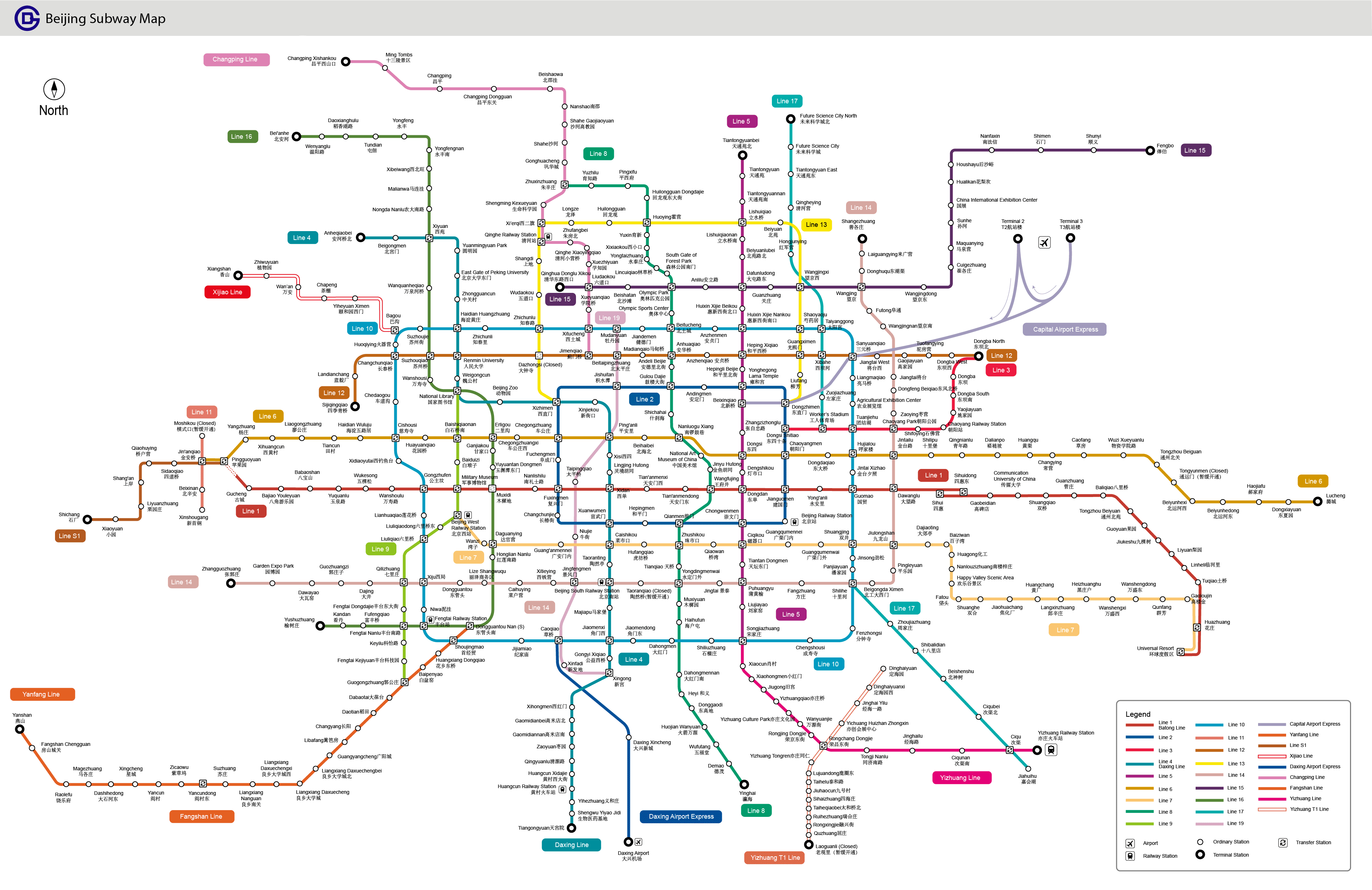
Some grid patterns and some circles. Of course not truly everything is close to a station, but the stations tend to be at important points, and points of interest / desirable living locations will appear around the existing stations.

I just don't understand this whole argument of "A lot of car drivers today probably wont accept that". Sitting in non-moving traffic in a car is truly horrible, I mean it's absolutely the worst, there's nothing fun about it, you're standing still, wasting time, taking 30 minutes for something that can be biked in 10 minutes. When you can instead just walk a few minutes, sit in a train, walk a few more minutes, sit in another train, walk to destination, all in 20 minutes, and you can do stuff on your phone in the meantime.

Even if you love the car so much, having a subway will maybe make driving a car acceptably fun again, since more people taking subway means less cars on the road so a chance you can actually drive instead of stand still all the time.

Re:Maps show how parking lots “eat” U.S. cities by palata on Sunday April 02, 2023 @05:12PM (#35415261)
To me your opinion sounds really US-centered (where public transports typically suck).

It is fine to say that US has evolved for the individual car, and it's very hard to change. But I don't get why you say that it's the same everywhere else...

Re:Maps show how parking lots “eat” U.S. cities by htag on Friday March 31, 2023 @10:46PM (#35396545)
Thirty minutes of walking everyday is a good thing, not a bad thing.
Re:Maps show how parking lots “eat” U.S. cities by kjkjadksj on Saturday April 01, 2023 @01:11AM (#35397345)
Of course but its more convenient when you choose when this time sink has to happen. Its why people go for a run in the morning instead of just jogging everywhere they go in life. Not to mention its a cost you pay more than once if you go down to the station multiple times a day. Take just three trips and your day just turned into a 22 and a half hour one only factoring the walk on the home side.
Re:Maps show how parking lots “eat” U.S. cities by htag on Saturday April 01, 2023 @01:36AM (#35397458)
1. Any commute is a time sink we have little choice when to do it. I found walking as part of a commute with mass transit to be a better use of my time than sitting in a car. My walk was exercise. On transit I could read a book or answer work email/slack. In a car I was sedentary and focused on driving.

2. I don't know anyone that leaves their home for three separate trips on transit a day. Two tops, and usually it's just one. It's rare to leave the home three times in one day with a car if one of the trips is an eight hour workday. Usually people combine trips.

3. Again, walking is good. We should be walking. It's fantastic to have places to walk to. This isn't a bad thing or a chore.

Re:Maps show how parking lots “eat” U.S. cities by kjkjadksj on Saturday April 01, 2023 @12:26PM (#35401538)
In a car you can listen to podcasts or audiobooks at least. If it self drives for you then email and slack is fair game too. 3 separate trips wouldnt be hard to imagine. The commute is trip one. Picking up takeout is trip two. Running to target after dinner is trip three. That sort of thing is tough with transit though. Oftentimes your business is not in the same place, so you might be going all over town running errands or making appointments. The car is of course much faster to pivot between places than tranfers and waiting. Walking is good, but clearly people today have opted for the temporal convenience of driving over the physical benefits of walking, which might be faster to achieve with a more intense gym session. Its not like many rail stations see 100% car free living within their walksheds today. For some they have big lots because many of their riders prefer a few minutes driving to the station in a climate controlled vehicle over the alternative.
Re:Maps show how parking lots “eat” U.S. cities by lozenge on Saturday April 01, 2023 @03:59PM (#35403551)
I also listen to podcasts and audiobooks... while walking and taking public transit to work. No difference.
Re:Maps show how parking lots “eat” U.S. cities by watwut on Sunday April 02, 2023 @09:51AM (#35410473)
I can listen to those while walking. And if that podcast or audiobook gets interesting, it is not interfering with my ability to pay attention. The amount of people who say they are taking their language lessons or other involved listening in car is absurd on HN. But, it explains some amount of causalities.

And no, going to gym is not easier. It costs money, it is time consuming and it does not have the same effect as normal walking.

Re:Maps show how parking lots “eat” U.S. cities by pandaman on Saturday April 01, 2023 @07:13PM (#35405155)
>I don't know anyone that leaves their home for three separate trips on transit a day. Two tops, and usually it's just one.

Is not this the problem with transit? Your traveling is so cumbersome that you seem to be restricting yourself to the bare minimum. Of course, you can also claim "that's a good thing!" but can you talk from the both sides of your mouth and claim that transit is faster and more convenient while also limiting your travel options?

Re:Maps show how parking lots “eat” U.S. cities by watwut on Sunday April 02, 2023 @09:50AM (#35410460)
Walking and jogging are not comparable at all. Jogging is a full on sport, walking is mode of transport with an element of healthy movement. People who frequently walk somewhere dont necessary go for jogging, only determined minority of people jog.

> Take just three trips and your day just turned into a 22 and a half hour one only factoring the walk on the home side.

The exact same thing goes if you go to the same place with a car. But, first, you did not had that healthy factor of walking. Second, if you are tired, overworked, have troubles you need to think about or want to listen some educational tape, you are becoming hazard on road as a bonus.

Re:Maps show how parking lots “eat” U.S. cities by nayuki on Saturday April 01, 2023 @01:38AM (#35397472)
Not Just Bikes preached this concept in "The Gym of Life": https://www.youtube.com/watch?v=KPUlgSRn6e0
Re:Maps show how parking lots “eat” U.S. cities by Retric on Friday March 31, 2023 @10:48PM (#35396554)
Large subways can easily beat cars. The problem is most public transportation sucks in the US so people don’t use it, so it isn’t fixed.

Just look at 248 mi of track in NYC vs 17.4 in LA.

Re:Maps show how parking lots “eat” U.S. cities by rainsford on Friday March 31, 2023 @11:22PM (#35396772)
I agree in the abstract on an individual level. All else being equal, it's very difficult to beat the travel time of your own point to point transport that leaves whenever you want. But the only way that works is with a non-trivial up-front personal cost to obtain that transport, ongoing cost to operate it, and a massive societal investment to ensure you have ample road and parking infrastructure.

There's also the consideration that all those point to point journeys and parking at each end is a fairly inefficient way to enable a city's worth of people to move around. There's no way a city like NYC could exist at all if everyone relied on cars for transportation. A point-to-point personal car journey in NYC may in theory be faster than taking public transit, but it would be impossible for everyone to do that as the car transit times would trend towards infinity as everyone is stuck in traffic. And because of the increased density a non car-centric city allows, you can actually shrink public transit times too because things can be closer together and transit can run more often and have more routes. And the increased density also allows point to point personal transport other than cars to be practical, like walking or cycling.

Re:Maps show how parking lots “eat” U.S. cities by seanmcdirmid on Friday March 31, 2023 @11:30PM (#35396831)
I can often get somewhere fast during rush hour in Beijing on the subway rather than a taxi. But Beijing’s traffic is Superbad compared to the USA. The city is also huge, but they have just done a good job building it out everywhere.

The same with most big Chinese cities (smaller cities have taxis, so you still don’t need your own car). Tokyo’s system works ok as well, although I’m not sure if taxi would be faster since it is too expensive for me to try. The subway/loop lines are good enough to get places as quickly as I don’t think taking a taxi would save much time.

Re:Maps show how parking lots “eat” U.S. cities by cycomanic on Friday March 31, 2023 @11:56PM (#35396952)
Funny I know plenty of places where public transport is faster than a car (maybe with the exception of the middle of the night). You bring up the example of walking 15min to a train station (that's already a longish walk), but somehow ignore the case of having to find a parking spot. I certainly have spend >20min finding a parking spot when I really needed to take a car for some reason (and the often still had to walk 10min after). Sure that's not the case if you consider a vast US City designed around cars where parking makes up a large fraction of the city (incidentally that's the point of the article), but a city like that is not very livable either.
Re:Maps show how parking lots “eat” U.S. cities by kjkjadksj on Saturday April 01, 2023 @01:07AM (#35397327)
I think its pretty easy to park because most american cities are overparked, and as they convert surface lot to 5/1 they end up even more overparked because that usually comes with a subterranean garage and another 300 spaces that weren’t there before.

You’d be hard pressed to lay rail based transit so densely where everyone in the metro area has a 15 min walk to a station much less one going somewhere relevant for them. Simple bussing upgrades are much more realistic for us to see comprehensive transit in our lifetimes. Things like signal priority and a protected lane would go a long way for little cash and time. Too bad the bus is invisible to most people and politicians.

Re:Maps show how parking lots “eat” U.S. cities by noelherrick on Saturday April 01, 2023 @03:01AM (#35397903)
If in your city, cars are faster than public transportation, I would say that's most likely due to poor implementation of it. In my experience in NYC, London, Tokyo, Bangkok, even the Bay Area (TBF, haven't visited in years), metros are much faster and much more pleasant.

Unfortunately, in the US, we let a bunch of politicians who claim the government is bad at everything run the government. They have a vested interest in making sure it's not well run. For goodness sake, we had a president who said, "The nine most terrifying words in the English language are: I'm from the government, and I'm here to help." A sitting US president, who according to Wikipedia, is part of the government. We should have demanded his resignation then and there, and got someone who wasn't terrified of the organization he was a head of.

The most immediate solution to this is stop relying on contractors and let the government at every level build up public planning departments and a construction workforce that doesn't get let go when the project is finished.

Re:Maps show how parking lots “eat” U.S. cities by kjkjadksj on Saturday April 01, 2023 @04:11PM (#35403634)
The metros being faster always is dependent on your destination being favorably connected to the lines you are near. Take a random a to b in any of those cities, and I’d say the car is typically going to be fastest. Here’s a random trip across tokyo, which at the time of writing takes 50 mins by car or an hour and 38 minutes by transit.

https://maps.app.goo.gl/Q17EFxjLKd85PYRv6?g_st=ic

Re:Maps show how parking lots “eat” U.S. cities by nayuki on Saturday April 01, 2023 @04:31PM (#35403793)
Not only that, right now is the middle of the night in Tokyo. If you change the "depart at" time to something like 5 PM, the driving time is estimated to be anywhere from 65 to 125 minutes.
Re:Maps show how parking lots “eat” U.S. cities by dublinben on Saturday April 01, 2023 @01:49PM (#35402311)
We wouldn’t ever expect public transportation to be significantly faster than driving the same trip. If it were, people would switch from driving to the faster option. Decreasing the number of cars would then ease congestion and speed up driving, until a new, faster, equilibrium was reached.[0]

This is how improving public transportation is actually one of the most effective ways to benefit drivers.

[0] https://en.wikipedia.org/wiki/Downs%E2%80%93Thomson_paradox

Re:Maps show how parking lots “eat” U.S. cities by baq on Saturday April 01, 2023 @03:47PM (#35403450)
It’s easy to beat the car if the car isn’t allowed where public transport is… which can be approximated by not building any parking in places where people want to or need to be.
Re:Maps show how parking lots “eat” U.S. cities by palata on Sunday April 02, 2023 @05:08PM (#35415231)
In which big European city is it worse to take public transports than to take the car?

You said "most places, not just in the US", I suppose they were included?

Re:Maps show how parking lots “eat” U.S. cities by sokoloff on Friday March 31, 2023 @09:25PM (#35396046)
I’ve previously written up “what would it take to make a 9 AM meeting at my office?” It’s a factor of 4 or 5 worse via public transit and I live in a probably top 5 (definitely top 10) US city as it pertains to our public transit system (Boston).

https://news.ycombinator.com/item?id=31723197

Re:Maps show how parking lots “eat” U.S. cities by htag on Friday March 31, 2023 @10:52PM (#35396584)
At 8.5 miles a commute by bicycle or e-bike would be cheaper and close to thirty minutes. It would be healthier. It wouldn't require a parking spot.
Re:Maps show how parking lots “eat” U.S. cities by quesera on Friday March 31, 2023 @11:16PM (#35396721)
> At 8.5 miles a commute by bicycle or e-bike

GP said Boston.

Re:Maps show how parking lots “eat” U.S. cities by htag on Friday March 31, 2023 @11:17PM (#35396727)
I've never been. Are bicycles illegal there?
Re:Maps show how parking lots “eat” U.S. cities by quesera on Friday March 31, 2023 @11:20PM (#35396752)
Yes.
Re:Maps show how parking lots “eat” U.S. cities by Dylan16807 on Friday March 31, 2023 @11:52PM (#35396932)
One of the first search results for Boston bicycle declares it the fourth best biking city in the US, so you're going to need to be more specific about whatever criticism you're exaggerating.
Re:Maps show how parking lots “eat” U.S. cities by jen20 on Saturday April 01, 2023 @12:25AM (#35397129)
Boston sometimes gets 2 feet of snow in a single day, and often has sub-freezing temperatures. People just get on with life (but not really on e-bikes).
Re:Maps show how parking lots “eat” U.S. cities by htag on Saturday April 01, 2023 @12:38AM (#35397196)
Do people in Boston drive in 2 feet of snow?
Re:Maps show how parking lots “eat” U.S. cities by inconceivable on Saturday April 01, 2023 @02:36AM (#35397755)
yeah dude they drive through 2 feet of snow, uphill, both ways.

actually there are snow plows, like everywhere else on earth where it snows.

Re:Maps show how parking lots “eat” U.S. cities by sokoloff on Saturday April 01, 2023 @06:20AM (#35399018)
After a 2 foot snowfall ends, secondary roads are usually passable within ~6-12 hours, depending on how much snow was removed during the storm. Major roads will almost always remain passable during the entire snow event. Essential stores and services almost never close as people can move around despite the weather (and except for a few hours immediately after, are expected to).

Sidewalks and bike paths will take days to be down to pavement and some bike paths aren’t salted or plowed at all so become safe to use again when the snow naturally melts.

Re:Maps show how parking lots “eat” U.S. cities by brewdad on Saturday April 01, 2023 @05:32PM (#35404297)
> Sidewalks and bike paths will take days to be down to pavement and some bike paths aren’t salted or plowed at all so become safe to use again when the snow naturally melts.

This is a choice, not an inevitability.

Re:Maps show how parking lots “eat” U.S. cities by sokoloff on Saturday April 01, 2023 @05:59PM (#35404536)
From my perspective as an individual living 8-9 miles from the office, there is no practical difference. It’s not like I’m going to go out and shovel it.
Re:Maps show how parking lots “eat” U.S. cities by throw0101c on Saturday April 01, 2023 @07:13AM (#35399266)
> […] and often has sub-freezing temperatures.

So does Finland. See "Why Canadians Can't Bike in the Winter (but Finnish people can)":

* https://www.youtube.com/watch?v=Uhx-26GfCBU

Also "Why Winter Cities Need to Reconsider Car Dependence":

* https://www.youtube.com/watch?v=kFkI3eglT1M

If things can be taken car of so cars can operate in winter there's no reason why they can't be for bicycles (as someone who lives in Toronto, Canada).

Re:Maps show how parking lots “eat” U.S. cities by sokoloff on Saturday April 01, 2023 @08:08AM (#35399591)
If you slide a front tire 12” to 18” on a car, nothing much happens. If you do that on a bike, something very much happens.

The standards of snow removal needed to permit 2 wheel vehicles to operate safely are quite a bit stricter than those for 4 wheelers.

Re:Maps show how parking lots “eat” U.S. cities by brewdad on Saturday April 01, 2023 @05:30PM (#35404272)
So the three times a year that happens, you find a different way to work or WFH. Don't let perfect be the enemy of the good. Minneapolis gets a decent bike share in winter. If they can bundle up and ride, it's positively simply for Bostonians to do it.
Re:Maps show how parking lots “eat” U.S. cities by quesera on Saturday April 01, 2023 @10:18PM (#35406472)
Search results do not match reality.

Boston is great for recreational biking for part of the year, sure. There are lovely bike trails.

But it is not great for commuting on a bike, nearly ever. And definitely not during winter.

Re:Maps show how parking lots “eat” U.S. cities by sokoloff on Saturday April 01, 2023 @06:08AM (#35398961)
Buying an e-bike to accomplish this commute would not be cheaper as it would not be a full replacement for the car, so I’d be paying for a car and an e-bike.

There is oodles of parking at the office (was built for commuters) and I already have to park the car near home. Eliminating a parking space on either end won’t move any of the existing buildings closer.

Re:Maps show how parking lots “eat” U.S. cities by htag on Saturday April 01, 2023 @11:35AM (#35401093)
The GSA usage rate is $0.585/mile. That is $9.945/day in car usage from a 8.5 mile commute to the office. I understand you can drive for less than this rate, but it would be hard to reach $0.35/mile and doing so would sacrifice dependability of the motor vehicle.

My e-bike is significantly cheaper to maintain than my car. It uses something like .7KWH for a full charge which handles over 30 miles. Thats less than 10 cents for a full charge at my rate. Other consumable goods like tires, chains, tubes, break pads are all similarly 10x-100x cheaper than their car counterpart. The only expensive wear item is the battery pack, which admittedly cost $550. I'd estimate my personal usage of the device to be around $0.05/mile.

It's cheaper to own both and maintain both if you are going to use both. Using simple linear math, the ebike will save you over $2000 in ongoing costs (initial price) within 3850 miles or 235 commutes. A pretty good ROI.

Re:Maps show how parking lots “eat” U.S. cities by rahimnathwani on Friday March 31, 2023 @11:01PM (#35396645)
Most of my journeys here in SF would take 2.5x to 4x by public transport.
Re:Maps show how parking lots “eat” U.S. cities by magicalist on Saturday April 01, 2023 @12:08AM (#35397019)
> This is evident in the fact that a 20-minute drive can easily transform into a commute of 90 minutes or longer when relying on public transit. I truly wish there were a way for me to avoid driving and still get to my destination efficiently

It's not like it's the natural state of things that 25% of the Atlanta city center is dedicated to parking so we just have to accept the downsides.

There's a reason everything is so spread out and so it's difficult to walk places or design efficient public transit, and it's the same reason driving and parking your car is the most efficient transportation method.