News for hackers. Stuff that matters.
Re:You Can Turn Your Backyard into a Biodiversity Hotspot by bmitc on Monday February 27, 2023 @11:52AM (#34958726)
After getting a house with a decent sized yard and trees, I have been having a lot of fun with planting native plants. While my neighbors are cutting down trees, which is honestly hard to watch, and paying landscapers to plant non-native plants, I'm spending a lot of time researching and planting native plants. It is honestly one of the more fulfilling things to walk outside and see all sorts of bees, butterflies, moths, rabbits, chipmunks, squirrels, and birds living their lives. They all work so hard that it is inspiring. I'm looking forward to spring again for this exact reason.

I sort of disagree with the article though. I think one should actually take a relatively hardline approach to planting only native plants. Just because you have a lot of activity around a plant doesn't mean it's the right activity. You could be attracting non-regional and non-native species which is generating the activity.

And honestly, native plant species are easy. If you plant them in the right place, they will grow very easily and strongly with minimal care. Then you can collect their seeds. I am really hoping that all the milkweed we're planting brings more monarchs. Last year, we saw a couple.

I like Douglas Tallamy's books Bringing Nature Home and Nature's Best Hope.

Re:You Can Turn Your Backyard into a Biodiversity Hotspot by frereubu on Monday February 27, 2023 @12:39PM (#34959421)
If you haven't already, you might enjoy learning about permaculture. This is a short and easily-accessibile introduction - two of its originators, David Holmgren and Su Dennett, talking about how they designed their house according to its principles: https://www.youtube.com/watch?v=ss1BjW2kSNs

The part of your comment which prompted the comparison was "... native plant species are easy. If you plant them in the right place, they will grow very easily and strongly with minimal care." This is one of the principles of permaculture - based on the land you have available (and it can be as small as a balcony off a flat) spend some time working our what works where based on your plot and plant that, rather than struggling to get something working where it doesn't belong.

Re:You Can Turn Your Backyard into a Biodiversity Hotspot by LegitShady on Monday February 27, 2023 @12:52PM (#34959590)
I had a neighbour who did a permaculture front yard that was ridiculously beautiful, but unfortunately the tall grasses etc became a haven for rodents which caused problems for multiple neighbours.

Sometimes there are good reasons why a regular grass yard might be ok.

Re:You Can Turn Your Backyard into a Biodiversity Hotspot by bmitc on Monday February 27, 2023 @12:59PM (#34959699)
That's an example of part of the problem though. By originally cutting everything down and destroying the ecosystem, it pushed out the predators that would keep the rodents in check. We have rodents here for sure, but there are also foxes, coyotes, fisher cats, hawks, raccoons, bobcats, and owls.
Re:You Can Turn Your Backyard into a Biodiversity Hotspot by dahfizz on Monday February 27, 2023 @01:39PM (#34960227)
A simple proposition for homeowners - trade your lawn for a bunch of coyotes and raccoons.

I wonder why more suburbs don't do that.

Re:You Can Turn Your Backyard into a Biodiversity Hotspot by bmitc on Monday February 27, 2023 @03:07PM (#34961209)
I have all sorts of predators in my area, and the only time you see them is from the security camera picking them up at night, and even that is rare.
Re:You Can Turn Your Backyard into a Biodiversity Hotspot by frereubu on Monday February 27, 2023 @03:45PM (#34961624)
That's a false dichotomy. I'm sure you could come up with something better than that if you put your mind to it.
Re:You Can Turn Your Backyard into a Biodiversity Hotspot by LegitShady on Monday February 27, 2023 @01:01PM (#34959734)
I dont want coyotes and bobcats around my house. neither does anyone who has pets or livestock. There's a reason they were pushed out. We still have owls and other birds of prey. We have raccoons and they are annoying and can damage property.
Re:You Can Turn Your Backyard into a Biodiversity Hotspot by nibbleshifter on Monday February 27, 2023 @02:48PM (#34960992)
> We have raccoons and they are annoying and can damage property.

Nothing a .22 can't fix, surely?

Re:You Can Turn Your Backyard into a Biodiversity Hotspot by bombcar on Monday February 27, 2023 @04:38PM (#34962230)
You basically have to hit them multiple times and keep shooting night after night if you don’t eliminate the food sources.
Re:You Can Turn Your Backyard into a Biodiversity Hotspot by LegitShady on Monday February 27, 2023 @07:29PM (#34964129)
unfortunately my municipality does not allow it.
Re:You Can Turn Your Backyard into a Biodiversity Hotspot by everforward on Monday February 27, 2023 @09:06PM (#34964775)
If you're in the US, you may want to look at air rifles. They're not a firearm due to the lack of combustion, and you should be able to get some powerful enough to take down raccoons and other small game.
Re:You Can Turn Your Backyard into a Biodiversity Hotspot by bmitc on Monday February 27, 2023 @03:08PM (#34961221)
That's why it's important to leave areas completely undeveloped so that these animals have somewhere to retreat to.
Re:You Can Turn Your Backyard into a Biodiversity Hotspot by anthomtb on Monday February 27, 2023 @03:27PM (#34961448)
>I dont want coyotes and bobcats around my house. neither does anyone who has pets or livestock

Only people who do a poor job of looking after their pets and livestock fear natural predators the way you do.

Re:You Can Turn Your Backyard into a Biodiversity Hotspot by Kon-Peki on Monday February 27, 2023 @04:25PM (#34962074)
I’m adjacent to a large natural area. We’ve got plenty of coyote and fox, hawk, owl and other predators.

The coyotes are pairing up for mating season, so they start to do crazy things like chase deer through my yard. During the rest of the year, when they tend to be solitary, they stay far far away from people and even mid-size dogs.

Get a fire pit and use it occasionally, and they’ll generally be pretty shy near your yard; its a smell nature has taught them to keep away from.

Re:You Can Turn Your Backyard into a Biodiversity Hotspot by LegitShady on Monday February 27, 2023 @07:29PM (#34964127)
I live on the very outskirts of a mid sized city (1.1 million people) and we have tons of coyotes on the outskirts who wander into the city looking for dogs, rabbits, cats, etc every night.

Everyone who hears or sees coyotes multiple times a week is careful about things, but also aware that they are a risk to small animals.

Re:You Can Turn Your Backyard into a Biodiversity Hotspot by nonethewiser on Monday February 27, 2023 @04:46PM (#34962328)
The real problem is living close to your neighbors and wishing you could escape things that entails.
Re:You Can Turn Your Backyard into a Biodiversity Hotspot by schiffern on Monday February 27, 2023 @05:45PM (#34963071)
Vegetation can make an excellent screen against undesired views. A food hedge makes a great fence to screen over an ugly warehouse, bright street, vacant lot, or pesky neighbor.

You can also use some kind of structure, of course. Sometimes that will involve more rules, and some people just prefer using plants.

Ideally this should be part of a complete sector analysis, which also considers things like sun and wind direction.

https://www.greenpathherbschool.com/greenpathblog/permacultu... (scroll down to "Sector Analysis")

https://smalldesignstudio.wordpress.com/a-permaculture-proje... (scroll down to "sector map")

Re:You Can Turn Your Backyard into a Biodiversity Hotspot by empyrrhicist on Monday February 27, 2023 @10:29PM (#34965294)
Are you in a city with rats? Otherwise I feel this is often overblown/misattributed. Like, mice are everywhere, permaculture or no.
Re:You Can Turn Your Backyard into a Biodiversity Hotspot by taeric on Monday February 27, 2023 @12:14PM (#34959051)
Native plants may be easy; but by that measure, invasives are where its at. :D

That said, bringing down trees is always odd to me. Definitely bring down any that pose a risk to your house. But otherwise, seems more effort than it is worth. I should probably be a lot better at pruning, as that is a ton of work. And, while intellectually I know the answer is that you are unlikely to kill the tree, I am always worried about that to the point that I don't prune enough.

Re:You Can Turn Your Backyard into a Biodiversity Hotspot by xyzzyz on Monday February 27, 2023 @12:37PM (#34959387)
Depends on your goals. I’d love to have some big towering trees around me, but I also love gardening and laying in the sun. One big tree in an inopportune could shade my entire yard.
Re:You Can Turn Your Backyard into a Biodiversity Hotspot by taeric on Monday February 27, 2023 @12:59PM (#34959705)
Note that posing a risk doesn't just mean "if giant tree were to fall toward house it would be a problem." Obviously, you should monitor the health of any giant tree nearby, but by and large healthy trees growing tall is not an immediate concern. Moreover, some of those trees would be perfectly healthy if you kept them pruned to a safer height.

So, posing a risk is more on trees that are likely to fall over and do major damage. Or those that have root systems that are too close to your foundation and going to cause issue in that way.

All of this is said as someone that loves giant trees nearby. Seeing eagles and such nest at the top of trees that are hundreds of feet tall is very cool.

Edit: Also consider fire hazard to the house, depending on where you live.

Re:You Can Turn Your Backyard into a Biodiversity Hotspot by bmitc on Monday February 27, 2023 @12:55PM (#34959633)
I'm still not totally certain how to "manage" the trees in our yard. We are in a quite woody area with huge trees. I contacted an arborist place last year and plan on paying them to come out and teach me about the trees on my property. The previous owners cutdown some huge trees, but luckily mainly concentrated on the trees that were super close to the house. It's possible remaining trees could hit the house, and they are actually relatively likely to snap off at some point due to the wind. But I think it's relatively unlikely it will happen and we have insurance if it does. I could remove the possibility and also completely remove ticks as well if I transformed the yard into concrete, but that is of course completely self-serving. My neighbor recently had a tree crack and slightly hit his house. I can't see any real damage from my point of view, but I can only describe it as him waging war against trees on his property afterward. He removed 99% of the remaining trees on his yard (these are huge trees), including ones that couldn't hit his house even if they broke at the base of the trunk (which they never do).

Another house that has sit empty for a year and a half recently cutdown all its trees. Literally all the trees. All that's left is a graveyard of stumps, which makes it look like a warzone from WWI or something. There was probably 50 trees cutdown.

There's no way I'm cutting down the oaks, and I'm unlikely to cutdown any tree, even if it's dead since even those support insects, owls, woodpeckers, and other birds.

Re:You Can Turn Your Backyard into a Biodiversity Hotspot by taeric on Monday February 27, 2023 @01:00PM (#34959715)
What was the reasoning to cut down 50+ trees? That feels excessive in any world.
Re:You Can Turn Your Backyard into a Biodiversity Hotspot by yostrovs on Monday February 27, 2023 @01:43PM (#34960269)
Loggers pay good money for straight, quality trees.
Re:You Can Turn Your Backyard into a Biodiversity Hotspot by NoImmatureAdHom on Monday February 27, 2023 @01:48PM (#34960340)
It's true, but just to clarify for people out there: "yard trees" bring less, and maybe nothing...if you can get someone out there. It's because there's usually only one or a few in that spot, they're difficult to get to (behind a house), and they're full of metal that will damage saw blades (like that clothes line pulley someone put up in 1930).
Re:You Can Turn Your Backyard into a Biodiversity Hotspot by bmitc on Monday February 27, 2023 @02:56PM (#34961079)
I have no idea. The house has literally sat completely empty for well over a year. The tree cutting was the first activity I have ever seen there. I don't know if they plan on tearing the house down and rebuilding or what. I also have no idea if there's someone who actually plans to live there or if it's owned by an investor.

It's possible I overestimated, but it has to be at least over two dozen trees. And these are not small trees. There's of course smaller ones but others are easily over 40-50 feet.

Re:You Can Turn Your Backyard into a Biodiversity Hotspot by toast0 on Monday February 27, 2023 @03:01PM (#34961140)
50+ has to be weighed against the total volume of trees. If you have too many trees in a small space, none of them thrive. It can be valuable to actively thin the forest so that you have a smaller number of thriving trees rather than a larger number of struggling trees.

If someone planted 50+ trees that are a terrible fit for the lot, well that's a good reason to take them out too, hopefully with replacements.

Personally, I live on a large lot with hundreds of trees, and it would be easy to select 50 trees that would be reasonable to cut down, and you'd hardly notice. But the only large tree we cut down was a (non native) cottonwood planted near the house that had bifurcated and was likely to fall on the house in the foreseable future. When we thin the forest, it's mostly younger trees in thick growth that don't have room to grow well.

Re:You Can Turn Your Backyard into a Biodiversity Hotspot by taeric on Monday February 27, 2023 @03:12PM (#34961275)
I mean, not wrong, but doesn't seem in the spirit of the upper post. "All that's left is a graveyard of stumps" does not sound like someone thinning out a forest. Or even preparing a lot for a house, since you will have to grind out all of the stumps.
Re:You Can Turn Your Backyard into a Biodiversity Hotspot by poulsbohemian on Tuesday February 28, 2023 @04:31PM (#34975136)
FWIW: In my area it is not uncommon for "off-grid" properties to cut down a number of trees around structures, as fire prevention. While 50 does sound like a lot, depending on the density and proximity to a house and the potential path of a fire, it may be reasonable. On the other hand, if a house had sat empty for a while, say in an estate sale type situation, it could be the estate trying to make a buck off some lumber while wood prices have been high.
Re:You Can Turn Your Backyard into a Biodiversity Hotspot by ender341341 on Wednesday March 01, 2023 @06:26PM (#34989833)
I know someone who's property was clearcut by a previous owner that knew they were gonna be foreclosed on as a "fuck you" at the bank. Which is a shame as the trees on the other side of the property line are beautiful and old.
Re:You Can Turn Your Backyard into a Biodiversity Hotspot by NoImmatureAdHom on Monday February 27, 2023 @01:47PM (#34960319)
I don't know where you live, but a lot of municipalities make what your neighbors are doing illegal. Might want to check.
Re:You Can Turn Your Backyard into a Biodiversity Hotspot by justajot on Monday February 27, 2023 @02:18PM (#34960676)
Thank you for leaving the dead … super important habitat!

Also wanted to mention the importance of diversity. Everybody thinks trees trees trees but, at least where I live, native prairie plants are just as, if not more important, and are unfortunately largely ignored.

Re:You Can Turn Your Backyard into a Biodiversity Hotspot by bmitc on Monday February 27, 2023 @03:02PM (#34961153)
That's a good point. I am mainly concentrating on plants and haven't even got to bushes or trees yet, in terms of planting. I will want some professional advice on where to place the trees I'd like to plant. I want to plant trees for looks, to return some areas back to trees where some were previously cut down, and to also re-block a backyard neighbor (another one) who tore down all their trees.

The plants are really fun because you can just basically plant them anywhere and see how they do. They take quickly and don't pose any harm to infrastructure.

Re:You Can Turn Your Backyard into a Biodiversity Hotspot by nonethewiser on Monday February 27, 2023 @04:43PM (#34962296)
Fallen trees killing people is not unheard of.
Re:You Can Turn Your Backyard into a Biodiversity Hotspot by schiffern on Monday February 27, 2023 @06:17PM (#34963413)
Similar situation. Maybe sharing my experience might help someone:

We're in a cold climate, so one of our goals is to have more deciduous (leafy) trees on the southern side. This provides shade in summer but solar heat in winter.

Right now in that location is an overgrown ~60 year pine replant. Bad for sun, bad for fire. After taking down a total of 50 (!) dead spindly pines, the building now gets noticeably more sun, but you can hardly notice a difference in forest density. But it gave a lot more room (and sun) for the maples and oaks already coming up.

To choose trees, I took a sun path app and walked back and forth along the south wall. This let me choose only dead pines that were shading the building in winter.

I avoid burning. The pine logs now rot peacefully (waterlogged) on the forest floor, feeding fungus while they buffer rainfall and cover chipmunk holes. Don't worry, there's still abundant dead stand habitat as well.

For ticks, you might consider chickens and/or ducks. Note that they will eat and scratch everything, so you might get one of those cheap solar electric fence enclosures. You can enclose a large area for little cost, leaving some habitat areas where toads and salamanders won't get gobbled up!

So sad to hear about thoughtless clearcutting. I cringe every time.

Cheers and good luck

Re:You Can Turn Your Backyard into a Biodiversity Hotspot by mikesabbagh on Monday February 27, 2023 @09:13PM (#34964811)
It seems that trees interlock their roots to prevent them from falling. So make sure trees are not lonely. Trees then would have to break to fall. And here you can trim the long branches to decrease the weight.
Re:You Can Turn Your Backyard into a Biodiversity Hotspot by genocidicbunny on Tuesday February 28, 2023 @10:16AM (#34970202)
> I'm unlikely to cutdown any tree, even if it's dead since even those support insects, owls, woodpeckers, and other birds.

Be careful doing this with any tree that can potentially fall on your home or one of your neighbors'. You will have a lot more trouble getting insurance to pay out if they find out you knew the tree was dead.

Re:You Can Turn Your Backyard into a Biodiversity Hotspot by bombcar on Monday February 27, 2023 @04:36PM (#34962213)
Trees can also be quite dead and need to come down without much external visible issues.

https://treeandneighborlawblog.com/ Has interesting stories tangentially related to tree duties.

Re:You Can Turn Your Backyard into a Biodiversity Hotspot by taeric on Monday February 27, 2023 @07:58PM (#34964341)
Somewhat interestingly, trees can also be quite dead and perfectly safe not being brought down. Even healthy for the forest. I'm looking at a dead tree just outside my house that is quite pretty and perfectly fine where it is.
Re:You Can Turn Your Backyard into a Biodiversity Hotspot by troyvit on Monday February 27, 2023 @08:23PM (#34964517)
> Native plants may be easy; but by that measure, invasives are where its at. :D

I can only agree. I ate a ton of dandelion last summer and can't wait to do it again this year.

Re:You Can Turn Your Backyard into a Biodiversity Hotspot by klondike_klive on Tuesday February 28, 2023 @07:28AM (#34968522)
Interesting! I've been drinking dandelion root coffee for a few years alongside regular decaf and it's great (although a bit subtle). What part and in what form did you eat it, leaves, root, flower?
Re:You Can Turn Your Backyard into a Biodiversity Hotspot by troyvit on Tuesday February 28, 2023 @11:21AM (#34971038)
Oh cool I tried dandelion root as a tea and didn't like it much but I think I need to try it again. We dried it, ground it, and ran it through a french press. Is that similar to what you did?

We pick the leaves early in the season (March/April in Colorado) and they're not too bitter and work great sauteed, or raw in a wrap. We also put extra in freezer bags, freeze them, then blend them up in a shake and that's pretty good. Because of the shape of the plant I found that it collects dirt really easily, so picking a more mature plant is not only more bitter but also tougher to get all the gunk off the leaves.

The heads are good too. Let the dandelion bloom, then as soon as the blooms close again we go out and pick them. I tend to just eat them as I'm doing other things in the yard but they keep for a little while in the fridge too. I threw some in a stir-fry once and it was pretty good. They're juicy, slightly sweet, and maybe a little nutty. Wait too long though and it's just fluff on the inside which doesn't taste that great.

One year we picked the flowers while they were still yellow and dried them, then we baked them into cookies. It was a lot of picking but it tasted pretty good.

Re:You Can Turn Your Backyard into a Biodiversity Hotspot by klondike_klive on Wednesday March 01, 2023 @05:11AM (#34980665)
Yes - actually I use store bought rather than homemade, the brand is Cotswold (here in the UK) and I suspect it's pretty expensive for what you get, probably because of the processing involved. Interesting to hear of the uses, I'm going to try it this year - there will be no shortage of dandelions in our yard. Culturally here there's a bias against eating dandelion, as a child I had it drummed into me that touching one will make you wet the bed!
Re:You Can Turn Your Backyard into a Biodiversity Hotspot by mcovey on Tuesday February 28, 2023 @08:50AM (#34969253)
My neighbor cut down and chipped a large area of mostly dead trees. Maybe his original intent was to clear the area and expand his back yard but it's been 2 years and it's still just a bunch of ugly stumps and brush. I have a lot of woodpeckers around and it makes me sad that they lost a bunch of homes - woodpeckers primarily nest in dead/dying trees.
Re:You Can Turn Your Backyard into a Biodiversity Hotspot by jlglover on Monday February 27, 2023 @12:19PM (#34959129)
I completely agree with most of your points. I have a spot in my garden where I want to plant a large native tree, probably an oak. I would love to plant all natives, except that they quickly get eaten by deer in my neighborhood. Even many "deer resistant" varieties like coneflower and beebalm. Of course, this make no sense, since deer and native plants should have evolved to survive beside one another. I think this contradiction is because the local deer population is just much much higher than the historical levels, since they have no natural predators here. My neighbors say they weren't a problem until recent decades. I was somewhat skeptical, except that I see many plant varieties thriving in the 2012 Google streetview shots that would not be feasible to grow today.
Re:You Can Turn Your Backyard into a Biodiversity Hotspot by bmitc on Monday February 27, 2023 @12:30PM (#34959286)
We have deer as well that keep eating certain plants. I am drawing a blank on which ones, but they kept growing back rather quickly. We are going to take into consideration this year and perhaps plant them in less convenient spots, more quantity, or something else when it comes to mind, like some sort of deer sprinkler project that targets them. Haha. Although it is quite annoying as they were eating two of my favorite plants I got last year, I'm not too bothered by it. I'm going to buy more and try what I mentioned above and see if it helps at all. They leave the milkweeds alone, probably for obvious reasons, and the milkweeds are the happening place for basically all the insects. It is crazy how popular they are. There are other plants they also leave alone. I think it's going to just be trial and error since they don't seem to like all the native plants, just some of them.
Re:You Can Turn Your Backyard into a Biodiversity Hotspot by circlefavshape on Monday February 27, 2023 @12:32PM (#34959320)
Couldn't you put a fence around the tree until it's big enough to survive a bit of deer-nibbling?
Re:You Can Turn Your Backyard into a Biodiversity Hotspot by chiefalchemist on Monday February 27, 2023 @08:49PM (#34964674)
Yes you can. I did it last year after transplanting a 4' to 5' tree that needed time and space to grow. I see deer "evidence" all around outside the fence. But they can't get close enough to munch.
Re:You Can Turn Your Backyard into a Biodiversity Hotspot by is_true on Monday February 27, 2023 @12:22PM (#34959189)
You could buy a bow and do some management. It's really interesting. There's a YouTube channel, seek one.
Re:You Can Turn Your Backyard into a Biodiversity Hotspot by jlglover on Monday February 27, 2023 @01:03PM (#34959749)
I live on a medium-sized lot within the limits of a city, so bow hunting is not allowed in my yard.
Re:You Can Turn Your Backyard into a Biodiversity Hotspot by is_true on Monday February 27, 2023 @01:39PM (#34960210)
Maybe somewhere close. Near where I live they had to start paying people to hunt because off all the accidents caused by deer
Re:You Can Turn Your Backyard into a Biodiversity Hotspot by bluGill on Monday February 27, 2023 @04:34PM (#34962173)
Are you sure? In some cities it is allowed. The city might say it is not allowed, but the state has different rules that overrule whatever the city says.

Of course you do still need to be safe in your hunting, and that can be tricky.

Re:You Can Turn Your Backyard into a Biodiversity Hotspot by quercusa on Monday February 27, 2023 @12:48PM (#34959529)
Deer densities are much higher than historical averages and, when hungry enough, they'll eat just about anything.

You can see this in wild areas with lots of deer - there's almost nothing growing less than about 7 feet off the ground.

Re:You Can Turn Your Backyard into a Biodiversity Hotspot by 0xdeadbeefbabe on Monday February 27, 2023 @01:08PM (#34959822)
You can see this if you don't get eaten by deer.
Re:You Can Turn Your Backyard into a Biodiversity Hotspot by schiffern on Monday February 27, 2023 @09:56PM (#34965106)
You might consider a splash of bone sauce[0] to deter deer.

[0] https://www.permaculturenews.org/2014/06/05/bone-sauce-a-too...

Re:You Can Turn Your Backyard into a Biodiversity Hotspot by pamelafox on Monday February 27, 2023 @12:14PM (#34959047)
Agreed! I've been gradually replacing the invasive plants with native plants, and for the most part, native plants are doing really well. We have one side of the yard with bad soil from an ivy infestation, but with enough soil amendment, I think it'll be fine.

If you're in the bay area, https://www.bringingbackthenatives.net/ is a great resource - you can tour gardens and find garden designers. Calscape.net also a great resource, plus the native nurseries like Oaktown and Watershed.

Re:You Can Turn Your Backyard into a Biodiversity Hotspot by throw_away1525 on Monday February 27, 2023 @11:56AM (#34958786)
I think you're right about the natives and the 'right kind' of activity.

Native species, especially the ones at risk, are more likely to be specialists. And of course, they specialize in the native plants.

Invasive species, on the other hand, are more likely to be generalists. That's why they become invasive in the first place. And they'll be happy to visit those non-native plants.

Re:You Can Turn Your Backyard into a Biodiversity Hotspot by ilyt on Monday February 27, 2023 @12:11PM (#34959006)
Yeah, I also don't understand appeal of "just a square of land filled with immaculate lawn and not much else. It's essentially space wasted for nothing.
Re:You Can Turn Your Backyard into a Biodiversity Hotspot by bmitc on Monday February 27, 2023 @12:34PM (#34959348)
Agreed. I've heard manicured lawns described as deserts but that that is actually not fair to deserts, the implication being that deserts are a healthier ecosystem than manicured lawns.

I still have a lawn in the front and back covering parts of the property. I did plant non-native grass last fall. I'm not sure I'm happy about that from an ideal standpoint, but I chose grass that is very drought resistant and needs basically no maintenance and looks fine when allowed to grow taller. I mixed in some mini-clover, which is also non-native, but it's a new species that is supposed to make the grass even more drought tolerant, provides natural fertilization, and supports pollinators. We'll see how it goes. I also plan to not mow as much, although last year with the drought, I barely mowed at all. I don't use chemical fertilizers and used only natural fertilizers. I have heard this approach described as feeding the soil and not feeding the grass. One of the fertilizers I used showed some fungus growing on the grass, which I was happy about.

I hope to keep evolving things and reclaiming parts of the lawn that we never use or want. It's nice as you reclaim it with plants and trees, because it's decreasing maintenance burden.

Re:You Can Turn Your Backyard into a Biodiversity Hotspot by hinkley on Monday February 27, 2023 @02:28PM (#34960774)
I saw a comedy set a long time ago with a line to the effect “the lawn was brought to us by the same pretentious assholes who got beheaded during the French Revolution”.
Re:You Can Turn Your Backyard into a Biodiversity Hotspot by rootusrootus on Monday February 27, 2023 @04:41PM (#34962276)
Some of us like to have a bit of open lawn for outdoor activities that need some space. I've still got dozens of trees, shrubs, wildflowers and such, but there's an area of just grass that is really nice to have. I can't remember the last time I saw a lawn around here that didn't have a boatload of additional plants as well.

I assume this must happen in other parts of the country/world, or it's a meme.

If you want to go completely wild with your own back yard, I understand, but I don't see the appeal of that either.

Re:You Can Turn Your Backyard into a Biodiversity Hotspot by andsoitis on Monday February 27, 2023 @10:09PM (#34965189)
You can play polo on it. Or if you’re not as wealthy, then croquet.
Re:You Can Turn Your Backyard into a Biodiversity Hotspot by caskstrength on Tuesday February 28, 2023 @07:18AM (#34968460)
> Yeah, I also don't understand appeal of "just a square of land filled with immaculate lawn and not much else. It's essentially space wasted for nothing.

The American custom of manicured lawns has always been quite incomprehensible to me. A lot of people in eastern Europe have dachas or live in SFH in suburbs but they tend to have some trees around the house for both comfort (provides shade in summer) and aesthetic reasons.

Re:You Can Turn Your Backyard into a Biodiversity Hotspot by onos on Monday February 27, 2023 @12:35PM (#34959368)
I don’t really understand the logic behind native only, beyond the desire not to introduce a plant or creature that would monopolize their environment.
Re:You Can Turn Your Backyard into a Biodiversity Hotspot by Loughla on Monday February 27, 2023 @12:39PM (#34959416)
In my experience, it's multi-faceted. First, is the ease of integration. Native plants are, well, naturally better suited for your area. If you select a flower that grows natively in your area, it will be okay as long as you match the sun requirements. Second, they take less maintenance. Less water and little- to no-fertilizing, because they're already well suited to the climate and soil. Third, is that they are almost guaranteed not to be invasive. And finally, you don't have to worry about introducing anything toxic to the native fauna inadvertently. If it's toxic, they already do not eat it.

For me, it was that they are super easy to take care of, and thrive under conditions that would murder "standard" sorts of landscaping plants. I'm forgetful, and a watering schedule is just not an option for my poor, poor brain.

Re:You Can Turn Your Backyard into a Biodiversity Hotspot by bmitc on Monday February 27, 2023 @12:43PM (#34959475)
What do you not understand about it? Just trying to address any specific questions you might have.

Here's some bullet points I've collected in my head. I'm not an expert and am still learning. See the links below. Planting native plants:

- reduces watering and fertilization needs, if not removing them, because native plants are built for the area they're planted in

- attracts native insects, which further attracts native predators like birds, mammals, and other insects. Non-native plants can attract a lot of activity, but it can be harmful to the overall ecosystem, as non-native pollinators are not evolved to interact with the regional ecosystems and are thus far less effective

- Non-native plants can not only monopolize the environment, but they can be highly detrimental to the soil, stripping it of nutrients

- Native plants are developed primarily locally and thus reduce emissions compared to having to ship around non-native plants everywhere to all the big box stores and nurseries

- Ecosystems contain individual species that evolved together. By replacing entire plant systems with non-native plants, you interrupt the system. This is not good because things get of whack. Things evolve but not in healthy ways, such as often encouraging non-native wildlife.

- Pollinators are extremely endangered but extremely important, not to just their local ecosystems but to humans as well. They are what allows our agriculture to be successful. It doesn't make any sense to smoke them out.

- Native plants are more efficient at carbon capture.

https://www.audubon.org/content/why-native-plants-matter

https://www.monarchgard.com/what-we-believe.html

https://homegrownnationalpark.org/

Honestly, the only reason to plant non-native plants is vanity.

Re:You Can Turn Your Backyard into a Biodiversity Hotspot by AlotOfReading on Monday February 27, 2023 @01:36PM (#34960177)
All of these things are partially true, but not fully.

Your yard is only rarely representative of the "natural" ecosystem that would otherwise exist. Generalist species may find your yard similar enough to thrive, but specialists (carnivorous plants are a popular example) likely will not even if they're native to the immediate area.

Non-natives can actually be even more efficient than natives at many things, including carbon capture. Prickly pear is a highly invasive example that outcompetes native crops with higher efficiency photosynthesis, huge adaptability to arid environments, and massive carbon capture potential due to its rapid growth rate.

Speaking of prickly pear, it's a native family in much of the western US, but it remains invasive in yards throughout that range because the ecological succession that would naturally control its reproduction takes decades and isn't allowed to occur. Don't plant it.

Your yard is a cultivated environment. Be cognizant of what you're planting and how it interacts. Natives are often a good choice, but there are perfectly valid reasons to plant non-natives or avoid certain natives.

Re:You Can Turn Your Backyard into a Biodiversity Hotspot by onos on Monday February 27, 2023 @12:59PM (#34959712)
Thanks for your response. I’ll think on your points.

FWIW, In my area of the world I hear about non natives being bad but they often seem to grow very well, eg in the wild. So it seems to me that they are often well suited to the local environment. The concern then seems to me to be an implicit preference for what was already here over new comers. To me, seems a bit “anti immigrant” and I just can’t relate.

I definitely appreciate the point that we should avoid catastrophic decrease in diversity, and bringing in foreign plants could raise risk of that.

Re:You Can Turn Your Backyard into a Biodiversity Hotspot by jonnycomputer on Monday February 27, 2023 @01:21PM (#34959990)
See my comment above, but one reason they thrive is lack of predation.

And yes, the rhetoric can be feel very anti-immigrant (something my immigrant spouse picked up on very quickly)

Re:You Can Turn Your Backyard into a Biodiversity Hotspot by HEmanZ on Monday February 27, 2023 @01:56PM (#34960436)
One point on top of the poster that I think also matters, especially if you want more people to get involved: aesthetics.

Any regions of the world people actually live have really beautiful natural plants that are often excluded from peoples yards just because it’s not what the builder has massive stockpile of. You can use local plants to make your property look distinctly and beautifully “of a place” and not some e.g generic American burb or “trying to imitate” some other place (palm trees in Seattle, im looking at you)

Re:You Can Turn Your Backyard into a Biodiversity Hotspot by caskstrength on Tuesday February 28, 2023 @07:23AM (#34968489)
> FWIW, In my area of the world I hear about non natives being bad but they often seem to grow very well, eg in the wild. So it seems to me that they are often well suited to the local environment. The concern then seems to me to be an implicit preference for what was already here over new comers. To me, seems a bit “anti immigrant” and I just can’t relate.

This seems like a plot of some South Park episode or Onion news article TBH.

Re:You Can Turn Your Backyard into a Biodiversity Hotspot by dahfizz on Tuesday February 28, 2023 @08:15AM (#34968907)
> Honestly, the only reason to plant non-native plants is vanity.

That's a bit extreme. Planting a bit of herbs and veggies in my garden alongside the native forest on my land will neither destroy the local ecosystem nor is it for vanity (nobody can even see the plants but me and my family).

If you live on a small plot of land and you only have room for a few plants, then native is a good choice. I have acres and acres of untouched woodland on my property. A few bell pepper plants in my garden does no harm.

Re:You Can Turn Your Backyard into a Biodiversity Hotspot by Flozzin on Monday February 27, 2023 @12:44PM (#34959485)
Many insects that are native to the area have co-evolved with the native plants. Which means that, non-native plants are not always the best fit for those insects. So planting native plants, usually means a plant better suited to live in that environment, but also, a plant that better benefits the native animal/insect life.
Re:You Can Turn Your Backyard into a Biodiversity Hotspot by MR_Bulldops on Monday February 27, 2023 @12:48PM (#34959531)
"beyond the desire not to introduce a plant or creature that would monopolize their environment"

That is reason enough to avoid non-natives and invasive species.

They reduce biodiversity making a habitat more brittle and boring. And they may spread beyond the bounds of your property, negatively affecting others.

Re:You Can Turn Your Backyard into a Biodiversity Hotspot by dahfizz on Monday February 27, 2023 @01:03PM (#34959760)
Not every single non-native species is invasive and would take over your whole property.
Re:You Can Turn Your Backyard into a Biodiversity Hotspot by quercusa on Monday February 27, 2023 @12:51PM (#34959578)
As others have recommended, check out Douglas Tallamy's Bringing Nature Home. He's an entomologist and sets out a very clear connection between native plants, native insects, and the larger ecosystem.
Re:You Can Turn Your Backyard into a Biodiversity Hotspot by jonnycomputer on Monday February 27, 2023 @01:19PM (#34959972)
The rhetoric and tone around natives and non-natives can be problematic. However, the ability for a specific species to thrive isn't a really good index into the health and resilience of whole ecosystems. One of the reasons that non-native plants often thrive, sometimes at the expense of other native plants, is the relative lack of predation. I think it was only a week or so ago that there was a post on HN about how white-tailed deer are becoming a threat to native plants and a boon to non-native plants because (a) no natural predators to keep deer populations down and (b) deer generally prefer eating native plants.

Anecdotally, looking at the invasive Amur Honeysuckle on my property, its leaves remain pristinely green well into Fall, but by comparison, other comparable native plants have leaves eaten by insects, covered in molds, etc. There can be a competitive advantage to being the new plant on the block; but that competitive advantage is clearly at the expense of anything that relies on those native plants to live.

Generally however, invasive plants tend to be those that like to colonize disturbed areas, and they tend to be plants that are easy to grow (and so people like them). The greatest threat, imo, is the continued and ongoing disturbance of the land, and, the continued introduction of new non-native plants (primarily via the large commercial nurseries).

Re:You Can Turn Your Backyard into a Biodiversity Hotspot by Scarblac on Monday February 27, 2023 @02:00PM (#34960481)
I want to make the local ecosystems stronger.

Native plants should grow well, but there are also many organisms around to fertilize them, prey on them, symbiose with them, eat their fallen leaves, and so on.

Everything else in the ecosystem from the microbes, fungi and insects up is native, so it seems obvious to me that the plants should be as well.

Re:You Can Turn Your Backyard into a Biodiversity Hotspot by onlyrealcuzzo on Monday February 27, 2023 @03:50PM (#34961678)
Modern vegetables are essentially "non-native".

Is it discouraged to have a vegetable garden these days?

Are we still allowed to grow carrots outside of Iran and Afghanistan without being frowned on?

Re:You Can Turn Your Backyard into a Biodiversity Hotspot by pascalxus on Monday February 27, 2023 @12:12PM (#34959028)
but you also need some balance. alot of native species don't taste very good and some aren't even edible.
Re:You Can Turn Your Backyard into a Biodiversity Hotspot by bavent on Monday February 27, 2023 @12:43PM (#34959467)
Don’t taste good and aren’t edible for you maybe, but all my local bugs and critters seem to love the ones I’ve planted.
Re:You Can Turn Your Backyard into a Biodiversity Hotspot by jmspring on Monday February 27, 2023 @01:29PM (#34960094)
I did this when I bought a house in Santa Cruz. Planted a bunch of natives, in particular bushes that flowered at different times of the year - ceanothus, manzanita, etc. I happily had bees and other insects around the yard almost all the time. It's worth doing.

Funny thing, monarch butterflies (and the caterpillars) seem to prefer the non-native Milkweed to the native variety.

Re:You Can Turn Your Backyard into a Biodiversity Hotspot by pamelafox on Monday February 27, 2023 @01:53PM (#34960400)
Which milkweed did you plant? I find that our Monarchs love narrow-leaf milkweed but HATE showy milkweed. They have to be absolutely desperate to nibble on it. Both are technically native, but clearly one of them is tastier.
Re:You Can Turn Your Backyard into a Biodiversity Hotspot by bmitc on Monday February 27, 2023 @03:14PM (#34961307)
The milkweed that I planted is common milkweed and swamp milkweed. I find swamp milkweed to be prettier, but they both seem extremely popular and they seemed to bloom at different times, which is a nice benefit. (I'm not certain about the bloom times as I'm going only on a year's experience.)
Re:You Can Turn Your Backyard into a Biodiversity Hotspot by kccqzy on Monday February 27, 2023 @02:52PM (#34961036)
In my yard, I didn't plant any milkweed but I found them growing on its own. Or at least, Google Lens told me it's milkweed. How do I know if they are native or not? How do I know if they are harmful or beneficial to the ice system, and whether I should remove them or let them grow? Where do you get this knowledge?
Re:You Can Turn Your Backyard into a Biodiversity Hotspot by bmitc on Monday February 27, 2023 @03:13PM (#34961292)
I use the app PictureThis (https://www.picturethisai.com/) and then supplement it by researching the online on various sites. I don't have any particular sites to offer offhand, as I'm still figuring everything out myself. Another thing I have considered is buying some books from local native plant societies and organizations. They publish books that contain pictures and information of regionally native plants. They also have plant sales every year, where they sell native plants that have been grown by themselves or by known third-parties.

In general, I have tried taking an additive approach. I have only removed plants that I knew for a fact, through the app and subsequent research, were non-native and particularly damaging.

Re:You Can Turn Your Backyard into a Biodiversity Hotspot by hammock on Monday February 27, 2023 @02:25PM (#34960747)
What’s the size of your lot?
Re:You Can Turn Your Backyard into a Biodiversity Hotspot by bmitc on Monday February 27, 2023 @03:19PM (#34961361)
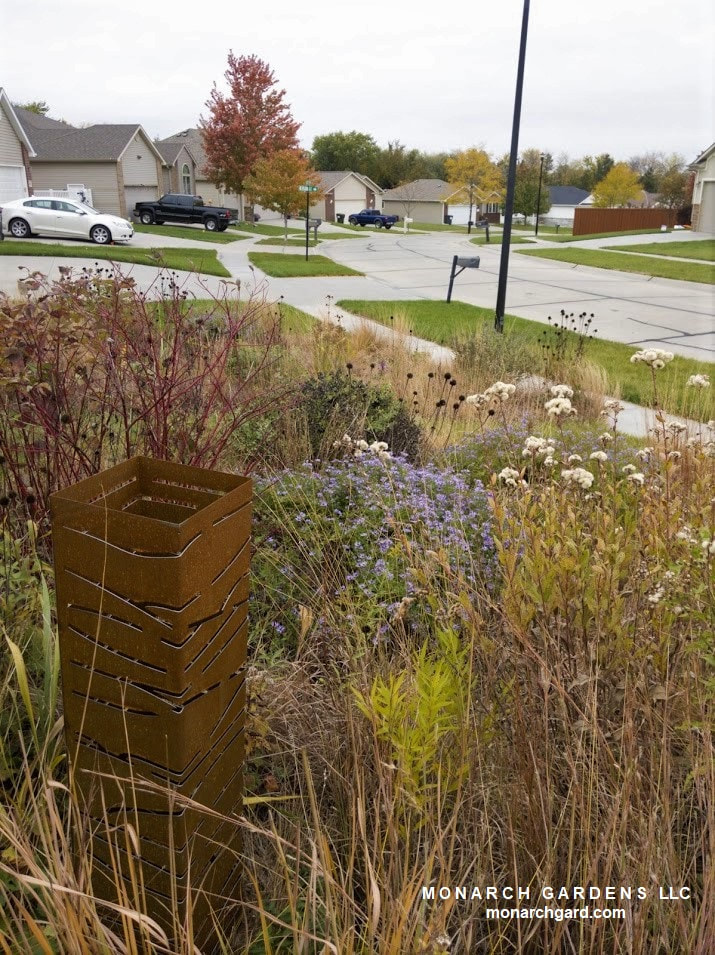
It can be small or big. Checkout Benjamin Vogt's work: https://www.monarchgard.com/portfolio.html

In particular, his house is on a small lot typical of suburban sprawl neighborhoods.

https://www.monarchgard.com/uploads/6/7/1/6/67169427/pxl-202...
Re:You Can Turn Your Backyard into a Biodiversity Hotspot by drewcoo on Monday February 27, 2023 @02:43PM (#34960955)
> planting only native plants . . . could be attracting non-regional and non-native species

Native plants do that, too. Invasive species thrive on that, in fact. Horticulture is more complicated than just "eating local." Ok, so a good diet is also more complicated than eating local.

> native plant species are easy

Absolutely! And if you're in a place that can flood or has droughts or sometimes has wild temperature spikes, those are plants that have adapted to the environment. They live through tough times that kill the plants that haven't adapted.

Re:You Can Turn Your Backyard into a Biodiversity Hotspot by wcarron on Monday February 27, 2023 @03:03PM (#34961164)
> I sort of disagree with the article though. I think one should actually take a relatively hardline approach to planting only native plants. Just because you have a lot of activity around a plant doesn't mean it's the right activity. You could be attracting non-regional and non-native species which is generating the activity.

I disagree. Native plants are great, but so are tomatoes or some bell and habanero peppers. You're projecting your personal opinions on what makes a garden good. To some, a good garden is defined by its native-plant biodiversity. To others, it's getting fresh herbs for salads at dinner. To others it is something else. It's not an either-or thing. You can plant many things and reap varying benefits.

Re:You Can Turn Your Backyard into a Biodiversity Hotspot by bmitc on Monday February 27, 2023 @03:06PM (#34961190)
I was distinguishing plants from crops. I think it's perfectly fine to be growing non-native vegetables and fruits that you'd like to eat or sell.
Re:You Can Turn Your Backyard into a Biodiversity Hotspot by wcarron on Monday February 27, 2023 @03:14PM (#34961313)
Ah, gotcha. Makes sense.
Re:You Can Turn Your Backyard into a Biodiversity Hotspot by bmitc on Monday February 27, 2023 @03:49PM (#34961667)
Your points were good though! I haven't yet started gardening for fruits and vegetables but would like to at some point.
Re:You Can Turn Your Backyard into a Biodiversity Hotspot by SirLJ on Monday February 27, 2023 @05:53PM (#34963147)
With edibles is getting tricky because everyone is eating everything… sometimes just one bite from a nice big tomato enough to ruin it…. Best to plant a lot to have for you, or plan for the ugly nettings and enclosures…. One thing that usually works are cherry tomatoes enough for you and the critters….
Re:You Can Turn Your Backyard into a Biodiversity Hotspot by wcarron on Monday February 27, 2023 @06:26PM (#34963525)
Same for you! Interestingly, contrary to you, my wife and I only ever gardened for produce. Didn't turn out that well with poor soil and drainage, but we tried. Wishing we had the space for it again at our current residence. And, of course, I'd actually like to have more space dedicated to native plants and biodiversity. I love bees, butterflies, moths, hummingbirds and other pollinators. Even small areas of 'nature' (if you can call specifically cultivated areas nature) really improve the enjoyment and charm of a living space.
Re:You Can Turn Your Backyard into a Biodiversity Hotspot by nonethewiser on Monday February 27, 2023 @04:39PM (#34962251)
They have the same downsides you identified for plants.
Re:You Can Turn Your Backyard into a Biodiversity Hotspot by djtriptych on Monday February 27, 2023 @05:11PM (#34962662)
Is it fair to call it personal opinion if it's also the ecologist consensus viewpoint?
Re:You Can Turn Your Backyard into a Biodiversity Hotspot by RHSeeger on Monday February 27, 2023 @06:02PM (#34963249)
Of course. To some people, that viewpoint is what defines it as good. For others, it's beauty. For others, it's pure diversity. For others, it's minimizing the work involved. The choice of what is considered "good" here is a very personal thing.
Re:You Can Turn Your Backyard into a Biodiversity Hotspot by djtriptych on Monday February 27, 2023 @08:38PM (#34964604)
Still, it's dismissive to place it into a class of personal opinion, when the colloquial understanding, especially here, is that there is no expectation of evidence behind it.

I think a fairer term here is 'argument'.

Re:You Can Turn Your Backyard into a Biodiversity Hotspot by wcarron on Monday February 27, 2023 @06:31PM (#34963579)
The other comment covered my thoughts mostly. Ecology is important. But I can't eat Blackfoot daisy. Not all gardens are there for ecosystem health. Some are for utilitarian purposes.
Re:You Can Turn Your Backyard into a Biodiversity Hotspot by KaiserPro on Tuesday February 28, 2023 @08:10AM (#34968847)
If the majority of your plants are native, a few non-native isn't going to hurt, assuming that they are well controlled.

Where they can be useful is that they often bloom at different times, or provide food at the start or end of the season, not furnished by native plants.

This can be really useful for supporting a wider range of species, especially with the seasons expanding/compressing.

Re:You Can Turn Your Backyard into a Biodiversity Hotspot by Natsu on Monday February 27, 2023 @03:37PM (#34961554)
* * *
Re:You Can Turn Your Backyard into a Biodiversity Hotspot by colechristensen on Monday February 27, 2023 @03:47PM (#34961648)
There are invasive plants and there are non-native plants and these things aren't necessarily the same. You do you with your yard but not everybody has to be so strict. There are plenty of non-native plants that have very low risk of becoming invasive which do a lot for biodiversity and are nice to look at.
Re:You Can Turn Your Backyard into a Biodiversity Hotspot by taftster on Monday February 27, 2023 @05:35PM (#34962972)
You should write a book, or at least blog, about the experience. This would be good reading and much appreciated to some of us. I'd definitely read.
Re:You Can Turn Your Backyard into a Biodiversity Hotspot by mikesabbagh on Monday February 27, 2023 @09:14PM (#34964816)
Douglas Tallamy is my new hero
Re:You Can Turn Your Backyard into a Biodiversity Hotspot by ascotan on Monday February 27, 2023 @10:14PM (#34965226)
I've been using the "Seek" app for plan identification and I'm floored to the amount of overgrown ornamentals from Asia everywhere. It seems like landscapers love to put non-native exotic grasses, trees, and shrubs all over the place.
Re:You Can Turn Your Backyard into a Biodiversity Hotspot by hunglee2 on Monday February 27, 2023 @10:21PM (#34965259)
this is great - more people should take this approach. Individual efforts like this might be enough to help native species hang on in face of government indifference. I'm reminded of that story of the survival of the Chinese Alligator, which I believe is mainly down to the efforts of a single woman who protected the nest sites which happened to be on her farm, and raised the hatchings beyond year 1 before release back to the wild. Every little bit matters!
Re:You Can Turn Your Backyard into a Biodiversity Hotspot by hosh on Monday February 27, 2023 @10:47PM (#34965389)
Native plants and species are already suited to the area, so it is a great place to start.

What I am finding though, is that the main difference between an invasive species, and a native species that is vigorous, is that the native species has a lot of interactions with other species within the local biome. And invasive species does not, so runs unchecked without a predator, or does not provide any benefits for other species. If they did, they would be “native”. Over time, the biome will adapt, and interactions will start arising.

There very much are circumstances in which an invasive, resilient species is the right thing. For example, Jerome, Arizona, is an old copper mining town with a devastated ecosystem. Tailings from the copper mine poisoned the land. It’s at a steep incline, with severe erosion. Houses had been sliding off the slope.

When the mine shut down, and the population dropped to about 100 residents, fhe mayor at the time brought in an invasive tree called the Tree of Heaven to save the town. That mayor hired an aircraft to seed it all around Jerome. This tree is invasive, difficult to kill once established, drives out other species, and produces copious amount of seeds. Crucially, it can survive soil that has been poisoned by the mining tailing. It grows everywhere in Jerome — and holds what soil is there. This terrible, aggressive plant is helping to remediate a land trashed by human activity.

https://youtu.be/Oayt7eru2nc

Re:You Can Turn Your Backyard into a Biodiversity Hotspot by kaitai on Monday February 27, 2023 @10:59PM (#34965451)
The Nature Conservancy had a recent article in its magazine about the change in bloom time for many natives (based on temperature) and the difficulty that can cause for migrating birds and for animals (whose schedules may be based on length of day). For this reason, I am moving away from native-only to a more utilitarian approach. (And don't get me wrong, I have scores of native plants in my very small yard.) I am thinking more about native-nearby plants and plants that may feed wildlife at adjacent times. So maybe it's best to have several types of milkweed that bloom at different times, as someone else noted below.

I'm in the Midwest and I'll also note the adage that many of our natives follow "sleep, creep, leap". Year 1, you'll be like "damn is this stuff even growing, this sucks" and year 2 you'll say "well I guess it came back? maybe?" and year 3 you'll say "it's starting to look nice here!"

I'm also taking a slightly heterodox approach in that I am mixing in non-native edibles with glee (I've got at least 6 kinds of berry bush for instance, some native some not). The weight is still on natives, but I've been influenced by, who, Todd Hemenway?? who pointed out that the ecological impact of shipping berries from far-away lands is much worse than the ecological impact of having berry bush that's well-behaved and not native. Similarly, there are very few non-native plants I try to abolish anymore. Instead to the best of my ability I eat them. It is extraordinary how many plants can be eaten. From Japanese knotweed (cook it like rhubarb in sweets, or stir-fry) to hops to daisies (eat young like arugula) to garlic mustard (great pesto) to hostas (nice asparagus-like flavor when roasted or sautéed young). I'm not introducing these, not at all, but when they appear I don't get xenophobic, I get dinner. Which also sounds kind of creepy. But what I mean is that I'm not digging up my echinacea to use the roots medicinally; I don't have enough plants to do so sustainably yet -- but I sure am serving 6 linear feet worth of hostas at a dinner party.

Re:You Can Turn Your Backyard into a Biodiversity Hotspot by hosh on Monday February 27, 2023 @11:11PM (#34965525)
Yup. It’s more about the connections the inhabitants of an ecosystem has to each other. Something that yields something edible or useful for humans is also a part of this.

Our role as humans is not some ideal, “untouched”, “pristine” Nature, as if human activity and design necessarily spoils Nature. I think a more sensible perspective is that humans are stewards of the land, and there are yields for humans and the non-human inhabitants. It’s that our civilization has been terrible stewards, not that we are incapable of being good stewards. We can care for the land and people, and still get our fair share.

Re:You Can Turn Your Backyard into a Biodiversity Hotspot by hackernewds on Monday February 27, 2023 @11:41PM (#34965701)
> I think one should actually take a relatively hardline approach to planting only native plants.

Why?

Re:You Can Turn Your Backyard into a Biodiversity Hotspot by smallerfish on Tuesday February 28, 2023 @08:03AM (#34968793)
> I think one should actually take a relatively hardline approach to planting only native plants.

I disagree.

Billions of birds fly around the world every year with seeds in their gut. Plants are constantly, naturally, migrating in territory.

"Native" plants are plants which were in a given place (in this example the US) before an arbitrary date (for the US, very roughly 1500), when we started keeping track of local flora.

The climate is observably changing, and what was "native" in 1500 may not be applicable to a local ecosystem anymore. Trees are already suffering in some ranges, and ranges are moving north.

Note that there is a difference between "non-native" (arbitrary) and "invasive" (measurable). Planting invasives (whether native or non-native) should be discouraged because they have the potential to disrupt ecosystems by completely filling niches. Planting non-invasive non-natives is harmless, and if well considered can be beneficial to your local ecosystem.