First, the primary organs that would be capable of this education are the media, who have a profit motive to stoke any and all fears (immigration, radiological warfare, world war, coffee being carcinogenic).
Second, I think this distrust goes beyond "the CDC said something wrong once, I don't trust them as much anymore." That could be solved with education. But we're seeing a more fundamental rise in broad-based distrust of any authority figure, and it's a much more instinctive response.
In a world where authority is more powerful and centralized than ever, some are bound to feel powerless. Someone's actions on the other side of the world have more impact on your life than they ever could (pick depending on your priors: a Wuhan wet market customer's appetite, or a Wuhan Institute of Virology employee's carelessness). With such an interconnected world, how could conspiratorial thinking not be appealing to some people?
Power inherently fosters distrust and cynicism. You can have as much pedagogy and education as you want: rational discourse just can't combat a fundamental instinctive reaction, a growing sense of claustrophobia and powerlessness that some people are bound to feel. And the response to this distrust? More control over discourse, over communication mechanisms[0], and ultimately, over citizens. Governments and corporations are more powerful than they ever were. Surveillance, and enforcement of rules, are easier and more automated than ever. How could our primitive, Dunbar-number brain wiring not react with distrust, or even hostility towards (some) authority figures?
[0]: https://www.reuters.com/world/europe/politician-says-germany...
Instead, those institutions have shown that they are willing to publish nobel lies. Specifically, they are willing to bend the truth and publish false information if they believe it is in the best interest of society / greater good. Given an entity that has shown willingness to bend the truth 'for the good of society', isn't distrust and cynicism is rational?
https://www.nbclosangeles.com/news/coronavirus/cdc-sets-shor...
https://www.theguardian.com/us-news/2016/sep/10/epa-head-wro...
Instead they prefer messaging to achieve an outcome instead of direct truth.
politicians, sure, but public officials such as the EPA?
> that doesn't reassure will quickly be replaced by one that does
sure, just doesn't need to be the EPA that does it. pre-empting politicians and doing their manipulation for them is not justified - politicians are not a source of truth.
I disagree. I think a big part of the problem is people having unreasonable standards of accuracy or consistency. On COVID, the CDC was never going have everything perfectly figured out in the beginning, and then consistently repeat the same message from January 2020 to January 2022. There have been too many unknowns and too much of a need to act urgently before everything was figured out. To this day you still have people people justifying their distrust by saying things like "I though we just had to stay home for a few weeks to flatten the curve."
Also, there's an unreasonable expectation that messaging should be be all things to all people. If a message widely disseminated and understood, it needs to be simple and clear. However that will lose nuance, and some people will launch into distrust because the nuance they demand isn't there. The problem is those goals are contradictory, so someone's not going to get what they want.
> Instead, those institutions have shown that they are willing to publish nobel lies. Specifically, they are willing to bend the truth and publish false information if they believe it is in the best interest of society / greater good. Given an entity that has shown willingness to bend the truth 'for the good of society', isn't distrust and cynicism is rational?
I don't think distrust and cynicism is rational in that case. It would be if they "lied" [1] selfish reasons, but if you assess that their motives are pure, then descending into "distrust and cynicism" is throwing the baby out with the bathwater.
And frankly, if "noble lies" bother you, wait until you learn the kind of ignoble lies people start believing when they become distrustful and cynical.
[1] Quotes because frankly most things people call lies aren't actually lies.
You may assume that "I" do not have sufficient education and training to interpret state-of-art publications, and/or assume that "I" would end up trusting dubious alternative theories, but you do not know. The "average" person may indeed be incapable of finding out the truth by themselves, but I'm really sick of "science-y" people giving blanket statements on what others should believe without actually checking whether they deserve the condescending remark in the first place.
If you're that smart, you should be smart enough to 1) understand the pressures they're under, 2) be empathetic, and 3) seek out information that may not be adapted for mass communication.
> but I'm really sick of "science-y" people giving blanket statements on what others should believe without actually checking whether they deserve the condescending remark in the first place.
Check with who? The public? You personally? Throughout this whole pandemic, precisely zero "science-y" authorities have had conversations with me on this, so I'm speaking exclusively about mass communications.
Institutions being wrong and misleading is something that is immensely harmful because of trust.
Most of the CDC guidance has been verifiably insane from the start of COVID — often from the CDCs own advice before the pandemic.
We need to stop excusing their behavior.
Perhaps not purely rational, but predictable and consistent with emotional norms.
That makes no sense to me. On an emotional level, my assessment of someone's intentions is a far more important factor in determining how I feel about them than any statement or group of statements.
Are you talking about the "don't buy masks" thing? Because when I dig up the actual early communications, they're not lies:
https://twitter.com/cdcgov/status/1233134710638825473
> CDC does not currently recommend the use of facemasks to help prevent novel #coronavirus. Take everyday preventive actions, like staying home when you are sick and washing hands with soap and water, to help slow the spread of respiratory illness. #COVID19 https://bit.ly/37Ay6Cm
https://www.nytimes.com/2020/02/29/health/coronavirus-n95-fa...
> “Seriously people — STOP BUYING MASKS!” the surgeon general, Jerome M. Adams, said in a tweet on Saturday morning. “They are NOT effective in preventing general public from catching #Coronavirus, but if health care providers can’t get them to care for sick patients, it puts them and our communities at risk!”
Both of those statements were made at a particular time under a particular set of unknowns, and the only way I could see them as "lies" is if I misinterpreted them by failing to consider that context.
The most egregious false statement is probably the thing about hand washing, but it's a not a lie because given how little was known at the time and the fact that the CDC isn't up in some ivory tower, so they had to say something and just recycled previous advice. In Feb. 2020, there wasn't much COVID period, so running around with an N95 to the grocery store would just waste it, especially if it's worn incorrectly (and I saw lots of that, especially using only one strap).
Also, both those statements are far more nuanced than I remember, which I think kind of proves my point about nuance. People claim they want it, but they still strip it away and remember some highly simplified version.
> So, why weren't we told to wear masks in the beginning?
> "Well, the reason for that is that we were concerned the public health community, and many people were saying this, were concerned that it was at a time when personal protective equipment, including the N95 masks and the surgical masks, were in very short supply. And we wanted to make sure that the people namely, the health care workers, who were brave enough to put themselves in a harm way, to take care of people who you know were infected with the coronavirus and the danger of them getting infected."
I think it's pretty clear that they intentionally downplayed mask wearing for the public with the goal of saving masks for hospitals, even though kn95 masks were on the market[1], and wearing masks would have saved lives.
[0] https://www.thestreet.com/video/dr-fauci-masks-changing-dire...
[1] https://web.archive.org/web/20200407162126/https://wiphone.i...
The CDC still has not performed or directed any large-scale experiments of any kind. They are a political institution, not practitioners of science.
Saying something definitive like 'Masks are NOT effective in preventing #Coronavirus' before the evidence is in is quite anti-scientific.
> Saying something definitive like 'Masks are NOT effective in preventing #Coronavirus' before the evidence is in is quite anti-scientific.
1. The statement you quote came from the Surgeon General, not the CDC. The Surgeon General is a political appointment, and as far as I know, the CDC does not report through him.
2. IMHO, the CDC's problem was actually the opposite of what you are complaining about. It was too scientific. Science is slooooooow, so if you rely on it too heavily then your problem will get "inside your OODA loop" and you won't be able to act quickly enough to tackle it effectively. The CDC has multiple hats, and it needed to push its science hat back in order to wear its crisis leadership hat in front.
Science is not the right tool for every job. It works great for things that change or move slowly (like physical laws) and very poorly for things that change or move quickly. It's an error to expect/demand every problem be solved with science
This is ultimately what happened during the early days of the coronavirus pandemic. It's what happens during fuel scares, it's what happened during 911 as a below poster explains, it's what happens within companies when layoff rumours circulate.
Even within the closest of romantic relationships each partner is not 100% truthful with the other because there are some things that are simply better not said.
Unless the idea is that we descend into some sort of authoritarian nightmare and the general population becomes irrelevant though, I'd argue that social order does require some semblance of trust in power even if only in the basics (e.g. if I don't cross the State, the State won't cross me).
Once that falls apart the whole thing is in ruins.
We need to separate research from politics. It needs to be a separate pillar of the state. You don't want reseachers chasing funds continously and doing short-term research for local sponsors. You want sizeable investments in long-term research projects, high autonomy and following of the scientific method. This way people would trust the results.
Tell an algorithm to optimize for engagement and it will promote the content causing the most engagement: novelty, conspiracy theory, outrage, surprising "revelations" and all sorts of clickbait.
If we removed Twitter, Facebook and Tik Tok and reverted YouTube to the pre-algorithmic (subscription based) era, we'd still have free speech on the internet but probably a lot less bullshit.
Note: Twitter would still promote bullshit even without a ML algorithm. The rules of engagement:
  - short content
  - individual popularity means content popularity
  - retweeting is instant, requires no critical thought
A big part of the anti-vaxx movement comes from the fact that the government have made it very clear they will lie and misrepresent data whenever it is politically advantageous for them.
If you want a very recent exemple, just look at this interview from someone very high up in the food chain at Bayer (youtube.com/watch?v=qowDwaYx7vI) and then try googling about whether or not mRNA is gene therapy. it was considered dangerous misinformation to say what he just did and yet he is overseeing the fabrication of covid vaccines.
It's far from the best example, but it's one where I won't have to waste an hour getting proper sources
However, even if it delivers to you true information about abuses and lies being told to you, you should still be aware that the system is doing this so that you will be outraged, rather than that you will be informed.
Here the exec is stretching the definition of the term gene therapy to include things that don't alter genes "mRNA vaccines are an example for that cell and gene therapy". He basically makes a mistake, because the same platform is also used for gene therapy.
To use a software analogy, just because both mRNA vaccines and mRNA gene therapies are software, doesn't mean that mRNA vaccines perform system updates (instead they trip the suspicious behavior detection of the anti-virus and trigger a download for new virus definition files).
Additional subtle distortion happens later on social media when people take this mistake and "shrink" it in the opposite direction "actually mRNA vaccines are NOT vaccines because they're gene therapy".
Joe Rogan then takes that and stretches it further to imply this is why the vaccines don't last long
> This is really gene therapy. It's a different thing. It’s tricking your body into producing spike protein and making these antibodies for COVID. But it’s only good for a few months, they’re finding out now. The efficacy wanes after five or six months. I’m not saying that people shouldn’t take it. But I’m saying, you’re calling it a thing that it’s not. It’s not exactly what you’re saying it is, and you’re mandating people take it
Sinopharm makes a COVID vaccine from dead / inactivated virus. Its used widely in China as well as in the developing world. We've also seen the same reduced antibody neutralisation there, and it isn't necessarily because of the passage of time but to a large extent due to the evolution of the virus to be significantly different from the original.
So yeah, this is a perfect example of how social media spreads engaging novelty - whether its deliberate disinformation or simply mistakes - and continues to distort it further by continuously applying stretching and shrinking. The info blob continues to evolve to evade people's "immune defences" and cause them to re-share it (e.g. retweet).
This is not something new, traditional media have been doing it for decades ever since the rise of the yellow press, with varying levels of subtlety. The difference is that this here is an "organic", crowdsourced process that yields better, more convincing results, as it has to defeat the "immune systems" of many people to get a good reach via resharing. Only the highest quality misinformation makes it through.
The worst bit about this phenomenon is that corrections don't work well. People who haven't heard the rumor don't care about the correction (its not interesting) so they don't share it. People that have heard the rumor before don't like being wrong, so they don't share it either. So it doesn't matter how many scientists explain the difference, the explanation will never have anywhere close to the reach of the original (likely hundreds of millions of people)
There is nothing organic about the speech that happens on YouTube. Veritasium explains the shift that happened when youtube switched to an algorithmic model from the subscriber model: https://www.youtube.com/watch?v=fHsa9DqmId8 - you need to carefully manipulate people to click your thumbnail based on the picture and the video title.
Making outrageous but believable shit up to sensationalize your content is a well known tactic of tabloids (which does continue today to some extent). YouTube and other social media incentivise exactly that.
The particular platform that has these characteristics is arbitrary and beside the point. No one is arguing that Tik Toks particular implementation of a short form engagement optimizing feed is dangerous.
Technology is supposed to compensate for our failings, not exaggerate them to the extreme.
https://www.rollingstone.com/music/music-news/michelle-shock...
The Clown Timeline might have been the last Cold-War era weapon, a doomsday weapon.
"You were -too cautious- about that new disease that was killing everybody in 1985" feels more like a dark joke than a serious claim. Everybody was shocked when Rock Hudson died in 1985.
History repeats itself.
If you ask anyone who was senior working in these institutions in the 1970s, things were far more dodgy back then.
Corruption and bigotry were rampant. But it was far easier to cover up back in the day.
Politicization is mostly driven by transparency.
Politicization is not a new thing, it's a fact that there's a lot of extremely conservative individuals in each country. And technology has bought them closer to their institutions.
Society is being brought very closely together, and we're working through the teething issues.
It is wild how people think things like institutional bigotry aren't politics. How is a scientific organization that excludes large swaths of the population due purely to the circumstances of their birth apolitical? Science has always been political because politics is how people interact with each other. That is true whether we are discussing how governments behave on the world stage or how that big project is being managed at your job. Wherever people exist, politics exists.
How are you using “conservative” here? The right certainly has no monopoly politicizing science.
But, if we acknowledge that was true then – why shouldn't we expect the same to be true now? The prevailing prejudices and ideologies may have changed, but has anything changed about the actual practice of science to make it more immune to those forces? I think a lot of people can't see it, because it is far easier to see when science is being influenced by beliefs you reject than when it is being influenced by beliefs you yourself share.
I think the politicisation of science is inevitable, and science is never going to be entirely politically neutral. Scientists are human beings, and as Aristotle famously said, "man is a political animal". I think science is going to achieve the maximum possible political neutrality when it is either (a) things so clearly established no one can sensibly debate them (which especially happens when scientific theories get translated into widely adopted working technologies–the very fact that the technology works is proof the theories behind it must be mostly correct); (b) things that avoid political entanglements because they have little relevance to everyday human life (e.g. string theory vs loop quantum gravity isn't influenced by broader societal politics because it has no relevance to issues of social/cultural/economic/political power, although even it is surely influenced by the micro-politics of the theoretical physics community, its funding models, etc.)
Take something like human-induced climate change – personally, I accept the mainstream account of that topic as most likely to be correct, but I can't be completely sure that it is right, surely there is some non-zero probability (even if a small one) that it is wrong. But, I expect people in a couple of centuries from now will be able to reach a much firmer consensus – they'll know whose predictions turned out to be right, plus technological and economic developments will likely greatly reduce the number of people with a vested economic interest in the non-mainstream answer. I think the most likely outcome will be that the mainstream account will be vindicated, and almost everyone will acknowledge that the minority were wrong; but it isn't absolutely impossible that it could turn out the other way around. And whichever way it turns out, I think people will see politics as having played a major role – if the mainstream account is confirmed, people will see much of the opposing minority as being led astray by politics; but, conversely, if the sceptical minority turn out to have been right all along, people will reach the same conclusion with respect to today's mainstream.
Compare now to ten years ago, before me too. Things are hugely different.
I fully expect that if you give it a long time, things will be markedly better. In a hundred years for example.
Perceptions of progress seem to depend a lot on (a) where in the world you are, (b) what things you value, (c) whether you choose to optimistically focus on the positive developments (from the viewpoint of your own values) or pessimistically focus on the negative.
Even if we agree that certain forms of progress are occurring, do those various forms of progress necessarily entail scientific progress? I think, the only form of progress which necessarily entails scientific progress is technological progress – but even for that, some scientific fields have much greater technological relevance than others, continuing technological progress requires continuing scientific progress in technologically-relevant fields, yet is compatible with going backwards in areas of science which lack direct technological application.
Getting physics and chemistry right is really essential to technological progress. How can technology advance if your physics and chemistry are wrong?
But, what about "softer" sciences, such as psychology or the social sciences? It seems you could be moving in the complete wrong direction with them, and yet still be advancing technologically – because technology largely doesn't depend on them.
And even for the "hard sciences", technology generally only depends on certain areas of them. How much of the Standard Model of physics is actually technologically relevant? Technological progress is strong evidence you've got the technologically-relevant parts of physics right, but is compatible with serious error in low technological-relevance areas. What is the technological relevance of electroweak unification, for example?
We also don't know what we are missing out on. Neuroscience is an area of biological research in which many promises of clinical translation have thus far failed to deliver. Is that because this the brain is very complicated, and we just have to wait longer and invest more before we see more results? Or could it be that we are doing the science wrong, and we'd clinically be in a much better situation now if we were doing it right? How can one tell which of those two possible situations we are actually in?
Why say "in the past"? Do you think it's not now?
Historically, scientists either were well-off and independent (e.g. Ulug beg, Newton, Cavendish), or worked at the expense of very rich personal patrons (e.g. Tycho). This limited the number of potential scientists, and the amount of science done, quite drastically.
In 18th-20th centuries it was somehow overcome, when partly states, partly industries gave more scientists more resources. By mid-20th century, the system started to develop cracks, as science became increasingly driven by formal metrics, such as impactful publications. The metrics are actively gamed, but worse, since science is unpredictable, honestly checking everything and building a picture of reality became a worse strategy than going for a flashy if more weakly researched result.
I don't know a good way out of the current trap.
Research is a high stakes, high rewards type of game. You need to pursue many potential ways forward, and most likely only one will win.
Rewarding short term wins makes academia no different from industry, and prevents finding anything but the local maxima.
It's not like the medical system was a highly trusted and respected institution that politicians somehow undermined in the last few months. The lost of trust in the medical system has been literally over 150 years in the making. If you read some books on the history of the rise of homeopathy in the United States in the mid 1800s, the parallels with today aren't exactly subtle.
That absolutely will never happen as long as the funding comes from the government.
The best you could possibly achieve is funding purely through small time (non business) donations from the public - and I'm still a little skeptical as to the scope of research that could realistically fund.
Of course it would. Whoever pays the piper always calls the tune.
It's no surprise that NPR and PBS advocate for the government point of view.
What I'm talking about is removing micromanagement and ensuring that the institution is trusted.
Social media just put some gas on a fire with engagement optimization. The rest was just human nature.
In particular I appreciate that you model authority as an analogue for trust, and trust as an analogue for independent verification.
I think trust is a prerequisite for successful convincing, because it is hard for human brains to overcome the emotional and relational elements of discourse, and we need to be in a receptive frame of mind. [citation needed]
We should study how authorities have built and lost trust, but I don't think we should be rebuilding those authorities using this knowledge. Instead I think focusing on how members of the public and different experts and scholars can build more diverse networks of trust relationships would create a more resilient system in the Internet age.
For example, instead of "I trust the CDC because they are an authority on disease" or "I trust Fauci on COVID because he is an immunologist", what if the common relationship was "I trust Fauci on COVID because his work on Zika and HIV was very interesting".
A related problem is what I call the 'knowledge gap'. Researchers develop a very comprehensive understanding of their chosen subjects, whereas members of the public have only a lay-person level of understanding. As experts become increasingly experienced and knowledgeable, the gap between lay-person understanding and expert comprehension grows. This means researchers are not always able to understand what a member of the public needs to know or how to explain it: how do you compress years of learning into a few minutes of talking, as part of a conversation? Good science communication skills are essential for experts if they want to develop trust relationships with members of the public, and if we as a society want to move from authority and coercion and towards education.
I've posted elsewhere in the thread about my own opinion that I believe the main issue we have is not with trust in the scientific sense (e.g. I think that most people generally _do_ believe that epidemiologists know what they're doing and that the outliers are exceptions), but with trust in the plan of action e.g. the entire chain of process.
Examples, all primarily via trust (I'm not a biologist):
I believe that excessive consumption of sugar can cause diabetes.
I know that alcohol can (will, given enough time) cause liver disease.
I know that driving my car drastically increases my risk of being in a car accident and therefore meeting a swift end, an agonising end, or perhaps a lifetime of disability.
I still engage in those activities despite the downsides because I believe them to be of net benefit, both to myself and to society as a whole. I'm willing to fully argue through that process.
Where I think the issue lies at present is that we're sorely lacking in convincing full-chain argumentation.
A person can trust that the UK health authorities know their stuff, they can believe that coronavirus exists and can be dangerous, but that doesn't solve the problem of whether or not they should skip out on their friend's birthday party or not. It only makes up a very small part of the jigsaw puzzle, the rest still has to be filled in somehow.
But that safety has to be balanced at some point. Same is true for any ministry of health.
Dying sober might not be the preference of everyone and optimizing on a trivial metric might do a lot of wrong. In fact I believe most people would be horrified to lead a completely rational and reasonable life.
I mean there is no real way for me to know if a vaccine is safe. I assume it is, and prefer to gamble on it not harming me and potentially helping the current situation.
But there is really no way for me to know for sure.
To put it another way, when the Omicron variant emerged, there were newspaper articles that often showed pictures of the spike protein labelled with different mutations.
As it happens, I did research in protein structural bioinformatics, so I have a good idea what the detail in these images 'mean' in a certain sense. However they are of zero use in making a single meaningful decision about how to alter my behaviour (or not!).
Of course, the journalists add these images as decoration, but to me it symbolises the mass of irrelevant detail provided. Which is not the same as saying 'just believe science!' as that is also wrong and unhelpful.
I'm not sure what the answer is, really.
For example, I think many distrust Fauci less because of Fauci himself and his behaviors and more because his behaviors may remind them of their primary care physician who treated them condescendingly, saying they were stupid for asking a question. Or because their parent got Alzheimer's or cancer and don't know where it came from and were told by doctors that their family member would be fine, even though their family is not fine.
I guess I just wished we paid more attention to the transgressions that happened to find the presumed cause of distrust so we can repair it, because I think trust can be highly efficient and distrust highly inefficient at times.
I can say, "I want to be honest with you, your relative may only have a few weeks left. I imagine that might feel really scary to hear or perhaps you might even feel angry, I don't know. I wanted to be honest with you and to let you know that my team and I will be here for you and your family."
If someone is trying to take advantage of a situation that's inherently complicated or unpleasant - it's easy to do so with a simple message that makes it digestible, even if it's wrong or harmful. We've seen this time and time again over the last few years. And then worse still, social media perpetuates it by keeping you in a bubble and pushing you further down a path.
But is it sustainable to lie to people in order to effect a desired (even if positive) change? How long can it go on for before people just turn off?
Maybe the answer is indefinitely. Empirically at least in my country this doesn't seem to be the case.
I've heard this been described as "pandemic fatigue", but it seems to more revolve around taking orders than believing in or being concerned about the pandemic itself.
People are willing to follow counterintuitive rules for a while, but eventually they need to understand some sort of final benefit derived.
The vast majority of people don't get "not drinking bleach fatigue" because they know it's bloody awful and that if they don't drink it, they're gone.
This part is a huge society-wide problem that can theoretically be fixed so people can become more informed and active participants in the framework of their daily lives. Don’t ask me how, though, because I just got off work and am too exhausted to do anything except let the news tell me what to be afraid of today, then probably binge The Office and slam a few brewskis until I fall asleep on my couch ‘cause I got work again tomorrow
You have to trust yourself to try anyway. Beats doomscrolling even if both are equally meaningless in the long run. Something that helps me is refusing to accept any narrative or conclusion about any topic where it would require a specific named group of people (e.g. members of any nationality, profession, corporation, ancestry, presentation, etc — anything) to be uniformly dumb or malicious.
That might sound silly but it means there’s no downside to entertaining any consideration, not even the downside of my own bad feelings from negative ideas. It totally removes a layer of mental latency I didn’t even realize I had until recently, even about topics where that wouldn’t ever be a question that’s possible to ask.
Instead of getting bogged down checking one story after another it’s easier to ignore entire storyline arcs at a time once they’re more obviously one set of jangling keys after another all vying for my attention at a higher priority than any self-directed interests :)
They lie and then act incensed when the public stops believing them. Given the massive damage they've done, I'd consider it justified.
The CDC is an incompetent, bloated and fundamentally dishonest organization that was perfectly comfortable throwing grandma to the wolves via lies (masks don't work!) if it meant their unpreparedness wasn't exposed.
Via anti-masking lies, CDC irreparably damaged their reputation and also likely got people killed who believed them. The damage is deserved.
Still, I don't share the distrust of a lot of folks regarding their policies and decisions over the last year or so. I think they're probably making reasonable calls for the available evidence even if hindsight eventually proves them wrong. To the extent their critics are correct, I think most will have arrived at their conclusions as a matter of luck (e.g., someone who knows nothing of virology happens to hear some study or other that hints that the CDC may be wrong and bases their entire worldview on that study without any awareness of the counter evidence).
The other one that pops to mind is probably statistical calculation helping services.
Maybe there are lots of other things as well - I haven't been involved with scientific research in a long time.
A theoretical climate change example might be:
Car A emits 10% less CO2 than car B.
Driving is 30% of your annual emissions (i.e. it's significant and one of the low hanging fruit).
That 30% of your annual emissions if multiplied by 7 billion people is likely to cause X.
If everyone drives car B instead of car A, Y will happen instead.
Y is better than X, because we end up with a more verdant Earth, cheaper food, better weather, less war (insert reason here).
Therefore, our overall quality of life is higher if we switch to car A.
Without the whole information chain, you just have isolated statistics that don't really mean anything.
Convincing argumentation is not only about mathematics, it's about appealing to the things that matter to people.
The problem is that while it's easy to calculate exactly how much less CO2 car A emits than car B, it is close to impossible to use science to predict to any useful degree of accuracy how much cheaper the food, better the weather, or less of the war we will get. It's often hard to even predict the sign, not even trying to determine the magnitude. This means that when scientists or politicians tell you that "we need to do X, so that we get Y", they're very often fooling you, because they have no good idea how much (if any) Y you get for each unit of X.
The scientific process involves testing the accepted and pushing ideas to there extremes. The fact there is a test of 5G on mice isn't surprising, but when these show a statistically insignificant blip and it's not in the conclusion that's not "big science hiding the real truths", it's that this blip in isolation is a true statistical anomaly...
What caused that trust to be lost? Is it something they did?
Over and over again those with authority have squandered it. An opioid epidemic devastated so many communities after doctors, health care executives, and McKinsey and Company said the new class of drugs were non-addicting. Our manufacturing sector evaporated after economists and politicians said free trade would benefit everyone. Thousands of young people were sent to die in the Middle East in a war all the experts said was necessary and would be relatively painless.
Those are just the first three examples off the top of my head. I could keep going. We were promised technology would improve our lives. We were promised borrowing money for education would improve our lives. And on and on and on.
All bullshit. All promulgated by supposed experts with impeccable credentials. It’s a full on disaster and the chickens have come home to roost.
Nobody takes note of the hundreds of life improving drugs developed in the same time period as opioid epidemic. Nobody takes note when cops arrest the right guy and saved the day. Nobody takes note when a country doesn't militarily threaten or invade the US.
Note well: I'm not actually a consequentialist. I'm just pointing out what "for success" actually means, at least some of the time.
We don't allow nonconsentual body snachers to harvest one person to save many. Alternatively we may allocate finite funds to save several lives instead of a single life. We may also choose not to spend the money to save a life
The outrage economy tends to focus on people and interpersonal drama. Some comedian said this, or maybe some company did something stupid and there’s a walkout.
If anything there’s a massive shortage of outrage. Given the degree of misery the entrenched elite is inflicting on the masses, the fact that we don’t have a general strike or torch wielding mobs swarming over the gates of billionaire’s houses is frankly astonishing.
It’s a struggle between the masses and the ruling class about who gets to make decisions in our society, not like lunch meeting where we can find common sense action items to agree on.
I don't think outrage changes minds, just engages your base. It also encourages the working masses to lash out at each other. Most outrage topics serve mostly to pit the masses against each other, based on skin color, gender, or who has bigger scraps from the economic table.
If you want real change, the solutions are relatively simple IMHO. Ranked choice voting, proportional representation in senate and congress, and less winner take all closer to a Parliament.
Just to clarify, many experts from generals to peacenik linguists to gonzo journalists predicted immediately that the wars would be an expensive and unwinnable series of atrocities. They weren't given airtime.
I think a good analysis of the history and changing landscape of media is highly in order if we want to get to the bottom of this.
As for me, I like to remind people of Operation Mockingbird quite a bit lately, and rest assured the name just got changed after the Church Committee and given the explosion of the internet they are certainly extremely pervasive in the new system.
As CIA director William Casey said: "We’ll know our disinformation program is complete when everything the American public believes is false."
But at the time, if you were observing “expert” opinion that was it.
- https://www.vox.com/policy-and-politics/2019/10/15/20849072/...
> [Biden] was able to choose all 18 witnesses in the main Senate hearings on Iraq. And he mainly chose people who supported a pro-war position.
- https://www.theguardian.com/commentisfree/2020/feb/17/joe-bi...
More?
> Iraq in 2002 was devastated by economic sanctions, had no weapons of mass destruction, and was known by even the most pro-war experts to have no missiles that could come close to the United States. The idea that this country on the other side of the world posed a security threat to America was more than far-fetched. The idea that the US could simply invade, topple the government, and take over the country without provoking enormous violence was also implausible. It’s not clear how anyone with foreign policy experience and expertise could have believed these ideas.
> Senator Dick Durbin, who sat on the Senate intelligence committee at the time, was astounded by the difference between what he was hearing there and what was being fed to the public. “The American people were deceived into this war,” he said.
- Also from the Guardian link.
And that's just war. We were lied to about sugar; about margarine, about recycling, about oil spills, about agricultural pollution, about public transport. We were lied to about trade, espionage, healthcare. Repeatedly, barefacedly. Lies are the most bipartisan issue in America.
In the face of all this, we're told the enemy is distrust itself, told to trust the science, told to believe that Biden and the Dems are fighting for us. We're told anti-war news outlets and comedians are secretly communist, Russian funded. It's all such utter wank.
https://www.cbsnews.com/news/arkansas-inmates-ivermectin-fed...
Hmm. I wonder how we got there...[1]
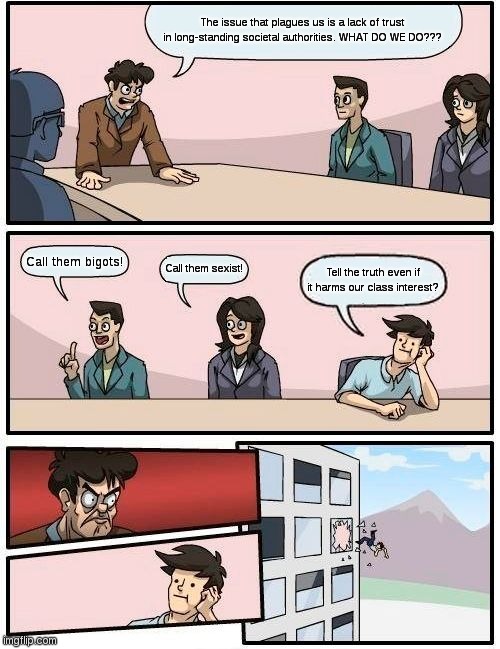
> I think your comic is referencing the political "left" vs "right" divide, you are part of "the right"
That's a big assumption. I could very well be part of the left who simply doesn't share "the left"(tm)(c)pat. pending)'s current party line because I find it to be nonsensical.
> People who exhibit this pattern are usually stuck in a rut of pseudo-truth.
There it is. That arrogance right there. "You don't share my class interests, therefore you are wrong". That, in essence, is exactly why no one trusts institutional actors -- because people realize they've aligned themselves with the bourgeoisie against the proletariat. There's no disguising it anymore. They will do or say whatever those who hold the purse-strings tell them to say.
> It doesn't help that a lot of institutions agree with the actual truth a lot of the time
Which truth is that? The one that said that masks helped halt the spread of the virus, or the one that said it didn't and we should stop hoarding them? Roll 2d6 and consult your Propaganda Master's Guide on page 666 to find the answer.
> People who exhibit this pattern often reflexively disbelieve whatever any authority says, just because they're an authority, i.e. Oppositional Defiant Disorder.
...or they've correctly identified them as class enemies who will do or say whatever it takes to defend their class interest such that you can't believe anything that comes out of their mouth. It honestly doesn't matter if they're right at that point because the lack of trust cannot be amended.
> The thing that makes it really insidious is the mentality they're right and everyone else is automatically wrong.
Indeed. Calling someone a part of 'the right' and saying they're from a side stuck in a 'rut of pseudo-truth' because they point out that institutional actors are biased to their own interest, have a history of lying, and this is why no one trusts them anymore, is quite insidious.
> I ask you: Hypothetically, if what you believed was not actually true, what would convince you of that?
Institutional actors abdicating their posts in favor of someone of proletarian class interest so proletarian ideals can be put to the test without interference.
So what happens when you present a video testimonial like this - https://www.youtube.com/watch?v=L2GKPYzL_JQ - and people just dismiss it, people not understanding that with clinical trials you're meant to keep track of and report all outcomes, and not only that - by limiting the scope via an app that has limited options, and no free form input, you're crafting a very narrow scope of outcome, literally doctoring the outcome by minimizing the potential range and severity of adverse events? (If the people even watch the video or understand the implications of what Maddie's mother has shared; and if not, then you're not able to educate or inform them further - probably because it's a counter-mainstream narrative point, arguably the mainstream and government captured, regulatory capture from industrial complexes, etc)
Does the video described build or harm trust of our institutions? Does that this happened with this clinical trial, does that not automatically extrapolate that all of the other clinical trials were ignored, not given proper oversight, nor having integrity to them?
Given the level scientific institutions have been spending trust over the past few years I'm not sure how this problem can be alleviated within our current framework.
Why do you assume that the financial incentive is for the truth rather than for the conspiracy theory?
But do you not see how this will result in conspiracy theories? You are no longer engaging with the merits of a study and are instead questioning the motivations and source behind that study. You are shifting from a more objective argument to a more subjective one allow more room for conspiracy theories.
>Collusion is very real when billions of dollars are on the line and it is naive to assume otherwise.
Yes, which is why "do your own research" is often misleading because those billions of dollars have greatly impacted what research is available to you.
It’s fundamentally an epistemological question: what is the ontological basis for thinking we know something?
Once again this is thinking that doesn't go beyond the first layer. If this situation is possible for the first link, it is possible for the second and the third and everything on the first 5 pages. However deep this hypothetical researcher is willing to go, if there are enough billions at stake the manipulator can keep pumping out misinformation. They have a financial incentive to lie and no one has a strong financial incentive for truth so how does this researcher find the needle of truth in the haystack of lies?
If however fact checkers were a pain in the butt for mainstream media and politicians as well they would be much easier to listen to.
This is basically "fact checking". In theory it's good, but it inevitably degrades into a farce with stuff like [1] or [2].
Skepticism of any claims is a pretty good heuristic, but should be equally applied to counter claims.
Everyone would agree that a person wandering around the street firing live rounds into targets is acting in a dangerous manner.
No-one would agree that a person drinking a cup of tea in their own house is acting in a dangerous manner.
But coronavirus isn't one of those things. It's genuinely a borderline issue, and not because of the science, but because it's almost exactly on the line in which some people consider it to be a disaster and others consider it to be a bit of a nothing burger.
As a result, you end up in a situation as described by rgrieselhuber below.
Some people think that we need to close (e.g.) schools to stop coronavirus. Other people think that we need to stop caring so much about coronavirus, so that we can go to (e.g.) school.
The question of whether there's misinformation is almost tangential to the point because there are huge numbers of people who do not doubt official statistics or modelling but also believe that data or those models are not severe enough to require us to 'stop the world' so to speak.
I guess my thoughts are that, if we can't even convince each other (and from what I can tell neither of us have really fallen for misinformation), what hope is there for the actual 'vaccines cause 5g' nutjobs?
What does this have to do with the price of fish?
Moreover, it's not just about the media's coverage of COVID or the moon landing, but about their overall credibility during the prior decade. For example, the media has reliably and brazenly lied and mislead on racial justice protests from ~2014 through 2020, which almost certainly affects its credibility on other issues (e.g., covid). Of course, the same applies to the academy and other institutions.
I’m not sure that has anything to do with “science”.
I think the problem could be "science communication", not bad communication or anything like that, but the existence of it in general. There's a casual interest in scientific stuff in the public, there's an entertainment market for it, and so now we have a scenario where people that publish research have to weigh this impact when publishing, including it's benefits. But most people interested are only casually interested (and most vendors of the entertainment have incentives not necessarily aligned with presenting fact, but that's not my point, only a secondary problem). I think it's possible that it might be better if, when someone was interested in something, they had to dig it up online. If we get rid of the whole "science communication" thing, truthful or not you get rid of all these problems.
I know it's impossible to do that, but it's interesting to consider that the problem isn't bad communication, but this drive to communicate everything all the time skewing the incentives and public perception.
Do you think 'scientific research' is in a great position from a funding perspective right now?
Have you looked at the press or out the window as to how "science" is portrayed due to covid? The lack of sanity in both political directions is alarming and depressing all at the same. Both sides of the public on this are both, equally, damagingly, wrong. However, they pick up and throw around scientific papers as though it gives them the right to be the next pope...
If science is paraded around like nonsense in the press there's a matter of time until we end up with politicians who make the decisions sit there and say "I don't see any public benefit in researching this".
That day will only come sooner if things carry on as we head into a recession.
Edit: My proposal to fix, as I've suggested elsewhere, keep scientific papers behind some (non-for-profit) walled access, obviously that has damaging impacts when you say X from country Y can't read paper on Z, but frankly maybe the public isn't grown up enough for completely open discourse when they can't understand the material.
Unfortunately "bad science" cuts both ways when it comes to miscommunication.
You can add any number of layers of scientific rigor and it won't convince someone who has a favorite talking head.
Yeah, because there's no rational basis to continue to afford them that trust. You're describing the symptom, not the disease.
But it's the only correct way, if credible studies contradict an official agency (more often it's the degree of the opinion where there is disagreement, not the opinion itself), my advice would be to trust the studies. For instance MRI contrast agents: the EMA banned most of them while the FDA did not, which is not the advice one would form by reading studies on the matter.
It is also difficult to come up with an example where it was warranted to suppress information. Can you name one? Educated and intelligent people are often very distrustful, especially of authority.
Society is not a boot camp of grunts.
(... And that's assuming it can be provided without being shut down as "indoctrination").
Loads of people are well aware that wearing a mask would result in less coronavirus particles being emitted from my face if they were infected.
But they don't act on that for various other reasons unrelated to the virus.
The same is true of climate change. You can think that it's real and still drive your car for precisely the same reason that you can think that cirrhosis is real and still drink a few beers.
This misses a lot of the cause. People aren't listening on the vaccine because there were no WMDs in Iraq. All the "experts" said that too.
The fact that huge frauds have been perpetuated at scale against our entire society and nobody has been held to account is a major reason for collapsing trust. It would be very helpful if the parties responsible had at least been censured even if the political class couldn't muster the will to truly apply penalties, but few in the political class have even admitted that anything bad happened.
When trusted authorities perpetuate frauds or display extreme incompetence and then just paper it over (often at others' expense), they are destroying the fundamental trust basis of society. Opportunistic politicians are destroyers of civilization.
Being able to construct a graph does not mean it's possible to check whether the claims are correct though..
In this way it would be more obvious why policies are choosen and provide a way to express current knowledge. As more nodes are added to the graph, the policy prescriptions would change which would prevent mistrust that is based on "health department said do x, now they say don't do x".
On the other hand, I don't disagree that the level of misinformation is ridiculous. It's difficult to understand why someone would trust someone with a popular podcast so much more than licensed professionals. Maybe there shouldn't be censorship, but where are the medical malpractice claims against these people? I think it's all tied in with the general acceptance of the "these statements have not been evaluated by the FDA" supplement industry. As long as your supplement does not do too much direct harm, we allow it.
I'm less convinced that this is a matter of trust, I think it's more about value systems and priorities.
I trust my dentist to recommend me the best filling or crown material for my teeth, even in the face of financial incentives.
But his advice does not tell me, in an absolute sense, whether it'd be worth me paying $1K for a crown if that means I miss the rent next month. It's not a tractable problem.
I can't speak to the US situation, but in the UK in my peer groups most coronavirus-related argumentation doesn't revolves around whether e.g. wearing a mask reduces the spread of coronavirus, but around whether wearing a mask is a net positive for the society and/or the wearer. The former is a matter for epidemiology, the latter is nowhere near clear cut.
But in the US, we have this extreme irrational vaccine skepticism where the math just does not work out. People believe the vaccine is much worse than its benefit. It's hard to argue with since prominent people are supporting this idea.
I think once you get into the situation in which people think "I'm being forced to do X", you've created an impossible catch-22 and you've basically ensured that some % double down.
It's hard for me to explain because it just seems intuitively obvious. I really enjoy a beer after work. But if you forced me to drink one, and made me document the fact in order to go on holiday or whatever, I would feel less inclined to do so because I'd instinctively think that something fishy must be going on.
I've personally had the generally recommended number of vaccines at the right times etc, but when it comes to stuff like showing barcodes to get into places, I've faked it on principle, I think it's a dystopian horror and it doesn't surprise me at all that a lot of people have responded by just tuning out and refusing everything.
You would think that, and they promote that, but it does not. It is obvious when you consider that all the vaccine skeptics were also vaccine skeptics before there was any hint of force involved.
I know a lot of people who took the first or second vaccine but are refusing further due to the coercion involved.
Or more generally, they behaved "carefully" in the early days of the pandemic but then switched off over time as they tired of being given legal commandments from God rather than sensible advice.
I agree that the same set of people think crackpot stuff like "5g causes corona" or the vaccines have microchips, I don't think those people are really relevant to the discussion.
To me it's analogous to like, telling one of my overweight friends to go on a diet so that I can pay less for the NHS or something. They don't want the advice, it feels rude more than anything else (even explaining this feels a bit ick!)
If it was shown that we could eliminate sars-cov-2 via herd immunity I'd probably be a bit more keen to encourage it but I still don't think I'd support mandates unless we had some crazy ebola mutation and people started dying in massive numbers.
Triple vaccinated and completely in agreement.
An argument can always be made that they fill up hospitals, but that same argument can be made against parachuting, being overweight, racing (or driving in general), all alcohol etc.
If choice is to meaningful it includes bad choices.
This isn't actually a problem so long as those past errors were caused by the limits of what we knew at the time and efforts are made to help prevent similar issues in the future when it's possible. It's inevitable that as our understating of science and medicine evolve we're going to discover that what made sense before is no longer a good idea.
The problem comes when we weren't wrong because of what we didn't understand, but because people who knew better just thought they could get more money if they manipulated results or outright lied. We had the tobacco industry pay off scientists to lie about the cancer risks the industry knew to be a problem. The resulting rise in people with lung cancer wasn't a mistake. We had doctors pushing opioids on people at insane doses because they were paid kickbacks if they did. That wasn't a mistake either.
What we need is strict regulation and oversight so that when science and medicine do get it wrong, it's because we couldn't have known better given what data we had at the time. That'd be a huge step up from where we are now.
We can't follow the entire scientific proof chain for every piece of information we encounter, because we don't have time.
So we rely on authority to some extent, whether that be peer review, government, independent bodies, etc.
We need to be able to trust that these bodies are telling us the truth and aren't seeking to mislead us. Because when we start to doubt them, we then inevitably elect alternative bodies, simply due to limited thinking capacity/time - as explained above it's impossible to do otherwise, no-one derives from first principles every opinion they hold.
The best way, _overall_, to convince someone to do something, is by clearly explaining to them the positives and negatives and letting them come to their own conclusion.
It doesn't always work, and there are specific situations (e.g. someone is holding a gun to your face) in which the cost/benefit analysis is very different - in such a situation, the short term is all that exists, the long term effect of misplaced trust is irrelevant - you simply have to neutralize them.
But in general, I'm absolutely sure that education over coercion is the correct approach for society.
Because if you force them, sure, you've got a short term win, at the long term cost of trust. What is the long term cost of lost trust?