As an example I've been looking at properties outside of suburbia since testing a friends Starlink terminal. I know i can get proper broadband on par with cable anywhere. It's changed my personal long term future plans. I think it's going to change a lot of things.
My guess is that enough rich people moving into the middle of nowhere will cause the government to pay for terrestrial solutions ("incentivize") within the next 10 or so years.
If you live in a dense metro area it will probably fill up very quickly - but then again Starlink is not really designed for those locations, which probably already have good connectivity.
The only other options, until Starlink launches in my area, are traditional satellites. My neighbor previously had one of those, and he had an 8GB cap per MONTH. Plus the ping time averaged like 600ms.
I'm not even mad about the price of $94. Internet is way, way worth it. The quality of the connection sucks, though. I would pay $200 for Starlink once it's reliable. I'm not actually sure what my limit is, but it's pretty high, because rural internet is painful
actual dedicated 1:1 geostationary network capacity costs at a minimum $1600 per Mbps per month each direction (eg: 2 Mbps down x 0.5 Mbps up circuit would easily be $3500/mo)
People are comparing (sub)urban US multi-carrier options, or heavily populated countries (like Italy), that have much cheaper pricing. It's not surprising that terrestrial services there are better spec'd and cheaper.
For me (in AU) it's compelling because I otherwise have an option of a 3G yagi / booster (nearest tower is 15km away, service is awful normally, but unusable in storms, frequently highly contended, etc), dial-up (there's very few places that still offer such a service, and just the landline connection fee is $40 / month to start with), or geo-stationary satellite (what I've just moved away from after 2+ years, which has > 600ms RTT to the nearest capital city, and a max downstream of 25Mbps, which is also frequently highly contended during peak times.
The 100W / hour usage is frustrating, and claims of electricity being 'just 10c / kWh' are quaint, I guess coming from well serviced parts of EU / US? Here most people are up for 30c (AUD) / kWh, and if on ToU that can go up to 60c during peak (2pm through 8pm). I've got solar, so on average I'm powering this 'for free' 25% of the time.
Dumb Q - is satellite any better in a storm?
1) The storm would have to be right on top of the ground station to be in the line of sight when talking to a satellite. For the 3g case, the storm could be anywhere along the 15km between the two ground stations.
2) Storms typically cover a larger area horizontally than they do vertically, so for most angles, communicating with a satellite should go through less of the cloud than horizontal 3g communication. I'm sure there could be storms where this is not true (eg a tall thunderstorm directly above the ground station), but my guess is that such storms are more rare.
Starlink during storms, and we've have a half dozen big ones since I got this service 4 months ago, seems to do more re-acquires during those events (several seconds of drop-outs) but I'm not seeing significantly lengthy outages.
The dish is still sitting on some concrete blocks on the ground, so it may simply be that it's wobbling more during the wilder winds.
in your case about $16.74 if you subtract 25% for the estimate of benefit from your solar (grid tied?) kWh going back to the grid
For the average Australian user, it means you add ~ $200-350 / year to your effective ISP cost. Not end of world for most, but certainly not trivial for all, either.
The regrettable history of Australian internet provisioning (specifically our national broadband network) and electricity pricing (specifically the rorts and corruption, and higher-than-rest-of-world pricing) are described much more eloquently by others.
I get 1gbps for ~$100/mo in the bay area, but if I lived a few miles further from the city I’d get 10mbps DSL over wet string regardless of how much I’m willing to pay.
This also means that, at least for us, 99$ (88€) per month for such a thing is a lot more at the end of the year (+756€). I hope they’ll eventually adjust that price for different markets because at the moment it’s not even competitive in my area.
If you get a good tech they will help you, you may get a dud, in which case you simply have to call them up and work the system again.
It's totally doable, I've done it dozens of times at every dwelling I've inhabited. I'm currently on their 1GB plan, and I do get 1.4Gbps down (they recently upped their provisioning rate, and with a newer modem with 1 2GB link on it, with a suitable router [I run the UDM Pro] it works).
A regular unlimited Gigabit Uplink runs 40€-80€ a month, with hardware included and a power usage in the range of 10W.
But, unfortunately, anywhere you have a Garden large enough to host starlink, you probably won't have anything near that speed available, so it's still pretty competitive.
:(
Your anecdote doesn’t really cover “game changer” since land outside of suburbia is pretty either scarce, big and expensive, underdeveloped, etc. and not many people want to live there (and I doubt fast broadband is the only thing holding people back).
I honestly don’t think starlink is useful for that many people. Personally I would categorize it as a quality of life improvement for a small group of wealthy individuals (and maybe even smaller number of industrial workers which work onsite in remote locations). I have a hard time seeing it doing anything more.
Although Comcast is a thing in town, most of the otherwise eminently suitable locations have no cable access. The choices are old-style satellite or Starlink.
We have met an increasing number of people who have left the Bay Area and moved to our area. Nearly all of these are remote tech workers. They have generally held their noses and signed up for geosynchronous satellite while waiting for their Starlink service. Those who have transitioned to Starlink are very happy they made the move when they did.
I think Starlink will prove useful to so many people that it will increase pricing for rural real estate.
It is amazing how our traditional telcos have failed us. Buildout of broadband was fully-funded by the government in the 90s, and it flopped; They took the money and never built anything. These communities still do not have access to reliable broadband as it was defined then.
Comcast could have built out service in so many of our current residential areas, but chose not to. For no apparent reason but that it cost capex.
There was so much funding to extend internet access to rural areas. None of the major vendors engaged these funds and used them to provide capacity.
If Starlink succeeds, I'll raise a glass to the memory of Comcast and others.
spot on:
>> a quality of life improvement for a small group of wealthy individuals
Only question is, will the money from this small group of wealthy individuals be sufficient to pay for the full system? We'll see in about 4 years the latest, when satellites will start falling down, and will have to be replaced by new ones...
Serving these communities with traditional infrastructure and maybe a 5G tower is very possible today, and frankly not that expensive for a country like USA. I think you undercount the political feasibility a bit. Politicians in the USA make a huge buzz about serving rural communities, infrastructure is a political buzzword at the moment. A good politician could easily capitalize on rural broadband. They don’t even have to be that well intentioned since they could take some lobby money from the telecom companies and bid out the infrastructure build out with conveniently specific requirements for contractors their family just so happens to own stock in.
Yes everything you've said about the possibilities is technically true, but it hasn't happened and there is no evidence it will happen. The RDOF has awarded another provider funding to bring fiber to within a few miles of my place but not directly to me.
Meanwhile I've been on Starlink since last February. I just checked and I'm getting 110M/12M with a 28ms ping time, which is 10x what I was getting for effectively the same price. Not only that, if I want to go on the road I can pack that little dish and take that bandwidth with me just about anywhere in the US. If I was broke I could pool funds with a few neighbors and we could split the cost.
With that available now, why would anyone spend millions of dollars to drop in a 5G tower to pick up another 50-100 customers?
> With that available now, why would anyone spend millions of dollars to drop in a 5G tower to pick up another 50-100 customers?
Your county would—and should—spend a few million dollars with some extra funding from your state and local telecom companies to drop a few 5G towers to pick up a few thousand more customers and voter happiness for sure. Your county counsel can call it something like Rural Broadband initiative and have a plan to bring a broadband connection to 30-70% of under-served rural households in the county before 2030. A good politician should be able to sell it even to city folks as serving the community.
It's a utility. If it costs twice as much as elsewhere you still need to pay it, until it starts getting really difficult.
Starlink exists.
You could get a Verizon hotspot (and ration data). But Starlink is pretty good. Video streaming does stutter a bit--you're better off downloading. I could actually work up there which I couldn't really with the old DSL.
I reckon if they put their mind to it they could cause enough pollution to make cellphones unusable, maybe even open-air wifi. They're smart, I'm sure they have the technology, they could make the whole EM spectrum so dirty the whole sky would glow.
Admittedly, most of my trouble is probably caused by the 70 meter coastal redwood on the western horizon. The network isn't quite dense enough yet that I can get a satellite visible at all times amongst the trees. It's just a bit sad, as the Starlink app reports like 95% clear sky. You really do need 100%.
We were seeing drops of a few minutes each day, but as of December we've gone days without even the slightest interruption. We had to really work to get Dishy to not have any obstructions, but since then it's been great:
https://pics.rickosborne.org/blog/wp-content/uploads/2022/01...
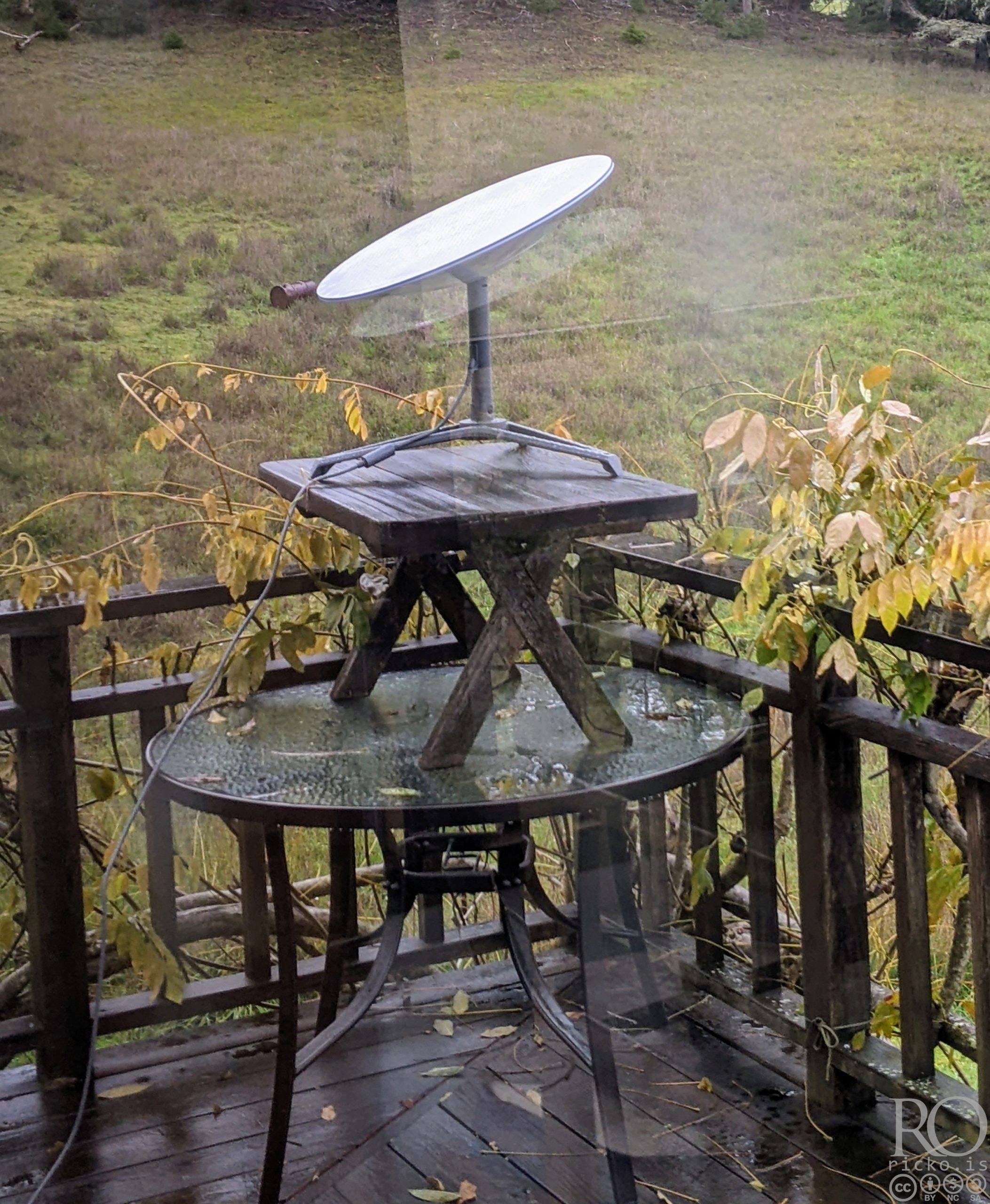
We also have Ukiah Wireless, point to point microwave, as a backup. I use it for my work uplink as it has more stable upload bandwidth than Starlink. And when we had those really bad storms over the last few weeks, Starlink definitely struggled more than microwave.
for people with trees they cannot cut down I see a lot more 40' aluminum light duty towers with foundation kits getting sold in the future. Much like people used to put up in very rural areas with yagi antennas on them to receive OTA TV a logn time ago.
The metrics to worry about are latency and loss and throughput. Jitter is really a SIPnRTP thing. Don't use ICMP to test for "quality" - it isn't even the same protocol that you worry about (TCP/UDP), it is what it is - ICMP (use it wisely).
jitter is really quite consistent at 23-28ms
I agree on the icmp, for me, icmp loss is really more like a cheap/easy early warning sign that something is wrong. if a properly implemented last mile connection has no icmp loss it's also unlikely anything else is wrong. if there is a few % icmp loss, very likely normal tcp and udp things will also behave badly.
(RIP Douglas Adams)
Useful low orbital shells around the Earth are an awful lot smaller. They're still big, like the sky is big, but airplanes do manage to, at least somewhat regularly, collide with each other "in the middle of nowhere" (most midairs are around airports, since there are a lot of airplanes heading in and out of them).
Aircraft debris, however, falls out of the sky in short order. Orbital debris doesn't.
The probability of an initial collision is fairly low, but once you have a few, or someone decides to show off their new ASAT weaponry (which is functionally a satellite collision, just one of them only having been in space for a short while), you now have flak that won't go away, moving in all directions at orbital velocity. That, then, has the potential to start causing all sorts of problems, and once that's taken out a few more satellites with orbital-energy impacts, you start having a real problem.
Will it happen? Those invested in littering certain useful orbital shells with satellites claim not. We'll see.
I've heard SpaceX claims to deal with it by putting their satellites in an orbit that requires periodic boosting to stay put -- if they don't, satellites decay and de-orbit after a few years.
The plan is, I think, to regularly retire (de-orbit) and replace these satellites so they can continuously improve the design, and as a nice side-effect any collisions or otherwise misbehaving objects will at least stop being a problem after a known maximum span of time.
Now, how many other satellites are likely to get hit in "5-10 years" of flak flying around at orbital velocities? It's nice if your goal is to say "Well, it probably won't render space useless forever..." - but that assumes one collision, and no ongoing collisions. If it's "5-10 years per collision," and each new one resets the 5-10 years timeframe, well, there's a lot of stuff up there that can make a mess.
Unfortunately, the low orbital shells are also "everywhere." It's not like geosync orbits where if you Kessler them, well... not going to have geosync stuff anymore, but you can still use other orbits. If you Kessler LEO shells, you pretty much have a high risk of anything you try to send to space getting blasted on the way up. It doesn't take much of a bit of debris, at orbital speeds, to trash your booster and make you have a bad day. I guarantee a bolt at 17,000 mph will do some damage (typical LEO velocities) - that's about ~22x the speed of sound in the atmosphere, depending on altitude.
If there are tens of thousands of things up there and you start things colliding and blowing up, you've basically put a defensive shell around the earth for a century, if not longer, by the time all the satellites get fragged and the debris eventually comes down.
It's not.
The concern is that unwanted collisions will become common enough that satellites break down or are completely destroyed within months. There will never be enough debris that we can't fly through LEO.
Flying through and flying through safely are very different things. With tens of thousands of objects in and below LEO and (presumably) increasing flights to orbit, it's only a matter of time until a rocket gets taken down. It doesn't require a particularly large piece for an involuntary update to your deorbiting plans.
> There are currently over 1,600 Starlink satellites in orbit, and that number will continue to grow; SpaceX has filed paperwork for up to 42,000 satellites for the constellation.
https://www.space.com/spacex-starlink-internet-satellites-la...
They're aware of the risk of collisions, but toss in a few more vendors trying for the same size, and you can have potentially hundreds of thousands of satellites in the shells. They're big, but they're not that big.
Obviously that is something to avoid, but it's not like we're filling up a non-renewable resource in low earth orbit. It cleans itself naturally.
FWIW.
oneweb is just now becoming barely usable above 55 degrees north latitude. they have a lot of launches to go before it's anything like a real network (and will not be for individual end user CPEs, a oneweb terminal is much bigger and more costly). other things like telesat LEO network remain in the land of vaporware, same as with amazon's.
[0] https://www.reddit.com/r/theydidthemath/comments/p0qws3/self...
Imagine you have a string wrapped tightly around the earth, how much more string to you need to raise the string 10cm above the ground everywhere? The answer just feels so hard to believe, but it indeed only depends on pi and 10cm.
Yes, they have a plan to deal with collisions.
Announced but not implemented Leo other than SpaceX include amazon, Russia, china, telesat.
Probably a better thing to observe is loss and congestion on normal TCP sockets, using retransmit counters, congestion window collapse, etc.
It'd be cool to see what a long running mtr in TCP mode says about Starlink.
starlink is not even close to oversubscribed, so I'm not sure why you're making this comparison.
Previously it was running somewhere around 0.15% to 0.60% which was still totally usable... if you put a similar test setup on a noisy/oversubscribed coaxial cablemodem DOCSIS3 segment in a randomly chosen house in a suburb somewhere, you might also see an average of 0.50% loss in many cities.
For anyone who has seen packet loss, jitter and transfer quotas on deeply oversubscribed consumer geostationary services, this is amazing.
The next big thing will be to see if they can really get satellite-to-satellite laser links working so that starlink service area and coverage is not limited by having multiple moving LEO satellites in line of sight of both the CPE and a regional spacex earth station at the same time. for instance if people wanted to put a working starlink terminal somewhere really difficult to reach like socotra, yemen.