News for hackers. Stuff that matters.
Re:Low interest rates in advanced countries have pushed mone... by deepnotderp on Wednesday November 24, 2021 @12:32PM (#29332610)
IMO this is the single biggest malaise in society. “Investing” (speculating) in real estate creates nothing of value to society and instead serves only to artificially drive up the cost of shelter, a basic necessity. It also directs capital away from investing in technology and businesses.

Due to the zero-sum nature of real estate, it fundamentally breaks the positive sum theory of capitalism. Adam Smith even called landlord’s right “theft”.

Re:Low interest rates in advanced countries have pushed mone... by api on Wednesday November 24, 2021 @12:40PM (#29332700)
https://en.wikipedia.org/wiki/Georgism

TL;DR: things that people produce such as labor, products, and services are not taxed at all. No payroll taxes, no sales tax, no income tax, and no capital gains tax on investments in productive activity or human-made capital.

Things that people did not produce such as land or the right to extract natural resources are taxed. For land the land value is taxed, but this does not include the value of things built on the land.

You're basically billed for the right to "own" things that existed before any of us were born. Since not much else is taxed, these taxes could be rather steep.

This strongly incentivizes efficient use of land and natural resources and discourages non-productive squatting on them. You would not see, for example, a bunch of self-storage places and gigantic sprawling car washes in Silicon Valley. The land value taxes in such an area would be far too high to justify anything but highly efficient productive uses of the land such as housing, manufacturing, offices, etc. Vertical construction would be highly incentivized in high value areas.

Re:Low interest rates in advanced countries have pushed mone... by deepnotderp on Wednesday November 24, 2021 @01:03PM (#29332990)
Yeah I’m personally a fan of Georgism but realistically something like a LVT is too radical to implement. I think that a carefully thought out property tax code (eg higher taxes for lower density buildings) can get you 80% of the way to the effects of a LVT while being pragmatic enough to implement today.
Re:Low interest rates in advanced countries have pushed mone... by larsiusprime on Wednesday November 24, 2021 @01:09PM (#29333091)
You could actually do a lot to adapt existing property tax regimes into something like a very close approximation of an LVT. Step 1 would just be improving the quality of assessments to take advantage of the state of the art of the latest mass appraisal methods (which requires no change in law, just requires you to influence the training and/or appointment/election of local assessors) from the last 15 years. Step 2 would be lowering the tax rate on improvements and shifting the burden off of buildings and onto land; this is barred in certain states but is perfectly legal in others.
Re:Low interest rates in advanced countries have pushed mone... by sokoloff on Wednesday November 24, 2021 @01:15PM (#29333177)
Lowering the tax rate on improvements would probably have the side effect of having more remodeling work be inspected. Much of the avoidance of building permits (and associated inspections) is about avoiding increased assessments and associated taxes. This in turn would likely lead to less totally slipshod remodeling work, at least by people who weren’t aiming for that outcome.
Re:Low interest rates in advanced countries have pushed mone... by larsiusprime on Wednesday November 24, 2021 @01:25PM (#29333306)
Wait why would LOWERING the tax rate on improvements INCREASE the amount of building inspections? Are you assuming that this would lead to an increased reliance on the cost approach for assessments?
Re:Low interest rates in advanced countries have pushed mone... by sokoloff on Wednesday November 24, 2021 @01:32PM (#29333409)
With a high tax on improvements (as is the case today), there is incentive to make improvements in a way that the municipality won’t know about (as is the case today). The easiest way for the municipality to learn about improvements is via the building department permitting and inspections process, so a lot of work is done without pulling permits.

Lowering or removing this disincentive would increase the amount of work that gets inspected.

As an owner-occupant, I want the inspections and am willing to pay one-time for an impartial second set of eyes.

As an owner-occupant, I do not want to pay a recurring subscription fee (in the form of higher property tax) as a result of the inspection.

Given how many properties have obviously recent remodels and no permits pulled in the last 30 years, it’s fair to say that at least some of the market has decided that permits aren’t worth the tax increases.

Re:Low interest rates in advanced countries have pushed mone... by clairity on Wednesday November 24, 2021 @01:29PM (#29333364)
that’s right, appraisal/assessment methods can be changed more easily than tax law, and could be a potential avenue for more equitable/productive taxation. the barrier is, of course, working with the ~5000 property taxing jurisdictions in the US, each its own special form of opaque bureaucracy, averse to any and all risk-taking (not saying this to discourage, but to show the magnitude of the challenge).
Re:Low interest rates in advanced countries have pushed mone... by ItsMonkk on Wednesday November 24, 2021 @03:12PM (#29334556)
lars's article is what made it fully click for me on how important this topic is, so I'm going to mostly leave it to him here, but I just want to stress one thing.

One thing the Bitcoin issue has shown me is just how pivotal that 'number go up' is to society. When 'number go up', that thing gets bought in, which brings more people to it. I think many look at the LVT like medicine, yes, this thing is good and important, but it tastes bad, so we can't get the collective buy-in, and never will. But we all know what's going to happen to Bitcoin, it's a bubble, and it will crash, crash hard. But so is the real estate market.

Real estate has gone up as interest rates have come down. With our interest rates at 0%, there is now no more room for the interest rates to go down, and thus real estate market to go up. We've reached the end, as we come out of CO-VID they might go up another 10% or so, but the easy money is gone - but the downside is now massive. If rates go back to 5% we will see real estate prices go back to where they were at when interest rates were last at 5%. Investors have a huge risk disparity.

And this is where the Land Value Tax can help. If we can implement the Land Value Tax, and at the same time implement a one-time tax credit equal to the price of the land, not only will no one lose out, but those that have the most at risk will now de-risk, and have the most to gain. All in the meantime instantly incentivizing the correct behavior.

Re:Low interest rates in advanced countries have pushed mone... by larsiusprime on Wednesday November 24, 2021 @01:34PM (#29333433)
Gotta start somewhere! Change is never easy.
Re:Low interest rates in advanced countries have pushed mone... by clairity on Wednesday November 24, 2021 @03:05PM (#29334477)
yes, but like most things worth pursuing, its a thorny problem, largely for economic and sociopolitical reasons, but also technical.

as you probably know, AVMs (automated valuation models) have been the hotness over the past few decades, but zillow (recently, but all along too) has shown the real limitation of AVMs. in theory, the likes of google and apple have enough geospatial data to create good land value AVMs, but you really still need appraisers on the ground for hyperlocal adjustments that just don't get captured in the AVM data and/or model. and that's all before the politicians, bureaucrats, and competing public interests get involved.

Re:Low interest rates in advanced countries have pushed mone... by deepnotderp on Wednesday November 24, 2021 @02:36PM (#29334176)
Indeed! Would love to start, do you have a good email address to reach you? Mine’s in my bio
Re:Low interest rates in advanced countries have pushed mone... by legulere on Wednesday November 24, 2021 @04:14PM (#29335242)
The current federal property tax was deemed unconstitutional in Germany. The new law has an opening clause for states to regulate the property on their own. The state of Baden-Württemberg has introduced a land value tax.
Re:Low interest rates in advanced countries have pushed mone... by kragen on Wednesday November 24, 2021 @02:02PM (#29333767)
> realistically something like a LVT is too radical to implement

That's what they said about the French Revolution, American democracy, the abolition of Russian serfdom, the abolition of US slavery, the Paris Commune, the Bolshevik Revolution, Prohibition, the Holocaust, the establishment of the State of Israel, the Great Leap Forward, the Iranian Revolution, etc.

I mean, that's also what they said about lots of other changes that actually didn't get implemented. And, as the examples above illustrate, it's easy for radical changes to have unintended effects...

Re:Low interest rates in advanced countries have pushed mone... by rcpt on Wednesday November 24, 2021 @04:43PM (#29335526)
That's what Pennsylvania did and it worked very well
Re:Low interest rates in advanced countries have pushed mone... by odiroot on Wednesday November 24, 2021 @04:21PM (#29335310)
> TL;DR: things that people produce such as labor, products, and services are not taxed at all. No payroll taxes [..]

This is actually very logical. Never understood why salaries are taxed so high. Always seemed to me like the governments are punishing workers for actively working.

Re:Low interest rates in advanced countries have pushed mone... by imtringued on Thursday November 25, 2021 @05:47AM (#29340149)
The government also spends the money on things like hospitals which raises the value of the land so you end up paying twice. Pay taxes and then pay increased rent to get access to the things your tax money was spent on. It's highly inefficient.
Re:Low interest rates in advanced countries have pushed mone... by bawolff on Wednesday November 24, 2021 @04:33PM (#29335434)
> The land value taxes in such an area would be far too high to justify anything but highly efficient productive uses of the land such as housing, manufacturing, offices, etc.

Wouldn't that just mean those lots would stand empty? Its not like the car washes are there because there is a higher revenue option but people just dont want to do it.

Re:Low interest rates in advanced countries have pushed mone... by BirdieNZ on Wednesday November 24, 2021 @06:33PM (#29336494)
If the lots are of value then someone will buy them and develop them to return a profit. Under a land value tax you expect land to be used more efficiently, not less.
Re:Low interest rates in advanced countries have pushed mone... by bawolff on Thursday November 25, 2021 @04:16AM (#29339636)
But umm, why?

In this specific example, what's preventing the land from being used for something more valuable than a car wash currently? I get that a land value tax would disincentivize hoarding land, but urban-sprawl-car wash hardly seems like a case of land hoarding. I think the parent was suggesting that these car washes would no longer exist because taxes would be too high under a land value tax regime - but that raises the question of what the more valuable usage is? Does there exist one, why isn't it currently being used that way, and is the reason something that lvt would rectify? If car washes are the most valuable usage, then they will either continue to exist or if the tax burden is too high in the new regime, they will stop existing and nothing will replace them.

I'm sure there are plenty of examples where lvt would encourage more efficient land usage, i'm just confused why this would be one of them.

Re:Low interest rates in advanced countries have pushed mone... by BirdieNZ on Thursday November 25, 2021 @06:46PM (#29346147)
Car washes are low maintenance, so it's an easy way to make a little cashflow whipe primarily owning the land for landbanking purposes. With the land freed up for something more productive, other businesses will be set up which are higher effort but higher returns.

Basically car washes are the slightly-harder version of land banking, but there is still enough value in the land that if the land was put up for sale, some other business would purchase it and utilise the land better.

If the car wash owner wanted to maximize returns they could set up a more profitable business today, sure. It's just more effort than they can be bothered with.

Re:Low interest rates in advanced countries have pushed mone... by i_have_an_idea on Wednesday November 24, 2021 @03:29PM (#29334758)
Well, maybe, but think of the flip side of this. I've worked very hard to earn X amount of dollars, however the monetary policies of banks around the world have pushed inflation up, essentially eating up my savings, all the while pushing the interest rate on deposits to zero and below. I would like to not lose the purchasing power that I've earned, so my only choice is to invest in something. I also want to invest in something as low risk as possible; if my hand wasn't forced, I'd be happy to keep my money at the bank at 2%.

Right now, investing in public companies and tech is very risky, as valuations are at record highs. Many experts estimate near-zero returns for decades from public markets. And, as a small-time investor, I don't have access to private deals or markets.

So, that leaves real estate. I don't put my money there because I want to drive up the cost of shelter for anyone, I do it because I don't have any other reasonable way to protect my savings.

Re:Low interest rates in advanced countries have pushed mone... by PragmaticPulp on Wednesday November 24, 2021 @04:35PM (#29335456)
> Right now, investing in public companies and tech is very risky, as valuations are at record highs. Many experts estimate near-zero returns for decades from public markets. And, as a small-time investor, I don't have access to private deals or markets.

> So, that leaves real estate.

That’s a huge leap to jump to real estate as somehow safer than public market investing. Real Estate can also be highly volatile and is also prone to significant drawdowns.

Real Estate also has very high carrying costs relative to other investments. Especially if you’re trying to rent it out, at which point it becomes a business with not insignificant labor requirements, either from you or someone you hire. It’s more of a side job than an investment.

If you’re serious about investing, you shouldn’t be choosing between a bank account or real estate. Those are on opposite ends of the risk spectrum and opposite ends of the work-required spectrum.

Instead, you’d want to do things like dollar cost averaging into equities over time (nobody really invests by keeping it all in cash and then flipping it all into specific stocks in the middle of a frothy market). Or you should be looking into ladder if CDs, or bonds, or something like I-bonds to invest an asset specifically indexed to inflation.

But choosing between a 0% bank account or real estate investing is a major false dichotomy.

Re:Low interest rates in advanced countries have pushed mone... by carom on Wednesday November 24, 2021 @10:32PM (#29337978)
>But choosing between a 0% bank account or real estate investing is a major false dichotomy.

Ok, so interest rates are near zero. A ton of money is leaving the bond market and going to stocks. Price of stocks is being pushed up due to the increase in money chasing yield there. These companies didn't get more valuable, your earnings per share just went down. Now you're anticipating inflation as printing money is a great way to get out of the next crisis when your interest rate can't get any lower. This personally leads me to real estate.

Re:Low interest rates in advanced countries have pushed mone... by phreeza on Thursday November 25, 2021 @02:28AM (#29339027)
Not sure if this is what the parent was talking about, but the risk equation changes significantly for real estate that you own to live in it, both because of government incentives and because you can always derive value from the asset through living in it, regardless of what happens to the resale value.
Re:Low interest rates in advanced countries have pushed mone... by walleeee on Wednesday November 24, 2021 @04:18PM (#29335286)
not to dispute your point, because it makes sense from the individual's perspective, but this...

> Right now, investing in public companies and tech is very risky, as valuations are at record highs. Many experts estimate near-zero returns for decades from public markets.

...is a big red arrow pointing to the fact that we're living in a castle made of sand

if we continue to let pathological incentives drive economic decisions the tide will wipe it all away

purchasing power is a mutually constructed fiction and remains a useful social technology only while material productivity can plausibly support the web of lies we tell each other

now that people have noticed the foundation caving in, it would be nice if we could formulate and incentivize a positive sum response, otherwise we get zero or negative sum dogfights over scraps as you describe

Re:Low interest rates in advanced countries have pushed mone... by rcpt on Wednesday November 24, 2021 @04:37PM (#29335474)
What's really awful is that this has happened before.

This write up of 80s Japan (from 1990!) is worth a read

https://hbr.org/1990/05/power-from-the-ground-up-japans-land...

Re:Low interest rates in advanced countries have pushed mone... by nemo44x on Wednesday November 24, 2021 @06:25PM (#29336418)
The difference is the USD is the global reserve currency. And that’s not changing anytime soon. It’s a totally different game when the entire planet wants to (or has to) transact in your money.

It’s also justified as the USA is by far the most dynamic economy in the world and has the most advanced military there to protect your investment in USD.

Re:Low interest rates in advanced countries have pushed mone... by ur-whale on Wednesday November 24, 2021 @06:44PM (#29336594)
> And that’s not changing anytime soon.

I wouldn't bet the farm on this one. The US ain't what it used to be and China is rising fast.

Re:Low interest rates in advanced countries have pushed mone... by nemo44x on Wednesday November 24, 2021 @07:09PM (#29336780)
Such an overblown and baseless talking point. The USA has never been in a stronger position. Literally just printed 40% more money than has ever been created and the demand for her bonds is insatiable.

I’m happy for China and Chinese people having a better quality of life. But their economy is based on humans doing things inexpensive. It’s essentially a services business, not a SaaS business. It doesn’t scale well but they have so many poor people to exploit that they can make a thing of it.

When the seriously export culture, novel technology, or medicines then sure. When they aren’t a net importer of food then sure. But the yuan is not a serious threat to usd. It’s pegged to it.

Re:Low interest rates in advanced countries have pushed mone... by dmingod666 on Wednesday November 24, 2021 @09:29PM (#29337648)
Behind the cheap workers is whole industries and ecosystems and know-how, it's not a cheap labor problem. Bangladesh is cheap labor but if you wanted to start building phones there you will not have the ecosystem to support you..
Re:Low interest rates in advanced countries have pushed mone... by wbsss4412 on Wednesday November 24, 2021 @04:13PM (#29335238)
This analysis frames the problem as though it’s concurrent with current inflation rates.

The problem goes back for much longer though. Interest rates hav been near zero since the Great Recession, and for most of that period, inflation was also below 2% almost the entire time. Add to that a lot of the year over year inflation we are experiencing is due to base effects eg the collapse of oil prices last year. Current oil prices are hardly elevated from their historical norms.

Re:Low interest rates in advanced countries have pushed mone... by toomuchtodo on Wednesday November 24, 2021 @03:47PM (#29334945)
You’re trying to store purchasing power as structural macro economic and demographic changes occur. This is challenging, at best. Look to Japan for what the future holds.
Re:Low interest rates in advanced countries have pushed mone... by saiya-jin on Wednesday November 24, 2021 @04:15PM (#29335248)
Not every country is, or ever will be, like Japan. I would say most of them won't during our lives.

I agree with OP, if you just leave hard earned money of us middle class sit in the bank, it will be eaten away by inflation and fees. Its what our parents did, and its properly dumb. Risk with markets which most don't understand, or invest into real estate which everybody does at least a bit. Most folks consider only these 2 options.

Also, if SHTF, in most cases you will have physical places or even land to live off, instead of few bank statements. People will still have to live somewhere, and there is constantly more of us.

Re:Low interest rates in advanced countries have pushed mone... by toomuchtodo on Wednesday November 24, 2021 @04:54PM (#29335616)
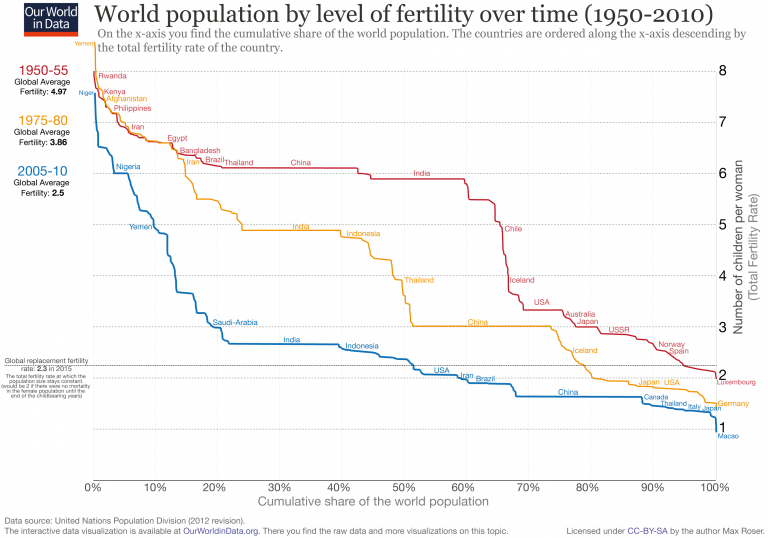
All countries eventually end up as Japan. India and Africa will race to be last. China is already somewhere between 1.1 and 1.3 total fertility rate. Sustained sub replacement rates (<2.1 fertility rate) locks in population momentum.

This is important because age of labor and consumers directly influences macro economic conditions, which trickles down to investment returns.

https://ourworldindata.org/uploads/2014/02/World-population-...
Re:Low interest rates in advanced countries have pushed mone... by phreeza on Thursday November 25, 2021 @02:33AM (#29339052)
The end of history has not been reached. Just because we haven't seen it yet doesn't mean fertility trends won't reverse in certain places at some point. Governments have by no means exhausted their means to effect such a change, for example.
Re:Low interest rates in advanced countries have pushed mone... by carom on Wednesday November 24, 2021 @10:40PM (#29338019)
On the world scale maybe, but the USA is still one of the most desirable places to immigrate to. So while some countries will be abandoned, the US can just increase immigration which creates the necessary future demand for assets.
Re:Low interest rates in advanced countries have pushed mone... by jbay808 on Wednesday November 24, 2021 @05:17PM (#29335829)
From the '80s to I think around 2002, real interest rates were positive and you earned money from a savings account faster than inflation.
Re:Low interest rates in advanced countries have pushed mone... by tedunangst on Wednesday November 24, 2021 @05:46PM (#29336082)
People were posting this exact comment five years ago. Stock market too high, crash is coming, pull your investments. They have not done well.
Re:Low interest rates in advanced countries have pushed mone... by llbeansandrice on Wednesday November 24, 2021 @06:43PM (#29336581)
I agree with your point about systemic issues pushing people towards real estate or to carry cheap debt (particularly in the form of mortgages). But the leap from:

> investing in public companies and tech is very risky, as valuations are at record highs

To real estate where valuations are also insanity and at record highs doesn't make any sense.

Re:Low interest rates in advanced countries have pushed mone... by i_have_an_idea on Thursday November 25, 2021 @03:49AM (#29339485)
> investing in public companies and tech is very risky, as valuations are at record highs

> To real estate where valuations are also insanity and at record highs doesn't make any sense.

The difference for me is that I saw what was happening in public markets and I bought real estate in a country where this wasn't yet the case. It is now though, so your point is valid.

Re:Low interest rates in advanced countries have pushed mone... by jonplackett on Wednesday November 24, 2021 @03:18PM (#29334622)
The weird thing about house prices is it’s the exact same house that now costs waaaay more.

What I mean is, for example, my house is 130 years old. So it’s in a _worse_ state than it was 20 years ago. But it costs probably 10 X more.

It’s not like houses are a fine wine that matures. Nor is it in any way upgraded or better like a new technology would be.

But up in cost they go, indefinitely. Exponentially. Pointlessly. A complete and utter failure of policy.

Re:Low interest rates in advanced countries have pushed mone... by enaaem on Wednesday November 24, 2021 @03:32PM (#29334790)
It’s not the house that’s worth more. It’s the land. If cities and towns develops, land prices should go up. Buildable land near an office, supermarket and bar should be worth more than the same piece in the middle of nowhere.
Re:Low interest rates in advanced countries have pushed mone... by skipants on Wednesday November 24, 2021 @03:55PM (#29335038)
I slightly disagree. The land definitely factors; I don't think we can argue that. But there's also a lot of value of a house just being on the land, no matter its quality (ignoring complete dilapidation).

If labour and material costs are also high that increases the value of houses that are pre-existing. It means the buyer does not have to pay extra for and wait for a house to be built, which has some value. Also, there's a certain tolerance that I'm sure many people, if I may project, have for how crappy of quality a house actually is. They just want a damn place to live and call their own. Especially when the market is not in the buyer's favour.

At least that's how it all seems in Toronto. In the city of Toronto proper, a detached house selling around $1,000,000 is almost guaranteed to be of relatively bad quality right now.

Re:Low interest rates in advanced countries have pushed mone... by saiya-jin on Wednesday November 24, 2021 @04:19PM (#29335297)
Yes but if prices rise, its 90-100% of the land price increase, and 0-10% of the house itself. That is land with all network connections and permit to build the house. It basically goes up only with material and labor costs.

House is often a necessary evil - its never what buyers imagine as ideal, but in comparison with going through the hell of building one's own (or also adding tearing down the old) its an acceptable compromise for many.

Life is too short, and no house is worth destroying a marriage.

Re:Low interest rates in advanced countries have pushed mone... by amcoastal on Wednesday November 24, 2021 @05:23PM (#29335872)
This depends on where you live. In rural areas, and dying towns (most of america geographically), land prices have stayed about the same over the last decade or so. However, materials and labor have increased a lot. So there are certainly situations where the building itself inflates in value more than the land.
Re:Low interest rates in advanced countries have pushed mone... by PeterisP on Wednesday November 24, 2021 @05:49PM (#29336107)
I heard an anecdote from a rural insurance agent that the fire insurance is crazy because repairing/rebuilding a house after a fire costs much more than the market price of the house + land, or an equivalent house + land nearby - the issue is that (in some areas) the rural house prices there are way down as there's no demand and everyone's leaving, while the costs of construction are sky high.

So if they offer a policy that covers the market value of the house, that's much less than what it would cost to repair/rebuild (so insured people can't afford to get their house back after a fire), and they don't want to offer full repair/rebuild value, as that incentivizes people to just burn the house down because in that case the insurance payment would be much more than what they can sell the house for.

Re:Low interest rates in advanced countries have pushed mone... by closeparen on Wednesday November 24, 2021 @03:51PM (#29334994)
To steal a phrase from Matt Yglesias: we only have so much "throughput" from land prices to housing prices because we refuse to build vertically.
Re:Low interest rates in advanced countries have pushed mone... by batshit_beaver on Wednesday November 24, 2021 @04:21PM (#29335315)
Slight correction - people don't want to live in vertically built accommodations. Everyone wants a nice little house they don't share with anyone. Can't exactly blame them.
Re:Low interest rates in advanced countries have pushed mone... by wallacoloo on Wednesday November 24, 2021 @05:29PM (#29335928)
i just have trouble understanding this angle. i grew up in the suburbs and moved into the city during year 2 of my career. i rent a home with 3 roommates even though i could afford that SFH you’re describing. why does a person desire to live in the city for any reason besides for the density?

“jobs”, “good food”, “nightlife”, “dating” and “social opportunities” are all things i hear. the last two are a direct result of density. the first 3 are only possible as indirect results.

anecdotally, the price per sqft of townhomes exceeds that of detached homes in several Seattle neighborhoods. several confounding factors, including the year of the building, but in general that suggests a preference opposite to what you claim. or at least, that, in the face of constricted supply we can’t really tell where the preferences truly lie.

Re:Low interest rates in advanced countries have pushed mone... by jb_s on Wednesday November 24, 2021 @11:37PM (#29338263)
If we're looking statistically, detached homes are more expensive than apartments pretty much everywhere once you take into account location. And having a family with a toddler myself, trust me, apartments are not the best fit for that situation.

Anecdotally, in Australia, post COVID both rent and real estate in regional areas have gone up dramatically - much more than in cities - rapidly pricing locals out and forcing them to move elsewhere and sometimes find temporary accommodation. Now that WFH is more normalised and either want a quiter lifestyle or straight up can't afford houses in major cities, so they are moving to smaller towns instead.

My own preferences are fairly different but I can't argue with data.

Re:Low interest rates in advanced countries have pushed mone... by siquick on Wednesday November 24, 2021 @11:25PM (#29338220)
You requirements for a good life change as your age changes - what you value during your 20's is not the same as what you value in your 40's, in the same way what you value in your 20's isn't the same as what you valued in your toddler years.
Re:Low interest rates in advanced countries have pushed mone... by JamesBarney on Wednesday November 24, 2021 @05:34PM (#29335964)
Everyone wants to live on an acre in the city in a palatial mansion.

But if you have to decide between an hour commute and living vertically plenty of people would choose to live vertically.

Re:Low interest rates in advanced countries have pushed mone... by mancerayder on Wednesday November 24, 2021 @07:42PM (#29336995)
But factor in hybrid remote and the palatial mansion has become an option again - what's 2 days a week of a hellish commute if you can stretch out on a lawnchair the other 3?
Re:Low interest rates in advanced countries have pushed mone... by missedthecue on Wednesday November 24, 2021 @05:50PM (#29336112)
I don't know... The suburbs are really popular
Re:Low interest rates in advanced countries have pushed mone... by JamesBarney on Wednesday November 24, 2021 @05:58PM (#29336191)
Most of the people I know who moved to the suburbs did so for better schools and a larger house.
Re:Low interest rates in advanced countries have pushed mone... by danny_codes on Wednesday November 24, 2021 @05:46PM (#29336085)
Eh, I don't think that's true. Maybe for older generations, but for people in their 20s and 30s I suspect the opposite is true. People want to live in cities and if they've done any research at all don't want to live in suburbia since it's a living hell.
Re:Low interest rates in advanced countries have pushed mone... by mancerayder on Wednesday November 24, 2021 @07:40PM (#29336982)
People in their 20's and 30's eventually reach their mid to late 30's and realize living as a couple with a child or two running around in an apartment, taking elevators to walk the dog or have the kids play in a park (a park probably with homeless people laying on benches if it's the parks I'm thinking of), and folding a stroller to walk down the subway is -- a giant pain in the butt.

And eventually those people visit friends or see pictures on social media of people similar to them with large back yards, land and big kitchens - and say, shit, maybe we should look into this.

As it happens, just possibly a black swan pandemic event keeps those folks indoors with their kids and dogs, with their nonplussed neighbors, children running around behind Zoom conference calls, and pictures on social media of people with houses and backyards causing massive envy...

And welcome to today.

That's the housing situation in the suburbs and exoburbs. This is BEFORE even even talk about the insanely low interest rates on offer during this time.

Re:Low interest rates in advanced countries have pushed mone... by closeparen on Saturday November 27, 2021 @12:02AM (#29357601)
If we’re going to ban things because “trust us, you don’t know your own preferences” or “you’ll change your mind later” then we’d better start with alcohol and cigarettes. Apartments would be pretty far down the list.
Re:Low interest rates in advanced countries have pushed mone... by edgyquant on Wednesday November 24, 2021 @06:09PM (#29336283)
This is mostly true in the US. There is, and has always been for the last century, a population of city dwellers who don’t care to ever own a house. But outside of the cities in the suburbs and rural areas owning your own home is seen as the thing that makes you an established member of a community.
Re:Low interest rates in advanced countries have pushed mone... by closeparen on Saturday November 27, 2021 @12:00AM (#29357588)
Living in the city only implies renting because condos are so rare, only the richest few can afford them. Allow condos to be as abundant as single family homes - what we’re asking here - and that would easily change.
Re:Low interest rates in advanced countries have pushed mone... by EVa5I7bHFq9mnYK on Thursday November 25, 2021 @12:42AM (#29338537)
Depends on upbringing. I grew up in tall buildings, and am comfortable in that environment. When I had an opportunity to buy a detached house, I saw how much work it is, and it felt a bit lonely there, so I decided it's not for me.
Re:Low interest rates in advanced countries have pushed mone... by closeparen on Wednesday November 24, 2021 @04:51PM (#29335591)
I don't think that's true. Obviously a lot of people pay a lot of money for them. I think even the most craven NIMBY would adore a high rise condo if it had comparable square footage.

It's everyone else's vertically built accommodations that attract the hatred.

Re:Low interest rates in advanced countries have pushed mone... by walshemj on Wednesday November 24, 2021 @05:44PM (#29336063)
In the UK the fall out from the Grenfell fire has made even low rise flats look a very poor investment.

And the experience of high rise social housing from the 60's and 70's shows that that tower blocs do not solve housing problems.

Re:Low interest rates in advanced countries have pushed mone... by zbrozek on Wednesday November 24, 2021 @05:09PM (#29335751)
I'm not sure that we build at all. Out, up, down, or anywhere else.
Re:Low interest rates in advanced countries have pushed mone... by jjav on Wednesday November 24, 2021 @06:52PM (#29336651)
> It’s not the house that’s worth more. It’s the land.

They are both worth more over time.

To build a new house just like the old one will cost more since labor went up and materials went up.

Re:Low interest rates in advanced countries have pushed mone... by cma on Wednesday November 24, 2021 @07:30PM (#29336913)
Somewhat true if you mean not adjusted for inflation. But that means you can buy more too with higher wages (except low-wage jobs haven't kept up). If you mean rare woods and stuff, maybe so. But compare the labor part of modern forrestry to the stuff 130 years ago:

https://www.komatsuforest.com/-/media/komatsu-forest/images/...

A machine grabs the tree, cuts it from the ground, rolls it through a thing to remove all the branches all in just a few rapid smooth movements.

Re:Low interest rates in advanced countries have pushed mone... by maximus-decimus on Wednesday November 24, 2021 @07:54PM (#29337082)
to build an old house like the old one will be impossible because you can't put asbestos in your walls and and have to comply with other build codes that were introduced over the last 120 years.
Re:Low interest rates in advanced countries have pushed mone... by sokoloff on Wednesday November 24, 2021 @04:15PM (#29335247)
It’s also partly the monetary unit being worth less than 20 years ago. $2 20 years ago is about the same as $3 today.
Re:Low interest rates in advanced countries have pushed mone... by baq on Wednesday November 24, 2021 @03:26PM (#29334725)
On the contrary, it’s demographics. If you had any land, as long as more people want to live on it, the price goes up. If there are more people full stop, land goes up more, because there’s more people to at the bid.

Now whether anyone should be allowed to own land is a good question. Lots of folks can’t even imagine a world where that’s impossible, but ownership is just law, a social construct.

Re:Low interest rates in advanced countries have pushed mone... by Dumblydorr on Wednesday November 24, 2021 @03:53PM (#29335015)
I'd disagree that houses are the same as they used to be. There's a spectrum of housing from from degraded to new to renovated. But the ideal house today, compared to the past, today's house has so many more luxuries and conveniences: appliances, energy efficiency, air quality, amount and variety of lighting, safety standards and knowledge of advanced materials, there's literally no system that you can't improve in a house. Even the humble hand made log cabin could be outfitted with an efficient modern solar battery system with a precisely engineered woodstove to boot.

All this to say, many houses are upgraded over time, not merely degraded. I'd much rather live in my house now after the decades of upgrades than when it was freshly made in the 70s.

Re:Low interest rates in advanced countries have pushed mone... by MathYouF on Wednesday November 24, 2021 @03:25PM (#29334707)
If everyone lived with their siblings in the same house they grew up in, we wouldn't have a problem.

As is, people have children who occupy a cumulative more houses with or without others than their parents/grandparents did, and there's not more land being made. So that's why the old land and what's on it go up in value.

Basically, the increasing population (demand) is the cause of an asset increasing in value despite not increasing in quality.

One can make policies which reduces the number people who wish to use homes in the domestic market of a given country if they want to prevent that from happening without expanding the supply massively instead, that may lead to other negative externalities though based on which method is chosen (birth limits, immigration controls, ect.).

Re:Low interest rates in advanced countries have pushed mone... by tibiahurried on Wednesday November 24, 2021 @03:20PM (#29334658)
What's 10x is not the house, but the land, the physical space the house seats on. The land is a finite resource, thus it can only appreciate in value.
Re:Low interest rates in advanced countries have pushed mone... by nickff on Wednesday November 24, 2021 @05:16PM (#29335825)
>"The land is a finite resource, thus it can only appreciate in value."

This is a non-sequitur; lots of things are limited, but often collapse in value. As a former Saudi energy minister once said: 'the stone age ended, but not for lack of stones'.

Re:Low interest rates in advanced countries have pushed mone... by max47 on Wednesday November 24, 2021 @06:06PM (#29336264)
land is the one thing almost never goes down because we can't create more of it. for almost every other aspect of our lives, they are alternative solution to the problem but you can't create more land. Building vertical to increase density is only kicking the can down the road in a context where the humain population is always increasing.
Re:Low interest rates in advanced countries have pushed mone... by jpetso on Wednesday November 24, 2021 @10:11PM (#29337847)
Well, apparently worldwide population will peak sometime and then slowly fall. The mitigating factor being that it probably won't happen in most of our lifetimes yet. That said, some countries might experience their population plateauing sooner than others. So perhaps if we kick the can down the road for a while longer, it will indeed have been enough.
Re:Low interest rates in advanced countries have pushed mone... by max47 on Wednesday November 24, 2021 @11:17PM (#29338180)
> That said, some countries might experience their population plateauing sooner than others

And all of these countries (except japan/Switzerland) are planning to bring more immigrants in to make sure the population is always increasing faster. Something that most people in first world countries don't realise is that the entire population of their country is smaller than the number of millionaires in china+india. Even if all if america+EU became sterile, there would still be enough foreigners to buy more unit and push the bubble further if they open borders. And they would, because the entire economy depends on it.

Re:Low interest rates in advanced countries have pushed mone... by Spooky23 on Wednesday November 24, 2021 @03:59PM (#29335083)
Only if the capital is available. Speculators tend to use borrowed money to do their thing and drive prices up. Good times until they’re not, then boom.

I have family who made a fortune off the backs of people living under this delusion in the 1980s and the 1960s.

Re:Low interest rates in advanced countries have pushed mone... by baq on Wednesday November 24, 2021 @03:27PM (#29334738)
Only if population grows. Land will depreciate if there are less people to live on it.
Re:Low interest rates in advanced countries have pushed mone... by snidane on Wednesday November 24, 2021 @03:43PM (#29334895)
In the 21st century, even if country population stagnates or even drops, population still grows in cities compared to rural areas.
Re:Low interest rates in advanced countries have pushed mone... by liketochill on Wednesday November 24, 2021 @03:30PM (#29334761)
Not just land, but land in desirable places with amenities like roads, sewer, water, power, schools, food stores near by.
Re:Low interest rates in advanced countries have pushed mone... by batshit_beaver on Wednesday November 24, 2021 @04:24PM (#29335336)
To add to this, it's not even necessarily true that the value of land itself is up 10x. It could very well be that the value of dollar is DOWN 10x. The effect on price tag is exactly the same.
Re:Low interest rates in advanced countries have pushed mone... by imtringued on Thursday November 25, 2021 @04:45AM (#29339800)
By that logic the value of all consumer goods is down by almost 10x as well.
Re:Low interest rates in advanced countries have pushed mone... by Spooky23 on Wednesday November 24, 2021 @03:57PM (#29335058)
I think you’re confusing depreciation with value.

In most cases every 20 year increment backward yields a higher quality house. Newer houses are garbage in many dimensions.

An older home requires a little more capital investment, but if it has lasted 130 years, it’s sound and could be remade/modernized at a cost well below any new construction.

Re:Low interest rates in advanced countries have pushed mone... by seanmcdirmid on Wednesday November 24, 2021 @06:05PM (#29336255)
Japan is different in this regard: housing actually depreciates, it is understood that it will be rebuilt every 20-40 years, and if it is a condo or some kind of apartment, there isn't much share of land appreciation to count on. That is why Tokyo is considered to be more affordable than NYC.
Re:Low interest rates in advanced countries have pushed mone... by Tiktaalik on Wednesday November 24, 2021 @05:44PM (#29336066)
Others have mentioned the underlying land values is the most important thing that is driving valuation increases, but beyond that the existing 130 year old house is worth more because the cost to rebuild it from scratch is increasing as construction costs increase.
Re:Low interest rates in advanced countries have pushed mone... by sharemywin on Wednesday November 24, 2021 @04:40PM (#29335497)
it's also replacement cost. to build a new house would require a ton of money.
Re:Low interest rates in advanced countries have pushed mone... by BenoitEssiambre on Wednesday November 24, 2021 @04:52PM (#29335601)
This is very wrong.

Investing in real estate is a real investment when it results in houses being built. In fact it is maybe one of the most timeless and obvious form of investment. People have built and traded dwellings through the ages. Prices have to rise when good land gets scarce and labor gets more expensive.

Low interest rates _also_ boost investment in technology and businesses.

Raising rates, if you mean central bank rates, would reduce investment in both houses and technology. Raising interest rates is a signal and incentive from central banks to not invest in anything and instead hold on to government paper.

Raising rates means funding the wealthy's savings by providing them a backstop. When they can't find assets that retain sufficient value on the private markets, they can just hold to government paper having above market returns. I wrote more here a while back: https://medium.com/@b.essiambre/the-world-deserves-a-pay-rai...

Re:Low interest rates in advanced countries have pushed mone... by deepnotderp on Wednesday November 24, 2021 @05:18PM (#29335836)
When people say “investing” in real estate they generally mean buying existing houses, not investing in construction projects.

And “throughout the ages” is nonsensical, slavery is as old as civilization and yet abolishing it led to wealthier and happier societies.

Imagine if instead of real estate speculation that capital went into creating new technologies and businesses.

Re:Low interest rates in advanced countries have pushed mone... by BenoitEssiambre on Wednesday November 24, 2021 @05:26PM (#29335895)
The bidding up of existing ones is a side effect that happens however central banks are more about controlling investment in new ones than the price of existing ones.

Higher prices of houses means there is more incentive for them to be built (or repaired) and for the builders to be paid well. Central banks stimulation is meant to make sure this happens to a sufficient degree, just not so much that builders (and workers more generally) are paid too well that it would drive inflation too high.

Re:Low interest rates in advanced countries have pushed mone... by BirdieNZ on Wednesday November 24, 2021 @06:28PM (#29336447)
Both you and the GP are correct, in different ways. Investing in housing development results in houses being built, but investing in land does not. Land values going up are the real problem here, not so much house values. Houses generally depreciate in value, as they deteriorate. In general, no one is opposed to investors who build new dwellings or improve and maintain existing dwellings. The issue is that land ownership is a monopoly which results in land-owners being able to extract economic rents from society without doing anything to improve or maintain or add value to society.

Land-lording and economic, monopoly rents are bad, housing developments and rentals being hired out are good.

Re:Low interest rates in advanced countries have pushed mone... by BenoitEssiambre on Wednesday November 24, 2021 @07:40PM (#29336986)
Land ownership monopoly is definitely a problem but it's independent from interest rates.
Re:Low interest rates in advanced countries have pushed mone... by throwaway2048 on Wednesday November 24, 2021 @05:19PM (#29335839)
Its not resulting in housing being built, its resulting in existing stock getting bought and flipped.
Re:Low interest rates in advanced countries have pushed mone... by missedthecue on Wednesday November 24, 2021 @05:49PM (#29336105)
You probably could have typed your comment without the "this is very wrong" leading it.
Re:Low interest rates in advanced countries have pushed mone... by HPsquared on Wednesday November 24, 2021 @12:44PM (#29332737)
Houses are not zero-sum, as it's possible to build more.

Even for land, the value is all about how developed it is, which is not zero-sum: one can always develop more land.

In England for example, known as a densely-packed country, only about 2% of land is actually built on, and of that 2% only a tiny fraction is actually dense.

Re:Low interest rates in advanced countries have pushed mone... by theluketaylor on Wednesday November 24, 2021 @02:47PM (#29334274)
Housing doesn't need to be this way, but in much of the developed world we've artificially turned it into a zero-sum game with development restrictions, zoning rules, height limits, historic districts, green belts, and tons of other rules. None of those things is inherently bad on its own, and some are even a net good for society like a well managed green belt. Zoning in north america has an awful racist history and needs to be first on the chopping block. In combination all these restrictions have made adding density and housing units in areas with economic opportunity nearly impossible.

Those who already own property (myself included) are participating in a system that is increasingly pulling up the ladder on those who wish to join. The housing market is one of the least free. Rules requiring bedrooms have 2 points of egress and that building have minimum fire resistance are fantastic and need to stay. Rules that do things like prevent 2, 3 and 4-plexes, mandate a whole city can't go above 4 stories, and require 1:1 parking for every adult need to get tossed out right away.

Re:Low interest rates in advanced countries have pushed mone... by wahern on Wednesday November 24, 2021 @03:09PM (#29334512)
> Rules that do things like prevent 2, 3 and 4-plexes, mandate a whole city can't go above 4 stories, and require 1:1 parking for every adult need to get tossed out right away.

In places like California, simply strictly applying the existing rules would be a huge step forward. Instead, even projects that are 100% compliant with all building and zoning rules and already granted building department approval are subject to an endless and often patently illegal "community review" process. See, e.g., https://www.sfchronicle.com/sf/article/State-gives-S-F-30-da... and https://www.sfchronicle.com/sf/article/Supervisor-Mar-pushes...

Under Supreme Court precedent such ex post facto community "vetoes" are unconstitutional. The community votes by passing laws a priori, not through ad hoc, targeted manipulation of the regulatory review process. But for complex procedural and policy reasons the Supreme Court has unfortunately been too reticent to police violations of this principle. My disposition is toward federalism and local control, but in many cases the system is violating fundamental principles in our society about the creation and application of law. Principles even more basic and fundamental than property, free speech, or personal liberty rights.

Re:Low interest rates in advanced countries have pushed mone... by larsiusprime on Wednesday November 24, 2021 @01:33PM (#29333418)
> the value is all about how developed it is

If by "developed", you mean "built upon", that's empirically not the case:

Here's an empty lot in the heart of San Francisco for $2 million dollars: https://www.fortressofdoors.com/content/images/2021/08/image...

Here's a building next door to it on a similar sized lot for $2.3 million dollars: https://www.fortressofdoors.com/content/images/2021/08/image...

Location, Location, Location. The vast majority of the value of urban real estate is land (locational) value.

Re:Low interest rates in advanced countries have pushed mone... by HPsquared on Wednesday November 24, 2021 @01:55PM (#29333684)
The land value is increased by the nearby development known as "San Francisco".

The same land in the same location, with no development nearby, would be worthless.

Re:Low interest rates in advanced countries have pushed mone... by BirdieNZ on Wednesday November 24, 2021 @06:30PM (#29336457)
This is why it is sometimes referred to as "location value" rather than land value. The dirt is approximately worthless, but the location is worth a lot due to the surroundings (usually, because of human development of the surroundings).

Advocates of a land value tax therefore often call it a location value tax, or a site value tax, because it is the location and the society around the location that has value, not the dirt itself.

Re:Low interest rates in advanced countries have pushed mone... by larsiusprime on Wednesday November 24, 2021 @11:58PM (#29338343)
Yes, that was my point. That is exactly how land appreciation works. The owner of the land gains value from the work of his neighbors, whether he contributes or not.
Re:Low interest rates in advanced countries have pushed mone... by tlss on Wednesday November 24, 2021 @02:33PM (#29334143)
It's possible to build more houses... up to a limit.

Cities need to be supported by enough resources -- that includes enough water, proximity to arable land, hospitable climate, and ease of access. The 2% figure you quoted can be a bit misleading because we can never develop 100% of the land into houses.

But as Japan/China/Korea has shown, it is probably still very possible for England to become much denser than it currently is. It would require all the residents to change their lifestyles to match though.

Re:Low interest rates in advanced countries have pushed mone... by KptMarchewa on Wednesday November 24, 2021 @03:17PM (#29334616)
>proximity to arable land

Any land is arable if we want to. See Phoenix.

Re:Low interest rates in advanced countries have pushed mone... by bumby on Wednesday November 24, 2021 @03:36PM (#29334825)
That potentially just shifts to another zero sum game for water rights. The West is dealing with that currently.
Re:Low interest rates in advanced countries have pushed mone... by deepnotderp on Thursday November 25, 2021 @01:00PM (#29343434)
This is purely a result of the fact that water is so cheap and water rights don’t incentivize water saving technologies.

There are residential and agricultural technologies that dramatically reduce water usage. For instance drip irrigation. Also the city of Las Vegas recycles almost all the recyclable water and consequently is extremely efficient at using water

Re:Low interest rates in advanced countries have pushed mone... by bumby on Friday November 26, 2021 @04:20PM (#29354234)
Can you elaborate? I agree water cost does not tend to incentivize conservation and leads to what seems to be inappropriate choices of crops for example. It’s also interesting how the idea of water rights in the East/West evolved differently because of scarcity. Is your point that the problems in the West would be solved by more expensive water?

I’d worry that it would upend agrarian economies (in the short and medium term, at least $

Re:Low interest rates in advanced countries have pushed mone... by bagels on Wednesday November 24, 2021 @03:54PM (#29335020)
Ocean is full of water. It just costs money (maybe a lot) to desalinate it.
Re:Low interest rates in advanced countries have pushed mone... by bumby on Wednesday November 24, 2021 @04:59PM (#29335665)
(And to move it).

That just pushes it to another zero sum game of money.

Re:Low interest rates in advanced countries have pushed mone... by bagels on Wednesday November 24, 2021 @07:34PM (#29336944)
Why does it matter if it's zero sum? Sometimes things we need aren't free.
Re:Low interest rates in advanced countries have pushed mone... by bumby on Wednesday November 24, 2021 @08:13PM (#29337198)
The GGP post was claiming housing was zero-sum. Posts responding to it seem to be trying to contradict it.

My point is that in a world of finite resources, it's going to be zero-sum at some point whether that's land, water, money, labor, or something else. It's not good or bad, but you do have to pick your poison to a certain extent.

Re:Low interest rates in advanced countries have pushed mone... by snidane on Wednesday November 24, 2021 @03:46PM (#29334920)
Land != land. Gresham law applies.

City center land > suburban land > rural land > land on Mars > land in faraway galaxy.

There is always scarcity of land even though there is an infinite capacity of it across the Universe.

Re:Low interest rates in advanced countries have pushed mone... by jimbob45 on Wednesday November 24, 2021 @02:58PM (#29334396)
To what end? How many houses do we need before we’re just making houses to enrich people rather than create shelter?

States like Oregon and Washington that greatly limit supply are widely praised for their natural beauty and conservation precisely because they don’t chop down forestry to build cheap homes to sell to the CCP.

Fools have created an acronym - NIMBY - to denigrate those who don’t want to waste land just for personal financial gain. However, there remain very real benefits to conserving forests and very real consequences to turning every square mile of land into an AirBNB. The landlord won’t live in that area and the renter won’t stay in the area long enough to care about the area but the long-term residents will pay the price regardless.

Re:Low interest rates in advanced countries have pushed mone... by JamesBarney on Wednesday November 24, 2021 @05:36PM (#29335988)
If you can afford to live in one of those places it's great. If your homeless you'd probably be ok with a little less green space if it meant you had a home to live in.

Also very little of the NIMBY vs YIMBY debate is whether or not to turn forests into condos, it's almost also SFH vs denser construction.

Re:Low interest rates in advanced countries have pushed mone... by iamstupidsimple on Wednesday November 24, 2021 @05:10PM (#29335760)
> Fools have created an acronym - NIMBY - to denigrate those who don’t want to waste land just for personal financial gain.

Coming at this from a UK perspective, housing is a nightmare here too. But our green belt is at an all time low and London is an unbelievable sprawl. No, I'd rather rent forever than ruin the countryside.

Re:Low interest rates in advanced countries have pushed mone... by francisofascii on Wednesday November 24, 2021 @12:54PM (#29332876)
The value is very much about the location of the land. The neighborhood, school district, proximity to parks or transit. The actual structure matters less and less these days. It is "possible" to build more, but rarely politically viable.
Re:Low interest rates in advanced countries have pushed mone... by HPsquared on Wednesday November 24, 2021 @02:17PM (#29333969)
Schools, parks and transit are not static and new ones can be built. Those all fall under "development".
Re:Low interest rates in advanced countries have pushed mone... by herlitzj on Wednesday November 24, 2021 @03:23PM (#29334681)
You say this as if it's fast or easy. All of these can easily take 10s of years build from conception to completion due to a myriad of reasons. Land acquisition, federal state and local funding, environmental review, court cases, zoning changes, public review proceses, etc. It's not like someone decrees that a school should be built and 6 months later it's up and running. And the school is the easy one on that list :)
Re:Low interest rates in advanced countries have pushed mone... by cik2e on Wednesday November 24, 2021 @02:45PM (#29334258)
I agree with your comment in theory but I'd say that only applies over a long-enough horizon. At any given point in time when someone enters the market, there's a fixed supply. Sure, someone could commission the construction of their own home, but good luck with that in an urban area.
Re:Low interest rates in advanced countries have pushed mone... by tlholaday on Wednesday November 24, 2021 @12:55PM (#29332890)
> Houses are not zero-sum, as it's possible to build more.

Every newly-built house lowers the value of every already-built house. It is straightforward to specify initial conditions where the result is negative-sum.

Re:Low interest rates in advanced countries have pushed mone... by kragen on Wednesday November 24, 2021 @01:29PM (#29333361)
> Every newly-built house lowers the value of every already-built house.

Do you mean every already-built house nearby or every already-built house in the world?

If you mean nearby then your theory would predict that places like San Francisco, Manhattan, and Paris would be among the cheapest places in the world to buy housing. This is very much the opposite of the truth, so if that's what you mean, then either your theory is completely wrong or the effect it describes is swamped by other effects that are much more important determinants of housing value.

If you mean in the world then I suppose it's possible that you're correct in a market-value sense, since the effect on the price of my house due to someone in Shanghai building a nice new condo would be to drop the price by, say, US$0.00003. But if we're talking about use-value rather than exchange-value (which is the sense in which it really matters whether things are zero-sum, positive-sum, or negative-sum) it's hard to see how that could be true. Perhaps you think the use-value of my house is primarily that it enables me to laugh at the suffering of the homeless beggars of Dhaka? I assure you I spend zero time on that activity.

So I think it's clear that your theory is just completely bogus.

Re:Low interest rates in advanced countries have pushed mone... by ProfessorLayton on Wednesday November 24, 2021 @04:27PM (#29335366)
It's not bogus. It really is as simple as supply and demand. Yes, SF and NYC etc. are super expensive despite their density, however, what you're missing is that 1: Supply hasn't kept up with demand, and 2: SF/NYC would be even more expensive if they weren't as dense as they are now, and continuing to build (however slowly).
Re:Low interest rates in advanced countries have pushed mone... by kragen on Wednesday November 24, 2021 @05:21PM (#29335856)
(I notice that you didn't answer the two questions I asked, an omission I deem discourteous.)

So evidently the main determinant of housing prices is "demand", not your hypothetical effect of houses getting cheaper because other houses are nearby.

What do you think produces "demand"? Why is there more demand for houses in Phoenix than for houses 200 km to the northwest? In some cases, of course, there are real differences in land quality: land that is close to waterways or railroads is more valuable for industry than land that isn't, land that's close to iron ore deposits is more valuable for automotive manufacturing, land that's frozen cold 9 months out of the year is less valuable for human habitation, and so on. But none of these explains the universally observed price premium for land in cities over land in the nearby countryside, which often amounts to three orders of magnitude.

It turns out that the main driver of demand for housing is being close to other housing. So building houses drives up the price of land nearby. Not down, as your theory predicts.

Re:Low interest rates in advanced countries have pushed mone... by sokoloff on Wednesday November 24, 2021 @06:43PM (#29336587)
> (I notice that you didn't answer the two questions I asked, an omission I deem discourteous.)

One of your questions was “Perhaps you think the use-value of my house is primarily that it enables me to laugh at the suffering of the homeless beggars of Dhaka?”

I think omitting a proper response to that question is more courteous than discourteous.

Re:Low interest rates in advanced countries have pushed mone... by kragen on Saturday December 04, 2021 @01:13AM (#29439102)
How am I supposed to rationally engage with their thesis, given that their theory of value is so ambiguous that I can't even tell if they think the value of my house is primarily a use-value in that it enables me to laugh at the suffering of the homeless beggars of Dhaka? The fact that they refused to answer even such basic questions makes me think that, rather than attempting to engage in reasonable discourse, they are playing some kind of sadistic mind game.
Re:Low interest rates in advanced countries have pushed mone... by ProfessorLayton on Wednesday November 24, 2021 @05:50PM (#29336121)
I'm not really sure what point you're trying to prove. You're using land and housing prices interchangeably, when the problem being discussed is about real estate prices not land prices specifically. Yes land prices are part of real estate costs, but that's not all of it by a long shot.

Building codes, bureaucracy, and NIMBYism all contribute to construction costs, which in many cases severely constrict supply (SF being a shining example), and thus make existing units more expensive. Focusing solely on land prices is missing the forest for the trees. The problem is that there isn't enough supply to meet demand, so prices are skyrocketing.

Building more housing will drive prices down at best, or slow price increases at worst, but it doest affect housing affordability, which is the original statement I was commenting on.

Re:Low interest rates in advanced countries have pushed mone... by bumby on Wednesday November 24, 2021 @05:31PM (#29335944)
>It turns out that the main driver of demand for housing is being close to other housing.

This seems to be conflating the symptom with the cause. I doubt housing is more attractive because there are more houses nearby; they're attractive because more services are nearby. Granted, they are going to correlate strongly but I think it's a mistake to conflate the two.

Consider the following:

1) A house with no neighbors within a 100 mile radius. But it has all the best restaurants, utilities, schools etc. within walking distance.

2) A neighborhood with hundreds of houses, but none of those services within 100 mile radius. It's a little isolated island of housing.

Which do you think would cost more to live in?

Re:Low interest rates in advanced countries have pushed mone... by kragen on Saturday December 04, 2021 @01:16AM (#29439105)
I think this is an interesting thought experiment. I suppose the restaurants, utilities, and schools are all fully automated, like Automats or Skinner's Teaching Machine? (Or perhaps they have employees, but they all commute from over 160 km away?) And my family is the only consumer of those automated services?

It seems like the price of each meal at the restaurants would need to be sufficient for the restaurant to operate for a month or two, perhaps a few thousand dollars. That seems like it would discourage eating at these wonderful restaurants.

Re:Low interest rates in advanced countries have pushed mone... by dan_mctree on Wednesday November 24, 2021 @05:13PM (#29335785)
Have you considered that density may drive demand?
Re:Low interest rates in advanced countries have pushed mone... by ProfessorLayton on Wednesday November 24, 2021 @05:18PM (#29335835)
What is one supposed to do with that consideration, not build more housing? Because that's already happening, and it's not going well.
Re:Low interest rates in advanced countries have pushed mone... by ushtaritk421 on Wednesday November 24, 2021 @01:07PM (#29333060)
It lowers the "value" as a monopolistic asset class but not the "housing/day units" value.

The second value is what society should care about increasing, and it should go out of it's way to destroy the first kind of "value".

Re:Low interest rates in advanced countries have pushed mone... by stocknoob on Wednesday November 24, 2021 @03:00PM (#29334414)
Why assume housing demand is fixed? Population increase, people want second homes, people want vacation rentals…
Re:Low interest rates in advanced countries have pushed mone... by antupis on Wednesday November 24, 2021 @03:27PM (#29334728)
There is simple solution for this https://en.m.wikipedia.org/wiki/Georgism but some reason georgism is still pretty marginal thing.
Re:Low interest rates in advanced countries have pushed mone... by bumby on Wednesday November 24, 2021 @03:32PM (#29334783)
That requires a somewhat radical shift in the societal perceptions of property rights. When the U.S. Constitution specifically mentions intellectual property rights, I don't think it could ever be construed as a "simple solution" to change that definition.
Re:Low interest rates in advanced countries have pushed mone... by tryptophan on Wednesday November 24, 2021 @06:35PM (#29336509)
And as much as I love georgeism in theory, it is in practice very difficult to calculate an accurate land value separate from what is built on that land.
Re:Low interest rates in advanced countries have pushed mone... by skybrian on Wednesday November 24, 2021 @06:57PM (#29336689)
Yes, there are often undeserved windfalls. But I think you're missing something? Buildings don't come out of nowhere and they don't maintain themselves. Abandoned buildings deteriorate. They need to be protected. (Sometimes, unfortunately, from the tenants.)

There is a social role to be played here, whether homeowners do it themselves or landlords do it.

Re:Low interest rates in advanced countries have pushed mone... by sien on Wednesday November 24, 2021 @05:57PM (#29336181)
At least 1/3 of people rent in most developed economics. Investing in real estate creates dwellings for them to rent.

Food, clothing and shelter are basic needs. Providing one of them is most certainly creating value.

Real estate is not zero sum. Having shops, schools, offices, factories and whatnot around your real estate makes it more valuable, not less.

There is a problem now around the world in many cities where a great deal of value is created in that government has made it too hard to build new dwellings and the price of dwellings has been rising.

However, there are also cities around the world that have had a lot of growth while having reasonably priced houses.

In 2000, Houston had a population of 3.8M in 2020 it was 6.3 M. From

https://www.macrotrends.net/cities/23014/houston/population

They have also managed this with affordable housing.

That's something to learn from.

Re:Low interest rates in advanced countries have pushed mone... by siquick on Wednesday November 24, 2021 @11:31PM (#29338242)
You can build houses all day long but that doesn't automatically make them places anyone can thrive in.

Sydney (some of the highest house prices in the world) has a few new estates built outside the city but they suffer from no schools, no shops (except a strip mall equivalent), no parks, no tree cover, and general shoddy building work.

https://www.theguardian.com/australia-news/2021/nov/16/ultim...

Re:Low interest rates in advanced countries have pushed mone... by joshlemer on Wednesday November 24, 2021 @06:05PM (#29336256)
In an ideal world you're right, but in this world where the reality is extreme supply suppression by nimby house owners, real estate is almost zero sum.
Re:Low interest rates in advanced countries have pushed mone... by deepnotderp on Thursday November 25, 2021 @01:03PM (#29343459)
Texas also has high property taxes and Houston has very lax zoning regulations, both things designed to prevent real estate speculation.
Re:Low interest rates in advanced countries have pushed mone... by dmingod666 on Wednesday November 24, 2021 @09:23PM (#29337614)
Not just this, the behaviours that the investment protection brings like activism against denser housing in their vicinity is just plain cruel.
Re:Low interest rates in advanced countries have pushed mone... by p0larbear on Wednesday November 24, 2021 @03:57PM (#29335071)
" It also directs capital away from investing in technology and businesses."

Empirically this does not seem like a problem in the US at the moment. Large US banks are starved for lending opportunities, and turning away deposits for lack of balance sheet. The Federal Reserve bought corporate bonds. Lending conditions are loose (see links)

https://fred.stlouisfed.org/series/DRTSCILM https://fred.stlouisfed.org/series/DRSDCIS https://fred.stlouisfed.org/series/NFCICREDIT https://fred.stlouisfed.org/series/NFCI

Re:Low interest rates in advanced countries have pushed mone... by max47 on Wednesday November 24, 2021 @05:57PM (#29336183)
>n real estate creates nothing of value to society and instead serves only to artificially drive up the cost of shelter

And yet there is literally millions of people begging for a opportunity to get a unit in large/rich cities. If there was no value to it, why does everyone cares so much about living there?

If you truly believe what you say, than you better never ever complain about home prices. Paying 100$/ft² for a massive modern house in a shithole place is an option that is always there for you if you think location doesn't matter. But let me guess... you want to live in [insert big city near your location] but people richer than you also want to and they priced you out

Re:Low interest rates in advanced countries have pushed mone... by wyager on Wednesday November 24, 2021 @03:24PM (#29334699)
Storing wealth doesn't redirect capital away from businesses. It represents the possessor deciding to temporarily step away from the continuous auction process to allocate productive capacity ("the market") which increases the purchasing power of those who remain, to either invest in capital goods or consumable goods. Buying monetized assets (real estate, gold, bitcoin) is not economically harmful - in fact, it's better than reflexively buying index funds, which is basically the other option.
Re:Low interest rates in advanced countries have pushed mone... by jspaetzel on Wednesday November 24, 2021 @04:15PM (#29335249)
The ability to transfer property quickly thanks to investors does provide some value. However, sitting on property and collecting rent is essentially theft. To fix this we need more incentives that reward the use of property more then the ownership of it.
Re:Low interest rates in advanced countries have pushed mone... by carom on Wednesday November 24, 2021 @11:19PM (#29338193)
I have a 4 unit apartment building. I live in one unit and make the others available for people to rent out. My alternative, which I am strongly considering due to what a pain in the ass this is, is to convert it to a single family home. Would you prefer me to take these units off the market?

I can afford the mortgage by myself. I won't have to deal with the city over problems $600 / month rent control tenants create when they were mad at the last owners. I won't have to pay $6k going on $20k to evict a tenant who requests a jury trial, not to mention house them for free for 6 months. My city already has a housing shortage and I am strongly considering just having an awesome SFH instead of this.

Every incentive seems to be against the use of this property. Rent control causes individual landlords to subsidize the poor societal zoning policies. Legacy rent control tenants also distort the market, raising the price of other units at market rate. It also lowers the income that would be put toward building more units. This property is zoned for 15 units and I would love to build those. Any extra income would be going toward that (as is my personal income). Instead the incentives are for this property to limp along so no one has to move ever.

Re:Low interest rates in advanced countries have pushed mone... by sokoloff on Wednesday November 24, 2021 @06:47PM (#29336616)
Property being rented is being used.
Re:Low interest rates in advanced countries have pushed mone... by VictorPath on Wednesday November 24, 2021 @01:33PM (#29333423)
> Due to the zero-sum nature of real estate, it fundamentally breaks the positive sum theory of capitalism.

From World War II to the early 1970s, the utilization of existing US capital equipment rarely dipped during the worst of a deep recession, to what have been the highest levels of capital capacity utilization rate since the 2008 financial crisis. The old lows have been about what the new highs have been. This indicates an overabundance of capital investment and overproduction, which was the opinion of former GE CEO Jack Welch.

https://www.federalreserve.gov/releases/g17/revisions/Curren...

Re:Low interest rates in advanced countries have pushed mone... by bawolff on Wednesday November 24, 2021 @04:29PM (#29335390)
Investing can also include making new buildings and structures (e.g. new apt building) which increases amount of shelter available.
Re:Low interest rates in advanced countries have pushed mone... by hyuuu on Wednesday November 24, 2021 @01:22PM (#29333269)
how would you direct private capital to maintain/build living spaces then? Unless you are thinking to have government to be responsible to do that, building more to keep up with the demand + maintenance of the existing ones. It does work in places like Singapore, but I am not sure I would trust the US Gov's execution.
Re:Low interest rates in advanced countries have pushed mone... by deepnotderp on Wednesday November 24, 2021 @02:33PM (#29334136)
By separating the productive activities of construction and administration from the parasitic activity of rent seeking.
Re:Low interest rates in advanced countries have pushed mone... by kansface on Wednesday November 24, 2021 @03:01PM (#29334436)
Rent seeking isn’t parasitic. It provides liquidity to the housing market where it wouldn’t otherwise exist. You want to move to a different city, renting doesn’t exist, then what? How does that work for anyone who can’t make a downpayment, or anyone who is in a hurry, or at all really? Nationalized housing in the US tends is even more dystopian than the private sector.

If you want a vibrant, sane, and fair rental market, we’d need an actual free and fair market in the first place.

Re:Low interest rates in advanced countries have pushed mone... by clairity on Wednesday November 24, 2021 @03:32PM (#29334787)
rent-seeking is the economic concept of income being captured from simply owning an asset rather than from productivity. its literally anti-capitalistic, as it's always a market distortion that creates the coercive force necessary to inefficiently funnel income this way. fair markets would compete away rent-seeking in short order.

that's different from providing rental housing, whereby owners earn rent by constantly working to provide safe and desirable housing. capitalism is premised on the idea of using markets to drive down prices to the marginal cost of production plus a small industry-/market-specific risk premium. rent-seeking is entirely counter to that.

Re:Low interest rates in advanced countries have pushed mone... by golemiprague on Wednesday November 24, 2021 @02:45PM (#29334263)
Some people want to rent and some other people supply it, there is nothing parasitic about it, it is like any other trade.
Re:Low interest rates in advanced countries have pushed mone... by snidane on Wednesday November 24, 2021 @03:41PM (#29334875)
This is not an innate trait of capitalism. This is due to tax favorability of land speculation compared to other options. Add zero interest rates to it and accelerate flows of all the extra money to into further land speculation.

I can easily imagine a society, capitalistic or not, that doesn't subsidise land speculation, which doesn't suffer from real estate bubbles.

Re:Low interest rates in advanced countries have pushed mone... by markus_zhang on Wednesday November 24, 2021 @03:20PM (#29334656)
Capital flows to where it can grow. I don't see this against the principle of capitalism. IMHO capitalism has one and only one rule: grow your capital as fast as you can. That said, if the return rate of investing in real estate is lower than the rate in technology, then naturally more money will pour into technology.
Re:Low interest rates in advanced countries have pushed mone... by globular-toast on Wednesday November 24, 2021 @06:38PM (#29336547)
Does speculating in anything create any value to society?
Re:Low interest rates in advanced countries have pushed mone... by chrischattin on Wednesday November 24, 2021 @04:23PM (#29335334)
This is 100% correct and caused by artificially keeping interest rates low. If the price of money was allowed to find it’s natural equilibrium, these distortions wouldn’t be present. It’s anti-capitalist, market intervention by the fed that’s causing inflated asset prices everywhere. Unfortunately, it ends up most hurting the most venerable in society.
Re:Low interest rates in advanced countries have pushed mone... by ok123456 on Wednesday November 24, 2021 @02:30PM (#29334111)
mao was right
Re:Low interest rates in advanced countries have pushed mone... by AnimalMuppet on Wednesday November 24, 2021 @03:26PM (#29334721)
That particular cure is far worse than the disease.