If labour and material costs are also high that increases the value of houses that are pre-existing. It means the buyer does not have to pay extra for and wait for a house to be built, which has some value. Also, there's a certain tolerance that I'm sure many people, if I may project, have for how crappy of quality a house actually is. They just want a damn place to live and call their own. Especially when the market is not in the buyer's favour.
At least that's how it all seems in Toronto. In the city of Toronto proper, a detached house selling around $1,000,000 is almost guaranteed to be of relatively bad quality right now.
House is often a necessary evil - its never what buyers imagine as ideal, but in comparison with going through the hell of building one's own (or also adding tearing down the old) its an acceptable compromise for many.
Life is too short, and no house is worth destroying a marriage.
So if they offer a policy that covers the market value of the house, that's much less than what it would cost to repair/rebuild (so insured people can't afford to get their house back after a fire), and they don't want to offer full repair/rebuild value, as that incentivizes people to just burn the house down because in that case the insurance payment would be much more than what they can sell the house for.
“jobs”, “good food”, “nightlife”, “dating” and “social opportunities” are all things i hear. the last two are a direct result of density. the first 3 are only possible as indirect results.
anecdotally, the price per sqft of townhomes exceeds that of detached homes in several Seattle neighborhoods. several confounding factors, including the year of the building, but in general that suggests a preference opposite to what you claim. or at least, that, in the face of constricted supply we can’t really tell where the preferences truly lie.
Anecdotally, in Australia, post COVID both rent and real estate in regional areas have gone up dramatically - much more than in cities - rapidly pricing locals out and forcing them to move elsewhere and sometimes find temporary accommodation. Now that WFH is more normalised and either want a quiter lifestyle or straight up can't afford houses in major cities, so they are moving to smaller towns instead.
My own preferences are fairly different but I can't argue with data.
But if you have to decide between an hour commute and living vertically plenty of people would choose to live vertically.
And eventually those people visit friends or see pictures on social media of people similar to them with large back yards, land and big kitchens - and say, shit, maybe we should look into this.
As it happens, just possibly a black swan pandemic event keeps those folks indoors with their kids and dogs, with their nonplussed neighbors, children running around behind Zoom conference calls, and pictures on social media of people with houses and backyards causing massive envy...
And welcome to today.
That's the housing situation in the suburbs and exoburbs. This is BEFORE even even talk about the insanely low interest rates on offer during this time.
It's everyone else's vertically built accommodations that attract the hatred.
And the experience of high rise social housing from the 60's and 70's shows that that tower blocs do not solve housing problems.
They are both worth more over time.
To build a new house just like the old one will cost more since labor went up and materials went up.
https://www.komatsuforest.com/-/media/komatsu-forest/images/...
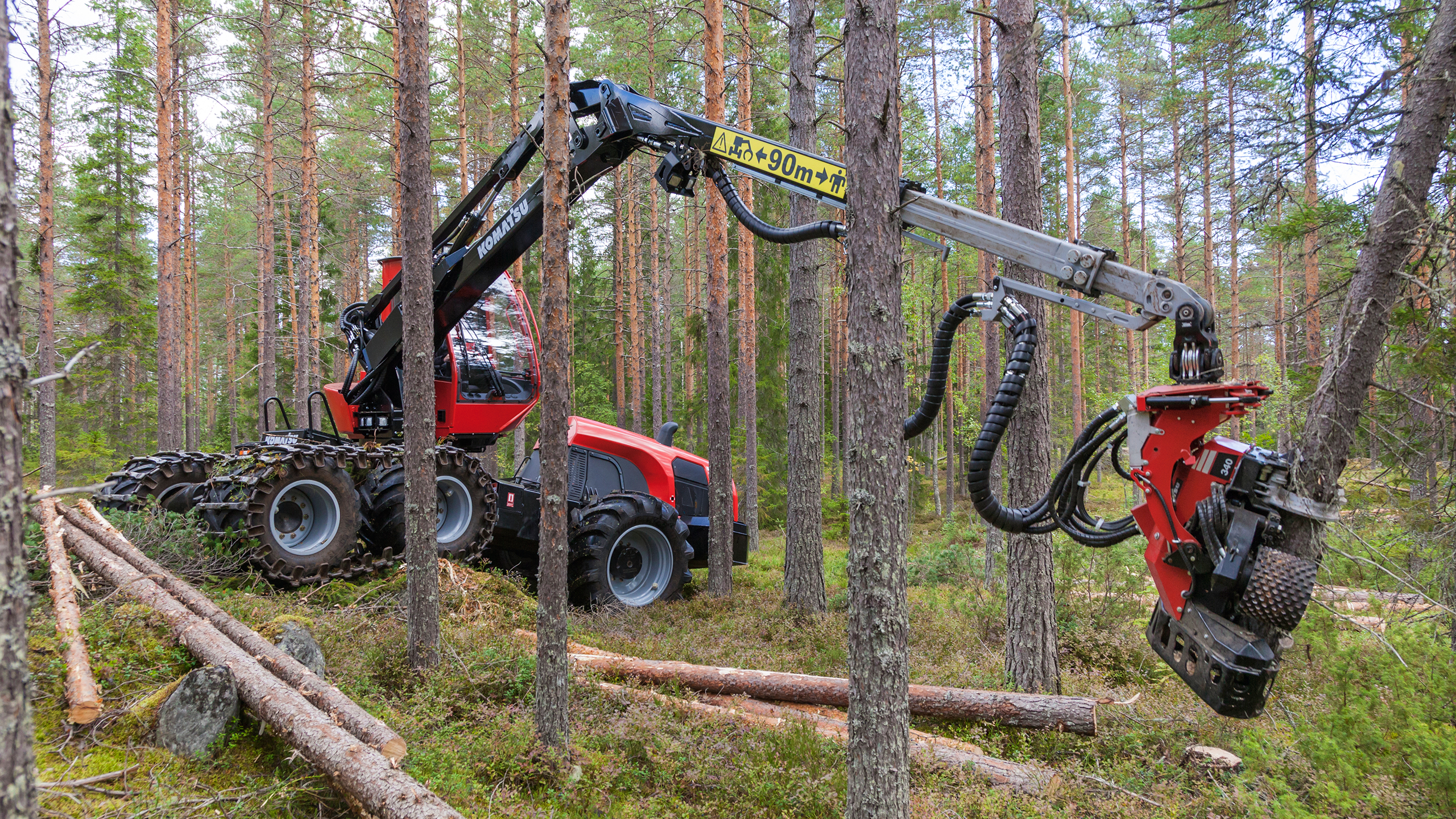
A machine grabs the tree, cuts it from the ground, rolls it through a thing to remove all the branches all in just a few rapid smooth movements.
Now whether anyone should be allowed to own land is a good question. Lots of folks can’t even imagine a world where that’s impossible, but ownership is just law, a social construct.
All this to say, many houses are upgraded over time, not merely degraded. I'd much rather live in my house now after the decades of upgrades than when it was freshly made in the 70s.
As is, people have children who occupy a cumulative more houses with or without others than their parents/grandparents did, and there's not more land being made. So that's why the old land and what's on it go up in value.
Basically, the increasing population (demand) is the cause of an asset increasing in value despite not increasing in quality.
One can make policies which reduces the number people who wish to use homes in the domestic market of a given country if they want to prevent that from happening without expanding the supply massively instead, that may lead to other negative externalities though based on which method is chosen (birth limits, immigration controls, ect.).
This is a non-sequitur; lots of things are limited, but often collapse in value. As a former Saudi energy minister once said: 'the stone age ended, but not for lack of stones'.
And all of these countries (except japan/Switzerland) are planning to bring more immigrants in to make sure the population is always increasing faster. Something that most people in first world countries don't realise is that the entire population of their country is smaller than the number of millionaires in china+india. Even if all if america+EU became sterile, there would still be enough foreigners to buy more unit and push the bubble further if they open borders. And they would, because the entire economy depends on it.
I have family who made a fortune off the backs of people living under this delusion in the 1980s and the 1960s.
In most cases every 20 year increment backward yields a higher quality house. Newer houses are garbage in many dimensions.
An older home requires a little more capital investment, but if it has lasted 130 years, it’s sound and could be remade/modernized at a cost well below any new construction.
What I mean is, for example, my house is 130 years old. So it’s in a _worse_ state than it was 20 years ago. But it costs probably 10 X more.
It’s not like houses are a fine wine that matures. Nor is it in any way upgraded or better like a new technology would be.
But up in cost they go, indefinitely. Exponentially. Pointlessly. A complete and utter failure of policy.