Those who already own property (myself included) are participating in a system that is increasingly pulling up the ladder on those who wish to join. The housing market is one of the least free. Rules requiring bedrooms have 2 points of egress and that building have minimum fire resistance are fantastic and need to stay. Rules that do things like prevent 2, 3 and 4-plexes, mandate a whole city can't go above 4 stories, and require 1:1 parking for every adult need to get tossed out right away.
In places like California, simply strictly applying the existing rules would be a huge step forward. Instead, even projects that are 100% compliant with all building and zoning rules and already granted building department approval are subject to an endless and often patently illegal "community review" process. See, e.g., https://www.sfchronicle.com/sf/article/State-gives-S-F-30-da... and https://www.sfchronicle.com/sf/article/Supervisor-Mar-pushes...
Under Supreme Court precedent such ex post facto community "vetoes" are unconstitutional. The community votes by passing laws a priori, not through ad hoc, targeted manipulation of the regulatory review process. But for complex procedural and policy reasons the Supreme Court has unfortunately been too reticent to police violations of this principle. My disposition is toward federalism and local control, but in many cases the system is violating fundamental principles in our society about the creation and application of law. Principles even more basic and fundamental than property, free speech, or personal liberty rights.
If by "developed", you mean "built upon", that's empirically not the case:
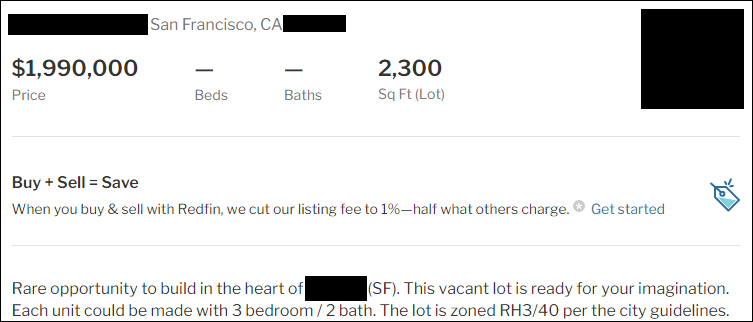
Here's an empty lot in the heart of San Francisco for $2 million dollars: https://www.fortressofdoors.com/content/images/2021/08/image...
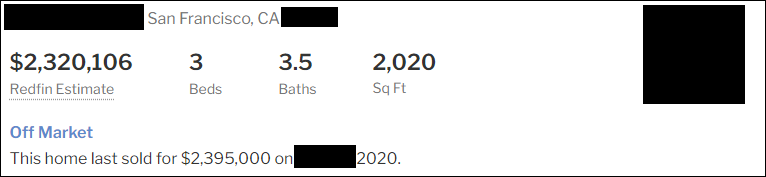
Here's a building next door to it on a similar sized lot for $2.3 million dollars: https://www.fortressofdoors.com/content/images/2021/08/image...
Location, Location, Location. The vast majority of the value of urban real estate is land (locational) value.
The same land in the same location, with no development nearby, would be worthless.
Advocates of a land value tax therefore often call it a location value tax, or a site value tax, because it is the location and the society around the location that has value, not the dirt itself.
Cities need to be supported by enough resources -- that includes enough water, proximity to arable land, hospitable climate, and ease of access. The 2% figure you quoted can be a bit misleading because we can never develop 100% of the land into houses.
But as Japan/China/Korea has shown, it is probably still very possible for England to become much denser than it currently is. It would require all the residents to change their lifestyles to match though.
Any land is arable if we want to. See Phoenix.
There are residential and agricultural technologies that dramatically reduce water usage. For instance drip irrigation. Also the city of Las Vegas recycles almost all the recyclable water and consequently is extremely efficient at using water
I’d worry that it would upend agrarian economies (in the short and medium term, at least $
That just pushes it to another zero sum game of money.
My point is that in a world of finite resources, it's going to be zero-sum at some point whether that's land, water, money, labor, or something else. It's not good or bad, but you do have to pick your poison to a certain extent.
City center land > suburban land > rural land > land on Mars > land in faraway galaxy.
There is always scarcity of land even though there is an infinite capacity of it across the Universe.
States like Oregon and Washington that greatly limit supply are widely praised for their natural beauty and conservation precisely because they don’t chop down forestry to build cheap homes to sell to the CCP.
Fools have created an acronym - NIMBY - to denigrate those who don’t want to waste land just for personal financial gain. However, there remain very real benefits to conserving forests and very real consequences to turning every square mile of land into an AirBNB. The landlord won’t live in that area and the renter won’t stay in the area long enough to care about the area but the long-term residents will pay the price regardless.
Also very little of the NIMBY vs YIMBY debate is whether or not to turn forests into condos, it's almost also SFH vs denser construction.
Coming at this from a UK perspective, housing is a nightmare here too. But our green belt is at an all time low and London is an unbelievable sprawl. No, I'd rather rent forever than ruin the countryside.
Every newly-built house lowers the value of every already-built house. It is straightforward to specify initial conditions where the result is negative-sum.
Do you mean every already-built house nearby or every already-built house in the world?
If you mean nearby then your theory would predict that places like San Francisco, Manhattan, and Paris would be among the cheapest places in the world to buy housing. This is very much the opposite of the truth, so if that's what you mean, then either your theory is completely wrong or the effect it describes is swamped by other effects that are much more important determinants of housing value.
If you mean in the world then I suppose it's possible that you're correct in a market-value sense, since the effect on the price of my house due to someone in Shanghai building a nice new condo would be to drop the price by, say, US$0.00003. But if we're talking about use-value rather than exchange-value (which is the sense in which it really matters whether things are zero-sum, positive-sum, or negative-sum) it's hard to see how that could be true. Perhaps you think the use-value of my house is primarily that it enables me to laugh at the suffering of the homeless beggars of Dhaka? I assure you I spend zero time on that activity.
So I think it's clear that your theory is just completely bogus.
So evidently the main determinant of housing prices is "demand", not your hypothetical effect of houses getting cheaper because other houses are nearby.
What do you think produces "demand"? Why is there more demand for houses in Phoenix than for houses 200 km to the northwest? In some cases, of course, there are real differences in land quality: land that is close to waterways or railroads is more valuable for industry than land that isn't, land that's close to iron ore deposits is more valuable for automotive manufacturing, land that's frozen cold 9 months out of the year is less valuable for human habitation, and so on. But none of these explains the universally observed price premium for land in cities over land in the nearby countryside, which often amounts to three orders of magnitude.
It turns out that the main driver of demand for housing is being close to other housing. So building houses drives up the price of land nearby. Not down, as your theory predicts.
One of your questions was “Perhaps you think the use-value of my house is primarily that it enables me to laugh at the suffering of the homeless beggars of Dhaka?”
I think omitting a proper response to that question is more courteous than discourteous.
Building codes, bureaucracy, and NIMBYism all contribute to construction costs, which in many cases severely constrict supply (SF being a shining example), and thus make existing units more expensive. Focusing solely on land prices is missing the forest for the trees. The problem is that there isn't enough supply to meet demand, so prices are skyrocketing.
Building more housing will drive prices down at best, or slow price increases at worst, but it doest affect housing affordability, which is the original statement I was commenting on.
This seems to be conflating the symptom with the cause. I doubt housing is more attractive because there are more houses nearby; they're attractive because more services are nearby. Granted, they are going to correlate strongly but I think it's a mistake to conflate the two.
Consider the following:
1) A house with no neighbors within a 100 mile radius. But it has all the best restaurants, utilities, schools etc. within walking distance.
2) A neighborhood with hundreds of houses, but none of those services within 100 mile radius. It's a little isolated island of housing.
Which do you think would cost more to live in?
It seems like the price of each meal at the restaurants would need to be sufficient for the restaurant to operate for a month or two, perhaps a few thousand dollars. That seems like it would discourage eating at these wonderful restaurants.
The second value is what society should care about increasing, and it should go out of it's way to destroy the first kind of "value".
Even for land, the value is all about how developed it is, which is not zero-sum: one can always develop more land.
In England for example, known as a densely-packed country, only about 2% of land is actually built on, and of that 2% only a tiny fraction is actually dense.