Just look at these female world records compared to 13-15 year old high school boys: https://boysvswomen.com/#/world-record
Hubbard is also 43 years old. There is no precedent for any human female being competitive in this sport at this age, not even the most freakishly talented female weightlifters in history, not even the Soviet drug cheats.
Kuinini Manumua, the Tongan woman who would have been given this place if not for Hubbard, is 21 years old.
Feagaiga Stowers, who placed second behind Hubbard in the Pacific Games in her native Samoa in 2018, is 20 years old.
This problem cannot be solved or even properly discussed without properly acknowledging biological reality.
This disparity is why women fought so hard for sex-based separation in the first place. I cannot understand why we would roll back those protections by considering “gender” equivalent to sex. It can only hurt women.
If you rolled back the clock and tried again, Michael Phelps would never be a champion weightlifter, and the best weightlifter would never be a champion swimmer.
Currently for olympic distance running at 400 meters or further, a female must present with a certain maximum level of testosterone. This rule was specifically made to exclude an intersex female-presenting runner who excelled. Due to medical complications, she cannot take medication to surpress her testosterone levels on a long term basis.
So yes, such rules exist.
Replace gender with race. Do you feel the same way about race?
The issues about race have less to do with the issues about transgender people, and more with their struggles faced by fault of modern society, in addition to the struggles one would face as transgender and/or female, which can intersect quite badly.
I'm honestly astounded that HN apparently doesn't have any idea about intersectional discourse in the slightest, should be pretty obvious stuff.
Is that sarcasm? Do you know what chromosomes are?
> And I don't see how someone would identify as black if they aren't
By simply claiming they do. Is that not the criterion you're using for gender?
"I don't see how someone would identify as female if they aren't."
And you still fail to see the difference between gender and sex and how that is different from culture and skin color. Congratulations.
>Is that sarcasm? Do you know what chromosomes are?
I didn't skip Biology 101.
> I didn't skip Biology 101.
Looks like you did. Chromosomes carry the genome.
It looks like you skipped out on Biology 101, otherwise the difference would be clear in context and upon my elaboration.
Good day.
Since the former includes the latter, your excuse makes zero sense. It sounds like a convoluted attempt to obfuscate the fact that you thought "chromosomes" was synonymous with "allosomes".
> It looks like you skipped out on Biology 101
How so? This is a weird projection. You're the one who clearly didn't know what chromosomes are.
Finally, you still haven't answered the question: Is a person black simply by virtue of claiming that they "identify as" black?
What potential problems would there be from having a biological women competition, and a trans women competition? Genuinely curious as to your answer and I am asking this in good faith
XX only division.
Unlimited division for everyone else.
Why have leagues for women in basketball but not "men under 6ft tall"?
Is it to encourage girls and women to be physically active for a health life? If so, so we need competition for that? (I'd say no -- boys and men who aren't eite talent are also pushed out by the focus on competition)
Now if people like women sports due to the style of play in WNBA or Women's soccer or whatever, that's great; just make the rules and marketing and such to promote that style, and women will tend to be the participants.
I would. Then it would be more about skill than strength and height, like football.
If you want a giant on your team, you'd need to balance him out by recruiting an exceptionally talented shorter guy.
And if 10 cm categories are too wide they can be adjusted to 5 cm.
I would actually change the rules in olympic basketball to have 1 player from each category :)

Average is at 200 cm compared to 175 cm in general adult male US population:)
Compare this to football: http://www.twolfanger.de/wp-content/uploads/2013/08/Average-...
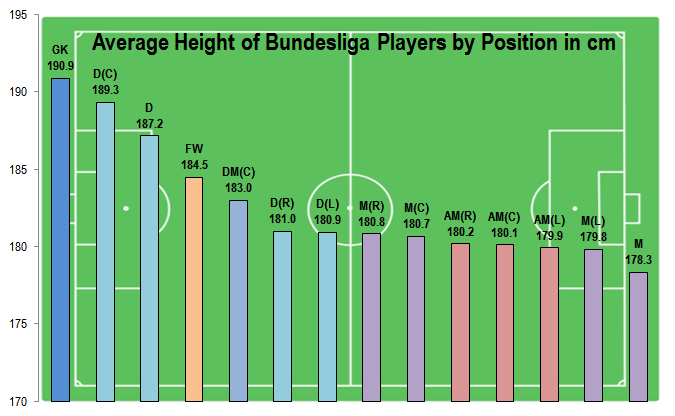
The argument presented was that height mattered more than skill. If that were true, the tallest players would also be the best, no? Instead, very clearly, the best players are usually _not_ the tallest, sometimes not even close.
It doesn't mean that skill doesn't matter at all.
Sorry, in what way is that clear? The best players aren't the tallest, so isn't it clear that your statement is false?
The attribute that defines success is skill, not height, which is evidenced by a look at the most successful NBA players.
You're saying "Because NBA players are taller than average, tall = success", which is just not really true.
In fact it's pretty obvious there would be a tipping point because extreme height is inversely correlated with health and mobility.
In similar fashion weight matters more than skill in boxing that's why we have weight categories. 120 kg boxer will win over 80 kg boxer 90% of the time or more assuming basic competency. But it doesn't mean that the most obese person in the world would be the best boxer.
And the correlation is even more obvious with basketball than with boxing which you can see comparing the height distribution in basketball with height distribution in adult male population [1]. Average for basketball is higher than 97th percentile for general population. That's not an accident :)
If skill is more important than height where are the 160 cm basketball players? None of them got enough skill?
In soccer 2 players widely recognized as the best in last decade are 170 and 187 cm. Different sides of the general height average.
In basketball this histogram for ALL professional players STARTS at the general average (5'9).
[1] https://www2.census.gov/library/publications/2010/compendia/...
If your argument is "Height of an NBA player is the most significant factor in determining their success", that statement is also incorrect.
> In similar fashion weight matters more than skill in boxing that's why we have weight categories
A 220 lb boxer is more capable of knocking out a 140 lb boxer, yes. A 6'10 basketball player is not more capable of outperforming a 6'3 basketball player. Also using single-player sports as a comparison to team sports is a waste of time and energy.
Skill is the determining factor. Not height.
I'll say, it really really seems like you don't know about/watch/care about _actual_ professional basketball. In which case, maybe you shouldn't just guess your way through a conversation about professional basketball?
Based on my observations, on offense (and in a team situation), skill trumps height.
On defense, there's no way a much shorter player can reliably guard a taller player. And definitely not one on one. I've watched many one on one clips and thought 'wow size is everything.'
Sure, Steph Curry is probably the most skilled player in the league. But do you think a team with five Steph Currys can beat a team with, say, five Paul Georges? I'm not so sure.
> there's no way a much shorter player can reliably guard a taller player.
Just flatout false. Clint Capela isn't the tallest center in the NBA but is an absolutely dominant defensive player. It's not about guarding all five players on the other team, it's about winning your matchup and providing help. In both scenarios, height isn't the most important thing at all. Jrue Holiday is also an elite defender but isn't very tall at all.
Height is a red herring; sometimes height can be used as a proxy in place of skill. The thing about elite levels of play, is that the skill level is so high that you can't really get away with lacking skill.
> Sure, Steph Curry is probably the most skilled player in the league. But do you think a team with five Steph Currys can beat a team with, say, five Paul Georges? I'm not so sure.
Steph's ability to set picks and create mismatches isn't nearly as good as his ability to use picks and exploit mismatches. Steph's playstyle is enabled by a totally different archetype of player. PG is a more "complete" offensive and defensive player.
So... like the WNBA?
It allows more people to compete in sport.
  sports has everything to do with sex and nothing
  to do with gender
Perhaps the more fundamental question — once again leaning on apparently somewhat flimsy terminology — would be: is biological sex something worthy of celebration and note? Half of our species is born a certain way, whatever we call it. Is that grouping to be given certain opportunities to demonstrate their talents that would not be afforded them on a level playing field?
So presumably you include other factors — but then you are simply dividing by ability. You could conceivably attempt to divide by innate ability (theoretically allowing competitors to compete against one another based on nurture, not nature) but that would be impossible to do fairly or in a way that would make sense to audiences.
While I understand the sentiment, but I think we need to speak of skill vs physical factors. The division of weightlifters in weight classes is to deal with the latter rather than the former.
Similarly - WADA does this already by banning doping. PEDs don't make you a high-skill athlete, they enhance physical capabilities (stronger, faster recovery etc).
Laurel Hubbard is in an unfortunately unique position, where she's at a natural advantage due to higher testosterone levels earlier in life.
It might be impossible to end up with a fair division, but I don't think "no division" is a good answer.
we're at HN - run PCA and clustering on the totality of athletes' results and biological data for the last N decades with end result being the groups based on identified parameters similar to boxing/wrestling weight groups.
>that would make sense to audiences.
we're already in situation which is harder and harder to make sense. Putting it on the firm basis of scientific analysis is the only way to move forward which would avoid all the pitfalls we're going to hit otherwise.
Also, if trans women are supposed to go to women competition, does it mean that trans men are supposed to go to men competition? Wouldn't that mean pretty much condemning them to having no chance of winning from the start in the most sports where sheer mass, power, etc. play major role?
Anyway, if we don't put it on the firm scientific basis today, i can see how tomorrow a number of male athletes form China and Russia would suddenly start to feel like they are women, may be would take some hormones to satisfy some doubts/requirements (giving the doping already going on i don't see any obstacles here), and that will be the end of female sports.
Is it fun to watch a bunch of length skiers that all have a similar rare medical conditions that enables an endurance and oxygen uptake that is way beyond what is possible for the wast majority of the population? Dividing by genetics seems as a good option, but would that then go against the spirit of the sport?
Sex is simply just a bunch of common genetic traits, but they are not the only traits that matters in sport. There are a long list of them, especially in extreme strength or endurance sports.
No one wants to watch a competition to see who is the "best of people we think are ranked 100-200" since it is an arbitrary grouping. They want to see people compete to be the best woman or man in the world.
Dividing based on weight makes sense for some sports since it is an added constraint that people compete to optimize their strength against. But dividing based on strength just moves the competition from the actual competition, into the ranking process.
https://pubmed.ncbi.nlm.nih.gov/24886927/
https://danielkiikka.com/performance/birth-month-athletic-pe...
You crucially missed an important variable which competitive sports of any kind fully hinge upon: skeletal muscle density… which hugely differs across biological sexes.
In other sports, there’s a rating system that effectively places people with competitors at their level (ELO in chess, tennis rankings)
Either would work in any sport, except for the fact that huge classes of people wouldn’t ever be represented at top level. Prime examples are women and people with disabilities.
In para-athletics, they try to solve that with an elaborate classification system (https://en.wikipedia.org/wiki/Para-athletics_classification)
Problem is that training can sometimes move you between categories. For example, https://en.wikipedia.org/wiki/T42_(classification) has “impaired muscle power or impaired range of movement” as criteria. Those can get better with training.
For women, it seems easier, but even ignoring transgenders, there’s various genetic rarities such as https://en.wikipedia.org/wiki/46,XX/46,XY that can put women at an advantage (https://en.wikipedia.org/wiki/Foekje_Dillema) that we may or may not choose to call unfair (we don’t think it’s unfair for men over six feet to compete in basketball, though, even though that’s largely genetic)
One of the advantages of weightlifting (at least for a middle aged cisgendered male) is that it increases testosterone production.
Significantly lowered levels can have some really bad outcomes as one age, ie killing energy levels, libido, physical strength etc.
I've been mainly focusing on my squats in my garage gym (full Olympic barbell/bench/rack with spotter bars/extra Olympic EzyCurl bar) setup, but looking at my history I've let the big deadlift slip - 14 days since last session.
So I took the 20 second trip to the gym last night to start fixing that, warmed up with squats and then just deadlifts - and can definitely feel the energy today (on top of the fatigue!).
I've been struggling with energy lately due to a lot of change and stress, so hopefully a renewed focus on the deadlift will be helpful. Cheers.
I wonder how this would apply in sports that don't typically have weight classes, like track & field. I imagine you'd start seeing athletes in pretty much every sport cutting weight like in boxing and wrestling, which I don't think is a healthy outcome.
Are we at a level of biological science yet to create reliable divisions/classes on anything more sophisticated? And what about non-professional sports in schools?
There's actually a campaign in wheelchair tennis to allow players who don't actually need a wheelchair to be allowed to compete. https://www.theaccessibleplanet.com/able-bodied-playing-whee...
I've wondered about this - it's an interesting idea. Then the sport is just "Wheelchair tennis" and anyone can try.
These are things for which there are also rather persistent differences in distribution between males and females.
Sports scientists do not agree
Tweets are a dreadful way to read something like this, which would be easier to suggest in a blog post or paper. But I suppose Twitter gives people the right to respond, so swings-and-roundabouts.
Edit: now I'm taking weight!
Ross Tucker made a point about safety, but also about fairness, about which he said (paraphrasing) that females would disappear completely from mixed sex sports, even with weight categories. His point about "fairness" categories is more like "how would that even work?"
If there is a way to level it out, that might be a solution, if it’s possible.
But this is true of lots of sports. Most recently, Simone Biles was punished by scoring judges for a gymnastic move that only she is able to perform, due to her height and musculature. "Genetic freaks" who train hard but still have an unalterable physical advantage tend to dominate any individual sport, to the detriment of their competitors - what makes Hubbard different?
Growing up under the influence of male genetics and hormones gives an individual a massive advantage in such a sport, that simply cannot be compensated for or against with just training or medical solutions. There's nothing that will take that edge away from such an individual because human intervention later in life can't entirely undo the course nature took when building that body.
The evidence is in the performance which falls squarely in line with male performance [0].
And to everyone thinking of a parallel with motorsports and whatnot, there is none. Those sports rely on technology developed by humans so anything is entirely reproducible and reversible. Nature on the other hand still does things that we don't understand, can't reproduce, or can't fully compensate for. We have no way to change the gender with all the associated factors so we focus on the critical and obvious ones like physical look and hormonal balance, which get a person 95% there. But when it comes to peak performance the 5% makes a difference and it's clearly an unfair one to every other participant.

The article seems to make clear that while she is in the top 10, she's not in the top 3 and is in no way a favorite to win. So I'm not sure what that graph is supposed to be showing.
Two women in this weight class have scored a 300+ in competition while Hubbard's best is a 285 from 2019.
You wouldn't let an adult compete in a junior competition because they feel young at heart. You wouldn't let someone compete while on performance enhancing drugs just because they needed them. You would ban athletes who who are repeatedly caught using steroids because it's well known they provide an unfair advantage even years later. And that absolutely pales in comparison to having a trained male body in a women's weightlifting competition.
Also, comparing a trans woman to someone who "feels young at heart" is a false equivalence, and an offensive one. One is an identity, the other is not.
You decided let your personal sensibilities get in the way of understanding my arguments that are much stronger than anything you presented. Sports aren't about gender identity but about sex. As entitled as any individual is to decide on a body that reflects their identity, their biological sex is still very much unchanged. And so are the advantages years of being a male provide.
As you can see from actual athletes, this situation is offensive for those women who after a lifetime of training and hard work see themselves competing against effectively a biological male body with a massive advantage that dwarfs even years of performance enhancing drugs would give.
And to your last point, saying gender identity is OK, age identity is not [1], and that it's OK to identify as a different gender or even no gender at all but anything else is not acceptable is grossly hypocritical and might be as ignorant as people were 50 years ago about gender related topics. Time will tell. I honestly do not feel like my age, and do not identify with that number but rather with a much younger age for many of the reasons you can read in the article linked. This being said, even if the law allowed me to change the number either way, I would not consider this to be a valid differentiator for sports.
[0] https://news.ycombinator.com/item?id=27603055
[1] https://www.theguardian.com/world/2018/nov/08/dutch-man-69-s...
How, exactly?
> and an offensive one.
Proof?
> One is an identity, the other is not.
And then we're back to the very first comment, "sex not gender": Sports are categorised into male and female by biology, not identity.
The definition of fairness is difficult when dealing with even single genetic features.
I don't see the clear difference. In what qualitative sense does Hubbard's genetic advantage differ from the genetic advantage of any athlete at the top of their sport? There are many competitions which are dominated by one individual, regardless of the training or medical help which every other competitor can afford. Should those people be excluded from competing for reasons of fairness?
Hubbard does, to some extend?
In Formula 1, Mercedes has dominated for the last 7 years or so. Is money their unfair advantage? Or is Hamilton just that good? It did make for a less attractive sport, if you already kind of know who will win.
Female sports will continue to be dominated by biological males if we continue to let this happen.
We should remember that most cis women cannot compete at an Olympic level anyways. That's the point I'm trying to make in this thread - physical outliers are already responsible for lots of non-competitions at the top level of many sports.
Every athlete with a physical advantage precludes some other athlete from the top of the competition. If the "point" of womens' leagues is to provide a level playing field for cis women, then maybe we should be more open to introducing level playing fields more generally - because there are large parts of the population that cannot win in the system we already have, either. Otherwise, the "point" of womens' leagues is just to provide a space for women to compete, and trans women should be allowed in those spaces.
The point of male/female separation is to protect biological female from the genetic advantages of biological male, not from genetic outliers.
This is patently false. In sports such as archery (which is an Olympic sport), where strength does not provide an advantage, men and women do compete together. So it's clearly not about providing a "space" for women to compete.
And in weightlifting, the subject at hand, all competitors are on their own, they might never be in the same room as each other. So again, what is this "space for women to compete"? It's clearly about the physical advantages of the sex, and I can't believe we're even having this discussion.
That non-trans women have no fucking chance of being champions in pretty much any sports at all anymore, obviously. You're bending over backwards to be "fair" to a tiny minority, and not giving a shit that in order to do that you're being as utterly unfair as one could possibly be to half of humanity. The much eaasier solution, if you want people born as males to hold all the records, is to just simply abolish womens' sports altogether.
Honestly, this question is so horrendously disingenious that I'm shocked you even had the gall to ask it.
Can one change their mind about whether they are a man or a woman whenever they want?
Which is the third party who should have the right to judge if you are a man or a woman?
Can a male self identify as a female when they wish and enter a women competition?
There are lots of examples at the Olympic level, some of which can be found elsewhere in this thread. Usain Bolt and Michael Phelps are probably the most well-known recent cases - both dedicated athletes who also had some physical quirk which helped to ensure that they totally dominated their respective sport for the period that they were in their physical primes.
To be clear, the point is that nobody is "worried" about genetic outliers in mens' sports. If you were unlucky enough to be competing in a national Olympic swim team at the same time as peak-fitness Phelps, you were expected to suck it up and accept that you very likely had no chance of getting a gold medal. A great deal is made out of training and mentality, but at the end of the day, physicality is still a big silent factor in these competitions that the athletes simply have no control over.
I always found it odd that there are not, let's say height classes for high jump. It always seemed unfair to me that I had to lift my center of mass higher than others for the same performance.
This graph would suggest she does:
The article suggests that she's top 10, but not top 3 in the world. She almost certainly won't win, but might get a medal (since 2 of the 3 best lifter in this category won't be competing in the Olympics for various reasons).
then there is robert förstemann, a track cyclist who might suffer from a myostatin deficincy (a hormone that restricts muscle growth).
Genuine question, one about which I haven't seen much in the way of conversation—although my experience is relatively limited.
Why is the subjective experience of gender privileged over the objective biology of sex?
I can anticipate a couple possible responses for which I'm not sure I have very clear thoughts, either—maybe someone can contribute more light than heat here?
1. Biology isn't actually all that objective: one's subjective experience is at least partially determined by biology, too.
2. We can turn the question on its head: why should objective biology be privileged over subjective experience?
It's less about one term being "privileged" (I must confess that word seems slightly unclear to me in this context) over another and more about the ease of treating people the way they would like, with no real downsides that I can see.
Anecdotally, refusing to use a trans person's pronouns seems typically to be a dogwhistle for not respecting the existence/legitimacy of transgender people.
So I think a natural conservative argument there would be that the primary reason why we have sex-based (not gender-based!) pronouns in the first place is so that we can talk about biological categories that are important for the continuation of our species: while some men cannot father offspring, certainly no transman can. So why should we call them men, if it is in fact the reproductive function because of which we use these terms in the first place?
Messing about with mechanisms that are crucial to our survival should at least not be done lightly.
Even as somebody who is non-conservative on most issues, the lack of acknowledgment by trans activists that that's what they're doing rubs me slightly the wrong way.
> Messing about with mechanisms that are crucial to our survival should at least not be done lightly.
I disagree with this. Unsurprisingly so, given that I am non-conservative. I believe in personal choice over reproduction and I believe that this choice simply is more important than any tiny effect on societies survival - something that in fact means very little to me other than the 'coincidental' lack of suffering in people I care about/humanity in general. I'm not sure there's any objective value in the human race surviving, in fact if I could push a button that meant all humans would be incredibly fulfilled and lead happy lives and then naturally (peacefully, painlessly, etc) die out in 3 generations time I would certainly strongly consider doing so... I'm rambling now, though.
> the lack of acknowledgment by trans activists that that's what they're doing
I think that's because it's largely incidental - indeed, it doesn't stop them from becoming adoptive parents. It doesn't stop them from freezing sperm/eggs and creating children through more modern means. It may not even lead to infertility in many cases - I'll admit I don't know any detailed knowledge on that.
But most importantly their right to lead their life in whichever way they want, and to choose not to have children, is not especially relevant to anyone else. Nobody should be forced (or be guilted into) to have(ing) children.
I don't think that's necessarily the case. The argument is less about individual cases and more about keeping the overall categories intact as traditionally perceived, which isn't really endangered in that case.
By the same argument, calling transmen men if they are passing perfectly would probably be fine. And that's likely what's been happening forever anyway, and is the point of "passing": those individuals don't threaten the general categories. It's a kind of "Don't ask, don't tell" policy.
[...]
> > the lack of acknowledgment by trans activists that that's what they're doing
> I think that's because it's largely incidental
Is it? What you write about personal choice is all(?) true and does not contradict the argument.
My impression is that while transphobia is definitely a thing, a lot of the backlash against trans activism isn't about trans people's individual rights and choices but about trans activists wanting to impose certain beliefs that they have on others. For example, for the purpose of this discussion, the belief that the categories of "man" and "woman" must be defined differently than many (most?) people intuitively define them based on some of the most deeply rooted perception and pattern recognition of the brain.
So it may feel incidental to trans activists, but the people who react likely don't feel the same because it's the aspect (or one of the aspects) of trans activism that affects them the most personally.
Sorry for any confusion.
By privileged, I simply mean that one's gender identity instead of biological sex should govern pronoun usage.
> 2. Is definitely the counter argument I would use - if people have preferred pronouns then what is the ethical argument for ignoring those and using words that would cause them harm? If nothing else it seems to me to come down to basic decency and respect for others.
I mean I guess that is part of the reason that pronoun usage is a controversial topic, right? Why are people uncomfortable with using others' desired pronouns? It may be deeply rooted beliefs or other identitarian characteristics (religious or political convictions for example) that could cause someone psychological harm if they use preferred pronouns instead of biological sex.
In areas where legal agency is at issue—in children, for example—use of pronouns could potentially elide complex challenges and lead to irreversible physical changes that don't correspond with later preference (i.e., sex reassignment surgery or puberty blockers may have permanent effects even if the child decides later that it was a bad idea).
Now I don't know that these are particularly good arguments, but they are two ideas that I've seen online or that arise from applying a subjective-experience argument to other identity characteristics.
Sorry for the delay. HN is not a great forum for long discussions (on purpose, I guess). I've been noodling on this for awhile, and so maybe just blathering into the ether.
I'm not sure that subjective and irrelevant necessarily go together.
I guess the argument I'm thinking of is more this: my pronoun preference is biological, so if my chromosomes disagree with my pronoun preference why should my chromosomes govern communication protocols instead of the rest of my biology?
If these things are truly irrelevant, then the notion of gender identity is itself irrelevant and so, too, are pronouns, aren't they? (I mean, maybe not, but I don't see how one could say chromosomes don't matter but preferences do.)
One of the real challenges gender identity raises is that it acknowledges that the body actually means something. It also implies that language means something. Mind and body go together, and when they disagree some kind of resolution is needed. Language shapes reality, so when language contradicts that resolution the reality of my existence, my very identity, is threatened or negated.
If we stipulate that, I think we have to admit pronoun use really isn't neutral. It's not merely a matter of common decency and respect (although it certainly is part of that), but about what we think it means to be human and how we attempt to shape and react to reality.
My own thoughts here aren't super well formed, hence my line of questioning and (perhaps poorly worded and thought out) reasoning...but I do think it bears some critical examination.
> Language shapes reality, Sorry I have disagree on this one. I don't think language shapes reality. It definitely shapes our perception, filters, and biases but shapes reality only in a very Probabilistic graphical model sense. And even then it shapes(as in cavemen---> civilization) reality as much as say, air shapes reality, mathematical formulae and theories shape reality . My usual stance on the gender identity debate comes along with the "freedom to swing your arm but not hit my nose" sense. In this case of weightlifting for ex: I recently saw a twitter mention comparing the same athlete before starting HRT therapy and now.(along with a co-competitor in the male category she used to compete with) It pointed out how much the gap between both the lifters progress has been because of the Hormones.
Anyway, I don't have a clear stance on trans-people competing in their gender category .. I think the gender based categorization in sports has to move further, but I'm ambiguous even about how the sports laws work on even doping. So since I don't have skin-in-the-game I only try to add clarity to the discussion without taking either stance strongly.
> Sorry I have disagree on this one. I don't think language shapes reality. It definitely shapes our perception, filters, and biases but shapes reality only in a very Probabilistic graphical model sense. And even then it shapes(as in cavemen---> civilization) reality as much as say, air shapes reality, mathematical formulae and theories shape reality .
Sorry if it's not clear: I'm not trying to say what's true, despite having opinions on the subject; I'm interested in best arguments.
What I think the implications are in assuming that gender is as much state-of-mind as state-of-body (if not more) is two-fold:
1. The body really does matter. It's inconsistent to say that the body has to align with the mind if the body doesn't matter. Surgical and hormonal intervention make no sense if the mind and the body aren't somehow connected in a very deep way.
2. The desire for pronoun usage is more, too, than mere courtesy, but the desire for consensus on reality. If I'm a woman trapped in a man's body or have no particular gender, when I ask someone to use pronouns of my preference I am actually asking them to make a statement about what is real and true. This implies in no small way that language shapes and makes reality in some nontrivial way.
Take Hanne Gaby Odiele (https://en.wikipedia.org/wiki/Hanne_Gaby_Odiele). They (their preferred pronoun) have an XY chromosome but due to an androgen insensitivity looks traditionally female - to the point of being a fairly successful model for woman's fashion. They'd certainly be very out of place in a mens bathroom if forced there due to their chromosome.
This is another assertion that I also don't quite understand. (I want to emphasize I'm not trolling here—I'm genuinely interested. Topics like this are obviously highly charged and challenging to discuss in a fruitful way.)
Vocabulary exists for discussing intersex characteristics, so the existence of intersex people is known and acknowledged. Is there something special about pronouns?
My default is to use appearance in the absence of other factors; I understand there are cases in which this is challenging at best.
Even so, I'm still not quite sure how this addresses my question about how using biological pronouns instead of preferred pronouns somehow "ignores the existence of the intersex" as you earlier asserted. (Indeed, it seems as though the question of pronouns actually rather highlights the existence of the person, if in an uncomfortable and potentially discriminatory way.)
My point, perhaps poorly delivered, was that not every person has a “biological pronoun”. How do you even define it?
There are people with XY chromosomes and female genitalia (and usually female identity): https://en.m.wikipedia.org/wiki/XY_gonadal_dysgenesis
There are also people with male characteristics and two X chromosomes: https://en.m.wikipedia.org/wiki/XX_male_syndrome
Addressing these folks by their “biological sex” (of you mean chromosomes) would be hugely insulting, besides the fact it’s not like we got our chromosomes written on our forehead.
Lastly, there are people with ambiguous physical characteristics. Often gender assignment surgeries are performed shortly after birth. Those folks usually get addressed by the gender a doctor chose for them when they were infants - and sometimes this turns out to be the wrong choice and doesn’t actually match their identity. They also don’t have a “biological sex” that neatly fits into the male/female schema.
My understanding is that historically the presence of the Y chromosome was considered determinative. One was male (therefore "he") if the karotype was 46,XY or 47,XXY or 48,XXXY, etc. Indeed, in discussions of the more common abnormal karotypes (e.g., Klinefelter), most of the literature I've seen uses the word "male."
> Addressing these folks by their “biological sex” (of you mean chromosomes) would be hugely insulting, besides the fact it’s not like we got our chromosomes written on our forehead.
With respect to chromosomes and forehead, that's not exactly true. There's sufficient divergence between male and female skulls that some gender expression surgeries target them.[1] I do understand what you mean, and I'm not trying to be snarky. Sexual differentiation is more than just genitalia, and we're well adapted to noticing those differences.
It seems like you're making two points:
1. Those with abnormal karotypes can have an experience similar to the normally karotyped: their self-perception and their anatomy might not line up, and they may prefer to be called by a pronoun that doesn't correspond with karotype or anatomy.
2. The experience of those with abnormal karotypes can and should be generalized to those with normal karotypes.
(I'm a bit fuzzy on (2) but I think I'm representing you correctly on (1). By all means correct me if I'm wrong.)
I could pretty easily see someone relatively conservative on the issue of pronouns (for, e.g., medical or religious reasons) agreeing that those with abnormal karotypes should be allowed pronoun preference but disagreeing with the second because chromosomal abnormalities are the exception that proves the rule.
I'm not sure how it helps resolve the initial question because it requires generalizing from a small set to a substantially larger one. It also offers a more clear reason why one's subjective experience doesn't quite line up with one's body (i.e., a clear abnormality on the chromosomes).
> Why is the subjective experience of gender privileged over the objective biology of sex?
My point was that biology is not all that objective and if we were to use pronouns in accordance with your thesis, we‘d eliminate the identity of many intersex people.
Whether gender-identity can be out of sync with your body in the absence of conditions described as intersex (which, for the record, I do believe in) and whether it should be respected is somewhat orthogonal to that. I believe the examples I’ve given of conditions where biology is either ambiguous or actively out of sync are sufficient to illustrate that using “ objective biology” would eliminate the identity of many intersex people. It’s my opinion, that that alone is reason enough to privilege gender over sex.
"You."
HTH!
(but the gap is in climbing seems to be smaller)
The applicability of higher grip strength to success in climbing is obvious, I hope.
not to mention development that happens in the womb etc that’s non reversible. hormones won’t change your bone structure or the shape of your hips or a million other things
But that isn’t important, because even if it were false: Purely for the question of athletics, athletic performance trumps all else.
Medical doctors will still need to know about chromosomes for dealing with chromosomal disorders, and if you’ve had your gonads out you’re not going to get gonad cancer, but purely for gender-related athletics issues, the 80-20 principle applies: most of the “million” things your chromosomes do are the same for basically everyone (and thus the reason nobody is born a literal banana), then there’s the subset of chromosomal stuff which affects athletic performance, then the subset of that subset where the gender interacts with the athletic genes such that men and women with those genes perform differently, and in that subset of a subset the difference can be overwhelmed by externally supplied steroids.
Which is why steroids are banned.
Now, in the specific case in this article, transition happened well into adulthood, and the athlete says:
> Vanbellinghen, 27, whose qualifying efforts were disrupted by injury, pointed out that the retained benefit of taking steroids, even years earlier, is widely known.
> "So why is it still a question whether two decades, from puberty to the age of 35, with the hormonal system of a man also would give an advantage [in competing against women]?
Obviously this isn’t the same as the case of someone transitioning pre-puberty. But, as I say, it’s why some trans people want to transition pre-puberty.
I searched. I can't figure out what these videos are about from the titles/thumbnails, and I'll be damned if I'm actually going to watch these things. Can you summarize?
you might be hard-pressed to find two bodies each "exactly like" the other. The interesting questions here are not about exactly equal, but about equivalence classes of people, and in different contexts.
If anything, going by biology is more inclusive because it allows both trans-women and trans-men to compete fairly against others that share their biological sex, as long as they postpone treatments until their athletic career is over. If we go by this evolving combination of gender identity and hormone level checks, pre-treatment trans-women aren't allowed in any category, post-treatment trans-women have a massive advantage over biologically female bodies, pre-treatment trans-men cannot compete at all and post-treatment trans-men are still at an extreme disadvantage.
for example, in American English, the trans community has centered on a separation between sex and gender
In commonwealth English, that specific separation in the lexicon hasn't reached consensus even within the trans community, let alone in a broader colloquialism from people wanting to understand and people actively resisting any form of trans acceptance
so its actually really impossible to determine if there is an educational moment possible if someone is coming across as trans exclusionary when using sex/gender interchangeably or if they are irreconcilable, especially as people pile on to being mad at that person (see for example JK Rowling’s tweets. nobody assumed it was an educational moment while its not even clear that the UK has sex/gender separation concept)
So far it doesn't seem people even notice this is going on, that the inclusive communities are evolving terminology slightly differently! Lets check back in 5 years!
In other words, anti-trans (or GC) beliefs occupy much the same position in law as anti-gay Christian beliefs. You can /believe/ them all you like & can’t be sacked for that belief, but if you express those beliefs in the workplace you’ve just created a hostile environment for other employees & your employer can simply fire you (after going through the appropriate disciplinary procedures where required by law) due to your breach of the Equality Act, under which being trans (specifically in law: gender reassignment) carries protected status in the same way that being a different skin colour or sexuality does.
On the other side of the coin, I recognise that the people I work with will surely have some deeply-held beliefs about the wrongness of some aspects of my life. That's inevitable when you have some minimum diversity of viewpoints, and of course "reasonable people may differ" on many of those topics. I don't think I have the right to insist they supress these beliefs, as long as they're not trying to harm me with them. (Assuming that just having a belief isn't harmful.)
The argument from the trans community would be that misgendering and encouraging other employees to misgender them(which will happen if the belief is propaganda-ised) will cause significant emotional harm, risk mental health, cause problems in fulfilling job etc.. I'm not sure about how true this would be, as I'm in the closet and I'm a bit indifferent about what other people think, but can imagine it being very difficult for others.
Not in terms of the Equality Act. You can be as critical as you like in private, or outside the workplace as I understand things.
But if you voice those criticisms directly to someone in the protected class in the workplace, then you’ve crossed the line.
So, eg, telling a gay person to their face that you oppose gay marriage & all gay people are going to hell might be your strongly held philosophical (or religious in this case) belief, but the act of voicing it to the individual in the protected class breaks your employers obligations under the Equality Act in the UK & they would be entitled to fire you for it. The same goes for persistently mis-gendering a trans person (quite apart from it being extremely rude of course!) as gender re-assignment forms a protected class in law.
(Obviously, this is as I understand things & not the opinion of a legal expert in these matters.)
TL;DR is that Maya was (apparently) fired for the first opinion, lost a first court case over it because being gender critical is not protected under UK, and won the appeal because it was after all.
Remember the story a few years ago about the gay couple where one of them was a transgender man and gave birth to their child? I'm sure similar situations do sometimes arise with transgender women.
Some of the more extreme trans activists seem to want to pretend that these clusters don't exist, which puts them at odds with reality.
Other seem to demand that the clusters shouldn't matter, which I find rather optimistic since they're relevant for reproduction.
Trans rights are a noble goal, but some of the statements made by trans activists are a bit out there.
I feel that the trans community has largely been forced into defending "trans women are women" (TWAW), even if it has holes as a philosophical argument, because they need to fight the transphobic "trans women are men" rhetoric and downstream policy decisions. How can someone live as a woman without constant risk of being outed? They need an "F" on their passport and to use the women's toilets, etc. without having a constant risk of being "caught", because that ends badly.
That's an interesting statement from the POV of falsifiability. Is there an experiment we could theoretically perform to find out if a person who's stating that he's "gender critical" really wants to eradicate all trans people?
I think you're correct in your second statement. This whole area seems very polarising. The edge case of women's sports is the obvious situation where a principle of 'Live and let live' doesn't work.
No, that's what they call themselves. You can see plenty of people using that label on twitter.
Polarize_d_, in that people have gone out of their way to polarize it. The last major legal advance was in 2004, https://en.wikipedia.org/wiki/Gender_Recognition_Act_2004 with broad support, and it's only in very recent years that this backlash has sprung up.
Intersex athletes exist too and are not as rare as you may imagine.
Here's a more notable recent example of the controversy of delineating by sex: https://en.wikipedia.org/wiki/Caster_Semenya
Likely there were always intersex athletes who had advantages, but only the relatively recent anti doping and medical examinations would reveal them.
I heard about it in this podcast (about 7:25) https://philosophybites.com/2019/05/kathleen-stock-on-what-i...
https://quillette.com/2019/04/11/ignoring-differences-betwee...
No one cares what pronouns an athlete uses, how they dress, what roles and behaviours society traditionally assigns/expects of them and how they respond to those traditions. They care entirely about biological advantages and disadvantages.
So the division is based on — again unsure of the terms here but — “sex” not on “gender”.
And no sport is trans exclusionary as far as I know: the person in question in this article would be welcomed everywhere to compete against other biological males, and any biological female would be welcome to compete against others of their sex whatever they identify as (so long as they haven’t taken testosterone). I’m not sure I understand why this has become an issue.